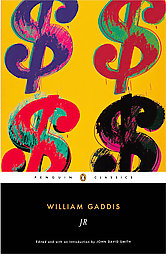
 SOUNDTRACK: BUILT TO SPILL-“Carry the Zero” (1999).
 For a time, before the bands each took off, I lumped Built to Spill, Death Cab for Cutie and Modest Mouse into a pile of bands I really liked but wasn’t always sure who was who. They each have melodic sections, noisy sections and high pitched singers. (It also turns out that both Modest Mouse and Death Cab for Cutie cite Built to Spill as a big influence). The big difference between the three is that Built to Spill’s Doug Martsch is a guitar god—he does amazing solos which is why his songs are so long (their Live album features a 20 minute version of Neil Young’s “Cortez the Killer.”
I have no real idea what this song is about, but I love it. It’s catchy and fun with a great melody. And, in this case it kind of ties in to JR, because JR is all about making money but his basic math is shaky. In the same way, carrying the zero won’t do anything in basic math. Although “you have become a fraction of the sum” is a nice refrain.
This was the song and album that introduced me to Built to Spill and I love it. Great 90s alt rock.
[READ: Week of June 25, 2012] JR Week 2
And since there are no paragraph breaks, week two picks up mid-flow. However, this proved to be a good breaking point because almost the entire read for this week is about Mrs Joubert and her class on their field trip to the New York Stock Exchange. And Edward Bast is steamrollered into doing (and paying for) everything. Gaddis’ style completely allows for the miscommunication and ease with which Bast is overtaken by Joubert and Gibbs. While it certainly calls into question Bast’s ability to stand up for himself, it also shows how easily one can be pushed into doing things (although in real life I suspect you’d just say “wait a minute, I can’t,” at some point). It’s still very funny and the action moves along so quickly that it works perfectly with the flow.
The scene begins with Mrs Joubert herding the kids onto a car and then talking to Mr Bast. He apologizes for what happened yesterday, Of course, he is talking about his disastrous TV meltdown but she thinks he means the loss of the bag of money and its turning up 3 pennies short. Through a series of unsubtle hints from Mrs Joubert, Mr Bast winds up joining their trip to the city. He had business to conduct in Manhattan so he was going in anyway, but now he’s roped in with the kids. There’s a lot of sexual tension on this trip–the boys are watching women bend over and Mr Bast keeps pressing his body again “her unyielding thigh.”
Then we get our first really big scene with JR. In this scene he and a friend (unnamed as far as I can tell) are going through all of their free mail publications and doing trades. Everything the boys try to trade is a load of crap (a word count on “crap” would be very high indeed). So the kids start looking through their brochures: K’ung-p’a, piano lessons, rare coins, scientific method builds powerful muscles,government surplus (a Tank that turns out to be an airplane gas tank (ha)), How to Make Big Profits Overseas, selling shoes, etc. There’s some very funny back and forth as smart-assed kids will do (he really has young kids’ dialogue down very well), like :What are you gonna do where it says “married” or what are you gonna do when it says shoe size and you put yours?
The kids are getting off the train and they pass through a carload of teachers (the dialogue snippets are great: “When we can’t even get room in the cafeteria for driver training because they took the Senior Citizens’ painting class out of the gym when they started the prenatal care program there what’s going o happen to the adult hobby show?”
When they get to the city Mr Bast gets roped into helping them get to the Stock Exchange (Mrs J is in a bit of a panic). And at some point she realizes they never counted the number of children. She herds this wild gaggle past a cemetery and into the NYSE. Wonderful comments as they head into the Stock Exchange:
–Boy what a mess.
–Hey I thought we were going to the Museum of Natural History
–We getting tested on this Mrs Joubert?
–See that little guy waving down there? I bet if I spit–
And then out comes Mr Davidoff. Mr Davidoff is the first person who communicates in full sentences and is allowed to finish a thought. Which is an interesting idea. In fact all of the people at the stock exchange exude a level of confidence unseen thus far in the book. However, soon enough the kids’ chaos takes over him as well (and later scenes when they are in meetings are just as chaotic as anything else). Mr Davidoff brings them to meet Mr Crawley, “a real, live stock broker.” He gets them ready to receive their stock certificate for Diamond Cable.
Crawley receives a phone call in which he says “it’s not just two or three stocks, it’s the whole market” so something must be up. They are about to go into the big office and watch a short film when there’s a call from Mr Montcrieff.
Davidoff tries to give the kids a basic stock lecture, but his analogy of a basket proves to be a poor one (“they’re stuck with all these her lousy baskets”) (84). And he keeps emphasizing that the kids are now the bosses, that the stock brokers are their employees.
I’ve also noticed that Davidoff is called David and Montcrieff is called Monty–amusing name jokes or is that stock exchange short hand.
Crawley tries again to explain what’s happening. And then the kids ask questions, which veer off topic (“did you kill all these animals?” “Is that TV on your desk a color TV?”). Then someone asks about futures which he tries to explain. But again we are interrupted by a phone call from Beaton. There’s some discussion about a final certificate, which one of the kids sees and shouts “Sure it says, holy, it says two hundred ninety-three thousand shares it says this is to certify that the Emily Cates Montcrieff Founda…” (86).
Things settle down briefly and the kids get their certificate for $24.63 (plus the 12 and a half cent odd-lot differential). They leave the money on the desk (which of course spills on the floor). The photographer comes in a takes their pictures (but Crawley is definitely at the end of his tether at this point). JR is snatching up brochures all over the place. And finally the men get the kids out of the room and on to their next location.
The kids head outside (where they see a homeless man with no hands) and get into a big black car and head to the Typhon International Building (But “the company our stock is is… –Just go in go in . It’s the right place”. They get on the elevator (and one kid loves the music and asks to stay so he can hear the whole thing) and head to the fifteenth floor. Davidoff meets them there.
He asks Carol for a dozen copies of the Annual Report and for Mr Eigen to come. He also needs a mailroom boy to run the projector and to bring the pile of box lunches. Eigen is working on Montcrieff’s upcoming speech, so he’s delayed. Then in comes Governor Cates, a director of the company (note the name on the stock above). Davidoff claims that Cates opened up America’s frontiers (“He was a frontiersman? –No not like Daniel Boone, the industrial frontier”).
They set up the projector, but Mr Eigen hasn’t arrived yet. Davidoff begins talking about television communication and how much can be absorbed by young minds today. There’s a quick question about voting for directors (Davidoff hopes they’ll vote for him one of these days), and how unfair it is that the kids get only one vote when that lady gets hundreds of thousands. A hand is straining to ask a question (presumably JR) but is being ignored. Finally the hand blurts out “where it says eight hundred sixty-seven thousand shares.” But before it can be answered, the projector gets stated and the scene shifts to another room.
Carol brings out the update to Montcrieff’s biography. Cates and company look at it, there’s some snarky comments about Monty (who cares whether you played football against Brown…they ought to see you running around with that damn butterfly net” (95).
Then Amy (daughter of Monty) greets her Uncle John (Cates). There’s a lot of business here to keep straight. Monty is retiring effective at the close of business today. There’s also a call about a deal for cobalt. Typhon will be getting $39.7 million to open a processing plant. And it’s clear that this contract needs to be signed while Monty is still president and before Doctor Dé in Nowunda causes civil unrest.
After much fighting Cates sends Beaton to get the shares for the Emily Cates foundation. Monty says he doesn’t care if it’s one damn share, to just get them. Cates is also mad at Beaton because of all the details included in the speech (Beaton tried to be very thorough as to why Monty was stepping down, but clearly the less Monty knows the smoother this will all go). Amy gets offended by things that Cates says about her and her father and blurts out, “If you think I’m so stupid and, and childish why am I a trustee why do you keep… –Damn law tells you how many trustees to have that’s why, want us to go pick them off the subway?”
Then there’s a startling interruption “–This Francis Cates Joubert what sir?” (101). Cates and Joubert? The story continues that Mrs Joubert is the boy’s guardian in the matter duly appointed by the Surrogate. And then, confusingly, Amy explains about her separated husband and their son. So I’m not sure just how this all matches up–is Amy a Joubert? Is Mrs Joubert related to all of this?
I enjoyed this exchange though, “Who asked for a press statement on Diamond Stock? –The, the press did, they… –Who’s paying you, the damn press?” (104).
There’s a few comments about book publishing as well. In addition to the comments from last week in which two people are writing books, this week there’s someone writing a book called The Romance of Cobalt for the firm. Although Cates declares he will not go bankrupt investing in publishing.
When the adults finally go to look at the kids, the room is empty and the projector is running by itself. Actually everyone was just asleep. Monty comes in to speak to the “newest owners,” but the audio from the projector is still running [I’m picturing this scene in a movie and it’s very funny indeed]. Things get settled and Monty begins to speak. One of the boys raises a question (again, i assume JR) about what he found in the Annual Report that they were given. Of course, this proves to be more than just the Annual Report, it includes a proxy statement and the speech that Monty is to give today. So the kids start asking him why he’s leaving the company for Washington. When the company men try to explain that it hasn’t happened yet the kids wonder why they’re printing news ahead of time.
But then it’s off to the bathroom (“how come they’re locked?….they must be scared somebody’s going to steal their toilets”) (108).
While the kids are in the executive washroom (pressing the hot air dispenser and peeking under toilet stalls) two men come in talking, one of them is Monty. We hear a deal made to buy Diamond cable at 19 (its currently at 20) with Beaton who is in one of the stall). When the kids are discovered the man say, “hear more straight talk in the washroom than at twenty board meetings”) (109).
As the kids head out, the boardroom is being cleared out–a pipe burst–which means no lunch for them. Davidoff runs in and says he wants to change a few words on the press release, but is informed it went out already. As he’s trying to straighten this out the photographer comes in (he got on the wrong subway) with proofs of the photos he took. When one of the men (Cates presumably) realizes they’re going to throw out the box lunches because the kids have gone to the automat (he says that the guy who was going throw them out should eat them all: “waste shows an undisciplined strain of mind, Mister” (110).
Back on the streets the kids are heading to the automat [I wish there were still automats, I love them in a nostalgia-that-I-never-experiecned way]. There’s more comments of the debauchery of Manhattan “–Did you see all that blood, hey?” (111).
The kids find Mrs Joubert and Mr Bast talking at a table. She’s telling him what she thought the lives of composers were like (very romantic). But the kids want money for the automat–which they get from Mr Bast. Then they have to pay for the toilet too. While the money exchanging is going on (JR offers to get Mr Bast some nickels for his dollar), he tells Mrs Joubert about a job he almost had–writing nothing music for commercials–but how he couldn’t do it. (The kids start scouring the nickels for valuable ones–they find a nickel from 1972 so that more or less dates the story at no earlier than 1972.). JR brings them back and says he loaned two nickles to Mr Gibbs.
Mr Gibbs is shouting at someone over the phone about paying money to the dept of probation. (The kids are pouring all of the ketchup into their water to make tomato juice). Mr Gibbs comes out of the phonebooth and the kids ask him what it means to have options exercised “take them out walk them around the block. –No honest, hey” (114). Mr Gibbs busts in on Mr Bast & Mrs Joubert. And Gibbs (as we saw last week) is a fast-talking abusive (and funny) guy. He talks all over Bast, mocks him for his TV appearance and his composing. Gibbs asks if he’s related to the composer James Bast and starts bashing praising [see Simon’s comment below, I misread this attitude about the whiner] his opera Philoctetes (the whining tenor part he gave to Ulysses).
Finally Mr Urquhart, the manager of the automat, comes over and asks them to control the children. They apologize and begin to wrangle them. Urquhart tries to light Joubert’s cigarette, but she’s just holding her fingers to her mouth and gets burnt.
She asks Mr Bast to gather the children and asks Mr Gibbs to sit up straight or the kids will think he’s been drinking. “Think I’ve been, listen they don’t know what drinking is” (118). Gibbs is belligerent and Mrs J doesn’t seem to like him, but he keeps talking to her. Then Gibbs sneaks over to Bast and says that he told Mrs J that Bast would take the kids home for her, since she’s really not feeling well. Bast stammers and isn’t sure, but more or less relents. Gibbs then tells Mrs J the good news but she says that no they must take the 4:17 train, that’s when the bus is meeting them. They were supposed to go to the money museum. Gibbs tells Bast to just go to any bank, they’re all money museums, right?
Gibbs escorts Mrs Joubert into a cab (and asks Bast for money for it). And the kids go off to the movies with Mr Bast. The first theater they see attests to Gaddis’ thoughts about Manhattan at the time (which are probably pretty accurate): “look you can see her tits. –Hey look at this relive the pulsating moment of climax” (123). They all wind up going to a Western, where Mr Bast pays for everyone as well as for a man named Gall who says he knows Bast although Bast doesn’t know him.
The make it to the train. Being a dad, I loved this bit (Bast talking to JR):
–And look, haven’t you got a handkerchief?
–Me? sure just a second…here
–No I mean you. Use it.
JR asks him if he is a college grad and Bast says that no he went to a conservatory.
The conductor comes up and asks for tickets. Bast thinks the kids have them, but they say that Mrs Joubert had them. So now he has to buy thirteen tickets. JR gives Bast money (he’s got a lot, and he calculates the interest). And then JR starts talking to him about the piles of papers he has–asking his advice and help and being a general pain in the ass. Gaddis even includes a picture of the classified “Business Opportunities” with JR’s scribbles. JR ask about Bast’s “business” he owns his own, right? Bast explains that no, he is a composer. JR doesn’t really know what to do with this information so he looks at Bast’s shoes and encourages him to sign off on the shoe selling business. Bast say he just wants to close his eyes. And then falls asleep. They nearly pass the station. But they stop in time and then have to pass through another car full of teachers (with more great dialogue). And finally, the bus door closes with most of the kids on it. Until one of them shouts “Have you seen my sweater?” (this sweater has been lost and found a few times today and is a nice ending to the chaos).
Bast heads back into the station to report the sweater where he sees Gibbs beating up a cigarette machine. Bast asks what he’s doing there and Gibbs asks him the same thing. Bast want to know who Mrs Joubert is, but Gibbs is off on his own tangent. He eventually gives Bast the tickets that Joubert gave him to pass along to Mr Bast. Bast says he should have given them earlier, but Gibbs retorts that she told hom to give them to Bast on the 4:17 which he has now done. Bast goes to turn in the tickets for a refund, but the window has just closed. (“Yes but you’re right here, couldn’t you just…” (132).
JR comes up and talks to Bast. He tells Bast that Gibbs often goes to a bar around the corner. And when Bast realizes that he didn’t take the bus, he asks why. JR says he figured he’d walk howe with Bast. JR continues to talk about business opportunities (import/export from the privacy of your home; shoe selling again). Bast asks why he would want these jobs. To make money, of course. Bast asks if JR’s father knows about these schemes. JR comments: “if you need any money just ask my father he’s got piles.” JR thinks Bast didn’t get the joke but Bast says “it’s one of the worst I ever heard” (133). Then Bast asks about JR’s mother–she’s a nurse and works all hours. JR asks some theoretical questions about making music which Bast doesn’t understand (are the songs in your head to start with?). JR starts taking papers out again and says “I just thought maybe we could use each other you know” (135).
Bast tries to pay JR back, but JR is busy calculating interest. So JR offers to take the tickets to the station for the refund. Bast says that he bought twelve tickets by JR says that Mrs Joubert had 13. Bast panics and asks JR who was left in the city, but JR has no idea . He’s also confounding the different transactions of loaning a dollar and trading in the tickets (in a very confusing sequence of attempted math).
He finally gets rid of JR and heads for the music studio. But he hears someone there. It’s Stella. She says that Norman wants this estate thing settled and Aunt Julia said to look in here for the papers. Stella says it’s very hot in there. Edward opens the window, and Stella disrobes saying the he doesn’t have to seduce her. And then he is on top of her, and they are…
and a voice calls up the stairs and Norman is there with the police. Stella gets dressed and goes downstairs. Norman is very confused. She introduces Edward to Norman and Norman is polite and unsuspecting. Norman asks if Stella found any papers. The police come in and shine lights around. The one policeman suggests that the culprits who broke in wer just looking for a place for some fancy screwing. “The first chilly day and that’s what they look for a place to screw.” The policeman say, “Kids…. Who else would have shit in your piano.” Edward repeats, “believing and shitting are two different things”
Stella brings up Reuben again, and Edward says that he was an acrobat–“all technique.” Stella says that James loved Reuben for the talent, not the boy. Norman and Edward both gang up on her and says, so what he loved Reuben for the talent and Edward “for the boy” because he didn’t have talent?. Edward starts to lose it, playing dissonant chords on the piano and singing along to the action. He then says to Stella, “Wait wait trust me cousin! you wanted to hear this part…” (143). As Norman and Stella start to leave Edward says that he has job offers–to go into the shoe business or an import export company.
Norman and Stella get into the car together (where they listen to a novelty group playing “Phil the Fluter’s Ball” “with vocal accompaniment that could only be described as suitable” (143).
Norman is very concerned about the estate and says that Edward could easily claim Thomas as his father instead of James. She gets and says “maybe Edward’s suddenly afraid he’s not Uncle James’ son. There’s quite a difference” (144). They discuss money; Stella’ snot interested but Norman thinks it is too important. When they get home they continue the discussion. Norman thinks that Edward and the aunts should go see the plant to see what they own. She thinks that’s a stupid idea. Norman says they hold about 30 shares altogether and (a piece of the puzzle put in) Jack Gibbs “took five shares with him when he quit, didn’t he? (147). Gibbs used to start an idea bit never see it through. Norman said Gibbs was writing a book but Norman never saw it (he looked in bookstores for it).
Norman gets to details–if Edward gets more shares in the suit, after death taxes are taken out, then Edward and the aunts will have a controlling interest in the general Roll Company. So if they can get Gibbs to return his shares, Norman and Stella would be back on top. She ignores him and he goes to make his dinner, clean up the bathroom and shave all the while humming “Phil the Fluter’s Ball.”
I’m going to stop there (half a page early) because the next scene is a big one and it starts right here.
$$$$$
This was an exhausting but hilarious section to read. I loved all of the stock room talk. And the obfuscation is certainly fun. I admit I had the wrong Bast for all of the earlier section (I confused James and Edward, and it makes a lot more sense that the Mr Bast here is Edward). And there are a ton of little details that are still way up in the air, which makes some of these scenes even more confusing. But like with Pynchon, if you let all of this flow over you, it’s much easier to read (its only when trying to recap it that it gets hard to parse the details).
I love all of the undercurrents of ideas running through these sections. And I wonder where Gaddis falls on these ideas. And the kids are hilarious.
Oh, and I apologize for not always giving page numbers. I was pretty good about writing them down and then forgot some and am frankly too late to go back now.
[Read Simon’s comments below from more details!]

 I Just Read About That...
> I’ve also noticed that Davidoff is called David and Montcrieff is called Monty – amusing name jokes or is that stock exchange short hand.
No short hand, we’ll quickly find they’re actually David Davidoff and Monty Montcrieff. Just like the two main business lawyers are Beaton and Beamish, etc. Gaddis has an awful lot of fun with most names throughout the novel. And in a lot of devious ways, especially with respect to entropy and Wiener. And somewhere in the novel is planted a clue telling us why he picked the name “Bast”, how’s that?
> the Emily Cates Montcrieff Founda…
Big clue. (Said spoilerlessly: not sure you want spoilers, since you read it a decade ago.)
> The kids head outside (where they see a homeless man with no hands)
No hands and no face; even this one is actually a recurrent bit player in the story (2 or 3 times, for Eigen and his wife).
> Eigen is working on Montcrieff’s upcoming speech
As Gaddis did for 10 years after writing “an important novel” then having to pay the rent: Eigen is the most direct alter ego for Gaddis in the novel.
> Davidoff claims that Cates opened up America’s frontiers
(For the other side of the coin, we’ll very soon see Gibbs do his own wildly off-the-script school lecture, telling us all about Cates’s salad days…)
> how unfair it is that the kids get only one vote when that lady gets hundreds of thousands.
From the certificate just before, and the Cates/Montcrieff scene just after, we find out that schoolteacher Amy Joubert is née “Emily Cates Montcrieff” and mother of “Francis Cates Joubert”. So about these kids, little do they know about “that lady gets hundreds of thousands [votes]” being their own schoolteacher Amy, ha!
> We hear a deal made to buy Diamond cable at 19 (its currently at 20)
So we saw them selling the kids a Diamond share at 24, then saw it go down to 22, it’s now at 20, and all that time they were expecting it to collapse at least as low as 19… (It’s also good to keep track of Diamond and its share price throughout the novel.)
> As the kids head out, the boardroom is being cleared out – a pipe burst
JR is built like a Wagner opera, with a patchwork of leitmotivs (Wagner himself being one of these). One minor leitmotiv is plumbing problems: we’ve already seen the school’s plumbing problem (and will see it again, with a hidden punchline); later, the school District Superintendent Vern will summarize the one and only role of schools then add “and the rest is plumbing”.
> Gibbs asks if he’s related to the composer James Bast and starts bashing his opera Philoctetes
Gibbs doesn’t bash it: he praises it and the genius of James Bast in casting Ulysses as a whiner. This Philoctetes already came up with the old Bast sisters and will pop up again: the Greek character is one of Gaddis’s metaphors for the status of the gifted ones in society.
> Finally Mr Urquhart, the manager of the automat
We’ll hear again of “the poor Mr Urquhart” several times later in the second half of the novel. (You really have to keep track of almost everyone.)
> Mr Bast pays for everyone as well as for a man named Gall who says he knows Bast although Bast doesn’t know him.
At the school, the two Foundation people were Mister Ford and Mister Gall: Gall has a vague recollection from seeing Bast’s off-script Mozart lecture on TV. (Toldya you really have to keep track of almost everyone.)
> and then have to pass through another car full of teachers (with more great dialogue).
The whole scene is largely an echo of the previous one, with similar lines; but this time you can also read all the disjointed dialog lines as if being one weird run-in sentence. (Plus a hidden punchline, that’ll be referred to at the end of the novel…)
> “Kids…. Who else would have shit in your piano.” Edward repeats, “believing and shitting are two different things”
Another of the many leitmotivs in the novel is excretions: this sentence, as well as Burmesquik and Tribsterill from the same Mozart lecture, the recurrent “holy shit”, etc. (Climaxing when JR will later stand accused of turning anything and everything into shit.)
> Edward starts to lose it
Not for the last time. (Later, Coen will dryly comment that he should have guessed, after meeting the two old sisters, that stability didn’t run deep in the Bast family. Heh.)
> Norman said Gibbs was writing a book but Norman never saw it (he looked in bookstores for it).
As Gaddis tried and failed to for his sophomore work (“the lost 1965 book” Agapê Agape, featured later in the novel): Gibbs is a more distant echo of Gaddis than Eigen is.
I have been thinking a lot about the names that Gaddis uses. Some of them are subtle, some not so much, but it’s got that wonderful Pynchon playfulness going on.
I figured that someone was Gaddis in the book. Eigen’s publishing troubles did seem to have some kind of parallel there too.
Thanks for clearing up the Ulysses bit *I took whiner negatively, obviously*.
The whole Amy thing is pretty amazing as she seems so oblivious to what’s happening. I never pictured her as being so intertwined when the story first started.
There are certainly a lot of plumbing mishaps, Grynzspan’s room is just amazing (when we get to it).
I actually own Agape Agape and was planning to read it after JR. It was really surprising to see it mentioned here.
Again, Simon thanks for this. It’s nice to know I’m on the right track (and when I’m off it!)
Dear Paul,
Congratulations on your wonderful work. Just one thing: For me it’s clear that Amy is Mrs Joubert. What do you think?
Thanks and best regards,
Mario