Feeds:
Posts
Comments

Archive for November, 2010

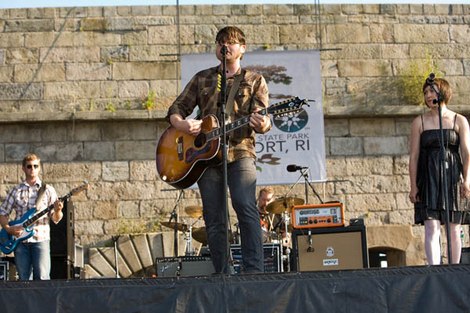
SOUNDTRACK: THE DECEMBERISTS-Live at the Newport Folk Festival [excerpts] (downloaded from NPR) (2010).

The Decemberists played at the Newport Folk Festival this year. NPR audio has an excerpt for free listen/download on their audio site.

They say that they were not going to play the entire Hazards of Love album at this show, as had been their wont on this tour.  I’m not sure what their entire set consisted of, but the three excerpts here include: “The Crane Wife Pt 3,” “Yankee Bayonet” and a very extended “Sons and Daughters.”

It surprises me how well The Decemberists work in a live setting.  I think of their music as  complex and convoluted with strange instrumentation, and yet, perhaps because of the theatricality of it all, it all sounds great in a live setting.

I can’t really imagine them releasing a proper live album, so for those of us who don’t get to concerts much, this is the next best thing (the recording quality is excellent–I only wish it was their whole set).

[READ: October 12, 2010] “Otravida, Otravez”

Junot Díaz is the next writer in the 1999 New Yorker 20 Under 4o issue.

I didn’t like this story in the beginning because I couldn’t tell for quite some time the gender of the narrator.  Normally this doesn’t make a difference, but when the narrator climbs into bed with the man in the room, I had a hard time deciding if this was a subversive act or just a straight act of romance.  [I admit that since the author was male, I assumed the narrator was male, too].

It turns out the narrator is a woman (there is a clue when he says “Yasmin,” but in the first read I was unclear if he was saying her name or just a name in general).

In fact, to me, the entire beginning was very strangely set up and it took a few paragraphs (when she describes her job) before I felt the flow really took off.  However, once it did I found this story fascinating and convoluted in a very good and clever way. (more…)

Read Full Post »

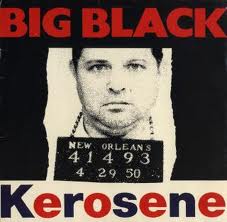
SOUNDTRACK: BIG BLACK-Kerosene [live] (1990).

It never occurs to me to go looking for live versions of songs online, even though there are clearly  thousands of songs I would like. So, I wait for them to come to me.  My friend Andrew posted a video of this song.  And it’s the first time I’ve seen Big Black live.

I’ve liked Big Black for a while (I got into them after they broke up). It’s not pleasant music by anyone’s standards, but there’s something visceral and unsettling about the lyrics and about Steve Albini’s guitar sound that I really enjoy.

I’ve seen pictures of Albini before, but I’ve never seen him in action, and I have to say, I can’t believe a guy as skinny and frankly, nerdy, as him is making sounds like this (although I can see someone like him being this angry).  Watching him in this video is pretty great.  He’s got huge glasses, his t-shirt is tucked into his pants–no that’s not right, it’s tucked into his guitar strap…how is he holding his guitar up??– and then he plays this guitar that sounds like, what…glass, needles, pins, shards of something, certainly.

And just when you think that the song is only noise, this fantastic bassline kicks in.  The riff is outstanding: it’s heavy and propulsive and balances the sharpness of the guitar perfectly.  In this version, about midway through the song he seems to be walking out into the crowd, and they sort of hold him up or push him back on stage, while he’s playing.  And at the end, of course, he destroys the guitar.

Lyrically, it’s as disturbing as anything Albini has written, but man is it cathartic.   And this live version is even more stark and brutal than the studio version.

[READ: June 2010 & October 12, 2010] “Extreme Solitude”

After reading “The Oracular Vulva,” I decided to re-read this, his recently published story.  When this story came out in June, I heard that to some readers the main character reminded them of David Foster Wallace, and they speculated about whether or not this story was inspired by or a tribute to him.  Unfortunately, I read that analysis before I read the story and it automatically influenced my reading (which if you haven’t read it I have now done to you, sorry).

I’m not in any way convinced that it is about him, although there are many similarities–size, athleticism, chewing tobacco, intelligence, semiotics.  But since I know nothing about DFW personally and I don’t know if Eugenides does either, I won’t pursue that line any further.  I will say that I didn’t find that train of thought terribly distracting while reading, though.

Anyhow, this story is about a senior in college named Madeline.  Madeline was a good student and a good girl.  She had dated some, but never had any crazy affairs (and was a bit uncomfortable when her roommate proudly wore (or displayed) her diaphragm–the joke about wearing it to an event is particularly funny).

By her senior year, after breaking of a long relationship with Barry, Madeleine was prepared to settle into her major: English.  She was excited to read and to read a lot (it was her passion as well as her major).  She also decided to sign up for a Semiotics class, which is where she met Leonard.

The description of the semiotics class is wonderful, from the pretentious students to the insanity of the class assignments–from Lyotard to Derrida and everyone in between, authors that I loved in college but since leaving academia I find so convoluted as to be kind of silly. I adored the sentence: “(Could “the access to pluridimensionality and to a delinearized temporality” really be a subject [of a sentence]?)” (more…)

Read Full Post »

SOUNDTRACK: WEEZER-Hurley (2010).

In my head, no band garners as much debate as Weezer.  According to this article, a man offered them $10 million to break up.  Even I go back and forth about whether they are great pop song writers or incredible sell outs.  I mean, look at one of the items on their thanks list for Hurley: “Dodge–makers of the timeless Challenger.”  Is this ironic or not and if not, does it matter?  I’m also torn by Rivers Cuomo’s Harvard degree, which I would think means he would write intellectually rigorous songs–and yet he never does.

But what of it?  Let’s talk about the music.  It has dawned on me that the closest band to compare them to is Cheap Trick.  They write poppy songs with often heavy guitars that are completely sing along-y but are in no way alternative to anything.  And yet everyone loves Cheap Trick, so why not love Weezer, too?

Hurley is no different.  Each song is 3 minutes of pure pop (for crying out loud Desmond Child is on one track–put one in the sell out column).  But they also have some odd fans on this disc: the crew from Jackass sings backing vocals on “Memories” and Michael Cera plays mandolin and sings backing vocals on “Hang On” (although you can’t hear any of them really).  “Hang On,” by the way is their most Cheap Trick-y song to date.

“Unspoken” features a flute and acoustic guitars until about two minutes into a three-minute song.  Then it bursts out of acousticland and into heavy rocking guitars.  The one song I don’t get is “Where My Sex?” which I suppose is the controversial song on the disc.  He’s clearly talking about socks but he keeps saying sex.  I really have no idea why.  It’s not funny, even remotely.  It’s just an odd decision.  And I would say I rather dislike the song, but the chorus is great, as is the totally unexpected third section (which is like  pop song unto itself) that comes in 2 and a half minutes out of nowhere.

“Smart Girls” has to be ironic, but who knows anymore.  To me the most interesting song is “Brave New World.”  It eschews the standard big-chords-for-choruses format they’ve been using with a much heavier guitar and single guitar notes in the verses.  (Although the chorus is, once again super catchy).

My version of Hurley has bonus tracks which are separated by an interesting 10 seconds of string music.  The bonus tracks include a cover of a song from Yo Gabba Gabba ( I really must watch that show some time).  There’s also a great cover of Coldplay’s “Viva La Vida” (in many ways Weezer is like a harder rocking version of Coldplay in terms of success and obvious sellout possibilities).  Although this live version shows that Rivers’ voice is no match for Chris Martin’s.

“I want to Be Someone” is an earnest acoustic solo track while “Represent” (Rocked Out Mix) is one of the heaviest things they’ve done.  I assumed the original was on Raditude, but it’s not.  Evidently it’s the unofficial song of the U.S. World Cup soccer team.  Huh, who knew?

So yes, it seems that they’re pretty much sell outs.  And yet for thirty minutes (all of their discs are so nicely short) it’s easy to stop worrying about “indie or not” and just sing along.

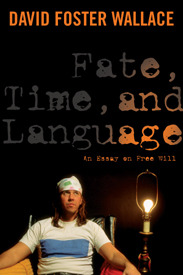
[READ: November 7, 2010] Fate, Time and Language: An Essay on Free Will

First I wanted to thank Columbia University Press for sending me an Uncorrected Proof of this book. I was pretty excited to read it, but to get it a few weeks early was even cooler (and, no, this won’t have any impact on my review).

Second, I wanted to state exactly what this book IS (because I wasn’t entirely sure myself).  The book is a reprinting of David Foster Wallace’s philosophy graduate undergrad thesis.  However, rather than just publishing the thesis (and giving us a short book or a long book with one sentence per page), Columbia University Press has packed the book with a great many essays that help to contextualize the thesis.  The Preface by Steven H. Cahn & Maureen Eckert explains this quite neatly.

So, my (briefer) version of the background: DFW’s thesis is about Richard Taylor’s article “Fatalism” (1962).  CUP has also included Taylor’s initial article (so we can see what DFW is talking about).  And even more than that, when Taylor’s article was initially published, it caused a bit of controversy and a lot of responses.  So, to get a sense of everything that DFW was working with (and against), this book also includes the intellectual dialogue: articles that range from four to ten pages (and also include a dense of Taylor by Steven H. Cahn himself (published in 1964).

Part II of the book includes an introduction by Maureen Eckhart and DFW’s essay.

Part III is a brief look at DFW as a student written by a former professor, Jay Garfield.

Before I get to the meat of the book itself, I wanted to say that I didn’t know anything about this essay.  And I’d thought about this thesis as possibly an interesting piece of philosophy from an author whose work I greatly admired.    Well the introduction to this book states in pretty certain terms that my thinking about this thesis is a massive understatement.  For, in fact, DFW’s thesis undermined Taylor’s argument in ways that no other argument had been able to do before.  His thesis more or less repudiated Taylor’s original essay.  The thesis also won the Amherst University Gail Kennedy Memorial Prize in Philosophy (and a wonderful piece of trivia: DFW’s father James won the same prize in 1959).  So, yes, this isn’t just a graduate undergrad thesis, this is real philosophy.

On to the book: (more…)

Read Full Post »

SOUNDTRACK: FUN BOY THREE-“Our Lips Are Sealed” (1983).

In an interview with David Foster Wallace’s sister, she says that David spent an entire summer listening to this song.  Most of us know the Go-Go’s version which is bubbly and playful (even though the lyrics–which are the same–are quite dark).

I’ve had this song on some compilation or other for years and I’ve alway thought of it as a kind of novelty.  And yet the more I listened to it, the more I liked it (and the more I liked it more than the Go-Go’s version).

Terry Hall, the singer of Fun Boy Three (and The Specials), co-wrote the song with Jane Wiedlin.  And it’s funny to hear how very different the two cowriters made their versions.

There’s definitely a new romantics vibe to the Fun Boy Three version, but the great bass backing vocals bring a coolly mysterious element to the song.  And if you check out the live version, you can see the polar opposite stage manner from Belinda Carlisle.  Terry Hall makes Robert Smith seems gregarious and silly.  And yet, for all of the darkness of the song, it’s still hard not to bop along to.  It’s pretty wonderful.

[READ: November 7, 2010] Consider David Foster Wallace

A group read of Consider David Foster Wallace is currently underway.  I had planned to read along and contribute weekly posts here.  I read the first two articles and, as it turns out, I have literally nothing useful to say about them.  And I certainly don’t have enough to contribute a weekly opinion about them.

It’s not that they are bad, not at all.  The onus is mine.  I am out of academia for something like a decade now.  I am totally out of practice for coming up with clever arguments and rebuttals to well researched pieces.  I have also seen a few people’s comments and critiques of these pieces and I realize that I am just not in the right mindset to be a productive member of the academic community.

But that doesn’t mean that I’m not going to read it and write a post when I’m done (I’ll likely follow along with the discussions, so this book won’t get posted for quite some time).

In the meantime, I wanted to say a few words about the preface and introduction.  (more…)

Read Full Post »

[LISTENED TO: End of October 2010] Brief Interviews with Hideous Men

There are three options for listening to Brief Interviews.

The first version is the original audio cassette which is read entirely by DFW (1999).  It’s out of print but you can download the audio for free at the David Foster Wallace Audio Project. The second version is the newly released audio book that coincides with John Krasinski’s film (2009).  This CD features some of the readings by DFW although most of the actual interviews are read by the actors from the film (see below for all details).  The third option is a collection of staged readings which were created by The Howling Fantods Brief Interviews Project.  They are available at the site and at the David Foster Wallace Audio Project.  [UPDATE Nov. 8: For the sake of accuracy, I wanted to state that George Carr is responsible for all of the work down for these recordings.  The Howling Fantods site simply hosted the results].

None of these recordings include all of the stories from the book.  Although the stories that they do include are unedited (this is officially listed as “unedited selections from the book”).  The stories that are not included in any of these recordings are:  creepy organ music

  • “The Depressed Person”  [this would have been a tour de force to read]
  • “The Devil Is a Busy Man”
  • “Think”
  • “Signifying Nothing”
  • Datum Centurio” [I can’t imagine trying to read this out loud]
  • “Octet”
  • “Adult World (I)”
  • “Adult World (II)” [I would have liked to hear how these were handled]
  • “The Devil Is a Busy Man”
  • “Church Not Made with Hands”
  • “Yet Another Example of the Porousness of Certain Borders (XI)”
  • “Tri-Stan: I Sold Sissee Nar to Ecko” [this is my least favorite bit of DFW work and I would have really liked to have heard it read aloud to see if I could get anything more out of it].
  • “On His Deathbed, Holding Your Hand, the Acclaimed New Young Off-Broadway Playwright’s Father Begs a Boon” (more…)

Read Full Post »

SOUNDTRACK: RUSH-“BU2B” (2010).

I’m a little freaked out that Rush has a song that is just initials (it’s so text message-y).  And, listening to the lyrics tells me that the 2 is for “to.”  That is no way for 50-some year-old men to behave!

Of course, neither is the pounding heavy song that is “Bu2B.”  Like “Caravan,” the song opens with a dark and dirty riff.  The song is not as complex as “Caravan” although it also features a quieter section.  After the verse, the quiet bridge comes as a more natural progression (and it, too has some strong bass stuff going on).

What’s fascinating about the song is that despite its heaviness, it is layered with some really delicate keyboards that plink along the top of the sections.  It showcases both sides of Rush in one track.  And lyrically it’s quite dark as well.

These two early release songs have me really excited for the new album, Clockwork Angels, due out in 2011.

[READ: October 11, 2010] “The Oracular Vulva”

Jeffrey Eugenides was the next writer in the 1999 New Yorker 20 Under 4o issue.

I really enjoyed Eugenides’ The Virgin Suicides, and I regard him highly as a writer (even though I haven’t read very much else by him).  About midway through reading this story I realized it must be an excerpt from Middlesex (which I haven’t read, but hope to one of these days).   The bad thing about realizing this is that it impacted my reading of the end, making it kind of hard to assess the story as a story (which, I realize it isn’t, so maybe it’s moot anyhow).

This excerpt focuses on Dr. Peter Luce (the famous sexologist).  The title of the story certainly implies a degree of sexology, right?  I was surprised however, that the story opens with the doctor in a jungle, studying the Dawat tribe.  Luce, a very comfortable middle class sexologist is miserable out in the jungle, with crazy animal sounds, oppressive heat and, worst of all, little children trying to pull down his pants.

The doctor is studying this tribe because they have very specific gender roles–so specific, that the men and women are not permitted to interact with each other at all, except for once a month for three minutes, for procreation.  So, for sexual outlet, the men engage in oral sex with each other (semen being a very important thing for the young men to consume).  Yet no matter how progressive Dr Luce is, he simply can’t deal with the thought of this young boy, who is trying to do his culture’s most honorable thing.  (more…)

Read Full Post »

SOUNDTRACK: RUSH-“Caravan” (2010).

I was watching a great, lengthy interview with Rush on CNN.  At the end of the interview they mentioned that Rush had released two new songs (somewhat unheard of for the band to release a “single”).  I had some extra download cash from Amazon, and was even able to get the “booklet” yeeha.  The song is also available on YouTube, if you want to check it out.

When a song throws you a curve, it’s really only a curve the first time you listen to it.  And boy, “Caravan” has crazy curves in it.  In fact, musically, “Caravan” is easily my favorite Rush song in years.

It opens with some faint chords and sound effects and then kicks in with a loud riff, the likes of which Rush has specialized in lately–heavy, heavy, nasty guitars.  The bass is insane throughout with some breakneck stuff, and then at the 1:30 mark, the bass slides and the song drops out into a delicate, gorgeous guitar piece; it surprised the heck out of me.  It’s brief and effective and sets the stage for the next heavy riff.

The beautiful quiet bit returns and is then followed by another twist: a mildly funky bass solo (which hasn’t featured prominently on the last few albums) which leads into a really cool instrumental mid section, that’s almost like a self-contained song.  All of this leads to one of Alex’s insane solos.  It’s noisy and crazy and wonderful.

I’m very excited about this new album.

[READ: October 10, 2010] “The Wide Sea”

Tony Earley is the next writer in the 1999 New Yorker 20 Under 4o issue.

After several funny, clever and witty stories this rather simple story came as a bit of a welcomed respite.

This is a very straightforward story about Jim and his Uncle Al. They live in Aliceville (which, I had to look up, is in Alabama).  Jim takes many trips with Uncle Al “to see a man about a dog.”

This particular trip is Uncle Al’s chance to buy Belgian horses (Uncle Al and Uncle Zeno currently use mules on their farm).  They travel to South Carolina (which, looking on the map is quite far–over 550 miles!). (more…)

Read Full Post »

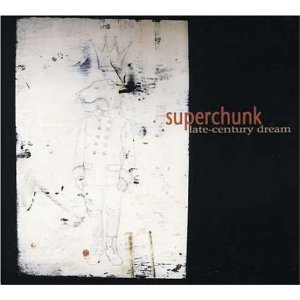
SOUNDTRACK: SUPERCHUNK-Late Century Dream (2001).

A Superchunk song that opens with keyboards, “Late-Century Dream” is one of the most mellow singles that they’ve recorded (even more mellow than some of the acoustic songs they’ve done).

It’s followed by “The Length of Las Ramblas” an even more mellow track.  This one is also full of keyboards (sort of tinny, high pitched keyboards) and acoustic guitars.

Rocking guitars return on “Becoming a Speck” which reminds me of “1,000 Pounds.”  It’s a fast-paced, punchy song with a guitar solo that sounds like it might collapse on itself any minute.

“Florida’s on Fire” is an acoustic rendition of the song from Here’s to Shutting Up. Initially, when Superchunk was a punky bratty band, these acoustic numbers were kind of a novelty.  Now they showcase the extent of musicianship that the band possesses, and this one is no exception.

It’s a good EP, and the last one that I bought prior to their return this year.  They have a couple other ones that I’m going to try to track down.  But in the meantime, it’s all Majesty Shredding.

[READ: October 10, 2010] “An Actor Prepares”

Donald Antrim is the next writer in the 1999 New Yorker 20 Under 40 issue.

This story is a funny look at college theater.  The subject is not terribly new, and yet there are so many wonderful details and the theater teacher is so over the top that this story was completely enjoyable.

The narrator is Reginald Barry, Dean of Student Life and Wm. T. Barry Professor of Speech and Drama at Barry College (ha!) and this semester his students will be performing A Midsummer Night’s Dream.   I had to look up some of the quotes in the story to make sure they were actually from the play (I didn’t know the line “Use me but as your spaniel, spurn me, strike me” was in Shakespeare), but they are, and Antrim takes lines like this and runs with them.

Barry has wonderful plans for this production which he envisions outside on the grounds of the campus, with a culminating orgy occurring just as the fireflies come out. (more…)

Read Full Post »

SOUNDTRACK: MARTIN TIELLI-“We didn’t even suspect that he was the poppy salesman.” (2001).

Martin Tielli’s first solo disc is a proper solo release: it’s almost all him on acoustic guitar and his gorgeous alto voice.  I hadn’t listened to this disc in a while and I was delighted by how much of the disc I knew so well.

Te opening track, “I’ll Never Tear Your Apart” is deceptively simple: harmonic’d guitars and his gentle voice.  There’s a great video to go with it here.  That is followed by the wonderful “My Sweet Relief” which sounds like a great Neil Young folk song: great verses an a strong chorus.  Lyrically, though, it is all Tielli.  “Double X” highlights Tielli’s beautiful acoustic guitar work (and his dark lyrics).  “Voices in the Wilderness” is another delicate song (which opens with a sound that reminds me of Led Zeppelin’s “The Rain Song,” although in no way is the rest of the song like that. This song also (mis)quotes Rush very nicely: “‘If you choose not to be free you still have made a choice,’ said a high and squeaky voice.”

“Farmer in the City” is the only track that Tielli didn’t write.  It’s a nearly 8-minute song by Scott Walker.  I don’t know the original, but Tielli’s version is a bit too meandering to be really satisfying (although it fits in with the album style quite nicely).  It comes across as an atmospheric song more than a song proper.

It’s followed by the delightful “World in a Wall” which uses mice in the wall as a metaphor for a broken relationship (with wonderful detailed lines like: She’s like a mouse, I know she’s around It’s a gnawing sound. Leaves little brown poohs from a little pink bum.”

This is followed by the odd rocker “That’s How They Do It in Warsaw” (which features a woman speaking Polish–no idea what she’s saying).  It’s coupled with a slightly less rocky but still loud track “How Can You Sleep?” (which makes another fun musical allusion, this time about Guided by Voices).

“She Said ‘We’re On Our Way Down'” returns to the more ethereal sounding songs (although this has some great guitar tricks thrown in).  Like the bulk of the album, the song seems to eschew melody but then a gorgeous guitar or vocal line shines through and really sounds brilliant.  “From the Reel” is a beautiful, aching little ditty.  And the disc ends with the odd, seven minute “Wetbrain/Your War.”

There is a really wonderful review of post-Rheostatics work here at The Ohs.  He’s pretty harsh on the Bidiniband (although I haven’t heard the disc proper, just the live concerts that toured it, so I can’t say for sure) but his assessment of Tim Vesely is spot on (I love the idea of a Canadian Wilburys) as is his review of this disc.  I particularly like the Mary Margaret O’Hara comparison: Achingly beautiful but in need of an editor from time to time.

[READ: November 1, 2010] “The man who saw grey”

One thing I have really come to appreciate about Connell’s stories over the years is that he is not afraid to deal with dark aspects of humanity that many people would rather not think about.

The thing that surprised me about this story is that, in the past, Connell has used very specific language, one might even say two-dollar words (some of which I had to look up), to convey his ideas.  But in this story, he largely refrains from such language, keeping the language down to earth and familiar, much like his protagonists.

So this is a fairly simple story: a man hits his head and can thereafter only see in shades of grey.  What makes the story much more interesting than that simple plot is that the protagonist is a painter (well, his hobby is painting, in reality he is an administrator at the DMV). (more…)

Read Full Post »

SOUNDTRACK: SUPERCHUNK-1,000 Pounds (2000).

This EP has four tracks: an acoustic version of the title song and, for the first time that I’m aware of, a cover track.

“1,000 pounds” is another great Superchunk single.  It’s boppy and catchy and there’s more and more instrumentation thrown into the mix–acoustic guitars, more strings, a crazy sounding guitar solo with effects I don’t recognize.  It’s also another song where the title is sort of thrown into the chorus without making it sound like the focus of the chorus–another fun Superchunk trick.

The acoustic version subverts the original somewhat with a strange swing vibe.  And speaking of vibes, there are actual vibes in the song.  It almost sounds like a different song entirely.

The second song, “White Noise” is a no longer novel twist to a Superchunk song (they’ve been throwing in so many twist to their sound that it’s impossible to pin them down to anything).  There’s a cool guitar and bass line that sound, somehow, unlike anything else they’ve done.  The soloing is also pervasive, running throughout the verses.  It’s a very cool song.

The big surprise comes in their cover of David Bowie’s “Scary Monsters.”  Their version is noisy and feedback-filled with crazy guitar solos throughout some of the choruses.  It’s full of reckless abandon and is one of their craziest track in some time.  And really it sounds almost nothing like the original.

It’s a great EP and worth tracking down.

[READ: October 10, 2010] “The Volunteers”

Chang-rae Lee is the next writer in the New Yorker’s 1999 20 Under 40 collection.

This story is set during World War II.  However, unlike most WWII stories that I have read, this one is told from the point of view of Japanese soldiers (specifically, it is narrated by a Korean-born, Japanese-raised medic).

The narrator, Lieutenant Kurohata, is friendly with an inferior soldier, Corporal Endo.  He and Endo are from the same town so they have a friendship which, when they are alone, supersedes their ranking differences (although Kurohata is a little uncomfortable about that).  Endo, like many soldiers, is somewhat obsessed with a series of photos of naked women.  He is constantly trading for new ones and then showing them (surreptitiously) to Kurohata.  Kurohata is not terribly impressed with the behavior–he seems more mature in general–although he also implies that he is not very sexual–and he finds the whole proceedings somewhat beneath him. (more…)

Read Full Post »

« Newer Posts - Older Posts »