Feeds:
Posts
Comments

Archive for October, 2010

SOUNDTRACKPUGWASH-Giddy (2009).

I found this CD through a connection to The Divine Comedy (Neil Hannon plays on a few of their tracks).  Pugwash (what a crazy name–it comes from a series of children’s books (and a TV show) called Captain Pugwash) is an Irish band with four CDs (and this collection).  And man, it’s hard to find their stuff over here (although their website has a wonderful collection of videos and such).

Giddy is a collection of songs from all of their albums.  Their first album is represented by two songs here “The Finer Things in Life” and “Two Wrongs.”  These two songs sound, with no disrespect intended, like great Oasis ballads.  Say what you will about Oasis’ originality, they wrote some great songs, and these two sound like the best Oasis songs you’ve never heard.

Their other three albums sound far less like Oasis and far more like XTC.  In fact, the XTC comparisons are well-founded as Andy Partridge eventually co-wrote a song with them and eventually signed them to Partridge’s Ape House records (which is how this collection was released in the U.S.).

The XTC comparison is unavoidable on a few tracks.  The opening of “Song for You” (the “when we die” part) sounds like an uncanny XTC outtake, but when the chorus kicks in it sounds nothing like them and moves into more of the gorgeous orchestral pop that overflows on this disc.  And the Partridge co-written “My Genius” is also a wonderful near-XTC outtake, clever, witty, and perfect.

And the song “It’s Nice to Be Nice” is just a wonderful cheery pop ditty.  It sounds retro and charming; if the simple lyrics (and gorgeous harmonies) don’t bring a smile to your face you must be made of stone.

Although the album is primarily orchestral pop, there’s a wonderful array of styles on here.  “Anyone Who Asks” has chipper keyboard bits in the verses, but the chorus is a wonderful mix of dark minor chords.  And then, the absolutely bizarrely wonderful “Monorail” sounds like a fantastic Beck song (with lyrics that are as decidedly unusual as anything Beck himself might write).   It even opens and closes with wonderful circa 1920s banjo.

Despite the obvious nod to XTC, Pugwash does something that XTC doesn’t.  XTC is a very mannered band.  They always seemed very rigid and formal (and were wonderful because of it).  Pugwash uses XTC as a springboard, but Thomas Walsh seems like a guy who likes to let loose with unchecked silliness, so he can move past the strictures of XTC (and sound like Beck!)

And the packaging is just wonderful. The carnivalesque appearance of the cardboard case is enhanced by not just a cardboard sleeve but also by a second cardboard half-sleeve that you slide on top.  Depending on which way you slide it on, it creates a different set of pictures.  It’s a little thing but it’s a nice nod to the fun of non-digital products.

This is certainly one of my favorite albums this year (even if it came out last year).

[READ: September 21, 2010] One False Note

I enjoyed the first book of the series so much, I couldn’t wait to get to Book Two.  In particular, I was interested to see if Gordon Korman’s writing style would differ much from Rick Riordan’s.  As I said last time, I hadn’t read Riordan before, (although I have read a few by Korman) and while I wasn’t expecting them to write in the same manner, I wondered if they would try to keep the style the same (or if it would be really obvious that they were different writers).

I have to say that I didn’t notice the difference between the two.  Korman’s seems a bit faster paced (but he had no exposition to deal with), and it’s possible that he made things seems a bit more scary/dangerous than Riordan, but not much.

The question I have with the series is three-part: Is the basic plot given to each new writer–like the writer is told what the 39 Clues are–or, possibility two, are they told very specifically, the clue is this and it is here and the writer has to figure out how to get the kids there, or possibility number three, they are free to do whatever they want.

Either way, this is an exciting series, and I’m looking forward to Book Three.

So in Book Two, Amy and Dan continue their adventure.  This time, they go to Saltzburg and Venice.  The Saltzburg trip leads them to the Mozart house.  There’s a wonderful sorta subplot about Mozart’s sister, Nannerl (real name Maria Anna), who was also a great pianist and harpsichordist, oftentimes getting top billing when they played together.  I’s never heard of her, and didn’t know of her talent, and that’s the point of the subplot–how Nannerl had to put her musical skills to the side because she was a woman.   This works nicely with the pairing of Dan and Amy and how they are both good at different things and are both very useful on the quest. (more…)

Read Full Post »

SOUNDTRACK: SWANS-“My Birth” (2010).

I was a mild fan of the Swans in college ( I loved Children of God) and then post-college, my friend Lar got me obsessed with finding their obscure releases (turns out I have a bunch of LPs that are “valuable.”  Who knew?)  Anyhow, after they broke up I lost touch with Michael Gira’s projects (although Lar got me a cool autograph when Gira last played Dublin).

But Swans are back as heard on NPR.  (NPR?  Yes, NPR).  They have a new album out, but I’ve only heard this track so far.

Swans are loud and abrasive.  Their early stuff is slow and ponderous, nearly glacial–some of the darkest music going that’s not speed metal.  But after a ten plus year hiatus, and all kinds of new musical advancements what will Swans sound like?

“My Birth” is still a bruising song.  It’s loud and heavy but still slow-paced (although much faster than their early stuff).  The drums and bass are loud.  Gira’s vocals are much faster than his almost comically slow deep voice, and now he’s sort of yelling from a distance.

The big difference is that the song sounds contemporary.  Even though it is very Swans-y, it sounds like it has tricks from the last decade (no, not autotune), just a solid juxtaposition of instruments and a very cool/creepy electronic sounding tinkling that runs through the background of the chorus (is it a chorus?).

It sounds more commercial than things they’ve done and yet in no way is it a commercial song.  It abuses the listener and we are thankful for it.  Welcome back, then.

[READ: September 26, 2010] “The Matter with Morris”

This was one of the longer pieces of fiction I’ve seen in The Walrus.  And it was very satisfying.

As the story begins, we learn that Morris is a columnist and that he writes a weekly piece which is taken primarily from his life.  His family hasn’t been all that pleased about what he writes, but he does his best at hiding the details.  (He initially used material from his wife’s analysis business, but he found raiding his own family life to be more satisfying).

And then his life encounters a real tragedy.  He can’t process the problem, and it shows up in his column.  Instead of being quaintly funny, it becomes existentially intense.  Instead of being in first person, it becomes second person (and makes the readers uncomfortable). (more…)

Read Full Post »

[LISTENED TO: September 27, 2010] Consider the Archive

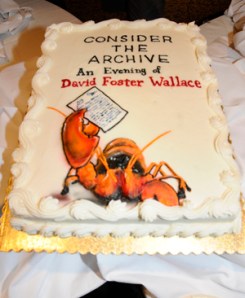
On September 14, 2010, The Harry Ransom Center at the University of Texas commemorated David Foster Wallace through an evening of his readings and (I love this) Wallace-themed refreshments.  It was also the opening of the Wallace archives at the Center.

[UPDATE: November 8, 2010: The research archives have gone online, details are available here.]

There was a live videocast of the evening, which included excerpts from several of his books. I didn’t get to watch it, but I was able to get an audio copy of the event.

The evening’s readers were:

  • Molly Schwartzburg –Introduction
  • Wayne Allen Brenner, L.B. Deyo, Kurt Hildebrand, Shannon McCormack–The Broom of the System (Grand Ohio Dessert excerpt)
  • Doug Dorst, L.B. Deyo–Correspondence with Don DeLillo
  • Owen Egerton —Infinite Jest (1960, Jim’s Dad)
  • Jake Silvertstein and Kurt Hildebrand–A Supposedly Fun Thing (skeet shooting excerpt)
  • Elizabeth Crane–Infinite Jest: (Avril & Mario)
  • Chris Gibson–Commencement Speech (This is Water) (more…)

Read Full Post »

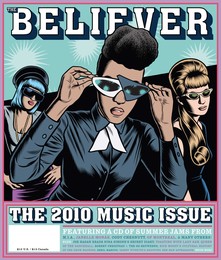
SOUNDTRACK: The Believer July/August 2010 Music Issue Compilation CD: “We Bumped Our Heads Against the Clouds” (2010).

Of all the Believer music compilations, this is by far my least favorite.  It would be oversimplifying things to say that the music is not for me, but in many respects it is not.  Chuck Lightning, the curator of the project states that this compilation is more or less a look into the state of the union for black artists.  And that invariably means a lot of R&B and songs that might be heard on Glee (I like the show, but I never know any of the music).

Deep Cotton’s “Self!” reminds me of novelty dance hit from the late 80s.  Of Montreal, who I thought sounded totally different from this, offer “Hydra Fancies” which is as catchy a disco anthem as any disco anthem can be.  Roman GianArthur’s “Depraved Valet” is an amazingly falsettoed Prince knock off.  Cody Chestnutt’s “”Come Back Like Spring” is a simple almost acapella ode to spring.  Saul Williams’ oddly titled “B.S. in a Tampon” is a spoken word with acoustic guitar that reminds me of Gil Scot-Heron.  Janelle Monáe’s “Cold War” is the first really catchy song (the la las remind me of Carole King), although  I could do without the overstated “Calinda” part and the extended fade.

The first song I really liked was BLK JCKs “Iietys” which sounded enough like TV on the Radio to be really interesting.  Spree Wilson’s “Chaos” also sounds like TV on the Radio (the more R&B side of the band, although the guitar solo is a dead ringer for “Hotel California.”  Scar’s “Rewind” is the song that should be on Glee.  I want to hate it but it is so damned catchy, I can’t.  Again, those Oh Oh Ohs are too perfect (and the auto0tune of course is unassailable).

Rob Roy’s “Velvet Rope Blues” is my favorite song on the disc by a large distance. It’s a weird rap that reminds me of The Streets, with an awesome sung chorus ala OutKast.  Hollyweed’s “Have You Ever Made Love to a Weirdo” is a trippy, juvenile space rap that is really silly.  Sarah hates it but I kind of like it, as it’s in the spirit of Frank Zappa, (although I hate the sax solo).  Fear & Fancy’ s “Off the Grid” sounds also not unlike OutKast.  And George 2.0′ s “Turn Off the TV” is a anti-TV rap rant (with the somewhat ironic conclusion that you yourself might end up ON the TV).

M.I.A. is probably the biggest name on the disc. “Born Free” is a weird little track of highly distorted vocals over a punk guitar buzzsaw sound.  But her vocals are mixed so loud in the mix that they sound unrelated.  It sounds not unlike a Go! Team track.  This track makes me wonder how she became such a sensation.

Hot Heavy & Bad’s “One” returns to that disco sound in the vocals with some contemporary bass sounds.  It wears out its welcome pretty quickly.  Tendaberry’s “Cold Boy” sounds like a less horn-y Fishbone.  Mother Novella offers one of the few all guitar songs, “Closer 9 1/2” and it’s an okay mid tempo rocker.

The final song is pretty awesome in theory: Nina Simone covering Alice Cooper.  That’s right, Nina Simone covering Alice Cooper.  Sadly I don’t know the Alice Cooper song, so it’s a bit lost on me.

[READ: September 16, 2010] Speaking with the Angel

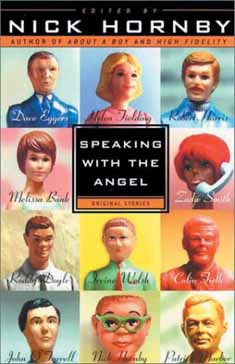
I bought this volume when it came out (and apparently donated $1 to TreeHouse at the same time).  It’s a collection edited by Nick Hornby (and the cover is designed similarly to the way High Fidelity and even About a Boy were at the time (“the Hornby look,” I suppose).

I didn’t buy it for Hornby alone, although he does have a story in it, but because it looked like a really promising collection of stories from authors I liked.  And for some reason I didn’t read it until now.  It includes 12 stories, and as the introduction notes, $1 was donated to TreeHouse.org.uk (in the US $1 goes to TreeHouse and another $1 goes to New York Child Learning Institute).  I don’t know if the money still goes there, but you can donate with a form at the back of the book.  (more…)

Read Full Post »

SOUNDTRACK: PAVEMENT-Crooked Rain, Crooked Rain (1993).

Now this album, Pavement’s second (after the Watery, Domestic EP, which I’ve never heard) is my idea of perfect Pavement.  Some might complain that this album is too commercial (although it hardly is) but to me is shows a consolidation of the talents into actual songs.

It opens with “Silence Kit” which sounds like a twisted take on a Buddy Holly song–disconcerting and familiar at the same time.  The second track “Elevate Me Later” ups the ante a bit with a noisy raucous chorus.

“Stop Breathin'” is a dark song, a sort of minor ballad that sounds even more disconsolate with the slightly out of tune guitar work.   But the lengthy instrumental at the end is (although simple) quite pretty.

And then there is the sublime nonsense of “Cut Your Hair.”  This was the first Pavement song I’d ever heard all those years ago.  And from the silly “oo oos” at the beginning to the crazy screaming guitar solo and crunchy “NO BIG HAIR” line I fell in love immediately. It was a wonderful left field hit (not unlike “She Don’t Use Jelly”) that brought a great band some attention.

It’s followed by “Newark Wilder,” a slow track that fits wonderfully after “Hair.”  One might even call it a ballad.  But it is definitely not standard fare, when the bass (or baritone guitar) plays a riff instead of a bridge.

The album picks up the rocking vibe again with, “Unfair” which I noticed is like a rough precursor to Weezer’s “Beverly Hills.”  It’s a fairly conventional song but it’s made unconventional by Malkmus’ delivery and guitar style (and would probably be a hit if it was released today).

I recently mentioned “Gold Soundz”.  (And it’s amazing how much the live version sounds just like the studio–as if everything was intentional).  It’s followed by the goofy Dave Brubeck parody/tribute “5-4=Unity.”  And of course, “Range Life” is just an awesome slacker anthem.  It’s got everything.

The last three songs offer a lot of diversity.  “Heaven is a Truck” is a piano based, drunken-sounding ballad.  “Hit the Plane Down” is a rambling wonderful shambles that devolves into a complete chaos, and “Fillmore Jive” is a 6 minute “epic.”  It opens slowly, and then builds into a fairly conventional sounding (drunken, sloppy, end of the concert) rock song.

I feel that Pavement peaked with this disc.  It’s really fantastic.

[READ: September 23, 2010] “Lost in the Mail”

As I am wont to do, I have gotten a little obsessed with an author. Recently it was Wells Tower (there’s still a few Harper’s pieces by him I haven’t read yet). And right now its Jonathan Franzen (even though I haven’t read any of his novels yet).  After reading the previous New Yorker piece, I wanted to see what else he had written for them.  Seeing his entire list at the New Yorker site is daunting and it makes it seem like he was constantly writing quite long pieces for them.  And yet, parsing it out, it comes out to about one article a year.  And yet some of these article, whoo boy, are 12 or 13 pages…quite lengthy for the New Yorker.

And so, I’m going to read these pieces over the next few weeks–I thought about reading each year’s piece during a different week, but that seems too regimented.  And since the majority of these pieces are non fiction (there are about 5 short stories in the mix) I’m going to be reading them with an eye towards these questions: Can a good writer make a story that I don’t care interesting?  Would I enjoy this same piece if it were written by someone else?  As a reporter (at large) does Franzen bring some kind of personality to the way the piece is constructed that someone else may not have?

This questions are unanswerable of course, because no one else wrote the piece in a different way.  But, when scanning the titles, some of the subjects interest me but others do not.  And those will be the real test.

This piece, about the Chicago Post Office is something that I didn’t care about specifically.  However, I have a certain love of the Postal System, and so I found this story heartbreaking and something of an illusion-shatterer. (more…)

Read Full Post »

SOUNDTRACK: PAVEMENT-Slanted and Enchanted (1992).

I decided to go back and give a good listen to Pavement since I’ve always liked them but never loved them And, yes, they were in Central Park the other night).  So I started at the beginning.

I listened to the disc about a half-dozen time at work and I really started enjoying it a lot more by the end. It’s a difficult album, one that doesn’t actively embrace its listeners.  It’ a noisy, sloppy album (and that’s one reason why I like it), but there are hints of melody within.

Because I’m not in the moment, I can’t decide just how revolutionary this album was.  Nearly twenty years later it sounds like any number of noisy distortion fueled, lo-fi recordings of the period.  You can hear all kinds of influences on the band, Sonic Youth, The Fall, even The Replacements.  So, it’s not like they created something out of the blue.

Perhaps they were the first band to consolidate these influences into this particular stew.  No songs really stand out for me, as this seems more of an album of sounds that a collection of songs.  I rather enjoyed some of the oddball instrumentals and the use of keyboards, (which seem too polished for their sound: out of tune guitars and scratchy vocals).

It’s a fun record, and it certainly sets a tone and an agenda for the band.  I’m just not blown away by it.

[READ: September, 22, 2010] “Meet Me in St. Louis”

As I mentioned in the Franzen article the other day, I missed the whole brouhaha with Oprah and Franzen.  This article, which touches on that somewhat, gives Franzen’s perspective on what happened.  But primarily it shows (his take on) the videorecording that happened for his big Oprah TV show.

Mostly it involves Franzen driving around St. Louis.  Franzen grew up in St. Louis but spent most of his adult life in New York City–which is where he considers his home.  However on the book tour for The Corrections, he stopped in St. Louis.

The producers of Oprah wanted to film his great homecoming, even though he never felt it was one.  About two years before this event he and his brothers sold their family house after his widowed mother died.  That was the last time he had been to the house, and he had planned to never return. (more…)

Read Full Post »

SOUNDTRACK: PAVEMENT-“Gold Soundz” live on the Colbert Report (2010).

Philistine alert: I never loved Pavement.
Yeah, let that sink in.  It’s shocking, I know.  I have liked a great many of their songs, and I could definitely see myself enjoying the entirety of their new greatest hits record.  But even though I have their first three discs, and I adore them in theory, in practice I just don’t love all of their output.

When they broke up in 2000 or so I wasn’t really that bummed.  I felt they’d done a number of great (and by now) classic alt rock songs, but I didn’t really feel like music had ended or anything.

Having said that, the fact that they’ve reunited makes me happy.  It’s nice to see yet another “classic” alt rock band banging out some tunes together.  And, in this case, it means that I get to hear them play a great classic track live on The Colbert Report.

This song is a kind of The Platonic Form of Pavement songs.  It features everything: noisy guitars, vocals that go from mid-range to high pitched with almost no warning, inscrutable lyrics and, in spite of itself, a catchy liquid center. I’ve never seen them live (and I missed a chance in Central Park recently, sorry Al) but this clip sure makes me think they’d be a great show to see.

And who knows, maybe I’ll have to actually get Terror Twilight.

Colbert’s interview with Stephen Malkmus is hilarious, too.

[READ: September 20, 2010] “Bodies”

As with a previous time that I scoured a New Yorker back issue, I found a short story that came directly after the article I wanted.  The name Jessica Shattuck sounded familiar (and her debut novel The Hazards of Good Breeding also rang a bell), but apparently I’d never read her before.

This story opens with a woman named Anna who we learn has recently been diagnosed with Stage III Hodgkins lymphoma.   She is currently living in her bosses’ house with her boss’ husband and five-year old son.  The arrangement is not ideal, but Anna had nowhere else to turn.  And, since she is not working, while she is recovering she is acting as the boy’s nanny (the boss is away a lot and the husband spends much of his time working out).

She is beginning to feel better, stronger, and is even feeling confident enough to leave the house for a little while.  And so, to me, the last thing I expected was for this story to grow sexual.  And yet it does. (more…)

Read Full Post »

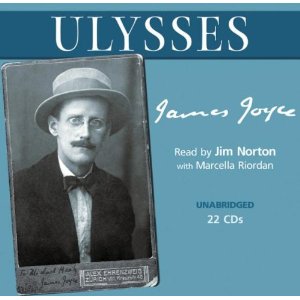
[LISTENED TO: September 27, 2010] Ulysses [abridged]

Because I am a glutton for punishment, I decided to listen to the abridged version of Ulysses as well (what’s 4 more hours of my life?).  (This edition is by Naxos, which Amazon is selling as a download).  I decided that the main reason was that since I have the text so fresh in my mind, it would be interesting to see what they abridged.  I mentioned in a recent post that the abridged version is 4 discs (just under 5 hours).  That is a serious abridgment, from 40 to 5 hours (actually the Naxos unabridged version is only 22 discs…how come theirs is so much shorter?  It seems that Jim Norton reads much faster).  And I am curious to see what they consider the “essential” text of the book.  Plus, realistically, I would never really want to do it at a later date.

So this version is read by two different people: Jim Norton (who read Dubliners, Portrait, and an abridged Finnegans Wake too) and Marcella Riordan.  There are a number of places where the two interact (she is Molly in the early scene in bed and she is some of the whores in the nightwon scene…it adds some real dramatic resonance to the story). (more…)

Read Full Post »

The new Fall TV season is pretty much underway.  It brings back a lot of old favorites, as well as a few new series that we’re going to check out. (more…)

Read Full Post »

SOUNDTRACK: R.E.M.- Fables of the Reconstruction of the Fables of the  (1985).

I’m willing to go on record saying that I like the title of this disc to be elliptical, even if the band has a definitive answer for what it should be called.

So, I’ve learned that I’m a bit of a fair-weather R.E.M. fan.  I’ve always felt that they were the bedrock of any alt music collection.  But recently (with the re-release of this album, which I did not buy) I decided to go back and listen to the full albums (I listen to Eponymous a lot, but I wanted to hear some deeper cuts, as they say).

This album has a lot of quintessential R.E.M.-sounding songs, and yet it’s also not a very poppy album, so it doesn’t feature too much of that jangly guitar–the other trademarked R.E.M. sound.  Rather, we get a lot of picked guitar bits, some great bass (a very underappreciated aspect of the band) and a lot of one of my favorite things: Peter Buck’s backing vocals.

There are a  few “hits” on this disc, songs that I love very much, but this disc also features a bunch of songs that don’t really excite me.  In fact, the back end of the disc is kind of ho hum. “Green Grow the Rushes” is a nice enough song.  “Kohoutek” just never really grabs me.  “Auctioneer (Another Engine)” is a pretty interesting experiment: the minor chord vocals section in the middle are rather creepy (and the guitar sounds a bit like an early-80s Cure song).  It’s my favorite track in the back of the disc.  The last two songs are gentle folk songs that are, again, nice, but not mind blowing.

Of course the front half of the disc is full of weird gems. “Feeling Gravity’s Pull” is a bizarre, off kilter delight.  And that weird string section at the end is only part of the oddity of it. “Maps and Legends” is a fascinating song that just seems chock full of noises (like an acoustic Public Enemy track) that keeps you guessing what will happen next.

“Driver 8” begins my favorite section of the disc.  “8” is one of the major highlights of this disc.  It’s dark and mysterious without being swamped under by murk.  And while I have no idea what it’s about it never stops me from singing along.  “Life and How t o Live It” features some great bass work (and an interesting guitar riff).  “Old Man Kensey” starts out really promising with a cool bass and peculiar guitar line, but it kind of drifts a little after that.  But the final track of this section, “Can’t Get There From Here” is an ebullient song, that feels really out of place here.  It’s one of my all time favorite R.E.M. tracks, and it adds some much needed adrenaline here.

I admit that I am more of a fan of R.E.M.’s louder songs (Document is a highlight).  So this disc is a little too tame for me.  I’m lead to believe that the new edition of the disc features some live tracks that really bring these songs to life, but I think I may just stick with Eponymous.

[READ: September 19, 2010] “Mr. Difficult”

I am planning on reading The Corrections soon (and one of these days Freedom, too).  Somehow I missed all of the controversy surrounding Franzen (I am blissfully ignorant of Oprah) when it was all over the place, but I recently learned that he and David Foster Wallace were friends and respected each other, so I thought I’d give him a read.  But before I get to the big book I decided to read some of his nonfiction (I had read about this Franzen article in which he talks about William Gaddis and wanted to read this right away).

So this article is a lengthy discussion about William Gaddis.  It is inspired by a letter writer (whom he calls “Mrs. M—-“) who accused Franzen of being an elitist–for using big words like “diurnality” and “antipodes”–and for not writing for the “average person who just enjoys a good read.”  So Franzen talks about two types of writers.  First is the Status Writer (like Flaubert) where the best novels “are great works of art…and if the average reader rejects the work it’s because the average reader is a philistine.”  And then there is the Contract Writer where a novel represents a compact between the reader and the writer “with the writer providing words out of which the reader creates a pleasurable experience.”

Franzen never says what camp he himself falls into, but rather, he explains that when he was in school, he wanted to be a Status Writer, he wanted to love difficult books.  However, when his screenplay was described as, basically, a knock off, he was despondent.  So, he decided to sit down and read Gaddis’ The Recognitions, a 900 page Difficult Book.

And he loved it.  He was engrossed and couldn’t stop.   (more…)

Read Full Post »

« Newer Posts - Older Posts »