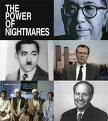
 [WATCHED: June 2009] The Power of Nightmares
This is a film, not a book. But I found it so fascinating that I had to say something about it. I have to say it again, this series was truly amazing, and I encourage everyone to watch it.
The Power of Nightmares is a 3 part documentary, totaling about 3 hours. It was created by the BBC in 2004. The underlying theme of the film is that politicians have begun to resort to fear in order to achieve their desired aims. Where in the distant past, politicians offered hope and future fulfillment, nearly all campaigns now try to scare you into voting for them. (This was before Obama, and may explain the popularity of Obama’s campaign).
The premise of the series is that the rise of the radical Islamist movement (including al Qaeda) and the rise of the American Neo-Conservatives not only parallels each other but actually supports each other.
This documentary is well researched and, obviously, controversial. It has, to the best of my knowledge, never aired in the U.S.
Part One shows the rise of the radical Islamist movement. It began with Sayyid Qutb, an Egyptian civil servant who came to the U.S. to learn about American education. He is disturbed by the rampant individualism that he sees in 1950s America. When he returns home and notices that Western beliefs are taking hold in Egypt, he becomes a leading member of the Muslim Brotherhood. One of their fundamental beliefs is that Western ideas are undermining the greatness of Islam. Therefore any leaders that are influenced by Western ideals can be executed. He himself is eventually captured and executed, but this radical belief inspires Ayman al-Zawahiri, mentor of Osama bin Laden.
Simultaneously, in the United States, political thinkers feel that Johnson’s Great Society has failed. Individual liberties have gone too far and have eroded the respect for America a a nation. They become united by the writings of Leo Strauss, who posits that people need a common evil to fight against if they want to be strong as a people. And who better to posit as the common enemy than the Communists. These political figures come to prominence during the Reagan administration, and here you see many figures that are familiar from the George W. Bush administration. Irving Kristol, Paul Wolfowitz, Dick Cheney, Donald Rumsfeld, basically the who’s who behind the Iraq war were instrumental in creating the Cold War as well.
In Part Two, Curtis uncovers sources who simply disprove the propaganda that the Soviet Union was about to destroy the U.S. These sources state that all of the evidence compiled to show the Soviets building their nuclear arsenal or disobeying nuclear treaties was either doctored or, as seems more likely, made up.
When the Soviets invaded Afghanistan, they fought a losing battle in the desert (sound familiar?). At the same time, the U.S. scaled up the nuclear deterrent in an attempt to out-military the Soviets. Yet all evidence shows that the Soviets were basically bankrupt already and were barely a military in any sense of the word. When the Soviet Union collapsed, both the Islamists and the U.S. claimed that they were responsible for destroying the Evil Empire. (Even though, as they note, the Soviet Union basically self-destructed).
After this “victory” both sides are blocked against further expansion. Attempts to create Islamist states are negated by force. And, in the U.S. first George H.W. Bush did not kowtow to the neo-conservatives. (This is the first portrait of G.H.W.B. that I have seen that actually made me like him). And then came the ultimate smackdown: Bill Clinton. The neo-conservatives they made him the new enemy. And so they did whatever they could to discredit him. In this case, scandal (nothing) after scandal (nothing), after scandal, where nothing sticks except Ooops, Lewinsky!
Curtis speaks to the man who fabricated the entire story of Whitewater. And he admits the entire story was fabricated out of nothing. There was no basis for Whitewater at all! I noted that some critics didn’t think this section, about Clinton, was believable. And yet, if you look at the neo-con attacks on Obama right now, they are throwing accusations at him left and right trying to get anything to stick, from birth certificates, to socialism, to taking away everyone’s guns to increasing taxes. It’s desperate. And yet, eventually something is bound to stick.
Part Three discusses the rise of al-Qaeda. With Clinton banished, the neo-cons celebrate the arrival of George W. Bush. But at first he won’t play ball either. From the start Bush said he didn’t want “nation building,” meaning, no foreign affairs. Then September 11, 2001 happened. And everything changed. Bush (and the rest of the country) got behind the neo-con agenda. But the agenda was to demonize an enemy. And while Osama bin Laden was clearly the enemy, al-Qaeda, as an organization was not.
This section of the film is the most intriguing and possibly the hardest to prove, but the suggestion is that al-Qaeda was not a terrorist network with sleeper cells across the US. Bush later claimed that we captured sleeper cells throughout the US, yet all of those “cells” have proved to be false. In fact, it’s not even a network. Without going into too much detail–watch the film for that–I’ll summarize that Osama bin Laden was a rich man who paid people to be his bodyguards, paid people to be his militia, paid people to rattle sabres around him. But he had very few real followers. The September 11 hijackers were, it appears, not even following bin Laden’s orders. Bin Laden was the money behind the attacks, but not the mastermind.
Curtis claims that the neo-cons propped up al-Qaeda because they needed an enemy, and, as a result, al-Qaeda has become strong in a way that they were not before Spetember11. He doesn’t suggest that the neo-cons were responsible for September 11 or anything remotely like that, only that in the need to find an enemy, we can inadvertently create an enemy.
I know very well that this is an inadequate summary of this complex film. In fact, I may even have asome of the details wrong–it was a heady piece. Wikipedia has a good summary. And any Google search will bring up someone’s opinion of it.
The whole thing is available online. I’m embedding the videos from Google Video here. But you can watch it elsewhere, of course. I’m not sure if the Wholphin videos are still available, but obviously that would be the best place to get the dvds.
I want to thank Wholphin for bringing this to my attention. It had a pretty major impact on me. I also wanted to mention that Lawrence Weschler, of McSweeney’s Convergences fame does the notes for one of the Wholphin discs, and his insights are welcomed and well-reasoned.
Part One:
Part Two:
Part Three:

 I Just Read About That...
Leave a comment