 SOUNDTRACK: THE DECEMBERISTS-The Hazards of Love (2009).
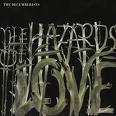 I first played this disc a few times without really listening to it, just to get a feel for it. And I was surprised by how heavy it sounded. The harshest moments of the disc really stood out to me, and I was quite surprised, as I think of the Decemberists as more folky than this.
But when I finally sat down and listened, I was pleasantly surprised at how much I liked the disc overall. I have yet to understand the complete storyline (the lyrics are printed in a near impossible to read size and color, so I’ve had to rely on what I could pick out.)
The disc is a concept album. It tells the story of Margaret who falls for a shape shifting creature of the forest and, I think, their offspring as well. There’s a jealous forest queen involved, and, of course, the Rake–although I’m not exactly sure how he fits in–but more on him in a moment.
In addition to some “celebrity” guest vocalists (Robyn Hitchcock and Jim James of My Morning Jacket sing backing vocals), for the first time on a Decemberists disc, Colin Meloy doesn’t sing all of the lead vocals. The two women characters’ parts are sung by two singers I don’t know: Becky Stark (of the band Lavender Diamond) and Shara Worden (of My Brightest Diamond). And when the queen (Shara Worden) sings, she’s pretty angry. She creates one of the harshest sounds I can think of by the Decemberists.
Interestingly, that song, “The Wanting Comes in Waves/Repaid” also contains one of the most beautiful passages that the Decemberists have done. “The Wanting Comes in Waves” part of the song has an uplifting chorus, a wonderful melody and a beautiful sing-along. Meanwhile, the “Repaid” part has some harsh, angular guitars and when the Queen repeats “repaid!” for the third time, the hair will stand up on your arms. (Of course, the song then repeats the beautiful part once again…phew…and it is reprised at the end of the disc, because how could you NOT include that passage again?).
This record also features the catchiest song about infanticide that I know of. “The Rake’s Song” rocks, and yet as you’re singing along to the simple but catchy chorus of “Alright, Alright, Alright,” you realize that the Rake has just killed all of his three children so that he can have a life as a free bachelor again. (Revenge does come at the end).
And that revenge comes in one of the 4 versions of the title song. What starts as a simple folky ditty (in Part 1) “singing, oh ho, the hazards of love,” morphs (in Part 2) into a rocking track, then (in Part 3) a track with a children’s choir (my least favorite track on the disc–it works with the story, but I don’t care for the kids voices, really) and (finally) a haunting epilogue.
This is The Decemberists’ most striking album to date. It is a bold attempt to alienate just about everyone, and yet I believe they have pulled off something just shy of a masterpiece. The harshness of some of the songs still makes me a little uneasy (at least when listening with the kiddies), but the rewards are ample, and they really do fit perfectly with the plot.
I never expected the Decemberists to venture into prog rock territory but since they embraced it fully, they really pulled it off. I do still need to get in and read the lyrics though, just to get all the details straight. (They are legibly printed here).
[READ: June 1, 2009] Cat’s Cradle
This is the first “well-known” Vonnegut book I’ve read (not counting Slaughterhouse Five, which I’m going to re-read soon for the first time in fifteen or so years). I’d heard of this book but never knew what it was about. And, boy, trying to summarize is pretty tough.
Why?
Because Vonnegut invents an entire new religion and a fictional island on which to practice it. And his characterization of the whole thing is so complete, that it is utterly believable. And that’s only half the book.
So, let’s try this: John, the narrator decides to write a personal biography of Felix Hoenikker, the Father of the atomic bomb. Okay, so we know we are on somewhat fictional ground, and yet it is sort of based in reality. Fine.
John discovers that Hoenikker’s kids are still alive. Like John, Hoenikker’s son, Newt, went to Cornell and pledged to the same fraternity (John learned of him in the fraternity newsletter). However, Newt just got kicked out of school because he didn’t really care about it all that much.
It turns out that Newt is, well, a midget. Newt has a brother, Frank, who is quite tall, and a sister, Angela. (There is some question of parental origin of the kids, but that is not explored very much). Angela basically raised her brothers (and her father) when their mom died while giving birth to Newt. For you see, Felix was about as absentee a dad as there could be. Not because he wasn’t physically there, but because he wasn’t psychologically there, or really anywhere except in his own head. (There’s a great example given that Felix once left a tip for his wife after a meal, he was so detached). But Felix was a gifted genius, and his wife was devoted to him. He just had no knack for interpersonal relationships.
And all of this background…chapters and chapters of family history (for there are 127 chapters in the book, most about 2 pages long), don’t prepare you in any way for what is to come.
Felix Hoenikker, in addition to inventing the atom bomb also invented something called ice-nine. A pentagon general explains to John what ice-nine would do if it existed, but since it doesn’t exist, he doesn’t need to worry about it. He didn’t know that Hoenikker had, just before he died, made enough ice-nine to destroy the world (in fact, it would only take a drop). And you can bet that that will come into play at some point.
But what about that religion? Well, the religion of Cat’s Cradle is Bokononism. It is unique to the island of San Lorenzo, where the bulk of the end of the book is set. Bokononism was created by a man named, what else, Bokonon. The San Lorenzian language is a hybrid of accented-beyond-recognition English. And so Bokononism uses language that is unusual at best. Words that are used frequently in the book include:
- karass – a group of people who, often unknowingly, are working together to do God’s will.
- duprass – a karass that consists of only two people., almost always married. The two members of a duprass always die within a week of each other.
- granfalloon – a false karass; i.e., a group of people who imagine they have a connection that does not really exist. An example is “Hoosiers”; Hoosiers are people from Indiana, and Hoosiers have no true spiritual destiny in common, so really share little more than a name. Also, really any group like Americans, Communists, Democrats.
- wampeter – the central theme or purpose of a karass
- foma – harmless untruths; lies that bring one comfort
 boko-maru – the supreme act of worship of the Bokononists, which is an intimate act consisting of prolonged physical contact between the naked soles of the feet of two persons.
So, as you read along you keep getting these weird words thrown at you, but pretty soon you start to get the words straight and really see how useful and truthful they are in the real world. (And you can totally see that people who loved this book undoubtedly used these words with each other–mostly in college, I’m sure. Indeed, if the book were written now there would be T-shirts with these slogans on them).
But that’s neither here nor there, because even though this religion forms the backbone of John’s entire being (he converts when he arrives in San Lorenzo and this book, Cat’s Cradle, is written during the events of the book (What??), Bokononism does not directly impact the plot of the story.
Well, except in one way: When San Lorenzo was colonized (or should I say one of the times that San Lorenzo was colonized) Earl McCabe and Bokonon (real name Lionel Boyd Johnson) devised a clever plan: Invent a religion and then ban it. Soon the entire population of the island became Bokononists and McCabe (for he became the dictator) threatened to kill anyone who believed or was caught practicing it. (This was a great way to distract the people from any real problems that the island was facing).
The current dictator, “Papa” Mozano takes the ban on Bokononism a little more seriously in that he actually does kill the occasional person (and engages a hunt for Bokonon), but aside from that very little has changed on the island.
The series of convergences that lead John, the Hoenikkers, and a few random Americans (including Mom, the one who creates the granfalloon about Hoosiers (see I told you we’d be using those words)), to San Lorenzo make up the main part of the story, so I’m not even willing to summarize. But once they all end up on San Lorenzo, the action REALLY starts.
Suffice it to say that this story takes a twisted look at nationalism, religion, love and death. One wouldn’t call the book funny, although there are very funny moments, but it is wry in its evisceration of conventional morality. It also reveals itself to be far deeper than any of these nonsensical words would ever lead you to suspect.
Vonnegut really hits his stride with this book. I’m not sure that this is even my favorite of his books that I have read thus far, but the confidence with which he throws out these ideas, and the utter conviction he has about what he has created–virtually ex nihilo–is amazing. You never suspect for a second that Vonnegut is making this stuff up. He may have been inventing Bokononism his whole life.
There’s also an interesting foreshadowing to Slaughterhouse Five in that a bird on San Lorenzo says “Pootee-phweet” a forerunner to Slaughterhouse‘s “Poo-tee-weet.”
In Palm Sunday, Vonnegut rated Cat’s Cradle an A+ (you can see the list here), and it begins a series of very solid books (I’m pretty excited to get to these). The title, Cat’s Cradle, incidentally comes into play later in the book and I adore its usage. Simply brilliant.

 I Just Read About That...
[…] 677 views posted June 2, 2009 Kurt Vonnegut–Cat’s Cradle (1963) SOUNDTRACK: THE DECEMBERISTS-The Hazards of Love (2009). And the final one, the big surprise is […]