 SOUNDTRACK: THE NEW ODDS-Cheerleader (2008).
 Craig Northey, singer of the Odds has written some great songs by himself and with a slew of other projects. But most notably, he did the theme songs (opening and closing) for Corner Gas. At last, “My Happy Place” the Closing Credits song has now been released on this disc by The New Odds. (The Opening Credits song “Not a Lot Goin On” is available on the
  disc that Northey made with Jesse Valenzuela, cleverly titled Northey Valenzuela. I mention Corner Gas aside from the fact that it’s a great show, because I mention it in the book write up below as well. But back to the Odds.
The Odds had a minor hit in 1993 with “Heterosexual Man” (which we all thought was hilarious). I  didn’t really think much about them until my friend Amber from Vancouver sent me a tape of Bedbugs. I was surprised how much I liked it and how, although the band was funny, they weren’t a novelty act at all.
I’ve enjoyed the Odds very much since then, they’ve appeared on a number of soundtracks, and r eleased four solid albums, especially 1996’s Nest.
The New Odds are, as you might guess, the Odds, only new. 3 of the 4 original members are back, and aside from updating their sound to the twenty-first century, the band isn’t radically different. They play what used to be called college music, but which really is more or less alternative or even just rock music.
As with previous Northey output, the lyrics are witty and clever, with some wordplay in evidence. There’s a pretty diverse collection of sounds on the record, yet they all stay within the range of alternative guitar pop. One or two songs rock harder than the others, “Leaders of the Undersea World” sounds like a dose of heavy metal in comparison to the rest of the record. “Write it in Lightning” is also a pretty good song, and “I Can’t Get You Off” has a wonderfully catchy hook to it.
Northey’s voice is easily described as inoffensive, and the music is catchy but not stick-in-your-head catchy. It’s not a ringing endorsement, but it’s also not a put-down. Like meat and potatoes, it’s a good staple to any alternative fans’ collection.
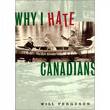
[READ: August 28, 2008] Why I Hate Canadians
I bought this book several years ago, probably in 2000, when I was visiting Montreal. I remember being very excited to visit Chapters and to see what kind of books they had that weren’t available down south. I was especially interested in the humor section as I had just started watching Mike Bullard, and I knew he wasn’t available in the States. I found Bullard’s book as well as two books about Canada by the Fergusons. Why it took me 8 years to read them, I don’t know.
This book is listed as a humour book; the copyright page has it listed as 1. Canada-Humor 2. Canadian wit and humor (English). But the thing is that the book isn’t very funny. Even with an outrageous title like that, it’s not very funny. It is however, a fantastic introduction to the history of Canada written in a style that is (yes) funnier than your average textbook.
DIGRESSION: I will state that I realize that Will Ferguson has a perspective, and quite often he’s very vocal about his perspective. Most good history is written with an acknowledged bias–trying to hide your bias makes for dull (or hypocritical) history. So, Ferguson’s history of Canada may not be Accurate, (especially if you are a Quebecois) and of course, I’d be interested to hear from those who disagree with him; however, to an American who is not well versed in the history of Canada, it was pretty enlightening.
So, the basic set up of the book is that Ferguson, after getting involved in many Uplifting Canadian Youth Activities [Katimavik (which sounds pretty awesome), Canada World Youth & Project Megapole (no link available). decides to leave Canada for Asia. He is gone for five years and on his return he feels that nothing has really changed in Canada. And the title comes from his reckoning that Canada the country is fantastic but that Canadians don’t appreciate (or perhaps don’t even deserve) such a great country.
The first Part concerns what he was like as a youth (idealistic, a citizen of the world) and how quickly reality changed that.
But in Part Two, Ferguson gets into the history of his home and native land. He begins by discussing the Voyageurs and Habitants (trappers and lumberjacks) who formed the backbone of non-Native Canada (more on Natives later). He also discusses Loyalists and other Losers. Now, as a U.S. fellow, I thought I knew a lot about history below the 49th parallel. [It’s also interesting to think of how or two countries see 54-40 in such opposing terms]. I never knew that the “losers” of the American Revolution (people loyal to Britain) were more or less forced out of the Americas and into Canada, and that they basically formed the backbone of English speaking Canada and its ties to Britain. Why didn’t I know that? Is it left out of U.S history because, like our maps, if you go northwest through New York, you just disappear? Anyhow, that was a pretty fascinating history lesson for me.
But it couldn’t compare to The Cold War on Ice. Non-Canadians and Non Soviet people probably don’t know too much about this cold war (although hockey devotees surely do). For my fellow Americans, I’ll summarize: Canada, considered by Canadians to be the best hockey country in the world, decided to play 8 games against the Soviet Union: 4 in Canada, 4 in Russia. Canada was expected (by Canadians) to sweep. Imagine their shock to find themselves down 3 games to 1 (with 1 tie) after 5 games. The last three games, played in Russia, all came down to 6-5 victories with all three winning goals being scored by Paul Henderson. (Games 6 & 7 went to OT and the last game…the defining moment…was won with 34 seconds left). My recap has removed all of the drama, all of the passion, all of the excitement, because I couldn’t possibly do it justice. But, reading Ferguson’s recap was riveting. And I rather wish I had seen it…. It seems to compare to the U.S. beating the Soviet Union in the 1980 Olympics in hockey–a moment I saw and which thrilled my 11 year old self with unimaginable pride, so I can just imagine what that felt like for a country who loves hockey.
If you’d rather not read about this hockey series then please, watch the Corner Gas episode “The Good Old Table Hockey Game” which replays the highlights of the series in a table hockey match between Brent and Karen. It almost compares to the real thing, eh Canada?
But back to the book. One of Ferguson’s main complaints about Canadians is that their commonly agreed upon characteristic is that they are “nice.” He feels that that’s pretty lame–although he does point out that it is sort of assumed that they are nice compared to Americans, which, how hard is that? He is able to narrow down the day that Canadians became “nice:” November 16, 1976, the day after the Parti Quebecois was elected. Why? Because “Canadians decided…that a party sworn to destroying the nation would be allowed to hold public office.” An interesting theory. And, he says that this act of niceness pushed Canada into a position of being too tolerant globally.
The middle of the book summarizes his critiques of Canadians: Hating America, yet wanting its attention; refusing to acknowledge the abuse it has doled out to the First Nations (because Canadians are nice, so they couldn’t have done that); an over reliance on the British Queen (who is anachronistic to begin with); and of course the Quebec separatists. This is a pretty brutal part of the book, but it is also the funniest, so it’s got that going for it.
Part Four concerns Canadian myths (like being able to make love in a canoe); the truth about their national symbol, the Beaver (it is not honest and noble); an inordinate pride in the Rocky Mountains (how can you be proud about something that you had nothing to do with); and the mall-ification of Canada (see: Sudbury).
The end of the book brings a hopeful yet impractical tone. Ferguson is greatly moved by the idealism of a production by The Spirit of a Nation Company. And he essentially realizes that being nice isn’t really that bad (well, he doesn’t say that but you get that sense).
So, overall, this book is a short but dense history of Canada…bright spots and blemishes included. And really, its point is that Canada has a lot to be proud of, not just being nice. I am surprised by how much I learned from this “funny” book (of course, I learn more from The Daily Show than TV News). But I was also surprised by how unfunny it was. Don’t go into this book expecting laughs (they come in the follow up book: How to Be a Canadian) but you will gain quite a lot of information. Okay, and a few laughs as well, see I can be nice, too.

 I Just Read About That...
I read the book years ago, so I don’t remember all the history lessons like you do, but I do remember thinking it wasn’t as funny as it should have been.
I do remember it was a pretty good book though.
It just SEEMS like it should be so funny, from the title on down. And there were funny bits, but I don’t think I’d even classify it as humour.