Feeds:
Posts
Comments

2000_05_15_p323

SOUNDTRACK: DR. DOG-Tiny Desk Concert #7 (October 20, 2008).

drdog

I have been hearing a lot about Dr. Dog lately (they are from Philly and the radio station we listen to is from Philly, so that makes sense).  But I had assumed they were a new band.  So imagine my surprise to see that they were the 7th Tiny Desk Concert and the first full band to play the Tiny Desk.  (Their first album came out in 2005!).

It’s fun to watch a five piece band squeeze into the Tiny Desk (the drummer is playing a small pink suitcase) and the fifth member of the band is playing some various percussions (I wonder if he does more in the band).  It’s also funny when one of the guitars breaks a string and the singer says “son of a bitch.”

Dr. Dog proves to be quite interesting.  Their first song is “The Beach.”  It’s a rocking awesome track–the guitar is great and bassist Toby Leaman’s move is raspy and powerful.  I really like this song a lot.  The second song is quite different, it’s a bouncy boppy song that sounds a bit like a more rocking Grateful Dead (that bass).  This song has a different singer–Scott McMicken, who plays lead guitar on “The Beach,” but acoustic guitar here.  (The other guitarist, Frank McElroy  played acoustic on The Beach and electric on this one).

After a lengthy discussion they play the third song (in a different version from the record) “How Dare.”  This song opens with their great harmonies (a wonderful feature of the band).  It also has a jam band quality (Toby’s back on vocals but less raspy and powerful, and more bluesy)/on this track.

The band seemed to think they were only to play two songs, and frankly it’s a shame they only play 3. At 12 minutes it one of the shorter Tiny Desk concerts.  But I am a convert to Dr. Dog, and I need to hear more from them.

[READ: November 10, 2013] “Reunion”

After listening to Richard Ford in yesterday’s podcast, I decided I wanted to read his take on the Cheever story “Reunion.”  And while I can definitely see that it was inspired by a kernel of an idea in Cheever’s story, I probably never would have put the two together had I not known.

Ford’s story opens the same way as Cheever’s with someone waiting in Grand Central Station.  It turns out that the person is Mack Bolger.  Bolger is waiting intently for someone.  We quickly learn that the narrator who spies Bolger had had an affair with Bolger’s wife, Beth about a  year and a half prior to this meeting.  It ended abruptly when Mack confronted them in their hotel room (in St. Louis).  Mack (who is a large man) boxed the narrator’s ears a bit and sent him running from the room in varying stages of dress (and without a precious scarf which his mother had given him).

He had not seen Mack again, although he did see Beth on one final instance–a sort of final closure.  They met in a bar and tied up loose ends, and that was that.

So when the narrator sees Mack he gets this sudden urge to speak to him:

just as you might speak to anyone you casually knew and had unexpectedly but not unhappily encountered. And not to impart anything, or to set in motion any particular action (to clarify history, for instance, or make amends), but just to speak and create an event where before there was none.  Continue Reading »

[LISTENED TO: November 19, 2013] “Reunions” podcast

podcastIn the very first New Yorker fiction podcast, Richard Ford reads a story by John Cheever from 1962.  This is an especially apt pairing because Ford explains that when he does author appearances, he often reads Cheever’s story “Reunion” before reading his own story “Reunion.”  The reason, he explains, is that the Cheever story inspired his own.  [I haven’t read the Ford story although it too appears in the New Yorker, but from the way he describes it, it doesn’t sound like it’s all that similar, just “inspired” by the Cheever piece].

I don’t know a lot of Cheever (which Ford says is a common and sad problem for American readers), but I have always loved his story “The Swimmer,” which I think is fantastic.

“Reunion” (the Cheever story) is very simple and yet it speaks a lot about family. (Both Ford and the New Yorker host talk about how remarkably short (about 1,000 words) and yet how powerfully concise it is.)  In the story, a young man has time to kill between trains in Gran Central Station.  He is en route from school and had about 90 minutes before his next train arrives. So he contacts his father to see about having lunch.  He hasn’t seen his father in about three years and he thinks this will be nice. Continue Reading »

jan2006 SOUNDTRACK: KURT WAGNER-Tiny Desk Concert #6 (October 8, 2008).

kurtI have never been a big fan of Lambchop.  It’s just not my kind of music—a little too slow for me.  But I really enjoyed Kurt Wagner in this Tiny Desk performance.  His guitar playing I really beautiful (I loved how he hit the high note on Bob Dylan’s  “You’re a Big Girl Now.”  He plays three Lambchop songs and two covers.

Wagner is from Nashville, and he has an air of Southern propriety about him–apologizing for taking up everyone’s time at work.  He sounds great doing the Dylan song, which I suppose is no real surprise.  The first Lambchop song is a pretty ballad called “Slipped Dissolved and Loosed.”

He is a charming and funny guy, joking about a few things (like working in an office) and then discussing about one of his songs, “National Talk Like a Pirate Day” (which is not as funny as the title might suggest).  Another song is titled “Sharing a Gibson with Martin Luther King Jr.” (and Wagner waves a fan of MLK Jr. (from a funeral home-(?)) to start the song.

The final song is a Don Williams song called “I Believe in You.”  I’ve never heard of him (and neither had anyone else in the studio).  It’s a really enjoyable, sweet song, and there’s a funny moment when sirens go past and he comments that at least they are in tune.  I still don’t think I’ll be listening to a lot of Lambchop, but I really liked this Tiny Desk show.

[READ: October 8, 2013] “Improvised, Explosive, & Divisive”

Two years after writing about his trip to Vietnam, Bissell returned to another war zone.  This time going to Iraq to get embedded (I suppose that’s the technical term for what he did) with some Marines at Camp Taqaddum in Iraq (17 miles from Baghdad).  This was during the Iraq war (and the Bush presidency), after Mission Accomplished, when the military was searching for a strategy for what to do in the situation.

This article shows interviews with Marines and makes assessments about our then current plans (such as they were) for how to extricate ourselves from a seemingly hopeless situation.  After Mission Accomplished the war went from a “war” to “stability and support operations against an insurgent element” or what is called MOOTW (military operations other than war).  And Bissell acknowledges that it barely seems like any resembling war in Iraq where the soldiers are headquartered.  They cannot drink alcohol, have sex or view pornography (they are trying to remain respectful of their host country), but at the same time they play softball and go to the gym, wear Co-Ed Naked Camel Watching T-shirts and have a Baskin-Robbins ice cream stand.  Not to mention DVD, video game consoles and Coke for sale in the PX.

Some of the article is technical—a side of the fighting that most readers probably don’t know. Like that the troops must be fully protected (and the vehicles as well) just to travel the relatively short distance between camps. Continue Reading »

contficSOUNDTRACKTHAO NGUYEN-Tiny Desk Concert #5 (September 4, 2008).

thaoI had never heard of Thao Ngyuen (who admits that her last name is a phonetic disaster–it’s pronounced When) before this concert and man is she a lot of fun.

  She plays a great acoustic guitar—very percussive on the strings (and even some percussive noises from her mouth before the first song starts).  Her voice is a strange mix of a few singers, reminding me a bit of Björk (but with a kind of Southern sounding accent) and maybe Beth Orton, if Beth was a bit more excited.   Thao plays her guitar very loosely—a kind of sloppiness that is really fun—but not in a “she can’t really play” way.  It’s an I’m having a lot of fun style.

NPR dude Mike Katzif heard her band Get Down Stay Down opening for another band.  And he loved her off-kilter melodies (which are ample).  “Bag of Hammers” is played on the high strings and it has an almost Caribbean feel—boppy and fun and totally made for dancing. Her guitar playing is very fast strumming, especially on “Beat (Health, Life and Fire),” I love watching the chords she is playing up and down the neck of the guitar.

I really enjoyed the conceit of “Big Kid Table” and the Hawaiian vibe she gets from her guitar.  “Feet Asleep” brings out a bit more of a country vibe from her singing (she is from Virginia).  I love the diversity of her music and I’m looking forward to checking out both her band and her solo work. In addition to being a great singer and songwriter, she is also quite funny—the story about her grandma and her calves is very funny indeed.

This continues the greatness of the Tiny Desk concerts.

[READ: November 14, 2013]  “The Empty Plenum”

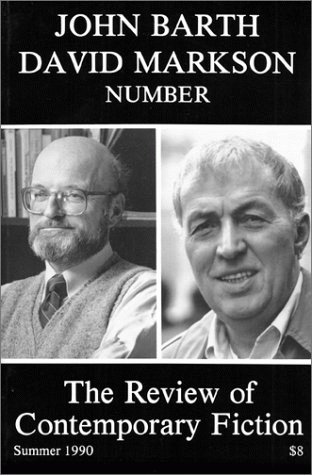
The reason I got involved with Wittgenstein’s Halloween was because David Foster Wallace had said Wittgenstein’s Mistress was one of the best books of the 1990s.

The whole list is on Salon, but here’s the quote about WM:

“Wittgenstein’s Mistress” by David Markson (1988)
“W’s M” is a dramatic rendering of what it would be like to live in the sort of universe described by logical atomism. A monologue, formally very odd, mostly one-sentence ¶s. Tied with “Omensetter’s Luck” for the all-time best U.S. book about human loneliness. These wouldnt constitute ringing endorsements if they didnt happen all to be simultaneously true — i.e., that a novel this abstract and erudite and avant-garde that could also be so moving makes “Wittgenstein’s Mistress” pretty much the high point of experimental fiction in this country.

I had also read his review of the book before [I copy everything I said then below].  I admit I didn’t get that much out of it before because it was mostly about Wittgenstein and a book I hadn’t read.  Well, now that I’ve read the Markson book, it seemed like a good time to revisit the review.

Two things strike me immediately–this was written after Wallace had written Broom of the System and some other fiction and yet he speaks of himself as a “would-be writer,” not a writer.  And two, this review really belongs in a philosophy journal rather than a literary journal–DFW was making the jump from philosophy to literature, but his knowledge of philosophy is very strong, so he is focusing on that aspect of the story. Continue Reading »

nov 2013SOUNDTRACK: SERA CAHOONE-Tiny Desk Concert #4 (July 10, 2008).

seraI had never heard of Sera Cahoone before this show.  NPR dude Stephen Thompson is the one who brought her to the Tiny Desk.

Sera used to be a drummer (for Band of Horses and Carissa’s Wierd) but then she picked up a guitar and started writing songs for her 2006 debut album.  Cahoone plays five songs (in about 21 minutes) for this set.  She plays acoustic guitar (and harmonica).

The songs are pretty, folky songs.  Thompson describes them as “hammock music” in that it simulates the sensation of lying in a hammock and sipping an iced tea, possibly while being fanned.  And that’s pretty accurate.  The songs are soothing and gentle, simple chords played in the right order (F/C/G/C).  Her voice is slightly husky, but she still manages high notes. easily.

“Runnin’ Your Way” is a very standard, pretty folk song.  “Couch Song” introduces some mild picking which changes the tone but retains the hammock atmosphere.  “Only As The Day Is Long” is probably my favorite of the five–I like the way she sings the verses and adds an interesting chord progression to the verse.  I’m not thrilled with the harmonica part but it’s fine.  “The Colder the Air” is a minor chord song that adds some tension to the proceedings–it’s really quite good.  “Last Time” is from her first record.  Its a little faster, and I like the change it introduces.

Although Cahoone’s music is similar throughout there’s enough variety for it to be interesting and very enjoyable. This was yet another great Tiny Desk set.

[READ: November 20, 2013] “A Summer Sunday”

This story is an interesting concept–an attempt at the narrator to not tell us something.

I admit that I found the beginning confusing.  I’m not sure when it was written but while before 2001 “two towers” may have referenced Tolkien, in 2013 it can only reference one event.  But after a few paragraphs we learn that the story is not even set in the United States (although the exact location remains a mystery).

In addition to the towers, there is a cemetery.  Near the cemetery is a house which the narrator has visited.  While they were there shells started falling near the General’s Residence, which was not too far away.  It had been a very bad day–lots of people were killed in the gunfire, but for the narrator and his family it was a pleasant Sunday.  Indeed, the whole weekend was nice, even if when he was sitting in a cafe on Saturday a piece of shrapnel landed near him.  He gleefully ran to collect it.  Later that evening he and friends were drinking in a garden when “rockets came screaming overhead.”  Several people dove for cover or huddled in a ball. The next line?  “It was very funny and we laughed a lot.”

Interesting reaction, but that appears to be all because of “that other thing I shouldn’t talk about.” Continue Reading »

CV1_TNY_09_16_13Tomine.inddSOUNDTRACK: SAM PHILLIPS-Tiny Desk Concert #3 (June 25, 2008). 

Isamt took a month and a half to get the second Tiny Desk player in, but it took only 20 days to get Sam Phillips to come in after Vic Chesnutt.  Sam Phillips plays four songs (in what is sauna-like conditions apparently) all from her then new album Don’t Do Anything.

Phillips has had a couple of incarnations as a performer (first as “Leslie Phillips” Christian singer).  This incarnation sees her as a kind of folky troubadour with dramatic flair.  She played a lot of the music on the Gilmore Girls (she does the la las), so of course I’m a fan.

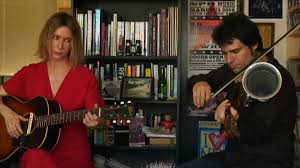
Sam is a funny performer, introducing herself (and then asking is she is allowed to talk) and later playing Bob Boilen’s cow in the can (and even questioning the way to say This is NPR).  She is accompanied by Erik Gorfain, who plays a Stroh violin which you can sort of see in this picture (there’s a better one below) and which Phillips suggests is plenty loud enough thank you.

Her first song, “Sister Rosetta Goes Before Us” opens with big strumming guitars and a bouncy melody.  It’s a great song that is a lot of fun–that violin brings great counterpoint.  “No Explanations” is a bit more rocking (with Gorfain on electric guitar).  It has a catchy chorus.  “Signal” returns to that kind of bouncy tin pan alley style which she does very well.  “Little Plastic Life” ends the set with… a screw up, which she handles wonderfully, and which makes the song seem all the better when she plays it again.

I really enjoyed this Tiny Desk and am going to have to listen to more of her work.

Check out what a Stroh violin looks like:

stroh

[READ: September 25, 2013] “By Fire”

Here’s another story about unemployment.  I had intended to post this back in September, so when I originally typed that this story is more dramatic than “yesterday’s,” I meant Lisa Moore’s story from September which was also about unemployment.

I wasn’t sure where this story took place (it was originally written in French).  The story is about Mohammed.  He graduated from University a few years ago with a degree in history.  It has been useless thus far.  When his father dies, and he is once again incapable of getting a teaching job, he gives up and burns all of his paperwork.

Then he sets out with his father’s fruit cart, determined to make some money selling fruit so he can move out of his house and in with his girlfriend.

There is ample back story in this piece.  We learn about Mohammed’s family—his mother has crippling diabetes, his brothers work but not very hard (one is downright lazy).  And we learn that the person who Mohammed’s father bought his fruit from was a crook who demands more and more money from Mohammed.

But the bulk of the story shows the daily life of Mohammed.  He is routinely harassed by the police for not having the proper paperwork or for being in the wrong place or just for being.  They start with simple harassment, but soon they turn to beatings.  Mohammed refuses to bribe anyone, even when the police give him the opportunity to turn in his former students. Continue Reading »

nov 2013SOUNDTRACK: VIC CHESNUTT-Tiny Desk Concert #2 (June 5, 2008).

chesnuttVic Chesnutt seems to have come into my life at random times. I bought the charity record/tribute album (Sweet Relief II) only because I liked a lot of the artists on it–I’d never heard of him at the time.  More recently his records were released on Constellation, a label I trust wholeheartedly.  And then just as I was really starting to appreciate him, he died in 2009 from an overdose of muscle relaxants.

He was a fascinating person.  A 1983 car accident left him partially paralyzed; he used a wheelchair and had limited use of his hands (which you can see in the video).   He struggled with drugs and alcohol and depression.  Despite all of this, he released his first album in 1990.

Robin Hilton, music dude at NPR, introduces him here and talks about how much he loves his music.  But even Hilton’s association with Chesnutt is checkered.  He writes that when he was younger and went to see him in concert, “[Chesnutt] was often drunk and sometimes belligerent. I walked out of at least one performance,” and “all of this probably made it easy to dismiss Vic Chesnutt’s music. He was a challenging guy, and his unpolished, idiosyncratic songs weren’t easily digested.”

And yet for all of that Chesnutt seems rather shy and unsettled in this Tiny Desk setting.  He seems unsure about what he wants to play and often asks if he should play this or that song.

He plays 5 songs (for 26 minutes total).  The opener is “When the Bottom Fell Out.”  A lot of Chesnutt’s songs, especially in this setting sound similar.  His voice is incredibly distinctive, as is his playing.  But since most of his songs are just him strumming and singing, they sound quite similar.  The second song, “Very Friendly Lighthouses” sounds a little different because he plays a “horn” solo using his mouth as a trumpet. It is a web request which he says he’ll “try” to do (and that he needs a cheat sheet).  I don’t know the song but it sounds fine to me.  He also emphatically states that the song is not about Kristin Hersh (something she has claimed).

“Panic Pure” also has a Kristin Hersh connection (she recorded it on Sweet Relief).  He says he stole the melody from “Two Sleepy People” by Hoagy Carmichael.  He turned it to a minor key and wrote his song.

For the next track, he asks if he should try a new song that he just wrote–more or less asking permission to do this unreleased track.  “You really want me to try out a new song that might suuuck?” (resounding yes). “We Were Strolling Hand in Hand” proves to be a very good song indeed.

The final track “Glossolalia” comes from North Star Deserter, the album I own.  It’s about being an atheist songwriter in a Christian country.  It’s funny that he says he hasn’t played it in a long time (it’s from his then new album…).

Chesnutt was not for everyone, clearly.  But his music is haunting and beautiful in its own way, and this is a very engaging setting to see him perform.

[READ: November 8, 2013] “Lovely, Dark, Deep”

Karen told me to check out this story and while I was planning to, she got me to move it up higher on my pile.  And I’m really glad she did because there is so much going on in this story that I was glad to be prepared for it.

The story seems simple enough, a young girl goes to interview famed poet Robert Frost at a writer’s workshop.  She is an unknown writer writing for a small college journal (Poetry Parnassus) and really has no business interviewing the Poet Himself.  She is shy and literally virginal.  When she walks up on Frost, he is sound asleep on a porch.  She dares to take a few pictures of the man (which later sold for a lot of money…although presumably not for her).

When Frost wakes up he is surprised and a little disconcerted by the young girl.  And then he gets cocky with her, suggesting she sit on the bench with him.  She demurs and begins trying to be as professional as possible.

Frost proves to be an obnoxious interviewee, full of ego for himself and nothing but disdain for all other poets.  She is intimidated by him, fearing that all of her questions are silly.  Then she tries to ask him some insightful questions but he tends to dismiss them as obvious or simply ignore them.  Eventually she asks one personal question too many and he becomes blatantly offensive.  He asks about her panties and if they are now wet (the cushion she is sitting on is damp from rain).  And he bullies her terribly.  She is offended but remains strong and continues to ask him questions. Continue Reading »

[LISTENED TO: November 8, 2013] Daniel Alarcón reads “Gomez Palacio”

alarcon The New Yorker has a Fiction podcast of current authors reading a story from the New Yorker archives.  I was unaware of this podcast until I recently stumbled upon this Alarcón reading.  I am trying to find out the breadth and depth of this podcast, but I find the navigation really unclear.  It seems like there are a lot of stories in this series.  (You can see the archives list here, although I wish it was a little easier to navigate).

The podcast is 30 minutes long.  What you get is a brief interview with Alarcón, in which he talks primarily about his exposure to Bolaño and his interpretation of this story.  And then he reads the story itself.

The interview was very interesting.  He talks about reading Bolaño when 2666 had come out in Chile.  What I enjoyed hearing him talk about was the Bolaño universe and him “sampling himself.”  And also how the shorter works reference each other and different characters appear and reappear–that Bolaño has created an entire world in which all of his stories are set.  These are things that I noticed, of course, but it is always comforting to hear others confirm your ideas. Continue Reading »

[ATTENDED: November 14, 2013] Much Ado About Nothing

much adoDespite all of my reading, I am fairly ignorant of Shakespeare. I’ve read or seen most of the big ones, but I don’t know a lot of his works first hand.  As a young reader I realized that reading Shakespeare was hard—as, really, any play with dozens of characters tends to be.  It’s not easy to keep character straight when there are no descriptors about them.  So I more or less gave up on reading Shakespeare and decided I would watch him when I could.

When the Princeton University theater offered us tickets to see Much Ado About Nothing, it seemed a great opportunity to brush up.

This was a student production, and I have to complement all of the students on their wonderful performances.  They never broke characters, and their Shakespearean dialogue was flawless (as far as I know).  What I found interesting was that it took about fifteen minutes before I was absorbed in the dialogue and understood, well, about 45% of it.  Well, maybe 60%.  They did speak a little fast sometimes.

What was incredibly helpful about the dialogue was…the actors.  Duh.  But really, the language comes to life when you see people actually performing the lines (making Shakespeare’s bawdy jokes that much more bawdy).  And while some of the performances seemed almost over the top, I have little doubt that that is how it was performed back in the day—why would they go for subtle when there’s jokes about sex? Continue Reading »

feb2003SOUNDTRACK: LAURA GIBSON-Tiny Desk Concert #1 (April 22, 2008).

gibsonI have enjoyed many of NPR’s Tiny Desk Concerts over the years.  And while I was listening to an All Songs Considered show, it was mentioned that there have been over 200 shows (I believe it is now over 300).  And I realized that I had missed dozens of good ones.  So, being the kind of person I am, I decided to start watching/listening to them all.  I don’t typically watch most of them as they’re usually not very visually interesting–they’re fun to watch for a minute or so, but most of the artists are there to sing, not to do visual entertainment.  So usually I just listen while doing something else.

I toyed with the idea of writing about one a day until I was done.  But the logistics of that made my head hurt.  So instead, I will write about them all over the course of however long it takes.  (And since they don’t post one every day, I will catch up eventually).

Laura Gibson had the first ever Tiny Desk show, and there’s some notable things about the show itself.  First, look how empty Bob’s shelves are!   And the camera work is a little wonky, I think.  I also enjoy how they introduce this performance without a clue as to whether there would be more of them!

I had never heard of Laura Gibson before listening to this.  She plays simple but beautiful guitar (I enjoyed watching how confidently she played the chords and individual strings).  But the big selling point is her voice.  Her voice is very quiet (this was the impetus for the Tiny Desk concept–they saw her in a club and the crowd was too loud for them to enjoy her so they invited her up to their office).  But her voice is also slightly peculiar (in a very engaging way), which you can especially hear on “A Good Word, An Honest Man,” where she is practically a capella.

She sings four songs: “Hands in Pockets,” “A Good Word, An Honest Man,” “Come by Storm,” “Night Watch.”  The sing-along at the end of the last song is really pretty–shame the audience wasn’t mic’d.  All four songs are beautiful and slightly haunting–her delivery is so spare you kind of lean in to hear more.  She currently has three albums out, and I’d like to investigate her music further.

[READ: October 31, 2013] “A Comet’s Tale”

Despite the fact that this article talks about and more or less guarantees the end of the world by asteroid or comet it was incredibly enjoyable and staggeringly informative.

Bissell begins by talking about the Biblical Apocalypse and how in 1862 Premillennial Dispensationalism (premillennialism is the belief that Christ will return before setting up his millennial kingdom and dispensationalism divides up the Bible and human history into various eras or dispensations, based on how God deals with humanity) was smuggled into the Americas and it has never left.  Fully 59% of Americans now believe that Revelations will come to pass (although what that could possibly literally mean is another question).  [Incidentally the book is not called Revelations, it is Revelation or more specifically Revelation to John.  And all of that numerology (666) must mean something right?  Well, yes, it means that the Ancient world was obsessed with numerology. The bible makes great use of the trick of predicting the future by describing the past.

Bissell pulls back from the bible to look at planet Earth “the most ambitious mass murderer in the galaxy.”  He then lists all the atrocities that have happened from natural causes to all species in the history of the planet.  But even recent tragedies (which seem to only happen to people in far off countries says the westerner) are only by happenstance happening there.  Between overpopulation and global warming we are preparing for our own apocalypse.  Although we also mustn’t look too crazy like in The Late Great Planet Earth (which still sells around 10,00 copies a year).  In that book Hal Lindsey predicted the end of the world but also the rise of a single world religion, a Soviet Ethiopian invasion of Israel and the obliteration of Tokyo, London and New York.  But astonishingly, Lindsey also worked for the Reagan administration, much like Tim LeHaye (famed “author” of the Left Behind series) was co-chairman of Jack Kemp’s 1988 presidential campaign.  Apocalyptos have way too much power in this country.

But even if we weren’t preparing for our own doom, there would still be space items to do it for us. Like 1950DA an asteroid that has near-missed the earth fifteen times and may just not miss us in the future. Continue Reading »