Feeds:
Posts
Comments

[ATTENDED: August 7, 2015] CHAPPO

2015-08-07 19.50.02I bought tickets to see the Flaming Lips at Musikfest (opening night headliners!).  By the time the show came around it was announced that there would be two opening acts.  Local Bethlehem band Voirvoir and Brooklyn band CHAPPO.  I had listened to the Voirvoir album streaming and I really liked it.  So I decided to get to the show at 6 to check them out.  Well, I didn’t realize how chaotic Musikfest was.  So between the parking and the shuttle bus and finally finding the venue I got to the band as their final chord rang out.  I didn’t even get to actually see them, just head then end of their last song.

But since I liked the stream I listened to, I bought the album… and it is fantastic.  I will post more about it shortly.  They are also playing again (3 times!) on Saturday at Musikfest, so I may try to bring the family down to check them out.

Since I was then plenty early for CHAPPO (whose music I didn’t stream because I knew I’d be seeing them), I walked around the grounds and checked things out.  And by the time I got back to the seats I was dehydrated and feeling a little unwell.  So even though I was in row H, I sat further back in the shade with a cold water.  And at first I wasn’t too impressed with CHAPPO.  The songs were good but I think the mix may have been off (or, more likely I wasn’t feeling great).

2015-08-07 19.24.10But I was watching the people up front having a great time, and I enjoyed that the singer was throwing things into the audience (turned out to be tubes with confetti (fun!)).  And I enjoyed watching the guitarist use a bow in his guitar (how many times this summer?).  And after a few songs, some water and the shade creeping into my section, I decided to head up to my seat.  And that when CHAPPO won me over. Continue Reading »

[LISTENED TO: August 2015] The Organist Season 1

organistGiven my love of the McSweeney’s empire, it seems logical that I would have listened to The Organist sooner than this.  But I didn’t.  It has been on for a couple of years, so i assumed I’d never catch up.  But then I saw that there were only 50 episodes and most of them were quite short.  So it was time to see what it was all about.

And, since it is more or less in conjunction with The Believer, it should come as no surprise that it is sort of an aural equivalent to that magazine–longish pieces about esoteric subject, but geared specifically to “radio.”

The Organists first season was done as a monthly podcast starting on Feb 1.  Each episode was about 50 minutes long and covered a variety of subjects with fun guests and other ephemera.

Episode 1: (February 1, 2013)
The inaugural episode kicks off with Nick Offerman spouting some hilarious nonsense about podcasts.  The rest of the show includes an interview with George Saunders talking about the voices of his fiction; Greil Marcus discusses the impact of the first Bikini Kill EP now that it is reissued.  Perhaps the most unusual and interesting piece is when Amber Scorah tells the story of her defection from the Jehovah’s Witnesses while working as a missionary in Shanghai; In short pieces, Brandon Stosuy editor of Pitchfork, presents five five-word record reviews of interesting new guitar rock and then musicians Matmos take a song from their new album apart, piece by piece, revealing its brilliant, pulsating innards.  Basically they used thought control to get people to “create” a song for them.  It’s a really neat process even if the final result doesn’t really sound like the sum of its parts. Continue Reading »

stupidSOUNDTRACK: DAN BEHAR-Songs from All Our Happy Days Are Stupid (2002).

beharIn the book, it says that you can hear all of Behar’s songs from the book here.  But that link takes you nowhere.  Bummer.  You can hear newer versions of four of the eight songs on Destroyer’s Your Blues album.

[READ: August 2, 2015] All Our Happy Days Are Stupid

Pretty much the only reason I read works by Heti is because she is often published by McSweeney’s (and since I subscribe to their book series, I’m going to read what they send me).  I tend to not really like her books–they often feel arbitrary and neither funny nor thoughtful enough to warrant the arbitrariness of the characters’ actions.  But this was a ply, written much earlier in her career.

This play was conceived in 2001.  She tinkered with it and rewrote it and it eventually became a convoluted mess.  She gave up on it and wrote her novel How Should a Person Be, in the mean time.  Then Jordan Tannahill read the novel and talked to her and learned about this play.  He asked to see the first draft and he liked it, so he put the play on.  Initially it was done a in small theater (about 30 people max) and since then it has been performed in larger venues.  This release corresponded with a joint Toronto and New York City series of performances in February 2015.

So this play is ostensibly about two families, the Oddis (who have a 12-year-old daughter, Jenny) and the Sings who have a 12-year-old son, Daniel).  They are both from Cedarvale (which I assume is in Canada) and they both happened to take a vacation to Paris at the same time.  The kids know each other from school but aren’t exactly friends.  Nevertheless, Jenny is super excited to see someone she knows.  In part that’s because she is generally pretty happy (even though her parents tend to shoot down her happiness), but also because she is sick of Paris because it appears that there is a parade every day and she hasn’t seen anything authentically French.

The families talk and immediately fail to hit it off.  Mrs Sing is intolerant of Ms Oddi and frankly none of the grown up appear to be very thoughtful or even nice.  By the end of their meeting, Daniel has run off.  And he remains missing for most of the play. Continue Reading »

princessSOUNDTRACK: DAWN OF MIDI-Dysnomia (2013).

domI heard about this disc while listening to The Organist podcast. (Episode 6)  I didn’t know anything about Dawn of Midi, but I understand they were/are a kind of improvisational jazz band (piano, contrabass and drums).  But don’t stop reading yet.  Dysnomia (between this and Method of the W.O.R.M.’s Cicatrix, I am certainly learning a lot of new words) is certainly jazzy.  But it doesn’t feel like jazz exactly.  In fact, I would never have guessed that they were playing real instruments.

The album is 47 minutes with 9 songs.  They are all instrumental and more or less flow into each other.  And as I say, I never would have imagined that it was just three instruments playing the music.  Not because it sounds weird–there’s nothing particularly unusual sounding about the record.  But because it is so precise.

And indeed, the piano doesn’t really sound like a piano (it’s a little muted), but the other two instruments are quite clearly drum and bass.  And yet it’s the rhythms and textures of the songs that are so unusual.  The songs are minimal, true, but they are complex in that minimalism.  So while there’s repeated piano notes, there’s complex drum patterns.  And the songs morph and change over the course of the record.  And not just from track to track but within a song as well.

Without going into great musical detail, there’s not a lot to say about the individual tracks.  As I say, it’s a lot of repetition, but there’s enough morphing that it never gets boring.  Maybe the piano is the emphasis for these few minutes, then a snare drum takes over.  Or the beat shifts or speeds up.  It’s really cool.  And it’s really hard to believe that these three guys are playing this live and not with machines.

I really can’t say enough about this record.  I didn’t expect to like it as much as I do, but I find that I can’t stop listening to it.

Check it out at their bandcamp site.

[READ: July 17, 2015] I am Princess X

Sarah brought this home from the library and said that I would like it and, as usual, she was right.

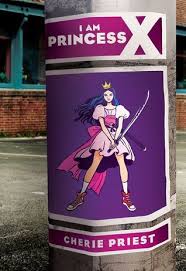
The story is about May and Libby, two young girls (fifth grade?) who are thrown together (they don’t know each other but are both skipping gym class) and form a cool bond.  Libby is a great artist, and while they are sitting in the Kindergarten playground, the little kids come over and ask her to draw things.  Soon enough, Libby draws a princess (I like that it was suggested by a boy).  She’s wearing red high tops, a crown and cape and has a cool katana sword (I must say this has to be the smoothest playground ever if she could get that much detail out of playground chalk).

The girls name her Princess X and since May can’t draw, she comes up with stories about her.  And soon enough, Libby and May have binders full of the Princess’ adventures.

As with a lot of YA books, there’s a horrific tragedy that follows.  Libby and her mom are in a car and her mom drives them off a bridge where she and Libby die.  (I know!).  May always thought there was something suspicious about the whole thing–Libby had a closed casket–but since May was a little girl no one paid her any mind.  Libby’s dad fled Seattle and that was the end of contact for May.

Meanwhile, May’s parents divorced and may moved back to the South (people in Seattle tease her about her accent).  But she does get to come up to Seattle to visit her dad from time to time.

And this time, when she’s walking around old haunts, she sees a sticker on a window.  It is Princess X and it even says “I am Princess X”  What the heck?  Well, when Libby’s dad sold the house, all of their Princess X stuff was given to goodwill.  So it must be someone who found it and stole their ideas.  But what if it’s something else? Continue Reading »

armadaSOUNDTRACK: RAID THE ARCADE PLAYLIST (2015).

raidIt should come as no surprise that Cline’s media campaign would include a Spotify “Raid the Arcade” playlist.  A playlist of the mixtape that the protagonist’s father made when he was a teen.

And I can pretty much see how this would have been a very satisfying mixtape for killing aliens and generally rocking out.  Of course, I had to have a listen and add my thoughts.

Side A: Track:

  1. One Vision – Queen (I was never a big Queen fan, particularly their later poppier stuff)
  2. Crazy Train – Ozzy (A classic, of course)
  3. Chase the Ace – AC/DC (I find it odd that the two AC/DC songs are instrumentals from the Maximum Overdrive soundtrack.  It makes sense given the guy who made them, but there’s so many better AC/DC songs)
  4. Hair of the Dog – Nazareth (One of my favorite classic rockers)
  5. Get it On – Power Station (I really hate Power Station a lot, and this version of an already pretty stupid song song is pretty dreadful)
  6. Old Enough to Rock and Roll – Rainey Haynes (I didn’t know this song.  It comes from the Iron Eagle soundtrack.  This song is not on Spotify and I imagine that’s because it’s terrible)
  7. Danger Zone – Kenny Loggins (This song is such a punch line that even if I did like it I’m not sure I could take it seriously)
  8. Vital Signs – Rush (I was totally psyched that he chose this Rush song)
  9. Barracuda – Heart (I’ve mixed feelings about Heart, but I do like this song a lot)
  10. T.N.T. – AC/DC (Now this is more like it for AC/DC songs–not an overplayed one either)
  11. You Really Got Me – Van Halen (Not my favorite Van Halen song, but a good rocker)
  12. Another One Bites the Dust – Queen (I loved this song when it came out.  It holds up pretty well (there’s some interesting sound effects in the background, but it’s nowhere near as good as the songs below)
  13. One of These Days – Pink Floyd (I love this song but never would have considered it particularly rocking–in the way these other songs are.  But it does rather work)
  14. Top Gun Anthem – Harold Faltermeyer (seriously?  Well, I guess if you like piloting video games, this makes sense.)

Side B: Track:

  1. I Hate Myself for Loving You – Joan Jett (I don’t care for this song, although the guitars sound good for the mix)
  2. It Takes Two – Rob Base (I’m surprised and pleased that this song made it into what is basically a metal compilation.  I never would have had such diversity at that age.  Although I got really sick of this song in college.)
  3. Hammer to Fall – Queen (I don’t really like this era of Queen)
  4. Twilight Zone – Golden Earring (I don’t love this song, but it is cool to hear once in a while)
  5. We’re Not Going to Take It – Twisted Sister (I loved TS back in the day, although I wince at them now. If this song wasn’t overplayed I could probably really get into it.)
  6. Rock You Like A Hurricane – Scorpions (I loved the Scorpions back in the day too. I certainly tapped my foot along to this one.)
  7. Black Betty – Ram Jam (This song is in a Rayman video game that Clark plays and while I think the song is really dumb, it certainly rocks.)
  8. D.T. – AC/DC (see above for instrumental AC/DC)
  9. Delirious – ZZ Top (I never got into ZZ Top, and while I do like some late 70s ZZ, I really don’t like mid 80s ZZ)
  10. Iron Eagle – King Kobra (Wow, this was obscure even to me–more pop metal from Iron Eagle)
  11. Run’s House – Run-DMC (Whose house?  It’s funny how stripped bare Run-DMC songs sound compared to contemporary rap.)
  12. We Will Rock You/We Are the Champions –Queen (overplayed but classic)

Bonus Track: Snoopy versus the Red Baron – The Red Guardsmen (a goof y novelty song that I think overstays its welcome.)

So I guess my verdict is that I really don’t like the Raid the Arcade mix all that much.  That’s kind of a shocker, actually.

[READ: July 31, 2015] Armada

I loved Cline’s first book Ready Player One.  And Sarah and I were understandably excited about his latest book, Armada.  I was surprised about the content of the book which is of similar plot to the new movie Pixels (I say similar based on what little I know of Pixels–that video game characters attack the earth).  This is surprising to me because Cline has already sold the rights of this book to Spielberg–and I have a  hard time believing someone would try to cut Spielberg with an idea.

Of course, Armada is rather different from Pixels in that the characters that attack the earth are not classic 80s video game characters.  Indeed, there is a whole back story that shows how very different these two premises are.

In a recent interview, Cline talked about how you have to include all the pop culture sci-fi and video games in his book because there’s no way you should be able to make a sci-fi book or movie on earth and not reference all of the pop culture that the protagonist grew up with.  So this story is not set in a vacuum.  In fact, it the pop culture establishes the plot.

Zack Lightman is a senior in high school.  He’s had a pretty crappy life.  His father was killed in a sanitation explosion when Zack was just a month old.  The death set him and his mom up for life, but he has spent his whole life immersed in his father’s life (he is close to his father’s age when his father died).  Zack has a lot of his father’s effects.  His dad was a huge gamer, spending a lot of time at the arcade, and loving all things sci-fi and fantasy.  His father would have been born around 1970, making the pop culture references perfect for those of us around the same age.

One day, while looking out the window of school, Zack sees an alien ship.  But not just a generic cigar shaped UFO.  Rather this is a ship directly from his favorite videogame, Armada.  Zack plays this game pretty much every day. In fact, he is ranked sixth in the world as a pilot protecting the earth from alien invaders.  Naturally he assumes he has gone insane–especially since no one else has seen it. Continue Reading »

raslSOUNDTRACK: METHOD OF THE W.O.R.M.-Cicatrix (2015).

motwormMETHOD OF THE W.O.R.M. is the project of one guy–known as Grimm.  Cicatrix is a collection of songs that spans decades (“begun long before the present digital day”) and recently remastered and released.

The blurb on CdBaby (where you can download the disc–it’s also on iTunes) notes that Method of the W.O.R.M. is “an industrial hard rock with a trip hop edge, intelligent grown up lyrics delving into the microcosm and macrocosm of our world. Influences run the gamut of NIN, Massive Attack, Cop Shoot Cop, Swans, Coil, Tricky, Skinny Puppy, Tom Waits and many others.”

There’s quite a diversity in that list even if the bands are similar, and you can hear the melding of influences.  And you can hear most of them in the songs. But what sets MotWORM apart from these bands is a keen sense of melody in the vocals.  Most industrial music tends to bury the vocals with distortion or just under the music.  But Grimm’s got a good (even pleasant) singing voice which elevates the songs above the din of lesser industrial bands.

While it’s not like pre-digital technology was all tape manipulation, it also wasn’t as easy as it is now.  And the complexity in these songs shows a lot of skill and attention to detail.

“No Flesh” opens the collection.  After some interesting noisy samples (steel drums?), a slow bassline enters (which also sounds sampled—it’s got a very 70’s sound).  The song slowly builds with more and more layers of sound until the vocals come in–a gentle singing that also builds.  There’s a Skinny Puppy feel in the music, but the vocals are very different from Puppy’s style.  “Purge” is the first of many songs with sampled dialogue, but it’s the sounds around the dialogue that are so interesting–squeaks and buzzes, radio tuners? who knows where they come from.  Once the verses start, the main music in this track is more synthy–a compelling riff that wends through the mix.  When the distorted guitars kick in, it takes the song to an entirely new level.

“Burned” showcases the vocals up front in the mix over a simple layered melody.  But there are actually a lot of vocals in this song, including a fascinating sample that opens and closes the track.  Grimm adds layers of vocals–harmonies (or not exactly)–distorted vocals and clean vocals.  I particularly like when the higher voice sings a new (very cool) melody in the middle of the song (the sampled voice melds nicely if creepily with this too).  This song is a real highlight.

“Tragic Rabbit” has some more interesting samples and a pulsing synth line with cool swirling sounds over the top of the vocals.  “As If a Dream” is a slow trippy number with an excellent processed sample.

“A Viral Method” introduces live drums (which sound great and were provided by Swans’ Phil Puleo).  It also has a great live guitar sound playing a fast riff and harmonics.  There’s more great harmony vocals. And a wild riff for the bridge (do I dare say a bit prog rock?).  Although I love the cool samples and layers in the earlier songs, this live instrumentation adds an excellent urgency to the music.  The only problem with this song is that it’s so short.

“Absolution” starts off quietly but after the distorted guitars, the chorus is super catchy–the way it seems like it’s going to end but rebuilds itself.  It’s really well crafted.  “A Moment of Silence” opens with a retro-sounding synth bass.  It’s a fairly minimal song with the vocals really taking over as that synth line drifts to the background and new sounds bubble up.  “Wasted” opens with distorted guitars kind of like a Ministry song, but the vocals are much cleaner, which brings an unexpected quality to what could have been a typical heavy song.  Especially the chorus which is musically bright (even if it’s lyrically dark).

“Freak-O” (what a great title) opens with some loud jackhammer type drums.  The song creeps along menacingly (with a great sample of someone shouting “You are one ugly son of a bitch!”).  I like the simple melody that simmers up from the noise by the end of the song.  “Miscreant” opens with quieter acoustic guitars before the drums kicks in and a menacing synth line takes over.  The vocals are quietly sung with an interesting effect placed on them.  The middle of the song has some wild sounds–I’m not entirely sure what’s happening with them, but it makes for an unsettling ambiance.

“I Love You Goodbye” is my favorite song on the disc.  It starts out simply with big guitars but quickly retreats into a much quieter verse.   There’s a great riff that throws in a slightly dissonant harmonic note that is just great.  But as the song builds into a unexpected bridge with horns, the song adds an dark carnivalesque atmosphere (and that harmonic note returns in a more prominent role).  It’s such an unusual riff and really bodes well for the interesting direction MotWORM might be heading (if they ever release anything else).

This is a real fun disc full of interesting sounds and samples.  If you like industrial music this is a disc totally worth checking out.

[READ: July 31, 2015] RASL

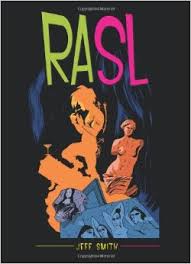
Jeff Smith is creator of Bone, one of my favorite comics ever.  As far as I can tell he hasn’t done a lot since Bone, but he sure did his research for this book.

The title is unfortunate (and is explained satisfactorily in the last few pages, but it’s still awkward and hard to manage).  But the work inside is extraordinary.  The story concerns dimension jumping, art theft and a whole lot of information about Nikolai Tesla.  It’s also more mature than Bone, in that there are a couple of (non-explicit) sex scenes.

In a nutshell, RASL (real name Dr. Robert Johnson) and his partner Miles are scientists.  They grew up together and studied the works of Tesla.  Miles married Maya, a beautiful scientist who has assisted them with their work over the years.  They delved deeply into the research that Tesla undertook (Resonant frequency, remote control, the earthquake machine, wireless communication) and used his ideas to create a machine that is something like a transporter/dimension hopper. They are working for the military but hope to be able to use the device to end wars (idealist scientists as they are).  Their small tests has been successful, but RASL believes that they need more testing to see if there are any effects when you use it on bigger subjects.

So he takes the machine and hops.  It turns out that each hop between dimensions takes its toll on his body and also tends to confuse matters.  (In one dimension, he checks his iPod and sees that Blonde on Blonde was recorded by Robert Zimmerman (I love that detail)).

We learn that RASL (who as the story opens has shaggy hair and cuts and bruises, unlike the composed scientist we see in flashbacks) has been jumping from dimension to dimension to steal precious works of art as a way to make some money.  There is also a really creepy-looking man whose face looks almost amphibian (Smith has some really disturbing characters in this book) chasing after him.  This man kills everyone that RASL knows in different dimensions because he is after something 9and he believes that the people in other dimensions are not real).  It is slowly revealed why RASL has been reduced to this state. Continue Reading »

reunionSOUNDTRACK: KATE TEMPEST-Tiny Desk Concert #456 (July 21, 2015).

kateKate Tempest is a British poet/rapper (and darling of NPR).  She raps with a really heavy South London accent and raps about the “everyday.”  But because she is a poet, her lyrics are really incisive.  And, when she sings, she throws in some really catchy choruses as well.  Her song “Lonely Daze” surprises when the big catchy chorus come in.

Although she doesn’t do that for this Tiny Desk.

Rather, she opens with an incredibly moving poem called “Ballad of a Hero.”  It is an anti-war poem that takes an amazingly personal look at soldiers and the sons of soldiers.  The NPR blurb says “Kate Tempest will connect you with your emotions and the cold, callous world around you. You may cry.”  When I first started listening to her Tiny Desk, I wasn’t really paying attention to the words of this poem, but by the end, I was totally hooked, and yes, I did cry.

The final lines:

I don’t support the war my son.
I don’t believe it’s right,
but I do support the soldiers
that go off to war to fight.

Troops just like your daddy, son;
soldiers through and through.
Who wear their uniform with pride
and do what they’re told to do

When you’re grown my sweet, my love
Please don’t go fighting wars.
But fight the men that start them
or fight a cause that’s yours.

It seems so full of honour, yes,
So valiant, so bold,
But the men that send the armies in.
Send them in for gold.

Or they send them in for oil,
And they tell us it’s for Britain
but the men come home like Daddy
and spend their days just drinking.

Despite the intensity of the poem (and her other lyrics), it’s fun to watch her rap because she always seems to be smiling.  And on the two songs she does “The Beigeness” and “Truth” she is so into it.  Her hand gestures and emphasis really complete the song.  And there’s also the matter of her accent–so noticeable and strangely musical.

I don’t know what the original music of these songs is like.  I gather from the official titles (“The Beigeness (KwAkE BASS remix)” and “The Truth (KwAkE BASS remix)”) that they must sound different on the record.  And KwAkE BASS plays around with her voice, adding echoes and interesting effects that add to the music).

I’ve enjoyed everything I’ve heard from Tempest, I’m just not entirely sure I would listen to a whole album of hers.

[READ: July 23, 2015] Reunion

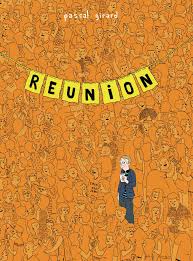
When I saw this book by Girard in the library I immediately flashed back to reading his other book.   I recognized his style (the self-portrait of the main character Pascal made him look much older and more frumpy than he actually was.  But what I’d forgotten was just how much of a dick everyone in the book was.

And it’s even more so in the this book.

It’s clear that Girard has a style and that his humor comes from everyone in the book (including the protagonist) being jut awful.  Last time I wasn’t sure if it was just the way Helge Dascher translated the book (and again, it may be her since she does this one too) but I now think that Girard may just have a very poor opinion of people.

This book culminates in a ten-year reunion. And all of Pascal’s actions leads up to it. Continue Reading »

essexSOUNDTRACK: SONGHOY BLUES-Tiny Desk Concert #455 (July 17, 2015).

songhoySonghoy Blues are from Mali.  They play an interesting style of rock/blues that follows rock conventions but subverts it as well.

“Sekou Oumarou” is a pretty straightforward bluesy number.  Until the vocals come in and you realize that they are not singing in English.  I think they are singing in French, but I’m not exactly sure.

It feels like the main instrument on “Al HassidiTerei” is the drums which, while keeping  pretty steady beat, don’t keep a simple 4/4.  This is not to say that the guitar and bass do nothing, because they play a cool riff and rhythm.  But they tend to keep the music pretty steady while the song plays on.  That is, except for the massively cool fuzzed out guitar solo at the end.

“Soubour” has a great classic rock style riff and when the guitarist stars going it sounds like it could be coming from the late 60s.  It’s a stellar track with a groovy psychedelic sound and wailing solo.

It’s tempting to want to like Songhoy Blues because of the politics and story behind the band (which is pretty intense), but they are so good that you don’t need to know anything about them to really get down to their great songs.

[READ: May 17, 2015] Essex County

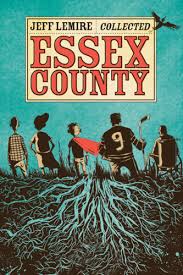
I saw this book in the library.  I was intrigue by the hockey player on the cover (okay and that it was 500 pages).  When I saw that it was a 2011 selection in Canada Reads, I knew it had to be at least worth a look.

This graphic novel looks at several generations of people living in Essex County, Ontario, Canada.  It collects the three books Tales from the Farm, Ghost Stories and The Country Nurse as well as some other odds and ends.

The introduction by Darwyn Cooke is really great for contextualizing this piece, although i wish he hadn’t spoiled the scene with the hockey players (so maybe for maximum impact, don’t read this before reading the book itself–actually, read the whole thing except that 8th paragraph). Continue Reading »

lostdogsSOUNDTRACK: GIRLPOOL-Tiny Desk Concert #454 (July 10, 2015).

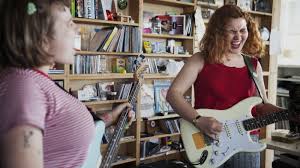
girlpoolGirlpool is a duo consisting of Cleo Tucker (guitar) and Harmony Tividad (bass).  Both women sing and what’s interesting about their singing is that they don’t sing harmony–they sing in unison, which gives them an really interesting resonance.  And when they do hit the occasional harmony it sounds magical.

As for the guitar and bass, they are playing largely the same thing there as well–with occasional guitar soloing.

The band has a new album out.  It’s pretty short (10 songs in about 25 minutes), and it is as direct and unsettling as it is catchy.  The riffs are unexpected and the pair sound so honest and exposed.  It’s really quite something.  It has the air of a novelty (two people, no drums), but aside from a few lyrics that are thoughtful/funny, there’s no joking from these two.  You can see from this photo that Cleo is really into it.

They play three songs: “Before The World Was Big” (the title track of the new album) which has an unusually paced riff and Cleo & Harmony’s stark vocals.  The harmonies when they get to “One hundred, one million, billion, trillion times” is really great.  I also like how they start singing in a round to end the song.  “Ideal World” has an even simpler riff (with a very cool dissonant guitar notes every few lines) and some cool harmonies.  And Tucker’s wailing guitar solo at the end is pretty shocking.  “Cherry Picking” opens as a far slower song, but it picks up after the first verse and has one of the few times when Cleo and Harmony are playing different things on their instruments.  Their singing at the end is really intense.

I like their album a lot and this is a great Tiny Desk Concert.

[READ: May 18, 2015] Lost Dogs

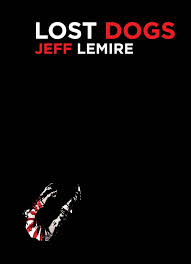
I picked up Lemire’s Essex County at the library and while there I also saw Lost Dogs.  I didn’t know anything about Lemire, but Essex County looked really cool, so why not grab his other book while it’s there?

Well, this was Lemire’s first proper book. He started it while trying to finish the 24 hour challenge–a 24 page comic in 24 hours.  He failed the challenge but he loved what he was doing so much that he decided to finish up what he started and he made this first book.

I’m glad I read Essex County first because Lost Dogs is so rough, so sketchy, that I wouldn’t have realized how talented Lemire was from this book alone.  This book is definitely an “early days” kind of project–a way to see where he came from.  Not that the story isn’t good, but that it is very rough (intentionally so).  It also notes that in the reproduction the lettering was made to look nicer because no one wants to read sloppy lettering.

If nothing else, I will enjoy this quote from Timothy Callahan who says that Steven Soderbergh said “audiences will put up with poor picture quality as long as the sound is clear, but a crisp picture and problematic audio will turn off even the most eager viewers.”  Callahan adds “the same is true for comics, where slick lettering can help even the most chaotic sequence of images seem readable.”  So remember, make sure your letters are good! Continue Reading »

herecoverSOUNDTRACK: CHRISTOPHER PAUL STELLING-Tiny Desk Concert #453 (July 6, 2015).

cpsSomehow after 450 some Tiny Desk Concerts I feel like I’ll know anyone that comes along.  But here’s yet another performer who I’d never heard of.  Christopher Paul Stelling plays an old beat up guitar (it ha a hole in it from where it has been worn down.  According to the NPR site:  That guitar, bought in Asheville, looks like a well-worn friend, with its dark bruised wood and his initials hand-carved into its body. Stelling marked the instrument a year after he bought it, when he made New York City his home in 2007.

Stelling plays some amazing fingerpicking and he backs it up with some catchy songs and interesting lyrics.  His voice is rough and reminds me a but of The Tallest Man on Earth.

He plays four songs.  The first “Castle,” is a really enjoyably folky song. His guitar work is amazing and almost as interesting as his lyrics (there’s some nice little twists i the words he sings). I was also amazed at how good the guitar sounded with the holes and carvings and all.

“Scarecrow” is more mellow, a bit sadder.  And when he tunes it up you can hear the resistance in the tuning pegs–that guitar has been through a lot.

“Horse” is a much faster completely intense song.  As the NPR site describes it: “Watch him lean in as if he’s about to lunge, his eyes bugged out, sometimes rolled back in his head revealing just the whites, skin blood-red, voice like a preacher on fire.”  The song is majorly intense, althouhg he kind of reminds me a bit of Chris Pratt’s character on P&R (but not in a funny way).  After the song he he says you see why I didn’t play that first

“Warm Enemy” reminds me of the guitar style of RT. A wild picking song, with some great runs throughout the piece.

It’s always cool to hear of a new artist who is really impressive.

[READ: May 10, 2015] Here

I read about this book when Five Dials devoted an entire issue to it.  And I’m so glad they did, because I probably wouldn’t have heard it about it elsewhere.  And it is fantastic.

In the Five Dials issue they talked about how McGuire had first created a version of this book many years ago–it was 8 pages and ran in Raw Magazine.  Now in 2014, he has redesigned and thoroughly expanded the book, adding color and a ton more information.  And it is really astonishing.

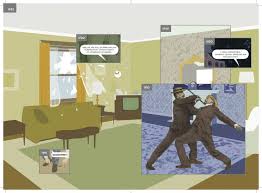
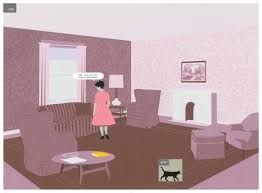
The book itself is quite simple.  We see a scene in a house.  It is a living room.  There is a window to the left, a fireplace to the right and various pieces of furniture.

The first page in the upper left corner says 2014.  There is a couch and little else.  Then there is a bookshelf.  And then the scene jumps back to 1957.  Same location, same angle, but (nearly) everything is different.  The furniture is chanced, there is wallpaper on the walls, there is a playpen in the center of the room.  Then the next page jumps back to 1942: the color scheme is maroon.

here3After a few pages it heads back to 1957 and we see our first person.  A woman saying “Now why did I come in here again?”  And then, the first break with the style–in the bottom right is a tiny box that says 1999 and there’s a cat in it.  And then the next page plays with things even more.  The woman from 1957 is still there as is the cat (who is licking her paw now), but the background is 1623 and the “house” is simply the woods.

The next page shows a scene from 1989 and in 1999 the cat leaves the room.

here2I’m not going to tell every page, obviously, but suffice to say that the next page goes all the way back to 8,000 BCE (while leaving the scene from 1989 in the book).

We see shots from 1763 (a lumberjack) and 1764 (a house being built).  And then in 1775 a colonial scene with, I believe, Ben Franklin.

here5Occasionally, there are a series of frames that show time passing in sequence like the children sitting on the couch in 1959, 1962, 1964, 1969, 1979 and 1983.  Or the one that shows Halloween parties from several years all on one page

The book also goes into the future with a small box showing 2017 and then 2050 with some interesting technology.  And then later forward to 10,175 with a strange creature in a wasteland,

The book is really amazing.  So much fun to look at and imagine the lives that were in this house.

For there is no plot. There is virtually no dialogue.  It is just snapshot after snapshot of a place and what people and creatures have done to it throughout history.  It is such an interesting idea (the original was quite revolutionary at least according to cartoonists) and while similar pieces have been made they don’t compare to the scope of this one.

Incidentally, the house is in Perth Amboy, New Jersey (and I believe is his childhood home).  It offers actual historical data as well as imagined information.  But he based many of his designs on photos from his family’s albums.

I’m so happy I got to look at the book.  And when I read it again, I’m going to try and read it in a vaguely sequential style just to see if there is a “story” to it.