Feeds:
Posts
Comments

SOUNDTRACKSOCCER MOMMY-“Wildflowers” NPR’S SOUTH X LULLABY (March 26, 2018).

I was supposed to see Soccer Mommy open for Phoebe Bridgers.  But I got sick on the way to the show and missed the whole thing.  Boo!  Since then I’ve been hearing more and more about Soccer Mommy.

This song, “Wildflowers” reminds me a lot of folkie alt songs from the 1990s.  There’s something about the kind of slackerish delivery of her vocals.

Our South X Lullaby with Soccer Mommy took us … to my favorite store in all of Austin, Texas: Uncommon Objects, a self-described “one-of-a-kind emporium of transcendent junk” or “your eccentric uncle’s attic on steroids.”

The song from the Switzerland-born, Nashville-raised artist’s album Clean which was released earlier this month is, as I hear it, about finding your place in the world — to discover who you are and to blossom.

“Wildflowers don’t grow in the city
I dreamt the sidewalk broke in two
The earth was calling to me”

I also like the way her chords are largely unexpected.  She plays a lot of chords high on the neck (but without a capo).  The melody that she plays (while playing the chords, which is cool) is also nicely compelling.

I don’t know if she is all folkie, but I’d like to check out more by her and now I’m even more bummed that I didn’t make the show.

There are 24 different antique sellers under the single, Uncommon Objects roof, and for Sophie Allison, aka Soccer Mommy, we found the perfect setting for her song “Wildflowers.” It was, in fact, filled with objects related to blooming flowers.

[READ: January 9, 2018] “The Year of the Frog”

This story was by turns confusing, infuriating, too long and then really interesting.

It begins with the narrator, a young girl, describing their horse, Sweet Macho.  The horse was a former racehorse who carried himself with ceremony.  Their mother’s boyfriend, known inexplicably as The Frog, is delighted.  Horses?  Why didn’t you say you had horses?  The narrator chuckles because the other animal, Gert, isn’t really a horse, she’s a Shetland Pony.

They had a real father but all they knew about him was “he’d been a son of a bitch, he’d worked in the fields and he’d once screamed like a woman when a bee got in the house.”

Their mother was an excellent horsewoman.  However, she had no time for the horses because she took care of three rich widows–she kept their gloomy houses clean.  Thus, neither creature had been ridden in years.  When he asks to ride, she says forget it Sweet Macho would throw you in a second. Continue Reading »

SOUNDTRACK: CORNELIUS-Tiny Desk Concert #718 (March 19, 2018).

I was familiar with an artist known as Cornelius, but I guess I didn’t really know anything about him, because this blurb came as a total surprise:

As Cornelius, Keigo Oyamada has stretched his vision across frenzied indie rock, lush ’60s-style pop, psychedelic funk and glitched electronics, all deconstructed and reassembled like a neon cubist-pop sculpture. After a little more than two decades, no one can really imitate his complex cool.

Sporting a pair of sunglasses (always), Oyamada recently brought his band from Japan to the Tiny Desk on a rare U.S. tour, including his longtime collaborator and Pizzicato Five session musician Hiroshisa Horie, drummer Yuko Araki (Mi-Gu, Cibo Mato’s live band) and synthesist Yumiko Matsumura (Buffalo Daughter). They’re all musicians who tease and poke at music’s fringe territory, but still know how to make a song buzz and pop with gleeful curiosity.

So I guess I know Cornelius from Pizzicato Five.  But I was not prepared for the trippy synthy music that this band created.

Cornelius performs three very different songs from last year’s Mellow Waves. There’s the robotic groove of “Helix/Spiral,” which repeats and mutates the same phrase and melodic fragments in a delicate and strange dance.

“Helix/Spiral” is all synth with his vocals auto-tuned into robotic sounds.  The lyrics are mostly him speaking those two words over and over (which I thought was saying Alex Spy-lo, but that is clearly me not understanding his accent.  The synths are great.  One is doing cool trippy backing sounds while the main riff is a disjointed melody that begins confusing and ends as an earworm.

“In a Dream” is a star-swept landscape that invites the subconscious to search for meaning, its keyboard flourishes and light acoustic strums so breezy you could almost call it a kind of retro-futuristic yacht rock.

I love the full synth sound (and swirling bass of “In a Dream”).  I believe he is singing in Japanese.  The chorus of the song is so incredibly catchy in an almost light folk sort of way.

But set closer “If You’re Here” is the real marvel to behold live, as the band performs at different tempos, gradually solving a polyrhythmic puzzle of a slow jam. The song also features one of my favorite guitar solos in recent memory — it’s unflashy, but twists, spits and resolves in the most unexpected ways.

“If You’re Here” is a longer song–nearly 7 minutes–with a kind of slow building feel.  Those electric guitar solos from Cornelius himself are very cool indeed.  There’s a lengthy instrumental coda at the end which is very trippy and cool.

I really enjoyed this set and every new listen brought in something new.

[READ: January 9, 2018] “The Send-Off”

This is an excerpt from a novel called Inhumaines which has just come out in English (translated by Camille Bromley).

The previous piece that I read from Claudel was pretty surreal.  This one is as well.

It begins

Last night, Roger Turpon, from dispatching, invited us to his suicide.  There were twenty of us.  Family and friends only.

Turpon has been talking about killing himself for a while now, but boy “A suicidal person is tiresome.”

Finally Dupond helped him out by calling him a coward, saying he won’t do it.  They stood in the parking lot in mid-autumn with leaves blowing all around them.  “It was lovely.”

Three days later they received the invitation: Mr and Mrs Turpon are delighted to invite you to Roger’s suicide this Saturday. Continue Reading »

SOUNDTRACK: RAUL MIDÓN-Tiny Desk Concert #718 (March 15, 2018).

I had never heard of Raul Midón before this Tiny Desk.  So I’ll use the blurb for an explanation of who he is.

Raul Midón lives in a world of sound — blind since birth, Midón’s interpretation of his surroundings is borderless. He sings with the passion of the best classic soul singers, and his instrumental chops stand along side the most accomplished jazz musicians.

Normally backed by a band that straddles styles just as well as he does, for his turn behind Bob Boilen’s desk Midón stripped it down to just voice and guitar, the musical equivalent of tightrope walking without a net.

You could choose any of the songs he performed, listen on repeat and continuously discover layers of musicality — the nuance of a bent note in his vocals, a burst of perfectly placed guitar notes.

Midón played five songs.

For “Gotta Gotta Give” he primarily uses a kind of slapping guitar style for his chords–he slaps all of the strings with his palm making a kind of gentle but loud sound.  But he also does some great picking on the descending chords.  I love the little harmonics he throws in a the end of the verses.  For this song he plays a trumpet solo with his mouth which is pretty cool.  Later he does a solo duet with his mouth-trumpet and the guitar.  His voice is powerful and soulful.  It’s a great song.

He says that he wondered how to address the fact that he was blind. He wanted people to talk about the issue but no one every would, so he called his new album Badass and Blind and people talk about it now.

“Sound Shadow” has a more abrasive picking style–almost like a slap bass but on all of the strings.  It’s a very different sound form the first song.  The solo is a mixture between very fast picked notes and some really fast pick-less strumming.  Vocally he really mixes things up as well, with some nice falsetto at the end.

“If Only” was inspired by Tin Pan Alley stylings which you can hear in the chords.  “Bad Ass and Blind” has a bluesy sound with some more cool harmonics and some dramatic minor chords.  I like the way the chorus is very different from the staggered melody of the verses.  The second verse is all rapped while he plays that guitar.  And his delivery is solid.  It’s got an even better sounding trumpet solo.

For “Mi Amigo Cubano” he switches to a nylon stringed guitar.  He says he wrote this song with Bill Withers, who wanted a song written sin Spanish–basically Raul translated what Bill wanted He asked how do you say “Hows your wife?” “Como esta tu esposa?”  “Well put that in there!”  This song has Spanish soul.

I really enjoyed this set a lot.

[READ: March 20, 2018] “The State”

I didn’t really enjoy this story.  It felt kind of slow and meandering and the ending was really bland.

But I have learned though, that if I don’t like a New Yorker ending because it doesn’t feel like an ending, it is probably an excerpt–which this was.  Knowing that now changes my opinion of the whole thing.  And reading a bit about the novel it sounds multifaceted and really quite interesting.  Now I feel badly for judging it harshly at first.

It begins “before you were born, you were a head and tail in a milky pool.”  Your history goes back further and further, but then returns to your birth when your heartbeat was arrhythmic.

Your dad said “maybe he as a drummer.”  And in the womb, you did begin to kick to any beat offered.  Your dad is 100 per cent Indian–a recovering alcoholic medicine man from Oklahoma.  Your mom is white but there is too much and not enough whiteness to know what to do with it.  You were raised Christian although you enjoyed your father’s powwows more–but your mother became more and more opposed to them as she got older. Continue Reading »

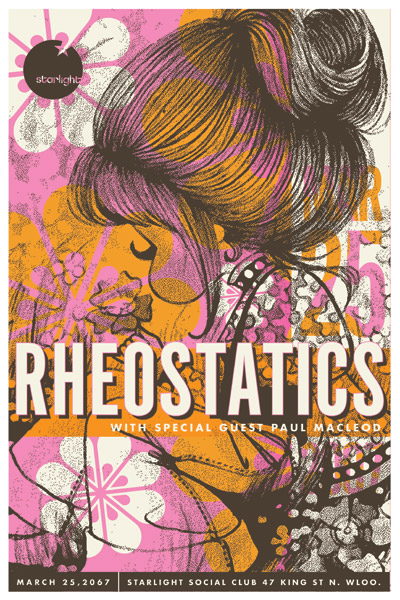
SOUNDTRACK: RHEOSTATICS-Starlight Club Waterloo, ON (March 25, 2007).

Rheostatics ended the first (or second, or third or whatever it was) phase of their career on March 30, 2007, presuming never to play again.  Before that final show at Massey Hall, the band played a few warm up gigs.

This first one was in Waterloo, perhaps a little over a year since their last live gig together.  It was hampered by the fact that Martin Tielli had laryngitis (just a few days before their final ever gig!).  Martin sounds like a caricature of a mobster whenever he talks–deep voiced and strangely Brooklyn-y.  And, obviously they don’t play many of the songs that he sings lead vocals on.  So, it’s a practice show of a sort.

Martin’s guitar is also too loud in the mix for some reason.  This means you can really hear the great sounds he’s making but it’s really distracting when it’s all you can hear.

“Fat” opens the show with all kinds of crazy sounds that Martin is making.  It sounds really cool and it goes on for quite a while, but it totally overwhelms Dave’s guitar and you can barely hear the bass.  The first time Martin sings backing vocals, he sounds completely sinister.

Next up is “Marginalized.”  There’s a long intro with some cool guitar sounds.  Tim’s voice is so quiet and Martin’s guitar so loud that the song sounds bizarre.  It also feels strangely subdued for such an angry song, but that may just be the mix.

“Me and Stupid” sounds good, although Dave forgets some words: “hang on, I got it, I got it.”

Dave tells a story of their first ever trip away from their home town.  Thanks to doc who brought us in to our first show in Waterloo in 1981.  We were ate the Kent hotel opening for L’Étranger, an old heroic Toronto punk/new wave band with Andy Cash, Chuck Angus and Bruce “Bruce P.M.” Meikle.  [Interestingly as of 2011, Angus and Cash were both in politics, sitting in the Canadian House of Commons as members of the New Democratic Party caucus].   We had on our dad’s blazers–our dads dressed cool at one time.  We did our set and were preparing to get high when L’Étranger showed up.  They had ripped jeans and leather jackets and they were shaking.  They had opened for the Dead Kennedys at the Concert Hall where they had been driven from the stage by spit and blood.  We thought they were a real band.

Tim picks up the story: they decided t o drive around and went to a park to get high.  Then the police came by.  Maybe they’d never smelled marijuana in Kitchener/Waterloo, but they let us go. Then we couldn’t find our way out of the twin cities.  We always got lost and ended up at the Alexanian Carpet Factory.

Paul Macleod fronts us for the next song, “Soul Glue,” another Northern Ontario tragedy.  Although it is sung by Tim.

“Four Little Songs” runs to 12 minutes long.  It has a fun cheesy keyboard sound and a silly long introduction.  Martin sings his and sounds insane.  Ford would you like to sing us a song?  Ford recites a quote from Valley of the Dolls, and the band poo poos that it was a song.  Martin sounding like a movie wise guy asks, “Ford was that really a song?”  So Ford sings a new song about Martin having laryngitis and he gets half of the room to sing “laryn” and the other have “gitis.”  Dave: “That bit’s gonna be great at Massey Hall.”

They do a really nice harmony at he end of the song “now they’re gone.”

Paul is back to the stage for “Little Bird, Little Bird,” although I’m not sure doing what.

Tim sings “Here comes the Image.”  I guess Martin is not on this song at all because everyone sounds the same level.  The keyboard solo is all back and forth in the headphones.

Guitar tech Tim Mech plays the terrific solo on “Legal Age Life.”  Then Martin says, “we’re gonna do ‘Take Me In Your Hand.'”  He gets cranky (or it’s just his voice–“oh Jesus, I’ll play it on electric.”  They either don;t play it or it didn’t get taped.  They move on to “Ozzy,” instead.  Martin, “we’re skipping tunes… things are changing…  We’re doing “Feed Yourself.”  This version is really intense with a lengthy guitar solo.   It runs about nine minutes.

Selina Martin comes out to sing “Dope Fiends and Booze Hounds.”  She says, “Poor Martin broke his voice.”  He makes up for it with a wild loud solo.  Then the go for a break.

Tim comes back out for the encore. He says some nice things, explains Martin’s voice and says somebody asked “Row” which he hasn’t done in a long time.  It sounds pretty good.

Andrew Roark the world’s tallest guitar tech and Paul will help us sing “Claire.”  Then they start “Horses” and Dave asks, “who has it in them to sing ‘Horses’ for us?”  The unnamed fan comes up and does a pretty decent job.  Martin’s solo is also really loud.

Finally Paul Macleod comes back to sing “Record Body Count.”  He says can you believe I get to to do this?  This is fucking crazy?  He sings an angry sounding version (not all that well).  Then he starts singing the praises of the band–really lays it on thick.  “This is the best band of all time.  Nobody is as good as this.  He gives a nod to Rush (Martin plays the Tom Sawyer riff).  He ends with I cannot believe that I have been alive during the time of this band (Dave: Holy shit!)

Martin recites (incorrectly) the end of the lyrics in that scary voice.

Someone (Paul, Michael?) starts the “whoo hoo hoo” intro to “Aliens.”  It’s pretty poor singing (he can’t get even close to the high notes), but it’s all in fun.

Michael: “give me more of Martin’s guitar in the monitor.”  Tim: “give me more of Martin’s voice, I can’t hear him.” (ha)

They play a really solid version of “When Winter Comes” (all 8 minutes of it), with Dave correcting one mistaken lyric “It’s ‘coal men’ not ‘snow men.'”

The show ends with a wild, scorching rendition of “R.D.A” with lots and lots of screaming from everyone except for Martin.  We hope that he will be ready in five days.

[READ: September 10, 2017] “Synchronicity”

I don’t know if it’s because I’m a city slicker or cosmopolitan or whatever stupid word people use for us East Coasters, but I don’t get stories like this.  And I don’t like them, either.

I can never tell if there’s supposed to be something beyond the obvious–some down home wisdom that I’m missing, maybe?

As far as I can tell, this story is about a guy visiting his friend Ward.  Ward likes to fix things, so when the narrator has a problem–like with his John Deere, he asks Ward for help. Continue Reading »

CV1_TNY_06_08_15_09.inddSOUNDTRACKLUCY DACUS-“Historians” NPR’S SOUTH X LULLABY (March 21, 2018).

I’m looking forward to seeing Lucy Dacus live in a few weeks.  Her music is often spare but grows very intense.  For this particular song it is just her and her guitarist who is creating textures and sounds as Lucy sings clearly and starkly.  She plays the (almost) title track from her new album Historian.

The idea behind our South X Lullaby series was to offer intimate moments with musicians as an antidote to the commotion and deluge that is the SXSW music festival. When we met Lucy Dacus for her Lullaby and found out she’d perform “Historians,” a most somber song from her deeply personal and triumphant album Historian, it felt just right. It’s a song of reflection, the story of two intertwined partners and the way they document one another’s lives and preserve each other’s memories.

With simple but compelling swirls of sound, Dacus begins singing clearly with a bit of softness on the edges of her words.  It’s fascinating to watch her face illuminated by the video around her (the same video that Stella Donnelly performed in front of).

The song is warm despite the sadness inherent in it.

The setting for this performance, by Lucy Dacus and guitarist Jacob Blizard, is an interactive art installation by the multidisciplinary Israeli artist Ronen Sharabani that’s part of the SXSW Art Program. This work, titled “Conductors and Resistance,” explores human-machine interaction in our ever-evolving technological world. The images projected behind Lucy and Jacob are two coffee cups, one empty and one that’s been almost drained, both tangled in and tugged at by a complex series of wires, representing what I think is human communication and miscommunication.  This is just one of three walls onto which images are projected in this installation — you can see another wall behind Stella Donnelly in her South X Lullaby video.

[READ: April 13, 2016] “The Magic Mountain”

Back in June of 2009, The New Yorker had their annual summer fiction issue.  Included in that issue were three short essays under the heading of “Summer Reading.”  I knew all three authors, so I decided to include them here.

This essay was about Aleksander Hemon’s childhood in Sarajevo.

He says that (not unlike Angell) his family had a cabin on the mountain called Jahorina.  His family would spend winter breaks there skiing and partying.  His parents thought it was heaven up there.  But he and his sister hated to go there in the summer. Continue Reading »

CV1_TNY_06_08_15_09.inddSOUNDTRACKKEVIN MORBY & KATIE CRUTCHFIELD-“Downtown’s Lights” NPR’S SOUTH X LULLABY (March 20, 2018).

I don’t know if Bob Boilen ever explained how he starte dto get people doing South X Lullabies, but here he explains why he started doing them:

In the midst of all the chaos that is Austin, Texas during the SXSW Music Festival, we seek moments of calm. And so one night, as the week was nearing its end, we made our way to the courtyard of St. David’s Episcopal Church, just a few blocks from the thousands of festival participants and onlookers. There we found a trickling garden-side waterfall, where Katie Crutchfield and Kevin Morby performed “Downtown’s Lights,” from Kevin Morby’s recent album, City Music.

I don’t know Kevin Morby.  I’ve heard of him, but aside from a Tiny Desk Concert, I’ve never explored his music.

“Downtown’s Lights” is a simple folk song.  He’s got a bit of a Bob Dylan delivery in what feels like a very deliberate folk song.  Katie Crutchfield is Waxahatchee who I’m excited to see in a few weeks.  Waxahatchee has been really rocking out the last few albums, so this folk song (and her Southern accent) stand out somewhat.

Their voices work nicely together, and that moment when you hear someone yelling, it almost sounds like a wolf howling.

“Downtown’s Lights” is a song of comfort and prayer for someone who is down and out in the city, and this version, with Katie singing — and the sounds of the city echoing in the background — is wistful and peacefully perfect.

[READ: April 13, 2016] “Two Emmas”

Back in June of 2009, The New Yorker had their annual summer fiction issue.  Included in that issue were three short essays under the heading of “Summer Reading.”  I knew all three authors, so I decided to include them here.

This essay was about Roger Angell’s summer home in Maine.

He says that on late February nights his mind often returns to his family’s cottage in Maine and the books that are on its shelves.

Those books have been there for as long as he can remember, and have been read and re-read every summer.  The list is interesting:

Good Behaviour [Molly Keane], Endurance [Alfred Lansing], Framley Parsonage [Anthony Trollope], Get Shorty [Elmore Leonard], Daisy Miller [Henry James], Dracula [Bram Stoker], Butterfield 8 [John O’Hara], Goodbye to All That [Robert Graves], Why Did I Ever [Mary Robison], Oblomov [Ivan Goncharov], The Heart of the Matter [Graham Greene], Sailing Days on the Penobscot [George Savary Wasson], The Moonstone [Wilkie Collins], Possession [A. S. Byatt], Morte d’Urban [J. F. Powers], Quartet [Jean Rhys], Emma [Jane Austen] and dozens more. [I have to chime in and say that this sounds heavenly].

He says that fat books like Martin Chuzzlewit [Charles Dickens], Orley Farm [Anthony Trollope] and the Forsythe Saga [John Galsworthy] were saved for a tedious week of Down East fog. Continue Reading »

CV1_TNY_06_08_15_09.inddSOUNDTRACK: SOUNDTRACKSTELLA DONNELLY-“Talking” NPR’S SOUTH X LULLABY (March 19, 2018).

The South X Lullaby is a really fun way to get to know a new (or familiar, but mostly new) artist in an intimate live setting.  I had heard one of Stella Donnelly’s songs before, but this Lullaby presented her by herself (with a very cool backdrop) with an amazingly clear recording of her voice and guitar.

Stella Donnelly has only one EP to her name, but that’s been enough to make her sharp wit come through in sweet, quiet songs that rage loudly. The Australian singer-songwriter’s Thrush Metal EP was recently reissued in the U.S. with a bonus track, “Talking,” which she performs here surrounded by video of wires, a weaving machine and woolen yarns.

Her voice is clear with big open vowels (you can kind of hear the Australian accent, but it’s somewhat indeterminate).  Despite it being just her electric guitar, she plays a in a couple of slightly different styles throughout the song which adds a lot of texture to the piece.

For the end of the song she really unleashes her voice even as the guitar doesn’t alter all that much.  It’s pretty intense.

I wish you could see the art installation a bit more (I realize this is a video for her, but the installation is pretty neat).  At least they hold the pull-back screen at the end a little long so you can see what’s going on.

Donnelly played “Talking” in Conductors and Resistance, an art installation by the Israeli artist Ronen Sharabani that’s on display as part of the SXSW Art Program. Like Donnelly’s direct and feminist folk songs, Sharabani confronts the viewer to increase action in areas of high resistance, the only way to ensure a strong reaction.

[READ: April 13, 2016] “A Soldier Home”

Back in June of 2009, The New Yorker had their annual summer fiction issue.  Included in that issue were three short essays under the heading of “Summer Reading.”  I knew all three authors, so I decided to include them here.

This essay was about Yiyun Li’s growing up in China.

And I was astonished by the first line: “The summer after my year of involuntary service in the Chinese army….”  I didn’t know that women were made to be in it.  She says that after that summer, she read Hemingway compulsively. Continue Reading »

CV1_TNY_06_08_15_09.indd

SOUNDTRACK: MAX RICHTER-“Dream 3 (In The Midst Of My Life)” from Sleep– NPR’S SOUTH X LULLABY (March 17, 2018).

This piece is remarkable.  And the except provided here (all 8 minutes of it) is but a teeny fraction of the entire 8 hour work.

I had heard about this piece on Echoes a few months ago and was very interested in it, but figured there was no way I’d hear it.  I never imagined anyone would hear it quite like this:

Right at the start of the 2018 SXSW Music Festival, Max Richter’s eight-hour composition Sleep was performed overnight to an audience tucked into 150 beds. They — the audience, not the tireless group of musicians who performed the piece — slept, dreamed and sometimes snored through this trance-inducing experience.

Richter has described this piece: “Really, what I wanted to do is provide a landscape or a musical place where people could fall asleep.”

In the video here, you’ll see Richter himself on keyboards and electronics, along with the ACME string ensemble and soprano vocalist Grace Davidson.

What I loved about the story of this piece is not that it is a piece to sleep to exactly but that it is based around the neuroscience of sleep.  He says, “Sleep is an attempt to see how that space when your conscious mind is on holiday can be a place for music to live.”

It’s wonderful and I would love to sleep to it some night.

[READ: April 13, 2016] “Old Wounds”

I thought that I had read more by Edna O’Brien but it appears that I’ve read hardly anything by her.

This story was an interesting look at Irish stubborness and the way families can hate each other over small things (or even big things).

The narrator explains that her family had a falling out and for several years there was no communication at all between them.  Even when they attended funerals they did not acknowledge each other.

Finally all of the older people had died off and it was just her and her cousin Edward (both past middle age) they met and put aside the hostilities. They even visited the family graveyard together.  The graveyard was on an island a short boat ride from Edward’s house. Continue Reading »

[ATTENDED: March 20, 2018] Judas Priest

Judas Priest was one of my favorite bands when I was a kid.  I remember being very excited when Screaming for Vengeance came out.  I even liked Turbo (“Turbo Lover” may be a terrible song but it is sure catchy).  But then by 1988 I had stopped listening to them, thinking that they’d gone all synth.  I moved on from JP to more heavy music, but I returned to JP’s earlier more progressive-sounding rock quite a lot.  Which means I missed the outstanding “Painkiller” and the whole “Ripper” Owens period.

I even saw Rob Halford live with his band Halford in 200o (opening for Queensryche and Iron Maiden).  I decided I wanted to see this essential childhood band especially since they had a new album out that had gotten decent buzz.  I knew it wasn’t all the original members.  Bassist Ian Hill was still there with Halford.

The drummer Dave Holland was replaced by current drummed Scott Travis in 1989, so he’s a veteran of the band.

Original guitar maniac K.K. Downing left in 2011 and his replacement Richie Faulkner has been accepted into the Priest fold.

And then there was Glenn Tipton, the other original member and part of the twin guitar attack.

So 3/5 original members is pretty good for a band that started in the mid 1970s.  Then Tipton revealed that he had Parkinson’s and would not be touring with the band.  Ouch.  I wondered if it was still worth gong, and I was soundly criticized for doubting the Beast which is Priest.  He was replaced by their engineer Andy Sneap. Continue Reading »

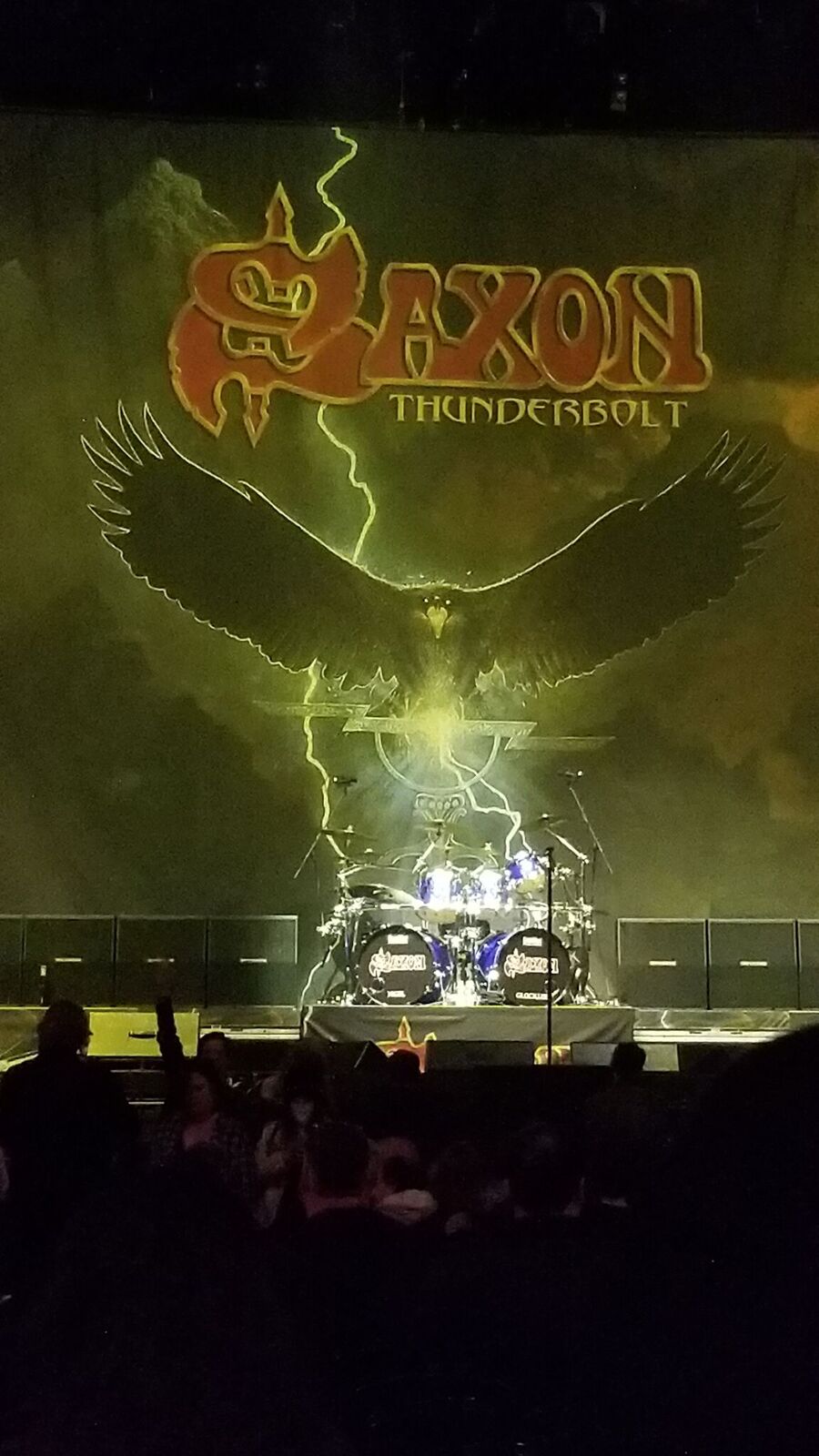
[ATTENDED: March 20, 2018] Saxon

Back in high school, I loved Saxon.  I may have loved them more for their logo than their music (that battle-axe S is still awesome). But I know I listened to their records enough that their songs were often familiar (and cool).

“Denim and Leather” was my introduction and favorite song, although hearing it now, it’s not as good as many of their other classics.

I bought their first eight albums on vinyl. And then I kind of forgot about them. Or at least assumed they had broken up or something.

But, unlike most bands that started in the 70s, Saxon appears to have never stopped.

Indeed, since that last album I bought in 1988, they have put out fourteen (!) more (not including ten live albums and countless compilations). Continue Reading »