Feeds:
Posts
Comments

[ATTENDED: October 1, 2018] Evan Dando

Back in 2015 I saw that Evan Dando was playing at the New Hope Winery.  I had no idea that there was a concert venue so close to me and that Evan Dando would be there.  For some reason, I was unable to make that show, (Thurston Moore was also playing there around that time and I couldn’t make that either, so we must have been away).

Since then I have monitored the Winery to see what other cool bands would be playing there.  Sadly, pretty much since that day, aside from Dar Williams (who is awesome) everyone playing there is a cover band.  Which sucks.

I have loved The Lemonheads since college and It’s a Shame About Ray is a stellar album.  I’d never seen him play, so when I saw he had announced one show (which has since turned into a small tour) at Monty Hall in Jersey City, I knew I had to go.

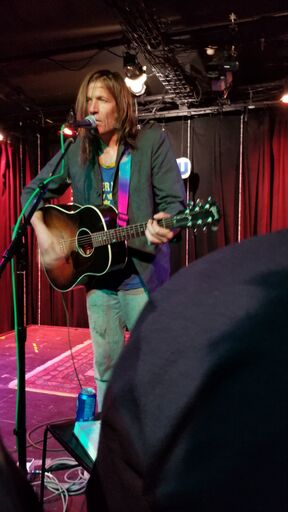
Evan came out pretty late by any standard.  But I wasn’t even sure if he was going to show up.  He seemed surprisingly discombobulated (he forgot his capo) and it took a pretty long time or him to get set up.  This was all fairly surprising since he’d been doing this forever.

He had a total artist look: pants that were filthy and a suit jacket that had a giant rip under the armpit (and which seemed too small for him).

He was wearing glittery flip flops!  Continue Reading »

[ATTENDED: October 1, 2018] The Sensational Country Blues Wonders

Evan Dando announced he would be playing a show at WFMU’s Monty Hall and it was so under-hyped that it was easy to miss.

Incidentally I love the name of this venue.  It’s funny to name it after the TV personality.  But it works because it’s on Montgomery Street.  So clever!

The show was announced with such short notice (two weeks, maybe) that I assumed there would be no opening act.  And then suddenly there was one, The Sensational Country Blues Wonders.

Right there in the name of the band was two genres of music I do not like all that much.  That didn’t bode well.

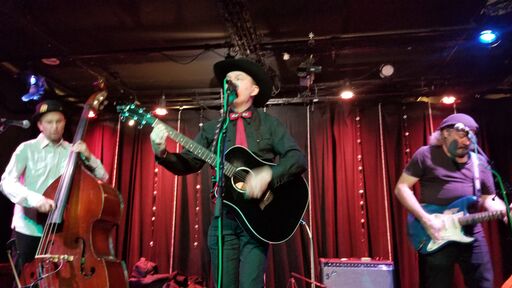
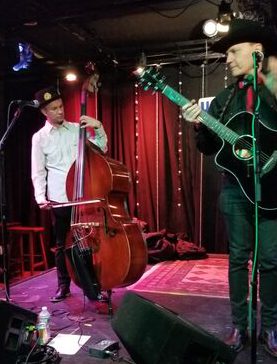
The trio (there’s normally a second guitarist apparently) got up on stage with John Warren (upright bass) wearing a porkpie hat, with the electric guitarist (either Malcolm Marsden or Jeff Sutton) wearing a beret (and looking a bit like David Crosby) and with lead singer and acoustic guitarist Gary Van Miert dressed as a real, old-fashioned country singer.

After a deliberate pause, Van Miert stepped up to the mic and in a real old-fashioned cowboy/preacher voice, he proclaimed “We are The Sensational Country Blues Wonders.”  They proceeded to play ten fanatics old-fashioned sounding country/blues/gospel songs.

And after two songs I was agreeing that they were sensational.  There’s no way that I should enjoy a band with this name playing this kind of music  But they sounded fantastic and had great stage presence.

Their bio says

“The Sensational Country Blues Wonders!” are a band that replicates the original instrumental lineup of acoustic rhythm guitar, electric lead guitar and upright acoustic bass used on the first rock and roll records recorded by Elvis Presley at Sun Studio. The “Wonders” are a group that has it’s own unique interpretation of American Roots Music – classic Country music from the fifties and sixties, down home spiritual songs from the Golden Age of Gospel, and time-honored Blues numbers that go back to the greats hailing from Mississippi and Chicago. We combine all these elements to create a “one of a kind” musical experience! 

The first song “Where is the Road That Leads Home” was so spot-on I as was sure that it was an old song but apparently all of their songs are original.  Van Miert’s voice was just perfect for this style of song–sharp and direct with a bit of a twang.

The second song “Mean Woman Blues” was a little questionable at this moment in history, except that the end of each chorus was “she may even be as mean as me.”

What was so interesting about the music was that it sounded like country and blues at the same time. The solos were all very bluesy and he played solos almost through the whole song, even though the sonsg proper sounded like country songs.

The humor continued with “My Baby Stabbed Me with a Steak Knife” and the delightfully profane “I’m Afraid of Every Goddam Thing

A little later in the set Van Miert again complained “We are The Sensational Country Blues Wonders.  And don’y you forget it.”

As they got near the end of the set I was flagging a little (that’s a lot of counrty for me, although it was actually some of the more bluesy songs that I was most bored by (“Baby Blues” is pretty dull)) but when their song “Second Fiddle segued into “Folsom Prison Blues” I perked right up.

Their version was great.  And although he didn’t sound anything like Johnny Cash, he had the perfect voice for the song.

Before playing the final song, Van Miert said in his normal speaking voice (which hilariously sounded totally New York/New Jersey (they are based in jersey City) that he was really grateful that we came out to see them. And then he was right back in character for the final song.

After the show, he handed out Sensational Country Blues Wonders pins to anyone who wanted one (which I did).

It was delightfully fun surprise.

SETLIST

The Road That Leads Home
Mean Woman Blues
My Baby Stabbed Me with a Steak Knife
I’m Afraid of Every Goddam Thing
I Can Hear the Music Play
Baby Blues
I Won’t Change Anything
Kansas City
Second Fiddle/Folsom Prison Blues
One Night

SOUNDTRACK: JULIA JACKLIN-Live at the Newport Folk Festival (2017).

I saw Julia Jacklin open for First Aid Kit and while I was looking for music by her I found this, her first show at Newport Folk Festival.

This show is a good representation of her live show, except that with when I saw her, she threw in a couple more upbeat songs–this set is a bit monotonous.  Or maybe that’s what an 11M crowd needs.

It’s often a sparse crowd that turns up to see an 11 a.m. set at a music festival — but not so at the Newport Folk Festival. When Julia Jacklin took the stage on Saturday morning, she seemed shocked to be faced with a tent full of attentive onlookers. (If it were any other festival, she pointed out, she’d probably be playing to an audience of four — and four hung-over people, at that.)

She played nine songs, several of which she played when I saw her.

“Hay Plain” is a slow meandering song  it takes almost 4 minutes before the full band kicks in, but when they do it really elevates the song.  ““Lead Light” she played when I saw her.  It has a kind of old school swing to it, almost 50s rock and roll.  The song build and stops several times.

“Cold Caller” is another slow-mover.  Midway through there’s a really cool–and to my mind, much needed–wicked guitar solo.  The backing vocals on “Motherland” mid way through the song perk things up.  She lets her vocals linger more on this one which shows of the power more.

“LA Dream” it is indeed dreamy and sweet and is mostly just her guitar.  “Eastwick” is a cool song that grows faster and louder in a rather slow and deliberate manner. “Coming Of Age” and “Pool Party” are slow brooding song.  “Pool Party” sounds familiar but defies what’s expected from a song with a title like that.

For the last song, “Don’t Let The Kids Win” the band left and it was just her on stage with her guitar.  The lyrics are so good and so well-delivered, it’s a real high point.

So, overall I find her songs to be pretty but a little flat.  She just not quite my thing.  But every time the rest of the band stepped up, the songs were much more fun for me (even when they werent “fun” songs).

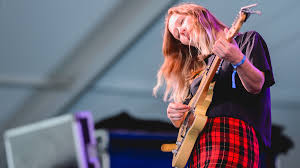
To read some lyrics and what it was like to see her in person, check out this post.  That plaid skirt must be a trademark.

[READ: October 1, 2018] “When We Were Happy We Had Other Names”

This story is about death.

It opens in a funeral home, as the director is meeting with the protagonists Jiayu and her husband Chris.  The story is set in the States–Jiayu thinks about how much stranger living in the States would have been for her if it were fifty years earlier–but that’s doesn’t directly impact the story, exactly.

The gut punch of the story comes as we realize–it is mostly alluded to–that their son Evan has killed himself.  Their daughter Naomi is off at college and while she does come home for the funeral, she also cuts off a lot of access to her.

Jiayu and Chris spent a lot of time with grief–they asked if they had done something wrong–Evan had seemed so happy.  But things did have to move along.  Would they buy pumpkins for the holiday?  Christmas trees?  Would anyone notice or care if they didn’t?

But thinking about death was an all-consuming act for Jaiyu.  She wound up creating a spreadsheet of all of the people she knew or had met who have died.  She entered birth and death year as well as cause of death.  She wanted to test her memory, so she didn’t look up anything.  By remembering each person it would prevent them from become generically dead. Continue Reading »

SOUNDTRACK: CÉCILE McLORIN SALVANT-Tiny Desk Concert #790 (September 25, 2018).

The blurb talks about Cécile McLorin Salvant’s punk roots.  This made me thing that their might be some rough elements in these songs.

But these songs sound akin to old-fashioned-sounding jazz standards (even if she wrote them recently) in the vein of Ella Fitzgerald or Sarah Vaughn.

The nod to punk seems to come in the vaguely erratic piano which verges on atonality at times.  And yet:

From listening to McLorin Salvant’s exquisite performance here, I also couldn’t tell that when she was 15, she was listening to Alice in Chains, sported a Mohawk and was into what she calls “radical feminist punk stuff,” as she told NPR after the performance. “Sometimes I still really like Bikini Kill, and I still have my little Pearl Jam grunge moments.”

What can be heard in each song is a seasoned jazz singer with a vast vocal range, meticulous technical execution and a superb classical vocal foundation, which actually began when she was just 8. Her background in classical piano is evident in the inventive harmonic and melodic construction of the first three songs heard here; all are romantically themed McLorin Salvant compositions from her third album, For One to Love, recorded in 2015. The record won her a 2016 Grammy for Best Jazz Vocal Album.

“Fog” opens with some striking minimalist almost atonal piano playing.  The song veers through many different tones and styles throughout its five plus minutes.

About “Look At Me” she says, “This was originally called “‘Friend Zone’ which is a zone I know so well.”  The piano is delicate–twinkling–as she sings about being the friend when she wants more.

She says the next song is called “Monday,” “Lets see if I remember the lyrics.”  After introducing Foster, he comments, “I just learned this on the train here, so bear with me.”  This is notable because there is a lengthy, lovely piano instrumental part in the middle.

After a hog, Foster leaves and McLorin Salvant prepares for the last song.

McLorin Salvant closes with “Omie Wise,” an American folk song that tells the tragic story of murder victim Naomi Wise and her husband and killer, John Lewis:

Then pushed her in deep waters where he knew that she would drown
He jumped on his pony and away he did ride
The screams of little Omie went down by his side.

Feminist themes are common in McLorin Salvant’s music, and while “Omie Wise” addresses gender-based violence, she says she sings difficult songs like this to address an important historical legacy. “We don’t sing to our kids and we don’t know any of our folk music anymore,” McLorin Salvant says. “But like all of the history of race songs, coon songs, minstrel music, music from Vaudeville, all of that is like, ‘No, we’re not going to address that — that’s too ugly.'”

This song is especially powerful sung a capella and even more so when it is heard on the weekend that that piece of excrement Kavanaugh is having his Supreme Court hearings.

[READ: January 19, 2018] “Admiral”

T. Coraghessan Boyle is an incredibly prolific writer.  He writes about a huge variety of topics as well.  Some of his stories are down to earth and realistic while others, like this one, are based in a near-future fantasy.

The premise of this story is simple and not all that far-fetched (especially in 2007).  A rich couple has cloned their beloved dog, an afghan named Admiral, for $250,000.  They want to raise this dog exactly as the first Admiral was raised.  They believe in the cloning to create an identical dog, but they also believe in the nurture aspect which means they need the girl who dog-sat for him to do everything exactly as she did all those years ago.

That girl, now a woman, was recently laid off and needs some cash. So when Mrs Striker called and told her she had an opportunity, Nisha said… why not?

She returned to the house where she hadn’t been in four years but which was such a large part of her childhood. Continue Reading »

SOUNDTRACK: JULIE BYRNE-Tiny Desk Concert  #788 (September 19, 2018).

Julie Byrne plays a quiet acoustic guitar and sings in a melodic whisper (almost).  She reminds me of Nick Drake in many ways.

Even in an office in broad daylight, Julie Byrne sings with both a husk and a whisper as if she’s gone a long time without speaking – as if she’s been alone, as if she’s been traveling. Her opening number at the Tiny Desk, “Sleepwalker,” sings of the road as a source of freedom.

I lived my life alone before you
And with those that I’d never succeeded to love
And I grew so accustomed to that kind of solitude
I fought you, I did not know how to give it up

Byrne’s guitar playing sounds very full as is each string gets its own special attention.

Julie Byrne’s hypnotic fingerstyle picking conjures a sense of wandering, a style she adapted from her father and a sound she grew up with until multiple sclerosis robbed him of that companionship and comfort. She now plays her dad’s guitar.

After performing “Sleepwalker” alone, Julie Byrne was joined by her musical companions, Marilu Donovan on harp and Eric Littmann on electronics. Together they conjure an ethereal compliment to Julie’s love of the open landscape.

“Follow My Voice” begins with just Byrne.  After a verse or so, the harp enters, making the song seem somehow even more delicate.  And the keys are there just to add a bit more substance–but not to solidify this delicacy.

“I Live Now as a Singer” is just the keys and the harp.  It reminds me a lot of Enya, with the washes of keys and Byrne’s deep but delicate voice.

[READ: January 5, 2017] “The Short History of Zaka the Zulu”

This story is set in a boys’ Jesuit boarding school in Africa.  The narrator is relating the story of a boy they nicknamed Zaka the Zulu. The narrator explains that Zaka was always odd but that they had never expected that hew would be accused of murder.

He was a very smart boy and he succeeded very well–which made him a little unpopular.  But he became even more unpopular when made head prefect.  He was so upright and sincere; he would get boys in trouble for the slightest infraction.  His worst punishment was when he made the younger boys stay for an extra period so that they could not watch the Mary Wards (the girls from Blessed Virgin Mary school) go for their weekly swim.

There were 40 or so Mary Wards every year.  They didn’t live with the boys, of course, but they were all part of the same school–the girls got the best Jesuit education the country could offer.   Only senior boys were allowed to mingle with the girls–particularly at the one or two dances each year.  It was felt that the girls had a civilizing effect on the boys. Continue Reading »

SOUNDTRACK: ANTHONY ROTH COSTANZO-Tiny Desk Concert #789 (September 21, 2018).

The first thing you see when you look at this Tiny Desk Concert is the amazing harpsichord–large and decorated like an old-fashioned leather-bound book.  It is stunning.

But you’re only likely to notice it if you haven’t first heard Costanzo’s voice and then had a look at him.

A word about Costanzo’s voice. He is a countertenor, a man who sings in the range of a female alto. The roots of the tradition date way back to the 1500s, when young male singers, called “castrati,” were castrated in order to preserve their high, flexible voices.

“I’ve managed to do it without castration,” Costanzo joked to the audience of NPR staffers. These days, countertenors sing in falsetto, and while as recently as 30 years ago it was considered something of an androgynous novelty, now countertenors are part and parcel of the opera world.

The music is exceptional and is wonderfully modern with that classical feel that opera naturally seems to add.

Costanzo performs songs from his new album, which pairs music by George Frideric Handel with Philip Glass. Strange bedfellows perhaps, and born more than 250 years apart, but somehow Glass’ repetitive, staccato beats and Handel’s long, flowing melodies manage to shake hands across the centuries.

The first piece is by Philip Glass.  And the music sounds like perfect chamber pop.  The flute plays the Glassian up and down melody while the bassoon plays the wonderful, peculiar bass notes.

One obvious common thread is the arrangements, by Nicholas DeMaison, that Costanzo commissioned expressly for this performance, featuring harpsichordist Bryan Wagorn (playing a beautiful double-manual French-styled instrument built by Thomas and Barbara Wolf), along with flutist Alice Teyssier and bassoonist Rebekah Heller.

Glass’ “Liquid Days,” begins with a recitative introduction, similar to a Handel aria. But the lyrics, by David Byrne, depict love, in all its quotidian splendor.

It is somewhat strange to hear a countertenor (or even if he were a female singing alto) singing lyrics in English.  His voice is truly amazing.

It is even more peculiar to hear the word “television.”  But Byrne’s lyrics are pretty awesome:

We are old friends
I offer love a beer
Love watches television

Love needs a bath
Love could use a shave
Love rolls out of the chair and wiggles on the floor
Jumps up
I’m laughing at love

And all the while Costanzo’s voice sounds operatic, serious, significant.

Costanzo’s agile voice, with its polished tone and patrician phrasing, is a singular reminder that we live in a golden age of countertenors – guys who sing high in music both ancient and modern.

Up next is Handel’s “Pena tiranna” (From ‘Amadigi di Gaula’) which means, I have a tyrannous pain in my heart and I can never hope to find peace.  It opens with harpsichord and bassoon, a wonderful combination.  The flute then enters to play a harmony with his voice.

“Pena tiranna,” from Handel’s undervalued Amadigi di Gaula, is a compelling example of how well the composer can spin a gorgeous melody to evoke the deepest anguish.

The final piece is from Glass: “In the Arc of Your Mallet” (from ‘Monsters of Grace’)” which has a text by the 13th-century Persian poet Rumi.  It speaks of longing in sexy undertones.  He says that in this translation brings out the strange, layered longing–sometimes dirty–meaning under the surface.

Anthony Roth Costanzo is a feisty performer who knows a thing or two about busting down barriers in classical music. After all, opera singers don’t normally belt out arias behind office desks, and they don’t insist on lugging harpsichords with them. They also don’t routinely sing in Bronx middle school classrooms and get students talking about emotions. But Costanzo is fearless. (And after seeing this amazing Tiny Desk performance, watch him melt the hearts of distracted sixth-graders.)

[READ: January 9, 2017] “The Driver”

I never anticipated where this story was going.  And the direction it took to get there was really interesting.

It begins with the story of Mrs Quantrill, a respectable woman who managed to get their house listed on the Nation Register of Historic Places.  She and her husband were philanthropists and they threw legendary parties.

There’s an aside that says when their son Spencer inherited the house, he demolished it and replaced it with storage units.

But at the time of this story Spencer is 9 years old.  And Mrs Quantrill has been called into the principal’s office because Spencer is struggling.  Spencer is nervous and doesn’t know what to do with his, feet, his eyes or his hands. Continue Reading »

[ATTENDED: September 27, 2018] Graham Coxon

I’ve been a fan of Blur since the beginning (I always picked them over Oasis).  I have never seen them live and it seems like I never will.  And while I enjoy Gorillaz I’m not going to see them live either.  So Graham Coxon solo was a wonderful draw for me.

My big attraction to Blur is Damon Albarn’s voice, but the music, especially Coxon’s guitar, is really fantastic too.

Coxon has released a bunch of solo albums.  I bought the first two.  The second one, The Golden D was an experimental noise fest (for the most part) and I didn’t listen to anymore after that.  Well, from what I gather, the rest of his solo albums were folk songwriting with some fantastic finger-picking guitar work. Continue Reading »

[ATTENDED: September 27, 2018] Rosali

Rosali opened for Graham Coxon.  She is a Philadelphia-based singer songwriter with two albums out (her last album got some pretty glowing reviews).

She has a lovely voice which reminded me of Aimee Mann.  In fact, a number of times I thought that she might be singing an Aimee Mann song.  But the problem was that there were no hooks in her songs.  There was nothing to hold on to.

She also had very little stage presence.  She stated as much, confessing that stage banter wasn’t her thing.  No kidding.  One time she asked if anyone watched the news today, after some mild boos, she didn’t follow it up.  Every other time that she tuned, she was basically quiet.  In fact, she never said her name, the most basic thing you do when tuning your guitar.  (I arrived a few minutes late because of the incompetent staff, so maybe she had introduced herself before I got there, but I’m not entirely sure it was her). Continue Reading »

SOUNDTRACK: SMIF-N-WESSUN-Tiny Desk Concert #787 (September 17, 2018).

As this Concert opens, you hear Steele or Tek, the duo who make up Smif-n-Wessun say, “Very mysterious as you can see.  I’ve been his partner for 20 plus years, so it’s alright.”   The other replies “I’m not gonna do nothing crazy, I promise.”

And with that yet another old school hip-hop act whom I’ve never heard of gets their 15 minutes of Tiny Desk time.  And once again, they are pretty great.

And the blurb seems to really love them:

Brooklyn-bred hip-hop duo Smif-N-Wessun – consisting of partners in rhyme, Steele and Tek – illuminated the Tiny Desk with their signature, 80-proof poetry: straight, no chaser. Their music, inspired by their gritty and pre-gentrified Bedford-Stuyvesant and Brownsville neighborhoods, offers the vocabulary of veterans who survived the grimy streets. The[y] represent quintessential ’90s true-school hip-hop from the bedrock, when Timberland boots were standard issue.

Backing Steele and Tek is D.C.’s own Black Alley band.  The Black Alley Band played (and were awesome) with Nick Grant some shows ago.  About the band I wrote

I really like the live band, Black Alley.  The percussionist (Walter Clark) is particularly interesting with his congas and an electronic “plate” that plays all kinds of effects.  The bass (Joshua Cameron) is also great and the guitarist (Andrew White) plays a lot of interesting sounds.  I also like how muscular the keyboardist is playing simple chords.  And the drummer is pretty bad ass too.

For this show, they were more subdued and there were only four of them, but their live music was great for the duo and made the whole thing sound great.

Steele says, “It’s always different for us to perform with a live band.  If I look a little sweaty it’s because I’m catching the holy ghost, alright.”

Smif-N-Wessun set things off with their classic debut single “Bucktown,” an ode to their native Brooklyn, which uses their love for lyrical clapbacks as an allegory for overcoming the violence-ridden reality of their wonder years.

Tek says “This was the first single from our first album.  Came out in ’92 that’s probably older than most of you all in the room.”

Throughout the performance, the two emcees dance, share easy banter and express their spiritual connection to the music they’ve created over the years.

Things climax when the two perform “Stand Strong,” another favorite from their debut album Dah Shinin’. Anchored by the mantra, “I never ran / never will,” … the music decries the struggles of late-stage capitalism and the plight of the disenfranchised. It’s a revelation of love, life, and brotherhood in an era when the antiheroes were really just the ones cunning enough to avoid becoming victims.

Steele says this goes out to our street soldiers.  Then says he says Rest in Peace Anthony Bordain, Rest on Peace Todd Banger.  Stay Alive, people!

That survivor’s drive is personified when Steele lets his guard down during the performance and gifts the audience a little boogie, “You can dance to Smif-N-Wessun music too, y’all.

The set concludes with an exclusive premier of their new single, “One Time,” from their forthcoming album, The All, produced by 9th Wonder & The Soul Council.

Steele says “I’m nervous about the next one, this next song has never before been performed.  It’s fresh off our yet to be released (maybe by the time you see this the album will be out).  Hope you enjoy it because we definitely don’t know what we’re gonna do.  I know these guys sound amazing so just listen to them.”

The song is smooth and cool and again the live band (this is the first time they’ve played with Black Alley) sound fantastic.

[READ: January 6, 2017]  “A Modest Proposal”

I don’t always get to read Sedaris’ pieces in order (if they are even published in order).  But this one follows up on a piece he wrote a while back about him picking up trash by the side of the road.

If memory serves he was picking up trash as a way to get extra exercise.  Anyhow, he states that he is still doing this. And while it doesn’t actually impact the story directly, it’s great to see the continuity.

It’s also hilarious to see that while he usually find candy wrappers and the like, on one outing he found a three-inch dildo: “You’d think that if someone wanted a sex toy she’d go for the gold-size-wise.  But this was just the bare minimum, like getting AAA breast implants.” Continue Reading »
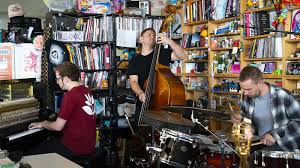
CV1_TNY_11_18_13Tomine.inddSOUNDTRACK: GoGo PENGUIN-Tiny Desk Concert #786 (September 14, 2018).

I’d never heard of GoGo Penguin before, but I was blown away by this Tiny Desk Concert.

The band is a trio: piano, upright bass, and drums.  They play jazz, I suppose.  But there are elements that are prog-rockish and avant garde (none of which makes it not jazz, I realize) such that their music, while instrumental, is genre defying.

GoGo Penguin models closely the leaderless jazz power trio set in motion by forbearers in The Bad Plus, but you can also hear the drippings of electronica groups like Bonobo, and drum-and-bass foundations akin to Roni Size with a bit more acoustic rattle (Turner even fashions his own prepared drum accessories from rope, duct tape, and metal rings, which you can see resting atop his ride cymbal and snare. He tells me he usually has more, but he hasn’t made new ones in a while).

This trio found a way to wedge themselves in the middle of the Venn diagram that overlaps musicians and music heads. Among my colleagues at NPR, I witnessed expressions ranging from studious squints to closed-eye meditation, those in the room experiencing GoGo Penguin’s tunes like they would a collage: the fine details as valuable as the larger shape.

It’s true that Nick Blacka’s fretless bass maintains a very jazz sound and Chris Illingworth has the fluidity of a jazz master on piano.  But it’s pointless to try to define it when you could just enjoy it.

“Raven” was inspired by a dream Chris had of playing chess with a raven.  It opens with ringing piano notes and a bowed double bass.  Then Blacka switches to plucked high notes while Turner plays the cymbals. After about a minute the song kicks into high gear.  The piano hasn’t change, but the bass is pulsing quickly and the drums are playing a fast but quiet rhythm on primarily the snare, but with flourishes left and right.  And it’s all really catchy too.  The rhythm section anchors Chris’ melodic piano lead as the song careens to a close that hearkens back to the opening.

The next one is called “Bardo.”

During his setup, GoGo Penguin’s pianist Chris Illingworth asked if he could remove our piano cover to “access the inside” and, after a few rotations of a screwdriver, he soon handed me a long plank of black painted maple, which has no convenient place to rest in the NPR Music office. If you look closely at the piano innards during “Bardo,” you can see a strip of black tape stretched over a few strings, opposite Illingworth’s bobbing head. It mutes a group of strings, turning them into percussive jabs and dividing the instrument into more explicit rhythmic and melodic sections. What you can’t see: GoGo Penguin’s audio engineer a few feet to the left of frame, dialing-in reverb effects on the piano, which we heard in the room. These two elements, in tandem with bassist Nick Blacka’s precise canvasing and drummer Rob Turner’s charged and delicate pulse, have heavily contributed to the sonic identity of this trio – a signal to jazz jukebox listeners that, “Ah yes, that’s a GoGo Penguin tune.”

It is so neat watching him the piano but making distinctly not piano sounds.  I would have argued that it was a synth making those sounds (which I guess it sort of is).  But the fact that he can do that while also playing a pretty piano melody is great.  I love the way Blacka repeats a simple high note–sliding up the neck of the bass before returning to that incredibly low note that really grounds the song.  All the way through this, Turner is playing some great drum parts–great off kilter rhythms that marry the snare with the toms in complex patterns. And then ending the song by sliding his stick across the top of the cymbals to create a high-pitched squeak.

The final song “Window” opens with a kind of contemporary classical piano melody.  The drums and bass starts playing a great counterpoint and the song just takes off from there.  There’s a false ending where everything stops, just briefly before resuming once more. It’s never clear who to pay attention to during any of these songs, there’s all so fun to watch.

[READ: January 4, 2017] “The Book of Simon”

Simon Rich continues to write very funny, rather blasphemous stories.

This one begins with the story of Job, the righteous Hebrew in the land of Uz.  He had more faith in God than anyone.  Satan made a wager with God that Job would not be so faithful if his life was hard.  And so Satan made Job’s life miserable but still Job praised God.

Four thousand years later however, the Hebrews had become less religious.  Oh there were still bar mitzvahs, but the themes were about Broadway or sports and the parents would hire dancers to come and teach the children dances, may of which were sexually suggestive.

So Satan started gloating.

And by the 21st century he would lean in and say “What’s yup now?  Or even more aggressively, ‘Sup now?” And this put God’s self-esteem at an all time low. Continue Reading »