Feeds:
Posts
Comments

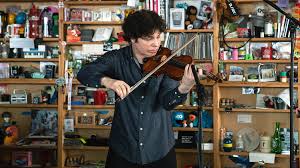
SOUNDTRACK: SPANGLISH FLY-Tiny Desk Concert #928 (December 31, 2019.

Spanglish Fly is a pretty funny name for a band

Spanglish Fly [is] one of the true pioneers of the boogaloo revival scene happening on the East Coast. For about sixteen minutes, our little corner of the building was the hottest Latin dance club in D.C..

The band (eleven members at the Tiny Desk) combine two styles of music to create a great deal of dancing fun in these three songs.

There is something absolutely infectious about combining the deep groove of an Afro Cuban tumbao bass line with a conga marcha, while the horns answer a call-and-response with the vocalists, all in a confined space.

The first song “Bugalú Pa Mi Abuela” opens with some clapping and that familiar conga style of piano from Kenny Bruno.  It’s cool how the music jumps between this style and the grooving bass (including some cool bass slides) from Rich Robles.  This song gets you moving right away and has a trombone solo from Ric Becker.

The second song slows things down and is a bit more serious.  “Los Niños En La Frontera” has a slow burn of social consciousness.  It means “children at the border.”  And although the song is more somber, the musical is style rich and vibrant.  It opens with shakers from Paula Winter and cymbals and timbales from Arei Sekiguchi.  Then the piano jumps in with a call and response from the horns.  In addition to a lead baritone saxophone line from Stefan Zeniuk, there’s also Matt Thomas on tenor saxophone and Jonathan Goldman on trumpet.

I haven’t mentioned the vocals yet because it’s in this song that both singers really demonstrate their power.  Jessenia Cuesta sings lead first but in the end Mariella Price takes over and sings a different, faster more intense style.  Their voices work together really well.  And as the song ends, Jessenia holds an impressively long note.

The final song is “a song about shoes.”

The horn ensemble work that drives “Boogaloo Shoes” is worthy of the song’s title, a name taken from the classic dance form that drove East Coast teens crazy in the 1960s. The percussion immediately causes hips to sway.

This song is sung in English and features some more of that great piano and even some yips and yells from the singers.  The chorus has a couple of really fun moments when Dylan Blanchard on the congas and Arei do fast drum fills.  Matt Thomas takes a pretty lengthy solo on tenor sax and the end features a spoken word in which Mariella tells us that they are putting the “you” in zapata boogaloo.  Jessenia Cuesta ends the song with one more great vocal turn.

It’s a really fun set and if your body is not moving during it, you must be dead.

[READ: January 6, 2020] “The Strangeness of Grief”

Recently, Michael Chabon wrote an essay about his somewhat ambivalent feelings about the death of his father.  Now it is V.S Naipaul’s turn to discuss this as well.

Naipaul’s father was forty-five or forty-six when he had a heart attack.  He was working for the Trinidad Guardian while V.S. was at school in Oxford.

Although his father was to receive half pay, he seemed unconcerned about the state of the family finances.  Indeed, the episode seemed to leave him with a lightness of spirit.  So he began writing comic short stories.  They were quite successful.  The BBC even asked V.S to read one of the stories in the “Caribbean Voices” program.  The amount they were going to pay him would be the amount it would cost for him to get to London from Oxford.  But when he told his father about the expense, his father decided to buy him a gift to show his appreciation. Continue Reading »

SOUNDTRACK: Bob Boilen’s Favorite Tiny Desk Concerts of 2019.

For 2020, I intend to put more albums in my Soundtrack section.  But it’s amazing how time consuming that can be.

Nevertheless, I’ll always be posting about Tiny Desk Concerts because I watch all of them.  So I’ll start 2020 with Bob Boilen’s favorite Tiny Desk Concerts of 2019.

It amuses me that Bob Boilen and I often share very similar tastes in music, but our favorite things are usually quite different.

When we first started filming musicians playing behind the Tiny Desk in April 2008, the beauty was in the intimacy and simplicity of these concerts. Now into our 11th year, after more than 900 Tiny Desks, the other treasure I find in these concerts is the variety. I remember having the cast of Sesame Street here in May, with NPR parents and their children seated on the floor watching the Muppets. The following Monday we had the blood red-faced raging of Idles, climbing all over the desk and singing “I’m Scum.” The scope of music is invigorating, especially considering a world of listening where we can not only get comfortable with what we love, but where the quantity of music from any particular genre could keep us happy all year. Tiny Desk concerts are here to shake up your tastes a little and help you stretch your ears and discover something you never knew existed or convert you to something you never thought you’d like. Here are 10 great examples of that magic from 2019.

I don’t have a list of favoirtes, but I will make some observations about Bob’s.

Bob seems to really like bands who put their names in all caps.  Also bands who have a number (specifically 47) attached to their letters.

Quinn was the Tiny Desk Contest winner.  Sesame Street is pretty iconic.  Taylor Swift is something of a surprise, but was clearly the biggest name they’ve ever had.  And yet, Lizzo’s Tiny Desk has twice as many views as Taylor Swift’s (5 million to 2.5 million!).

Looking forward to their 1,000th show later this year.  I wonder who it will be.

[READ: January 6, 2020] “Playing Metal Gear Solid V: The Phantom Pain”

This was a great short story about playing a video game.

For decades, the video game industry has been releasing video games in which a protagonist kills people from other countries.  Since I don’t play these games, I never really thought about what it would be like to be from that country and to play those games.

Surely people from all around the world like to play video games, and they probably want to play the popular ones as well.

In this story an an Afghani-American kid, Zoya, who works at Taco Bell has saved up all of his money (the money that he doesn’t give to his out of work father) to buy the final game in the Metal Gear series.  He has been playing this series which has becomes “so fundamentally a part of your childhood that often, when you hear the Irish Gaelic chorus from “The Best is Yet to Come” you cannot help weeping softly into your keyboard.” Continue Reading »

SOUNDTRACK: JANN ARDEN-“Leave the Light On” (2018).

Jann Arden is a Canadian singer-songwriter who I know pretty much exclusively from her 1994 song “Insensitive.”  Arden has also made numerous media appearances over the years, including showing up on Corner Gas, Robson Arms and other shows that I haven’t seen.  She also appeared extensively on Rick Mercer Report (I found out by reading the book).

“Insensitive” is a slow song with a bit of mid-90s production.  The melody is catchy and the lyrics are great:

Oh, I really should have known
By the time you drove me home
By the vagueness in your eyes, your casual goodbyes
By the chill in your embrace
The expression on your face, told me
Maybe, you might have some advice to give
On how to be insensitive, insensitive, ooh, insensitive

Now, nearly 25 years later, Arden has other things on her mind.  I don’t know much about Arden, but evidently both of her parents suffered significant health problems in the last decade.  Her father passed and shortly after that her mother began a battle with Alzheimer’s as well.

“Leave the Light On” is a beautiful song about her mother.

A slow piano opens before Arden starts singing–her voice sounds wonderful–powerful and exposed.

I never pictured life
Alone in a house
Surrounded by trees
That you’d forget yourself
Lose track of time
Not recognize me

The bridge comes in with a harmony voice that shows even more pain.

Then the chorus kicks in and a song that could be maudlin or easily schmaltzy goes in exactly the right place to prevent that.  It shouts a sense of optimism that’s the only way people can keep going sometimes

A four note melody picks up the pace and uses a perfect parenthetical voice (the first voice is quieter, almost internal)

(Out of the dark)
I leave the light on
(In through the cold)
I leave the light on now
(Safe from the night)
I keep my eye on the road
(Good for the soul)
For when you come home to me

What is so compelling about the song is how musically understated it is.  While it could go big and heartbreaky with strings and over the tops effects, it stays quiet with the piano and a quiet electric guitar playing a melody deep in the background.  And really once the drums kick in, it’s almost like the drums are the only instrument–like Arden’s voice is the melody and the piano and guitar are there purely as support.

There’s a short bit near the end of the song that is a real gut punch though.  After a short guitar solo, she sings following the guitar, “do you know my name, do you know my name?”

Dang.  It’s a starkly beautiful song.

It also showcases what a great songwriter she is because she is apparently a truly fun person to hang out (according to Rick Mercer).

[READ: December 2019] Rick Mercer Final Report

I read The Mercer Report: The Book over ten years ago.  I had been a fan of Rick Mercer Report on Canadian TV (we used to be able to get Canadian satellite down here).  As an introduction to that book I wrote

Rick Mercer is a great political comedian.  He puts all American political commentators to shame. I’m sure that much of this difference is the way Canada is structured. There seems to be so much more access to politicians there than in our system.  While politicians do appear on our TV shows, on the Mercer Report, Rick goes white-water rafting with the head of the Liberal party. Rick has a sleepover at the Prime Minister’s house.  For reasons I can’t fathom, all of these politicians agree to hang out with Rick even though in the next segment he will rant about their incompetence.

It’s these rants that were a highlight of his show.  Every episode, he would stand in an alley and go off for 90 some seconds about the issue of the week.  His rants are astute, funny, and right on the mark.  He takes aim at all sides by ranting against incompetence and hypocrisy.  The only disappointing thing is that since this book covers the lifetime of the show and some of the topics have appeared multiple times, I guess it shows that his rants didn’t accomplish their goals.  But they made us feel better, anyhow.

The book is organized in reverse chronological order, with the final rants (April 3, 2018) coming first.

Topics in the final year included how run down the Prime Minister’s residence is.  Justin Trudeau said “The place is filled with mould and lead–I’m not raising my children there.  Typical Liberal.”  Also payday loan sharks; the Paralympics (Mercer was a huge supporter) and technology. Continue Reading »

SOUNDTRACK: WONDERFUL ESCAPE: Birds (2018).

I was looking for a bird song collection to pair with the book.  I found this 20 minute collection on Spotify.  It turns out that Wonderful Escape has many releases of nature sounds.

I haven’t listened to any of the others, but it strikes me that this recording was made by a person with a microphone who didn’t really know what birdsong CDs sound like.

Normally a bird sound recording is meant to be soothing, a “wonderful escape” if you will.  This recording feels like a hastily compiled collection of nature songs.  I would say it’s cash grab, but I doubt there’s much money to be made in posting bird songs to Spotify.

This collection starts out with “Crowes at the Cemetery” (no idea why Crowes has an e in it–there’s no jam band in sight).  These crows are raspy and rather unpleasant.  They are certainly telling us to eff off.  There’s also a long stretch in the middle with no crows at all.  This seems rather odd for a three minute track.  The end of the track has some church bells which I assumed was from the cemetery but which seems to be the natural segue to “Birds at Saint Birgitta Church.”  This track is much calmer.  The twittering and pretty call of birds sounds rather distant though.  Its really not until 2 and half minutes that you hear some really pretty birdsong up close.  Did the bird just happen to land near the microphone?  It also seems very likely that the recording equipment has just moved to the other side of the cemetery because you can hear those same crows from track one in the background.

Track three is called “Birds at the Graveyard” which I suspect is the same graveyard as the above cemetery since you can still hear the crows in the background.  There is some melodious bird song throughout.

This track differs quite a lot from the similarly named “Birds at the Cemetery” (seriously, did they just walk around the building for 20 minutes?).  The sonic quality is very different.  The cemetery sounds less crowded and the birds are less frequent and further away.  This one actually has a more somber feel, which seems weird to say about a field recording.  For the final thirty seconds or so there’s hardly any birds at all.

The next track is “Birds in Village Park,” so at least there’s some kind of place mentioned.  There is a vast array of birdsong in this track, although it is all very far away and seems once again to be dominated by crows.  Halfway through there’s a raspy sound that sounds more mechanical than avian, but I suspect it is a bird chitting.

The penultimate track is called “Birds Swedish Countryside.”  This makes me wonder if all the recordings are in Sweden, but who knows.  It starts out promising with some interesting noisy birds but once again, it is very quiet in the middle.  Then the noisy birds appear to fly over the recording equipment, getting noisy and then quieter again.  This is a pretty cool treat because it changes things up.  But the majority of the track it sounds like the birds are trying to avoid being recorded.

The final track title seems like a joke.  It is called “Birds Way Out in the Countryside.”  And like all the other tracks, it sounds like the birds are way out in the countryside and we are behind a fence unable to get into the countryside.

This is a weird field recording to be sure.  And there are far better nature sound tracks out there.

[READ: December 31, 2019] Effin’ Birds

I saw an ad for this books and asked for it for Christmas.  I loved the idea of a beautifully illustrated book of birds which tells you exactly what they are really thinking of you.

Every page has illustrations from John James Audubon’s Birds of America or Thomas Berwick’s History of British Birds.  These are lovely mostly black and white reproductions, with a few plates in color.

The book begins

Have you ever listened to the melodic chirping of birds and wondered what they were trying to communicate?

Advances in machine learning over the past ten years have allowed for detailed scenario analysis of birds and their songs, and multiple computer-driven studies* that compiled years’ worth of audio and video recordings came to an astonishing conclusion: most of the time, birds are just saying “Fuck off.”

*I made these up because this book is fake — but keep that as a secret between you and me and the handful of other nerds who read footnotes,

Continue Reading »

SOUNDTRACK: RONG-“Shrugging at the Dearth of Discourse” (2019).

Every year Lars Gotrich publishes his list of favorite music in an NPR podcast called Viking’s Choice: The Year In The Loud And The Weird.  I always listen to these songs because I’ll never hear them anywhere else (he mostly seems to scour bandcamp for unknown music.

One that he especially liked was by the band Rong from Boston.

He says:

Just bonkers. Boston’s Rong channels the joyous chaos of Japanese punks Melt-Banana and the aggro skronk of Brainiac with a tad of Deerhoof’s weirdo-pop hooks, in what sounds like a swarm of bats fighting a comically large industrial fan… and the bats win. Dissect the noise and you’ll find some truly athletic guitar interplay, held together by a sturdy rhythm section and Olivia W-B’s vocal acrobatics.

This song starts out with Olivia screaming quickly and almost inaudibly while the drummer thrashes away on every surface nearby.  There appears to be two guitars each playing their own riff that seems irrelevant to anything else. It’s a chaotic statement that will likely make most people turn the song off.   After 30 seconds one of the guitars plays a riff and at 35 seconds the riff is actually really catchy and Olivia sings along with it.  Wow.

And the song is not even one third over.

After a few more rounds through similar styles things really slow down around 1:45.  It is just bass and drums and vocals for a bit before two separate solos happen at once.  About five more parts occur before the song ends at 3:11.  This includes a riff that is repeated a few times and a absolutely berzerk ending.

That’s the first of 8 similarly eclectic and, yes, bonkers, songs.  Finding the melody and connections between the parts is rather strangely rewarding.

Incidentally, the final track on the album is called . ༼ ༎ຶ ෴ ༎ຶ༽   In a bigger font, that’s:

༼ ༎ຶ ෴ ༎ຶ༽

[READ: Summer 2019] The Long Cosmos

The “Long Earth” Tetrology is complete.

This was a series that was pretty much impossible to end.  I mean the very premise is that there is unlimited exploration to be had in the various “Earths.”  So how do you end it?  Well, really you end it by following the main protagonist of all of this, Joshua Valiente to his logical conclusion (or something like that).

This book also serves as a kind of reconciliation for many of the estranged characters, but, thankfully does not resurrect any dead characters (well, except for Lobsang–whatever he may be).

The Foreword to this book answers a question that I had: If Terry Pratchett died in 2015, did he have anything to do with this book which came out in 2016?  Baxter explains that indeed, he and Pratchett had created drafts of the final three books by August 2013.  Terry and Stephen worked on the book together as late as autumn 2014.  Then Baxter dealt with final editorial and publishing stages.  So that makes me happy.

I am, as always with this series, puzzled as to what Terry’s contributions were to the books.  I haven’t read anything else by Baxter, so I don’t know if this is a Baxter book with Pratchett sprinkled in or if it’s a combination of their writing styles   The one thing is that this series is never really all that funny (with one huge exception later).  Not to say that Pratchett had to be funny, but it was certainly what he was known for.  Maybe I’ll try a Baxter book one of these days to see just what his works are like.

But back to the concluding chapter of this long series.

This book opens with the invitation: JOIN US. Continue Reading »

SOUNDTRACK: FALHA COMUM-“Film Do Mundo” (2019).

Every year Lars Gotrich publishes his list of favorite music in an NPR podcast called Viking’s Choice: The Year In The Loud And The Weird.  I always listen to these songs because I’ll never hear them anywhere else (he mostly seems to scour bandcamp for unknown music.

One that he especially liked was by this band Falha Comum, a duo from Brazil.

He says:

The Brazilian post-punks scaled down to a duo, but opened a festering third eye. The psychedelic noise receptors of a previous decade (think Raccoo-oo-oon and Gowns) run throughout Rakta’s Falha Comum, but in levels below, the sinister grooves and cackled reverb inhabit a life all their own with primal incantations to spirits unknown.

The album is like a few things and nothing else that I’ve heard.  There’s elements of krautrock–but not sterile and efficient, more groovy and cool, with a warm bass and seemingly wild, improvised vocals.

This particular song is 7 minutes long and opens with a spoken word section (presumably in Portuguese).  There are synths and screams behind the speaking and then everything starts pulsing as the vocals echo and echo.   The music–a simple repetitive drum and bass (I guess) line, keep a terrific groove going while on top, the high notes (vocals and other synths) skitter and flit about.

Midway through, the song goes through a phase shift–it sounds like it’s been transported somewhere else, and that’s when the bass gets cleaner and the vocals grow a bit more intense.  But the groove remains.

Somewhere around 6 minutes, the groove changes slightly–a brief shift in notes suddenly gives the song a brief moment of extra melody.  The following keyboard frenzy keeps it from getting too comfortably melodic though.

It’s an unexpectedly interesting and cool record.

[READ: Summer 2019] The Long Utopia

This was the fourth book in the Long Earth series.  I brought it along on vacation thinking it would be a fairly slow and leisurely read like the others—something I didn’t mind putting down and picking up a few days later.  But this book changed that pattern entirely.  It was fast paced and quite exciting and my favorite book of the series so far.

The previous book about the Long Mars seemed to be more than anything else, a distraction.  Not a lot happened, although there were some cool ideas in it.  The one big thing that book 3 did that effects book 4 is the cable/elevator thing—which I still don’t understand [see yesterday’s post about book 3].

This book also introduces a new concept in Stepping.  Typically Stepping is described as moving left or right, east or west through the Earths.  But suddenly, in this one world, it seemed like a person could move…north.  Into an entirely different world—night instead of day:  “No stars exactly, it was like he could see the whole galaxy…from outside.”

This book is set in 2052.  Protagonist Joshua Valiente:

will be 50 years old. He has been stepping for 35 years and has been all over the Long Earth.  But some things are still unsettling—things that he can feel in his bones or his head.

The reason for his feelings date back to 2036 in New Springfield.  Cassie Poulson had been digging a basement for her house when she hit some kind of opening.  Not a cave or anything natural, but some kind of manufactured tunnel or the like.  When she poked her head in,  what poked back was a humanoid metal beetle.  Obviously she freaked out and covered up the hole. Continue Reading »

SOUNDTRACK: FIRE-TOOLZ-“mailto:spasm@swamp.god?subject=Mind-Body Parallels” (2019).

Every year Lars Gotrich publishes his list of favorite music in an NPR podcast called Viking’s Choice: The Year In The Loud And The Weird.  I always listen to these songs because I’ll never hear them anywhere else (he mostly seems to scour bandcamp for unknown music.

One that he especially liked was by this band Fire-Toolz.  He says:

When I try to describe the simultaneously fantastical and obliterating sounds of Fire-Toolz to folks, I usually throw my hands up — not out of frustration, but from awe. Angel Marcloid has clashed New Age synthscapes, clubby raves, jazz fusion and metal shrieks for a few years now, but Field Whispers (Into the Crystal Palace) goes beyond the mash-up, into an idiosyncratic master’s pure creation.

The album credits indicate: Angel Marcloid: voice, drums, electric & acoustic guitar, fretless bass, virtual studio technology, field recordings, circuit-bent junk, composition, lyrics, recording, production, mixing, mastering.

The only other musician is Ian Smith: who plays what can only be described as a smooth-jazz saxophone solo.  Oh, and her cat, Breakfast, gets a vocal turn.

I have listened to some of the whole record, (a lot of tape manipulation on track 2), but nothing sums up the project like the first song, “mailto:spasm@swamp.god?subject=Mind-Body Parallels” (yes, that’s the title).  In 2 minutes and 11 seconds, she includes more genres than I can name.  And the amazing thing is that unlike other artists who squeeze many genres into one song (there are those who do this well and those who do not), these shifts feel at once hairpin but also natural. 

The song starts with a skittery electric melody that almost sounds like digital pipe organ.  It’s very new-agey, but with heavier drums than you might expect.  The quiet death metal growling is certainly unexpected, but somehow it doesn’t feel out of place (and is low enough in the mix to feel more like another sound than vocals–I have no idea what she’s saying).

After the first verse the music shifts to a kind of jazzy new age followed by a punishingly fast electronic drum and a scorching heavy metal solo and the song devolves or crescendos with inhuman growls.

Welcome to 2020!

[READ: May 2019] The Long Mars

I found the first book in this series rather compelling–almost surprisingly so given that it’s not a fast-paced book and, to be honest, not a lot happens.

But it was really well written and the things that do happen are compelling and fascinating.  And I couldn’t wait to read more.

In the first book:

A man creates an invention (The Stepper) which allows one to step into a parallel world that is next to ours.  There are a possibly infinite numbers of parallel worlds in each direction (East or West).  The worlds that are closer to ours are almost identical to our Earth (known as Datum Earth).  The further you go, the greater the differences.  But none of them have experienced humanity before Step Day (aside from earlier hominids).

The main character is Joshua Valienté.  Joshua is a natural “Stepper.”  He doesn’t need the device to Step from one word to the next, nor does he feel the nausea and other side effects that most people feel as they travel.  Most of the book follows his exploits.

The Black corporate has a ship with an entity known as Lobsang who claims that he was a human reincarnated as artificial intelligence.  Joshua is sure that Lobsang is a computer, but Lobsang’s human skills are uncanny.  This ship has managed to Step as an entity, meaning everything in the ship can go with them.  Normally you can only bring what you can carry (aside from metal).

The novel more or less is an exploratory one with Joshua and Lobsang Stepping through millions of Earths.  Not a lot happens, but the novel never grows boring.  The interactions between Joshua and Lobsang are often funny.  And the writers have infused the Earths that they stop in with just enough differences to make each stop strangely compelling (this must be Baxter’s hard science leanings).

I found the second book less compelling on a story level, but no less compelling on a conceptual level.  There was still some cool stuff going on.

Joshua Valienté has settled down in a town called Hell-Knows-Where.  He has a wife, Helen, and a child, Daniel, and lots of regrets about what happened at the end of book one.  He is embedded with the rest of the community.  They show off what a successful community can be way out in the Long Earth.  It is more or less cut off from Datum Earth, which means that everyone needs to work for the community to survive.  Since trust and companionship are key to survival, people don’t really try to take advantage of others and crime is pretty much nonexistent.

This independence is a major concern for the governments of Datum Earth.  In fact, some of the more thriving distant communities (like Valhalla) want to declare independence from Datum Earth altogether.

Another issue is human (or alien) rights.  The trolls from the first book have become a part of most communities at this point.  And yet, the way they are treated seems largely dependent on who they are with.  Some are welcomed like family members, other are treated like animals, slaves or worse.   And the mistreatment of a mother and son troll are what set a series of events in motion.   Maggie Kauffman is a new character introduced to speak on behalf of the trolls.  Before their otherwise peaceful nature gets pushed too far.

Another plot line (and there are quite a few) concerns Roberta Golding, a young genius who goes on an exploratory mission with the Chinese.  The Chinese are exploring the “East Earths” (most of the other travelers went West).  Roberta is an odd child, who anticipated jokes and therefore finds nothing funny. She is cold and emotionless.  Her story remains unresolved by the end of the book.  But her crew managed to get to Earth East 20,000,000 with the crew.

When Sally tries to get Joshua involved in an adventure once again, he is reluctant, but Helen is the one who spurs him on–as long as she and Dan go with him. This adventure is a bit of backtracking, though–an attempt to use Joshua’s name and status back on Datum Earth–where he is not welcomed by everyone.  He tries to prevent the government from harming trolls–because he knows what is at stake if the trolls grow angry.

In their adventure, they also encounter a race of beings known as Beagles.  It is a pretty dark and disturbing world, with Joshua getting tortured and Sally and Monica being the only things keeping him from a brutal death.   There’s a lot of brutality now, which is not unexpected given the reality of the situation, but it does often seem rather harsh

That’s a lot of summary to prepare for Book Three.  But book three does continue the saga, just another twenty years or so later.

Continue Reading »

30SOUNDTRACK: TANYA TAGAQ-Toothsayer EP (2019).

toothEarlier this year, Tanya Tagaq released a five-song EP to accompany the British National Maritime Museum’s “Polar Worlds” exhibit.

Tagaq’s music doesn’t radially change from release to release but she does vary things quite a bit within the style she creates.

This album feel more electronic than organic.  It’s full of drones and pulsing sounds.

“Icebreaker” opens with a low rumbling drone joined by a pulsing drum beat.  Then her heavy breathing/growling enters and she moved between guttural throat singing and high squeals.  A vocal melody appears around 2 and a half minutes but it is quickly swallowed by the main pulsing rhythm.

Tagaq uses katajjaq which Pitchfork explains is the vocal game traditionally played among Inuit women while men are away hunting. It involves two women standing face to face, exchanging repetitive vocal motifs until one fails to keep the pattern going. In older recordings of katajjaq, it’s easy to sense just how entertaining they were: Many games end with laughter.

When Tagaq does katajjaq she is solo (and not laughing).

 “Snowblind” is next.  with slow pulsing synths (from the Iranian-British electronic musician Ash Koosha) and a delicate piano as she sings a gentle wordless melody. The piano starts to pick up half way through and the low note grow more ominous as her voice grows more urgent.

“Toothsayer” features guttural breathing underneath while her voice soars above.  Midway through, it resolves into some gentle voices and an harsh stabbing guitar solo.

The most exciting track to me is “Submerged,” her katajjaq is delivered over what sounds like Inuit drumming, but Inuit drumming underwater–echoing and slightly underwater sounding.  Deep, slow clicking and heavy gasping breaths make up most of the song until about three minuets when a chord comes crashing in and her voice soars like a scream.  The pulsing continues and her voice sounds more ragged.  As it reaches its climax so does her voice shrieking louder and higher louder and higher until it abruptly ends.

The disc ends with the prettiest song, “Hypothermia.”  It is a quieter song, awash with keyboards.  Her voice soars like a siren.  Like the feeling of hypothermia, you are lulled by beauty when really your body is shutting down.

In “Hypothermia,” her katajjaq takes on the desperate cadence of someone panting, while the crystalline harmonies of “Snowblind” are both a vivid evocation of landscape and a bittersweet expression of pain—the pain of knowing that this could all be gone.

[READ: December 30, 2019] “I Can Speak!™”

The end of the year issue is called the Cartoon Takeover: A Semi-Archival Issue.  So there’s a lot of cartoons, but there’s also some old stories. Like this one.

This was originally published in the January 14, 1999 issue of the New Yorker.  I’ve now read it a few times, but it has been a while and I enjoyed it more this time than any other time.

The story is actually a letter to a customer unsatisfied with her I Can Speak!.  The customer service rep from KidLuv says he is on his lunch break–that’s how much he cares about her satisfaction. Continue Reading »

[ATTENDED: December 31, 2019] Ryley Walker

I saw Ryley Walker open for Calexico in May of 2018.  He played with a trio–second guitar and bass.

Even though I was at the show, I clearly didn’t remember it very well, because I was puzzled why he was on this jam band bill.  The confusion is because I mostly remembered him singing the song “Telluride Speed,” a mellow folky song.

But re-watching some of the videos from that show I realize that much of the show was instrumental jams between he and his co-guitarist Bill McKay.  So I should have realized it made sense.

But I was so puzzled when he came out and started playing that I genuinely wasn’t sure if it was the same guy.

In part because the music he was playing was abstract and noisy and utterly experimental.  (It makes sense that his jamming for Calexico would be a bit more folky).  Plus, he looked completely different. Continue Reading »

[ATTENDED: December 31, 2019] Chris Forsyth + Garcia Peoples

I was blown away the first time I heard Chris Forsyth’s album Dreaming in the Non-Dream.  When I saw his Tiny Desk Concert I was convinced that he was someone I wanted to see live.

Forsyth is based in Philly which means I should be able to see him a lot.  And, in fact, he does seem to play in the area quite a lot. But always when I’m unavailable!  So, if it meant travelling to NYC to see him so be it.

Garcia Peoples’ set ended at around 1:15 and, since they were backing up Forsyth, there was no take down/set up to deal with.  At around 1:30, Forsyth came up on stage and made sure his stuff was in order. Then he called back Garcia Peoples to the stage and off they went.

Like the GP set, Forsyth only played three songs.  And like the GP set, it lasted 45 minutes of awesomeness.

They started with Forsyth’s new song “Tomorrow Might as Well Be Today.”  It’s got a great opening riff and the song just takes off from there.  The song is only 4 minutes on the record (his latest record Mystic Mountain), but they jammed it out for a few minutes more.  Forsyth’s soloing was just fantastic. Continue Reading »