Feeds:
Posts
Comments

Archive for the ‘YA Books’ Category

town-boy SOUNDTRACK: DUBLIN GUITAR QUARTET-Tiny Desk Concert #409 (May 15, 2015).
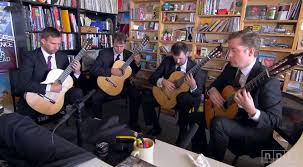
dgqWhen I first listened to this brief concert for some reason I didn’t realize that the quartet were playing Philip Glass.  Of course, once he stated that that’s who they were playing, it became quite obvious–but having Glass played on acoustic guitars instead of synths or violins, is quite an unusual experience.

The music is still rigidly repetitive, but there is a great deal of warmth added with the guitars (and the human element as well).

The Dublin Guitar Quarter has been around since 2002 and they play pretty much only contemporary and new pieces (despite being dressed in suits and playing on “classical” guitars).

They play two pieces, with two and three movements of each piece respectively.  They were originally recorded for strings, so these guitar transcriptions change things quite a lot (especially in Mishima).

The first piece is called “Company.”  They play Movements 2 and 3. What’s most impressive about the first piece is that you can hear all of the musical lines.  Glass often interweaves line up line of music ad you can see each guitarist playing these lines on high guitar notes and low notes while the other play accompaniment–transcribing these must have been a real challenge.

The loud chords are practically heavy metal chords on the guitar as opposed to what the strings might sound like.  And for all of the repetition, these two movements of clock in at less than four-minutes total.

It’s interesting to listen to the original after this and hear how it’s clearly the same piece but it sounds so very different.  From tone to drama, everything is changed.

The final pieces are three movements from Mishima.  In Mvt 3 there is some fast picking while the other three play chords.  It’s also fun to watch them all doing similar but distinct things through the middle of the movement.  This doesn’t have the fast lines that Glass is known for but it has a lot of loud repetitive notes.

What’s so interesting is that original is full of drums–and parts of only drums.  Obviously these aren’t present here, but the music resonates in a similar (but again, distinct) way.

Mt 2 is a slow meditative piece, and is far shorter than the original (which is also full of drums).

The final piece opens with some chords and then grows very beautiful as the Glass riff takes on an almost prog rock feel because of the guitar and the way the bass notes contrast so wonderfully with it.  It is short in this and the original and is great excerpt to listen to.

  • Glass: String Quartet No. 2, “Company,” Mvts. II & III
  • Glass: String Quartet No. 3, “Mishima,” Mvt. III, “1934: Grandmother & Kimitake”
  • Glass: String Quartet No. 3, “Mishima,” Mvt. II, “November 25: Ichigaya”
  • Glass: String Quartet No. 3, “Mishima,” Mvt. XI, “1962: Body Building”

[READ: March 24, 2015] Town Boy

This book was written (and drawn) in 1980.  First Second books had it translated and published in 2007.

I found Lat’s first book, Kampung Boy to be quite charming.  It was about a boy growing up in a small village in Malaysia in the 1950s.  This is the sequel and it is about moving from the village into the town and being a teenager.

This book is a little less episodic than the first.  Most of the story is laid out as text on one page and a drawing on the next.  But the drawings also have speech bubbles, so there’s a lot of different things going on. (more…)

Read Full Post »

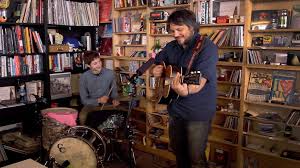
nameless SOUNDTRACK: TWEEDY-Tiny Desk Concert #391 (September 22, 2014).

tweedyI’ve recently become a major fan of Wilco and Jeff Tweedy’s songwriting.  This band is Jeff Tweedy and his son Spencer (on drums).  They usually perform with a full band, but here it’s just father and son.

The songs sound very much like Wilco (Tweedy’s voice is unmistakable), but there is a different, almost patient feel to these songs that makes them seem not-Wilco.  Spencer’s drumming is not flashy (that wouldn’t work here anyway), but it is right on the beat with occasional flourishes.

“Wait for Love” is a sweet ballad.  “New Moon” is a bit more upbeat.  There are 20 songs on the record.  After the second song, Jeff says he doesn’t know how many songs they’re supposed.  Bob says they’re supposed to play til 6″ (it appears to be early afternoon).

Jeff says they can stay till six, There’s nothing happening in the world, right? Bob states, “There is no news today.”  Jeff smiles and says that later “Spencer and I are going to reveal our strategy for ISIS, so it’s a good thing you’re here.”

“Low Key” is more rocking with some cool chord change progressions in the middle (ans a little drums-only section).

Before the final song, he says he wrote it for Mavis Staples (She didn’t sing it when I saw her…bummer).  He says that “Spencer didn’t play on that record… but we know how to play it together.”  He pauses and says, “We know how to play all of our songs together.”  Pause  “I’m such a good front man” (to much applause from everyone).

Jeff laughs and says that Spencer is gonna get a microphone and “you’ll have to talk to people.”

“You’re Not Alone” is a bit more complex and powerful than the others and that repeated refrain of “open up this is a raid” is really great.

The Wilco Tiny Desk Concerts have been raucous and fun.  This one is much more low-key and shows off a different side of Tweedy.

There’s a sweet moment at the end of the set where Spencer give his dad a hug.

[READ: April 20, 2016] The Nameless City

Faith Erin Hicks has been consistently excellent with her graphic novels.  I was pretty excited to see that she had a new book coming out.  And I was even more excited to go to the library and see that Sarah had requested it already.

I dove right in to this story.

It begins with some unnamed people riding down the River of Lives and going into a city.  They ask several different people what the name of the city is and they get several different titles.  They determine that this is the nameless city.

It turns out that every civilization that has conquered the city (which happens every thirty years or so) renames the city.  And, depending on which invaders you like best, that would be the name you would choose to call the place.  We later learn that most of the conquerors only conquer the main walled city proper and that the houses and markets on the other side of the wall pretty much just go with the flow.  The people who live outside hate everyone who is in charge and just try to keep their heads down to survive. (more…)

Read Full Post »

lilychen SOUNDTRACK: BARRY DOUGLAS-Tiny Desk Concert #537 (June 3, 2016).

barryBarry Douglas is a “classical” pianist from Ireland.  I’ve put classical in quotes because although what he plays is classical in sound, the music actually comes from Celtic tradition rather than the classical canon.

“The Coolin” (An Chúileann) translates to “The Fair-Haired Girl” and dates to around 1641.  His arrangement has a very baroque feel (he is actually a classical pianist, too), which gives the traditional song a more regal air.

He follows that lovely delicate song with “Planxty Dylan.”  Planxty is an Irish dance.  He says that harpists would travel around Ireland and people would look after them.  The harpist would then thank the homeowner by writing a song named after the home where they stayed.  This romp of a dance (at only about 1 minute long) was dedicated to the house of Dylan.

From playing a planxty to the band Planxty.  Douglas has arranged the Planxty song “Raggle Taggle Gypsy” for solo piano.  It has been around since the 18th century.  Planxty made it more famous as a vocal song (which I know) but Douglas’ piano version has a lot of fun with the melody as well.  The melody is also known as “Black Jack Davy.”

“My Lagan Love” is about the River Lagan in Donegal (there are actually four Lagan Rivers in Ireland).  The melody and poem were written by unknown persons.  Douglas arranged this without words in an attempt to make it more timeless.  I know the original and this is a really lovely in this instrumental version.

I can say that I was pleasantly surprised to hear this was the kind of solo music that Douglas was going to play.

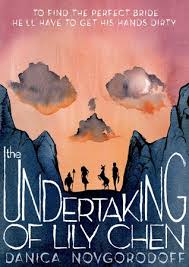
[READ: April 2, 2016] The Undertaking of Lily Chen

The whole premise behind this story is disturbing and apparently true.

Novgorodoff includes a section of an article from 2007 which says that parts of rural China have seen the rise of “ghost marriages.” In this situation, when an unmarried an dies, his parents procure the body of a woman, hold a wedding and then bury them together.  This has led to a black market in corpse brides.  EW!

This story explores that revolting concept. (more…)

Read Full Post »

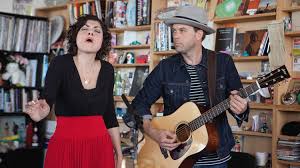
broxoSOUNDTRACK: CARRIE RODRIGUEZ-Tiny Desk Concert #535 (May 27, 2016).

carrieCarrie Rodriguez is also from Texas.  She sings in both Spanish and English, plays guitar and violin and has a wonderful stage presence.  Her voice is powerful and confident and her duet partner Chip Taylor is a perfect accompanist for her.

Her first song is called “I Dreamed I Was Lola Beltrán.”  Beltrán is one of Mexico’s most highly regarded ranchera singers.  In the lyric she sings, “and you were Javier Solis” (he was another highly regarded ranchero singer).  The end of the lyric is “and we were baile baile baile while you sang to me.”  It’s quite romantic.  Rodriguez plays the four string guitar while Taylor plays slide guitar.  Given the instrumentation, this song could feel very country, but it doesn’t primarily because of the way she sings–more sultry than country with a dapple of ranchero on top..

She introduces the second song, “Llano Estacado” by saying that her grandmother is from there.  It’s up near the panhandle with ghost towns and strange people up there.  She says people there pronounce the town Lano es Tacado.  Taylor switches to electric guitar and she stays on the four string acoustic. There’s some wonderful Spanish pronunciations there.  This feels more like a cowboy song (except for the buzzy electric guitar).

Somebody brings her a beer (or maybe champagne) which she says is perfect as the final song is a drinking song “Noche de Ronda” (a night out on the town).  She says that in this song, “She is singing to the moon because her lover isn’t with her because he is out with his friends having a good time.”  Taylor laughs and says, “it’s a fictitious song.”

He plays guitar.  She sings a beautiful Spanish and hits some lovely notes.  After a lengthy introduction, the song turns into more of a Spanish lullaby (with some very fast lyrics).  It’s a really beautiful ballad. Then, about four minutes in, Carrie picks up a violin and begins playing a solo.  After about a minute of beauteous soloing, she shifts gears and starts playing a wild solo fiddle with scratchy bowing and some really fast playing. It’s fun and intense and  the whole solo lasts about 4 minutes.

Rodriguez really showcases all of her talents in this Tiny Desk.  She’s a force to be reckoned with.

[READ: February 15, 2016] Broxo

The drawing style of this book reminded me a lot of Bone.  Between the setting and the way the human characters looked, it had a very Jeff Smith feel.  On closer inspection, there are enough dissimilarities to make Broxo its own.  And it’s compelling in a very different (and darker) way.

What is particularly interesting about this story is how elliptical it feels.  The story begins with a woman, Princess Zora of the Granitewings, reaching the top of Peryton Peak in search of the Peryton Clan.  But we don’t learn all that much about her or all that much about the world she’s in (we get enough to make the story work, but that’s about all).

Peryton Peak looks abandoned, there’s no sign of human life.  While exploring, she is set on by little ferret-looking creatures, but she quickly gets rid of them.
(more…)

Read Full Post »

alieeenSOUNDTRACK: THEE SILVER MT. ZION MEMORIAL ORCHESTRA-Hang On to Each Other EP [CST105] (2014).

Hang_on_to_each_otherI try to go in sequence with a band’s records.  But this release is, inexplicably, a dance remix Ep of a song from the album Horses in the Sky.  The original is basically an a capella song with a harmonium.  Efrim sings the main melody and the chorus sings the repeated refrains.

It’s pretty cool and the spareness of it really resonates.  About four minutes (of 6 and a half), the refrain switches to “any fucking thing you love.”  Then about 5 minutes in he switches to “birds toss precious flowers from the murky skies above” while the chorus starts singing, “Any fucking thing you love.”

This EP features vocals by Ariel Engle of AroarA, and virtually nothing of the original song except the words.

The first side “Any Fucking Thing You Love” is 11 minutes long and is as promised, a dance remix.  And it is a serious, get your butt on the dance floor remix.  No irony, no winking, just butt shaking.

It opens with roars and a boat (ocean liner) whistle and then some dance drums.   Then there’s what sounds like lions roars, a middle-eastern-sounding instrument and screams.  Then the female vocals come in singing “Hang On To Each Other.”   The majority of the song is an instrumental dance section with washes of keyboards and drums.  There’s roaring noises as the beat keeps up the pace.  About 9 minutes in she starts chanting “Any fucking thing you love” and the song continues to dance on until the feedback sounds at the end.

Side two is “Birds Toss Precious Flowers” which opens with that same boat whistle.   Some skittery keyboards come in and out and then a big bass drum starts keeping the beat.  It doesn’t start getting dancey until after about 90 seconds.  That’s when the vocals come in—echoey and very cool.  About four minutes in the music cuts away and it’s just the thudding bass drum and vocals, then the song picks up again  At around 7 minutes the “birds fly” part kicks in.  The song turns really dancey with a vocal solo   The last two minutes are more or less the keyboard winding going through a very slow reverb pedal.

Of the two, I like the second one better as there’s more interesting things going on, but I have to assume that the first is a better club song.

[READ: February 15, 2016] A.L.I.E.E.E.N.

Lewis Trondheim found this book while on vacation.  It is the first collection of extraterrestrial comic strips every discovered.  And Trondheim convinced First Second to publish it [#10yearsof01].

A.L.I.E.E.E.N. stands for Archives of Lost Issues and Earthly Editions of Extraterrestrial Novelties.  (The book was originally published in France with the title A.L.I.E.E.N.)

The book is adorable, with cute and cuddly aliens creatures on a fascinating world.  There’s a blue four-legged guy and a yellow two-legged guy with a long tail and they are frolicking amidst butterfly-looking creatures.  The aliens only speak in alien tongue (I wonder if the characters can be translated or if it is just gibberish).  Then on page two, the blue guy runs into a tree and has both his eyes poked out in pools of blood.

WHAT?! (more…)

Read Full Post »

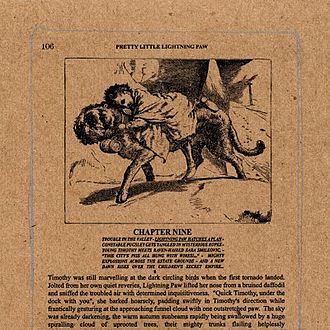
ninthSOUNDTRACK: Thee Silver Mountain Reveries-The “Pretty Little Lightning Paw” E.P. [CST030] (2004).

lightpawAfter three albums, it was time to make an EP under yet another variant of the band’s name.  This is a fun release (which is interesting to say about a band who is typically quite serious).  What made this “fun” is that many of the band members switched instruments for this recording. Violinist Sophie Trudeau plays bass guitar.  Guitarist Ian Ilavsky, usually one of the band’s guitarists, plays drums.

Also when they finished recording, was complete, the EP was played on a boombox and re-recorded from that.  I can’t tell that it was recorded in this way, so who knows if that made any difference.

There are four songs, “More Action! Less Tears!” is the first.  It begins with Aimee shouting “Hello!  Hello!” and then messing up and laughing.  So she begins again, “The name of this song is More Action.  The name of this song is Less Tears.”  It sounds unlike anything that SMtZ have done so far.  The guitar that opens it is distorted and plays a fairly conventional riff while the violins play a suitable melody over the top.  The strings build and the songs oars.

“Microphones in the Trees” opens with a guitar melody that’s quickly joined by the same melody on upright bass.  Efrim begins singing (his voice is distorted and echoed and sounds almost more like an instrument than a voice, although you can hear the lyrics: “microphones in the trees, cameras in the sky.”  The choir starts singing along with him until about three minutes when a wash of noise over takes the song. This lasts for a few minutes and then fades, allowing the words to continue.  About half way into the song a rather shambolic chorus sings “we are the flood.”  The last two minutes or so are simply feedbacky noises wafting around.

“Pretty Little Lightning Paw”is the ten-minute title track.  It opens with bass notes and chimed notes.  The strings follow Efrim’s vocal lines (which sound ragged and quiet).  And then after a minute or so new strings come in, slightly unsettling sounding.  About three minutes in the 4 voice choir begins singing an alternate melody above Efrim’s repeated mantra.  The song continues in this vein for pretty much the rest of the song, only modifying at the end where the sounds and feedback resemble birdsong.

“There’s a River in the Valley Made of Melting Snow” is 5 minutes long and is basically a solo song from Efrim.  He plays guitar, sings and plays “toybox.”  The melody is fairly simple and his voice sounds pretty good–not too shrill.  It may be the most conventional song that SMtZ has recorded.

While this EP doesn’t deviate drastically from the band’s normal sound, it is fun to see them mix things up a bit.   For this recording, the band was

  • Thierry Amar – violin, bass guitar, vocals, pianohandle
  • Ian Ilavsky – drums
  • Efrim Menuck – guitar, piano, organ, vocals, feedback, toybox
  • Jessica Moss – violin, vocals
  • Sophie Trudeau – bass guitar
  • [Beckie Foon is absent]

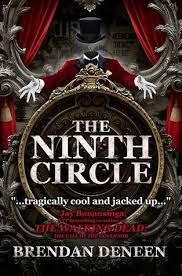
[READ: May 5, 2016] The Ninth Circle

Brendan and I went to college together.  In fact, I knew Brendan from his submissions to both the newspaper and the literary magazine.  He was a major talent back then (I still remember details from the story he submitted twenty some years ago) and continues to be one now.  He works in comics and has written for Flash Gordon, his own book Scatterbrain and something that I can’t wait to find a copy of: Charlie Sheen: Vatican Assassin Warlock.  Check out his output on Goodreads.

This is his first published novel, I believe. And I was hooked from the first chapter.

The story is about 16-year-old Dan.  His family is a disaster–his brother is obsessively mean to him, his father is an alcoholic, his mother is probably sleeping with someone else, and neither parent gives him the time of day.  For his 16th birthday they take him to the circus, even though he never said he wanted to go to the circus.  His brother promises to get revenge for having to go to this lame spectacle.

Dan’s not even sure that he’s going to like it, but he winds up being mesmerized from the moment he walks in.  The trickster tricks him, the freaks entice him (he finds the bearded lady especially enchanting) and the whole show is truly amazing.  Later that night, while lying in bed thinking about his crappy life, Dan decides to take action. (more…)

Read Full Post »

breachSOUNDTRACK: THE SILVER MT. ZION ORCHESTRA & TRA-LA-LA BAND (WITH CHOIR)-“This Is Our Punk-Rock,” Thee Rusted Satellites Gather + Sing, [CST027] (2003).

MtzionthisisourThis album is a pretty massive change for A Silver Mt Zion.  It both brings this band closer to their alter ego GYBE but also pushes them further away at the same time.  How?  Well, musically, this album sounds a lot more like GYBE–epic songs all over ten minutes with lots of strings and soaring moments.  But the big difference now is that every song has vocals (hence the new title of the band).  The line up has stayed the same although they have many guests for the choir.  The choir is referred to on the album as Thee Rusted Satellite Choir.

“Sow Some Lonesome Corner So Many Flowers Bloom” opens the disc with someone counting of “1234… 12345678.”   And then a simple guitar and bass melody starts up.  The song sounds fairly conventional, in fact.  And then the choir kicks in.  Many many voices singing, “Ahhhh.”  And then a solo voice continues the “Ahhhs” in another pitch while the choir continues.   I love this whole introduction–the various keys the voices are in, how the bass voices start singing “fa fa fa la la so” and on and on in varying formats.  The choir (a bunch of friends and bandmates) sounds great–not perfect but perfect for this song.  This lasts for about 7 minutes before the choir fades and the rest of the song begins with a swelling of droning music.  Strings come in and the song stays quiet for a couple of minutes before the guitar riff from the beginning returns this time with string accompaniment instead of voices.   Around 12 minutes the strings change to something else–more grandiose music which sounds amazing.  About a minute later the drums begin and the song takes on a whole new style.  This more rocking sound continues until the end of the song.  It’s awesome.

“Babylon Was Built on Fire/StarsNoStars” opens with staccato echoed guitars (it also feels a bit like Pink Floyd).  There’s ambient washes of guitars that float around, but the whole things sounds very trippy (not a sound I associate with this band).  About six minutes in, Efrim begins singing.  This is the first time he’s sung quite so loudly and clearly.  His voice is anguished and a bit harsh, but it works pretty well with the violins and the cool bassline that walks throughout the song.  With about 4 minutes left, the music changes direction.  The guitar starts playing a single note, growing louder and louder as the strings surround the guitar and voice: “Citizens in their homes and missiles in their holes.”  Efrim (I assume) sings a round with himself as more and more lines of text fill the song.  Although his voice doesn’t sound radically different in each one, he does adjust volume and tone enough to make it sound pretty interesting.

“American Motor over Smoldered Field” is the shortest song on the disc at 12 minutes.  It begins with a simple acoustic guitar melody (quite pretty) and Efrim singing over it (I appreciate the different vocal styles in this song).  It’s really quite a compelling song as that guitar continues and the strings come in behind it.  Around four minutes in, the drums crash and the song takes off.  The strings change and the song becomes very intense–faster and louder.  This lasts about three minutes before a staccato guitar picks up and choral voices are heard way in the background.  The voices (all Efrim, I believe) build and build as the guitar maintains.  Around nine minutes the strings and guitars change and the song flows as a new vocal line joins in “this fence around your garden won’t keep the ice from falling.”

The final song, the 14 minute “Goodbye Desolate Railyard” also opens with acoustic guitar and Efrim’s vocals. The song (an elegy for a dying city) remain simple–acoustic guitar, simple violin and bass notes.   The song is repetitive, lulling the listener into as sense of contentment.  Although at around 5 minutes, the violins swell and become a little unpleasant–kind of harsh and a little staticky.  This continues for some 5 minutes until it is replaced by the rather close up sound of a freight train going slowly down a track.  After two minutes of this, the acoustic guitar returns with Efrim singing (in a very Neil Young kind of voice) “every body gets a little lost sometimes.”  The full choir joins in to sing these final words for a several rounds before fading out.

[READ: May 10, 2016] Breach Point

Steve and I are pals of Facebook.  If I may wax jealous for a minute, Steve has done everything that I’d ever wanted to do when I was younger–he’s been in a band (cuppa joe–they released several really good albums); he’s a graphic designer, something I always imagined being when I grew up; and now he has written a novel.  So, yes, basically I hate Steve.  Except that, of course, I don’t hate Steve.

I hate him even less because this book is not only really good, but it has brought back a part of my childhood that I had forgotten about.

When I (and anyone else who grew up in the New Jersey area in the 70s) was a kid, there were always commercials for Brigantine Castle in Brigantine NJ.  The commercials scared the hell out of me and I was always terrified to go to this place.  I knew it was down the shore but never exactly where.  And there were times when we drove to the shore and I was convinced we were going to the castle instead (totally false, Brigantine was way further north than any beach we would have gone to).  And then Brigantine Castle burned down.  Interestingly, after watching these commercials again coupled with The Haunted Mansion (another commercial played quite often), I learned that the Haunted Mansion was in Long Branch.  I never went to that Haunted House either, although I have since been to the convention center that now stands where the Haunted Mansion once stood before it burned down.

Yes, Both Brigantine castle and the Haunted Mansion burned down.  People know what happened in the Haunted Mansion fire, but the Brigantine Castle fire is shrouded in mystery.

This is all a long way to say that Steve has written a book that is based around this mystery.

Clara is a 16-year-old girl who travels to Breach Point for the summer.  She has gotten a job at an engineering firm and she is going to live with her Aunt Maureen.  When the book first opens, we see her on the bus, happy to get away from her mother and excited but nervous about gong to this place that she vaguely remembers. (more…)

Read Full Post »

witoy SOUNDTRACK: JUANES-Tiny Desk Concert #172 (November 3, 2011).

Juanes is a Colombian superstar (he’s really juanesquite hunky).  This performance consists of Juanes singing and playing electric guitar (mostly solos) and his accompanist playing acoustic guitar.

The blurb says that he usually plays arenas and large venues, so it’s a treat to see him up close like this.  He was in town to receive an award from the Hispanic Heritage Foundation.

His voice is great and powerful and while he is singing in Spanish, his phrasings don’t sound Spanish at all.  Perhaps its the blend of Colombian roots-folk and rock ‘n’ roll.

“Hoy Me Voy” begins with some acoustic guitar playing and Juanes singing.  It’s a bouncy and upbeat folk song.  And while I don’t understand the words, I feel like I can make sense of the song.

For “Yerbatero” he opens the song with a guitar riff while the other guy plays percussive chords.  The “yeaaaaaaaaaaaah” section is catchy in any language.  And the solo he plays is pretty fun.  There’s also a fairly wild guitar solo near the end of the song.

“La Camisa Negra” was requested by someone in the audience–it was one of his bigger hits.  Juanes plays a cool intro riff (and some complex chords) before launching into the song proper.  I love the middle section with the warm guitars and catchy vocals that counter the staccato verses.

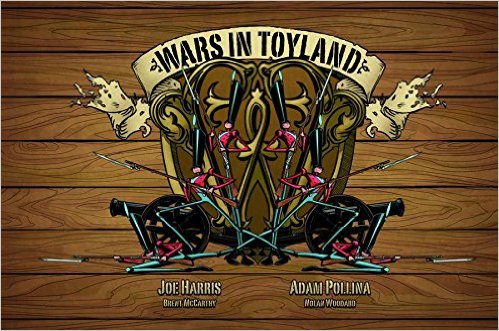
[READ: September 24, 2015] Wars in Toyland

There have been many books about toys coming to life, but I don’t think I’ve read anything quite like this before.

And the artwork is so good that it made the whole story even more compelling.

This book is geared towards YA readers and I can see why… although there’s no bad words (one “bastard”), the subject is very dark.  As it opens we see that young Matthew’s brother Adam is missing.  There’s even Missing posters on the fridge (it’s pretty dark).  Matthew and Adam used to play war with their toys all the time (I love the way the toy soldiers are drawn).

But now that Adam is missing Matthew doesn’t feel like playing war anymore.  And that’s when the toys drag Adam into the toy box and into Toyland, where things are very bad indeed. (more…)

Read Full Post »

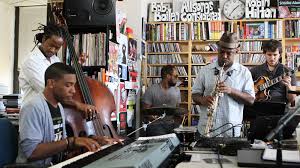
nessSOUNDTRACK: BEN WILLIAMS & SOUND EFFECT-Tiny Desk Concert #170 (October 24, 2011).

ben williasmBen Williams is a jazz upright bass player (I didn’t realize bass players made band leaders, but clearly they do).  In 2009, he won the Thelonious Monk Jazz Competition.  And is an up and coming star.

He plays two original songs from his album State of Art.

It’s not often that the blurb describes a song, but it does a better job than I could have so for the first song, “Home”

the guitar (Gilad Hekselman) and drums (John Davis) lay down an aggressive, snappy foundation. The bass and electric keyboard (Christian Sands) fill out the polyrhythms. That groove, with its snappy hip-hop flavor, feels at home cruising down Georgia Avenue, then turning right on U Street NW, the historic African-American commercial district of Washington [D.C. where Williams is from]. Then the saxophone (Marcus Strickland) enters, and it’s game on.

That saxophone really runs the show on this song.  There’s an interesting keyboard solo (I like the sound he chose, very Stevie Wonder-ish, but it’s a little quiet).

The sax switches to a smaller sax for the second song, “Dawn of a New Day.”  The song is much slower and is more than twice as long as “Home.”

There’s a pretty lengthy bass solo (which sounds very old-school to me).  It’s followed by an electric guitar solo that has an interesting effect on it which made me think at first that it was a horn.  The horn comes next with a lengthy sax solo.  The final solo comes from the keyboard (which now sounds like a piano).  And then the song returns to that interesting main riff.

[READ: April 20, 2016] The Rest of Us Just Live Here

Sarah brought this book home and told me the premise–imagine what the stories of the other kids in the Buffy Universe would be like–wondering about all of those weird kids fighting vampires or whatnot.

At first I thought she meant that the other kids didn’t know what was going on, which would have been funny.  But in this story, the kids know that there are vampires and other mystical things, they just aren’t any part of the action–they are not the Chosen Ones.

It’s a very funny premise for a book, and I looked forward to how Ness would create a story around people who aren’t “doing” anything.

But that’s not the only thing that the story is about.  Ness makes the lives of the other kids so compelling and so, human (even if one of them is a quarter god). (more…)

Read Full Post »

SlewisOUNDTRACK: BEN FOLDS-Tiny Desk Concert #508 (February 16, 2016).

benfolds I’ve liked Ben Folds for many many years.  He’s funny, he’s amazing live and he plays a mighty good song or two.  He’s the kind of artist you say, Has he really not done a Tiny Desk Concert before? (He did an episode of Live from Daryl’s House after all).  But he’s finally here to bang the hell out of their piano and curse up a storm.

He plays several songs from his new album So There, which is  a collaboration with the sextet yMusic.  I haven’t actually listened to the record much because I gave it to Sarah and haven’t grabbed it from her pile yet.  Since there’s no strings for this Tiny Desk, these songs sound just like normal Ben Folds songs–clever lyrics, fun piano and unexpected twists.

The first song is “Phone in a Pool,” one of his rollicking stompers.  It’s catchy and fun to sing a long to and after one listen, you’re right there with him in New Orleans throwing a phone in a pool.  Midway through the song, he forgets the words and just starts laughing: “In a world where you get applause for fucking up.”  And then he makes up a verse about forgetting the words.

“Not a Fan” is a slower song with a beautiful piano melody and biting, funny lyrics (get your T-shirt signed, fangirl).

“Capable of Anything” is a fast, romping song.  He says on the record the vocals are very quiet, so he’ll see what he can do.  After a run through a verse he stops and realizes that he has knocked the piano out of tune.   And when he bangs on the keys at the end, its easy to see how.  There’s some really fast piano work (and you can hear him stomping along).

he says he’ll play some old songs.  He asks for a song and someone shouts “Emeline,” which he immediately starts playing.  And then about a verse in, he gives some story behind the song.  He says that when he was a kid 8 or 9, he wrote earnest songs, but when he was a teenager he wrote “cool”s songs like “Having Two Dicks is Cool.”

And then he started using songwriter vernacular, words you only use in pop songs, “why’d you make me cry, girl?”  Why do people do that? When he was 18 or 19 he started to write songs that were more natural, like Emeline, the first song he was proud of–using the word “stupid” or a money analogy–and which he still loves playing.

He’s willing to do more songs and asks for requests saying which ones he can or can’t do.  And then Bob points out that he’s going to miss his plane if he does more than one song.  So he chooses for everyone and plays an amazing version of “One Angry Dwarf And 200 Solemn Faces.”  he says it can probably be done and will put the rest of the piano out of tune.  And he’s not kidding.  He really pounds the heck out of that thing–how does his own piano manage?

The song is bouncy and fun and he even jokes with the lyrics near the end.

It’s an amazing, invigorating set and has me really excited to see him this summer.

[READ: February 28, 2016] Lewis and Clark

In 2014, Bertozzi made the excellent Shackleton graphic novel.  But three years earlier he had created another historical graphic novel, this one about Lewis and Clark.

Like Shackleton, it aims to be truthful but not comprehensive.  Bertozzi himself explains that it is not meant to be a replacement for the scholarly recounting of the journey.  Rather, he hopes to show the “experience” of the journey.

The book doesn’t really include any historical context, so in a brief summary:

Shortly after the Louisiana Purchase in 1803, President Jefferson commissioned a group of U.S. Army volunteers under the command of Captain Meriwether Lewis and his close friend, Second Lieutenant William Clark to explore the territory.  Their journey lasted from May 1804 to September 1806. The primary objective was to explore and map the newly acquired territory, find a practical route across the Western half of the continent, and establish an American presence in this territory before Britain and other European powers tried to claim it.The campaign’s secondary objectives were scientific and economic: to study the area’s plants, animal life, and geography, and establish trade with local Native American tribes.

(more…)

Read Full Post »

« Newer Posts - Older Posts »