Feeds:
Posts
Comments

Archive for the ‘Witches’ Category

SOUNDTRACK: PHISH-Ventura (2013).

Not content to have just one concert on a release, Ventura contains two complete concerts from July 30, 1997, and July 20, 1998, at the Ventura County Fairgrounds in Ventura, California.

It’s an opportunity to compare the band at the same location one year later–these two shows exist in the vacuum between the release of Billy Breathes (1996) and The Story of the Ghost (1998), so there’s a few “new” songs in 1997, but it also doesn’t mean that they are playing the same sets–not by any means.  In fact, between the two shows they repeat only two songs: Water in the Sky (new) and Prince Caspian (from Billy)

1997 sees the band in good form.  After two solid openers with “NICO” and “Wolfman,” they play a wild “Chalk Dust” which has some crazy dissonant soloing in it.  “Water in the Sky” is a slow countryish version with piano and twangy guitar.  There’s a great “Stash” with appropriate audience clapping (I really want to see that live) and then a typically fun “Weigh.”  This is followed by lovely versions of “Piper” and “Cars Trucks Buses,” and the set ends with a slow funky version of “Character Zero.”

Set two opens with a groovy “Pinch You in the Eye” (9 minutes) and a great jamming version of “Free” (almost 12 minutes) with a funky solo.  “Free” is one of my favorite songs by them and I always think of it as “new” because it is rather poppy.  But it’s from way back in 1996 so it’s surely not new. After about four and a half minutes of trippy sounds and echoes. they start “David Bowie” (which includes The Simpsons riff and a Doh!).  The solo is long with a lengthy piano section and a mellow jazzy middle before it turns a little funky and then to a groovy jam to the end.  It runs for just over 21 minutes and the end of the song starts the chords for Talking Heads’ “Cities,” which the band segues into perfectly and then segues back into “Bowie” fop another 6 minutes.  There’s a scorching end of the song with a lot of noise before the end.  Those last scorching solos each have a break where the band sounds like they are collapsing before resuming perfectly.  It is a spectacular 32 minutes of music.  (Their live releases have me believing that they “Cities” a lot more than statistically they do).

They slow things down with a relatively mellow version of “Bouncing around the Room” (as mellow as that song can be anyhow) and then the bluegrass version of “Uncle Pen.”  The end of the second set comes with a mellow jam to start “Prince Caspian.”  Even the jam is mellow for about 9 minutes, but the set ends with a raucous version of Jimi Hendrix’ “Fire.”

The encore is a rollicking run through “My Soul” with a very fast “mymymymymymmysoul oh my soul.”  It’s a great show with lots of perfect peaks and valleys.

There’s a bonus track–a 9 minute soundcheck jam.  There’s some casual singing of some “dah dah dahs” and some high pitched “ooohs.”  A keyboard solo follows and it ends with a noisy section and a scream of delight.

In 1998, the band opened the show with a 21 minute “Bathtub Gin.”  It’s not that often that their opening song is a big ass jam.  (I’m sure someone has stats to back that up).   There’s a lot of piano riffage in the middle too.  After this, the band plays mostly short songs for a while: a mellow version of “Dirt.” Then a  fast and fun “Poor Heart” (in which Trey introduces Mike as the author–which he is).  Then a jazzy “Lawn Boy.”  There’s a romping “My Sweet One” which segues into a rocking “Birds of a Feather.”  By the time the get to “Theme from the Bottom,” which sounds great, they’re ready to stretch out.  It’s about 9 minutes long with a nice long solo.

They repeat “Water in the Sky” from last year.  It’s pretty although a minute shorter than 1997.  There’s a 4 minute jam before “The Moma Dance” starts proper (that will be on Ghost).  The set ends with a 14 minute “Split Open and Melt.”

Set 2 opens with a really long (14 minute) version of The Who’s “Drowned” and a dark moody jam although the reggae chords of “Makisupa Policeman” start long before “Drowned” ends.  And as the reggae jam starts, Trey sings “woke up this morning… SKUNKED” to much cheering.  The song ends with a trippy synth section that segues into “Maze.”  Page continues The Who theme with a solo version of “Sea and Sand.”  It’s interesting that in 1997 their second to last song was “Prince Caspian” (about 9 minutes). A year later their second to last song is also “Caspian,” this time 12 minutes with a rocking solo.  It segues into a stellar set-ending fifteen minute “Harry Hood.”

The encore is a crazy “Sexual Healing” sung by fish.  It’s goofy and it goes on way too long (nearly 8 minutes), but they follow it with a 12 minute jam of “Haley’s Comet.”  I love the harmonies.  The song ends with some rumbling noises as the guys leave the stage.

The bonus soundcheck is a reggae riff with them reciting the lyrics “I’m your Venus, I’m your fire.”  It’s a decent enough jam for a soundcheck although I’m most impressed with how Trey ends with a wrap-up riff instead of just stopping the song.

The bonus soundcheck songs aren’t that great to have–more like special feature on a DVD.  But the main sets are fantastic.  And you get 35 different songs between the two shows.

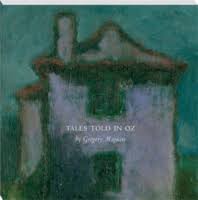
[READ: November 22, 2016] Tales Told in Oz

I read the 16 Madras Press Books some time ago and posted about half of them.  So here’s the other half coming up.  So what is Madras Press?

Madras Press publishes limited-edition short stories and novella-length booklets and distributes the proceeds to a growing list of non-profit organizations chosen by our authors.

For this particular book, “The author of the bestselling Wicked Years series returns to Oz with a compendium of folktales.  Proceeds to benefit Friends of West Hartford Library.”

I’m probably the only person who would read this book not knowing who Gregory Maguire was.   Well, I’ll amend that.  I knew who he was and I loved Wicked when I read it.  But I forgot who he was (his name  did sound familiar, though).

As I said, I loved Wicked but didn’t read anything else in the series.  I was only vaguely aware that there was a series–evidently there are 4 books and this book is considered 0.5.

All of this is introduction is to set up why I didn’t really enjoy this book that much.  Not realizing that it was part of Maguire re-imagining Oz, I thought it was weird and arbitrary that it was “set” in Oz.  Why not just make up your own world to tell these stories about.

Now realizing what was at stake, I appreciate it more, but since I’m not invested in his series (or really in Oz itself–I’ve never read more than the first book of that series either), these were just amusing tales. (more…)

Read Full Post »

[LISTENED TO: August 2017] Falling In

Our trip to New Hampshire wasn’t going to be that long but I decided to really stock up on audio books.  This one sounded interesting, but I was mostly intrigued because I’ve enjoyed Jessica Almasy’s narration in the past (she sounds very young and like she is always smiling).

I liked the premise of this story: a girl walks through a door into another world–not terribly original, I admit, but still interesting.  And the way O’Roark Dowell set up the story was really promising.

The main character is Isabelle Bean, a middle school girl and a misfit.  And I absolutely loved the way her character is set up:

Over the years Isabelle had demonstrated an impressive talent for irritating teachers to the extremes of their patience. It wasn’t something she set out to do. In fact, she never quite understood what she did to raise her teachers’ blood pressure to such dangerous levels. Neither did her teachers, and this irritated them even more. Teacher’s college had equipped them to handle nose pickers, fire starters, back talkers, hitters, biters, and whiners. But quiet girls who weren’t shy, girls who talked in riddles but were never actually rude, girls who simply refused to comb those confounded bangs out of their eyes, well, girls like that were beyond them.

(more…)

Read Full Post »

  SOUNDTRACK: SARAH JAROSZ-Tiny Desk Concert #324 (December 7, 2013).

I know Sarah Jarosz’ name from somewhere (anything spelled like tha I’ll remember), but I’m not sure where.  It turns out that Jarosz plays awesome bluegrass.

Perhaps I’d heard of her because of her youth:

The singer and multi-instrumentalist first surfaced as an 18-year-old wunderkind with the release of 2009’s Song Up In Her Head, which generated the first of what will likely be many Grammy nominations; now a grizzled 22, she’s out performing songs from her fine new third album, Build Me Up From Bones.

performed with the aid of fiddler Alex Hargreaves and cellist . All

“Over the Edge” has a great riff.  It starts out with Jarosz’ guitar (which is an 8-string guitar: twinned four string, so almost like a bass and yet strummed).  She’s accompanied by a plucked cello (by Nathaniel Smith).  And then her voice comes in: distinctive, raspy and really lovely.  But it’s after the first verse when the guitar and cello both play that fast 8 note riff that the song really kicks into bluegrass territory. In the middle of the song, it’s fiddler Alex Hargreaves who throws in some great bluegrass fiddling lines.  It’s swinging and rollicking and really fun.

“Build Me Up from Bones” is more folk sounding—her voice is beautiful and the melody of this song (which she plays on that 8 string guitar) is outstanding.  There’s a cool alt-folk tone to the song, especially in the bridge.  The cello is bowed, giving a rich sound before the violin (rather than fiddle) solo comes in.

For “Fuel The Fire” she switches to banjo.  This is a great bluegrass song and that banjo sounds great.  I’d love to see a double bill with her and Punch Brothers.

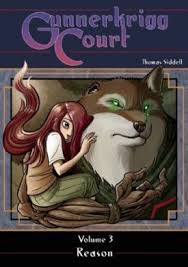
[READ: November 12, 2016] Gunnerkrigg Court 3 [23-31]

I really enjoyed book 2 of the series and was pretty exited to see that book 3 was already out–in fact books 4 and five have been released, too.  This book collects Siddell’s online series–for frame of reference, this book ends with chapter 31 and as of May 2017 he is up to chapter 62 online.

I loved that Chapter 23 started with a totally different style–looking like a kind of sci-fi epic (and called Terror Castle of the Jupiter Moon Martians). But we quickly learn that this new look is a simulation–a kind of test for the main kids.  But it’s very poorly made and they solve the mystery almost instantly. This plot leads to a couple of interesting revelations.  That Parley has a thing for Smitty (everyone can tell but the two of them), and that Jones is becoming a fascinating and enigmatic important character. Reynard is also even funnier with his comeback “I think you detect a hint of shut your face” which Anni responds to with “Hah, Katerina must be helping you with your comebacks.”

The simulation room also allows for us to learn more about the origins of Reynard and Coyote. (more…)

Read Full Post »

  SOUNDTRACK: ASHLEY MONROE-Tiny Desk Concert #317 (November 3, 2013).

Ashley Monroe is a country singer.  She’s part of the new way of female country singers, most of whom I don’t really like.

But some of the folks at NPR music love country, so I’ll let the blurb do the talking for me:

The title track from Like a Rose tells an optimistic story of survival, the ambivalent ballad “You Got Me” chronicles ill-advised romantic obsession, and, of course, the Top 40 country hit “Weed Instead of Roses” functions as a playful, fun-loving mission statement. Speaking of “Weed Instead of Roses,” which closes this charming performance, Monroe says the straitlaced [Vince] Gill insisted upon the song’s inclusion on Like a Rose — even going so far as to declare it a condition of his producing the album. The guy knew what he was talking about, both in his support of the song and of Monroe herself.

“Like a Rose” is almost comical in how stereotypically country it starts out:  “I was only 13 when daddy died /Mama started drinking and my brother just quit trying.”  Good lord.  At least it has a positive message.

She says that the melody for “You Got Me” came to her in her sleep and woke her up.

“Weed Instead of Roses” is a song she wrote as a joke when she was 19.  She says her grandpappy first heard the lyric as “give me weeds as well as roses” and he thought that was right on because the weeds are just as important as the roses.

The song is definitely fun (and funny) but the whole set is way too twangy country for me.  And IO find her back up guitarist/vocalist to be even more whiny/twangy than her.  Yipes.

[READ: February 26, 2015] Gunnerkrigg Court 2 [15-22]

I was originally mixed on Volume 1 of this series, but I jumped right into this one and loved it from start to finish (even if I admit to not understanding everything that was going on).

The book, which compiles chapters 15-22 and some extras, doesn’t begin with any kind of recap, so you kind of have to catch up as you go along.

We meet the fairy from beyond the river who was turned into a girl.  She is very upset that her friend is no longer friends with her.  She assumes it’s because of her hair (which is now long).  In an amusing sequence, she believes that if she cuts her hair short and spiky she will be friends again (with some other girl).  She is delighted to learn she can cut her hair and it doesn’t hurt (then she attempts to cut off her finger).

But these cute one-off chapters are strategically placed between the more serious arc, which involves the awesome looking Muut (an owl head on a hunky man’s body) and the introduction of a short-haired woman who might be a teacher and who goes by the name Jones. She is a wise woman and an amazing fighter (she shows off by beating a man wielding a sword while she is unarmed). (more…)

Read Full Post »

melvin3-cover_SOUNDTRACKCREOLE CHOIR OF CUBA-Tiny Desk Concert #192 (February 6, 2012).

creoleThis concert was something of a surprise for me.  The blurb seems to think that it should be a surprise, especially if you are familiar with Cuban music.  I’m not, so I’m even more surprised.

Just when you think you know Cuban music, along comes the Creole Choir of Cuba. This group sprang from the ashes of Grupo Vocal Desandann, a small vocal outfit created in the late 1990s to celebrate traces of Haitian culture in eastern Cuba.  That history dates back to the late 18th century, when slaves from Haiti were delivered to Cuba to harvest sugarcane after successful slave revolts in Haiti. A long-lost culture was revitalized by the group through music performed largely a cappella and entirely in Haitian Creole.

As with other forms of music associated with the African diaspora, The Creole Choir of Cuba’s work resonates with songs of resistance and celebration of community life, which offered hope and relief from the bitter realities of slavery.

The choir sings three pieces.  And it’s cool the way it is a choir for certain, but that they throw elements into it that are not normally associated with choirs.  For “Marasa Elu” their voices are beautiful, with a great bass voice underpinning the soaring lead voice.  It’s fairly astonishing that she starts to cry at the end of the song (whether fake or not it’s hard to tell).

“Ayiti Krye” has a different lead singer with a very different voice.–although the rest of the choir still sounds great with her.  It comes as quite a surprise about half way through the song when the drums and percussion come in–it really changes the feel of the song and of this choir.  Suddenly the piece is a more dancey song, especially as the percussion picks up speed.  A guy with a wonderfully raspy voice takes over lead.  And the rest of the group really starts to get into it–dancing and singing a beautiful backing vocal that sounds much less like a choir and more like a Cuban dance song.

For “Lumane Casimir” the first singer is back.  There are quiet congas keeping the beat.  While the backing vocals sound a lot like a choir, the lead singer sounds more like a conventional singer.  By the end, they are having a ton of fun and she invites two of the audience members to dance with her (including Felix, the host).  And as any music like this should, the end of the song introduces a whistle keeping a beat.

This is a very different kind of choir–at once sacred and fun.

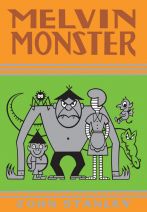
[READ: January 22, 2016] Melvin Monster Volume 3

Last year I really enjoyed the Moomin books which Drawn & Quarterly reprinted.  Another artist that D+Q has reprinted is John Stanley.  And they have made the appropriately titled The John Stanley Collection.  This collection is somewhat confusingly labelled because there are collections of different characters (Nancy, Tubby, Melvin) each with multiple volumes, and it seems like maybe they are supposed to go in a certain order.  And really it’s not that hard to figure out once you know the way it works, but it’s a but of puzzle if you see only a few books on the shelf at the library.

These books were originally printed as comic books.  This book contains the final Melvin Monster comics.  The title page says “Collected from the issues seven to nine of the Dell comic book series”  And D+Q has retained that look perfectly.  Even the paper that they have used for this beautiful book looks like comic book paper (although it is very heavy stock).

In the first issue of the book, Baddy tries to get Melvin a job as a babysitter.  The baby is actually a huge giant which leads to all kinds of amusing scenes of Melvin fleeing from the giant.  Although Stanley was never concerned about being PC, the fact that he set his strip in Monsterville certainly allowed him to get a way with a lot of rather un-PC dialogue.

I’m not sure why Stanley only made nine issues (if it was Dell’s decision or his), but there’s a lot of repetition in the premises.  Melvin trying to go to the school and Ms McGargoyle not allowing him in is a very common joke.  Although in fairness, she does think up many new ways to keep Melvin away.

Little Horror is always a fun character.  In this one she does a spell which turns Melvin into a half frog.

There’s a joke about Cleopatra, the family’s alligator, trying to eat him. And the one with Damon constantly giving him bad advice would be funny whether they were monsters or not.

“Blackout” is an interesting strip as it shows Baddy getting ready to watch wrestling –“the first four rows of human bean lady fans armed with cement filled handbags an shish kabob skewers.”

Book 8 opens with “Supermonster” in which a huge monster living nearby is getting ready to destroy Monsterville.  And it’s up to Melvin to help out.

I enjoyed seeing him integrating snow into a few of these strips (although not sequentially in any way).  There’s a good one that involves digging to the school.  There’s a short one that involves Little Horror breaking ice with her high-pitched shriek and another short one with a giant snowball (that I don’t quite get).

Speaking of un-PC, there’s an entire story that involves a Native American totem pole monster–I guess since it’s a monster its okay, although the way it talks is pretty awful.

Book 9 starts with a monster that frightens Baddy.  I enjoy that Baddy is actually quite a coward despite his size and demeanor).

Little Horror returns with a broken magic wand which is pretty fun.  The punchline where a tiny Baddy is afraid of Mummy is outstanding .

I also really enjoyed the way that McGargoyle got rid of Melvin in the final schoolhouse joke–by having him learn C-A-T and B-A-T and then telling him he graduated.  Of course Melvin redefines high school for us all.

The final strip in the book is the one I knew from the D&Q 25th anniversary book.  In it, Melvin drinks a potion that turns him into a normal-looking boy. Which would of course freak out the whole family.

I also like that the final pages of this book include all of the original covers from the Dell comics (12 cents each!)

I’m fascinated at the publishing schedule of these issues

  • Apr-Jun
  • Jul-Sept
  • October
  • December
  • July
  • October
  • January
  • Apr
  • May
  • August

Perhaps the most interesting thing of all though is his biography which states that John Stanley “bitterly left comics sometime in the late 1960s never to return.”  Woah, I want to hear more about that!

Maybe when I read the Nancy books.

Read Full Post »

melvin2-cover_SOUNDTRACK: GLENN JONES-Tiny Desk Concert #188 (January 23, 2012).

glennI’d never heard of Glenn Jones.  The blurb says that he only recently took up the banjo (which I assume means he has played the guitar for a long time?).  Also, how funny is it  that there are two banjo players in a row.

Jones plays 3 instrumental pieces  “Tinka Marie” is a very pretty banjo instrumental (although I can’t help but feel that his high string is slightly out of tune—I find it a little jarring throughout the song).  The banjo also sounds very compressed or tight or something.  It’s unusual especially when compared to the expansive sound of the guitar in the other two songs.

Before “The Great Pacific Northwest,” he says that if he plays it right, “Mt. Rainier should burst right through the floor of this room.” He has a very interesting playing style.  He has capoed the three bass strings, but not the higher strings.  He then plays chords up and down the fretboard (leaving the capo where it is).  The beginning of this song is a series of slowly played chords, which allow each individual string to sound.  Then it picks up as he begins playing fast finger-picked (with a  thumb pick for the bass strings) melodies.

“Of Its Own Kind” continue with that half capo style and finger picking.  It has a really lovely melody, as do all three.

[READ: January 17, 2016] Melvin Monster Volume 2

Last year I really enjoyed the Moomin books which Drawn & Quarterly reprinted.  Another artist that D+Q has reprinted is John Stanley.  And they have made the appropriately titled The John Stanley Collection.  This collection is somewhat confusingly labelled because there are collections of different characters (Nancy, Tubby, Melvin) each with multiple volumes, and it seems like maybe they are supposed to go in a certain order.  And really it’s not that hard to figure out once you know the way it works, but it’s a but of puzzle if you see only a few books on the shelf at the library.

These books were originally printed as comic books.  The title page says “Collected from the issues four to six of the Dell comic book series”  And D+Q has retained that look perfectly.  Even the paper that they have used for this beautiful book looks like comic book paper (although it is very heavy stock).   (more…)

Read Full Post »

melvin1-cover_SOUNDTRACK: DEBASHISH BHATTACHARYA-Tiny Desk Concert #319 (November 12, 2013).

I like how the blurb for this Concert begins:

You’ve probably never seen or heard an instrument like this. The Hindustani slide guitar is the creation of Debashish Bhattacharya, whose creation pairs his first love — a Hawaiian lap steel guitar, a gift from his father when he was only 3 — and the sounds of India. You can see the similarities to a lap steel guitar, as Bhattacharya lays the guitar across his legs, sliding a metal bar to create the fluid, almost vocal melodies. The additional strings (and lack of frets) allow him to slide easily between notes, in the process creating a sound that resonates and drones while remaining attuned to his Calcutta home.

It’s a pretty cool instrument and does evoke Indian sounds without necessarily sounding entirely Indian.

His music incorporates a good deal of North Indian (Hindustani) classical music, but you can also hear the blues pouring out from this stunning creation. I first met Bhattacharya 17 years ago when he was touring with other great slide guitarists, Bob Brozman and Martin Simpson. In those 17 years, his music has become even more astonishing, and his instrument refined even further. This trio includes his daughter (Anandi Bhattacharya) on vocals and his brother (Subhasis Bhattacharjee) on tabla.

He plays two lengthy pieces.  It’s clear that the three of them are totally in synch with each other.  He often plays off of his daughter as she sings and he follows her (or vice versa).  He is constantly kepimg an eye om her to see what will happen next.  It’s cool watching him play the drones throughout as well.

“Raaga Khamaj” She sings beautifully.  I love the way the little finger taps can create such a great expressive sound on the tabla, but then he really wails later.  Two thirds of the way through the song almost stops entirely and then he switches to a really funky riff–its a great transition.  At times he’s almost scratching the strings making even more interesting sounds.

There is some tuning between songs and then “O My Beloved!/Pillusion” begins.  It’s more mellow overall, goalmouth the middle has an absolutely wild guitar solo which has him sliding his slide all over the place.  It’s pretty wild

The current album and some of what’s played here today can be found on two different records, the first with guitarist John McLaughlin and Dobro master Jerry Douglas (titled Beyond the Ragasphere) and the second with his brother and daughter (titled Madeira: If Music Could Intoxicate). These are brilliant recordings — and a good place to start exploring more from this unique artist after his intoxicating Tiny Desk Concert is done causing your jaw to drop.

I really enjoyed this set a lot and would love to check out his studio records to see what those sound like.

[READ: January 19, 2016] Melvin Monster Volume 1

February starts children’s month here.  Partially it’s because we can all use the good messages and kindness that children’s books offer.  But also because some of the books that I’m going to post about have been sitting in queue for over a year.  So let them see the light of day.

Last year I really enjoyed the Moomin books which Drawn & Quarterly reprinted.  Another artist that D+Q has reprinted is John Stanley.  And they have made the appropriately titled The John Stanley Collection.  This collection is somewhat confusingly labelled because there are collections of different characters (Nancy, Tubby, Melvin) each with multiple volumes, and it seems like maybe they are supposed to go in a certain order.  And really it’s not that hard to figure out once you know the way it works, but it’s a but of puzzle if you see only a few books on the shelf at the library.

These books were originally printed as comic books.  The title page says “Collected from the first three issues of the Dell comic book series”  And D+Q has retained that look perfectly.  Even the paper that they have used for this beautiful book looks like comic book paper (although it is very heavy stock).

So the premise of this strip is that Melvin Monster is a nice, good boy.  But he is raised by literal monsters.  Melvin wants to do what normal human kids do, but his parents Baddy and Mummy want him to be more disrespectful and monstrous.

The characters are Melvin Monster, Baddy (his father), Mummy (his mom) and Cleopatra their pet crocodile who wants to eat Melvin.  There are a few other recurring characters as well, like the witch and

Even though these books were first, I read them second.  And I have to say I enjoyed the long form of these stories a bit more than the short stories of the later issues.  Although interestingly the very first strips are short and don’t establish the character at all. They are just thrown right on to the page.  Well, it does actually establish that Melvin is a disappointment to his Baddy because he wants to go to school (his father played hooky for 8 years straight).

The next strip sees him going to school and other monsters trying to beat him up for wanting to go.  That’s when his demon guardian Damon shows up, although he calls him Medwick rather than Melvin–this mixed up identity results in some good jokes later on.  Ultimately Melvin winds up accidentally blowing up the school which makes his parents very proud.

The next strip continues right where the previous one left off, with Melvin sailing through the air after the explosion.  He winds up in Human Being Land where everybody treats him very badly–and he thinks it’s so nice that they want him to feel at home.

The next book focuses on the door in the cellar. His parents get mad at him and send him to the cellar.  They never go there, but milkmen and mailmen love it so much they have never come out.   When Melvin is down there he opens a secret door.  The path leads him to the subway which is pretty funny.  Incidentally in this book it is called Humanbeansville.  Through his good intentions, he breaks up a crime ring and flies home

I enjoyed that the following story introduces us to Little Horror but also continues with Baddy’s adventures in the basement hole.

Some funny scenes include him being captured by a zoo, where a specialist on monsters comes to investigate him.

In the third book Melvin gets in more trouble and Damon is there to rescue him (with a little pain as of course) from a quicksand trap.

He also manages to not die from the witch’s apples–one good one spoils the bad ones.  And then there is short strip about him breaking a window, which is deemed a good bad deed.

The final long story is a weird one about the giant rat who lives in their walls and has opened up a 4 star French restaurant (I kid you not).

There’s a few more short ones and then the final strip is about a rock that has been teetering in place for centuries.  Of course, Melvin bumps into it and then has to think fast.

I’m not sure how people reacted to these strips when they first came out–if they were considered “bad” or whatever, but it’s funny how sweet and innocent the bad behavior ultimately is.

For ease of searching, I include: Bela Bartok

Read Full Post »

castle SOUNDTRACK: TINDERSTICKS-The Waiting Room (2016).

tinderstIt had been four years since the previous Tindersticks album.  And this one was not released on Constellation Records, but rather on Lucky Dog.  Whether or not that had anything to do with the sound of this record I don’t know, but I really like this album a lot.

“Follow Me” is a slow broody melancholy instrumental with a high accordion playing a lovely melody.  It’s completely evocative.  “Second Chance Man” has a kind of unsettling vibrato on Staples’ voice.  But the melody (sparsely played initially on keyboards) is really catchy.  The rest of the band fleshes out the sound after a verse and chorus.  I love that it builds in the middle and then again at the end with horns lifting the gloom off the song.  “Were We Once Lovers” has a thumping bass line and an uptempo feel as Staples’ sings in a kind of falsetto.  I love the way all of the parts form together in the chorus that’s introduced by a simple but effective guitar: “How can I care if it’s the caring that’s killing me.”

“Help Yourself” opens with some soulful horn blasts and Staples’ whispered vocals.  The bass keeps the song going as occasional horn blasts accent this strangely catchy song.  Staples also sings in an uncharacteristically angsty style in this song, which is strangely unsettling as well.  I love the way the song keeps circling round and then almost surprising the chorus when it comes back.

Whenever Tindersticks use a female guest vocalist, they really seem to step up their game.  “Hey Lucinda” is an incredibly catchy song, starting with simple bells and an accordion playing a great melody.   When Staples’ deep voice is balanced by the exotic voice of Lhasa, it makes for a great pairing.  It’s unusual for a catchy song to be so spare, but the simple accordion accents really hold the song together before it takes off near the end.

“This fear of Emptiness” is another gentle instrumental with bass and acoustic guitar accompanied by accordion sections (sometimes dissonant near the end).  “How He Entered” is another spare song with mostly bass and keys and an occasionally scratching sound as an ascent.  But it’s still a very catchy melody.

“The Waiting Room” has that same echo on his voice as he slowly sings over a keyboard melody.  His anguished singing of “don’t let me suffer” totally makes the song.  “Planting Holes” is a short delicate instrumental with a sweet but melancholy keyboard riff running through it.

Perhaps the most dynamic song on the disc is “We Are Dreamers!”  It’s the angriest song I can think of from Tindersticks, with rumbling keyboards and tribal beats as Staples sings bursts of vocals.  But it’s when Savages’ singer Jehnny Beth adds her voice that the song turns really aggressive.  They sing the chorus “This is not us/ We are dreamers!”  And as Beth takes over the chorus, shifting pitch and intensity, Staples is commenting including lines like “You can rob us/ You can trick us/ Peer over our shoulders and steal our ideas”

The final song is “Like Only Lovers Can.”  The delicate and pretty keyboards belie the sadness in the lyrics: “We can only hurt each other the way lovers can.”  The quiet keyboards end the disc.

[READ: March 15, 2016] Castle Waiting Volume 2

I loved Castle Waiting.   And I couldn’t wait to read Volume II.

And I loved it even more.  Linda Medley is such an engaging storyteller.  Her characters feel utterly real and funny and charming.  I could read more and more and more from her.  Which is why I am so bummed that the series ends here (with rumors that she is doing more).

This volume is a bit more playful.  The characters are well-established and settling into their lives at the castle.

As in the previous volume, there are a lot of flashbacks to Jain’s childhood.

But there’s also a lot of wonderfully meandering stories in the present. The man who looks like a horse (literally) has injured his hoof, so he is hobbling around and is not as useful as he might be (and is cranky about it).

But the main story centers around the arrival of two dwarves, I mean hammerlings–only racists would say dwarves.  They are the relatives of Henry, the quiet blacksmith (who is actually human, but was adopted by the dwarves).  Henry is super excited to see them (as excited as his monosyllabic grunts allow him to be).  Actually, we finally learn why he is so standoffish and quiet most of the time.

They are here for a very specific an(and embarrassing) purpose.  They need women’s clothes for the human who works with them back home.

Their presence enlivens everyone in the Castle. They are fun and interesting–enjoying hard work and being very playful. It is with their help that the Castle dwellers do some remodeling, find a booby trap and even learn how to play nine pin bowling.  The older women who still live in the castle take some bets about who will win–with much merriment.  I love that there a whole chapter about them bowling.

There’s a subplot about Jain’s son Pindar being a leshie–a species we learn a bit about, although we also learn that they are extinct.  This plot line is never concluded properly, though.

We also finally learn about Doctor and his crazy mask (it was a sort of gas mask for the plague).  They are all worried about his sanity, especially when he starts walking around wishing everyone a happy Yule (the Christmas stocking subplot is outstanding).

Speaking of Jain, she has decided to move into the Castle (where there is indeed a ghost).  But her kindness appeases the ghost somewhat.  Especially when she teaches Simon to read (I love the scene where he learns to read and then sits at the table reading instead of eating–just like in my house).

There’s a hilarious thread about a very stubborn goat (whom Simon can outsmart).  And a multi-chapter thread about Sister trying to get a cross for Jain’s room.  We finally get to the bottom of the house sprites (they are adorable when we finally find out what they want).  Finishhtory!  Finit!  Reetoomee.

I am so attached to these characters, that I need to hear more about them.

As in the previous book,Medley’s art is simply gorgeous.  She does realism like no one I know and her characters have an awesome blend of realism and hyper-realism that makes them so enjoyable to look at (and unbelievably detailed as well).

There have been a number of graphic novels that I have gotten completely attached to, but none like this.  It was so bittersweet to finish this, knowing there’d be no more–but holding out hope for a surprise some day.

Read Full Post »

castlewaitingSOUNDTRACK: TINDERSTICKS-The Something Rain [CST086] (2012).

tinders This was Tindertsicks third and final full length album for Constellation.  It has some noisy elements–especially the distorted guitar–that feel different from their other releases.  Although overall I find the album a bit too slow and drawn out.

The first song on this disc, “Chocolate” is quite unlike other songs by the band.  It is a 9 minute slow song with a spoken word story delivered by by keyboard player David Boulter.  The music sets a nice tone for this story of living in a squalid bedsit and heading into town.  As the song picks up momentum, the guitar lines and the rest of the band add more atmosphere.  In the story, he goes to the bar to play some pool and picks up a woman–a regular.  By six minutes, the whole band, including horns is playing and the song is louder and more noisy while the story continues.  For the final two and a half minutes the band drops out and the denouement reveals a secret.  It’s a cool story, well delivered.

“Show Me Everything” opens with some slow bass and a buzzy electric guitar as the backing voice sings “show me…”  And, after ten minutes on the disc, we finally hear Stuart Staples’ iconic voice sounding deep and whiskery as lawyers.  I love the songs with the female backing vocals like this one.  “This Fire of Autumn” is a faster song with a throbbing bass line and catchy chorus (with more backing vocalists).  The addition of the vibes makes this a great Tindersticks song.

“A Night so Still” slows things down almost to whisper with the gentle keyboard riff under Staples’ languid delivery.  “Slippin’ Shoes” is a bit more upbeat and the horns come in right at the front of the song.  I love the way the bridge seems almost sinister and slick before resolving into a bright chorus.  “Medicine” is another slow song with multiple layers of guitars and slow horns and strings.

“Frozen” opens with slow horns that sounds like feedback, almost.  When the fast bassline and almost discoey drums come in, it’s kind of surprise, but a nice pick me up from the previous slower songs.  Staples is singing quickly over himself–the echoes of his voices catching up to his new lines. And the scratchy guitars and jazzy horns make a nice moody soundtrack of him pleading “If I could just hold you, hold you.”

“Come Inside” is  7 minute song with a simple keyboard riff that floats over the slow beat.  There’s a long slow jazzy outro–too long frankly.  The final song is the 2 minute “Goodbye Joe.”  Its all tinkling bells and a shuffling bass, a pleasant instrumental to end the disc.

While Tindertsicks albums tend to be kind of slow, this one has a few too many extended slow parts and not enough of Staples’ magical crooning or the more dramatic sounds that the band does so well.  I’m not sure why their next album was not put out by Constellation, ether.

[READ: February 15, 2016] Castle Waiting 1

I have been aware of Castle Waiting for a long time.  I believe I have even picked up an individual book at the comic book shop (of course I never read it because I wanted to start from the beginning).

So this book collects Chapters 1-19 (plus an epilogue).

I was instantly hooked by Medley’s outstanding drawings–so believable and realistic while exaggerated enough to make them all unique characters.  Not to mention the fact that there are humans and human hybrid creatures (and no one bats an eye).  And then top it off with the incredibly creative first chapter.

The story opens with a king and queen having a baby.  Actually they couldn’t have a baby so they employed a local witch for assistance.  The nice witch gives them good advice but when the town’s evil witch hears of this betrayal she plans to curse the baby.  And thus on the girls’ fifteenth birthday, the evil witch says she will prick her finger on a needle and die.  This should sound vaguely familiar to fans of fairy tales   But Medley puts a twist on things immediately by removing all needles form the castle and hiring a creature named Rumpelstiltskin to do all of their work off site.  Rumpelstiltskin has been cut in half and stitched together so when the creature asks for the Queen’s child in payment, the King yells at him and says he knows what kind of trouble that leads to.

The good witch is able to deflect the curse somewhat to make her sleep for 100 years (that should also sound familiar) rather than dying.  So, when the girl’s fifteenth birthday arrives, the bad witch comes and brings a needle to set the plan in motion.  The princess falls asleep–the whole castle falls asleep and, in a neat twist, the bad witch is killed.

And then Medley has a ton of fun with the story.  When the prince comes to wake up the princess, they run off an get married.  And there’s a hilarious multiple paneled spread of the rest of the castle sanding there, mouths agape.  As the scene ends, we see three older women telling a man with a bird’s head that that all happened along long time ago.  And the castle has been a refuge ever since. (more…)

Read Full Post »

beraSOUNDTRACK: ANDRA DAY-Tiny Desk Concert #478 (October 13, 2015).

andra Andra Day looks…unusual.  Her hair is put up in a yellow scarf, she has a day-glo green clip in the front of her hair. She has dramatic eye liner on and bright red lips.  It’s quite a look.  And when she contorts her face in voice–the makeup really accentuates everything–as if she was made up for the stage rather than a close up.

But she earns the look with her powerful voice and delivery.

“Forever Mine” is an R&B song that her band assist with nice backing vocals. I love that the pianist is playing what sound lie a toy piano on top of the real piano.

“Rise Up” has a descending vocal melody that’s not unlike Prince.  It is a simple ballad played on keys and acoustic guitar.  The end has a kind of gospel tinge (and of course she does the vocal gymnastics of the genre that I really hate).  This could easily be in a movie or on some TV singing show.

Before “Gold” she asks “am I allowed to say that?” but I can’t figure out what she’s asking about as there’s nothing bad in the song that I can hear.  Of the three songs this is my favorite, particularly her unusual deliver of some of the verses and the neat keyboard sound they use.  Of course it drives me a little nuts that she sings “slipping true my hands” (her backing singers do actually sing “through” thankfully), but this is a good dramatic set ender.

[READ: October 12, 2016] Bera The One-Headed Troll

This is an unusual book.  It’s kind of cute, but in a dark and creepy way.  The whole book is done in tones of brown, making it unique in its appearance.

It took me a few dozen pages to get into this book (which is 126 pages–pretty long for a children’s graphic novel), but once the flow started happening, I thought it was quite good.

The slowness in the beginning was largely because of exposition–some of which wasn’t really necessary, I don’t think.

I also felt some confusion about Bera herself. Bera is a one-headed troll.  The fact that this is important enough to be the title seems like it should be addressed in some way in the story. But it isn’t.  We meet some other trolls with more than one head, but it’s unclear if they get more heads as they get older or if they are born that way.  Her one-headedness is never actually addressed. (more…)

Read Full Post »

« Newer Posts - Older Posts »