Feeds:
Posts
Comments

Archive for the ‘Violence’ Category

SOUNDTRACKALEJANDRA RIBERA-Live at Massey Hall (February 5, 2016).

I had never heard of Alejandra Ribera before. She has a beautiful deep voice that can really soar.

I love that she sings in English and Spanish (in the same song) and sometimes, because of her delivery it’s hard to tell which language she is singing.

The show begins with her talking about Massey Hall and how the trajectory from the [working in? a] bar to this moment is unexpectedly fast and natural (because when you’re in it, you’re in it) but it has been overwhelming with ‘pinch me’ moments.

She says, “I used to have a poster on my wall with all of these goals… to get played on the CBC and to play at Massey Hall.”

The band is minimal and they create terrific sounds with just (primarily) an acoustic guitar from Jean-Sebastien Williams and upright bass from Cedric Dind-Lavoie)

The first song “La Boca” has the acoustic guitar and upright bass moving briskly with her voice soaring (but low) on top of it–really mesmerizing.  She sings parts in Spanish.

“Goodnight Persephone” has a muted picked guitar and bowed upright bass (it opens in vaguely Velvet Underground “Heroin” way until the bowing becomes bigger and deeper).  Alejandra sings to Persephone in a wonderful wounded, pleading voice.  The ending build with the refrain “keep this light burning bright for me.”

Before starting the next song, “No Mi Sigas” she tells us (not the audience) that when she was a young girl, she had crushes on girls and at the time she knew it wasn’t okay so she started writing poetry that was metaphorical and laden in imagery so no one would know what she was writing about.  And now she’s older and it doesn’t matter who she is writing about but she has still taken this approach and it’s why all of her love songs are in Spanish because she lives in Canada.

It’s only a shame that they cut off part of this beautiful song so much while she is talking.  She plays guitar as well in this sultry love song while Jean-Sebastien plays some wonderful leads.

“I Want” is an award-winning song and her voice really reaches deep to sing it.  She sounds great in this moody piece.  And the lyrics are very cool too: “There’s so much labor just in breathing lately.”

“Carry Me” is a bit more uptempo and she sings with that great style of hers–I’d never guess she was Canadian, even with the line “all the snow in Montreal couldn’t bury this.”

Turns out she is of Argentine and Scottish descent but was born and raised in Toronto, Ontario, and has been professionally based in Montreal, Quebec.

The bridge of this song is quite compelling with the three of them singing just notes the rise through a scale–strangely compelling.  And then Ribera gives a great whistling solo–which people want to applaud for (and should) but no one does.

In the last segment, she says that before playing music publicly she had gone through a nasty depression.  She had seen that Ron Sexsmith was playing at Massey Hall and she wanted to go see him.  But the depression was too powerful and she checked into St Mike’s across the street.  She had checked in for a time and then one night went to the stairs to smoke and saw the Ron was playing at Massey Hall that night.  That was the pivotal moment–she was so close–and she decided to get on the other side of that door.

Once again, it’s a shame she talks over so much of her song “Led Me To You” which starts quietly but builds to a great powerful ending (with her on guitar again).

This series has been excellent in introducing me to new artists, and Ribera is a great one I hope to explore more.

[READ: January 9, 2017] “Fifty-Seven”

If you were paying attention, you’ll notice that I have been posting these old New Yorker stories on the date that they were published (no matter what the year).  There have been some exceptions (like when there was more than one story in an issue), but I thought it would be a fun thing to keep up).  I am making an exception for this because when I read this story and the one after it I felt like they were connected in some way.  So I’m moving this to July  because there’s a ton of stories to go in November.

I feel like this story was trying to make a point.  And I didn’t like it because of that.  Although I will say that it seems like Kushner really did a lot of work (unless she happens to know this much about the penal system).

This is the story of a murderer.  It is third person but from his point of view. (more…)

Read Full Post »

SOUNDTRACK: FROM THE TOP-Tiny Desk Concert #758 (June 22, 2018).

From the Top is a radio show (and podcast) which showcases young, talented classical musicians.

For over 20 years, From the Top (distributed by NPR) has built an impressive platform to celebrate the music, lives and stories of youngsters playing classical music. That’s right. Young people in this country love classical music.  We invited three talented From the Top musicians to the Tiny Desk. No squeaky violins here. These kids are terrific players.

From the Top alum Derek Wang is our good-natured emcee, in addition to serving as a sensitive accompanist for two of the pieces.

The first piece is played by 12-year-old violinist Kaia Selden–sparks fly (and bow hairs, too) when  she tears into

  • Henryk Wieniawski: “Scherzo-Tarantelle, Op. 16”

A bouncy piano opens up this amazingly fast violin piece.  Selden plays with fire and passion as her fingers fly over the fretboard for these incredibly fast notes and runs.  It’s stunning how composed and confident she is.

She explains that the song is a tarantel, a kind of dance, named after when you are bitten by a tarantula–you have to dance really fast and crazy to get the venom out of your system.

Up next is cellist Noah Lee who uncovers fascinating new sounds on his instrument

  • Mark Summer: “Julie-O”

The piece opens with plucked notes and strummed chords.  He pays what sounds like rock riffs and then after a minute or so he picks up the bow and begins playing the instrument conventionally–with some quick runs and cool sounds.  Then he adds new sounds–slapping the strings with just his left hand and then using his right percussively.  There’s some more plucking notes and full chords before ending with more bowed music.  It’s a mesmerizing solo piece.

The third musician is Javier Morales-Martinez who makes his velvety clarinet sing in elegant music:

  • Francis Poulenc: “Clarinet Sonata, II. Romanza”  The

The juxtaposition of piano and clarinet is quite lovely and Javier greats some amazing sounds out of the instrument,.

Javier says that when he was 7 or 8 he used to play music with his dad from Mexico.  He was later introduced to classical music and has been playing it ever since.

It’s an inspirational set from amazing young musicians.

[READ: February 9, 2016] “The Flower”

Erdrich had a short piece in the previous issue of the New Yorker, and here she gets a full short story.

I was really surprised to find this story set in 1839 in Ojibwe country (although I see that Erdrich has written extensively about Okibwe country, so that’s my bad, clearly).

The story is a fairly simple one.  There is an older Ojibwe woman, Mink, who is wailing and carrying on, demanding the trader’s milk –a mixture of raw distilled spirits, rum, red pepper and tobacco–from Mackinnon.  It was driving Mackinnon crazy, but Mink was from a family of healers and could not be denied.

The other man in the tent was Mackinnon’s clerk, Wolfred Roverts who was trying his best to get the sound out of his ears. Wolfred aged 17 was from Portsmouth New Hampshire.  He missed his home terribly but there was no life for him back there. (more…)

Read Full Post »

SOUNDTRACK: CRASH TEST DUMMIES-Oooh La La! (2010).

Crash Test Dummies were once huge, then mocked and then silent.  They are still a band, although the band is really only singer Brad Roberts anymore.

In fat they were more or less broken up but then in 2010 Roberts began experimenting with toy instruments, the Optigan and Omnichord.

Those instruments were the inspiration for this music and yet the songs don’t sound like novelty or “toy” creations.  Both of the instruments were proto-samplers and they allowed Roberts to generates sounds on styles he didn’t normally play.  And so we get this interesting and fun release which features many contributions from fellow Dummy Ellen Ried, who still sounds amazing.

Roberts’ voice is still deep, but he really has his songwriting chops down well.  “Songbird” is a pretty folk song with a lovely chorus.

“You Said You’d Meet Me (In California)” was recorded as a Dummies song, although this version is more fun, with the way he sings it and the way he uses the instruments’ effects.

“And Its Beautiful” really is beautiful–it’s a very catchy song with pretty instrumentation and great backing vocals from Ellen Reid.  “Paralyzed” is a slow piano ballad while “In between Places” has some cool effects sprinkled on the song.

“Not Today Baby” is a goofy song.  Dummies have always been seen as a novelty band, and it’s songs like this that are why. But honestly, what’s wrong with having a sense of humor in your music.  This song isn’t ha ha funny but it should raise a smile.

“Heart of Stone” is the kind of sad song that Brad does so well.  Ellen Reid’s doo doo doo doo” are a lovely touch.

“Lake Bras d’Or” is a pretty ballad with minimal instrumentation, while “What I’m Famous For” is over the top.  This one has a kind of Western feel–a banjo-picking, fast-talking monstrosity.  And yet it’s a fun country ditty with some pretty funny lyrics.

Roberts talked about the big band sound of “Now You See Her” as something of an inspiration for the album–that this toy could make this kind of music and he wanted to see if he could wrote a song in that style   is a kind of big band.  It’s again, kind of a novelty, but I think he pulls it off really well.

The final song “Put a Face” is played with accordion and violin and is sung entirely by Ellen Reid.  It’s a beautiful song and a lovely ending to this unexpected disc.

[READ: January 20, 2017] “Two Men Arrive in a Village”

I usually love Zadie Smith stories–even when she writes things that are quite different from her usual style  But this one is simply odd.

The title is sort of a parable and the story reads like one as well.  It even starts as if the title is the first half of the sentence:

Sometimes on horseback, sometimes by foot, in a car or astride motorbikes, occasionally in a tank—having strayed far from the main phalanx—and every now and then from above, in helicopters. But if we look at the largest possible picture, the longest view, we must admit that it is by foot that they have mostly come…. Two men arrive in a village by foot, and always a village, never a town. If two men arrive in a town they will obviously arrive with more men, and far more in the way of supplies—that’s simple common sense.

After a fairly long setup of the things two men might carry, we find that these two men arrived in the narrator’s village at sunset. (more…)

Read Full Post »

SOUNDTRACKRHEOSTATICS-The Horseshoe Tavern, Toronto (May 25, 2017).

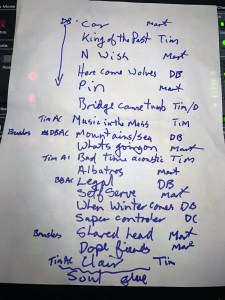
Second of four shows at The Horseshoe Tavern dubbed Spring Nationals. First Time played live for the new songs Rear View (Tim), Here Come The Wolves (Dave B), AC/DC On My Radio (Dave B/Dave C).
Lineup is:
Dave Bidini / Dave Clark / Hugh Marsh / Ford Pier / Martin Tielli / Tim Vesely

The show starts with a kind of quiet, hushed version of “Stolen Car” with cheers for Hugh’s violin solo at the end of the song. And then Martin introduces “Ford Kristofferson on the keyboards” (Man I wish I could see what Ford looks like).

Someone shouts “Rheos rule” and Clark comments, “if we did, there’d be world peace.”

They play a wonderful combination of “King Of The Past” (Clark: King of the Pasta) and “Northern Wish.”

The crowd whoops and Dave says that that is the appropriate sound for the new song.  Clark: “It’s called “Confused Wolf.”  The song is really called “Here Come The Wolves” and it’s a powerful song with great toms and violins.

This one [“P.I.N.”] is called “Snakes on a Plane.”

Clark says “Big thanks to Dani Nash and her rocking band.  She also drums for the Samantha Martin Band.  She is a wicked drummer and a knockout visual artist, too.

[We’re skipping a song on the setlist, shhh–they were going to play “Bridge Comes Tumbling Down”].  They “bridge” to “Music Is The Message” and as Tim says, “we played a bunch of new songs last night and playing them again tonight and they’re completely different.  It’s awesome.”

Dave B: We’ll try to play this next song (Dave’s “Mountains And The Sea”) well for once.

Clark says “That is the first chord of Dust in the Wind, right?  It was a hit for them, why not us?”

There was a lengthy solo from Hugh including a funny bit where he holds off on playing notes busting all the anticipation.

Martin comments: “I’ll call you David from now on.”
DB: “Are you mad at me?”
MT: “No it’s jut you insist on that….  Don’t Davids bug you?  Or Mikes who insist on being called Michael.”
DB: “I’d like to send that out to Michael Philip Wojewoda who is here tonight.”
MT: “I’ve always hated that about Michael Phillip.”
Tim: The only thing worse that David is “Daveed”
Clark: “And yet David Durango is one of the nicest guys going.” (I can’t figure out who they are talking about).
MT: He’s the only guy who almost drummed for Nick Buzz.  A Band with a “no drummer” policy.”
DS: “No drummer policy? Where do I sign up?”

Tim will surprise us with an instrument change…
Someone in the audience: “Polka the shit out of us, Tim!”
DB: “There’s heavy male patter presence, which must be offset at some time.”

Tim is on “the gentleman’s instrument” for “What’s Going On Around Here?”  It sounds great to hear again, although Tim says, “that accordion was exhaling musty basement smell in my face. It’s been down there a long time.”

Up next is a duet with Hugh and Tim (on acoustic) doing “Bad Time To Be Poor” it’s very cool to hear it this way.

Dave announced the last new song of the night.  “I know you want to hear new songs but you get worried, I hope they play the one I like.  But you’re such an elastic forgiving crowd, you’ll let us do anything.”
Tim: ” Wednesday’s crowd were a bunch of assholes.”
(Someone in audience: “I’m never coming back.”)
Tim: “This is the best crowd ever.”
Martin: “Maybe the penultimate.  There was one other that was better.  They were so good.  I loved them.  I dream about them.”

Tim tells a story about opening for The Hip and getting ambivalent and odd crowds.  We expected that.  There was no abuse.

But Dave B says they played in Quebec in purple and orange jackets and people laughed… they got it!  We should be bigger in Quebec.

Martin says in New Brunswick somebody threw something at us.  Martin says he picked it up and whipped it right back at them.
But Dave says at another show, something hit Martin and he got pissed, but it was a T-shirt that said “We love you Rheostatics.”

Tim: “The moral of the story… Fucking Rheostatics fans.”

They play a wonderful “The Albatross” which is really gelling live and then a solid “Legal Age Life At Variety Store” (with an introduction to Tim Mech).  Dave shouted that he end, the Eagleson ripped off Bobby Orr line and Tim shouted “can’t you ever get over that?” During “Self Serve Gas Station” Martin sings “What went wrong with Ford?”

After some banter they’re on to “Shaved Head” which sounds great even though Martin misses a lyric.  It doesn’t throw him, although he does apologize later.

The pretty ending gets cut off but only by a little I’d guess. And they go for an encore.

After the break Dave Clark comes out to sing an a capella version of “Johnny’s Got A Problem” by D.I.   The crowd is really into it and sings along.

As soon as Martin starts playing the crazy guitar intro to “When Winter Comes” someone in the crowd goes crazy “Oh my God!  Oh my God!”  It sounds great to hear again as well.

They end the night with a song “co-written by Paul Quarrington.  Go to a library and take out one of his books.”  A lovely version of “Claire.”

It seems like maybe there might be more, but that’s where the recording ends.  The new songs have been getting better and better, and the band is having a lot of fun up there.  Dave Clark is even being a bit more silly, but nothing like he was back in the old days.

[READ: May 18, 2018] “Candidate”

This is a story of a man who works for a presidential candidate.

It is told in first person in the present and in flashbacks.

The flashbacks talk about how he and his best friend Spencer were marginal kids in school.  Spencer in particular was a somewhat shunned individual–he could have been in the Trench Coat Mafia.  But while the narrator and Spencer shared the same views and ideas, the narrator passed more easily with the other kids. (more…)

Read Full Post »

SOUNDTRACK BELA FLECK & ABIGAIL WASHBURN-Tiny Desk Concert #741 (May 11, 2018).

I know and like Bela Fleck.  I know and like Abigail Washburn.  I had no idea they were married.

A very pregnant Abigail Washburn points to Bela Fleck at the Tiny Desk and says “and just so you know, this is his fault.” I won’t spoil the video by telling you his response.

Bela Fleck and Abigail Washburn are two American musical treasures. This husband-and-wife banjo duo write original tunes steeped in the roots of folk music. Their playing is sweetly paced with melodies interweaving through their intricate, percussive picking all while Abigail soars above it all with her discerning, yearning voice.

I also had no idea how political they are.

Their first tune, “Over the Divide,” was written at the height of the Syrian Refugee Crisis. They’d read a story about a Jewish, yodeling, Austrian sheep herder who helped Syrians out of Hungary, through the backroads that likely only sheep herders know.

Lyrical content aside, the music is just stunning.  The banjo is oft-mocked for its twang, but these two play such beautiful intertwining lines, it is just magical.   The opening melody is just jaw-droppingly lovely.

They each switch banjos to rather different-looking ones–deeper more resonating sounds

The second tune, “Bloomin’ Rose,” is a response to Standing Rock and the Dakota pipeline that is seen as a threat to water and ancient burial grounds. The intensity and thoughtfulness in Bela Fleck’s and Abigail Washburn’s music is why it will shine for a good long while, the way great folk tunes stay relevant over the ages.

But Abigail isn’t just banjo and vocals,

For the third tune, Abigail waddled over to a clogging board. And before she began her rhythmic patter, told us all that “my doctor said that what I’m about to do is ok! I have compression belts and tights on that you can’t see.” [Bela: so do I].  They then launched into “Take Me To Harlan,” another one of their songs from their 2017 album Echo In The Valley.

She says that they met at a square dance in Nashville, and she loves dancing and movement.  Bela plays and Abigail sings and taps for this jazzy number.  The middle of the song features a call and response with Bela on banjo and Abigail tapping [“Eight month?  No problem.”].

For the final song, “My Home’s Across the Blue Ridge Mountains,” Abigail says it’s usually done in a perky bluegrass country style but they listened to the lyrics and decided it was not perky at all.  So they turned it into a different thing.  It’s a somber song with Bela on a relatively slow banjo (with a slide that he sneaks on near the end) and Abigail singing mournfully (she can really belt out a tune).

Although as Steve Martin pointed out, with a banjo almost everything is upbeat.

The parties at their house must be a hoot.

[READ: January 21, 2018] “Active Metaphors” and “Death By Icicle”

“Active Metaphors” is one of Saunders’ funniest pieces that I’ve read.  And whats strange about that is that it was an essay published in the Guardian newspaper.

There are two headings: “Realistic Fiction” and “Experimental Fiction”

“Realistic Fiction” begins with the narrator in a biker bar.  He overheard two bikers, Duke and StudAss discussing these two types of fiction. –they’d purchased their “hogs” with royalties from their co-written book Feminine Desire in Jane Austen.  There was some verbal sparring during which they threw Saunders out a window “while asking questions about F. Scott Fitzgerald’s fallen American utopia.”

The narrator explained his theory of realism to them–everything happens the way it actually would and then suggests that maybe a central metaphor would help define things.  There’s an impotent farmer and every time he walks past the field, the corn droops.  An active metaphor like this helps the reader sense the deeper meaning of the story.

As they ride off with him on their hog, the bikers use some great professorial language–the end is hilarious. (more…)

Read Full Post »

SOUNDTRACK: GORDI-Tiny Desk Concert #740 (May 7, 2018).

I had an idea of what Gordi sounded like (a much more rocking band, who was I thinking of?)  Rather, Gordi is Sophie Payten a woman with a piano (and a harmonium and a guitar).  Gordi has a lovely deep voice (dusky and evocative) that is not afraid to break.

The blurb says her voice

usually gets enshrouded somehow: It often sounds like it’s echoing down a stairwell, or else she’s bathed it in vocal effects a la Imogen Heap or Gordi’s occasional tourmate, Justin Vernon of Bon Iver. But Payten’s voice is an expressive and powerful instrument on its own, as her debut appearance behind the Tiny Desk demonstrates.

Aside from a bit of looping — in the strangely infectious notes that open “Heaven I Know,” from last year’s terrific Reservoir — Gordi here keeps her voice both unadorned and centered within warm, cool arrangements that include piano, acoustic guitar, pedal steel, a harmonium named Barbara, a saxophone played by Yellow Ostrich’s Alex Schaaf, and more. The effect here is rawer than on Reservoir, but that’s part of the point: These songs stand up to being stripped down, every time.

“Heaven I Know” is really pretty with a staggering sense of loss.  She met her backing badn while they were playing with The Tallest Man on Earth.  She plays piano, there an electric guitar and some kind of synths in the back.  And the drums (played by Zach Hanson) crescendo as needed.  The song runs a little long but it’s quite pretty.

For “Can We Work It Out” guitarist Alex Schaaf switches to saxophone.  Gordi pulls out the harmonium.  She says she bought the harmonium on the Australian version of Craigslist called Gumtree.  She bought it from an Indian lady named Barbara so the harmonium’s now called Barbara.

For the final song, “On My Side” she’s on guitar and Ben Les switches from keys to pedal steel.  The song is a little faster with some great harmonies from the drummer.

This is really lovely stuff.

[READ: October 10, 2017] Death of the Pugilist

Okay, so this is a boxing story.  That means that there is going to be a fight and the guy he is writing about is either going to win or lose.

That’s the attitude I took when I started this story–I don’t care for sports stories in general and feel that they have to work very hard to be more than just win or lose.

This story is a little different because each section starts with a question.

Who was Burke? His beginnings. (more…)

Read Full Post »

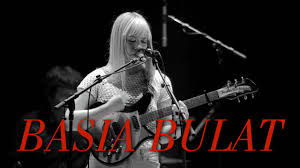
SOUNDTRACK: BASIA BULAT-Live at Massey Hall (July 10, 2014).

Baia Bulat is an adorable singer.  She plays autoharp and ukulele and seems incredibly upbeat.  She also has a soaring, delightful voice.

About Massey Hall she says, “It’s not a stadium or a club, it feels huge and intimate ta the same time.”

She opens with “Run” in which she plays the autoharp (and you can actually hear it amid the other instruments).

Next up is a new song “Five, Four” with Basia on guitar with a cool almost sinister bass line.

For “Wires,” she stays on guitar.  This song is almost aggressively upbeat and is much more upbeat.  It also has a fun middle section in which she sings an Ooooh melody  (like a solo) into a microphone with a distortion that makes it sound a bit like a kazoo. Its super catchy.  She even takes that microphone and walks around, ultimately hopping of the stage and sitting in the front row (and the guy next to her of course pulls out his phone) to continue with the oohs.

“Tall Tall Shadow” is a slow moodier song with a great big chorus. They leave the stage and come back (I’m surprised they left in the whole encore scene).

When they comeback she says, “We’re on a curfew so we’re going to try to not get in trouble.”  For an encore it’s her and two other women.  One is playing a small 8-string ukulele as they sing “Before I Knew.”

When it’s over she asks, Am I allowed to sneak one more in?  Try not to get kicked out of Massey Hall!  She gets out the ukulele and plays that wonderful melody of “It Can’t Be You.”  Then she walks away from the mic and sings her heart out.  You can’t always hear her that clearly, but you can hear her hitting the soaring notes.

It’s funny that she worries about curfew and then sings a rather long song.

But it’s a great collection of songs and a beautiful set.

[READ: March 15, 2018] Beautiful Music for Ugly Children

I really enjoyed Kristin Cronn-Mills’ book Ugly Fake which was kind of novel/graphic novel hybrid.  This is one of her earlier stories and it is all novel.  It is about music and teen angst and high school.

And it’s about a girl named Elizabeth who is in fact a boy and wants to be known as Gabe.  He has recently revealed this to his parents and his best friend, Paige.  Paige has been nothing but supportive.  His parents are a little more mixed about it.  And of course he hasn’t told anyone at school.  But since he dresses gender-neutral he has always been made fun of a school–where they know that he is Elizabeth.  He is somewhat surprised that the boys make fun of him more than the girls–calling him he-she-it.  Undoubtedly they are threatened by his looks.

But he is a senior, and school is almost over.  He can certainly cope until it’s time to move away to the city.

In the mean time, he has a DJ gig that is the best thing ever. (more…)

Read Full Post »

SOUNDTRACK: GREAT LAKE SWIMMERS-Live at Massey Hall (July 8, 2014).

I don’t know all that much about the Great Lake Swimmers.  I have heard of them (for years), but never actually heard them, I guess.

They are a five piece who play thoughtful folk songs.  Their tempo is varied with some upbeat songs and a few slower ones.

The lead singer is Tony Dekker and when he is joined by violinist Miranda Mulholland on vocals their harmonies are quite lovely.

“Think That You Might Be Wrong” is a slower song with a kind of sad violin and great harmonies.

“Put There By the Land” has a kind of fun build up with everybody “warming up” making strange sounds especially the guitar and drums, before the song kicks in properly.  The addition of the pizzicato violin really elevates the song.  I love the way in ended kind of noisily with some thundering drums as it segues into “Pulling on a Line.”

“Your Rocky Spine” opens with a banjo (Erik Arnesen) and changes the tone of the music–Dekker’s voice seems a bit higher too.

“Everything is Moving So Fast” opens with a cool mini drum solo (Joshua Van Tassel)–not a show off solo just a cool rhythmic exploration that leads to the quiet thoughtful lyrics.   There’s some wonderful harmony vocals from Miranda at the end as well as a little upright bass solo (Bret Higgins).

They brought in a string quartet to play with them, although I can’t tell if it make much of a difference since they already have a violin.

They end with “I am Part of a Large Family” which opens with another “warming up intro” which is fun.  It’s builds to a wild and fun climax with a ripping violin solo.  An excellent show ender.

These guys should certainly be in heavier rotation on folk shows.

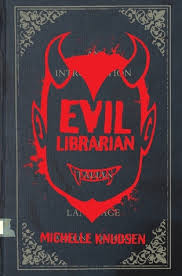
[READ: March 20, 2018] Evil Librarian

Sarah was reading the sequel to this book (Revenge of the Evil Librarian) and I thought it sounded pretty funny.  So she encouraged me to read the first one.

I really enjoyed the combination of teen romance and demonic villianry.  There’s an obvious antecedent in Buffy, but this goes in very different directions.

I also enjoyed the way the story was paced.  The book felt very long–which I know is a contradiction–and could have been a lot shorter.  But I think the stuff that fleshed it out was what made it so much fun, so I’m glad it wasn’t shorter

It opens on our heroine Cynthia.  She is crushing hard on Ryan.  Ryan is like TV sitcom architect/kindergarten teacher–jobs that people have that work well in sitcoms but that no one really has in real life).  He is a jock who loves musical theater.  He hangs out with all of his jock friends.  But he has an amazing voice and is the lead in the school’s upcoming production of Sweeney Todd.

And he’s single! (more…)

Read Full Post »

SOUNDTRACK: RHEOSTATICS-Live at Massey Hall (April 29, 2016).

After their farewell concert at Massey Hall in 2007, who would have guessed that some nine years later they’d be back again.

When I heard this show was announced I immediately bought a ticket, not really thinking about how I would logistically manage such a thing.  I was able to get it to a fan who could go, but at least I’ll have my email confirmation:

Live at Massey HallRheostatics
Fri 04/29/2016 8:00 PM
Main Floor Centre Front  Seat I-44   $29.50

This time Martin’s voice is working again.  But in the intervening years he has had something else go on with him.  I don’t know details, but there’s some kind of anxiety present–and it comes out during this show.

Amazingly, for such a big show, there is hardly any evidence of it online.  There’s a few fan videos but no full sets available.

The only performance available that I can find is the official release from (the terrific) Live at Massey Hall series.  The whole series is wonderful–professionally filmed and beautifully recorded.  The only problem is that it’s so short.  I don’t know how long the show was, but the video is only 40 minutes.

The video opens with Martin talking about his laryngitis, “laryngitis taught me to enjoy singing in a lower range.”  There’s Tim talking about seeing Devo (who were walking on treadmills the whole show) at Massey Hall and overheating from wearing a heavy coat in winter.  Dave saw lot so new wave bands who weren’t great live but were great because they were in Massey hall–it’s a forgiving and inspiring place.

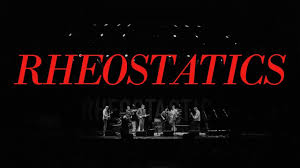
Big red letters in the back of the stage spelled out RHEOSTATISC (sic).

The set opens with “King of the Past” Martin plays a lovely solo and gets some applause and the whole thing sounds great.

“Californian Dreamline” opens with some great sound effects from Martin, Hugh Marsh and Kevin Hearn.  But after the “sensamilla” bit, Martin freaks out.  He steps away from the mic and waves everyone off.

Dave jumps in, “this happened in Montreal once. It’s true.  We were opening for Moxy Fruvous, so it’s a kind of curse we’ve got to exorcise.”

The band jams on and them Martin comes back to sing and the crowd gives him a big cheer–there really is no more forgiving crowd than a Rheostatics crowd.

The opening acoustic guitar of “Claire” begins.  That’s Tim on acoustic, Dave on bass and Martin on his gorgeous double neck guitar.  The letters have been rearranged to say SORTA ITCHES and Martin plays a great solo.  Tim sounds perfect, of course.

They start “P.I.N.”  Martin sings the first line and then has an issue.  He steps away again while the band plays on. He catches himself and returns (again to encouraging applause).  Once it gets going it all sounds great.

Dave finally gets a lead vocal song.  The letters spell out SHITCOASTER as they play a flawless “Mumbletypeg.”

Then apparently the entire rest of the show happens and we get the night-ending encore–a wild and raucous “Dope Fiends and Boozehounds.” (The letters finally spell RHEOSTATICS). The song gets off to a pretty good start.  For the middle, Martin and Hugh face each other (Martin always seems comforted by being with Hugh) and then Don Kerr gets a drum solo (with sound effects from Kevin Hearn).

At the end of the song, for the “moon,” there are howls, probably from Kevin, possibly from the audience.  As they slowly fade away, Dave jumps of the drum rise and the end of the song begins.  But this is an extended jam ending.  Hugh and Kevin make some menacing sounds and then Martin plays a solo with a slide.  It’s a weird, very undramatic ending for such a dramatic band.

I have always been sad that I couldn’t go to this show, but it sounds like it would have been a real roller coaster of a night.

Read this review from Radio Free Canuckistan for the perspective of someone who was there.

Over the closing credits, Kevin Hearn’s father read “The Laughing Heart” by Charles Bukowski.  I assume he read that before the band came out (accompanied by Hugh Marsh).

I don’t know much by Bukowski, but this is great for its simple profundity.

The Laughing Heart

your life is your life
don’t let it be clubbed into dank submission.
be on the watch.
there are ways out.
there is light somewhere.
it may not be much light but
it beats the darkness.
be on the watch.
the gods will offer you chances.
know them.
take them.
you can’t beat death but
you can beat death in life, sometimes.
and the more often you learn to do it,
the more light there will be.
your life is your life.
know it while you have it.
you are marvelous
the gods wait to delight
in you.

[READ: March 5, 2018] Head Games

As with some of my favorite books, the story behind the creation is almost as interesting as the book itself.

Craig McDonald is a journalist and he says that he is often frustrated by trying to write the truth: “read five biographies about the same person and you’ll feel like you’ve read about five different people.”  With fiction maybe you can find something bordering truth.

The introduction by McDonald tells us that we will be riding with pulp novelist Hector Lassiter.  Lassiter is the protagonist of a finite arc of ten novels. The last one, Three Chords & The Truth is a sequel to Head Games and appeared in 2016.  Lassiter is a charmer, a rogue, a rake and a crime novelist who lives what he writes and writes what he lives.  Hector was born in Texas in 1/1/1900 and the arc of the novels spans the 20th century.

McDonald says the publishing history of the books is not chronological. Head Games was the first novel published.  The second was set in 1935 and features Hemingway prominently.  Other books hopscotched through the decade. They have recently been reissued and presented in roughly chronological order.

The novels “follow secret histories and underexplored aspects of real events.”  They’re set in real places and use history and real people to drive the plots. (more…)

Read Full Post »

olymmpSOUNDTRACK: LOGAN RICHARDSON-Tiny Desk Concert #734 (April 23, 2018).

Logan Richardson is a jazz saxophonist.

I’ve been down on saxophones lately, but I do really like the sound he gets.  I’m a bit more impressed by the rest of his band, though.

Since I don’t know Richardson, I’ll let the blurb speak for me, with some of my comments.

Richardson ‘s latest project, Blues People,  … was derived from the early slave calls that inspired the earliest American jazz and blues musical traditions. Here at the Tiny Desk, the saxophonist revisits that history with four remarkable songs from the album, all performed with a hope that our country’s future will be less painful than its past.

“80’s Child” is a reflection on the decade Richardson was born. Its colorful melody complements the band’s energetic fusion groove. Continually pushing forward with momentum and anticipation, its 8/8 time signature moves seamlessly into 10/8 to create an intensity that is both focused and free.

I love the opening guitar work (by Igor Osypov) which sounds very un-jazzy to me–you could hear an alt-rock sound being built out of that.  While Igor is doing a simple but pretty guitar solo rhythm guitarist Justus West keeps the rhythm work with some interesting whammy bar bending.   About three minutes in, drummer Ryan Lee gets some great little improv moments.  I really enjoy the song even if I find myself tuning out the sax and listening to the guitar.

Richardson notes, “The desk is tiny but it’s mighty.  I have a tiny saxophone that I forgot to bring.”

The next groove, “The Settlement,” maintains a similar tone and features DeAndre Manning slapping on his funky bass.

This song feels more jazzy to me–prominent sax with jazz guitar chords.  But I do love the jazz/prog rock section with the slap bass and the guitars following suit.  I definitely tune out the sax to listen to the great riffage from the strings

While the band is ringing out the last notes of the song, Richardson introduces the next

The song gently segues into the only vocal piece, “Black Brown & Yellow,” a lovely reminder that racial diversity is something to celebrate.

They do a short chant of “Black, brown and yellow is beautiful.”  It’s a pretty, almost sensuous song sung first by West and then joined by everyone else.

I love that I am now quoting someone quoting some else about this last song:

“Anthem (To Human Justice)” ends with brilliance best described by my colleague Nate Chinen, “By design, too, Richardson’s alto saxophone often functions more like a lead vocalist than as a virtuoso solo instrument. He’s a good conduit for soaring, plaintive melody…. And however the band surges or thrashes around him, there’s a feeling of urgent communion in this music.”

The backing music is once again excellent and interesting, with cool time changes a nifty guitar solo (while the second guitar is doing some other cool stuff too) and some great bass work.  I really like the way the whole band jams it out at the end–the band sounds great and Logan’s sax is right there with them soloing the whole time.

I feel like this is jazz for people who don’t like jazz.

[READ: March 17, 2018] Olympians 10

I’m still not sure how many books O’Connor has planned for this series, although in his introduction he talks about saving his favorite books for the end, so I assume there are at least two more (although 12 seems reasonable).

Here’s the summary of the man himself:

George O’Connor is a massive geek and Greek scholar.  He has done lots of research for these books, including going to Greece and visiting sites and antiquities as well as comparing all manner of ancient stories to compile the most interesting pieces. He explains that since these stories were orally passed down, they were modified over the years.  He doesn’t change the myths, he merely picks the story lines that are most interesting to him.  And then he adds a lot of humorous modern touches (and dialogue) which keep it from being at all stuffy.

O Connor’s drawing style is also inspired by superhero comics, so his stories are presented in a way that seems much more like a super hero than a classical hero, which is also kind of fun.

Each book ends with an author’s note which is hugely informative and gives plenty of context.  It also has a bibliography, but more importantly, it has a list of notes about certain panels.  Do not skip these notes!  In addition to providing a lot of insight into the myths of the characters themselves, there are a lot of funny comments like “Greeks raced in the nude (point and laugh)” which really bring new depths to the stories. (more…)

Read Full Post »

« Newer Posts - Older Posts »