This song is also on Greasy Kid Stuff 3 (I was disappointed to realize that I couldn’t find all that many of the other songs online). But when I found the video for it, it had also been gathered on a compilation called The Rhino Brothers Presents The World’s Worst Records.
The song is about the narrator trying to find her missing dog, Fluffy. In all honesty I don’t know if she ever found the dog because her voice is so (intentionally, I hope) off-key and distracting that it’s hard to pay attention to what she is saying The music is a big sweet ballad, which is completely undermined by her voice.
I suppose this is funny, but I’m honestly not sure what to make of it and I don’t intend to listen to it again to find out. Maybe that Greasy Kid Stuff album isn’t as desirable as I thought.
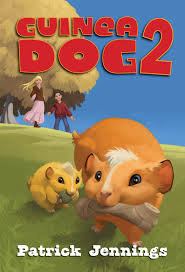
[READ: August 3, 2014] Guinea Dog 2
When I picked up Guinea Dog, I also grabbed Guinea Dog 2. Since the kids enjoyed the first one so much that we started #2 right away.
This book picks up right where the first one left off. It may even be the next day. Everyone has learned about Fido and her amazing tricks (thanks mostly to Dmitri taking a video and threatening to show it on YouTube). And Lurena is so totally in love with her (she has offered to take her home many many times, but Rufus keeps refusing). Heck even his dad seems to like her now. Rufus has had it with the attention.
So he decides to stop playing with her like a dog. He doesn’t let her out of the cage as much. He stops treating her like a dog too–he wants to untrain her, to make her a proper guinea pig.
Now, like in the first book where I didn’t understand the motivations behind Rufus’ actions, here again I don’t get it. No matter how much he hates the attention, how can he not think that having a guinea dog is awesomely cool. (We have guinea pigs and they are certainly cute but they are not awesomely cool). So the more he protests and tries to hide how cool she is the more weird it seems to me (and to his friends).
Murphy of course wants to get a guinea dog just like Fido, even the wicked Dmitri wants to buy her from him. And rodent loving Lurena would do anything to own her. But Rufus doesn’t want to give her away, he just wants her to be normal. Which I guess is motivation enough, I suppose. (more…)
SOUNDTRACK: KEY WILD & MR. CLARKE-“Favorite Names” (2012).
This is a simple song (as kids songs should be). But what appealed immediately was the big fuzzy guitar that introduces the song. Lyrically it’s very simple: a list of the singer’s favorite names (all of which start with the letter J). After repeating them twice, a voice asks about girls names, and we get a few J fronted girls names.
The twist comes with the next verse when it is sung “en Espanol” and a new collection of Spanish names crop up (with the rest of the words in Spanish, too). And then they switch the en Francais. It’s multilingual!
I found out about Key Wild & Mr Clarke from WXPN, but I see that this song comes from an album that sounds awesome: Greasy Kids Stuff 3, a collection of songs from KNRK in Portland. The collection sounds great and I’ll mention more songs from it this week.
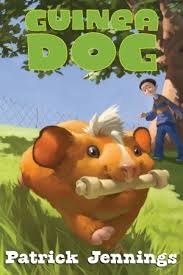
[READ: July 31, 2014] Guinea Dog
I was unfamiliar with Patrick Jennings when I grabbed this book. The title sounded intriguing, especially since we own guinea pigs. Interestingly, after reading this book we read several other Patrick Jennings books, so this will be like Patrick Jennings week here at I Just Read About That. I enjoyed reading this book to the kids, and they found it rather funny as well.
Guinea Dog is about a boy named Rufus. All he wants is a dog. He would like a big, friendly, fast, funny dog. Like the one his best friend has. In fact, he would love his best friend’s dog. The problem is that his father hates dogs. He hates them big time. He has a list of reasons why he hates dogs and that list goes on for two pages (and it was fun to read aloud).
Rufus’ father is an anal retentive, stay at home annoyance (a little over the top frankly, but it works for dramatic comeuppance, right?) who needs everything to be perfectly clean and who doesn’t want to be bothered while he is working. And there is no way he will cave on the dog thing.
Rufus’ mom looks for a way to make things better, so she buys Rufus a pet. The pet is… a guinea pig. Rufus is devastated. He decides to mock the guinea pig by naming her Fido. Rufus and his dad finally agree on one thing–they want the guinea pig taken back to the store. But when they go look for Petopia, the store is gone, without a trace. They are stuck with Fido.
But very soon, Fido starts acting like a dog. She makes little barking sounds, she plays, she catches Frisbees (sort of), she runs with him, she fetches things. She does everything a dog can do. Frankly, she is amazing (I certainly looked askance at my guinea pigs after reading this).
And yet, Rufus doesn’t want anyone to see this creature. He doesn’t like having attention drawn to himself (unlike his best friend who is a major attention hound). So he doesn’t want anyone to know about Fido’s skills. But of course Fido is a playful, outgoing creature (who follows hm to school one day). And soon, more and more people are aware of Fido. (more…)
I expected Brass Bed to be a goofy band because of the snapshot image of them singing into toy microphones. I was initially disappointed by how normal they were, but I was soon won over by their interesting floating sound. They have this overall trippy underwater vibe (which seems to be accomplished by a bowed slide guitar). This is especially notable on “Yellow Bursts of Age” their best song in the set. Later the guitar solo is echoey and also underwatery. It’s a very wild sound for a fairly simple song.
They tell a funny story about being from Louisiana and encountering Washington DC snow and (of course) not having an ice scraper (although they did have bag of sand).
“Cold Chicory” is an upbeat sounding song musically although it is kind of a bummer lyrically, but again there’s the great sound of the bow on the slide guitar and the echoey lead guitar. “Please Don’t Go” is a slow song—with more interesting effects from singing into that slide guitar.
The plastic mikes do come out in the last song “Have to be Fine” in which they sing into the echoey mikes for the intro (with very nice harmonies). They sing the intro for about a minute, and then the slide guitar player takes lead vocals on this simple but pretty song (I don’t know any of their names).
At the end, the NPR folks gave them an honorary NPR ice scraper.
[READ: June 24, 2014] My Struggle Book Three
I read an excerpt of Book Three just a few weeks ago. And in the post about it I said I wouldn’t be reading this book for quite some time. But then the book unexpectedly came across my desk and I couldn’t resist grabbing it while it was here. So it appears that I will now have to wait well over a year before Book 4 (which is, I think about 1,000 pages–yipes). I also see that Book Three is fully called “Boyhood Island” in Britain.
At the end of Book Two, Karl Ove was more or less caught up to the present–writing about what he was then up to (with a few years gap, of course). So it makes sense that this book is about his childhood–showing us how he came to be the man he is.
The book, amusingly enough, starts off with memories that he cannot possibly remember, and he even says as much. He is using memories of his parents and piecing together pictures from when he was an infant. In 1970, (Karl Ove was born in 1968) his family moved to the island of Tromøy (and check out the idyllic picture that Wikipedia had). This is where Karl Ove spent his (rather traumatic) formative years. Their island is small, so he knows everyone in his school, but there are some amenities around like the Fina station and the B-Max, and there’s lots of soccer to be played and bikes to be ridden.
Things seem normal at first–he runs and plays with his friends, there is ample green space to run around in, and they have boats to sail on. And we meet two of Karl Ove’s earliest friends: Geir and Trond (so many people are named in the book, I’m very curious to know if any of them remember him). In an early scene they chase the end of a rainbow looking for a pot of gold (and have a discussion about what happens to it when the rainbow vanishes (the boys even play a prank on Karl Ove that they actually found the pot,a dn while he doesn’t initially fall for it, he is compelled to go back and they tease him).
But the looming figure here and throughout the book is Karl Ove’s father, who, at least according to Karl Ove’s memory, is pretty much a monstrous dick. He is demanding and exacting, unforgiving and seemingly uncaring. He is either bipolar or a drunk, jumping from goofy to outright rage in a mater of seconds. Karl Ove and his brother Yngve fear him unconditionally and, by the end of the book they both seem to hate him. The scene where their dad tries and fails to teach Karl Ove to swim is heartbreaking, especially when the dad goes home and tells their mom right in front of him “He’s frightened of water.” There are dozens of instances of fear and intimidation (often accompanied by a wrenching of Karl Ove’s ear). Like when Karl Ove turns on the TV for his grandparents (he wasn’t allowed to touch the TV but he wanted to do something nice for them). After a few minutes, the TV fizzed out and, naturally, he was blamed for it and sent to bed without supper (after some minor physical abuse). (more…)
To my dismay, my friend Lar recently informed me of a terrible thing that is happening to Phish’s LivePhish series of CDs. This series came out from 2000-2002 and consisted of 20 CD sets of full concerts. The “nifty” thing about them was that they were packed in plastic sleeves (4 discs to a sleeve) which had three holes in them so you could store them in a binder (the LivePhish binder with secret pocket for your stash).
Well, it turns out that whatever material they used in the plastic sleeves leeched out of the sleeves and onto the CDs. For many CDs, it left a goopy residue that wiped off with a little effort. But on other CDs, the goop actually ate through the paint and, apparently (although I don’t know how) through the music. When you look at the discs there are clear “holes” in the paint, so you can see right through the disc. When you play the discs, it ate away at the music as well.
Since this was over a decade ago and Phish is no longer with Elektra and the collections are long out of print, it looks like fans are simply shit out of luck. I have at least 8 sets that have at least one disc that was eaten away like this.
The shows are available for download at the Phish Dry Goods Store, but then you’re paying $10 for something you already own.
Those sleeves seemed like a great idea, but they clearly weren’t tested for long term durability.
I don’t believe there’s any recourse for this, but if you know of any, do pass it along. I’m sure fans must have the concerts online somewhere too, but that’s not the point. Seeing as how the sets are fetching as much as $300 on eBay (which I’m sure no one is paying), there was the possibility that these would have collector’s value. But clearly not anymore. Major buzzkill.
[READ: July 29, 2013] In My Home There is No More Sorrow
This book came with McSweeney’s 40. It is a book unto itself, hardbound and with its own ISBN, so I didn’t feel compelled to read it right then (especially given that the subject was Rwanda and it didn’t seem like an especially happy book to be reading).
But I decided now I was up for it and so in I dove. And it’s not an especially happy book to be reading.
Bass is a writer with many books to his credits (although I didn’t know him). He was sent to Rwanda on an assignment. I gather that as part of the assignment he was sent to teach a writing workshop to local writers. (The actual purpose of the trip, as far as logistics goes, is a little vague I must say).
At any rate, bass and his family (his wife and teenaged daughter) went to Rwanda for ten days. And the first few days are as harrowing as one might expect. I was familiar with the atrocities in Rwanda, but only insofar as I had heard bits and pieces of the story from the news. I had no idea about the extent of the violence–millions of Tutsis killed by Hutus. Nor the extent of the way the survivors have dealt with the atrocities in the seventeen years since they happened. Which is: they have created shrines to the dead and in many cases have not cleaned up or in any way hidden what happened.
And so , we have churches with blood on the walls where people were murdered (I will spare some of the details of the way the children were killed, but I will certainly never forget it). The family also goes to a shrine where the bodies were exhumed and placed in this area for fuller viewing. And the creepiest thing about this shrine is that the bodies were packed so tightly in the mass grave–with no oxygen and with quicklime poured on them , that they did not really decompose–they were more or less mummified–their skin just sort of shriveled. These bodies are practically like living skeletons, left ion their death poses. That’s another image I will not be able to expunge from my mind any time soon. (more…)
I enjoyed the really noisy chaos of another Drug Church song that NPR played (“Deconstructing Snapcase”), but I really like the name of this one (although I can’t tell if it has anything to do with the lyrics–as the lyrics talk about walking with canes and using wheelchairs).
The song starts with thudding drums and angry vocals which are all about the singer’s ailments. The chorus is fast and kind of repetitive, but fun to sing along to (decline, decline). I enjoy the song for its aggressive, distorted sound–not quite metal, although I think it needs a bit more…something.
[READ: July 2, 2013] “May I Touch Your Hair?”
I recognized the name Julie Hecht but I couldn’t place her. It was only after I read this whole story that I looked back at a review of something else I had read by her and I was pleased to see that I felt the exact same way about her narrator then as I did this time.
Hecht writes fiction with that seems like non-fiction. Her narrator is first person and everything that she writes about seems very real–opinionated enough that you think she’s telling non-fiction. Indeed, at times I had to confirm that it wasn’t simply an essay.
This story looks back at the narrator’s childhood. Much of the story spends time at their beach house looking at all of the families who lived around them there.
There is not a lot to this story except really the narrator’s tone. Little things come through like “Elinor was in her own upper-teenage world of grown-up girls in college. She was studious as well as boy-crazy.” That “boy-crazy” note is a bit of a judgment. The narrator is very judgmental. Like: “she got married at a young age, then made the mistake of having a baby right away.” Or, “My mother told us she’d heard that Elinor had said to her three-year old child, ‘Your parents are young and want to go out, and you can’t expect us to be with you all the time. We have our own lives.’ This was thought to be a bad thing to say to a child.” I love that last line. (more…)
It’s probably hard to like a song with a title like that, but there’s something strangely compelling about the whole proceeding–the great intricate percussion and drums that start the song, the ponderous pipe organ that lays down the melody, and then Anna’s voice which has a country-ish feel (kind of like Neko Case), but also has a kind of Dead Can Dance vocal style. Or perhaps that’s just because she is Swedish.
By the time the chorus comes around, the ache of the song is apparent. And the end has more of that amazing percussion. I rather like the beginning and the end of the song more than the middle, which I guess doesn’t say a lot for it, but it is intriguing.
Evidently this album is primarily full of pipe organ, an interesting choice for a rock album. I’d be curious to hear more.
[READ: June 17, 2013] “Twisted”
As if anticipating that I would not be able to write posts this week, the New Yorker has supplied me with a series of very short “True Crimes” pieces. In fact, the whole issue is a fiction issue, which means a half a dozen or so stories as well. But it’s these “True Crimes” that will keep me posting this week.
The first is from George Pelecanos, and it’s a story of his own crimes. He explains that when he was younger, he did all manner of illegal things but had never been caught (aside from a few minor infractions). He broke into houses and stole records from someone he didn’t like. He rode in a stolen car, stole wallets from strangers at stores (at this point I really don’t like this guy). But he doesn’t try to make excuses for himself. He was a boy and he was having fun.
But the crimes continues long past adolescence. In 1985 he was 28 and got involved in a high-speed chase. He was drinking and smoking pot at a wedding. He and his fiancée stopped at a convenience store where he backed into someone’s car. A gang of people came out and the threat of violence was imminent. But he hopped in his car, drove on the sidewalk and sped off with the police in pursuit. (more…)
NPR opened their summer preview show with two rap songs. This was the second. The bass line is very neat—propulsive and continuous and there’s this little keyboard sprinkling across the top. This is West Coast rap style and I like the music quiet a bit.
The rapping is unusual—some amusing voices and nonsense words, but I admit I didn’t really get into it until about half way through when the rapper (ScHoolboy Q or guest Kendrick Lamar I don’t know) comes in with an unusual-sounding voice—sped up and goofy. And he does one of my favorite rap things—singing really fast in a high voice then ending with a low word (Gawd).
The song feels atmospheric, although overall, I’m not a fan. The DJ who introduced the song says that he is part of the “supergroup” Black Hippy, along Ab-Soul, Jay Rock and Kendrick Lamar. She describes ScHoolboy Q as the darkest of the bunch, which makes me think I should check out the rest to see what other kinds of things they do. [I did, and I didn’t like them–lyrically they are remedial at best].
[READ: June 18, 2013] “Rough Deeds”
This story is set in New France, (also known as Canada). Duquet is a timberman, seeking his fortune by amassing the largest area of woods to be exported both to the Americas and back to Europe. He connected with a man named Dred-Peacock (I included him mostly for his name) who set him up with a connection in Scotland.
Duquet wasn’t exactly sure about trading with the enemy, the English, but money is money and they had lots of it and need for lots of wood. And soon a fortune was made.
Then Dred-Peacock encouraged him to head to Maine where thousands of acres were there for the asking. Indeed, Duquet was able to buy twenty thousand acres at 12 cents an acre. But when he and his man Forgerson went to investigate, they found a crew cutting down trees on his property! When he accosted them, they fled. The youngest member of the thieving team had a limp and fell behind–which gave Duquet the opportunity to hurl his tomahawk at him, felling him instantly.
When the boy won’t talk, Duquet cuts off two of his fingers (Duquet does not mess around) and the boy reveals that he works for McBogle. The boy already had an infected leg and Duquet had no intention of healing him, so he allowed the boy to die, ultimately killing him and burning his body in McBogle’s makeshift mill.
While Duquet was doing this, Forgerson was off scouting a new way to get the timber to the mill and finding people to work with them. When he returned, he wondered where the boy had gone, but said nothing.
I always thought File Under: Easy Listening was a very funny title. But it’s possible that people took it too literally as it didn’t sell all that well. And in Mould’s autobiography he says he didn’t have much time to write songs for this disc and he thinks it suffered. Of the three Sugar discs, this is definitely the weakest, although there are some great moments on it.
The disc opens with “Gift” which has some ragged distorted guitars. It’s got some noises and grungy sounding solos showing that FU:EL was a joke. Although, the overall sound is kind of a cleaner version of the angry songs on Beaster. “Company Book” is kind of a pounder, until the voice comes in and you realize…it’s not Mould! It’s got a catchy chorus, but after the kind of underwhelming opener, it’s a strange place for a song that’s also not so dynamic. Especially when it’s followed by “Your Favorite Thing” another great pop song from Mould—not top tier but a really strong second tier (although that bright, simple guitar solo is a real winner). “What You Want It To Be” is a another decent song (the addition of that extra guitar playing the melody line really makes the song shine. “Gee Angel” is also a high point. A catchy song, but which never quite reaches the heights of the previous albums.
“Panama City Hotel” has the same feel as the opening of Beaster: bright acoustic guitars and a similar riff. But it never really goes anywhere, and the 4 minutes seem. The “do do do do’s” that open “Can’t Help You Anymore” are certainly the brightest spot on the album, and a big pop song as well. “Granny Cool” has a nicely abrasive riff although it seems kind of mean spirited. It’s funny that he tucked “Believe What You’re Saying” at the end of the album. It’s a minor song but it sounds so bright on this album after the other songs. It’s really quite pretty.
And the closer, “Explode and Make Up” is one of Mould’s great angry songs. Unlike Beaster, this one has a happy acoustic field—bnright guitars with that raging distorted guitar underneath. It’s a great slow burner of a song and at five minutes it ends a somewhat lackluster album in a great way.
[READ: March 31, 2013] McSweeney’s #20
McSweeney’s #20 is an issue that I have read before. At least I think I have. My recollection is that it was the last one I read before I started writing about them on this blog. I was hesitant to read it soon again, which is why I waited until now. And while I remember the issue itself (with all of the art), I didn’t remember the stories. So who knows if I actually read it six years ago.
Anyhow, this issue comes jam-packed with art. Every fourth page has full-color artwork on it–many of them are quite famous. It makes for a very beautiful book.
In between these artworks are a number of stories–ranging in size from 2 pages to 30-some pages. There are no letters, and the explanatory and copyright information is on the cover of the book–which would be fine, except that it is covered up by a kind of 3-D artwork. I wonder if the whole text is available anywhere?
The book also comes with a separate pamphlet–an excerpt from Chris Adrian’s Children’s Hospital. I intend to read the novel eventually so I didn’t read the excerpt–although maybe if I put off the novel for six years I should just read the excerpt now. (more…)
Before releasing Diamond Eyes, Deftones had two band crises. The first was that they didn’t really seem to like each other anymore. The previous album was fraught with tension and they barely toured. After deciding that they wanted to remain as a band, they were invigorated and made an album called Eros. But during the recording, bassist Chi Cheng was in a car accident and was in a coma. As of yet he has not fully recovered. So they shelved Eros, hired a temporary bass player Sergio Vega and set about recording Diamond Eyes. And for whatever reason, it proved to be one of their best releases so far.
“Diamond Eyes” opens with a heavy down-tuned guitar–very abrasive–until the chorus come in and it’s their most beautiful ones yet–with soaring keyboards and harmonies. And then the heavy guitars come back–it’s what Deftones do so well–beauty and ugly together. Stephen Carpenter really shines, as always. “Royal” is a fast song with a great harmonizing chorus. “Cmnd/Ctrl” has a shocking low riff that explodes into a bright chorus. “You’ve Seen the Butcher” has guitars that seem almost untuned as the song starts. But it morphs into a kind of sexy butt-shaking chorus. And Abe Cunningham’s drums are, of course, fantastic.
“Beauty School” is the first that doesn’t really start out heavy, it’s a got a gentle guitar intro and the first song where Vega’s bass is really prominent as a separate instrument and it creates a beautiful alternative song–great vocals throughout. “Prince” brings in a lot of new textures to the album, including a clanging guitar sound and a great screamed chorus. “Rocket Skates” is one of my favorite songs on the record, it has a classic metal riff and the great screamed-beyond-comprehension chorus of Guns, Razors Knives and a weird little whoooo that ends the chorus.
“Sextape” is a surprisingly gentle song, opening with an echoed guitar riff and one of Chino’s most gentle choruses. “976-Evil” has an echoey guitar and voices not unlike the Cocteau Twins. “This Place is Death” has another great alt rock feel–a big song with bright guitars and dark lyrics. I haven’t really mentioned Frank Delgado on keyboards and samples. He’s been with the band since White Pony, and I feel like his presence was made notable on a few songs here and there. But it seems like on this disc he really comes to the fore, adding new textures and sounds to the album which really fill it out.
[READ: March 12, 2013] McSweeney’s #14
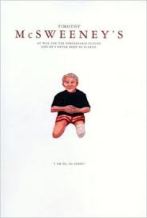
After the colorful extravaganza of the Comics Issue of McSweeney’s #13, this book settles down into something more somber The book is softcover and all white. The cover depicts a cartoon of George Bush with both legs blown off and the caption, “I Am So, So Sorry.” On the spine in small print: “We’re praying as fast as we can.” It is the most context-full cover they’ve done yet and, nearly a decade away it seems like a rather mean cover, but if I remember correctly at the time it seemed apt and delicious, especially in light of the upcoming election.
Yet despite the overtly political cover, the content inside is not political or even thematic (although it is pretty dark stuff). Nevertheless, the table of contents gives us a small joke when it says “To help you know which stories to read first, we have indicated with either a * or a † those that deserve special consideration from you, the reader. If you see either a * or a †, do not miss that story.” Of course every story has either a * or a † but they cleverly did not put any kind of pattern to the symbols.
The colophon explains that when they were in Ireland, they met an actual Timothy McSweeney. He had been given a copy of Issue #3 and then promptly forgot about the magazine. But when McSweeney’s was in Galway to do a reading at the Galway Arts Festival, Timothy (Ted) McSweeney traveled from Dublin to check it out (not a short trip). This also resulted in a letter from Mr McSweeney which is actually quite funny.
There are also illustrations in the book, although they are small illustrations and are placed on the title of each piece in the book. All of the illustrations are old, mostly coming from the 1800s, although one dates back to 1670. They illustrations are all technical scientific ones and don’t have anything to do with the stories. (more…)
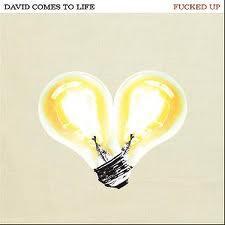
For a band named Fucked Up, they make music that is surprisingly catchy. Of course, as befits their name, they also have a pretty aggressive punk sound with lots of drums and loud guitars. But many of the guitar lines and choruses are surprisingly melodic. And then comes singer Pink Eyes. He screams in a gravelly, rough, cookie-monster type voice (although he is mixed lowish in the mix so he doesn’t often overpower the music). Despite the fact that most of the words are indecipherable, he also have a good sense of melody.
So how does a band that plays distorted hardcore punk with a barely comprehensible singer decide to make a 78 minute concept album? Beats me. But guitarist 10,000 Marbles has written a pretty solid collection of songs. Of course, it also beats me exactly what the concept is. According to allmusic the plot is: In the fictional town of Byrdesdale Spa UK, David has a humdrum life working at a light bulb factory, and finds an escape by falling in love with a communist rebel rouser, only to find out later that she has died in a terrorist bombing and that he has a lot of emotional turmoil to face.
I’ve listened to the disc a dozen or so times and never got that plot. I even followed along with the lyric sheet and never got that plot. Part of the reason may be that Pink Eyes sings all of the parts in the same way, so it’s really hard to notice that there are different characters (like Veronica) in the story. While it is fascinating to hear a really catchy choruses sung by someone who is kind of scary, it doesn’t do a lot for the story. The other odd thing is when Mustard Gas provides female backing vocals–they are sweet and pretty–a drastic counterpoint to the noise that Pink Eyes makes. But she only comes in on a few songs. I wish she did more.
There are some really great songs on this disc. Song two, “Queen of Hearts” has some incredibly catchy sections. And the “dying on the inside” harmony in “The Other Shoe” compliments the grizzly “It can’t be comfortable when you know the whole thing is about to fall” very nicely. The b vox are also great in “Turn the Season.” I find myself singing the “Hello my name is David, your name is Veronica. Let’s be together. Let’s fall in love” section over and over. It’s surprisingly sweet when sung by such a voice.
Since this is a concept album (or rock opera I suppose), there’s things like the nearly two-minute instrumental intro to “Remember My Name” which doesn’t fit with the rest of the song but is really catchy. There’s also a kind of introductory “theme” that crops up in the album. Fucked Up confound you at ever turn with beautiful melodies that morph into noisy punk.
By the middle of the disc (where I gather David is a low point), there’s some really loud heavy songs. Amid the pummeling noise, there’s some nice acoustic guitar in “A Slanted Tone” and some very cool rumbling drums and bass that propel “Serve Me Right.” These songs help to break up the flow nicely. “Life in Paper” which is near the half way point opens with the same staccato notes as the disc itself, and it proves to be a very catchy song in which David asks “Who can I trust?”
The second half of the disc continues with the more catchy style with “Ship of Fools.” But as the story nears the end, it starts to feel very samey. There’s a few breaks, but it’s a hard row to hoe. There is redemption in the end, but you still feel exhausted. Perhaps 78 minutes of Fucked Up is too much. For some listeners even 5 minutes will be too much. Despite the accolades (and they received a lot), you won’t be hearing this one the radio (and not because the DJs couldn’t say their name).
And yet amid all of the noise, there are some really shiny gems. They have even released four music videos for the album! The first one, “Queen of Hearts” is especially cool as the video is set in a classroom and the kids sing all the parts (after a nearly two-minute spoken intro of the song. I admit to not having any idea what’s actually happening in the video, but it’s still cool.
[READ: January 26, 2013] An Extraordinary Theory of Objects
This is a strange little book. It was another one that I saw while waiting online at the library. I was attracted to the cover (I know, don’t judge… but honestly, you can tell a little bit about a book by the way it is marketed. And this was marketed at me.) It’s a small book with a stark cover and interesting drawings on it. And then there’s the unusual title.
The book was only 180 pages (plus notes and a bibliography) and it was chock full of pictures. I mean, this thing can be polished off in an afternoon.
And here’s what it’s about. Well, let me modify that. Here’s what’s in the book. Stephanie is a young girl when her family moves to France (for her father’s work). She has always felt like an outsider and now feels even more so in France. She is introverted and spends a lot of her time in books. Then she moves back to America and reflects on her childhood.
Yeah, that’s about it. For here’s the thing, Lacava isn’t famous and she hasn’t done anything that you might have heard of. She’s just a person who went to France as a kid. The introduction kind of gives you some reason as to why you should read the book. Lacava was a sad and miserable child and she took refuge in objects–not as a collector so much as an admirer. On her windowsill she has collected various geegaws that she treasured (and which she brought from America in her carry on, they were so precious). And she has this interesting relationship with objects. Although, as with many things in the book, that relationship is not really delved into very much. (more…)
 SOUNDTRACK: GLORIA BALSAM-“Fluffy” (1983).
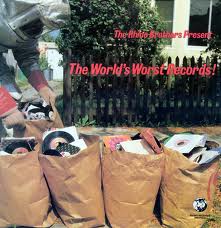 This song is also on Greasy Kid Stuff 3 (I was disappointed to realize that I couldn’t find all that many of the other songs online). But when I found the video for it, it had also been gathered on a compilation called The Rhino Brothers Presents The World’s Worst Records.

















 I Just Read About That...