Feeds:
Posts
Comments

Archive for the ‘Michael Hofmann’ Category

SOUNDTRACK: .

[READ: February 22, 2025] The Living Statue

This book came as part of my New Directions subscription.  It’s a “newly discovered” story written by Günter Grass in 2003.  It’s very short.  57 pages with big margins.

This story sees Grass (or a fictional substitute) travelling around to give book talks.  On a trip before the Berlin Wall fell, he and his wife went to Naumberg.  They visited a chapel which featured “life-size” statues.  But everyone on the trip is disappointed at how small they actually are.  One of the statues is of Uta of Naumberg [click for  the Wikipedia explanation of who she was].

The repeated phrase in the book is “you can do anything on paper.”  And so, he invites the 12 statues to lunch. It’s a jolly time with these ancient statues not really grasping modern behavior (they all hate the potatoes).  He was quite taken with Uta.  She ordered a Coke and then said she had to go.

He ran into her again after the Wall fell,  She was being a living statue outside of Cologne Cathedral.  She was very convincing, standing still and doing nothing.  He approached her and got very close whereupon he whispered to her that she should take a break and get a Coke with him.  She did not break character at all. But her manager/boyfriend came up and told him to get lost.

He saw her again some time later and wanted to approach, but the manager/boyfriend was staring. (more…)

Read Full Post »

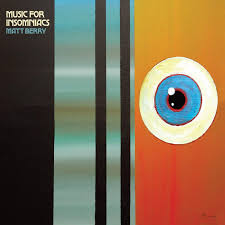
SOUNDTRACK: MATT BERRY-Music for Insomniacs (2014).

Matt Berry is a renaissance man and I love everything he does.  Whether it’s acting in over the top comedies or making over the top prog rock, Berry is my guy.  He has several albums out already.  This one was his fifth. Evidently he created this album in the middle of the night while unable to sleep.

The back cover image is of him sitting amid a Rick Wakeman-like array of keyboards.  And if you’re into gear, he lists everything that he plays on this album:

Arp Odyssey Synthesiser, Korg MS-20 Synthesiser, Korg MS-20008 Synthesiser & Vocoder, Korg Sigma Synthesiser, Korg Polyphonic Ensemble, Korg SV1 Electric Piano, Minimoog Synthesiser, Mellotron-Pro, Solina String Ensemble, Roland Jupiter 4m Synthesiser, Roland Pro Mars Synthesiser, Roland juno 6 Synthesiser, Roland Gaia Synthesiser, Roland Jupiter 80 Synthesiser, Yamaha CS-15 Synthesiser, Yamaha CS-60 Synthesiser, Hammond XKB Organ, Korg & Roland rhythm boxes and found percussion.

Why would anyone need so many synthesisers?  Well, to make an album like this.

It is two 23 minute “songs.”  They are meandering, trippy sounds mashed up with snippets of “songs.”

Part 1 opens with vocals and then an organ playing a familiar-ish classical organ melody but it’s only a nod to classical music because soon enough a bass comes in and turns the music into a very different sounding piece.  I particularly love the way he phases and echoes the drums.  Variations on this song/theme run for about five minutes with more and more interesting sounding effects, until it all fades out into waves of synths.

The swirling synths create an atmosphere for another five minutes when abruptly, you hear something being turned off (or on) and a shushing.  More trippy synth washes follow and then at 13 minutes a new keyboard melody is added to the washes–a gentle tune that give the washes some momentum.  It starts building until 16 minutes when it grows distinctly dark.  Creepy echoing voices come out of the fog.  And you can hear someone shouting okay okay.  Then out of the quiet, a martial drumbeat grows louder and louder as a song starts to form.  At 19 minutes, the melody from “October Sun” from his Kill the Wolf album starts playing.  A processed voice sings the lyrics, but they are very hard to hear.  I assume it is Cecilia Fage, as she is credited with voice/choir.

Part two is not radically different.  It opens with a choir of voices.  It morphs into gentle washes of synths like mid-period Pink Floyd, complete with space sounds–whooshing and zapping.  Then comes what sounds like a horse walking by and some slightly dissonant keys before some hugely vocodered voice start singing a melody.  It’s followed by pianos at seven and a half minutes which merge with the rest of the synth melody.  There is much more going on in the background–voices, sounds, who knows what.

Things abruptly end with a big splash of water at 8:45 and remain underwater for a time before a new synth pattern emerges. Things become celestial with a choir around 13 minutes.  After a big explosion at 14 minutes, spacey chords return followed by another explosion and a return underwater–squishy sounds, then a distant bay crying (my daughter just walked in and said this music is creepy).  Other sounds swim in and out as angelic voices sing.  This goes on until 17 minutes when things settle down into a more stately organ-fueled section.  Things drift away almost to silence and then at 19, a pulsing synth bass starts things up again.  He adds a jaunty synth melody to the bass and it’s suddenly a new wave song.  This dancy part continues until the end of the song when things grind to a halt.

This is a peculiar record for sure.  It’s not soothing for sleep, nor is it particularly upbeat for non-sleep.  But it is an interesting look into Matt Berry’s headspace.

[READ: November 18, 2020] “Fata Morgana”

This is an excerpt from Koeppen’s novel Pigeons on the Grass which was translated by Michael Hofmann.

I’m not sure where in the story this comes from, but I feel like it jumps in right in the middle of a scene.

A black man, Washington Price, is walking through the streets of tenement houses (in Germany) with a bouquet of flowers: “he had marriage on his mind.”

He wasn’t particularly notable in this area, but the fact that he arrived in a blue limousine started a lot of people grumbling behind the tenement windows.

He was there to see Carla.  Carla lived on the third floor with some other girls and their minder, Frau Welz.  The other girls were there for the soldiers.  As (maybe?) was Carla.  They all knew he was there for Carla, but that didn’t stop them from trying to entice him into their room. (more…)

Read Full Post »

SOUNDTRACK: BORIS-Archive Volume Four “Evil Stack Live” (2014/2020). 

In early August, Boris digitally released six archival releases.  Volume Four is called “Evil Stack Live” and it is a fantastic-sounding concert from 2003.  Boris released their fourth and fifth albums in 2002 and 2003.  This fifty minute set picks songs from both of these albums: Heavy Rocks and Akuma No Uta.

Full set live recording [NHK Tokyo, 15th May 2003] that was broadcast on Japanese government-owned radio. The setlist is compiled from songs representative of their “Uppercase BORIS” distinction, including tracks from “Heavy Rocks” (2002) and “Akuma no Uta” (2003).  (Originally released on March 5, 2014. Included in Archive 2, limited to 1,000 copies)

The show open with some splashing gong and two songs from Heavy Rocks (2002).  That instantly recognizable riff from “Heavy Friends” kicks in as Atsuo screams to open the show.  The riff continues, eventually picked up by Takeshi on the bass while Wata unveils a soaring guitar solo.  It’s segues into the fast and heavy “Korosu.”  This song has a catchy chorus that’s punctuated by a nifty riff from Wata.

The set shifts to the blazing rocker “Ibitsu” from Akuma No Uta.  The song is three minutes long and has some great guitar licks and solos from Wata while Atsuo and Takeshi sing the lyrics.  The really fast riffing at 2 minutes is energizing as they then return to Heavy Rocks for “Death Valley” which combines a classic riff with some great droning verses.  The song stretches out to almost seven minutes with some heavy jamming in the middle.

There’s a slight pause before the start of the epic 11 minute “Naki Kyoku.”  It starts slowly with some lovely picked guitar from Wata.  After two minutes, Wata begins her extended solo.  Atsuo and Takeshi jam a simple rhythm while Wata plays her soaring solo.  Atsuo sings a catchy line (although I don’t know what he’s saying) as the song jams out around a thumping bass line and Wata’s chill noodling.  The middle has a kind of call and response with the guitar and drums as Wata intersperses her licks between Atsuo’s drum fills.

They jump out of the slower song with two from Akuma.  First is the fury of “Furi,” a ripping heavy song with lots of chaotic drums and yelps and screams (I think Takeshi is singing lead).  A few gong crashes introduce the beginning of “Akuma no Uta.”  It’s a slow grooving song with Takeshi’s heavy bass and Wata’s simple riffage.  After two minutes the song takes off in a classic heavy jam–ripping guitar work and fast bass and drums.

They end the set with two songs from Heavy Rocks.  “Dyna-Sore” is a fast rocker with a catchy guitar riff and chord pattern.  The call and response between Takeshi and Atsuo while Wata plays the soloing riffs is only exceeded by the heavy middle drum section that turns into a super fast end riff.  The set ends with “1970” another great riff-based rocker.  This song features Takeshi and Atsuo singing together and a great rumbling solo bass moment before Wata ends the song with another ripping solo.

The quality of this recording is top notch and the selection of songs is just fantastic.  This is a great archival release.

Takeshi: Bass, Guitar & Vocal ; Wata: Guitar & Echo ; Atsuo: Drums & Vocal.

[READ: August 15, 2020] “Knife Play”

This is yet another fragment from Franz Kafka collected in The Lost Writings.  The one big surprise for me is how well fleshed-out the part of the story that exists is.   It’s unfinished, but the sentences that are there are well composed (depending on how much translator Michael Hofmann has added to or spruced up the original German).

It feels like he he plotted and executed the beginning of the story very thoroughly and then just stopped.

In this fragment, the narrator is sitting next to his wife in a theater box.  The play was exciting–a jealous man was raising a knife to stab his wife.

The narrator leaned over to his wife, but what they thought was curtain was actually a man.  He and his wife jumped in shock. (more…)

Read Full Post »

SOUNDTRACK: MADAME GANDHI-Tiny Desk (Home) Concert #38 (June 24, 2020).

I have never heard of Madame Gandhi.  That’s a constant theme with these Home Tiny Desks–they seem even more geared toward introducing lesser known artists to the world.

Madame Gandhi’s is surrounded by her yellow bongos and congas, a yellow desk from her youth and a yellow nightstand, her Tiny Desk (home) concert lighting nods to the lavender-lemon artwork of her 2019 Visions EP.

Her music is mostly prerecorded.  The live elements are her vocals (soft and gentle with a lot of nonsense syllables amid the good vibe lyrics) and her wonderful hand drums.

Her music is inspired by her South Indian heritage and she lights a stick of palo santo.

For the first two songs she plays the damaru (I think).  “Waiting For Me” is about returning to the earth–returning to nature.  I enjoyed the way it began:

Wake up in the morning / hit space bar and start recording

She plays cool-sounding drums–she has wonderfully diverse sounds from that tiny hand drum.  And they seem to be modified in some way, too.

Before “Moon in the Sky,” she says “I don’t want our identities defined according to how oppressed we are.”

She’s intentional with everything she does, including activism that focuses primarily on gender liberation. She uses music to help elevate and celebrate female voices, from working with primarily queer women BIPOC on tour and video sets, to writing socially-conscious lyrics that challenge the white male-dominated music industry.

She continues, “if we are not brave enough to tell our stories end to end, somebody else will.  And they will get it wrong.

on tour and video sets, to writing socially-conscious lyrics that challenge the white male-dominated music industry.. Madame Gandhi’s clear, soft voice and swells of percussion give you the necessary space to meditate on her message of inclusion and equality.

She says her music is Indian trap.  The music has fun beats and a downplayed vocal delivery. I rather like it.

For the final song, “Bad Habits,” she stands up and plays the bongos: “put your phone down and stand with me.”  The catchy chorus of the song is “all my bad habits have got to got to go.”

Her parting words are that each person’s contribution is unique and valuable and can be of service to my community and my family.

This has been a great introduction to a new form of music for me.

[READ: June 28, 2020] “The Rescue Will Begin In Its Own Time”

I really don’t understand what was going on with these previously unpublished stories by Kafka (translated by Michael Hofmann). There are four flash fiction pieces and they seem much more like story ideas than stories.

In the first section he talks about the four ways the Prometheus legend can be viewed.  After the fourth, it ends, “The real riddle was the mountains.”

In the second part, there is a large load of bread which the Father of the family cannot cut.  The Father is not surprised, “Isn’t it more surprising if something succeeds than if it fails?”  When the children woke the next morning he had been up all night but had not managed to cut it. (more…)

Read Full Post »

fivedials_no26SOUNDTRACK: BOB DYLAN-Christmas in the Heart (2009).

220px-Bob_Dylan_-_Christmas_in_the_HeartI have been a dabbler in Dylan over the years.  I like his hits, I like some of his albums, but I’ve never been a huge huge fan.  So the biggest surprise to me was that Bob Dylan now sounds like Tom Waits.  His voice is so crazily gravelly, it’s almost (almost) unrecognizable as Dylan.

That said, on some of the tracks it works very well–like he’s had too much to drink and is enjoying the revelry of these traditional songs.  I imagine him as a benevolent uncle trying to get the family to sing along.  And sing along they do.  He has a group of backing singers who sound like they are straight out of the forties and fifties (on some songs the women sing incredibly high especially compared to Dylan’s growl).  I’m not always sure it works, but when it does it’s quite something.

The first three songs are a lot of fun. However, when he gets to “Hark, the Herald Angels Sing,” it really sounds like he has hurt himself.  He seems to really strain on some of those notes–note the way he pronounces “herald” (heeerald).

The more secular songs fare better with “I’ll Be Home for Christmas” sounding especially Waitsian and being all the better for it.  Although I feel that perhaps he made up some lyrics–“presents on the tree?”  It’s interesting that in “O Come, All Ye Faithful” he sings the first verse in Latin (I don’t know that I’ve heard any other pop singers do that) and it works quite well.

A less successful song is “Have Yourself a Merry Little Christmas” in which the music just seems to be too slow for him.  His verses end early and it seems like the backing singers are just out in the middle of nowhere.  Perhaps the best song is “Must Be Santa.”  I love this arrangement (by Brave Combo) and Dylan has a ton of fun with it (and the video is weirdly wonderful too).

“Christmas Blues” is a bit of a downer (as the title might suggest).  I’d never heard this song before and Dylan is well suited to it.  Dylan’s version of “The Little Drummer Boy” is also very good–he croons gently and his voice sounds really good.  I was surprised to hear him do “Christmas Island,” a song I have come to love this year–his version is quite fun as well, with the backing singer doing Aloha-ays.

Finally, “O Little Town of Bethlehem” is pitched a wee bit high for him (and the Waits voice is more scary than avuncular here).

So overall it’s a weird collection (to say nothing of the artwork–both the cover and the inside cover), but I think it’s well suited to the day after the festivities.

[READ: December 15, 2013] Five Dials #26

I was shocked to realize who many Five Dials issued I had put off reading (and that this one came out over a year ago!).  I knew 26 was a large issue, so I put it off.  And then put it off.  And then put it off, until Issue 29 came out.  (I read 29 before this one, which got me to jump back and tackle this large one).

I have to admit I did not enjoy this one as much as previous Five Dials.  The bulk of the issue was taken up with German short stories, and I don’t know if it was the choices of the editors, but (a few) of the stories just didn’t grab me at all.  Having said that, there were one or two that I thought were very good.  But with this being such a large issue, perhaps it deserved to be spaced out a little better–Weltanschauung fatigue, no doubt.

This issue starts with Letters from Our Glorious readers and other sources.
I feel like this is a new feature for Five Dials (although again, it has been a while).  There is applause for the Bears (From Issue #24) and the acknowledgement of Zsuzsi Gartner’s first adoptees of her story ideas (Issue #25 Pt 1).  There’s also the amusing story of a guy who got nailed at work for printing the color issue (something I used to do at my old job as well) and a refraining of answering spam.

CRAIG TAYLOR-On Ewen and German
Taylor doesn’t say much in this intro, since the “heavy lifting” is done by Anna Kelly.  He does mention Paul Ewen (and his food writing) and the first Five Dials questionnaire (which I assume it is too late (and too far away) for me to submit for that free HH book).

ANNA KELLY
She explains about wanting to know secrets, and how when she was little, learning Pig Latin was a such a huge boon to her secretive life.  Then her sister started studying German, and Anna herself was hooked.  She says that reading German works in German is like flying.  And she wants to share German language writers with us.  Of course, we won’t be reading them in German, so there will be no flying.  (more…)

Read Full Post »

SOUNDTRACK: SISKIYOU-Keep Away the Dead [CST083] (2011).

I really enjoyed Siskiyou’s first album. This album updates the sound and makes it a bit bigger.  And yet somehow the album still sounds fragile.

The album is full of songs that are catchy, but not really easy on the ear.

The first song reminds me of Arcade Fire.  Something about the ringing guitar and crescendos.  But the recording feels more like a demo, much more intimate that Arcade Fire.  “Where Does That Leave Me” is an even more spare number, just vocals and guitar although it slowly builds.  “Twigs and Stones” is the first song that sounds like the bulk of the album—where Colin Huebert’s vocals really come to the fore.  His vocal style is loud and verging on the whiny (again, like Arcade Fire).  This song also has a lot of other instruments that percolate to the top—reminding me of older Mercury Rev.

“Revolution Blues” is the standout track for me, it’s incredibly catchy (and fun to try to sing in his eccentric voice).  The accordion and the minor key intensity is really powerful.  I guess it’s a shame that it was written by Neil Young, then (although the Siskiyou version is much better).  “Dear Old Friend” is a more country sound (which for me is shorthand for slide guitars), but it keeps the same style and feel as the other songs.  “Fiery Death” is the first song where percussion makes itself known very loudly.  It’s a cool introduction of loud thumping.  “Sing Me to Sleep” is a 2 minute lullaby and “Dead Right Now” is a 2 minute coda that ends the album nicely.

The disc is short (about 30 minutes) but a lot of emotion and craft is packed into it.  It’s really enjoyable.

[READ: May 24, 2012] “Sweet Dreams”

I’m always disconcerted when a story is in English but is set in another country.  Well, that’s not exactly right.  When it seems like it’s set in another country because the author is from that other country and he or she is writing about that other country without specifying it (usually because it is translated).  It’s very Amerocentric, but perhaps everyone thinks a story is set in their town unless told otherwise.  So I didn’t realize that this story was originally written in German (it was translated by Michael Hoffman), but it felt like it was taking place in Europe.  I actually guessed France, until later on it was revealed to be Switzerland.

There’s something cool about stories that are written elsewhere, especially if you don’t know the place well, it allows for almost anything to happen.  A couple riding a bus in Europe doesn’t mean the same thing as a couple riding a bus in, say Tallahassee.  But having set up that distinction, this story is about love.  And love is universal.

The story is written from the point of view of Lara, a shy bank worker.  She has been dating Simon for several months and they have recently moved in together.  They should be in the first bloom of love—on their own for the first  time (they never felt comfortable fooling around at their parents’ houses)—but her shyness in particular won’t loosen.  She doesn’t like him to see her naked, and they are very reserved in their love-making.  And from the start Stamm places a dark tone over the story.  The get a place in the town that he likes but it’s pretty run down.  He hadn’t brought much to the apartment, and he seems critical of some of her purchases.  He even comments that “forever is a long time” when she says that the towels she bought will last forever.  And then on the bus, a man, dressed in a long black coat stares at Lara over and over.  It may be innocent, but it’s still disconcerting.

When they get home, she takes a bath (she won’t let him in the bathroom) and asks him to go to the restaurant downstairs to buy a bottle of wine.  She finishes the bath and he’s not back yet, so she reads the paper.  Which is full of more grim news.  When she reads about a dead body found in the lake nearby and since we know she doesn’t feel comfortable about the restaurant downstairs, we know something bad has happened. (more…)

Read Full Post »