Feeds:
Posts
Comments

Archive for the ‘Translation’ Category

SOUNDTRACK: JOVINO SANTOS NETO-Tiny Desk Concert #904 (October 21, 2019).
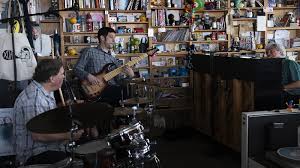
Jovino Santos Neto plays piano–and then surprises by playing a lot more.

I have a come and go relationship with jazz.  I like some of it.  I like it sometimes.

But the blurb might explain why I liked this music right away:

Something happens for me when I hear jazz mixing it up with Brazilian rhythms. In the right hands it falls into the realm of magic.  Pianist, multi-instrumentalist and composer Jovino Santos Neto certainly cast a spell over those who gathered for this joyful turn behind the Tiny Desk.

I loved everything about this performance.

The trio rushed right out of the gate with the samba-influenced “Pantopé” that introduces the concept of the trio: seamless interaction between the musicians that make the band sound like one big, melodic rhythm machine.

“Pontapé” opens with slow piano and woodblocks from drummer Jeff Busch.  Then after about thirty seconds, the song takes off with some amazing piano playing and some great five-string bass from Tim Carey.

There’s a really impressive bass solo–Carey has got some really fast fingers.  Then, midway through the song–and a huge surprise if you’re not watching–Santos Neto pulls out a very solid-looking melodica and plays a really impressively fast solo on it.

It’s a solo that’s interspersed with some fun drum fills–cowbell, snare, wooblocks and a little whistle at the end.  It’s a wild and fun track for sure.

He explains that the name”Pontapé” means kick.  People who can play soccer can do amazing things with their feet.  But we do it with the notes instead.

Up next is “Sempre Sim.”  The song

starts with percussionist Jeff Busch riffing on the traditional percussion instrument called berimbau. 

It looks like a giant fishing rod.  Santos Neto says, “don’t be afraid it isn’t a weapon… I mean in the right hands.”  One plays the berimbau by hitting the instrument with a tiny drum stick (and also hits the cymbals with tiny stick).

its ethereal sound creating the perfect intro to the dreamy melody and solo from Santos Neto on piano, while bassist Tim Carey echoes the double beat on the bass drum that drives Brazilian music.

There’s some great piano and amazing bass.  The middle solo is an astonishing amelodic feast.  By then Busch has switched back to sticks and is playing drums.

They finish and Santos Neto seems to think they are done.  There’s a long pause with everyone looking off at someone.  Then he says Okay!  We’re going to play one more to much chuckling.

The final song is “Festa de Erê.”  He says that

Erê represents the spirits of children in the Brazilian Umbanda tradition, which makes “festa de Erê” an appropriate title for the intensely whimsical tune that weaves in and out of the different traditional rhythms performed by all three musicians.

The song starts bouncy and lively.  But they settle down so Santos Neto can play the main piano melodies.

Then midway through the song he surprises once again by playing a lengthy, pretty flute solo–the end of which consists of him playing the flute one-handed while he plays the piano with his right hand.

All the while Carey is tapping out the notes with both hands, but that impressive feat is overshadowed by the incredible stuff going on behind the piano.

Like the sometimes frenetic energy of the music they play, Jovino Santos Neto and his trio are perfect examples of musicians who have so much music coming from within, sometimes one instrument is just not enough.

Perhaps I like jazz best when it’s mixed with Brazilian rhythms too.

[READ: November 16, 2018] “The Trip”

I’ve only read one other story by Weike–a story of a difficult romance.

This story is also of a difficult romance, but in a very different way.

The story begins

In Beijing, he boiled the water.  It was August, so the hottest month of the year.  He put the water into a thermos and carried the thermos on a sling.  He called himself a cowboy because he thought he looked dumb. Other people in the group carried a thermos too, though he wife did not.

The opening is certainly confusing.  It continues to be so.  He and his wife go to the Great Wall.  She sprints along it to show him a particular spot hat her cousin showed her as a teenager.  Her cousin taught her the Chinese word for cool–imagine not knowing that word– shuang–until you were 13.  Can you imagine how that felt?  He says that she knew the word in English, though right?  She made a face and then sprinted on.

The trip had been a gift from her parents who wanted “her first husband to see China and have good memories from there and sample its regional foods and see the warmth of its people and not hate us civilians should our two great nations ever partake in nuclear war.”  At least that’s how she translated it. (more…)

Read Full Post »

SOUNDTRACK: MOLLY SARLÉ-Tiny Desk Concert #898 (October 4, 2019).

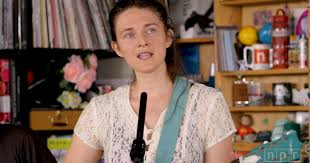
Molly Sarlé was recently on a Tiny Desk Concert with Mountain Man (who I heard but didn’t really see at Newport Folk Festival).

During the Mounatin Man songs, Molly tends to have the high harmonies.  In this session, she doesn’t sing especially high–although her voice is quite delicate.  It’s hard to believe she was a back up vocalist for Feist, not because her voice isn’t lovely–it is!–but because she doesn’t seem to be a very powerful singer.

The first Mountain Man album came out in 2010.  The second Mountain man album came out in 2018.  This is Molly’s first solo album.  During the intervening years, she did a number of things (like sing backup for Feist), but was apparently never sure if music was her calling.  And yet her songs are personal and powerful.

The songs Molly Sarlé performed at the Tiny Desk are all from her debut solo album, Karaoke Angel. These songs aren’t frivolous–at the heart of Molly Sarlé’s songs are stories. Sometimes they feel like dreamy inner thoughts loosely connected.

She opens with “Human,” a song I knew from a different Mountain Man show on NPR (Tiny Desk Family Hour).

 It may simply be a breakup song; but its wisdom is in recognizing our individual flaws, being OK with them and even finding pleasure in being imperfect beings.

Although interestingly at the Family Hour, she said it’s about how “unfortunately easy it is to talk to god like he’s a man.”

The song is fairly simple–a pretty melody and a steady one-two snare/hi-hat (Austin Vaughn).  In the Family Hour, the song was just her and her gently strummed guitar with backing harmonies.  It’s really lovely.  This version has an absolutely wonderful bass line (from Brian Betancourt) that runs through it.  It doesn’t detract form the beautiful simplicity of the song, it adds a nice counterbalance and I can’t really tell which version I like better.

Bob also says, “She’s a captivating performer who sings as much with her eyes as she does her voice.”  That is so very true.  She looks out at the audience throughout the song, with a possibly inquisitive look.  He blue eyes piercing through the lovely melody.

It’s weird just how funny Molly is–she seems fairly serious, and her delivery is quite slow, and yet she has a  great (or wicked) sense of humor.

Before “Karaoke Angel” she starts looking at the tchotchkes on the shelves.  She

began her fascination with the multitude of objects shelved behind the Tiny Desk back when she sang with Mountain Man earlier this year. This time, with her own band, those objects left by others inspired a tale of a sweaty towel, an old lover and more.

The item, labeled “Betty’s Boob Sweat” leads to a funny story of dating a ember of Feist’s band and the sad aftermath when she could feel somewhat jealous of a sweat rag.

After telling this story she ends with this amusing non-sequitur:  “No one should have to see their ex-boyfriend’s sweat rag on an other woman’s clutch.  Life is painful and this song is called Karaoke Angel.”

Molly plays the main guitar chords (so gently) while Adam Brisbin plays a quiet wavery slide guitar part.  The song sways gently and Molly’s voice is just beautiful–unadorned and clear and very pure sounding.

For all the quietness of the song, the lyrics are pretty amusing too:

I walked into a bar and gave my heart away to the first stranger I met who could remember my name.
I got up on the stage and sang at the top of my lungs Its so easy so easy to fall in love.

Each subsequent verse is about a man in the bar

Mike walked over / he was picking up what I was putting down / he said honey I am only gonna disappoint you somehow / oh Mike quit talking to me like you’re saying something I didn’t already know / I can tell by the beauty / of the furrow in your brow / you’ve been anointed by disappointment / and it might even be something you like.

Before the final song “Almost Free,” Molly tells the shockingly sad origin of the song, but has to laugh, because what else can you do

Molly cleared her throat and said this song is “about my dad wanting to talk to me about committing suicide — and it turns out writing a song about your dad talking to you about wanting to commit suicide is a great way to shift the conversation, because now we just talk about this song.” Molly Sarlé laughed a bit about the absurdity and truth of it all and, with what I sense as holding back a tear, sang a powerful, personal song in an awkward, open office space.

It starts out with just Molly strumming her guitar and singing.  It seems so stark and exposed, that when the rest of the band comes in and the song almost rocks a bit (sounding like a jam band song) that it’s comes as a relief.

This is a quietly powerful Tiny Desk and really shows off how beautiful Molly’s voice is.

[READ: Summer 2019 and October 29, 2019] The Helios Disaster

This is a weird book, to be sure.  It was written by the then wife (now ex-wife) of Karl Ove Knausgaard.  But it is absolutely nothing like his books.  Linda has her own style and perspective that makes these authors miles apart.  This book was translated from the Norwegian by Rachel Willson-Broyles.

It opens like this:

I am born of a father.  I split his head.  … You are my father, I tell him with my eyes.  My father.  The person in front of me, standing in the blood on the floor, is my father. …The blood sinks into the worn wooden floor and I think, his eyes are green like mine.

How at my birth, do I know that?  That my eyes are green like the sea.

He looks at me.  At my shining armour.  He lifts his hand.  Touches my cheek with it.  And I lift my hand and close it around his.  I want nothing but to stand like this with my father and feel his warmth, listen to the beating of his heart.  I have a father.  I am my father’s daughter.  These words ring through me like bells in that instant.

Then he screams.

His scream tears everything apart.  I will never again be close to him.

She removes her armor, puts down her lance and flees the building.  The neighbor, Greta, says she will help the girl, while the police come and investigate the commotion.  When Greta asks the girl what she wants, the girl says she wants to go to her father.  But Greta says that Conrad doesn’t have any children.

What is going on? (more…)

Read Full Post »

SOUNDTRACK: Y LA BAMBA-Tiny Desk Concert #893 (September 20, 2019).

It used to be that no one was invited back to play a Tiny Desk Concert.  The rules have been relaxed somewhat as of late (I would have thought that maybe they’d wait until 1000 shows).

The blurb explains why they (she) was invited back though.

Luz Elena Mendoza has such a far-reaching creative spirit that it’s almost impossible to confine her to a single musical identity. Which is why she’s one of just a handful of artists who’ve been invited back to the Tiny Desk to offer a revised musical vision.

Y La Bamba was on back in 2011 and they played a more acoustic style of music–accordion, percussion, guitar and lot of singers.  For this show, lead Bamba, Luz Elena Mendoza looks quite different.  In 2011, her hair was black and long, here it is silver and short–the neck tattoo is the same, though.

When she was here last with the band Y La Bamba, it was a vocal-heavy, folk outfit. The band’s sound has always been about vocals and her music has become even more so over the years.

Back in May, Y La Bamba played Non-Comm and Mendoza was pretty confrontational.  She is less so here, allowing the music to speak for her.

And the music is quite different.  It’s almost all in Spanish this time.  There’s a second guitarist (Ryan Oxford), a bass (Zachary Teran), and a drummer (Miguel Jimenez-Cruz).  She also has two backing singers, Julia Mendiolea who also plays keyboard and Isabeau Waia’u Walker.

I knew that Y La Bamba was the project of Mendoza, but i didn’t realize she did everything herself:

Y La Bamba’s albums are meticulously crafted sonic treats with her vocals layered like a choir made with a single voice. But in our offices, she called on vocalist Isabeau Waia’u Walker to replicate their distinct sound.

There’s a great variety of styles in this Tiny Desk.

“Paloma Negra” (“Black Pigeon”) [also played at Non-Comm] benefits from the voices of the entire band in a high-energy mediation on rhythm and voice.

It’s got a groovy, funky bassline and some cool echoing guitars.  There’s a tension in the verses that is totally relieved in the super catchy chorus.

This song segues into “Rios Sueltos” which is a kind of rap–but sung.  It’s bouncy and catchy but I sense is probably not a happy song, despite the catchy “hey ey ey heys” in the middle.

The song ends with a rumbling from Mendoza’s guitar as she starts up “Bruja de Brujas” [also played at Non-Comm].

There is a bruja energy and spirit to their performance, and not in the negative connotation that is the Spanish word for “witch.” In Luz Elena Mendoza’s hands a brujeria spirit is all about conjuring the kind of magic that took place on this video.

The song opens with a cool bass line and a somewhat menacing feel.  It starts quietly, but when all three vocalists sing together it’s really lovely.

At the end of the song she sinks to the ground to play with her effects as the song fades out with trippy sounds.   She jokes, “And aliens came down.:

Then she realizes, “we forgot to do one more.  Sorry the aliens did come down… and took my brain.”

The final song is the fantastic “Cuatro Crazy” [also played at Non-Comm].  It is sweet and pretty and has echoing guitars and a vocal style not unlike a Cocteau Twins song.  It even ends with a lot of “dah dah dah dahs.”

I really enjoy their music quite a lot and should really look into their stuff more.

[READ: October 6, 2019] “Abandoning a Cat”

This essay is, indeed, about abandoning a cat.  The cat story has a happy ending (although another one might not).  But mostly the essay is about how mundane events trigger memories of our parents.

He says that when he was little, his family had an older cat and they needed to get rid of it.  “Getting rid of cats back then was a common occurrence, not something that anyone would criticize you for.  The idea of neutering cats never crossed anyone’s mind.”

His father took the bike and he sat on the back with the cat in a box.  They rode to the beach about 2 km from their house, put the box down, and headed back.

When they returned home, they opened the door and there was the cat “greeting us with a friendly meow, its tail standing tall.”  His father’s expression of blank amazement “changed to one of admiration and, finally, to an expression of relief.  And the cat went back to being out pet.” (more…)

Read Full Post »

SOUNDTRACK: UMM KULTHUM (أم كلثوم‎‎)-“It is Too Late” (Fit al-ma’ ad) (1967).

I picked this song because it is mentioned in the story.

I don’t really understand the song and I didn’t really understand the story, so I guess it all fits.

Umm Kulthum was an Egyptian singer, songwriter, and film actress active from the 1920s to the 1970s. She was given the honorific title Kawkab al-Sharq (كوكب الشرق, “Star of the East”).

The version of the song that I found is 27 minutes long with three sections.  I can’t find anything useful in the way of translation (even of the title) which means “It’s too late” or “The rendez-vous is over.”

There are several parts to this song, although it is so traditional it is hard for me to determine them.  I also have a hard time understanding why her voice is so remarkable as she doesn’t really “do” very much.  She seems to have a limited range although with a lot of stamina.

Perhaps there is a different standard of excellence in Egyptian music.  Although I do understand how in the story she hears the song in the cab and calls him and he seems to take a Panadol then lays down and relaxes before turning on the radio and the song is still on.

[READ: June 1, 2019] “The Tortoise and the Hedgehog”

This is an excerpt from Sweileh’s novel Remorse Test.

It was translated from the Arabic by Jonathan Wright.  The original won an award for literature in 2017.

I include this last part because I found this story really hard to follow and even harder to enjoy.

It is written from the narrator to “you” and wonders what “remorse” is. (more…)

Read Full Post »

SOUNDTRACK: HAYKO CEPKIN-“Kabul Olur” (“Accepted”) (2018).

Hayko Cepkin is a Turkish singer of Armenian descent.  He was born on March 11, 1978 in Istanbul.

It’s hard to find out anything about him that’s not in Turkish.  So I’m including what I find interesting

In June 2005, he released his first album “a collection of compositions he recorded at home and all lyrics, music and arrangements of his own.”

He left Istanbul in 2014 and moved to Selçuk, İzmir.  He bought 9 acres of land from Şirince, and created a place where the lovers of Varil / Barrel Camping will enjoy and relax. The artist continues his music studies here.

He even had a festival there some years ago.

This song is from his latest album which is a great example of Anatolian rock–a fusion of Turkish folk and rock music.  He has taken it to some heavier levels than other bands with heavy electronics.

“Kabul Olur” starts with some electronic sounds and a flute before Cepkin starts singing in his rather lovely, powerful voice.

A minute it the drums kick in and the song starts to rock.  And then comes the power chorus at 1:20 (the second time through is even more powerful).  The post-chorus–the repeated title–is like a decompression after the intensity of the chorus.

The pounding middle section is a great combination of his growls and a traditional flute.

The denoument is him repeating “tamam” which means okay.  Its an ntense ending to a song that totally rocks.   Here’s the translated and original lyrics and the video below.

“Accepted”

My path is long, slow
Yolum uzun, ağır ağır geçer 
Life is tired I lean a little, see me
Ömür yoruldum eğilin biraz, beni görün 
The road is not this life desperation
Yol değil bu ömür biçaresizlik 
Stop, this is the final final way to death.
Durdurun, kesin final bu yol ölüm. 
Hear my voice, my voice is a little choked.
Duy duy sesim sesim biraz biraz kısık kısık buruk. 
He sees the end, walks, crazy heart.
Sonunu görür, yürür, deli gönül. Why isn’t my day in the season. 
Neden mevsim olupta günüm geçmiyor. 
Why is it born in my hands and dying? 
Ellerime doğupta neden ölüyor 
Even after all life goes by 
Bile bile sonuçta ömür geçiyor 
Heavy heavy heavy heavy heavy …
Ağır ağır ağır ağır ağır…Acceptance?
Kabul mu olur? 
Yeah, okay.
Evet, tamam.
Why isn’t my day in the season. 
Neden mevsim olupta günüm geçmiyor. 
Why is it born in my hands and dying? 
Ellerime doğupta neden ölüyor 
Even after all life goes by 
Bile bile sonuçta ömür geçiyor 
Heavy heavy heavy heavy heavy … 
Ağır ağır ağır ağır ağır… It’s okay.
Kabul olur. 
Yeah, okay.
Evet, tamam.


[READ: June 4, 2019] “Geneva, 1959”

The June 10th issue of the New Yorker features five essays by authors whom I have enjoyed.  They were gathered under the headline “Another Country.”

I do love a story which features lots of diacritics, and this one sure does.  Orhan talks about his brother Şevket and their mother Şekure and how they left Turkey because their father had gotten an good job with IBM in Switzerland.  The boys were seven and nine and their mother wanted them to learn French.  She had learned French in Istanbul and believed she could teach them at home.

But the boys were willful and she gave up, assuming the children would learn the language on the shore of Lake Geneva, in the parks, on the streets, or even at school.

But Orhan resisted the French language.  All of school was in French and Orhan seized up.  Mostly he hated being separated from his brother and he felt at sea. (more…)

Read Full Post »

SOUNDTRACK: BLACK PUMAS-NonCOMM 2019 (May 14, 2019).

A couple of years ago I had a pass to NonComm, but ultimately I decided not to go.  I had never been to World Cafe Live and, while it sounded like a fun time, it was just so many mid-week nights and lots of leaving early, that it sounded more exhausting than fun.

I have now been to World Cafe Live and I can imagine that the (less divaish) bands are hanging around talking to people (and radio personalities) which is probably pretty cool.

I love the idea of these sorta personal concerts, too.  But I have since come to see that they are 20-45 minutes tops.  Hardly worth driving 90 minutes (one-way) for.

But since the shows are streaming you can watch them live.  Or you can listen to the recorded version online.

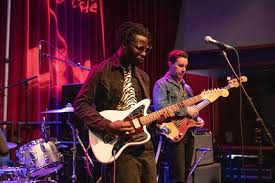
Black Pumas was the opening band on the opening night.  They play and exciting and fun psychedelic soul.

It is hard not to be moved by Eric Burton’s powerful voice. Joining Burton onstage was production partner and guitarist Adrian Quesada, as well as a bassist, keyboardist, and two backing vocalists. The whole band moved as a unit, but each member added their own unique talents, making Black Pumas’ sound undeniably theirs.

The set mostly comprised of songs from the band’s upcoming self titled debut, due June 21st.

“Next 2U” had some great keyboards and Burton’s impassioned vocals.  “Colors” showcased their ability to slow things down a bit and to lean into improvisation.  There was a grooving guitar solo and a cool keyboard solo.  There was even more grooving on “Black Moon Rising.”  I enjoyed Burton giving us the occasional falsetto “AH!” at the end of the verses.

I really couldn’t believe how young these guys turned out to be because their sound is really old-school, but with enough of a modern twist to keep it from being retro.

“Fire” opened with a cool guitar riff before backing away from the rock a bit to allow the big harmony vocals to really soar.

The final song “Etta James” was surprising because it was more like a Rock n’ Roll shuffle–a fast bass line running through the quick verses.   It’s when the soulful chorus comes in that Etta James surfaces both in the lyrics and in the soul of the song.   Although the scorching guitar solo brings the song back around to its rocking sensibility.

Black Pumas sound like a great live band that would be even more fun to see than to hear.

[READ: May 2, 2019] “Tax Niʔ Pik̓ak (A Long Time Ago)”

The July/August issue of The Walrus is the Summer Reading issue.  This year’s issue had three short stories and three poems as special features.

This story was written by Troy Sebastian / Nupqu ʔa·kǂ am̓, a Ktunaxa writer living in Lekwungen territory based in Victoria.  It’s not often that I read a story with a glossary, but it was very helpful, because this story uses a number of Ktunaxa words.

  • tax niʔ pik̓ak—a long time ago
  • Ka titi—grandmother
  • suyupi—white people
  • ka·pi—coffee
  • Kupi—owl
  • Ktunaxa ʔamak̓is—Ktunaxa lands

The story starts fairly simply, a long time ago.  Uncle Pat says that the suyupi have built a statue of David Thompson.

(more…)

Read Full Post »

SOUNDTRACK: DIET CIG-“Tummy Ache” (2019).

Diet Cig put on one of my favorite Tiny Desk Concerts.  I am really looking forward to seeing them live.  Singer/guitarist Alex Luciano has more energy than anyone I’ve seen.  And drummer Noah Bowman is a perfect foil for her.

As a duo, they play simple pop punk songs that are full of energy.  Their bio sums them up quite nicely.

Diet Cig are here to have fun. They’re here to tear you away from the soul-sucking sanctity of your dumpster-fire life and replace it with pop-blessed punk jams about navigating the impending doom of adulthood when all you want is to have ice-cream on your birthday.
But there’s also a deeper, more powerful fuck-you among the bangers that see Diet Cig grow into an unstoppable and inspiring force. “I’m not being dramatic, I’ve just fucking had it with the things that you say you think that I should be” spits Luciano on ‘Link in Bio’;

Over a four chord pattern, Luciano sings

Well i’m just a kid, a girl, a runt
And i’m starting to get real sick of
Trying to find my voice
Surrounded by all boys

Between verses the guitars get louder and play a slight variation before returning to verse two:

I’ve been yelling my whole life
And finally it’s time
to make my words count
In a way i haven’t quite figured out

And i don’t need a man
To hold my hand
And that’s just something you’ll never understand x2

The end of the song shifts tone while she quietly sings

And my stomach hurts
Cause it’s hard to be a punk while wearing a skirt

Then the instrumental passage above proves to be the music for this repeated refrain/chorus.  A simple, catchy and fun song with a message.  Can’t wait for them to come back around.

[READ: May 11, 2019] “Assassin”

Translated from the Arabic by Raymond Stock

This is the story of Bayumi.

He has been down and out and living as a beggar.  He’d been to prison, had no friends left and no way to make money.

He wondered how he could get out of this rut.

Then someone called out to him.  The man had Bayumi follow him and then asked indifferently if he would kill al-Hagg Abd al-Samad al-Habbani. (more…)

Read Full Post »

SOUNDTRACK: NEGATIVLAND-Points (1981)

Negativland’s second album continues with the noisy nonsense of the first.  This disc actually has track titles, which is nice.  It’s about 38 minutes of experimental sounds, home recordings and all manner of noisy sound effects.

“Harry to the Ferry” features David teasing his mom who is playing the accordion–retake after retake with laughing and frustration.  Totally covered by jamming noises.  At the end his, aunt sings while his mom plays the title song.

“The Answer Is…” is simple synth sound–possibly even a demo from a synth?  It sounds like an ice skating rink.  It’s quite nice.  After three minutes we get the title sampled and then the music begins again with a bit more improv.

“Scolding Box” over menacing synths, David says “Green boy is extremely mad, he’s going to start scolding.”  The rest of the nearly six minutes is wavery, unsettling synth waves and what might be clarinet samples.

“That Darn Keet” David shouts, “Blue boy escaped!” followed by thumping and more menacing synths.

“Dear Mary” with a buzzing sound underneath and amid slamming noises, a man recites a stiff, formal letter to Mary about how hard it is to be yourself.  The end is a TV clip from a game show.

“Clutch Cargo ’81” piano improv with weirdo synth sounds bouncing in an out.

“Babac D’babc” all manner of weird chirping sounds and maybe balloons and then people arguing about their marriage.  The argument comes in chunks with each one getting more intense.

“A Nice Place to Live” a promotional audio for Countara Costa county.

“A Bee Fly” mechanical sounds and high pitched noises for a minute before it jumps to a track that actually talks about a bee.

“No Hands” starts as a song of sorts under lots of echo.  Then come voices of people at a barbecue (with more bee interruption) and meat sizzling.

“Potty Air” is basically six minutes of various electronic noises and static–seems like they are testing out to see just what their electronic machines can make.

[READ: April 20, 2019] “White Walls” 

This story is set in Russia and was translated from the Russian by Jamey Gambrell.

It begins with the tale of Mikhail Avgustovich Janson, a pharmacist of Swedish descent.  In 1946 he built a dacha near Leningrad intending to rent it out to city folk.  He was soon ready for tenants and a family.  But “The Lord had something else in mind,” and Janson died soon after finishing everything.

The narrator’s family were his tenants and they bought the land from Janson’s widow.   But that was years before the narrator was born–she never met Janson.  But she and her brothers found all kinds of artifacts in the house.  Items in the attic and a large iron object that the kids assumed was a bomb even though they were told it wasn’t.

In 1997, the narrator and her family decided to strip the wallpaper and make the place their own at last.   They bought new wallpaper that they rather liked and began stripping the old. (more…)

Read Full Post »

SOUNDTRACK: NAO-Tiny Desk Concert #833 (March 18, 2019).

This was possibly my least favorite Tiny Desk Concert I have seen.  And it was endless.  It kills me when bands I like play short sets (often only three short songs) while shows like this push nearly 20 minutes.

Nao’s voice is a comic book character–underneath that comic book voice there’s a powerful voice, but it’s all wrapped up in this goofy–how can you take it seriously–nasally nonsense–and when she goes deep, it’s even more amusing.  Worse yet, her backing singers sound like bleating goats and sheep in the first two songs–single note: “baaa.”

And yet , clearly I know nothing because the blurb describes “Nao’s sophomore effort and one of 2018’s best albums.”

Just to top it off, the album is about astrology.

In astrology, your Saturn return is the time in life when Saturn goes back to the same spot it was at the time of your birth. As Nao explained during her appearance at NPR’s Tiny Desk, “It’s about leaving adolescence and going into adulthood.” This crossing of the threshold that happens around your late 20s to early 30s is the inspiration for Saturn

Maybe I would like the album more if her voice was drowned out in synths.

While Nao usually performs with synthy, electronic twinkles, her day at the Tiny Desk was stripped down by comparison. At times, her lyrics ring out with just a sparse guitar to carry them. Like a roller coaster of unexpected upheaval, Nao’s distinctive vocal range on this four-song set goes from bellowing and husky to soft and coy, often within the same verse. Be it the breezy, Brazilian funk of “If You Ever,” the hallowed harmony of “Orbit” (complete with prayer hands) or the valiant soul-searching of “Make It Out Alive,” it’s almost as if Nao duets with herself, answering her own questions, settling into her own quirks.

I listened to the show twice to see if I was wrong.  The first song is a bit catchy–I like the guitar lick from Ariel O’Neal.  In fact, focusing on her throughout the show is a highlight.

I also really like the part between the songs when she introduces the band, because she’s not singing–it’s a nice light jam.  I admit that it amuses me that she says “that’s my cousin Samson Jatto on drums–he’s not really my cousin I just wanted to say that.”

If she didn’t do the R&B warble, the opening of “Bad Blood” would be okay.  But the comical vocals just undermine anything serious.  And then the bleating starts.  I’m not sure if only Troi Lauren and Taylor Samuels are making the goat sounds, but it sounds like it’s coming from all around the room.

“Orbit is similarly okay to start with.   “Make It Out Alive” is the fastest song in the show, with some uptempo keys and bass from Joe Price and Henry Guy.

If it were one song on a mixtape, I’d skip it, but 20 minutes was a lot to take.

[READ: March 26, 2019] “Setting the World to Rights”

A powerful opening from this story: “All his life he lived on hatred.  He was a solitary man who hoarded gloom.”

And how about this: “Good people are afraid of hatred, and even tend not to believe in it.  If it appears before their eyes, they generally call it dedication or some such name.”

Those in the kibbutz believed the subject of the story (unnamed) was full of faith and dealt severely with the world–“We invested him with a halo of self-sufficient reticence.”  This halo afforded protection against gossip although the children called him ‘wicked Haman” and pointed fingers at him.

He works with machines and is efficient and hates waste. (more…)

Read Full Post »

SOUNDTRACK: KING GIZZARD AND THE LIZARD WIZARD-Murder of the Universe (2017)

Every KGATLW album is different.  Including this one.  Murder of the Universe is their second album of 2017.  It is narrative concept album split into three separate stories, each containing elements of spoken word to carry a narrative. The first two chapters feature Leah Senior’s narration, while NaturalReader’s “UK, Charles” text-to-speech application narrates the final chapter.  And it totally rocks.  There’s great riff, distorted guitars and harmonicas and lots of whooping vocals.

There are, essentially three stories on this disc.  The first chapter, The Tale of the Altered Beast, is about a human who stumbles on a mystical human/beast hybrid.  The narration is quite long and deadpan and tells a fairly complex story, which starts:

As soon as the dust settles, you can see
A new world in place of where the old one had been
Your skin is crawling with dry, crusted mud
And your naked feet are wet in a pool of blood
And the whistle of the wind in your ears is so loud
That your memories have blown up in a mushroom cloud
And as your eyes accommodate
There appears by the meadow
A brute like a bear with a long, dark shadow
And you violently shake over what you have seen
As you remember the tale of the Altered Beast

Nearly each of the nine tracks has narration interspersed with singing.  There’s a lot of repeated sections, but more as a thematic choice rather than as repetition.  The titles of the songs are indicative of this: Altered Beast I, II, III and IV and Alter Me I, II and III.  But those parts are not simply repeats.  Rather, they allude to each other with repeated riffs and words.  But even though parts are repeated there are plenty of original riffs throughout.

The third part of “Alter Me” has a cool 80’s sci-fi keyboard sound, which works perfectly before the noisy harmonica returns.

The “Altered Beast” story is the longest part of the story at 19 minutes.  And the final “Altered Beast” part has a very nifty fast section that I believe is in 11/4.

The last track “Life/Death” is very different–keyboard-fueled and almost poppy sounding, this final minute of the story is not a happy one.

The second chapter, The Lord of Lightning vs. Balrog, focuses on a battle between the forces of light of darkness.   And the segue between the two, called “Some Context” references “People-Vultures” from Nonagon Infinity.

It opens with guitarist Joey Walker’s Mongolian throat singing behind the narration on some of the tracks.  This adds an extra sense of ominousness to the story.

So the main story is a battle between The Lord of Lightning and Balrog and  they each get a song:

When the songs proper start, “The Lord of Lightning’s” theme is somewhat proggy with all kinds of ostinato (to use a term form the narration).  In addition to keyboard parts and some heavy rocking parts, there’s a callback to the chorus of “Nonagon Infinity.”  The music for this chapter is very complicated with fits and starts and various drum lines.

While the interstitials in the first chapter were done with an interesting guitar riff, the interstitials in this part come with a fast rumbling bass line.  “Balrog” has a lot of chanting befits a KGATLW song.

The war comes to a head in the Floating Fire which has more throat singing and a martial beat and its aftermath “The Acrid Corpse” … but which one is the corpse?

The third and final chapter, Han-Tyumi & The Murder of the Universe, is about a cyborg in a digital world who gains consciousness and decides to strive only for what a cyborg cannot do: vomit and die.  How very King Gizzard.  There’s a lot about vomit in this song. Maybe it was just fun hearing the robotic voice say vomit?

He decides to create a creature dubbed the “Soy-Protein Munt Machine” whose only purpose is to vomit. When the creature rejects his love, Han-Tyumi decides to merge with the machine, which causes it to lose control. This machine explodes and infinitely expels vomit, which eventually engulfs the entire universe: and so the universe is murdered.

It opens with keyboard swirls, like the opening credits a sci-fi soap opera

This is a much heavier bunch of songs, like the thumping (with extra drums) on “Digital Black.”  Over a futuristic keyboard section Han-Tyumi recites his problem:

I am bereft of two human things
Two things that a cyborg can never do
Two things that I strive for
Two things between myself and mankind
Death
And
To vomit

This story is bonkers.  But it totally rocks and it leads to the really catchy song (which they played live when I saw them called, what else, “Vomit Coffin.”  The final song is a tour de force of instrumental power while HanTyumi talks of vomiting and getting bigger and bigger until he destroys the universe.  Gross and hilarious and totally rocking.  Destroying the Universe never sounded so good.

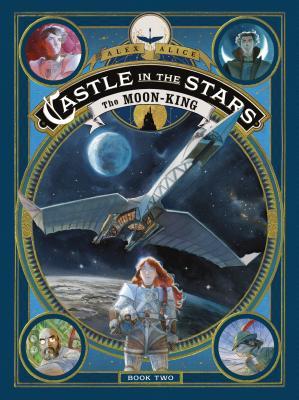
[READ: February 28, 2019] Castle in the Stars 2

This gorgeous graphic novel was originally published in French and was translated by Anne and Owen Smith.

Part two continues with the beautiful look of his book.  I am really fascinated at the way these characters can look at time cartoonish and at times almost photo-realistic (in soft focus).

At the end of the last book our team escaped from certain danger by jumping aboard an aethership.  The crew is Seraphin (whose mother has been lost in the aether when she took a ship there and never returned), Seraphim’s father as well as Seraphim’s friend Sophie (a girl!) and her half-brother Hans (the very cartoony looking character). They are joined by King Ludwig whom we are told at the begiinning of the story just wanted to leave everything behind. (more…)

Read Full Post »

« Newer Posts - Older Posts »