Feeds:
Posts
Comments

Archive for the ‘Translation’ Category

SOUNDTRACK: SISKIYOU-Keep Away the Dead [CST083] (2011).

I really enjoyed Siskiyou’s first album. This album updates the sound and makes it a bit bigger.  And yet somehow the album still sounds fragile.

The album is full of songs that are catchy, but not really easy on the ear.

The first song reminds me of Arcade Fire.  Something about the ringing guitar and crescendos.  But the recording feels more like a demo, much more intimate that Arcade Fire.  “Where Does That Leave Me” is an even more spare number, just vocals and guitar although it slowly builds.  “Twigs and Stones” is the first song that sounds like the bulk of the album—where Colin Huebert’s vocals really come to the fore.  His vocal style is loud and verging on the whiny (again, like Arcade Fire).  This song also has a lot of other instruments that percolate to the top—reminding me of older Mercury Rev.

“Revolution Blues” is the standout track for me, it’s incredibly catchy (and fun to try to sing in his eccentric voice).  The accordion and the minor key intensity is really powerful.  I guess it’s a shame that it was written by Neil Young, then (although the Siskiyou version is much better).  “Dear Old Friend” is a more country sound (which for me is shorthand for slide guitars), but it keeps the same style and feel as the other songs.  “Fiery Death” is the first song where percussion makes itself known very loudly.  It’s a cool introduction of loud thumping.  “Sing Me to Sleep” is a 2 minute lullaby and “Dead Right Now” is a 2 minute coda that ends the album nicely.

The disc is short (about 30 minutes) but a lot of emotion and craft is packed into it.  It’s really enjoyable.

[READ: May 24, 2012] “Sweet Dreams”

I’m always disconcerted when a story is in English but is set in another country.  Well, that’s not exactly right.  When it seems like it’s set in another country because the author is from that other country and he or she is writing about that other country without specifying it (usually because it is translated).  It’s very Amerocentric, but perhaps everyone thinks a story is set in their town unless told otherwise.  So I didn’t realize that this story was originally written in German (it was translated by Michael Hoffman), but it felt like it was taking place in Europe.  I actually guessed France, until later on it was revealed to be Switzerland.

There’s something cool about stories that are written elsewhere, especially if you don’t know the place well, it allows for almost anything to happen.  A couple riding a bus in Europe doesn’t mean the same thing as a couple riding a bus in, say Tallahassee.  But having set up that distinction, this story is about love.  And love is universal.

The story is written from the point of view of Lara, a shy bank worker.  She has been dating Simon for several months and they have recently moved in together.  They should be in the first bloom of love—on their own for the first  time (they never felt comfortable fooling around at their parents’ houses)—but her shyness in particular won’t loosen.  She doesn’t like him to see her naked, and they are very reserved in their love-making.  And from the start Stamm places a dark tone over the story.  The get a place in the town that he likes but it’s pretty run down.  He hadn’t brought much to the apartment, and he seems critical of some of her purchases.  He even comments that “forever is a long time” when she says that the towels she bought will last forever.  And then on the bus, a man, dressed in a long black coat stares at Lara over and over.  It may be innocent, but it’s still disconcerting.

When they get home, she takes a bath (she won’t let him in the bathroom) and asks him to go to the restaurant downstairs to buy a bottle of wine.  She finishes the bath and he’s not back yet, so she reads the paper.  Which is full of more grim news.  When she reads about a dead body found in the lake nearby and since we know she doesn’t feel comfortable about the restaurant downstairs, we know something bad has happened. (more…)

Read Full Post »

SOUNDTRACK: LAMBCHOP- “2B2” (2012).

I don’t have much exposure to Lambchop.  I know of  them mostly as a slow, country-type band.  And that’s why I haven’t listened to them much.  So I picked one song from their latest album, Mr. M, to talk about (because they are associated with Five Dials, see below).

And, indeed, they are slow.  I wouldn’t say country so much as roots, maybe, traditional folk or something.  It’s certainly slow.  This song reminds me in someways of Tindersticks, although a very stripped down Tindertsicks.  Of course, what I like about Tindertsicks is that they are not stripped down.  So this song kind of leaves me a little flat.  I like it, but I’ve already got music that’s like this ti listen to.

I’ll bet though, that it would make great background music to an engaging story (see below).  I wonder what song they chose to remix.  It’s be crazy if I picked it.

[READ: May 3, 2012] Five Dials 23

Five Dials 23 was recently released with quite little fanfare.  That may be because it is like an appetizer for the soon to be released Issue 24 which promises to be very large.

Five Dials 23 contains only one piece (and an Letter from the Editor).  The piece is by Javier Marías, whom I’ve read and enjoyed and have put on my list of authors to explore more.

CRAIG TAYLOR-“On That Fiction Feeling and Lambchop”

Craig Taylor’s introduction wonderfully encapsulates why I prefer to read fiction to non-fiction.  I have friends who say they only like to read non-fiction because at least they’re learning something (or some variant of that).  And while it’s compelling to argue that you learn stuff from fiction too, it’s not always easy to prove.  So Taylor’s Letter from the Editor is where I can point people in the future:

I remember it happened when I read part of Runaway by Alice Munro, specifically the three linked short stories ‘Chance’, ‘Soon’ and ‘Silence’. I remember the names of the North London streets I was compelled to walk – from Messina Avenue to Woodchurch Road to Greencroft Gardens – just to free myself from the sensation that had blossomed within me after I set down the book. During that walk, the neighbourhood seemed raw and responsive. I was unsettled, but in the best possible way; I was in the midst of experiencing the kind of sadness that can only be induced by fiction, which is more potent sadness than most. Also in this jumble of sensation brought on by Munro was a vow to live better, to somehow dodge the mistakes of her characters. There was a bit of a ‘what the hell am I doing with my life?’; a bit of a ‘pay attention to the details’; a bit of an ‘appreciate life more’. In short, the great inner churning that comes at the end of a few extraordinary pieces of fiction.

The details aren’t relevant, it’s the overall mood and idea that he conjures that is.  Although he mentioned Munro, he begins to talk about The Leopard by Tomasi di Lampedusa.  How this debut (and only) novel has left a strong impact not only on him and many more who have read it but also on Marías.  And that that it was Marías’ essay is about: The Leopard.

The second half of his introduction talks about the next issue and that a 10″ vinyl album will be released with it.  It will feature a double A side with author Hollis Hampton-Jones reading from her novel Comes the Night, while backed by Lambchop.  The other side features a remix of a song by Lambchop from their Mr. M album.  The end of the Letter from the Editot is given over to Hampton-Jones and her remembrance of the recording session.  (It’s very cool).

EMILY ROBERTSON and TUCKER NICHOLS drew the cool pictures of leopards.

JAVIER MARÍAS-“Hating The Leopard

This essay, translated by Margaret Jull Costa,talks about the novel The Leopard and how as a novelist, Marías hates it, even though as a reader, he loves it.

I love the surprising way he opens this: There is no such thing as the indispensable author or novel.”  Because even if the best novelist in the world never wrote, the world woul dnot be different.  I also love this insight, which I actually used recently when talking about Ulysses to someone (yes, I’m that guy) that books which “aspired to being ‘modern’ or ‘original’… leads inevitably to an early senescence or, as others might say, they become ‘dated.’  …. They can sometimes seem slightly old-fashioned or, if you prefer, dated, precisely because they were so innovative, bold, confident, original and ambitious.”  But he quickly points out that The Leopard does not fall into this dated category.

Before explaining why The Leopard has stayed with him, he gives some basic background about its publication and near lack of publication.  Indeed, Tomasi di Lampedusa (how do you say that last name?) died before it was published (but not before receiving several rejection letters).  What’s especially surprising is why he wrote the novel in the first place: “the relative late success of his cousin, the poet Lucio Piccolo…led Lampedusa to make the following comment in a letter: ‘Being absolutely certain that I was no more of a fool than he, I sat down at my desk and wrote a novel.'”  Nothing inspires like jealousy!  He also wrote because he was a solitary person.  He was married, but he seems to spend a lot of time alone.  He wanted the book published but not at the expense of his heirs (that’s nice).

Marías talks a bit about why he finds the book so extraordinary (although he says that so much has been written about the novel that he is reluctant to add more).  But one thing that impressed upon him was how the book is about preparing for death, but how, “Death stalks the book not in any insistent way, but tenuously, respectfully, modestly, almost as part of life and not necessarily the most important part either.”  As far as hating the book, Marías feels that perhaps some novelists have earned the right to hate it.

I always enjoy Five Dials.  I can only hope that my posting about it here can get more people to check it out.  Now to see why my library doesn’t have a  copy of The Leopard.

For ease of searching I include: Javier Marias.

Read Full Post »

SOUNDTRACK: TRACY THORN & JENS LEKMAN-“Yeah! Oh Yeah! from Score! 20 Years of Merge Records: The Covers (2009).

This cover makes me think that I like The Magnetic Fields for their songs, but not really for their singing or arrangements.  This song is pretty hilarious (every yeah oh yeah is in response to something awful (Do you want to break my heart?  Yeah, yeah, Oh yeah!).  The cover by the wonderful Tracy Thorn & Jens Lekman is much more understated than the original, with simple instrumentation.

The original is a chiming, kind of noisy track.  While the cover has Thorns beautiful voice languorously singing the lines while Lekman chimes in.  The backing music is delicate and almost sweet (a nice contrast to the lyrics).  I think the song is fantastic, but once again, I like the cover more than the original.  This is especially surprising as the cover is actually slower than the original.  But, really, it’s hard  to pass on Jens Lekman.

[READ: April 30, 2012] “Borges on Pleasure Island”

When I browsed for Rivka Galchen articles the other day, I found a few published works that were not in Harper’s or The New Yorker.  So, yes, I’m going to write about them here.  And since I’m caught up with the end of Gravity’s Rainbow, these short non-fictions were a nice balm.

I have been encountering a lot about Borges lately.  Roberto Bolaño loves him, there was a recent article in Harper’s about him (a review of some new translations called “The purloined Borges: Translation and traduction” by Edgardo Krebs) and now I get this article.  This article is a strange one–and I’m not entirely sure where it would have appeared in the Times.  It’s strange because it’s kind of a review of a new collection of Borges’ work (this one called On Writing, the first of three Borges’ related works published that month).  Although really she only talks about one essay, “Literary Pleasure.” (more…)

Read Full Post »

SOUNDTRACK: FIONA APPLE-“Every Single Night” (2012).

Many things have been said about Fiona Apple, and I’ll not repeat them here.  I will say, however, that she has put out some of the most consistently interesting music over the years.  From her introspective pop to her lavishly orchestrated pop, to the two mixes of her last album (one official, the other leaked), I’ve enjoyed all of it.

This is her first song in some seven years.  And it doesn’t skimp on what makes Fiona Fiona.  Specifically, it really showcases her voice.  And that’s because it is practically a capella.  The music is very spare–simple instrumentation (which sounds like a music box) and it more or less simply keeps the pace for Fiona’s voice (which sounds more full and powerful than ever) which creates the wonderful melody.  This may sound like a weird comparison, but I actually hear a bit of Eddie Vedder in her voice, too.

It’s a haunting song and the arrangement is curiously cool.

And I’ll share it here (well, actually I won’t share it, I’ll give you the link because it doesn’t want to embed):

http://w.soundcloud.com/player/?url=http%3A%2F%2Fapi.soundcloud.com%2Ftracks%2F43923280&show_artwork=true

[READ: April 18, 2012] Varamo

Varamo is the most recently translated of César Aira’s hundred or so books.  It was written in 2002 and translated by Chris Andrews.  So far it is my favorite of the Aira books I’ve read.

It’s a fairly simple premise, although like most of Aira’s books, the premise isn’t exactly followed from start to finish.  And like his other books, there are fun avenues of detours.  But unlike his other books, it is a remarkably consistent story.  Except of course, that even though the book is set on the day that Varamo writes his famous poem, we never even get to see him entering his house to do so.

What?

Well, I’m going to quote from the beginning because it really summarizes the “plot” of the story: (more…)

Read Full Post »

SOUNDTRACK: MEGAFAUN-Live from the World Cafe, November 9, 2011 (2011).

I loved the Megafaun song “Get Right,” a trippy 8 minute workout.  So I was interested to hear them in this live setting.  There’s a lengthy interview with WXPN’s Michaela Majoun (full of all kinds of details about Bon Iver–whom they used to play with before they broke up and he became Bon Iver–and about, North Carolina and Wisconsin and lutefisk).  And the band plays three songs, too.

“Real Slow” opens with a banjo (and it is real slow).  It has a very Grateful Dead feel to it and beautiful harmonies.  After the freak out of “Get Right” I was quite surprised to hear such a traditional folky song from them.  “Second Friend” is a but more upbeat–bright guitars and more beautiful harmonies.  It’s a simple song.  “State/Meant” has a bit more electric guitar, but it continues in the folkie vein.

I admit I didn’t enjoy this set as much as I expected.  The songs were really nice, but they didn’t really push any envelopes sonically, especially compared to “Get Right.”  But at the same time, what they do, they do very well.

You can hear it here.

[READ: April 23, 2012] “The Investigation”

This is an excerpt from a novel called The Investigation which is coming out in English (translated by John Cullen) in July.

I don’t know what the story is all about because this excerpt is really bizarre and wonderful, but it’s certainly not any indication of what the storyline will be.  However, it is a huge indication (I imagine) of what the story will be like.

The word “Kafkaesque” is thrown around a lot (well, in my house it is anyhow), but this excerpt is really and truly Kafkaesque.  The Investigator wakes up in a tiny hotel room to the sound of a telephone ringing.  He is naked and has no idea how he got there. And the telephone appears to be attached to the ceiling.  He has a confusing conversation on the phone that opens more questions about his situation. (more…)

Read Full Post »

SOUNDTRACK: UNDER BYEN-“Samme Stof Som Stof” from Viva Piñata! (2008).

Under Byen is a Danish band and has only one song on Viva Piñata.

I had originally written a review under the impression that it was different song (the CD and even iTunes confuses this song with “Kiss ME” by Uncut.  And you can see my initial impression below).  Now, knowing that this band is not singing in English changes a lot about my perception of what the sounds actually are.

This is one of the few remixes on the disc where I listened to the original first (to make sure I had the right song).  The original is an interesting mix of peculiar instruments and some cool soundscapes.  This remix chops it up into pieces and puts it back together.  It’s an interesting twist on the song but man, the original is so much better.

[Here’s my original thoughts, when I read a bit about the song when I thought it was by the band Uncut and I thought that it was not a remix.  And I saw that they were described as a poppy fuzzy band.

this song comes from one of their official releases.  “Kiss Me” is not a remix but it sure sounds like one.  It is kind of warped and the sounds feel manipulated in crazy ways. The vocals are mostly moans and noises. But it has a catchy beat and some interesting sounds. This is a weird song, and I’m not sure how it fits in with the rest of the album.  I do kind of like it, but I wouldn’t hunt them down for more.

Of course, now that I know it’s supposed to sound like that, I change my tune completely. And I will hunt down some other songs for comparison.

[READ: March 23, 2012] An Episode in the Life of a Landscape Painter

This is the third novel from Aira that New Directions has released (translated wonderfully by Chris Andrews). It’s the first one they published and the first one of his that I had heard of.  I actually heard of it long before I knew of Aira because the Preface is by Roberto Bolaño.  And if you do a search for Bolaño, this title always comes up.

And so now I finally got to read this mythical essay.  Sadly, it turns out to be an essay called, “The Incredible César Aira” which was recently published (2011) in Between Parentheses–bad timing for me.  It also has nothing to do with this novel specifically

But on to the novel itself.

This short book is about the German painter Johann Moritz Rugendas.  Little did I know that he was real.  He was a landscape painter (a profession which became obsolete with the invention of cameras) and he was very well-regarded.   Twice during his career he went to the Americas to paint the land.  On his second journey (from 1831-1847) he went to Mexico, Chile, Peru, Brazil and Argentina, which resulted in thousands of paintings.

The opening of the book is rather philosophical (and a little dry).  But after about ten pages, the book picks up with the titular episode.  Rugendas and a German painter named Robert Krause set off in 1837 from Chile.  They got on well.  Rugendas was far superior technically and Krause, although also quite talented, was always respectful.  Rugendas had sold prints and books and his Picturesque Voyage through Brazil was printed on wallpaper and China. (more…)

Read Full Post »

SOUNDTRACK: YOU SAY PARTY! WE SAY DIE!-“Monster (RAC Remix)” and “Like I Give a Care (Octopus Project Remix)” from Viva Piñata! (2008).

Viva Piñata is a free CD compilation that I received I think when I ordered a Tokyo Police Cub CD.  It celebrates “5 years of ass-whippin’ at Paper Bag Records.”  It came out in 2008, so presumably, Paper Bag Records has now been whippin’ ass for 9 years.

You Say Party! We Day Die! (that’s a name that seems to be trying too hard) is from British Columbia, Canada and they seem to be a noisy keyboard band.  “Monster” is a keyboard-heavy poppy song.  Of course, since this is a remix I have no idea what the original sounds like.  The lead singer has a cool deep voice (a more poppy Kim Gordon, perhaps?).  But this song is dominated by the propulsive synths.

“Like I Give a Care” has a remix that is even more intense, overeffected, noisy and chaotic with a great propulsive bass.  It also seems like most of the song has been stripped, leaving just a chorus repeated.  As a remix it works fine.

I’ve often complained about remixes–if I like a song, why would I want to hear a remix of it?  This is the opposite.  I’ve never heard the song before and the remix is kind of fun. I’m intrigued to hear what they actually sound like.

[READ: March 22, 2012] “I Can’t Read”

Another month, another excerpt from a new posthumous Bolaño release.  This latest book is called The Secret of Evil which Harper’s says will be out this month (we’ll see about that).  The Secret of Evil is evidently a collection of unfinished pieces that Bolaño was working on when he died.

This particular story certainly seems finished, so who knows what the rest of the book will be like.

I am particularly fond of this kind of story from Bolaño–it reads like nonfiction (and maybe it is).  It seems to be a true account from his life (written in first person and about his family)–it’s a personal, relaxed style in which he muses about things and events.  It is also set during his first trip back to Chile since leaving in 1974 (a subject he mines quite well).

This one starts with the line: “This is a story about four people.”  The first two people he talks about are his son Lautaro and a new friend that his son made named Pascual.  Lautaro was eight and Pascual was four, but since Lautaro was desperate for someone to play with, he overlooked the age difference and made a holiday friend. (more…)

Read Full Post »

SOUNDTRACKKHÔRA’s-Silent Your Body Is Endless [CST071] (2011).

This is the third and final disc from Constellation’s MUSIQUE FRAGILE 01 collection.  Khôra is Matthew Ramolo doing solo work on the guitar.  But unlike any other guitar album you may have heard, this one is processed and manipulated so that much of the album sounds nothing like a guitar.

Most of the sounds on the disc are washes and waves of guitars that grow and fade.  Although the opening track “Natura Naturans” has a recognizable acoustic guitar melody, the washes are all processed guitar sounds.  This sound also has an echoing church bell, the kind of sound that would bot be out of place on a black metal album although this is as far from black metal as you can get.

The church bell, by the way is a field recording, and in addition to the guitars there are plenty of field recordings on the disc.

He generates a wonderfully expansive amount of moods as well.  There are haunting melodies like on “Body Aperbut also beautifully upbeat ones like on “Hushed Pulse of the Universe”

I find the artwork that accompanies the Khora album to be the most satisfying of all three.

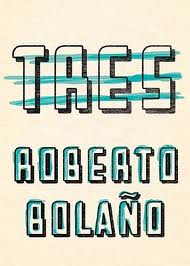
[READ: February 15, 2012] Tres

Another month, another posthumous Roberto Bolaño release.  Tres is so-called because there are three pieces in it.  They are described as poems, although I have a hard time seeing them as such.  It has the Spanish title because it was originally published as Tres and the English version is actually a bilingual version with facing Spanish and English pages (translated by Laura Healy–I guess if Laura Healy translated it, it must be poetry as she is Bolaño’s poetry translator).

Tres is also amusing to me because it is so clearly a way to make a very small book seem bigger.  In addition to the facing pages of the text, most pages have a paragraph or two at most (short ones at that).  So it’s total 173 pages is really half that and then, given how much white space there is, it’s easily half that as well.  None of this is a complaint, it’s just an observation.

The reason I’m confused about calling it poetry is because of the three pieces only one “looks” like poetry (with line breaks and what not).  Indeed, the first piece, “Prosa del otoño en Gerona” literally translates as “Prose from Autumn in Gerona.”  The second piece (the one that looks like poetry) is called “Los neochilenos” or “The Neochileans” and the final one is a series of numbered paragraphs (again, with no poetry conventions) called “Un paseo por la literatura” or “A Stroll through Literature.”  I read each of these pieces three times primarily because I found them hard to follow and wondered what I was missing.  Multiple readings did help, although I find with Bolaño’s longer short pieces, the details are exquisite while the overall picture is a bit confused. (more…)

Read Full Post »

SOUNDTRACK: MY MORNING JACKET-Circuital (2011).

I have really gotten into My Morning Jacket with their last couple of albums.  I know that they are quite different from their earlier releases, so I’m not quite as surprised by the diversity that’s on them.  With each release, they keep exploring new territory, although it’s all held together nicely by Jim James’ (or Yim Yames’) amazing voice.

The first half of the disc is much more wild than the second half, with longer songs, and more unusual textures.  The second half slows things down and feels almost, but not quite, acoustic.

“Victory Dance” is a slinky song and a cool intro to the disc.  It’s quickly followed by “Circuital,” a 7 minute long epic with two distinct parts.  The first is a kind of quiet echoey introduction, but when the guitars roar in at around 2:30, it turns into a big anthemy song…very ctahcy

“The Day is Coming” opens like a 70s AM radio song, with lots of da da das.  It’s a mellow song, the kind of song the MMJ flesh out with wonderful vocals so it never gets dull.

“Wonderful” is a simply beautiful song.  A gentle ballad about feeling wonderful.  I just found out that this song was originally intended for The Muppet Movie.  It would have been perfect.  Of course, the band are on the soundtrack doing a cover, so I guess that’s kinda close.

“Outta My System” is another catchy little number, also reminiscent of 70s AM radio, although it’s all about doing bad things as a youth and getting them out of your system.  Musically it would also work very well for the Muppets, but I suspect lyrically it might be a bit outré for the movie (granted I haven’t actually seen it so I can’t say for sure).

All the recent MMJ albums have one crazy track and on this one it’s “Holdin’ on to Black Metal.”  So the title is pretty unexpected but it’s nowhere near as unexpected as the content of the song.  It is complete with a children’s chorus and what sounds like horns, although I suspect they are keyboards.  It’s full of blasts of sound and woah woah ohs.  It’s crazy.  I love it.  Much like I love the crazy song, “Highly Suspicious”  from the previous album.  And I just found out that this song is more or less a cover (although with different words of “E-Saew Tam Punha Huajai” by Kwan Jai & Kwan Jit Sriprajan from the album Siamese Soul: Thai Spectacular 1960s-80s Volume 2.  More on that tomorrow.

  After that bizarre track, the album really settles down into an easy groove.  “First Light is a pretty traditional, simple song.  It also has lots of horns.  “You Wanna Freak Out” is also unexpected for the title, as it’s a pretty straightforward rocker. “Slow Slow Tune” doesn not belie its title.  It has a kind of 70s Pink Floyd feel and continues the more mellow second half od the disc.  The disc ends with “Movin’ Away” a slow, piano ballad.

  Although the album has a very comfortable, familiar feel, MMJ have little tricks (great soaring guitars and, again, James’ voice) to make it rise above the ordinary.  It’s great disc that warrants multiple listens.

[READ: January 28, 2012] How I Became a Nun

I didn’t love Aira’s Ghosts because it was too ephemeral for me (as befitting a book called Ghosts, right?).  How I Became a Nun is the exact opposite: a terrifically visceral story that is straightforward and easy to follow, except for perhaps two things.

The first thing is something that’s mentioned on the back of the book (so I’m not threatening a spoiler here).  The main character is named César.  Whenever someone talks to him, they address him as César or boy or him.  And yet, the whole book is written from the point of view of young César, and César describes himself as a girl.  In the fourth paragraph, the narrator states, “I was a devoted daughter.”  And yet, shortly thereafter, another character says about the narrator, “Is it my fault if the boy didn’t like it?”

This goes on throughout the story–not a lot–but enough to keep it in your mind.

The second thing is the ending.  Which I don’t want to spoil.

So what is this wonderfully titled story about?  Well, six-year old César begins, “My story, the story of ‘how I became a nun’ began very early in my life.”  The opening chapter tells the story of César’s first experience with ice-cream.

It is a wonderful chapter, with César’s father promising the wondrous delights of ice cream and taking them both out for a cone.  César’s father enjoys his cone very much, but César, although instantly in love with the pink strawberry color is instantly disgusted by the taste. He even retches a little bit. (more…)

Read Full Post »

SOUNDTRACK: WILD FLAG-SXSW April 1, 2011 (2011).

Wild Flag has released one of the best albums of 2011.  I can’t stop listening to it.  So, it’s funny that this show has been sitting on NPR’s download page for months without me checking it out because I didn’t know who the band was until the album came out.  Wild Flag is Carrie Brownstein, Mary Timony and Janet Weiss (and a keyboardist who I will never remember because I never heard of the band she was originally in). 

This show at SXSW is one of their earlier shows.  It’s so early that one of the songs in the setlist appears on the album with a different title.  And the band is full of raw energy and passion. 

Although research shows that they’d been touring since November, Mary Timony seems somewhat hesitant in a few songs.  But Carrie Brownstein seems fired up to be playing again, and she rages and jumps around the stage, her voice as aggressive and fun as it was in Sleater-Kinney.  Janet Weiss, as ever, kicks massive ass on the drum kit.  man can she wail–she is a vastly underrated drummer. 

The band has great cohesion and they seem like they’re really enjoying themselves. 

 In many respects this band sounds like Sleater-Kinney (2/3 of the band are here).  But the addition of Timony’s lyrics and more gentle voice bring a cool change.  And the keyboards flesh out the songs in wonderful ways as well–for a band with no bassist, it’s funny that the most pronounced keyboards riffs are at the high end of the register.

There’s a few flubs during the set, in one of the more pronounced keyboard riffs, there’s a pretty major gaffe.  And sometimes it seems like they don’t know exactly how they should be harmonizing with each other (not true on the record at all).  And during the extended soloing of “Glass Tambourine” (6 minutes), I’m not really sure what Mary is up to.  But that’s okay.  The band is all about rawness, so that can be forgiven. 

While the album is better, this live show is a good introduction to the band. 

Since Carrie Brownstein worked for NPR I almost expect all of their shows to be available here.  But for now, watch the whole show here.

[READ: January 17, 2012] “Old Mrs. J”

Stephen Snyder translated this story that was originally written in Japanese.  It’s interesting to me when a work is translated from another culture.  Does the translator intend to keep the other culture obvious or does the translator try to make the story, in this case, more European or American.  There’s some inevitability in that, since the language is changed, and yet the sensibility of the original often remains.

I bring this up because I tend to think of Japanese writing as being very distinctive.  And yet this story didn’t really “read” very Japanese to me (Kiwi fruit aside).  It did read a little bizarre, but that was the fun part.

The story starts out simply enough: a young writer (who is a woman, although you don’t find that out until very late in the story unless, unlike me, you assume the main character is a woman because the author’s name is Yoko).  The author works late and sleeps in til noon or so.  It’s a quiet, peaceful place.  The landlady is older and somewhat feeble.  Until, that is, she gets into her garden and then she seems possessed by a fire. 

The landlady hasn’t really talked to the writer.  Then one day the writer hears the landlady in the garden cursing at a stray cat.  The landlady hates cats and curses them up and down.  Finally the writer tells her to put pine needles down, that cats hate prickly things on their feet.  This I did not know.

And they strike up a friendship.  The landlady reveals that her husband was no good and that he left her.  She also reveals that she gives massages.  And she begins leaving the writer vegetables from her garden.  Then one day, the landlady brings her a strange carrot with 5 “fingers” coming off of the central stalk.  The carrots are quite special.  And she keeps them a secret until sure enough, she begins growing lots and lots of them.  Even the newspaper comes to take a picture.

This idyllic story is interrupted in the last few paragraphs.  First by what seems like metaphorical scariness and then, ultimately, with reality.  It is a wonderfully realized story, wonderfully told and with enough hints of magical realism throughout that the ending isn’t totally unbelievable–even if it is quite unexpected.

Read Full Post »

« Newer Posts - Older Posts »