Feeds:
Posts
Comments

Archive for the ‘Translation’ Category

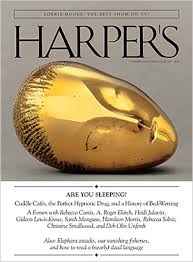
harper septSOUNDTRACK: LINDA THOMPSON-“Love’s for Babies and Fools” (2013).

lindaAfter two pop songs, here’s a major bummer from Linda Thompson.  Thompson is a fascinating figure.  She was married to Richard Thompson and made many albums with him.  They split very acrimoniously and them Linda suffered from psychogenic dysphonia, which rendered her incapable of singing.  She stopped singing for 11 years.  Now with botox injections into her throat she can sing again, but cannot perform live. She released an album n 2002 (Richard played guitar on a track) and another album in 2007.  Now’s she’s back and Richard plays on this song as well.

In the grand tradition of folk music, Linda’s lyrics are achingly straightforward and powerful:

My father is a traveler, he has a cuckold’s luck,  my mother is a queen but her hands are tied with blood. I’ve a brother in the graveyard, my sister has the blues.  I care only for myself.  Love’s for babies and fools.

The guitar work is beautiful, the song itself is beautiful and depressing at the same time.

Linda’s voice has always been unique—almost otherworldly and yet ordinary at the same time.  It’s strange and mesmerizing.  Welcome back Linda.

[READ: October 1, 2013] “A Different Kind of Father”

This is an excerpt from a new book by Franzen. The book itself is fascinating.  It is a translation of a “Nestroy and Posterity” a somewhat obscure essay from 1912 by the Austrian satirist Karl Kraus.  Franzen’s book is called The Kraus Project and in addition to the translation, Franzen includes a ton of footnotes that are all personal, like this one.  The book is 300 some pages and it sounds like the majority of it is footnotes.  [For those who like to keep track of Franzen’s connections to David Foster Wallace, of course this collection with footnotes does make one think of DFW.  Interestingly, Franzen talks about a book he was writing in 1981 (long before he met DFW which had a main character whose name was Wallace Wallace Wallace].

This footnote (no context is given) is all about the concept of thriving as a man by surpassing your father.  Be that literal or figurative (or literary).  In the case of Kraus, Franzen says, he is denying false paternity.  It was believed that Kraus was the literary son of Heinrich Heine, but Kraus tries to annihilate Heine by dismissing his successes and impugning his character.  However, Johann Nestroy was also a precursor to Kraus but Nestroy was a somewhat neglected and undervalued one, and so Kraus seeks to place Nestroy as his surrogate father. (more…)

Read Full Post »

aug2013SOUNDTRACK: KISS-MTV Unplugged (1996).

unpluggedEver ones to jump on a bandwagon, Kiss did an Unplugged special in 1996.  They had been laying low for a while.  Conventional wisdom says they were working on the follow-up to Revenge (and the successful Alive III tour) when they got called in to do this Unplugged.  (The follow-up Carnival of Souls would eventually be released to little fanfare).

And so here we have Kiss in an unplugged setting.  The big surprise for this show was that Peter Criss and Ace Frehley were invited back on stage to play some songs.  And things went so well (and there was clearly money to be made in a reunion) that the original guys got together, made an album and even toured it (which I saw).

But to me the real surprise is what a great set list this is.  I would love to go to a Kiss show and hear these selections because the diversity is fantastic and there’s very few of the obnoxious hits that I’m tired of.  It’s true that the bulk of these songs are their more mellow offerings (which is smart since the heavier ones wouldn’t work so well with the big acoustic guitar sound), but the choices are so unexpected.  I mean look what they start with.

“Comin’ Home” a deep cut off of Hotter Than Hell that, well I won’t say Kiss fans wouldn’t know, but that contemporary Kiss fans may not know.  And it sounds fantastic in this recording.  The heavier songs don’t sound quite as good with the big acoustic guitar treatment—so “Plaster Caster” seems a little odd.  However, “Goin Blind” (however absurd the lyrics) works great in this setting (you can really hear the complex bass that Gene plays).  Surprisingly, “Do You Love Me” falls a little flat here because in the studio version the choruses are so big, but here they are gentle and it kind of undermines the intensity.  I keep reiterating how much I really dislike “Domino” lyrically.  But musically it’s pretty interesting and it works fine in this setting.

The biggest musical surprise comes with “Sure Know Something” from Dynasty.  Even though the original is very discoey, the acoustic treatment sounds great.  “World Without Heroes” is another huge surprise and it also works very well in this setting (I’m trying to imagine how all of them needed to relearn all of these songs).  With the intro to “Rock Bottom” being a sweet melody the acoustic version works well.  Surprisingly the louder part works pretty well here too.  And then woah, “See You Tonite” from the Gene solo album!  They pulled some crazy things out for this show. I suppose this set wouldn’t be very exciting in the full makeup stage show, but it would be very cool to hear these tracks live.

“I Still Love You” is an aching ballad that works well in this context because really the main feature of the song is Paul’s voice which sounds great here.  “Every Time I Look at You “ is a cheesy ballad which of course is tailor-made for Unplugged.

And then comes the surprise—Peter and Ace.  It’s the first time they’ve all played without makeup and the first reunion in years.  And as a nice treat they play “2,000 Man” the track that Ace sang on Unmasked (surprising that they didn’t do “Shock Me,” but that is not really right for an Unplugged).  “Beth” is not really a surprise as it is Peter’s song, although it is surprising to hear it on guitar which changes the song quite a bit and makes it sound quite good.  The real treat is “Nothin’ to Lose” in which everyone comes out on stage and takes a verse.  It’s always fun to hear how into it Peter is.  The set ends with “Rock n Roll All Nite” and even in this more stripped down setting the song sounds good (although they must be so tired of singing this song).

Unplugged albums tend to get forgotten in artist’s catalogs, but this is a really enjoyable set and a must for any Kiss fan.  Incidentally there are some “uncut” versions of the show online that are worth checking out for the extra tracks.

[READ: September 17, 2013] “The Exiled Queen”

This is the kind of story that makes me wonder why someone would write about the things they do.  Not because it’s bad or not worth writing about, I just can’t imagine where the idea came from.  This is a story about a boy named Filippino who is an art prodigy.  He could draw a Madonna before he knew what a Madonna was.  He learned to paint and gild frames before he could talk and his work was impeccable.

This was a challenging story for me to read because there are no paragraph breaks (and I love my paragraph breaks).  It is just an endless stream of prose about this painting prodigy.  But some details do come through the verbiage.

It is 1469 (!), the boy’s father has died, and he was soon taken under the wing of the great painter Battigello.  And Battigello began to teach him more and more, but young Filippino would learn so quickly.  he could just watch the master’s arms and imitate his brush strokes.  We later learn that Battigello would come to be called Botticelli. (more…)

Read Full Post »

CV1_TNY_09_09_13McCall.inddSOUNDTRACK: KISS-Alive III (1993).

alive iiiI’m aware that there are questions about the real “live” nature of the first two Kiss Alive albums.  This naturally makes me suspect the nature of the live-ness of this one as well.  Not that I don’t think the songs are live, but I have to question the volume of the fans, who at times sound artificially enhanced.  I’ve also read that the “I Was Made for Lovin’ You” was taken from the soundboard during soundcheck with cheers added later.  If that’s true I have to give credit to Paul for being so “into it” during soundcheck.

back in the 70s, Kiss made a point for Alive II to not duplicate any songs from Alive!.  Obviously Kiss are much more mercenary now than they were back then–duplication is part of their thing now.  But since this is the first live album since the 70s, there’s a lot of new material to choose from.  Nevertheless, this probably shows a realistic set list for the time, so there are going to be some overlap from the 70s, and that’s okay.  And the band sounds quite good (this was 20 years ago it’s hard to believe).

“Creatures of the Night” is a rousing opener.  It’s hard to imagine they didn’t open with “Detroit Rock City” and end with “Rock n Roll Al Nite”.  “Deuce” is one of their best songs, so it’s a welcome old song.  Then there’s some questionable choices.  “I Just Wanna” is a bad song with a very obvious vocal line.  But it came from the then current album and it’s got the “naughty” singalong section (which was apparently dubbed out to avoid a Parental Warning sticker).  Despite all of the entendre in Kiss, they’ve never really been explicit, so the “I just wanna fuck” seems weird for them (especially when you know how many kids have been going to their tours recently).

“Unholy” fares much better.  It’s one of their cooler new songs.  Paul introduces “Heaven’s on Fire” in a fairly amusing way (and he can still ht those notes).  I don’t especially like that song or “Lick it Up,” but they will always be their bigger hits, so they get played.  Obviously I’m delighted to hear “Watching You” which they do very well.  I dislike “domino” lyrically quite a lot and I feel like Gene’s delivery here is disinterested at best (is it possible he is as disgusted by the lyrics as I am?).  But the song rocks musically.  “I Was Made for Loving You” is updated and sounds far less discoey.  “I Still Love You” is a great concert staple and it’s nice to have it on record.

Probably the biggest surprise on the disc is that “Rock n Roll All Nite” is not the encore (or maybe it was in concert, but it’s not last on the album.  I’d be delighted to see them and have this not be the encore.  I’d also be delighted if I never heard “Lick It Up” again.  I don’t know why this song irks me so much, but it does.  And in this live version, hearing Paul state “I wanna lick you” just creeps me out.  “Forever,” cheesy ballad and all, sounds pretty great live.   but “I Love It Loud” which is a great song sounds off here—too many backing vocals or something?  “Detroit Roock City”sounds great of course, although it’s funny to hear it have an introduction.

The disc is pretty much over for me here because I don’t like “God Gave Rock n Roll to You II” although this version is fine.  And the very end of the disc is, strangely, “The Star Spangled Banner.”  It’s a whole band version (without words) but  simple cannot imagine them doing it live for any reason.

So, this proves to be a pretty decent live album.  Not quite up to the stellar heights of Alive! and Alive II, but a worthy addition to the series.

[READ: September 15, 2013] “The Heron”

This story begins with the statement that the best place to feed herons is in Frederiksberg Gardens because they are tame.  The tone is very much like Julie Hecht–all matter of fact and somewhat indignant.

The story continues to talk about herons and the strange man who often stands on the paths that lead to the Chinese Pavilion. The narrator avoids this man by walking around to Damhus Pond (where the suitcase with the woman’s body chopped up inside of it was found).  He imagines the man who found it (well, technically the dog found it) was never the same again (nor, no doubt was the dog).  Despite the grisly scene (the narrator has never found anything there) he walks out of his way by the pond to avoid the herons.  And the strange man. (more…)

Read Full Post »

werwolvsSOUNDTRACK: VOIVOD-Nothingface (1989).

nothingI have talked about Nothingface before, but here it is in sequence with the Voivod catalog.

This is the culmination of Voivod’s move toward progressive metal. Even nearly 25 years after its release, this remains one of my favorite albums ever.  The guitar chords are complex and wonderful.  Snakes’ voice is melodic with odd tinges of weirdness thrown in—where he goes up or down a note unexpectedly.  Plus, he has that peculiar pronunciation/emphasis that makes the words sound even more exotic (like “repugnant”).  And despite the fact that they cover Pink Floyd (!), the album is still heavy.

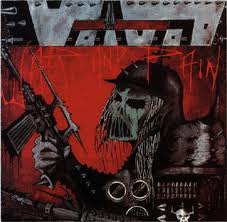
The whole band is in top form here—Away’s drumming is explosive and complex, Blacky has a fantastic rumbling sound that’s not distorted but really fills in the bottom end and Piggy’s guitar is masterful.  “The Unknown Knows” has some cool staggered notes and a great catchy guitar riff during the verses but the time changes come fast and furious.  I love the way the guitar and bass play off each other in this song.  But then comes the cover of “Astronomy Domine”.  Imagine the band from War and Pain who used to cover Slayer and Venom now covering Pink Floyd.  It’s hard to fathom, but man, do they pull it off wonderfully—adding a heavy bass element but keeping it very faithful.  And Away’s drumming is stellar.  It’s a marvelous cover.

“Missing Sequences” starts with a cool bass line and Snake’s great pause… “NOW!” Then when he starts singing again, his voice is phased in a very cool sci-fi kind of way.  There’s also some interesting effects—keyboards maybe–in many of the songs.  There’s also a great part where there’s a rumbling bass and Snake’s scream of “GO!” before a weird guitar solo and then even weirder shifted guitar chords.  It’s magnificent.

As is the guitar playing in the verses for “X-Ray.”  I’m not even sure how Piggy came up with the bizarre chords in “Pre-Ignition.”  And yet despite the harshness, there’s pretty melodies like in the cool catchy “ground and rock and sand” section of the song.  And as for pretty, the quiet beauty that opens “Into My Hypercube” is really impressive for such a dissonant album—Snake whispers his vocals and the guitars are all pretty, major chords.  Until the bridge where dissonance enters and then the post bridge (who even knows what to call these song parts) which is once again a heavy round of dissonant chords.  And then when the “tumult in the dark” section starts, it’s practically a whole new song—until Blacky’s bass section reintroduces the beginning motif.

The final track has a wonderful moment where Snake’s voice follows Piggy’ unusual guitar line perfectly.  And then the very cool almost funky (great bass sound) of Blacky after the “too late for S.O.S.” line.  The album ends abruptly (too late for S.O.S.) and you’re left contemplating everything that just happened (I haven’t even mentioned the lyrics).

It’s a prog metal masterpiece.

[READ: August 26, 2013] Werewolves of Montpellier

I enjoyed Jason’s Lost Cat so much that I went to the library and checked out some other books by him as well.

Werewolves has the same looking characters as in Lost Cat, but they are different people (I assume).  The strange thing about this book is that the werewolves don’t look all that different from the main drawings.  At first I wasn’t even sure that he was wearing the werewolf mask.  But on closer inspection there are subtle differences (the eyes, the ears, the fingers).  Indeed, it took two reads for me to really notice all the subtle details.  Nevertheless, it’s just funny to imagine the characters thinking he was a werewolf when he looks for the most part the same anyway.

But so this story starts with the main character, Sven, dressed like a werwolf and breaking into someone’s house.  When the victim comes home, she catches him, but is frightened and he flees out the window.  In the next scene his next door neighbor, Audrey, (not his girlfriend, as she is dating a woman named Julie) brings him some food and tells him that he was in the paper (unidentified but in costume).

Then we see the main character and a bird looking guy playing chess in the park (and talking about the value of escalators for checking out women’s asses).  The main characters seems to be primarily dog-like and bird-like, but they intermingle freely.

The final new characters are two men talking about the photo.  They say that the werewolf in the photo is not part of their brotherhood and they want to punish this newcomer for causing them trouble. (more…)

Read Full Post »

lostcatwarandSOUNDTRACK: VOIVOD-War and Pain (bonus stuff) (2004).

The War and Pain reissue was packed with goodies for Voivod fans.

You get “Anachronism” which is 3 songs from their very first live show in June 1983.  (“Condemned to the Gallows,” “Blower,” “Voivod”). They had (it sounds like) a surprisingly large audience for the show.  You also get “To The Death” which is 3 songs from the Metal Massacre V sessions (“Condemned to the Gallows,” “Voivod,” “Iron Gang”) of which “Condemned to the Gallows” was used on that compilation.  I think this is one of their better early songs, and it’s a shame it never got a proper release (although it’s all over this package).

If the sound quality on their proper album was bad, you can imagine how bad this sounds.  Their first show may have been recorded on a microcassette it is so low-fidelity.  And somehow the Metal Massacre tracks sound like they were left in a puddle of mud since 1984.  I have the Metal Massacre albums and I don’t think they sounded that bad.

That leaves Disc 2: “Morgoth Invasion.”  This is a live show from December 1984.  It has 16 songs (surprisingly no “Voivod” and two covers:  Venom’s “Witching Hour” and Slayer’s “Chemical Warfare”).  Like the previous live tracks, this one sounds pretty dreadful–but not quite as bad.  It is fun for the historic value–hearing the band play fast and tight hearing Snake’s guttural French (he did most of the between song banter in French).  Also hearing how well they play the covers shows how seriously they took their metal.

The third disc is a CD-ROM.  You get lyrics to the album, biographies of the band and comments on the 20th anniversary release.  There’s also band photos and art by Away.  There’s even the old  video for “Voivod.”

But for fans the most exciting part is the “Sounds” section.  In addition to including all of the above audio (in case you wanted it all on CD-ROM?), there’s also seven songs from a 1984 concert.  I am fairly certain that these tracks would eventually be released on the To the Death 84 album (it’s the same order and I don’t have that record).  Again, the sound quality is not great, but it’s interesting to hear these songs played live–to hear just how fast these guys can play.

So the anniversary package is worth investing in if you like your Voivod.  If not, wait a couple more albums when they become amazing.

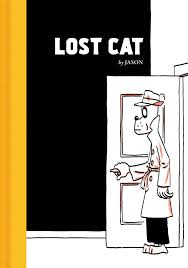
[READ: August 26, 2013] Lost Cat

I had not heard of Jason before this book passed across my desk.  Jason is a Norwegian graphic artist and comic book maker whose real name is John Arne Sæterøy.  Many of his books have been published in English by Fantagraphics.  This one was translated (from the Norwegian I assume, although Jason now lives in France, so maybe it was written in French) by Kim Thompson.  The interesting thing about the translation is that I didn’t realize it was one at first…I just thought the characters were deliberately speaking in a weird sort of way.  I wonder if this is intentional on the translator’s part.

The striking thing about Jason’s art is that his characters do not have eyeballs (as you can see from the cover art).  This seems to convey an overall sadness to the characters.  And yet he is also incredible at creating mood and tone from these animal people (even without eyeballs!).

This story has a few threads that tie it together.  As the story opens we meet Dan Delon, a private detective.  As he walks home for the night he sees a lost cat sign.  A few panels later he see the cat.  He calls the number and returns the lost kitty.  The kitty’s owner, Charlotte, is very nice.  She invites him in and gives him a drink.  She owns a local bookstore which he was recently in (although they did not meet).  They seem to have a lot in common.  Charlotte is fascinated that he’s a private detective.  But he quickly dismisses the excitement saying that it is mostly just taking pictures of people having affairs–and then upsetting both parties when all is said and done.  He seems to realize the loneliness of his life as he says this (again, conveyed wonderfully with the art). (more…)

Read Full Post »

neglectfulSOUNDTRACK: TWO INCH ASTRONAUT-“Spank Jail” (2013).

two-inch-astronaut-cover-de5df21ccbfbcb75c6d6c83315becf109f32f74e-s1Two Inch Astronaut resuscitate some great dissonant sounds of the 1990s.

This song packs abrasive chords and unusual riffs.   But there is also so much going on in these three and a half minutes, that if it weren’t for the recurrent riff it might be several different songs.

This song opens with a brittle guitar playing an odd riff.  Then the band jumps in all playing that same fast, odd riff.  By thirty seconds, a pounding riff takes over until the verses start–spoken/shouted words (like great punk of the 80s) over a pulsing bass.  But then comes the great big melodic chorus–giving you something to latch on to in all the chaos (which comes back right after the chorus with guitars that sound practically unhinged).

The second verse is not spoken, but yelled, changing the song once again.  As does the third verse which is primarily bass with guitar accents and a few quiet moments.  But the guitar solo is just as fast as might be expected from the band.  What’s unexpected is that the guitar solo leads to a closing riff, and no more vocals.

This is challenging, harsh music designed to keep you off-balance.  And it’s a welcome sound that I’ve missed over the last few years.

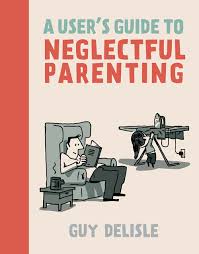
[READ: June 21, 2013] A User’s Guide to Neglectful Parenting

This book came into my pile of new books at work. Since I’ve often wondered if I am a neglectful parent I thought maybe I could learn a trick or two from this User’s Guide.

Well, I read the whole thing in about ten minutes.  There are about twelve twenty page cartoons included.  Each one is a little saga of bad (and hilarious) parenting.

The first is about the tooth fairy (which in this version is a mouse—Delisle is Canadian…where does the mouse come from?).  It, of course has to do with every parent’s tooth fairy woe—when they forget to have the tooth fairy show up.  The punch line is quite good on this one.

One of the premises of the strip is that the dad is a Manly Man—and he thinks his son is a wimp.  So, when he sees a punching bag he encourages his son to be a man and hit it.  No, not like that…really hit it.  I know, pretend you’re hitting your sister.

WHAM WHAM WHAM.

Or perhaps the “here son, try out this chainsaw” strip.  The son, sensibly doesn’t want to.  The dad says he’s ½ Canadian, he’ll have to do it.  Then he tries a practical joke.  Practical joke with chainsaw.  The son freaks out, but the punchline is even better.  Very twisted. (more…)

Read Full Post »

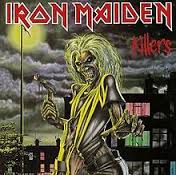
43SOUNDTRACK: IRON MAIDEN-Killers (1981).

killersKillers picks up right where Iron Maiden left off–indeed many of these songs were written at the same time as the first album.  The difference is new guitarist Adrian Smith.

It opens with the great (but simple) instrumental “Ides of March” which segues into the blistering “Wrathchild.”  And it’s on this song that you can tell some of the rawness has been removed from the recording.  The guitars sound a wee bit more polished.

And you can tell the band are getting a bit more symphonic with the bass harmonics that intro the wonderful “Murders in the Rue Morgue” a song that feels long but actually isn’t.  It has several parts that all seem to signal the end until Clive Burrs drums come pounding in to restart the song.  Very cool.  “Another Life” is another fast punky song, and while I like it, it is probably one of the weaker songs on the album.  But that’s okay because it is followed by one of Maidens greatest instrumentals–“Genghis Khan” which has beautiful symphonic soaring solos over a cool propulsive beat.

“Innocent Exile” opens with another great noisy slappy bass riff that only Harris was doing at the time.  “Killers” is a classic track: fast and yet complex, with a very cool riff.   “Twilight Zone” sees Di’Anno reaching for higher more operatic notes.  He makes it, but you can just tell that the band needs more from their vocalist.  “Prodigal Son” opens with a pretty acoustic guitar intro.  I used to like this song quite a bit (whatever Lamia is), but I can see that it’s actually quite long and meandering (maybe this one is more like “War Pigs”).  It’s pretty but could probably be a bit shorter.  “Purgatory” sounds like track off the first album–fast raw and punky with screaming riffs.  “Drifter” ends the disc with a cool bass line and some more thrashing.  It’s a solid ending for an album that overall works pretty well, but which kind of shows that the band had to either do something big on the next album or get stuck in a rut.

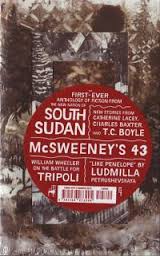
[READ: June 1, 2013] McSweeney’s #43

And with this issue I am almost all caught up with my McSweeney’s.  More impressively, I read this one only a few days after receiving it!

This issues comes with two small books.  And each book has a very cool fold-out/die cut cover (which is rather hard to close and which I was sure would get caught and therefore ripped on something but which hasn’t yet).  The first is a standard collection of letters and stories and the second is a collection of fiction from South Sudan.  Jointly they are a great collection of fiction and nonfiction, another solid effort from McSweeney’s.

Letters (more…)

Read Full Post »

42SOUNDTRACK: IRON MAIDEN-Iron Maiden (1980).

Steve Harris was on That Metal Show recently.  Harris is the baimssist and primary songwriter for Iron Maiden and has been since their first album in 1980.  When I was in high school Iron Maiden was my favorite band hands down.  I had all their albums, I had all their singles, all their hard to find British vinyl 12 inch singles, even a few pictures discs.  Wonder if they’re valuable?

Every album was an epic event for me–I even played “Rime of the Ancient Mariner “off of Powerslave to my English class (not telling anyone it was 13 minutes long).

And then, after Somewhere in Time, I just stopped listening to them. Almost full stop.  I did manage to get the first four albums on CD, but the break was pretty striking.  I actually didn’t know that they’d had personnel changes in the ensuing years.  I’d vaguely heard that Bruce Dickinson  left, and that others followed, but I don’t think I quite realized that they were back to their big lineup these days.

Anyhow, Harris was so earnest and cool that I had to go check out some of their new stuff. Which was okay.  I’d need more time to digest, but then I had to listen to the first albums again.

And wow I had forgotten how much the first Iron Maiden album melds punk and prog rock into a wild metal hybrid.  There’s so much rawness in the sound and Paul Di’Anno’s vocals, not to mention the speed of some of the tracks.  And yet there’s also some epic time changes and starts and stops and the elaborate multipart Phantom of the Opera….  Wow.

The opening chords of “Prowler” are brutal.  But what’s surprising is how the second song “Remember Tomorrow” is a lengthy song that has many ballad-like qualities, some very slow moody sections–although of course each chorus rages with a great heavy riff and a blistering solo.  On the first two albums Paul Di’Anno was the singer.  He had a fine voice (it was no Bruce Dickinson, but it was fine).  What’s funny is that Bruce does the screams in “Remember Tomorrow” so much better in the live version that I forgot Paul’s vocals were a little anemic here.

However, Paul sounds perfect for the rawness of “Running Free” a wonderfully propulsive song with classic Harris bass and very simple metal chugga chugga riffs.  And this has one of the first real dual guitar solos–with both players doing almost the same riff (and later Harris joining in on bass).

“Phantom of the Opera” is the band’s first attempt at an epic multi-secton kinda-prog song.  It opens with a memorable, if slightly idiosyncratic riff and some wonderfully fast guitars/bass.  There’s a great slow bit that morphs into an awesome instrumental soloing section with bass and twin guitars playing a wonderful melody.

“Transylvania” is an instrumental that is challenging but probably not one of the best metal instrumentals out there, although again when Dennis Stratton and Dave Murray play in synch solos it’s awesome.  This track segues into “Strange World” a surprisingly trippy song (with effects that seem like keyboards but which aren’t).  It’s slow in a “War Pigs” kind of way, but it doesn’t entirely break up the album, because there are other slow bits on the disc.  It is a little out of place though.

Especially when “Sanctuary” blasts forth.  True, it wasn’t originally on the album (in the UK), but man, blistering punk or what!  “Charlotte the Harlot” was always one of my favorite songs (it taught me what a harlot was after all), it’s quite proggy, with a lot of stuttered guitar work and a middle section that features some loud and complex bass.  The disc ends with the by now almost immortal “Iron Maiden.”   A great raw riff opens the song, a harmony guitar partners it and the band blasts forth.  Who even knows what the lyrics area about, the song just moves and moves–There’s even a great chaotic bass/drum break in the middle.  And listening to the guitar noises in the solos at the end.  Amazing.  It’s quite the debut.

[READ: June 7, 2013] McSweeney’s #42

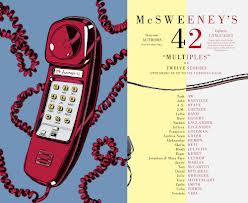
I have made it a point of (possibly misguided) pride that I have read every word in every McSweeney’s issue.  But this issue has brought that to an end.  As the title states, there are twelve stories in the book.  But there are also sixty-one authors writing in eighteen languages.  And there’s the rub.  One of my greatest (possibly misguided) shames is that I don’t speak any other languages.  Well, I studied Spanish and German, I know a few dozen words in French and I can read the Greek alphabet, but none of these would help me read any of these stories.  So, at least half of this book I didn’t read.

But that’s kind of the point.  The purpose of this book is to make a “telephone” type game out of these stories.  Stories are translated from one language to another and then re-translated back into English.  The translators were mostly writers rather than translators and while some of them knew the second language, many of them resorted to Google Translate or other resources to “read” the story.  Some people read the story once and then rewrote it entirely, other people tried to be as faithful as possible to the original.  And so what you get are twelve stories, some told three times in English.  Some versions are very similar and others are wildly divergent.

I normally write about the stories in the issues, but that seems sort of beside the point as the original stories were already published and were selected for various reasons (and we don’t even see any of the original stories).  The point here is the translation(s).  So, in a far less thorough than usual way, I’ll list the contents below. (more…)

Read Full Post »

220px-The_Invention_of_Morel_1940_Dust_JacketSOUNDTRACK: RODRIGUEZ-“Sugar Man” (1971).

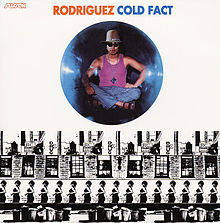
RodriguezcoldfactThis song was played a lot on WXPN, and when I first heard it I couldn’t imagine what new artist was talking about “sweet Mary Jane.”  So it turned out that this song was over 40 years old but it had been resurrected for a movie called Searching for Sugar Man, which is a documentary about Sixto Rodriguez and how he released two albums and then disappeared.

There’s something extremely catchy about this song–the loud down strums that stand out over the quieter strumming, the crazy high frequency sound that sails throughout the song and that hint of horns that gives more depth to this simple folk song.   All of these elements make this song more complex than it might have been.  In fact, the song seems like it’s going to end after about two minutes but there’s the instrumental section full of crazy sounds and electronics.

And even though it seems over after that there’s one more verse and chorus to go.  And then the song just drifts away echoing into nothingness.  It’s quite a catchy little number.

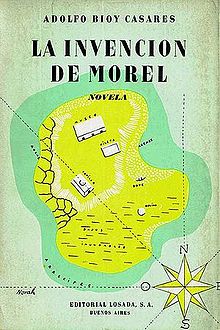
[READ: June 4, 2013] The Invention of Morel and Other Stories

Roberto Bolaño recommended this main story (the other ones as well, I assume).  He’s a big fan of Bioy Casaraes.  But also, Jorge Luis Borges has a prologue to the story in which he states of “The Invention of Morel”

“I have discussed with the author the details of his plot.  I have reread it.  To classify it as perfect is neither an imprecision nor a hyperbole.”

Holy crap.

I can’t say exactly that it I perfect although it is quite fine.  It deals with all kinds of interesting issues and is inspired by (maybe that’s not exactly the right word) The Island of Dr Moreau.  The funny thing is that Morel is neither the main character, nor even a major character for half the book.

The story starts on an island with the narrator writing this book down to leave a  record of “the adverse miracle.”   We learn that the narrator is a fugitive and he was told by an Italian rug seller in Calcutta that the only possible place for a fugitive like him is an uninhabited island.  And on this particular island in 1924 a group of white men built a museum, a chapel and a swimming pool.  But no one dares to go there—not Chinese pirates, not even the Rockefeller Institute because there is a fatal disease located on the island—anyone who has visited there has been found later dessicated. (more…)

Read Full Post »

mystrugglSOUNDTRACK: TRICKY-“Christiansands” (1996).

christiansandsThis book is set in Kristiansands, and so naturally this song was ringing through my head the whole while I was reading it.  I’ve known this song for ages, but had no idea that Chirstiansands was an actual place in Norway.

This song is dark and tense.  Over a slinky beat, a spare guitar riff introduces Tricky’s voice as he rasps (his voice is slightly modified to give him a weird echo).  And while he’s reciting his verses, the gorgeous voice of Martina Topley-Bird, repeats what he’s saying in a whispered voice until she sings out the chorus “I met a Christian in Christiansands.”

The verses repeat with Tricky emphasizing, “master your language and in the meantime I create my own.  It means we’ll manage.”

I honestly don’t know what the song is about, and it feels like it never properly ends–that riff, at once menacing and gripping never seems to conclude.  It’s a masterful track and hard to forget once you’ve heard it.

[READ: May 11, 2013] My Struggle Book One

I read an excerpt of Book Two from this series in Harper’s.  And despite the fact that nothing really happened in it, I was drawn in by the writing style.  This first novel is very similar in that not a lot happens but the voice is very captivating.  The translation is by Don Bartlett and it is fantastic–I can only assume the original Norwegian is just as compelling.  So, despite the fact that this autobiographical series contain six books (six!) and totals over 4,000 pages (how could this be if Book one is a mere 400?  Books 4-6 are over 1,000 pages each), I decided to give it a try.  (Incidentally, Book Two has just been translated into English this month).

This series has caused some controversy because it is given the same title as Hitler’s Mein Kampf (Min Kamp in Norwegian), and also because he says some pretty means stuff about people who are still alive (like his ex-wife).  Although there isn’t much of that in Book One.

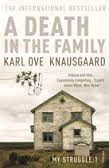
death in the familyIndeed, Book One basically talks about two things–a New Year’s Eve party when Karl Ove was youngish and, as the bracketed title indicates, the death of his father.  (The title A Death in the Family is the same book as My Struggle Book One–from a different publisher.  It has a totally different cover but is the same translation.  I don’t quite get that).  But indeed, these two events take 430 pages to write about.

How is this possible?  Because Karl Ove writes about every single detail.  (I assume this why the books are considered novels, because there is no way he could remember so much detail about every event).  I’m going to quote a lengthy section from a New Yorker review (by James Wood) because he really captures the feeling of reading the book:

There is a flatness and a prolixity to the prose; the long sentences have about them an almost careless avant-gardism, with their conversational additions and splayed run-ons. The writer seems not to be selecting or shaping anything, or even pausing to draw breath….  There is something ceaselessly compelling about Knausgaard’s book: even when I was bored, I was interested. This striking readability has something to do with the unconventionality of “My Struggle.” It looks, at first sight, familiar enough: one of those highly personal modern or postmodern works, narrated by a writer, usually having the form if not the veracity of memoir and thus plotted somewhat accidentally, concerned with the writing of a book that turns out to be the text we are reading.  But there is also a simplicity, an openness, and an innocence in his relation to life, and thus in his relation to the reader. Where many contemporary writers would reflexively turn to irony, Knausgaard is intense and utterly honest, unafraid to voice universal anxieties, unafraid to appear naïve or awkward. Although his sentences are long and loose, they are not cutely or aimlessly digressive: truth is repeatedly being struck at, not chatted up.

That idea of being bored but interested is really right on–and it may sound like a bad thing, but it’s not.  You can read along thinking that there’s no way he is going to give so much unimportant detail.  But you get this description of drinking a cup of tea: (more…)

Read Full Post »

« Newer Posts - Older Posts »