Feeds:
Posts
Comments

Archive for the ‘Translation’ Category

harp febSOUNDTRACK: RHEOSTATICS-Commodore Ballroom, Vancouver, BC (August 18, 2000).

commThe band went back to the West Coast again (man, they’re everywhere).  They must have played a few shows out there, but this is the only one we’ve got. It’s over two hours and the sound is amazing (thanks so much for soundboard recordings).

Michael Phillip Wojewoda is with them on this leg, playing keyboards.  Which allows them to open with “Monkeys Will Come.”   This is the only other place I know of them playing it after Canada Day.  The recording quality is much better than the Harbourfront show so you can really get a good sense of the song.

Tim Vesely gets two songs in a row with “Remain Calm” and “We Went West” (which they have been extending to nearly 7 minutes).

When they play Satan is the Whistler, Dave says they’re not welcome back in Whistler anymore.  The crowd is rowdy and fun, but at one point someone shouts out for a moment of silence for the Russian Sub (I had to look this up, it was the Kursk disaster).  Dave says, everyone prays in their own way.

“Horses” continues to throw in the “Still Waiting” section from the Talking Heads during the middle improv.  And “Dope Fiends and Boozehounds” has a drum solo and an interesting synth part, along with a very brief coda of “Alomar!”

The set has a weird dancey bit at the end, which seems like maybe the songs are out of order.  It’s hard to be sure, but the set is great nevertheless.

One programming note is that the set list states “RDA” but it’s not.  It’s actually “Song of the Garden.”

[READ: March 5, 2015] “The Moronic Inferno”

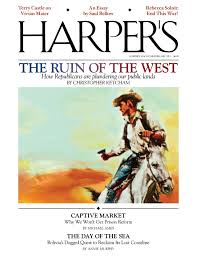
As I had done with the New Yorker, I had also done with Harper’s.  Namely, I had put off reading several months worth of issues.  So I’m doing a run through of the last eight months or so.  The good news is that Harper’s is a monthly, so there’s a lot fewer issues to worry about.  Although I do find that I typically write about three or four pieces per issue.  The February 2015 issue had two worthy pieces.

This is an excerpt from Revulsion: Thomas Bernhard in San Salvador, translated by Lee Klein.  It is described as fiction, although Moya appears to be a character.

I have no sense of what the full book is like, but this expert (which is barely a whole page) is one long paragraph with the character of Vega ranting at Moya.  The rant is all about how horrible San Salvador has grown.   (more…)

Read Full Post »

harp marchSOUNDTRACK: RHEOSTATICS-Cowichan Theatre, Duncan British Columbia, (January 23, 2000).

cowichanWhoops, slightly out of order here, but no one’s counting.

This third night in BC was at the Cowichan Theatre.  This night was held as a benefit for the Women’s Coalition Institute’s campaign against GM food.  Luke Doucet’s band Veal opened, there were families and young kids in the crowd and Dave even talks about buying some art that was for sale.

Amazingly, the band plays nine songs that they hadn’t played the two previous nights.  The only bad thing about this show is that 6 songs are missing from the posted recording (including a night-ending “Shaved Head.”)  But the set still clocks in at an hour and fifteen minutes.

I found the audio a bit muffled on this recording.  In fact, for the first few songs I thought Martin was hard to hear.  Especially on “Stolen Car.”  But he seems to get louder as the show goes on.

There’s a joke about Martin’s shirt–(like he took Greg Keelor’s shirt (Keelor was in Blue Rodeo).  Martin admires his “cowboy look” and jokes about big city folks.  There’s also a funny bit later about the Beatles where he seems to forget George Harrison’s name and says he was going to call him “Gino.”

Martin was still experimenting with the slower opening of “Northern Wish” here, which sounds cool.  “Claire” sounds great (it’s the first time they played it in the three nights) although I wish the quality were a little better.  There’ s great noisy solo inserted into it as well.  And “Self Serve Gas Station” totally rocks.

It’s a shame that “The Wreck of the Edmund Fitzgerald” was cut off, along with the end oft he set but it s a good sampler of some different songs.

[READ: March 5, 2015] “The Man Stopped”

The introduction to this story says that it may be the last complete unpublished short story by Nabokov.  It was written in 1926 and is believed to be a parody of the then current crop of Soviet writers who wrote in an ornamental pseudo folky style.  The story is full of “rustic idiom” which has been translated to very rough English idiom by Gennady Barabtarlo.

Given that Barabtarlo describes the story as a parody I expected it to be funny, but to my ear it isn’t.

Indeed, it’s a very simple story of a man on a journey who is constantly set upon (verbally) by the locals. (more…)

Read Full Post »

01cover-articleLarge-v3SOUNDTRACK: DIANA GAMEROS-“Ligerita(Tiny Desk Contest Runner-Up 2015).

ligeritaLast week, a Tiny Desk Contest winner was announced. This week, All Songs Considered posted ten runners up that they especially liked.  And I want to draw extra attention to a couple of them.

Diana Gameros doesn’t do anything flashy or fancy in this video.  She simply plays the acoustic guitar (amazingly) and sings.  And man, does she have a beautiful voice.  Even more impressive is the way her guitar begins as delicate finger-picked melody in the verses and then transforms into a rollicking Spanish guitar style beauty for the chorus—the way she uses her right hand for the chord playing is great.

This is an absolutely beautiful song, and I was happy to read that she was recently featured on Alt.Latino.

I’m not sure what relaxing location she is in, but it’s nice little room. And even her cat—Lulu—seems to have enjoyed the song.

[READ: February 26, 2015] “My Saga Part One”

I didn’t know that Karl Ove had written this piece for the New Yorke Times magazine until someone brought it to my attention.  I was pretty excited to read it because Book Four of My Struggle isn’t due out until April and I think I’m going through Karl Ove withdrawal.

This first part of the story (because of course it would have to be in two parts) was, I have to admit, a little disappointing.  It features everything that I’ve come to expect from Karl Ove–minutiae, history, shock at people who are unlike him, and a general misanthropy.  But it almost feels like Karl Ove lite–like the Times asked him to write a piece like My Struggle, but, you know, more suitable for a newspaper.  Which may even be how they phrased it.  Of course, it may also be the translation.  Unlike the books, this was translated by Ingvild Burkey.  It’s not that the translation is bad, it seems perfectly fine to me, but the story isn’t as compelling in some way, and perhaps Don Bartlett knows how to capture Karl Ove’s voice better? (more…)

Read Full Post »

Cover_Blue_Angel_MarohSOUNDTRACK: LAIBACH-Sympathy for the Devil (1988).

sympathyAfter recording Let It Be, Laibach decided to tackle another sacred cow–the Rolling Stones’ “Sympathy for the Devil.”  “Sympathy” is my favorite Rolling Stones’ songs and even so, I love this incredibly different version of that song.

The Laibach version does everything that they did to Let It Be–changing tempo, deep spoken vocals, marching beat and chanting and they do it eight times.

This is an album/EP (it’s 50 minutes long) and it features several (quite different) versions of the song as well as some recordings by Laibach side projects Dreihunderttausend Verschiedene Krawalle and Germania.

I’ve broken the track listing down by artist, although on the disc, they are interspersed a bit more which adds to the variety.

Laibach: “Sympathy for the Devil” – Done in a big bombastic style–with deep spoken words.   I love the way the horns (after the second or third verse) bring in this cool militaristic/triumphant feel.
Laibach: “Sympathy for the Devil (Time for a Change)” – This version isn’t that different.  The music is minimal–the keyboards are stripped away, although the triumphant horns seem louder and the hoo hoos seems to be more present in the mix.  There’s some wild orchestration in the middle and some very cool tubular bells at the end as well as an instrumental denouement.  I think I prefer this version.
Laibach: “Sympathy for the Devil (Dem Teufel zugeneigt)” – Features some quotes from Kennedy and is spoken in German (with sitar (!) accompaniment).  The remaining verses are done in the original deep voice.

300.000 V.K.: “Sympathy for the Devil (Anastasia)” or “Anastasia” – Sirens open this song as pianos lull us into a sense of peace before the chaos of sampled music and loud beats takes over.  Even though it has really nothing to do with “Sympathy” the “oh ohs” from the Laibach version are also sampled.
300.000 V.K.: “Sympathy for the Devil (Soul to Waste)” – Vocals slowed down even more, sounding deeper than Laibach (in fact he kind of sounds like Andre the Giant).  I’m not even sure what he’s saying in the beginning (the “Sympathy” lyrics do kick in properly at some point).  It does have the same feel as the Laibach version but faster and even more dancey.  The female backing hoo hoos are a nice lightening touch.  There’s also a rocking guitar solo.
300.000 V.K.: “Sympathy for the Devil (Soul to Waste – instrumental)” –Just an instrumental dance version of the above, probably the least interesting on the disc.  Twice as long as the non instrumental version.

Germania: “Sympathy for the Devil (Who Killed the Kennedys)” – This song opens with an interviewer asking if someone has a theory about who killed Kennedy.  The answer is a sullen no.  This interviewer pops up throughout the song repeating the questions and then asking about mixing drugs.  There are all kinds of samples buried in the mix (I hear “All You Need is Love”).  The lyrics are whispered by a female vocalist while the original Jagger vocals are played quietly behind her.  The deep male voice comes in too.  The music is kind of a discoey dance version of the Laibach bombast.
Germania: “Sympathy for the Devil (Who Killed the Kennedys – instrumental)” – Only has a little of the spoken word business–it is basically just a dance remix.

So even though these versions are all basically variations on a theme (and yes 50 minute scan get a little maddening), the variety is pretty impressive (especially since they reuse many of the parts in the different versions).  No one is going to love this version more than the original, but all these years later, I still think it’s pretty cool.

To see the original Laibach version in all its glory, check out this video which I’ve not seen before:


[READ: January 17, 2015] Blue is the Warmest Color

I was intrigued enough by Maroh’s Skandalon, that I wanted to check out her earlier book, Blue is the Warmest Color.  I had no idea that it was a really big deal or that it has been made into a movie.

This book, which was translated by Ivanka Hahnenberger, is about a woman who is sure of her sexuality until she meets a woman who changes her mind.

The book is incredibly moving and touching, and it is told in a way that gives you the (sad) end right up front, although the end is not exactly what you think it is.  It’s incredibly well done.

As the book opens up, we see that a woman is riding a bus to go to her lover’s house.  There are superimposed words from her lover’s diary which says that when the woman on the bus (Emma) reads these words, the writer will be dead.  As the first sequence ends, we read: “I love you Emma, you are my life.  Signed Clementine.”  Emma has gone to Clementine’s parents house (where Clementine was living) to retrieve the diary.  Her parents are not happy with Emma.  And they seem to blame her for Clem’s death.

The book is kind of a visualization of Clementine’s diary from when she received it on her 15th birthday until her final entry. (more…)

Read Full Post »

skandSOUNDTRACK: THE BEATLES-Abbey Road (1969).

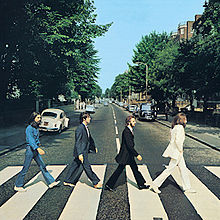
220px-Beatles_-_Abbey_RoadWithout knowing the history of The Beatles and their recordings, you’d never know the acrimony that was created by this record and Let It Be.  This record doesn’t really seem all that different from their other records, but it in part caused the band to break up.

The opening of “Come Together” is unique in music, it sounds so unusual and so unlike the Beatles.  I love it.  This song seems to be psychedelic in lyrics but very standard rock in music.  It’s a cool mix.   “Something” is a beautiful song (I had no idea it was written by Harrison!)

“Maxwell’s Silver Hammer” is another goofy Paul song–he really was quite silly.  I like it, it’s fun.  But the other Beatles hated it–Lennon said it was “more of Paul’s granny music” and left the studio for two weeks.  Harrison was also tired of the song, adding “we had to play it over and over again until Paul liked it. It was a real drag”. Starr was more sympathetic to the song. “It was granny music”, he admitted, “but we needed stuff like that on our album so other people would listen to it.”

Even though “Oh Darlin!” is not usually my style (doo wop), I really like the song a lot–probably because of how raw McCartney gets his voice by the end.  “Octopus’ Garden” is of course a goofy fun song–Starr wrote it.  It takes some of the seriousness out of the album, but it’s always fun to sing along to.

“I Want You (She’s So Heavy)” is quite a shocking song especially after “Octopus.”  I’ve always liked the way the end cuts off seemingly in the middle of nowhere–even Clark last night listening to it said That was weird about the end.  It’s a fairly simple song (there are hardly any words), with a bluesy section a kind of prog rock section and it goes on forever.

“Here Comes the Sun” is a song that I knew as a kid which I never connected to the Beatles until I was in college.  My mom loved the song, but didn’t really like the Beatles, so I’ve always just assumed it was some folk song.  It’s a really pretty song (by Harrison).

“Because” has an interesting chord progression and is very cool with the multilayered voices.

“You Never Give Me Your Money” is a fun bouncy song that begins as a mellow piano song and then turns very jaunty.  Then comes some great guitar solos and a rocking ending.  This song begins what is considered the medley at the end of the album.  This song itself has so many parts that it could be a medley itself.  The remaining songs are all between 1 and 2 minutes all blend into each other.

Starting with “Sun King” which is quite pretty with lovely harmonies and Italian lyrics at the end.  I never knew “Mean Mr. Mustard” was called that.  It’s a bouncy song about a nasty guy.  It quickly jumps to the fast “Polythene Pam” which is barely over a minute.  Then come four songs written by McCartney, “She Came in Through the Bathroom Window” a super catchy song with great harmonies–it’s just under 2 minutes long and it merges into “Golden Slumbers” which I always assumed was just the introduction to “Carry That Weight” (as they always seem to get played together on the radio–which makes sense since together they are 3 minutes long).  The medley ends with “The End” which features a Ringo Starr drum solo and a rocking guitar solo.

At the end of the album and not part of the medley is “Her Majesty” a 38 second song.

Abbey Road is a pretty near perfect album.  There’ s a couple of goofy songs which kind of undermine the intensity of the record, but they are also really fun to sing along to, so that makes it okay in my book.

[READ: January 7, 2015] Skandalon

Maroh wrote and illustrated this book (translated by David Homel) about a rock star and his attempts to deal with (or not) the increasing fame he gets.

The artistic style she uses is really interesting–I assume it is all painted with very heavy paints.  It is occasionally “sloppy” but it is always effective and quite powerful in the images it creates.  It also reads very European to me, which I find interesting (given that she is in fact French).

As the book opens, we a singer Tazane on stage with his adoring fans.  And then, at a pres conference he plays up his diva act and walks out on a question he finds impertinent.

In the tradition of the Wall and Jim Morrison, Tazane tries harder and harder to get a reaction out of his fans, or maybe just to alienate the  fans and the press. He sings songs with lyrics like “I feel nothing about people.  I feel nothing about myself.”  And his “public image” (a phrase he hates) gets damaged every time he speaks. (more…)

Read Full Post »

oct13SOUNDTRACK: PRIMUS-The Brown Album (1997).

brownThis is the first Primus album to not feature Tim Alexander on drums.  Brain has taken over.  And while the difference isn’t that substantial, the overall feel of the band has shifted, to a less progressive, more heavy, loud band.  Brain evidently brought super-sized, very tall bass drums which added a big whomping sound.  And while for the most part his is a simpler style, he doesn’t shy away from fills and noise when necessary.

I haven’t listened to this album as much as many of their others but after revisiting it lately I’ve decided that it has a lot more really good songs than I remembered.

“The Return of Sathington Willoughby” is a great introduction–a far richer and more complex song than I remembered.  It begins with some ominous drum and bass with Les’ spoken word proclamations from Willoughby.  But I love the way the fast part of the song jumps in and features a really fast funky bass and some great squeaking guitars–which absolutely make the song.  “Fisticuffs” is a really deep heavy song (the drums are really loud).  It’s a classic story song from Les, with great stomping bass and cool guitars from Ler.

The riff from “Golden Boy” is quite good–complex and interesting.  One of the nice things about most of these songs is that they are largely shorter.  This song for instance would have suffered if it were 5 or 6 minutes, but at 3 minutes, it’s a tidy little fast number.  “Over the Falls” is one of their slower singles, a story song that’s under three minutes.  Not super catchy, but interesting.  “Shake Hands with Beef” was the first single–it’s a big stomping song with a group chorus–something unusual for Primus.  It’s no less weird than some of their other singles, but I feel like it’s missing something–maybe guitars?

The next few songs are kind of muddy and not terribly memorable.  “Camelback Cinema” is a sludgy kind of song without a lot of interesting components.  On the other side of the spectrum is “Hats Off,” a short honky-stomping song that feels like a country number.  It’s not terribly interesting but it does break up the album nicely.  “Puddin’ Taine” has a kind of classic Primus stomp, although it’s a little muddier.

After those middle songs, I love “Bob’s Party Time Lounge” which switches between slow verses and a super chorus that has a great bass riff and some nice big guitars.  It’s a simple song, but really effective and fun.  It’s one of may favorite late period Primus songs.  I also like “Duchess and the Proverbial Mind Spread” for the fun riff and style of the song.

“Restin’ Bones” actually has a lead guitar riff (!)  It’s nice to hear a lead guitar but the song is only so so and a little too long.

But I do love “Coddington” which is another of my favorite later period songs.  It features the (really fast) bowed bass and a thumping drum.  This song whips by and is amazingly catchy.  I also really like “Kalazmaoo” both for the great guitar riff and because he references “I’ve Got a Gal in Kalamazoo” with the same alphabetical introduction.

I like “The Chastising of Renegade” for the nice big drum openings.  The guitar and bass riffs are also really cool and the switch to the reggae guitar strumming is quite a surprise.  It feels a tad long, but it’s overall a good one.  The final song, “Arnie” opens with big loud distorted drums.  It has a groovy bass and simple but cool guitars.  I feel like this should have been an instrumental, as the lyrics aren’t that interesting.

So overall this one is a bit of a mixed bag.  There are definitely some great songs that I would absolutely have out on a greatest hits record.

[READ: January 10, 2015] “Scheherazade”  Ted Goossen

I really enjoyed this story.  As with a lot of Murakami, I feel like he has an interesting perspective and tells stories that are unlike anyone else’s.

This story is interesting for the layers that he puts into it.  It opens “Each time they has sex, she told Habara a strange and gripping story afterward.”  Okay, simple set up.  He thinks of her as Queen Scheherazade from A Thousand and One Nights (although he had no plans to chop off her head).

Habara keeps a journal and he keeps track of her visits, using a secret code–her name and a one word summary of whatever she talked about that day.  He didn’t know if her stories were true or not and he didn’t care–he just enjoyed them, usually more than the sex.

Then details of their relationship emerge–she is a housewife with two children and he is a housebound man–he never leaves.  She was sent to him as part of his situation (which is never explained–is this a common thing in Japan?).  She brings him food and books and DVDs two or three times a week, although he cooks for himself. He simply never leaves the house.  She also has sex with him–he’s unclear if this is supposed to be part of the deal or if it is her own impetus.  The sex is not passionate, but it is enjoyable.  And yet as the story shows, it is the stories that she tells afterwards that he enjoys more. (more…)

Read Full Post »
CV1_TNY_08_11_14Mattotti.indd SOUNDTRACK: PRIMUS-Sailing the Seas of Cheese (1991).

cheeseHere they come, here comes the bastards again.  Sailing the Seas of Cheese was the band’s major label debut, and they were given a lot of freedom to do whatever they wanted.  Which they did.

The first two songs sort of ease you into the chaos that is “Sgt Baker” a noisy stomp that mocks the military. It’s followed by “American life” a relatively quiet song that is rather sad.  Although I like Ler’s solo at the end (which is rather conventional for him).

But the album really takes of with “Jerry Was a Racecar Driver”, Primus’ first real hit.  Which is amazing in and of itself given how weird a song it is and how noisy (and moshy) the middle section is.  Fun drumming opens “Eleven,” a rocking song done in 11/4 time–count it, its crazy!  I just love the lunacy of “Is It Luck?”–the bass is fast and so bizarre while Ler’s guitars are playing one simple dissonant note for much of the song.  “You wanna get lucky little boy?”

“Grandad’s Little Ditty” is basically Les singing in the shower (and one of the few songs I know of which use the word “flatus”).  It leads into the new recording of “Tommy the Cat.”  This time the role of Tommy is played by Tom Waits, which make a slot of sense.  The Primus book has a funny story about Waits singing this (he sent them a version without having heard the song and he sang it through a megaphone).  The bass in the middle of the song is just incredible.

“Sathington Waltz” continues the adventure of Sathington Willoughby, although this is a scattered instrumental with banjos and loud drums (and lots of guests).  “Those Damn Blue Collar Tweekers” is a stomping song with a great riff.  I never knew exactly what it was about (not that its hard to figure out), but the book explains exactly who Les was talking about.

“Fish On” is a 7 minute song (most of the songs on this record are shorter than on Frizzle Fry) with a lengthy intro and outro.  The disc ends with “Los Bastardos” a reprise of the opening bastard music with some samples from The Young Ones and all kinds of friends playing along.  It’s a really fun record with some absolutely classic songs on it.

Shut up you bastards!

[READ: January 5, 2015] “Picasso”

The ever prolific César Aira had a new short story in The New Yorker (he usually writes novella length pieces, but this appears to be an actual short story (3 pages)) which is a little different.

In the story, the narrator says he was in the Picasso museum enjoying the artwork when a genie came out of his bottle of Miracle Milk and offered him a choice: Would he rather have a Picasso or be Picasso.  I enjoyed this twist on the typical three-wishes genie (he even mention how most people are prepared to ask for more wishes), and that this was totally unexpected.

To me, the answer was obvious from the start, Picasso was a pretty unhappy guy, why would I want to be him?  Of court, as the narrator goes through the options, he says that if you were Picasso you would automatically have all the Picassos.  Plus, he says that he himself has a pretty unhappy life, so Picasso would be a step up.

The narrator reviews Picasso’s life and output, but ultimately he decides that owning a Picasso would give him the financial security to allow himself to write his novels.

As soon as he thinks that, a painting appears on the table in front of him.  It is clearly a Picasso.  He spends the next few paragraphs describing the painting and then comes upon a “meaning” for it.  It’s an interesting look at a Spanish fable or joke.  The fable involves a queen who is lame and her servants who want to tell her without actually telling her.  The punchline of the joke comes down to “Su Majestad, escoja” which translates as “Your Majesty, choose” or if the last word is broken up (into es coja) “Your Majesty is lame.”  It’s a pretty elaborate painting or what amounts to a joke (and I have no idea if this is a real painting or not).

As the story comes to an end, the final paragraph introduces a whole new aspect of the story which was hilarious and unepxetced.  It was a great twist.  I do have to wonder if this is part of a bigger story because although it feels complete, I could easily see him following this character further.

This was translated by Chris Andrews.

For ease of searching I include: Cesar Aira

Read Full Post »

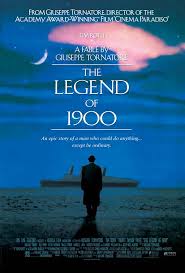
[WATCHED: December 29, 2014] The Legend of 1900

1900After really enjoying Novocento, I wanted to see what they would do with a film of the book.  I was especially curious how they took the sixty-some page monologue and turned it into a 2 hour film.

The film was written by Giuseppe Tornatore who directed Cinema Paradiso.  It was filmed entirely in Italy (which explains how they got the New York scenes to look so old world) and yet it was written entirely in English (apparently before Novocento was translated).  It starred Tim Roth as Nineteenhundred (not Novocento, like in the book) and a bunch of other people I didn’t know.

The movie was, as I say, written by Tornatore, based on the book. He kept virtually the entire book the same for the movie.  But he added a bookend section to give the narrator someone to talk to.  And this is how the film was stretched out to two hours.

The new parts are certainly interesting.  Max, Nineteenhundred’s only real friend and fellow shipboard musician, is selling his trumpet at a pawn shop.  This part confused me because the pawn shop owner is British, but I thought the ship was docked in New York.  But whatever.  He plays his trumpet one last time and the melody he plays is the same one that the shop keeper then plays on a phonograph. (more…)

Read Full Post »

barbariabnsSOUNDTRACK: ULTRA LOUNGE: CHRISTMAS COCKTAILS Part Three: Yule Tide Cheer Through the Year (2005).

xmastails3The final part of the Ultra Lounge Christmas set certainly sees them running out of steam.  There’s far fewer songs and the total running time is nearly 20 minutes shorter.  But that doesn’t mean there aren’t some great tracks here.

CARMEN McRAE-“Baby It’s Cold Outside” a fun opening with some talking before the song between Carmen and Sammy Davis Jr.  Davis is really silly through the song (and she seems to be laughing him).  BING CROSBY-“Frosty The Snowman” wonderful.  LENA HORNE-“Santa Claus Is Comin’ To Town” a trippy opening in which Horne was “in the milky way.” Then the song kicks in—a fun version overall. Strangely she switches “bad or good” into “good or bad.”  JOHNNY MERCER-“Jingle Bells” a fun hopping version with plenty of swing.  There’s even extra lines (“there’s nothing new about jingle bells”).

WAYNE NEWTON-“Let It Snow! Let It Snow! Let It Snow!” Female vocalists again (I thought Newton was a singer?), but nevertheless, it’s a fun version.  NANCY WILSON-“That’s What I Want For Christmas” a pretty song, that I didn’t know before.  I really dig Nancy Wilson.  DEAN MARTIN-“Winter Wonderland” delightful, I do love the Deano.  BILLY MAY-“Do You Believe In Santa Claus?” – Billy May’s deep dark rather scary voice presents this weird song.  It’s funny and a little spooky what  with the crazy way it ends.

PEGGY LEE-“White Christmas” this version is too for me.  AL MARTINO-“Rudolph, The Red-Nosed Reindeer” this is a nice version, though.  RAY ANTHONY-“A Marshmallow World” a lovely version of this fun song.  LOU RAWLS-“Have Yourself A Merry Little Christmas” Rawls has finally won me over.  I like this song by him.  JULIE LONDON-“I’ve Got My Love To Keep Me Warm” slow and jazzy but too slow for me.  NAT KING COLE-“Buon Natale (Means Merry Christmas To You)” a fun song quaint and cute and one you don’t hear very often.  JUNE CHRISTY-“Sorry To See You Go” I don’t know this song, it’s more of a New Year’s song. Swet and bouncy. Although not my favorite ending to the discs.

So that’s the Ultra Lounge mixes, easily my favorite way to spend a holly day.

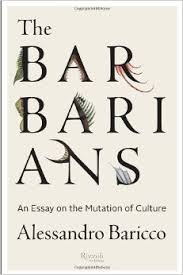
[READ: December 24, 2014] The Barbarians

This was the final Baricco book I planned to read this year and it’s a good way to end the year–reflecting on the past but planning to move forward.

It’s nonfiction so I didn’t really know what to expect.  But I certainly didn’t expect the story in the beginning of the book.  Baricco explains that he really wanted this book to be translated into English (especially for the American market where he felt it would be particularly on target) but he couldn’t find anyone to publish it.  And he didn’t want to go self publishing.  He ultimately found a friend in New York, owner of Eataly who agreed to foot the cost.  They did the work and then Random House distributed it.

So Stephen Sartarelli translated it.  The book is a fun and interesting look at the barbarians who are ruining our culture and destroying our soul.  But Baricco is very careful to point out that just because they are ruining things, it doesn’t mean that they are making things worse or doing it maliciously.  He uses several specific instances in which the barbarians have changed something held sacred and made it, if not better, then different and often more enjoyable.

This book was originally written as a series of newspaper articles in 2006 (not sure exactly when).  He says it was fun to see feedback as he was writing each installment (each “chapter” is about four pages). (more…)

Read Full Post »

gogolSOUNDTRACK: ANDY WILLIAMS-Merry Christmas (1965).

awxmasMan, I love some Andy Williams at Christmastime.  I don’t really know much about him at other times of the year and I imagine that I would never listen to him, but he is one of the voices of Christmas. I like his voice so much even if I don’t love all the songs on this record.

His “Sleigh Ride” is the essential version–boppy and fun–you can imagine zipping along on a sleigh with jingle bells bouncing along.

“Have Yourself a Merry Little Christmas” is a bit slow, but “Winter Wonderland” sounds great.  His “Let It Snow! Let It Snow! Let It Snow!” is fun–he can really belt out those notes and “Silver Bells” is also a highlight.

The choice of “My Favorite Things” (from The Sound of Music) is unexpected, as it has nothing to do with Christmas, but his rendition is wonderful.  “Christmas Holiday” is a song I don’t know but Williams belts it out as well.  “Do You Hear What I Hear” is also great.

“Some Children See Him” is a fascinating song that I haven’t heard too much (although Rivers Cuomo does a cover of it(!)).  It’s all about how children from different countries see Jesus a different way (a rather progressive idea).

“Little Altar Boy” is a slow and somewhat ponderous song that I’m unfamiliar with.  The final two songs “Mary’s Little Boy Child” and “The Bells of St. Mary” are pretty but not fun (as you would assume from the titles).

So I love about half the disc and like most of the rest.  Williams has an earlier Christmas album as well.  I think I’d like to pick and choose between the two discs for a great Williams collection.

[READ: December 23, 2014] The Night Before Christmas

I had intended to read all Dickens stories this week.  And then my latest New Directions Pearl arrived and it was this one: The Night Before Christmas (also translated as Christmas Eve) by Nikolai Gogol.  Well, that put a change in my plans.

I don’t know much about Gogol, although apparently he wrote only short stories (no novels).  My book has a quote from Dostoevsky that says, “We all came out of Gogol’s overcoat.”  So imagine my surprise when this night before Christmas is actually about witches and the devil and affairs with beautiful women!

The story is set in Dikanka, Ukraine.  It is Christmas Eve and, according to legend, that is the night in which the devil is free to perform tricks and torment people.  Before the devil comes, we see a witch flying around the sky collecting stars.  The devil decides that he is going to steal the moon–this will make it very dark so he can create even more mischief.  The moon proves to be very hot, and he winds up juggling it a few times until he gets it into his pocket.

The devil decides to get back at Vakula, the village blacksmith.  In addition to being the blacksmith, he is also an artist and he has painted some really cruel pictures of the devil on the side of the church.  And the devil is pretty miffed about this.  So he sets an elaborate plan in motion. (more…)

Read Full Post »

« Newer Posts - Older Posts »