 SOUNDTRACK: hiatus
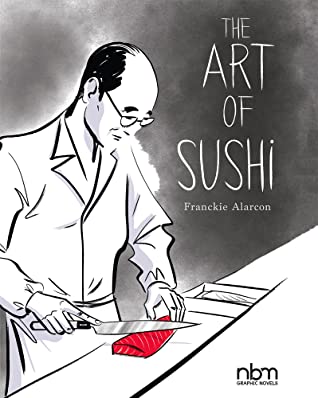
[READ: May 5, 2023] The Art of Sushi
This beautiful hardbound book is a translation of Alarcon’s L’Art du Sishi. It is a full on graphic novel style documentary about the process of making sushi–as well as fishing, making sake and growing rice and wasabi. The book is almost entirely black and white with splashes of color on the sushi itself.
Alarcon has a minimalist style that works perfectly to show off a room that allows you to focus on details as well.
Alarcon starts the book with himself in France making sushi. He’s proud of it but acknowledges it’s not award-winner. A friend of his says she can put him in touch with Hachiro Mizutani, master sushi chef with three Michelin stars.
After a brief history lesson into how fish were prepared in Japan over the centuries, there’s a page that shows nine varieties of sushi.
Then it’s on to Hachiro Mizutani’s place, which is, in fact a small room in the upper floor of a building–not a large sushiya at all. I got a kick out of reading that it’s okay to use your hands, that you should never let your sushi fall apart and (for Hachiro Mizutani at least) no photos!
Hachiro Mizutani gives them a chef’s menu. 16 individual pieces in a very specific order, including a dessert sushi made of shrimp paste and egg. He prepares it right on front of them. The next day Hachiro Mizutani takes them to the fish market where he discusses how he picks out fish and why so many foreign chefs (French, in particular since the author is from France) wait too long to pick the perfect fish. There’s pictures of men cutting up fish (and even using a sword to cut tuna.
The sword discussion leads to a diversion about the greatest knife makers in Japan–a family who have been making swords and blades for generations. The Oroshi bocho is used to cut tuna. The blade can be up to 5 feet long and it is forbidden to take it out of is the fish market. (Although Yakuza do have them).
Hachiro Mizutani tells them about cutting fish and how his apprentices do most of the work but he always prepares the rice to get it just right. When he was an apprentcice he slept in the restaurant and for the first four years he did nothing but clean the building–never touched a fish or rice.
They tale a 3:30 AM trip on a boat to watch the Japanese fishermen hauling in their catch, some of which they bring to their next stop. Okada, a modern sushi chef. He is not afraid to change things up.
This leads to a trip to rice paddies to learn just how many different types of rice there are in Japan alone.
Okada pairs his sushi with sake. And the sake comes in specially made ceramic cups. We meet the ceramicist and his brick oven (it’s pretty cool). Okada, brings out the heads of the fish they are going to eat as well as the sword from the swordfish.
The next day they are off to a sake factory. Who knew how much went into making sake and how different the various styles can taste. There’s even a soy ice cream (which is actually really sweet not salty).
Then it’s off to someone’s house while we watch her make eel sushi. As well as some artist friends who do a fun homemade spread. There’s a discussion of how seaweed (nori) is processed and what to look for in the best quality. And finally Alarcon gets to make another sushi–his is laughable (although it looks fine to me).
The last trip involves them going to a Kaiten Sushi–the affordable alternative where the sushi travels on a conveyor belt. The food is good and somehow affordable (they pay $10, each, I feel like that’s unlikely in the U.S.)/ Although some things are pretty weird even for them=–grilled salmon with melted cheese?
After a quick run through a store of essential sushi items (it is a massive store), the two non-Japanese speakers head to a restaurant to try to order on their own. But one of the pieces smells fishy and seems off–they shouldn’t eat it.
The epilogue is back in France and shows how things are necessarily different in France. How more humane fishing practices are being used but also how chefs, even Japanese chefs have differences to contend with, Like the kind of fish that is available to them. Takuya Watanabe is a Japanese chef working in France who has earned a Michelin star. He tells them about actual wasabi (not the horseradish paste most of us are used to), where it grows and why it is so infrequently used.
Finally, it’s off to Yannick Alléno and his L’Abysse, a large restaurant dedicated to sushi. His main chef is Yasunari Okazaki has been training for years and is not afraid to make traditional sushi as well as contemporary French version of sushi. Like Tuna tartare with sliced hazelnuts grilled with a blowtorch, or even Strawberries with a sugar crust and nori (there are no desserts at sushiya in Japan).
The book ends with some recipes. Which are all pretty cool looking but which I’ll never try.
Read Full Post »
 SOUNDTRACK: .







 I Just Read About That...