Feeds:
Posts
Comments

Archive for the ‘Trains’ Category

dogSOUNDTRACK: RHEOSTATICS-The Music Hall, Toronto, Ontario (May 2, 1998).

musichalThis show sounds different from all of their other live shows on Rheostatics Live around this time.  I don’t know much about The Music Hall, but it sounds like a more formal venue–like a bigger, perhaps seated, crowd.

There is also a string section and the ever reliable Kevin Hearn playing along with them.  Well, string section might be stretching it–there are musicians from UofT playing along with them, including beautiful violins on “Self Service Gas Station” and a surprise flute on “Take Me in Your Hand.”  There’s also a bunch of the musicians playing along on “King of the Past” which means I finally get to hear the great end section with a violin–but it gets cut off!  Agh.

With Kevin playing with them, they showcase some tracks from the Group of 7 release (which they explain didn’t have titles but now sort of do).  So they play “Boxcar Song” and “Yellow Days Under a Lemon Sun.”  They also play “Monkeybird” which they say is from Harmelodia (even though it’s not out yet).

There are a lot of glitches and weird things happening with this tape which is kind of a shame as it is a pretty unique concert.  It’s also only 90 minutes, which might just means a lot of the show was cut off.

[READ: January 3, 2014] The Bridegroom was a Dog

I bought this book years ago based on some recommendation or other.  Then I recently received a new version of it from New Directions.  Their version was just the title story.  This original book (which had the same translator, Margaret Mitsutani) contains the title story and two other longish stories.

Because I just read the other book (and its the same translation) I didn’t re-read “Bridegroom.”  But I did read the other two stories “Missing Heels” and “The Gotthard Railway.”

“Bridegroom” was certainly a weird story.  But “Missing Heels” may be even stranger.  I say this because of what may or may not be deliberate ambiguity in the word heel.  As the story begins the protagonist is stared at by people because of her heels.  I assumed she meant the heels of her shoes.  But by the end of the story it seems that she means the heels of her feet, which is even stranger. (more…)

Read Full Post »

[LISTENED TO: December 2012] It Happened on a Train

brixton3After the raging success of Brixton Brothers Books 1 and 2 we were thrilled to get to Book 3.

Twelve-year old Steve Brixton has given up on being a detective.  His hero, the author of the Bailey Brothers mysteries has proven to be a thief and a liar and he wants nothing to do with the man anymore.  So he has bundled all of his Bailey Brothers books–his favorite books in the world–and put them in the trash.

His chum, Dana, is not that upset about the closing of the agency, especially since he has now been dating a girl named Dana (“other Dana” as Steve calls her).  Other Dana has gotten Dana into a book series about wizards and dragons which Steve simply cannot believe.

This 3rd novel proves to adhere well to the title–it does all happen on a train.  Well, most of it anyhow.  The boys have been invited to the Model U.N. meeting in San Diego.  After last book’s fake debate club ruse, Steve’s mother is very suspicious of the Model U.N., especially since no one has ever heard of it.  [It turns out that my school had a model U.N., but most of us had no idea what they did either–imagine my surprise to see that very organization appear in an episode of Community!]  The story checks out and Rick (jerk) takes this as an opportunity to bond with Stevie Brix (what, you don’t get it) by tagging along for the nine-hour train ride.

Before the train ride gets underway, Steve is approached by a surfer dude who is looking for help.  Steve hears the man’s case but tells him that he has retired (a recurring joke).  It took us a while to get to the end of the story and we had all but completely forgotten about this plot point by the time we got to the end.

Anyhow, on the train, Steve winds up talking to a girl, Claire, whose uncle is a private detective.  The girl is nice but thinks it doesn’t make sense that 12-year-old Steve is retired.  Steve is annoyed by her, and has mixed feelings about her.  But he sees that she has left her book behind, so he finds her to give it back.  But she is nowhere to be seen. (more…)

Read Full Post »

SOUNDTRACK: BAND OF HORSES-Live on KEXP , April 13, 2006 (2006).  

Band of Horses played KEXP in 2006.  They had been around since 2004 but their debut came out in 2006.  Since they are a Seattle band, they are treated as yet another Seattle band, which is kind of funny as they would be huge not long after this release (okay technically in 2007).  This show takes place about a month after the debut album came out (although the DJ says they’ve been playing them for a while).

I did not know that many of them were in a band called Carissa’s Weird (nor had I heard of that band), but thanks to the KEXP DJ for bringing that up.  I also found out that “Wicked Gil” is about baseball player Gil Meche.  The band sounds great–not quite as polished as on record, which is to be expected of course, but the vocals all sound great and the band is very tight.  They also play “Part One,” “The Great Salt Lake” and “The Funeral.”

It’s fun to hear a band before they became famous.

[READ: September 3, 2012] “Amundsen”

I read this story a day or two before I got laid off.  Unsurprisingly I didn’t feel like posting about it then.  But now it’s time.

This story is  about a young woman, Vivian Hyde, who is to be the new teacher at a rural santitorium.  She has traveled from Toronto to work at the ward where the girls have TB.  She has a B.A. and wants to work on her M.A, but she thought she’d earn some money for a time, first.  The story is set during the war, and the nurses are doing their wartime duty.

The first girl she meets, Mary, is the daughter of one of the employees who lives there.  She doesn’t have TB and does not participate in the studies that the TB girls do.  Vivian likes her but the headmaster, Dr. Fox, scolds the girls and sends her away so that Vivian can get settled in.

Munro is wonderful with details, like when the doctor asks is he knows anything about  tuberculosis:

“Well I’ve read–“

“I know, I know. You’ve read The Magic Mountain.”

[This is novel by Thomas Mann from 1924 that dealt with TB.  I love how Vivian does not respond to his comment one  way or the other]. (more…)

Read Full Post »

SOUNDTRACK: LAVENDER DIAMOND-“New Ways of Living” from Score! 20 Years of Merge Records: The Covers (2009).

This song plays around with the Destroyer original a little bit more than some of the other covers have.  Lavender Diamond’s lead vocalist is a woman, Becky Stark, so her voice is different from Dan Bejar’s.  Of course, Bejar’s voice is kind of high-pitched so it’s not that different.  The original also has a female backing vocal on all of the Lie-Dee-Dies, which Lavender Diamond supplies by herself.

The Destroyer version is softer, a bit more delicate (especially the ending section which is washes of strings and gentle keyboards).  Lavender Diamond’s version is primarily piano, and that starkness somehow makes the song more intense.  So yes,  I find myself enjoying the Lavender Diamond version a wee bit more.  I hadn’t heard much by Lavender Diamond before (I knew that Becky Stark was on the Decemeberists’ Hazards of Love album).  But I think it’s time to investigate her stuff a little bit more.

[READ: April 5, 2012] “Train”

I had put off reading this story for a little while because it was pretty long (12 pages in Harper’s which is quite long for a Harper’s story).  Not only was it justifiably long, it was thoroughly enjoyable.

The story was set up in an unexpected way (especially for Munro whose stories tend to be pretty straightforward).  It opens with a man jumping off a train (I also tend to think of Munro as writing about women, so a male protagonist is also something of a surprise).

So Jackson hops off of a train.  It was going slow, but it hurt more than he expected.  After he gets his bearings, he realizes that he is closer to civilization than he realized–indeed, there’s a woman out milking a cow.  The woman turns out to be Belle (the cow is Margaret Rose).

After years of reading different kinds of stories, there were so many different ways this meeting could have gone (most of them badly).  But Munro tends to not write about physical violence, so this meeting goes pretty well–it’s not even all that awkward because Belle is a sweet, almost naive, woman.

Belle lives by herself, although that is a recently development.  Her mother passed away a few months ago after decades of needing a lot of physical help.  Her father has been dead for many years–he was hit by a train.  He used to take care of Belle’s mother, but once he died, the responsibility was all hers.

She was also more or less supported by the Mennonites who live up the road.  The introduction of them is wonderful, as it is how Jackson sees them: “Over the hill came a box on wheels, being pulled by two quiet small horses….  And in the box sat half a dozen or so little men.   All dressed in black with proper black hats on their heads.”

Of course, these little men are the Mennonite children who look after her.  Jackson pities Belle, although she neither seeks it nor really deserves it.  She seems quite content with her situation.  He decides to stick around and fix up her house for her (which is in bad need of repair).  He imagines that he can work for her for a few months and then maybe help the Mennonites a bit and then continue on his way. (more…)

Read Full Post »

SOUNDTRACK: THE FEELIES-Crazy Rhythms (1980).

Not too many albums start out with clicking blocks and quiet guitars that build for a minute before the actual song kicks in.  Not too many albums sound like early Cure sung by Lou Reed and not too many albums are called Crazy Rhythms when the thing that’s crazy about them is their vocals and guitars.  But that’s what you get with The Feelies debut.

In addition to the blocks, the opening song also features some sh sh sh sounds as a rhythm (techniques used by The Cure on Seventeen Seconds, also 1980).  There’s two guitar solos, each one vying for top spot in different speakers and, yes, the rhythms are a little crazy.

The album feels like it is experimenting with tension–there’s two vocalists often singing at the same time, but not in harmony.  There are oftentimes two guitars solos at the same time, also not in harmony.  The snare drum is very sharp and there’s all manner of weird percussion (all four members are credited with playing percussion).

That early-Cure sound reigns on “Loveless Love” as well, a slow builder with that trebly guitar.  There’s a lot of tension, especially with the interesting percussion that plays in the background.  And there’s that whole Lou Reed vibe in some of the vocals.

But not every song sounds like that, “Fa Cé-La” is a punky upbeat song with two singers trying to out sing the other.  “Original Love” is another short song, it’s fast and frenetic and fairly simple. It’s as if they couldn’t decide if they were going to be The Velvet Underground or New Wave punks.

The next surprise comes from their choice of covers: “Everybody’s Got Something to Hide (Except for Me and My Monkey”).  It goes at breakneck speed with some surprising pace changes after the chorus.  And a wonderful ringing percussion that makes the song sound even more tense than it is.  “Moscow Nights” is a more traditional song (although the backing vocals seem very spartan.

“Raised Eyebrows” is almost an instrumental, until the last-minute when the seemingly random vocals kick in.  And the final track, “Crazy Rhythms” seems to combine the speed of the faster tracks with the insanity of the other tracks.  It’s a pretty amazing debut, really heralding an age of music.

  It’s a shame it took them 6 years to make another (very different sounding) record.

[READ: February 8, 2012] “To Reach Japan”

I love Alice Munro’s stories, but I found this one a bit confusing.  Now, I admit that i read this under poor circumstances (while I was supposed to be attending a company-wide presentation), so that may have led to my confusion. But it felt like there was some questionable juxtapositions of the timeline in this story.

It opens simply enough with Greta and her daughter Katy waving goodbye to Peter (the husband and father) as they pull away from the train station.

The story immediately jumps back to Peter’s mother and how she fled on foot from Soviet Czechoslovakia into Western Europe with baby Peter in tow.  Peter’s mother eventually landed in British Columbia,where she got a job teaching.

The second time jump comes a few paragraphs later.  It seems like we’re back in the present, but the section opens, “It’s hard to explain it to anybody now–the life of women at that time.”  This describes how it was easier for a woman if she was a “poetess” rather than a “poet.”  But I’m not exactly sure when that was.  Presumably when Greta (who is the poet) was younger, but how long ago was that?  In Toronto, even?

The story jumps back to the present to say why Greta and Katy are on the train and Peter isn’t.  They are going to housesit for a month in Toronto while Peter goes to Lund for a summer job.

Then it jumps back to when Greta was a poetess and actually had poems published.  The journal was based in Toronto, but there was a party in Vancouver for the editor.  So she went.  And she had a lousy  time among the local literati.  She gets drunk and sits in a room by herself, but soon enough a man approaches her and offers to take her home. There is the potential for something more to come of it but it never materializes.  But she never forgot the man’s name: Harris Bennett, journalist. (more…)

Read Full Post »

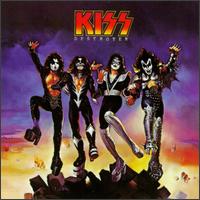
SOUNDTRACK: KISS-Destroyer (1976).

Although this is not the first Kiss album I heard (that would be Love Gun) it was probably the one I listened to most (it had “Beth” on it after all).  It is also full of some of the most over the top theatrical music of any heavy metal band at the time (is it any wonder that I also enjoy Meat Loaf and other over the top bands if I was raised on this?)  Kiss has always been about theater, and how much more theatrical do you need? (How about a cartoon of the band standing on a pile of ruins?).  But this album is such a classic, it’s hard to even think critically of it

“Detroit Rock City” is, well, it’s “Detroit Rock City.”  An amazing, iconic (albeit simple) guitar solo, great effects in the beginning (with Paul (I always assumed) singing along to other Kiss hits on the radio) and an awesome crash at the end.  Fill it out with an amazing riff and great work from the whole band.  What more need be said?  How about the way it leads perfectly into “King of the Night Time World.”  This song is overlooked despite its greatness.  It opens so loud and full then the verses get awesomely tinny until the galloping chorus kicks back in (Petter Criss plays drum rolls mid-song like no one else).  It also has great riffs and a memorable solo.  Oh and then a little song called “God of Thunder.”  Awesome bombast, creepy kids’ voices (I remember some kind of rumors about who the kids were and how they were held captive by the band or something).  It’s a wonderfully memorable song.

“Great Expectations” slows things down but adds the bombast.  I’ve always enjoyed this egocentric song, even as a kid singing along in a mirror.  Although the extra musical notes (keyboards and such) are kind of wimpy.  But it’s followed by the electrifying “Flaming Youth,” a hard-edged guitar song that is pretty simple, but pretty potent.  Again, the keyboard bits undermine the heaviness, but the repeated “higher and higher and higher” is pretty bad ass.

“Sweet Pain” is a great dark Gene-sung song (evidently about S&M, although I never knew that quite so specifically–I never understood the first two lines until I looked them up just now: “My leathers fit tight around me/My whip is always beside me”).  “Shout It Out Loud” is one of the great Kiss anthems.  I actually prefer it to “Rock and Roll All Nite” although that could be just because of the over exposure of “RaRAN.”  Of course, “Beth” is next and it is impossible for any Kiss fan to say anything about “Beth”.  This was the first song I ever memorized the lyrics to, and I sang it to my no doubt confused grandmother when I was 9 years old–my first and only live performance until college.

I always liked “Do You Love Me” (I think these Kiss fantasy songs were pretty big for me).  I was always confused by the tinny voice in the final verse of the song.  It was very strange to my young mind, but it really stands out in the song–as does Paul’s ending rant.  The overall sentiment of the song  is kind of funny coming from the guys who would soon be singing “Love Em Leave Em” but it is nice that they feel insecure once in a while too.

My LP of this album (or maybe it was an 8 track?) did not have the “bonus” track, which is just 90 seconds of a crazily processed version of “Great Expectations” with some lifted vocals of Paul in concert.  Apparently even though it is untitled, it is called “Rock and Roll Party” by most fans.  It appears to be a joke about all of the backwards masking that was supposedly on Kiss records.  Huh.

This is still one of my favorite albums of all time.

[READ: September 30, 2011] “The Russian professor

Nabokov did not secure the teaching position at Wellesley where he had been creative writing professor the year before (Lolita would not come out for a nother 13 years, so he was working via his Russian book reputation).  So instead, he went on a several-month speaking tour of Unites States colleges, many of them in the South.  These (excerpts from) letters to his wife detail some of the indignities that he suffered and reiterate his love for her and his son.

On his way to Coker University in South Carolina, his train car was double booked, his taxi didn’t show up and he wound up going to the wrong hotel.  When he finally was picked up: “Feeling that I wouldn’t have time to shave before the lecture…I went in search of a barber” [what kind of time management is that??].  Nabokov writes of the shave:

He shaved me horribly, leaving my Adam’s apple all bristly, and since in the next chair a wildly screaming five-year-old child was grappling with the barber who was trying to touch up the back of his head with the clippers, the old man shaving me was nervous, hushed the child, and finally cut me slightly under the nose.

(more…)

Read Full Post »

SOUNDTRACK: GRINGO STAR-“Shadow’ (2011).

This song was forecast as a great Fall song on NPR.  The band’s name is perhaps too cutesy, but the music is interesting.  The verses are jangly and in no way prepare you for the Beatlesesque (ie., soaring harmonies) chorus that follows. 

There’s not a lot to the song, and on my first listen I wasn’t all that impressed in the beginning.  But by the end of the song I was won over. 

The song feels very familiar, but I can’t say that it sounds like anything in particular.  The ooo-ooohs in the chorus are really pretty, the intro guitar is more intricate than I realized.  And after just a few listens I was totally hooked.  It just seems like more of a summer record to me.

I’m curious to see what else is on this record. 

[READ: September 15, 2011] “A Hobo Memoir, 1936”

My company provided some links to interesting articles that are available on JSTOR, an electronic archiving resource.  If you have access to a university database, chances are you have access to these articles.  I was particularly struck by the fascinating subjects of a few of these pieces and for the next few posts I’m going to mention them.

I had to start with this article because for some reason my kids are obsessed with hobos.  I don’t really know how it came about–reading older kids’ stories, I suspect.  On our first train ride, we saw a freight car with a door open and there was much talk about hoboes sleeping in the cars and, hoo boy, it just escalated from there.  And, despite the fact that hobos haven’t really existed in eighty some years, once you keep an ear open for the word, you hear it quite a lot (Craig Ferguson was calling his audience hobos for a while–it’s a good comedy word).

This article contains an introduction by Elizabeth Rambeau, assistant editor of the magazine, who gives us a brief history of John Fawcett and of hobos in general.  Including this very informative distinction: a hobo is a transient person who looks for work while he travels, a tramp is a drifter who does not look for work and a bum is a stationary person who does not look for work.  So, be mindful of the epithets you use!  Fawcett, Rambeau tells us, was unlike most hoboes at the time.  Indeed, he wasn’t really a hobo at all.  He was the son of a wealthy doctor.  But he grew tired of his life at boarding school and decided to take a trip on the rails from West Virginia to Texas.  But he lived the hobo lifestyle, hopping trains, getting busted by the police, and not carrying any (or much, anyhow) money.  He even hung out with a hobo named Shorty.

The reason that this article is noteworthy (in terms of hobo literature) is that unlike other hobo memoirs from the time, Fawcett was an educated man and a decent writer in his own right (most hobo memoirs were recollections from the hobos themselves, written by ghostwriters).  This Memoir comes from meticulous diary entries that he kept during his entire trip.  And, of course, the article includes hobo signs, everyone’s favorite piece of folk art.  What’s interesting is that there are no extant records of original hobo signs.  They were made with chalk and all were ephemeral.  All of the signs we have are from people’s recollections and the signs included here were done by an art dept.

Fawcett’s original work comes from an unpublished 1991 book called Awakening of Conscience.  What we have is a twelve page excerpt.  In the author’s introduction, he explains his life situation, his family situation and his pressing need to have some freedom in his life.  In hindsight, he can’t imagine what kind of grief he put his parents through (he left a note saying he was going to a friend’s house but then took a month-long hobo journey) and he regrets that.   But he’s also pretty proud of what he did. (more…)

Read Full Post »

« Newer Posts