SOUNDTRACK: LOS CAMPESINOS!-Tiny Desk Concert #67 (July 5, 2010).
This Tiny Desk show really accentuates what fun can be had with the Tiny Desk format. Los Campesinos! are an eight piece band, but only four of them could come (or could fit, anyhow) in the tiny office. And so we get a hugely stripped down set from the wonderful Welsh band.
One of the real benefits of these Tiny Desk shows is that it really highlights the songs themselves. I enjoy Los Campesinos!, but sometimes I feel like their songs are so busy it’s not always easy to know exactly what’s going on. This set shows how cool and interesting these three songs are underneath all the wild sounds and effects.
It’s also fascinating to watch these four folks perform in this room with nothing to hide behind. The singer doesn’t even have a microphone, he’s just standing there with his arms behind his back singing to a small room. And how odd it must be to sing to a dozen or strangers the a capella ending of “Straight in at 101.”
The three tracks all come from Romance is Boring and include the wonderfully titled: “A Heat Rash In The Shape Of The Show Me State; Or, Letters From Me To Charlotte”, “Straight In At 101” and “The Sea Is A Good Place To Think Of The Future.”
As you might be able to guess from the titles, the band is wordy and articulate. What you might not be able to guess is just how sexually explicit their lyrics are. Not dirty (well, a little dirty) just unabashedly frank (and its made even more so in this quiet setting).
These next two books in the series are really fantastic. Issue #25 brings the confrontation with Cain to a head. It almost comes too quickly–there has been so much lead-up to it that when they finally meet the confrontation is (necessarily) brief and explosive. They finally meet at the top of a mountain (where yet another really gruesome act is done to someone–although really it pales to what happened to the guy who was practically a skeleton). The intensity of the confrontation, and the excitement of the denouement made me think that the series was just about to end.
But them comes Issue #26 in which the final panel changes the entire game! (more…)
Charlotte Gainsbourg is Serge Gainsbourg’s daughter. Segre is, of course, known for his risqué songs–although Charlotte doesn’t fall into that same camp.
This is her third album. Her first was released when she was 13. The second was recorded with the band Air. This album was written by and recorded with Beck. And it’s a fantastic forum for her wonderfully complex voice and also just a great album of varying styles and textures.
IRM is the French abbreviation for MRI (she had a life threatening accident and was subject to many MRI’s). In fact, track two, called “IRM” is an electronic workout with sounds not unlike what you might hear in an MRI. But the album is very diverse, from whispering vocals to soaring altos. She has some scary/creepy songs as well as some sultry tracks. Gainsbourg is also an actress and I like to think that her skills in film have allowed her to inhabit so many characters in these songs.
“Le Chat Du Café Des Artistes” (written by Jean-Pierre Ferland) is the only cover on the disc, and man is it great. Whether it’s the French lyrics, which add a cool Stereolab-ish feel to the proceedings or the outstanding keyboards which are creepy and alluring at the same time, I don’t know, but this song alone makes the disc worthwhile.
Luckily there’s a lot more great songs here, too. “Heaven Can Wait” is a duet with Beck (although really, Beck takes the lead). It sounds like a great Beck track with a stomping acoustic guitar feel.
“Me and Jane Doe” follows with a sound like it belongs on the Juno soundtrack. It gives Gainsbourg a great opportunity to show of her vocal tricks, since she sings with a flatly American accent. “Vanities” is a beautiful string-filled track which emphasizes Gainsborugh’s voice (and has a kind of Bjorkian symphonic sound to it().
“Trick Pony” is a heavy electronic dance track, bringing an amazing sonic change to the proceedings of the disc. And “Greenwich Mean Time” is a nasty sounding song where Gainsbourg is not afraid a to sneer at the listener.
The disc ends with “Dandelion,” a kind of slow blues, “Voyage,” a tribal track (sung in French) and “La Collectionneuse,” which is not sung in French, but which is a piano based song that kind of creeps along on the edge of sinister. The end of the song has spoken French words at the end and it sounds not unlike an early Sinéad O’Connor song
It’s rare that you hear an album full of so much diversity which actually holds together so well. Gainsbourg doesn’t have an amazing voice or a voice that makes you go “wow,” but what she has is a really good voice that she can manipulate to convey a lot of styles, and I think that may be more impressive than an eight-octave range.
[READ: November 4, 2010] “Lucy Hardin’s Missing Period”
It’s hard to talk about this story as a story because of the gimmick that is attached to it. This is a choose your own adventure story, albeit for adults. In the magazine itself, there are two paragraphs. You have to continue the story online here. The technology involved is superb (you can save your story so that when you come back you can pick up where you left off) and each time you click to go to a new section, it fills in right after the section where you were reading so that the finished story looks like a complete (printable) story.
I tried two different stories and it became obvious that there are hundreds of story segments to choose from. I’m rather amazed at the author’s ability to create what appears to be so many different stories parts out of these few characters (although I suppose realistically there can only be a half a dozen or so outcomes, no?). And yet for all of that, I didn’t find the story all that interesting.
SOUNDTRACK: THE DUCKWORTH-LEWIS METHOD-The Duckworth Lewis Method (2009).
This is a CD released by the combined forces of Neil Hannon of The Divine Comedy and Thomas Walsh of Pugwash. And if that weren’t enough of a sales pitch, the title of the band is a method of calculating cricket scores! And even more…in concordance with that, this CD is largely about cricket. Huzzah! Buncha sellouts.
I don’t know a thing about cricket, but I know about great orchestral pop, and this disc has it in spades. Some of the more obvious cricket songs are even understandable to non cricketers (the themes of “Jiggery Pokery” are familiar to anyone who has failed in a sport–and musically it sounds like a silent film soundtrack).
“The Age of Revolution” begins with an olde-fashioned soundtrack as well (jazz swing, including tap dancing) but quickly jumps into a dancey discoey verse (the two soundtracks blend surprisingly well in the chorus). And the revolution? Well, it has something to do with cricket. Next, “Gentlemen and Players” is a wonderfully Divine Comedy-esque track complete with harpsichords.
“The Sweet Spot” is another discoey dancey track with some funky bass work (and innuendo whispered vocals). And “Rain Stops Play” is a fun musical interlude.
“Mason on the Boundary” is the first track that seems distinctly Pugwash-y. Hannon and Walsh have similar singing styles, and I find it hard to know who is who sometimes. But this track is clearly Walsh’s and it’s very nice indeed. Similarly, “Flatten the Hay” has that distinct Pugwash XTC/Beach Boys vibe and it’s quite good.
“The Nighwatchman” is also a very DC type song (it even sounds a bit like “The Frog Princess” but pulls away before being a repeat of that great single by introducing some very 70s sounding strings). The rest of the disc follows in this same wonderfully orchestrated pop feel. This a great record that, as far as obscure bands that get no statewide attention go, is top notch.
Oh, an it’s even more fun with headphones!
[READ: October 9, 2010] Skippy Dies
Wow, there’s a lot going on in this book. It’s exhausting just trying to think of all the topics covered: boarding school life, failed romance (two big ones), life as a teacher, the appeal of pop singer Bethani, the Catholic priest sex scandal, drugs of all kinds, sneaking into a girls’ school, World War I, institutional cover ups, M-theory–which is pretty much the entire universe, and donuts.
But let’s start at the beginning. Yes. Skippy dies. In the first couple of pages. And what’s fascinating about this is that we don’t care. I mean, in the scene where he dies, he’s not even the major character. But then Skippy turns out to be more or less the glue of the book once the story proper begins.
Skippy resides at Seabrook school in Dublin (the best, most prestigious Christian academy in the country–sorry Gonzaga). His roommate is Ruprecht (perhaps the strangest major character name I’ve read in a long time). Ruprecht is a large boy who is incredibly smart (he will single-handedly raise the school’s average on the year’s final exams). He is a computer geek who is obsessed with aliens and SETI. And he hopes to be able to communicate with the other world by using techniques suggested in M-Theory. The book does an admirable job explaining M-theory and string theory. I’m not going to take up space here, but there’s a fine description at Wikipedia (or, if you don’t like Wikipedia, here’s an academic explanation that is written for the lay person).
Anyhow, Skippy and Ruprecht are two of a few dozen boys who reside full time at the school. (Most of the other kids are day students). And they have a cadre of half a dozen friends that they hang out with who make jokes at each other’s expense. It’s a very realistically written entourage. Mario is Italian and claims to have had sex with many many women (thanks to his lucky condom which he has had for three years). Dennis is the ballbreaker. He’s the abusive one (but by most standards, he’s not a bad guy). And a few other hangers on.
This story of dorm life is a good one. The boys are funny, their stories believable, even if they are all eccentric in their own way. And then, one day, Skippy sees a girl playing frisbee at the girls’ school across the way (Ruprecht has a telescope which he uses for the stars, while eveyrone else uses it for the girls’ school). And Skippy winds up becoming rather obsessed with the unknown “frisbee girl.”
This girls’ school plays a part in the story in another way too. Carl and Barry are the Seabrook’s thugs. When Barry hits upon the idea of selling ADD meds to the locals (as diet pills), it’s the girls’ school that he mostly preys on. For yes, this story is also about drugs. (more…)
SOUNDTRACK: PAVEMENT “Stereo” on Late Night with Jimmy Fallon (2010).
Pavement were making the rounds of lat night TV around the time of t their Central Park reunion concert. They showed up on Jimmy Fallon. I don’t really like his show, but he has consistently great musical guests.
Pavement played “Stereo” which is a song I’ve always liked (the Geddy Lee part makes me smile), even though I never bought the album that it’s on. This is one of their weirder songs (which is saying a lot). The opening is all kinds of crazy noises (feedback and keyboard nonsense). When the verse starts it’s all bass and drums, but when the song kicks in it rocks heavily and crazily.
The live version features a crazy cal and response from the keyboardist (which I enjoyed a lot) and some really great guitar work. The video also has the winner of Fallon’s “Play Guitar with Pavement” contest, although I can’t tell how much he adds/subtracts from the performance.
[READ: September 24 & 25] “FC2” & “Books”
These three pieces were short, so I’ve decided to lump them together.
“FC2” is a Shouts & Murmurs piece. I thought that the Shouts & Murmurs were all comic pieces. This one is funny but it’s not as “ha ha” as many of the other pieces I’ve read. It even seems to be autobiographical.
Franzen says he had just recently written a section of “The Fifth Column” for the Village Voice. And on this particular day he received a very suspicious package whose return address was FC2. He speculates that the content of his section of the story may have triggered a psychopath to come after him. (The Unabomber used to use the letters FC as his code, so perhaps FC2 is his protegé).
Obviously it didn’t blow up or anything, and the revelation is anticlimactic, but it’s still a mildly amusing tale. (more…)
I found this CD through a connection to The Divine Comedy (Neil Hannon plays on a few of their tracks). Pugwash (what a crazy name–it comes from a series of children’s books (and a TV show) called Captain Pugwash) is an Irish band with four CDs (and this collection). And man, it’s hard to find their stuff over here (although their website has a wonderful collection of videos and such).
Giddy is a collection of songs from all of their albums. Their first album is represented by two songs here “The Finer Things in Life” and “Two Wrongs.” These two songs sound, with no disrespect intended, like great Oasis ballads. Say what you will about Oasis’ originality, they wrote some great songs, and these two sound like the best Oasis songs you’ve never heard.
Their other three albums sound far less like Oasis and far more like XTC. In fact, the XTC comparisons are well-founded as Andy Partridge eventually co-wrote a song with them and eventually signed them to Partridge’s Ape House records (which is how this collection was released in the U.S.).
The XTC comparison is unavoidable on a few tracks. The opening of “Song for You” (the “when we die” part) sounds like an uncanny XTC outtake, but when the chorus kicks in it sounds nothing like them and moves into more of the gorgeous orchestral pop that overflows on this disc. And the Partridge co-written “My Genius” is also a wonderful near-XTC outtake, clever, witty, and perfect.
And the song “It’s Nice to Be Nice” is just a wonderful cheery pop ditty. It sounds retro and charming; if the simple lyrics (and gorgeous harmonies) don’t bring a smile to your face you must be made of stone.
Although the album is primarily orchestral pop, there’s a wonderful array of styles on here. “Anyone Who Asks” has chipper keyboard bits in the verses, but the chorus is a wonderful mix of dark minor chords. And then, the absolutely bizarrely wonderful “Monorail” sounds like a fantastic Beck song (with lyrics that are as decidedly unusual as anything Beck himself might write). It even opens and closes with wonderful circa 1920s banjo.
Despite the obvious nod to XTC, Pugwash does something that XTC doesn’t. XTC is a very mannered band. They always seemed very rigid and formal (and were wonderful because of it). Pugwash uses XTC as a springboard, but Thomas Walsh seems like a guy who likes to let loose with unchecked silliness, so he can move past the strictures of XTC (and sound like Beck!)
And the packaging is just wonderful. The carnivalesque appearance of the cardboard case is enhanced by not just a cardboard sleeve but also by a second cardboard half-sleeve that you slide on top. Depending on which way you slide it on, it creates a different set of pictures. It’s a little thing but it’s a nice nod to the fun of non-digital products.
This is certainly one of my favorite albums this year (even if it came out last year).
[READ: September 21, 2010] One False Note
I enjoyed the first book of the series so much, I couldn’t wait to get to Book Two. In particular, I was interested to see if Gordon Korman’s writing style would differ much from Rick Riordan’s. As I said last time, I hadn’t read Riordan before, (although I have read a few by Korman) and while I wasn’t expecting them to write in the same manner, I wondered if they would try to keep the style the same (or if it would be really obvious that they were different writers).
I have to say that I didn’t notice the difference between the two. Korman’s seems a bit faster paced (but he had no exposition to deal with), and it’s possible that he made things seems a bit more scary/dangerous than Riordan, but not much.
The question I have with the series is three-part: Is the basic plot given to each new writer–like the writer is told what the 39 Clues are–or, possibility two, are they told very specifically, the clue is this and it is here and the writer has to figure out how to get the kids there, or possibility number three, they are free to do whatever they want.
Either way, this is an exciting series, and I’m looking forward to Book Three.
So in Book Two, Amy and Dan continue their adventure. This time, they go to Saltzburg and Venice. The Saltzburg trip leads them to the Mozart house. There’s a wonderful sorta subplot about Mozart’s sister, Nannerl (real name Maria Anna), who was also a great pianist and harpsichordist, oftentimes getting top billing when they played together. I’s never heard of her, and didn’t know of her talent, and that’s the point of the subplot–how Nannerl had to put her musical skills to the side because she was a woman. This works nicely with the pairing of Dan and Amy and how they are both good at different things and are both very useful on the quest. (more…)
SOUNDTRACK: SONSEED-“Jesus is a Friend of Mine” (1983).
My friend Nick sent me a link to this song. And he said that it would have been the theme song to his radio show back in college. (We went to a Jesuit school, so it could be taken seriously as well). Of course, knowing him, he absolutely would have played it as his intro music.
Anyhow, I listened to it and enjoyed the video in the spirit of gentle mockery that it was sent. But I found myself listening to it quit a lot and I have concluded that I now enjoy it irony-free. And how can that be?
Well, first off, Christian rock generally sucks. In addition to many other reasons, it’s often played with a style that is inappropriate to the message. And Gawd, forget the bombast of arena Christian rock bands (who shall remain nameless).
What I like about this song is that a) the musicians are really good. It’s a live song (I assume–they wouldn’t lip synch on Christian TV show would they?) and they are tight. Also, the music (ska!) is upbeat, just like the message. Finally, while lyrically not very clever (most of the lyrics are pretty laughable), they are sincere and not aiming too high.
And, I hate to say, it’s catchy as hell (although I suppose you have to like ska to like it).
This new issue shocked me because I noticed that it was printed in Canada, not Iceland. I’m not sure when this switch occurred, but I feel somewhat saddened for the Icelandic press!
The cover is a (softcover) foldout (with two flaps). The front shows two people crossing a street, but even more shocking than the Canada thing is the cover itself…something I didn’t notice until I left it out in the car. The black of the cover (see above) is actually heat sensitive. When it gets warm, it reveals a secret underworld to the picture. Very very cool! I was really confused when I picked up the book and it was no longer black but green with fishes swimming around, and I couldn’t imagine why I ever thought it was black. Pretty sneaky, sis.
This issue features a newly revised letter column (although “letter” is a subjective term here). There are four longer stories, and the rest of the book has two sections. The first is comprised of an awesome photo series of lunch bags (which I will attempt to emulate for my kids when they begin school). The second is “a Portfolio of Stories from Norway.” The Norwegian Stories are great, and really show the strength of literature coming from the country. (more…)
This soundtrack comes with the book mentioned above and below. It is the soundtrack to the film “I’m Here” which also comes with the book mentioned above and below.
I haven’t watched the film yet, so I don’t know how well the music works. But the book explains how many of these songs came to be in the film. And the organic nature of the compositions sounds like they are very suitable.
The first track (and “theme” of the movie is by Aska & The Lost Trees. The Lost Trees are a factious band made up for the film. Aska wrote the song (and there’s sheet music for it in the book). She has a second song called “Y.O.U.” later on the soundtrack. It’s a synthy dreamy song.
Gui Borrato’s “Beautiful Life” is an 8 minute techno song. It seems like an instrumental, but there are eventually lyrics. And it is rather catchy.
Then there’s a number of bands who I have heard of but don’t know these songs: Sleigh Bells: “A/B Machines” (which is on their debut Treats–a loudly mixed, increasingly noisier and noisier dance track, which is strangely addictive); Animal Collective: “Did You See The Worlds” (which is on Feels and gets better with each listen); Girls: “Hellhole Ratrace” (which is on their debut Album and which sounds like a distortion-free Jesus and Mary Chain) and Of Montreal who remixed “The Past is a Grotesque Animal” from Hissing Fauna… so that The Lost Trees could “cover” it in the film. I don’t know the original but this has punky abandon and distortion and rocks pretty hard.
The final two tracks are by Sam Spiegel: “Lonesome Robot Theme” and “There Are Many of Us (Electric Dream Reprise).” They are both slow keyboard washes–delicate songs that close the disc nicely.
It’s an enjoyable soundtrack, a little heavy on the electronics–which makes sense for a movie about robots, right?
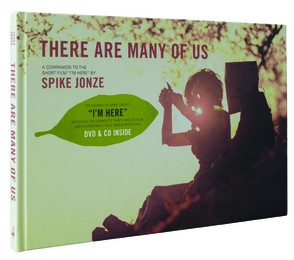
[READ: September 2, 2010] There Are Many of Us
[UPDATE: September 6, 2010] Just watched the film…. Reading the book first will definitely lessen the emotional impact of the film. So, be sure to watch the DVD, then read the book.
This book came the other day in the mail as part of my McSweeney’s Book Club. It’s funny to get a book that is a companion piece to a film you’ve never heard of and which you will likely never see. And that’s why it’s great that the book includes the film on DVD! (Along with several bonus features).
I really enjoy short films. And that’s why I like the Wholphin Series as well as the DVDs of Academy Award winning shorts. I only wish there was more access to them. I mean, frankly, where would I ever be able to see this film but here?
As I write this I haven’t had the chance to watch the film, so maybe it’s awful. But I have liked everything that Spike Jonze has done, so I don’t expect to be disappointed.
The stills in the book are fantastic, and the robots look incredibly lifelike. I’m not sure if it’s better to read the book or watch the film first. The book doesn’t really give much away about the story (except that it says that the film is inspired by The Giving Tree). And whether or not I should have watched the film first, the book has me really excited to watch the film soon. (more…)
SOUNDTRACK: PHISH-LivePhish 11.14.95 University of Central Florida Arena, Orlando FL (1995).
I have a number of these LivePhish discs. They are universally solid releases (all from soundboards, I believe, which, have they really been recording all of their shows since like forever?). And it’s fun to hear Phish totally jam out on a few of their more meandering songs.
One of the most interesting aspects of the series is that they almost always throw in a cover song (on Halloween, they cover an entire album by another band).
I haven’t really mentioned any of these releases because there’s usually not much to say about them: you either like Phish live or you don’t. But this one is notable for being particularly odd.
They do an a cappella song in the first set–typically if they do an a capella track it is as an encore or the intro of the second set, but this one is right there in the beginning.
The end of the set also had the only instance (of the shows that I have) where Trey explains the audience chess match. Many of the recordings open up set two with an audience chess move. In this case, Trey explains that they have been playing chess with the audience at each show. Phish is white, the audience is black and anyone who wants to just has to go to the Greenpeace booth to play a move…I have no idea how they would choose who gets to play the final decision.
There’s some other odd things in the show. “The Divided Sky” features one of the prettiest solos that Trey plays. In this show there is a very long pause between the end of the first half of the solo and the beginning of the second. The crowd cheers quite a bit during the pause, but we the listeners, have no idea what happened.
And then there is the extra long rendition of “Stash.” It’s broken into three sections. The first one features a fun audience response guitar solo. And in this instance, he plays it in a much more staccato style. The middle one features a bizarre percussion type solo. And the third features a rendition of “Dog Faced Boy” which is not sung to the appropriate music, rather, the keyboards just play simple, unrelated chords while Trey sings.
Set two ends with a wonderful rendition of “You Enjoy Myself” that ends in their bizarro screaming and grunting. You’ll get funny looks listening to that loudly.
So this set is a good one, and it stands out as unique among the others for being so darn bizarre.
[READ: June 27, 2010] The Boy Who Couldn’t Sleep and Never Had To
I’m always bummed to read a prepub after it gets published. Sigh.
Sarah told me that I’d love this book and she was correct. It’s about a misfit high school boy who draws pictures and draws them really well. Despite this talent, he is not lauded by the cool kids in his class (the kid who draws licensed characters holding joints is lauded by the cool kids).
He’s also kind of defensive about his drawing, because he gets tired of people asking him what he’s drawing. Especially when they think that he’s just doodling. But then one day Eric Lederer asks him what he’s drawing. He and Eric have never talked. In fact, he doesn’t think anyone talks to Eric. Eric’s THAT kind of weird.
And what our narrator realizes is especially weird about Eric is that he is standing really really still: “No one stands this awkwardly sure of themselves except characters in my drawings staring straight ahead with their arms at their sides” (8). And with that awesome detail I fell in love with the book. (more…)
SOUNDTRACK: PEARL JAM-Halifax, Nova Scotia, Metro Centre, September 22, 2005 (2005).
This show came as a free download if you purchased Pearl Jam’s Backspacer CD.
Pearl Jam live shows really showcase the band’s strengths. And no shows are better than when they go to a place for the first time. This was their first trip to “Halifax to the Max” and the band sounds fantastic.
Even when Eddie Vedder forgets the words in the first verse of a song “Breath” (which he says they don’t normally play and hadn’t yet played in on the tour) and just shouts “FUCK!” the band continues and the songs starts again as if nothing happened (the crowd wildly supportive of course).
There’s also some surprise treats, like the often overlooked “Glorified G” (not anywhere close to being one of their best songs, but fun in a live setting). I especially liked the snippet of Sleater-Kinney’s “Modern Girl” that the toss in at the end of “Not for You.” Although the inclusion of “Bow wow wow yippe yp yippe yea” in “Blood” is certainly odd.
Eddie in particular has a lot of fun with the locals when he demands that they bring him a can of Keefe’s Irish Stout. He gets sillier and sillier with them (describing what he assumes the beer must be like) until one is finally procured for him. And the bit about “fetch me a new guitar, I shan’t be playing this one” was a great set up for a joke.
The only complaint is that my downloaded version ends with Bu$hleaguer but the setlist suggests that there should be two more songs (“Fortunate Son & Rockin’ in the Free World”). Bummer, although I’ve heard those songs on enough bootlegs to not really miss them. (New comments added February 26, 2011).
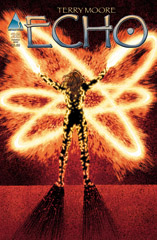
[READ: August 26, 2010] Echo: 23 & 24
The series continues to grow in intensity and depth. After something of a cul de sac in episodes 21 & 22, number 23 burst forth with new excitement.
The biggest news (ha ha) is that the alloy is making Julie grow. The revelation is done rather humorously because, as we knew already, she needed clothes. And when Ivy buys her her normal size, the clothes are simply too small (which Ivy has a mocking field day with). [The whole of Issue 23 is devoted to some female fighting. Terry seems to have an ear for this sort of fighting because it sounds very believable. Although it did make me uncomfortable that his two main characters, both of whom are female devolve into this sort of sniping, at least it didn’t get really ugly.] (more…)
Like Woody Guthrie, Pete Seeger has been singing for the common man since forever. Unlike Woody Guthrie, Pete Seeger is alive and well and still kicking up a fuss.
This collection of his songs is fascinating in that it shows a certain aspect of Pete’s music: his songs are designed for “folks.” His songs almost demand audience participation. And so, he has albums for kids (that are weird but wonderful) and other, grown up songs that kids also know, which people have been singing for generations.
And so this disc features more than “studio tracks.” It opens with “Little Boxes” a wonderful song which features some awesome lyrics including this verse:
And the people in the houses
All went to the university,
Where they were put in boxes
And they came out all the same,
And there’s doctors and lawyers,
And business executives,
And they’re all made out of ticky tacky
And they all look just the same.
But in addition, you get some classic tracks that define rebellious folk: “Which Side Are You On?” “We Shall Overcome” and “Waist Deep in the Big Muddy.” It also has songs like “Wimoweh (The Lion Sleeps Tonight)” and “Abiyoyo.”
And of course, it features, “Where Have All the Flowers Gone” and “Turn Turn Turn” songs which I’ve known since I was a little kid, but whose lyrics never meant anything to me until I became an adult. There’s even “If I Had a Hammer” with the final verse:
It’s the hammer of justice;
It’s the bell of freedom;
It’s the song about love between my brothers and my sisters;
All over this land
For a really comprehensive collection of his “studio work” the ideal disc is If I Had a Hammer: Songs of Hope and Struggle (where he sets the tune of “Battle Hymn of the Republic” to a song called “Solidarity Forever” (Solidarity forever, Solidarity forever, Solidarity forever, For the union makes us strong.)
Pete Seeger is indeed a national treasure, and a man who fights in his own way for each of us.
[READ: August 23, 2010] Social Anarchism or Lifestyle Anarchism: An Unbridgeable Chasm
After reading Letters of Insurgents, I felt the need for a palate cleanser. Melissa suggested this title. And it really did wonders for me.
All along while I was reading Insurgents, I felt like everyone in the book was misguided about their role in society and, frankly about their ability to undermine the world. I never understood the idea that people were “making” them work. They didn’t have to work. They could have lived off the grid somewhere and eaten berries. What else is the point of a strike than to improve working conditions, not to abolish work altogether (that whole apart about the plants’ foreign offices plugging along despite their big lockdown was particularly hilariously naive).
In many ways I felt like their opinions were on par with what I thought anarchism was, and yet their opinions were nothing I wanted to be a part of. Bookchin argues that their attitudes are examples of Lifestyle Anarchism (this article does not address the book at all, but you can see the characters in what he’s describing.) (more…)
 SOUNDTRACK: LOS CAMPESINOS!-Tiny Desk Concert #67 (July 5, 2010).
 This Tiny Desk show really accentuates what fun can be had with the Tiny Desk format. Los Campesinos! are an eight piece band, but only four of them could come (or could fit, anyhow) in the tiny office. And so we get a hugely stripped down set from the wonderful Welsh band.
 It’s also fascinating to watch these four folks perform in this room with nothing to hide behind. The singer doesn’t even have a microphone, he’s just standing there with his arms behind his back singing to a small room. And how odd it must be to sing to a dozen or strangers the a capella ending of “Straight in at 101.”









 I Just Read About That...