Feeds:
Posts
Comments

Archive for the ‘Suicide’ Category

ampsSOUNDTRACK: MISSY MAZZOLI-Vespers For A New Dark Age (2015).

missymazzoli_sq-80d1109aad30ab9a4bfe1a45d5c82d99354bc079-s400-c85Missy Mazzoli’s Vespers for a New Dark Age, is a 30-minute suite for singers, chamber ensemble and electronics. The piece was commissioned by Carnegie Hall for the 2014 Ecstatic Music Festival.

It’s a fascinating mix of traditional and contemporary instruments.  And there’s a surprise musician as well: Martha Cluver and Virginia Warnken Kelsey from Roomful of Teeth, provide operatic soprano voices.  Mazzoli’s own ensemble Victoire, provides the music while Wilco drummer Glenn Kotche adds percussion and thunderous pounding.

As the suite opens, electronic chimes sound before the beautifully soaring voices come in (I don’t know who is who).  The instrumentation is complex and the vocals are often in English (but operatic and not always obvious to hear). There’s some great rising and falling notes from various instruments.

The first piece is called “Wayward Free Radical Dreams” and I like the surprise of the simple English phrase “Come on, come on come on” A bell ringing is the segue into part 2, “Hello Lord.”  Over a lonely flute and some synths, the vocalist sings a poem by Matthew Zapruder for lines like: “hello lord / sorry I woke you / because my plans / are important to me / and I need things / no one can buy / and don’t even know / what they are / I know I belong / in this new dark age.”

I love the rising and falling notes of “Interlude 1″ over the fast violin moments.  “Come On All You” opens with some ticking hi-hats and squeaky violins.  There’s a lot of drums in this song—some punctuate the melody until the soprano voice takes over and then around 4 minutes into the section, the drums burst to life.  “New Dark Age” has some moody synths under the soaring voices and “Interlude 2” opens with the sound of big deep bells.

“Machine” has a mechanical staccato feel in both strings and voices.  When it returns to “Come on Come on” refrain (this time with two voices), it’s very cool.  The “Postlude” ends the piece with moody strings and distorted mechanical sounds that overwhelm the voices at times.   The piece ends on an up note but not in an overwhelmingly happy feeling.

The final piece on the disc is not part of the suite, although it fits in sonically.  It is called “A Thousand Tongues (Lorna Dune Remix)” and it has echoing pianos and overlapping synths.  While this piece is pretty it is probably the least interesting of the disc.  Perhaps because there are fewer voices and more synth melodies.  Perhaps because it is a remix.  The song feels fine, but not as compelling as the suite.

I was happy to discover his disc, which really explores different classical motifs.

[READ: March 15, 2015] All My Puny Sorrows

As with many books, but especially those published by McSweeney’s, which I always read, I didn’t really know what this was about.  I can pretty much guarantee it would not have been high on my list had anyone told me it was about dealing with a suicidal sibling.

But what’s great about the McSweeney’s imprint is that they gather such a wide variety of books and most of them are of such good quality that I know I won’t be disappointed.  And this book not only didn’t disappoint, I found it really fantastic.

The story is fairly simple, although from my perspective it was also fairly exotic.  The main action of the book takes place in present day Winnipeg.  But there are flashbacks to the main characters’ childhood in 1979.  And the way it opens–with the family watching as the house that their father built is put on the back of a truck and driven away is one of the more memorable opening passages of a book that I’ve read.

The family consists of the narrator  Yolandi, her older sister Elfrieda and their parents.  And, perhaps most exotic to me they are Mennonites.  Their family is not entirely pious in the tradition in their town–they are seen as somewhat less than observant.  Things were made even worse by the deliberately provocative nature of Elf.  She was creative, she loved to read and she had a real sense of outrage.  The church pastor once accused her of “luxuriating in the afflictions of he own wanton emotions.”  She embraced poetry, particularly the line “all my puny sorrows” and decided it would be her slogan.  So she began spray paining AMPS all over the town. (more…)

Read Full Post »

lauraSOUNDTRACK: FUN.-Some Nights (2012).

funI didn’t realize that this wasn’t Fun.’s debut album. I hadn’t heard of them until, well, until they got pretty big.  Sarah got this for me for Christmas in 2012 on the recommendation of an NPR list.  Of course, my biggest surprise was playing it Christmas morning and hearing the word fuck twice in the first song.  Merry Christmas, kids!

I read recently that the band really liked Kanye West’s My Beautiful Dark Twisted Fantasy so much that they hired the same producer to get that sound.  And that makes a ton of sense on the style and final product here–big grandiose sounds that are layered and layered and dense. The difference of course is that Fun. writes more catchy/poppy songs with a pop rock sheen.  And the Queen comparisons are unavoidable.  But with auto-tune.

“Some Nights (intro)” opens the disc with a quiet piano intro that builds to what you’re really going to get here–dramatic, theatrical, anthemic over the top pop rock.  Because after a minute when the backing vocals come in, it sounds pretty much like an updated modern day Queen.  While lead singer does bellow like Freddy Mercury the Queenisms come more from the backing vocals and the orchestrations.

The first song proper, “Some Nights” has a more polished, more poppy sheen to it.  And like the rest of the album, it has a huge sing along chorus with whoa hos and everything.  It’s nearly inevitable that they would become huge because of this album.

And yet, despite all the pop, I like this record a lot.  The artsy, theatricality is so over the top.  And really each song is like a mini showstopper.  “We Are Young” has the title of an anthem and thus the song is an anthem.  It starts with just drums but after some clever lyrics, it shifts to a slow building chorus that the world can sing along to.  The same is true for “Carry On,” a slow piano ballad that builds in a big anthemic chorus.  “It Gets Better” is a bit more electronic and fast paced from the start.  “Why Am I the One” slows things down again, this time with guitars.  But again each one has a big sing-along chorus.

“All Alone” is a bit more electronic (with harpsichords!) and a little more drum heavy, while “All Alright” stays anthemic throughout.

What’s surprising really is the lyrical content–he sings a lot about loving his parents (there’s a few shout outs to his mom).  I admit I don’t entirely know what’s happening on the album–I haven’t looked at the lyrics too carefully, but it seems far more introspective and personal than big anthemic pop hooks would suggest.

“One Foot” is the first song that diverges a bit from the formula–it’s still a big stomping song, but the way the main riff is played on orchestral hits rather than more conventional instruments points to the more Top 40 elements of the band.  And the final song, “Stars” really tips the balance. This is the one song that I don’t really care for.  It’s 7 minutes long and the melody is more pop than artsy.  The song builds in a less dramatic and more poppy way.  This song has the most mom intensive lyrics: “Most nights I stay straight and think about my mom–oh god I miss her so much.”  By 2 minutes it devolves into an auto-tuned ballad where the Kanye influence really rears its head.  For the last 3 minutes or so it is a string filled ballad with crazy auto-tuned vocals (especially when they harmonize!).  It’s a bit much even for me, although I think it works pretty great as an album ender.

The strange thing about that is that there is one song after it. It turns out that it’s a bonus track, which i didn’t realize until recently.  I couldn’t imagine why you’d put a song after that autotuned nonsense.  So it makes sense as a bonus track, although after “Stars,” I’m done with the album.  The song, “Out on the Town” brings back the guitars but the “oh oh oh oh” in the beginning is really boy band like.  And I fear the whole set up is more commercial than theater. So, no real bonus for me.

Basically, the album sounds quite the same throughout (in that it is big and theatrical, although there are some differences that distinguish the songs enough).  And if you don’t like one of the songs there’s not going to be much here for you.  But if you like your theatricality over the top, you could do worse than Fun.  Just get ready to sing along.

[READ: October 1, 2014] The Original of Laura

naboI have had Nabokov on my list of authors to read for a long time.  I have read and enjoyed a few of his books and planned to read his oeuvre at some point, just not quite yet.  And then, as serendipity would have it, I stumbled on a book of his novellas (the Penguin classic edition) and decided to read them.  Because they aren’t really meant to be taken as one item, I’m going to mention them individually.

The Original of Laura is a controversial release because of its history.  And it seems that more words have been written about the history of the book than the actual content of it.  So I will summarize the history by saying that Vladimir said that if he didn’t finish the book that it should be destroyed.  Vladimir’s wife did not destroy the book and some thirty years later his son Dmitri decided to publish it [cue cat fights and gnashing of teeth].

The interesting way the book was published was as a series of index cards.  Nabokov wrote all of his stories on index cards.  The book version is on heavy card stock in which all of the index cards were reproduced and the words were typed below (errors and cross outs and all).  And all the pages are perforated for, in theory, the reader’s ability to mix and match the pages as apparently Nabokov did.

This seems like a cool idea except that most of the index cards are numbered, so it’s not like there is any doubt as to what order they should go in.  The final cards are not numbered, but again, they are pretty much sequential–there’s not a lot of play at play here. (more…)

Read Full Post »

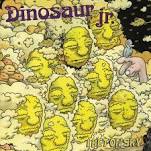
nobokov eyeSOUNDTRACK: DINOSAUR JR.- I Bet on Sky (2012).

ibetI have been so pleased with the reunited Dinosaur Jr.  I’ve enjoyed each of their albums, and feel like they really have hit a great stride of songwriting.  The only difference to me is that these songs are all pretty long, something I don’t really think of as a Dino Jr thing.  They do often have a few longer songs, but on this disc, 5 songs are over 5 minutes and two are nearly 5 minutes long.

As with the last album, I’m not sure why Lou Barlow agreed to reuniting.  Barlow is a great songwriter and has successful other projects.  He gets two (short) songs that he write and sings and that’s kind of it.  I mean, they sound great and really flesh out the album, but it seems like a weird thing for him to do unless he just likes playing the old Dino stuff again.

And then of course there’s Mascis.  It’s amazing how much of a slacker J Mascis sings like and yet what a careful and meticulous guitar player and songwriter he is.  And yes, it’s great to have Murph on drums, too.

“Don’t Pretend You Didn’t Know”  opens just like a great Dino Jr song—that guitar is unmistakable. It’s a fast rocker. With a big old Dino chorus. There’s a lengthy outro solo that really stretches out the song into a jam.  “Watch the Corners” is the other kind of Dino song, a chugger with big slow open chords and a nice riff. (and again a wonderful chorus).  “Almost Fare” is the other, other kind of Dino song, poppy with a kind of cute riff and a slow drawl in the vocals.  And “Stick a Toe In” is a slower ballad–the fourth kind of song that Masics writes so well. It has a nice chorus (with piano (!)) and some dramatic steps in the chorus.  Suffice it to say that although they all sounds like Dino Jr., it’s impressive how many styles of song Mascis writes so well.

Barlow’s first song is “Rude,” a short fast punk rocker.  At just under 3 minutes (with no solo) the song pounds along with a very funny chorus: “I wish I didn’t care cause caring is rude.”  Even though it changes the flow of the album, it just adds to the diversity that is Dino Jr.  In “I Know It Oh So Well” Mascis’ ringing guitar comes back  It’s a simple song with just a few chords and a simple interstitial riff, but he makes it sound very full.

“Pierce the Morning Rain” is the only short Mascis song on the disc (and perversely it gives the album its title).  It has a very heavy metal guitar riff and a super fast paced (and sung) tempo.  “What Was That” is a slow burner with many elements of classic Dino—a great solo in the background of the song and a cool riff along with Mascis’s patented delivery.  “Recognition” is Barlow’s other song. It almost makes 4 minutes.  It sounds more like part of the record (and, strangely, also like the popular Sebadoh tracks). You can really hear Barlow’s vocal style shine through and it’s a great counterpoint to all the Mascis on the disc.  It’s also great song—kind of slow and angular but with a cool fast riff in the bridge.  It also features a pretty wild (and un-Masics-like) guitar solo

“See It on Your Side”  is the last song and at nearly 7 minutes, it feels a little long.  Although that may be because the song seems to end and then starts again.  And yet, that end solo is pretty great.  It’s a very notable Mascis type riff that starts the song.  Even with all of the long songs, the disc still clocks in at around 45 minutes, which is really a perfect amount of Dinosaur Jr. consumption.  Looking forward to the next release.

[READ: October 1, 2014] The Eye

naboI have had Nabokov on my list of authors to read for a long time.  I have read and enjoyed a few of his books and planned to read his oeuvre at some point, just not quite yet.  And then, as serendipity would have it, I stumbled on a book of his novellas (the Penguin classic edition) and decided to read them.  Because they aren’t really meant to be taken as one item, I’m going to mention them individually.

The book includes a Foreword by Vladimir (his son Dmitri translated this with help from Vladimir) that talks a bit about when he wrote it and how he didn’t bother to include details about the location because it wasn’t important to the story (it’s a surprisingly casual foreword).

“The Eye” is a strange story (technically a novella or a very short novel) in which a man, despondent at the beating he receives, tries to kill himself and then believes that he does.

The narrator has been having an affair with a married woman named Matilda.  He’s been a little bored with her lately, and is pretty much over her.  But one night when the narrator is working as the house tutor for two boys (the boys are completely disrespectful to him and every scene with them is very funny), the cuckolded husband comes over and really beats him up.  Just really lays into him (the narrator’s protestations about this not even being his house are rather amusing).  I especially liked that the husband calls first and doesn’t tell him who he is “So much the better–it’ll be a surprise.” (more…)

Read Full Post »

boughSOUNDTRACK: PROTOMARTYR-Under Cover of Official Right (2014).

martyrMy favorite description of Protomartyr is that the three younger guys ran into their old high school math teacher at a bar and asked if he wanted to sing with their band.  Protomartyr are a heavy band from Detroit (and none of the above is true about them, but check out the picture below for how true that seems).

The lyrics are dark, literary and sometime quite funny.  The music is a sort of post punk.  The drums are amazing with all manner of complex patterns.  The guitar is angular and precise, eking out notes and then blasting away on gorgeous ringing chords.  The bass plays patterns–not simple notes.  His is a great counterpoint to the guitar.  And then there’s the voice.  Gruff, worldly, knowledgeable and occasionally angry.  But mostly he sings in a kind of spoken word style, telling of his distrust with…well, whaddya got?

My CD did not come with a lyrics sheet (although I believe the LP does), so I don’t exactly know the words to these songs.  I can certainly guess though.

The disc opens with a sinister chord that slowly rises, only to be replaced by a jangly open guitar chord and then a very lengthy riff.  And then the deadpan vocals comes in.   “Shade goes up shade goes down, one of my dead moves.” And that sets the tone (that song along with many other is a reference to a novel: in this case Patrick Hamilton’s Hangover Square). I love the way the second song “Ain’t So Simple” opens with an interesting drum rhythm and these great lyrics, “Hello there, you are all witnesses to a kind of confrontation between me and these three men.”  The lyrics are basically an attack on the other guys in the band: “this thing that sits behind me: jumped up homunculus, and yet he sings so sweetly.”  The guitar is quiet and complex with an interesting riff.  Then the bridge bursts forth with all kinds of chaos and noise and a faster riff.  The song ends somewhat positively, “guess I will keep him around, until the next song.”  And it ends with the same drums that opened the song.

Most of the songs are just over 2 minutes.  “Want Remover” is pummeling rock, heavy and distorted.  “Trust Me Billy” reintroduces a spiralling riff but with a heavier drum.  “Pagans” is only 1:11, with a very sparse sound.  “What the Wall Said” slows things down (it clocks in at 3:11).  It has a slow intro that is mostly bass.  When the chiming guitars come in, the drums follow and the songs picks up speed.  It has one of my favorite lyrics: “What will you miss? Alice in Chains played on repeat–not feeling great, you’re 20%.”  Followed by morning ringing guitars.

“Tarpeian Rock” is set to a cool bass line.  It’s basically a list of people who should be “thrown from the rock” “greedy bastards, emotional cripples, gluten fascists” etc.  “Bad Advice” opens with a smacking drum sequence and ringing guitars.  It’s angular and prickly until about half way through when it suddenly slows down with the simple “bad advice” chorus.  “Son of Dis” is a blistering punk song.  Barely over a minute, it is a relentless blast.

There’s something about the guitar sound on “Scum, Rise” that is so unguitar-like, I’m totally intrigued by it.  And the repeated simple chorus of “scum…rise” is pretty hard not to sing/speak along to.  “I Stare at Floors” is another fast rocker.  “Come and See” has more great weird chords (with a vibrato put on them for extra weirdness.”  It’s another fantastic song, with the chorus introducing a brand new drum sequence and a super catchy but dark chorus: “And I’ll try to live defeated, come and see the good in everything.”  I can’t decide which section of the song I like better.  Well, maybe it’s the repeated third part where the drums come bashing alive to really emphasize that section.

“Violent” is another slower song, with a lonesome riff and sparse drums.  The vocals are so almost-flat that it makes the lyrics “if it’s violent…good” seem even more dark than they might otherwise.  “I’ll Take That Applause” opens with a sample of someone singing something, maybe?  Garbled, rather creepy sounding voices introduce a big ringing chord.  The song introduces a piano buried under the chorus of “nothing ever after.”  And then you press play again and listen to the whole thing again.

I simply can’t stop listening to this album.

proto

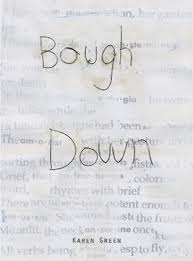
[READ: September 15, 2014] Bough Down

Karen Green is a visual artist and poet.  She was married to a man who hung himself, and this collection address that horrific incident almost exclusively.

Green’s poems aren’t structured like poems (meaning that they are blocks of text and have no concern for line breaks or rhyme scheme).  Nevertheless the words she has used are quite powerful and evocative and do everything that good poetry should do.

Interspersed within the poems are small images.  Most of the images are cut up pieces of text arranged but also obfuscated by what looks like a gauzy white paint (in the same way that the book has a gauzy white slip cover (nicely done)).  I don’t know what the actual size of her prints is, but I wish they were bigger in the book.  It’s really hard to see the details that are clearly there.  And I know that hiding is part of the point, but if it were bigger it would certainly be easier to understand.  I’m fascinated by her use of dollar bills as well as other tiny objects (fingerprints? stamps? boxes?).

Most of her poems are untitled; those which are titled have “jazz standards” as titles.  Like “summertime and the living” or “let’s call the whole thing off.”  This jibes nicely with one of the “characters” in the poems, a woman called “the jazz lady.”  For indeed, although I’m reading this as a series of poem, there is so much continuity between poems, that it almost reads like a novel as well.  If nothing else, there seems to be time passing between the poems.  And while the story itself is unfinished, it does imply that things will be moving forward.

The pieces about the jazz lady are interspersed with the stories about “you.”  The jazz lady “is in first or third person.  She is keeping secrets and everyone who loves her is tired of them.”  In “Black and blue and” it begins “No one knows how the jazz lady ended up in the hospital again.”  I took the jazz lady to be Green, or perhaps just someone else Green knew. (more…)

Read Full Post »

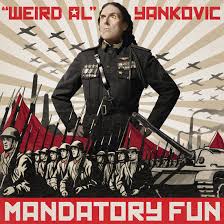
kimie66SOUNDTRACK: “WEIRD AL” YANKOVIC-“Inactive” (2014).

alAs I mentioned, there  are only four songs from Al’s new album that he didn’t make videos for.  The biggest surprise to me is that one of the songs is this parody of Imagine Dragons’ “Radioactive” (a song that, I’m not supposed to like but which I do).  Al’s parody is fantastic, but, given that it’s about being inactive (and is kind of gross) it would probably make for a very disturbing video.

The song begins sounding just like the original (of course) and we soon learn that the protagonist is, well, really inactive, (it makes me laugh that this song about inactivity is so upbeat and anthemic, although I think their “Woah oh ohs” are a bit more lethargic than the original.  I love how he spoofed the breathing-in section by saying he’s using his inhaler.

And then as with many of Al’s couch potato songs, this one gets into some funny details–he hates the show he’s watching but can’t reach the remote control, he’s growing cobwebs on his feet, etc.

The song ends “really inactive, not so attractive.”  It’s actually quite a depressing song, but strangely funny.  It’s also one of my favorite songs on a disc filled with favorites.

[READ: July 27, 2014] kimmie66

This book was written and drawn by Aaron Alexovich.  Alexovich drew the other Minx title Confessions of a Blabbermouth.  And his drawing style is much the same here–a little wild, a little crazy and, his virtual world is also convincingly different (much like the situation in Blabbermouth).

I wasn’t too keen on the story when it first opened.  It is set in the future (23rd century, we find out later) and is all about how most people spend their time in the virtual world, in specially created lairs that meet their desires.  This is a fairly old trope, although given that this book is 7 years old, it may not have been all that old at the time, so I’ll cut him some slack.  But anyhow, it starts off with all this jargon and such about 23rd century VR and whatnot.  And I was a little, well, uncompelled.  But then Alexovich brings in a human element and the story quickly grows very interesting.

So kimmie66 is not the main character exactly.  The main character is Telly, a young girl who spends most of her time in the virtual lair “Elysium” a kind of goth hangout (Alexovich’s style can most easily be labelled goth, even if that is a very simplified description).  Telly is pretty much herself in her virtual world–she looks pretty much exactly like her real life appearance.  This is uncommon, of course, since most people make their idealized selves online.  Like her friend nakokat (she amusingly points out, nako means cat, so her name is cat cat).  She loves nakokat, but doesn’t know anything about her in real life.  And then there’s her friend kimmie66 who has just sent Telly a suicide note.

Kimmie66 is the daughter of the founder of the TenSys, a company that makes “Minisoft” look puny.  And Telly doesn’t know if kimmie66 has really killed herself or not, but it seems that kimmie66 or someone like her is appearing in all of the different virtual lairs–something that is forbidden.  And she seems rather ghostly in all of them.  What is going on?

She calls in the help of Coil, a guy who hangs out in her brother’s lair (a scary place where half the people’s avatars are creepy ghosts)  A word on the lairs–although they were kind of simplistic in terms of content, i really liked them, especially this clown one.  It was weird and funny.  Coil thinks that kimmie66 is just playing–a poor rich girl–until he realizes that something bigger is going on.  Something that could threaten all of the lairs.

It is only when Telly meets kimmie66’s real life mom, the founder of Tensys, that she learns exactly what is going on, and it’s pretty intense.

This story proved to be far more interesting and thoughtful than I imagined from the beginning, and I really enjoyed the end did not reject technology but it did suggest that there was more to life than VR.  And again, tha drawing style complimented it perfectly (and was pretty cool looking).


Read Full Post »

skimSOUNDTRACK: LOWLAND HUM-Tiny Desk Concert #341 (March 6, 2014).

humLowland Hum are the husband and wife duo of Daniel Levi Goans and Lauren Plank from North Carolina.  He plays guitar and she plays (snare) drum and percussion.  They tour with a few homemade wooden platforms that have small metal jingles, so when they stomp on them, they get great percussive sounds.

They play three songs.  The first is “War Is Over,” a sweet folkie song with tambourine. Their voices meld very nicely (interestingly, her voice which I think is doing harmonies sounds stronger here–but that may just be a trick of the microphone).  There’s something interesting and compelling about they way the song starts–the verses are slightly unconventional, but when the “war is over now” chrous kicks in it sounds like a very different song.  It’s a good combination.

Before the second song, “Pocket Knife,” Daniel explains that this is the first song they wrote together.  It’s a funny story about wanting to write together but being afraid that their voices or styles would be incompatible and how would a husband and wife deal with that?  (Fortunately, they felt very compatible). The song is surprisingly short.  The verse is very quiet, especially his voice. Then the song gets loud–but there’s no vocals during the loud part.  She takes a verse and then it’s over.

Then they open it up for questions.  They explain that they are on stage together and in the van together and so with audiences basically staring at them, they decided to  open up a dialogue on stage.  So they often ask people for questions and comments.  Someone asks about the lyrics books.  They have made lyric books and passed them out before the show (something they do at all of their shows).  They like having something tactile or the audience.  The previous song was number 19 (which reminded me of a hymnal).

“Four Sisters, Pt. One” has many parts and is really interesting.  It has dynamic sound changes.  And when they harmonize on the “use your voice” section, they sound great.  I like the duo and would enjoy seeing them opening for someone, although I don’t think I like them enough to get a record.

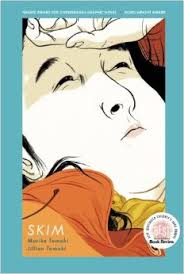
[READ: June 29, 2014] Skim

In Skim we meet Kimberley Keiko Cameron who is called Skim (because she isn’t).  She is a heavyset Japanese woman into the goth scene and a wannabe witch.  Her best friend is Lisa, already a witch and, despite her blonde hair, also kinda gothy.  The witchcraft is wiccan lite.

As the story opens, we see that Skim has broken her arm tripping over the makeshift wiccan altar in her room.  But trumping that is the news that Katie Matthews, a super popular girl in school was dumped by her boyfriend, John.  She has drawn a broken heart on her hand with a Sharpie.  Lisa hates Katie and Skim does too, sort of (she doesn’t really hate anyone), but it is still super annoying.

The other principal character is Ms Archer.  Ms Archer is a hippie with red hair and flowing dresses who teaches drama and English.  Skim likes her because she feel a kindred freakishness. (more…)

Read Full Post »

torSOUNDTRACK: THE KIDS-“Forelska i lærer’n” & “Norske Jenter” (1980).

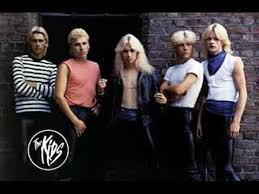
kids2 The Kids are a Norwegian band that was mentioned in Karl Ove Knausgaard’s story yesterday.  He is pretty disparaging of them as they were hugely popular when he was in school (and he liked other bands).  They sing in Norwegian and are quite poppy.

“Norske jenter” is the poppier of the two.  It’s pretty synthy, with a super catchy melody and chorus.  It seems just shy of being a sleek pop hit, but I can imagine that a band singing in your native tongue would fair well even without super slick packaging.

Of course, having said that, “Forelska i lærer’n” is nothing if not slick–check out these guys with their super blond hair.  Actually the video is pretty funny and with a name like “In love with the teacher,” it is quite a different subject than I expected).  I love the way they designed the teacher.  And that wink is fantastic.  If only the lead singer could act a little better.  kidsThe song is kind of a heavy classic rock sound–maybe a poppier version of Thin Lizzy (those guitar solos are very Thin Lizzy).  I’m of course very curious what the lyrics are.

I found two videos on YouTube (and apparently there are some more recent live songs)

Norske jenter: There’s no visuals in this video, just music:

But the video for “Forelska i lærer’n” is here in all of its glory–it looks much more modern than 1980.  The self pogoing at the end is fantastic.

[READ: June 15, 2014] Replacement

I found out about this book from Karl Ove Knausgaard, who claims that it is the best Norwegian novel ever written (he also has a quote on the back of the book).  I had never heard of Tor Ulven before.  It turns out that he has written mostly poetry.  And then he wrote a few prose-like poems and then this novel called Avløsning in Norwegian.  And then he killed himself.

This book was translated by Kerri A. Pierce and it has an afterword by Stig Sæterbakken.  And literally that is all I can tell you about the book for certain.

Why?  Because the back of the book and the afterword actually differ about what they say is happening in the story.  To a pretty intense degree.  The back of the book says that “the perspectives of unrelated characters are united into what seems a single narrative voice: each personality directing the book in turn.”  Whereas Stig makes the case that the book is all one narrator at different points in his life.

And why can’t you tell?  Because there seems to be different perspectives (all by men), and yet no one is named.  And then there’s the fact that some of the book is written in second person, while the rest is in the third person–this suggest at least two narrators, and yet it could also be a flashback.  There are at least four different time settings and seemingly different people.  There’s an old man in a wheelchair, there’s a security guard, there’s a taxi driver (I think).  There’s a guy who likes to list things, there’s another guy who thinks parenthetical thoughts.  And there’s an intense obsession with “her,” a woman who doesn’t seem fictional but is certainly mythical.

And what happens?  Well, nothing. (more…)

Read Full Post »

200px-FatesWorseThanDeathSOUNDTRACK: THE STATLER BROTHERS-“Flowers on the Wall” (1965).

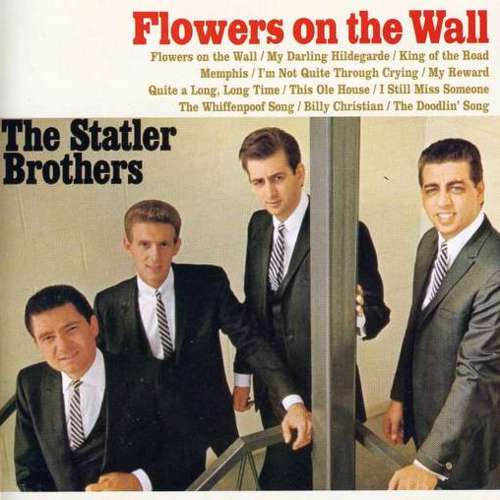
flowersonthe Vonnegut mentions this Statler Brothers song in Palm Sunday as well.  I know this from Pulp Fiction–a song that I found very amusing and never would have guessed was a classic country song.  Country music was very different in 1965 than it is now.  I don’t even know if there was a folk or bluegrass category back then, and this song, with its banjo and bouncey acoustic guitar is a great example of the kind of country music I like.  And those harmonies!

This song certainly seems to be about insanity–about a man counting flowers on the wall, playing solitaire with a deck of 51 cards, smoking cigarettes and watching Captain KAN Kangaroo.  Don’t tell him he’s nothing to do.  What a weird little song.  And man is it catchy.  No wonder it was a #1 hit.

[READ: May 31, 2013] Fates Worse Than Death

After reading Palm Sunday I learned that Fates Worse Than Death was a kind of autobiographical sequel to that non fiction book.  I also learned that the two essays that make up Nothing is Lost Save Honor which is impossible to find (and for which I can’t even find a cover) are available in FwtD.  However, since there is no real contents or index, you do have to read the whole thing to find out which chapters contain the essays.  Or you can just look here and see that “The Worst Addiction of Them All” (which was published in The Nation) is in Chapter XIV and “Fates Worse Than Death” appears in Chapter XV.

The last time I read a bunch of Vonnegut together I got a bit burnt out on him and the same thing happened here.  The problem with Vonnegut’s nonfiction is that he tends to repeat himself.  A lot.  And while this book is ostensibly about the 1980s, he talks an awful lot about his family and his friends from the war and his other literary acquaintances., like he did in Palm Sunday.  In a number of places, he says that he doesn’t like to read himself in English, and it would seem that he doesn’t proofread to see if he said something already either.

This is not to say that the book is not worth reading.  Indeed, if you read Palm Sunday in the 80s and then this one in the 90s, you might not remember all of the details that pop up again, but when you read them days apart…well. (more…)

Read Full Post »

mouldbookSOUNDTRACK: BOB MOULD-Silver Age (2012).

silverage

I was a huge fan of everything Bob Mould put out.  And then he more or less gave up on music.  So I just enjoyed his past and ignored what else he did.  But then I heard great reviews of his new album Silver Age.  So great in fact, that I couldn’t help but listen to it.  And it is amazing.  It’s a major return to his punkier roots.  The guitars are loud and fast but the melodies are still present.  And what’s more important, his voice sounds great and the album is mixed really well–previous Mould records have suffered in production quality.  But this is a great great record.

“Star Machine” opens the disc with loud guitars, a simple melody and lots of attitude.  I love the repeated “Said It” that appears throughout the song.  “Silver Age” is something of a manifesto for Mould.  The guitars are harsh and jagged with lots of distortion and the lyrics tell you everything: “Never too old to contain my rage  This is how I’m gonna spend my days gonna fight gonna fuck gonna feed gonna walk away.”

“The Descent” is classic Mould–big guitars, great catchy vocals and really nice harmonies/backing vocals.  “Briefest Moment” starts with a thudding drum and a sparse fast guitar (which somehow reminds me of Cheap Trick).  The bass comes in with a galloping line rather than playing the same notes and it adds a lot of depth to the album.  “Steam of Hercules” slows things down a bit but “Fugue State” comes crashing back in with more fast thumping drums and sparse but effective guitars.

“Round the City Square” picks up the noise level and includes a wild guitar solo.  “Angels Rearrange” again sounds like classic Mould.  While “Keep Believing” has a great bridge that reminds me a lot of Hüsker Dü (yes I mentioned the band that should not be named).  “First Time Joy” ends the disc on a gentle note.  It’s a ballad (where you can really hear Mould’s voice and how clean and strong it sounds).  There’s keyboards on this song that add some nice dimension.  By the end the song gets bigger and more powerful, ending on a really strong chord.  It’s an awesome return to the rock fold for Mould and I look forward to more from him.

[READ: March 5, 2013] See a Little Light

After getting The Silver Age, I remembered that Mould had written an autobiography and that I’d heard it was quite good.  I don’t really read a lot of autobiographies, but my history with Mould is pretty deep and I was curious to see what had happened in his life to make him abandon his rock roots.  So I tracked it down.  And I really enjoyed it.

The fascinating thing is what a reasonable man Mould presents himself as.  I’m not disputing this–I don’t know really anything else about the guy–but every time someone dumps on him, he accepts partial responsibility for the problem and moves on.  If he’s really like that, that’s very cool.  But he almost seems too nice sometimes.

As I’ve said, I didn’t know much about Mould.  My friend Al got me into Hüsker Dü and I’ve been a fan ever since.  I’ve bought some of his solo records and all of his band records, but I kind of lost interest in him the last decade or so (during his experimental phase).  But I didn’t even really know why Hüsker Dü broke up.

Some interesting things about Bob: he was born numerically gifted–I really enjoyed the section about his childhood and the genius-y stuff he did.  Although he had a pretty rough childhood–his older brother died when Bob was young and so Bob was seen as a golden child (especially after something that happened to him which he didn’t learn about until much later).  And he started drinking at a very young age.

When he got to college he formed Hüsker Dü with Grant Hart (Greg Norton came a little later).  I enjoyed hearing about the early days of Hüsker Dü because I only learned of them much later.  And man were they productive!  They’d release an album and have new material ready to record before they even toured for the album that came out already.  It’s cool reading about the punk scene back in the days before the internet when bands had to rely on each other for support.  There’s also a lot of people who Bob name checks and it’s fun to hear all of the punk names again, especially the names of people who are still active.  (There’s also some bad vibes against SST, but since this is Mould, the bad vibes are pretty mild). (more…)

Read Full Post »

SOUNDTRACK: CYMBALS EAT GUITARS-Live on KEXP June 18, 2009 (2009).

Cymbals Eat Guitars are from Staten Island (with members from New Jersey).  They have released two albums, although this recording is from after the release of their first album.    They play four songs:  “And the Hazy Sea,” “Cold Spring,” “Tunguska,” and “Wind Phoenix.”   They are noisy songs (mostly) with squalls of guitars (squalls is a good word since two of the guys are from Manahawkin, New Jersey.

The band has true progenitors in the indie rock scene–there’s sounds of Pavement, The Replacements,  even more melodic Sonic Youth .  They play noisy guitars and the vocals veer from softly sung to loudly screamed (often within the same line).    “Cold Spring” starts like a kind of shoegazery song and then after almost three minutes it turns into a  blast of pummeling rock with a noisy guitar section, before moving into a third more melodic section.

There’s   a lengthy interview with the band, where they give a shout out to New Jersey and seem genuinely surprised by the success they’ve had.  It’s a good show, and you can hear it here

[READ: September 25, 2012] God Bless You, Dr. Kevorkian

Again, against my better judgment I brought this Vonnegut book home too because it was on the shelf (and it was very short).  I still haven’t finished Bluebeard yet, but I have been curious about this book for some time.  It references Vonnegut’s early novel God Bless You, Mr Rosewater, but it also name checks Dr Jack Kevorkian.  So just what is it?

Well, it is collection of radio spots that Vonnegut did for WNYC radio in New York back in 1998.  Vonnegut claimed that he went to Kevorkian’s facility, was strapped in and almost killed multiple times, but Kevorkian brought him back each time creating a near-death experience. And each time Vonnegut travelled through that “blue tunnel,” he would interview a dead person.

The people he interviews vary quite a lot in fame and stature: (more…)

Read Full Post »

« Newer Posts - Older Posts »