 SOUNDTRACK: ABIGAIL WASHBURN-Tiny Desk Concert #101 (January 3, 2011).
 Abigail Washburn had plans to study law at Beijing University in China. Before she left, she bought a banjo—she wanted to take something to China that was American. Then Washburn went on a road trip to study the banjo and to learn some tunes. She found her way to the Augusta Heritage Center in West Virginia, then to North Carolina and then Kentucky to the International Bluegrass Association. It was there that she sat down with a few women to play music, and right then and there was offered a record deal. She blew off China ans has made a career as a banjo player–typical story.
In the ten years since then, she has been to China (with her banjo) where she learned Chinese folk music. She now mixes American bluegrass and folk with Chinese folk music. For this Tiny Desk, she plays three songs with her band Rob Hecht on fiddle, Jared Engel on bass, Jamie Dick on drums and Kai Welch on keyboards and trumpet. She uses two different banjos, a normal sized one and, om the final track, a great big-bottomed one.
The first song “City of Refuge” she says is done in hop high tuning (in case you were interested). It’s fun seeing how fast her right hand is moving while her left hand is fairly still and her vocals are fairly slow.
“Taiyang Chulai” is a traditional Chinese song meaning “The Sun Has Come Out and We Are So Happy.” She sings in Chinese (and plays no banjo). Her Chinese sounds amazing (and it’s really funny to see her speaking/singing it). She says that taught American folk music in China and learned that she needed to do arm gestures since all Chinese folk songs have accompanying arm movements. She also wore armbands which her grandma made for her.
“Bring Me My Queen” is the final song. I found it interesting that her songs are rather slower than the Chinese song, at least in tempo. This song is even slow for a banjo song. But it’s quite beautiful. In addition to being a great banjo player, Washburn has a lovely voice, too.
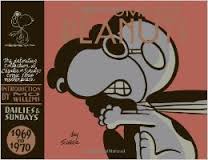
[READ: December 8, 2015] The Complete Peanuts 1969-1970
I was excited to get to this book to see which strip was published on my birthday (it’s sort of like seeing the headlines from the New York Times on your birthday).
Well, sadly, my strip was kind of boring–part of an annual be kind to animals or national dog week or something like that. Nothing life-changing or earth-shattering. Good grief.
I also decided that I’m taking a break from Peanuts for a time. I have really enjoyed what I’ve read, but I need a breather. I have read twenty some years of the strips over the last few months and, even if Schulz never rested, he didn’t condense twenty years into a few months either. So sometime later in 2016 I’ll resume the books.
This book is notable for revealing Woodstock’s name! I feel like that was the last big revelation that we’ll see for a while. I am curious to see if the 70s added any new characters. (Well, there is Marcie. I wonder when she comes along).
1969 starts out with Lucy saying that this is her year, “it’s all mine.” Although a few days later she asks for a refund. Lucy finally gets fed up with Schroeder and not only kicks his piano but throws it into the kite eating tree. In March of 1970, Lucy says “I’m a new feminist.”
There’s a lot of Lucy/Snoopy rivalries. In May 1969 we see the first an only reference so far to tether ball–Lucy is great at it (until Snoopy beats her). There has been a somewhat recurring joke about Lucy beeping Snoopy on the nose (which he hates). She does it in April and says it has been 384 days since she did it last (I wonder if anyone confirmed that). In June, Charlie and his family go on vacation and Lucy is in charge of Snoopy (and she is particularly harsh).
Los of things happen to Snoopy this year. As is per usual, Snoopy is skating in the winter time. He is planning to win trophies (skating with Peppermint Patty–although she has to break the news that she is not interested). He is also in preparation (in March 1969) to be the first beagle on the moon (wearing an astronaut helmet). Surprisingly, there is no acknowledgement when the first man does land on the moon.
In April 1969, Snoopy goes on a two-week journey looking for his mom (but doesn’t find her). In July of 1969 Snoopy takes up roller derby (for a very brief time). In September of 1969 Snoopy finishes his first novel and submits it for publication. But he is rejected! In Sept 1969 there are a lot of football jokes involving Snoopy and the little bird (the bird being too small to move a football of course). March 1970 shows the return of the Easter beagle.
1969 sees a lot of talk of “Head Beagle.” First Frieda reports Snoopy to the Head Beagle for not chasing rabbits. Later Snoopy is appointed Head Beagle but can’t handle the workload.
In the summer of 1970, Snoopy goes to give a speech at the Daisy Hill puppy farm and a riot breaks out with tear gas! And in September 1970 Snoopy wears a cooper bracelet to cure his arthritis.
In July 1970 Snoopy reveals a good truism “If you think about something at three o clock in the morning and then again at noon the next day you get different answers.” Also in July is the first mention of “The Six Bunny-wunnies” fictional series of books.
For a few weeks in August of 1970 Snoopy pretends to be a grocery clerk (butter 28¢, bread 39¢, eggs 59¢, tea 79¢).
Lots of things seem to happen on the baseball field this year.
And in April 1969 Charlie Brown’s team wins two games in a row–neither team could make it so they both forfeit (Franklin is on one of those teams). Later in June of 1969 Snoopy wins the Rookie of the year award for the baseball team.
In March of 1969 Linus make a sports drink which “replaces the body stores and prevents and diminution of vitally needed electrolytes and nutrients.” (Gatorade was invented in 1965 and became popular with athletes in 1967).
Some great moments in this book:
In May of 1969 (on the baseball mound, of course) the team is talking about the costs of college “it can cost almost sixteen thousand dollars to go to college.” The joke comes that Charlie is hoping for a baseball scholarship and every one busts out laughing.
In May of 1969 the school nurse is going to weigh them and Linus says he’s going to as about his hurting shoulder, “never pass up a chance to get a little free medical advice.”
In August, Linus’ gramma says she’ll donate $10 to his favorite charity, “ten dollars is a lot of money.” (He ultimately decides not to accept).
In July of 1969 the little red-haired girl moves from Charlie’s street! And Charlie never says anything to her. Later in December 1969 Linus Charlie and Snoopy go skiing (on a school ski trip). Charlie sees the little red-haired girl and falls off the ski lift.
Charlie makes a funny joke when he offers to shovel Lucy’s snow. He asks for a quarter and she says “What if it snows tomorrow and covers up our walk again. Do we get our quarter back?” He replies, “No by then I will have spent it on riotous living.”
Peppermint Patty gets a lot of strips in these two years. In Nov 1969 she talks about school: “I signed up for Folk Guitar, computer programming, stained glass art, shoemaking and a natural foods workshop. I got spelling, history, arithmetic and two study periods. I learned that what you sign up for and what you get are two different things.” (I would TOTALLY sign up for those classes too).
She returns a lot in 1970–she’s a great character allowing Schulz to explore all different kinds of kids and ideas. In the beginning of 1970 she is called to the principals’ office because she’s not allowed to wear sandals to school any more. She cries and calls Charlie Brown for advice. It takes Snoopy to kiss away her tear to snap her out of it. The strip series ends with Franklin saying, “All I know is any rule that makes a little girl cry has to be a bad rule.”
Patty also says that she got an F on a test because she has a big nose–if a teacher doesn’t like your looks there’s nothing you can do. Franklin looks at the paper and says “you turned in a blank test paper.” She sighs, “there’s nothing you can do.”
In December 1970 Peppermint Patty invites Snoopy to a “turn about dance” (where the girls ask the boys). They have a good time until a boy asks who her weird-looking friend is. She punches him out and feels guilty about it until Snoopy says he had a great time and he’s the one who bit the chaperone. Their friendship is great.
In Sept 1970 Patty has a crisis–thinking she’s not beautiful (then Snoopy gives her a kiss). The following week her dad gives her a dozen roses and says that the boys will be calling on her when she grows up and he wants to be the fist one in her life to give her a dozen roses. It brought tears to my eyes.
In June of 1970, Peppermint Patty asks to borrow Charlie Brown’s glove for a kid on her team named “Thibault.” Which leads to Charlie asking “Thibault?” at least twice. Then Thibault (who has sideburns), refuses to give the glove back. But Charlie Brown is happy by this because Thibault accuses him of “thinking you’re better than us.” And Charlie gleefully says “Me? Better than someone else?”
1969 ends for Charlie when he buys a ticket to a sports awards dinner. He gets a seat right next to Joe Shlabotnik…who never shows up.
This strip really sums up why Charlie Brown is so likable. On October 26 in which Linus describes an amazing football game in which a team makes an amazing come from behind victory with seconds left in the game . He describes the great plays and then Charlie’s response is “How did the other team feel?”
Sally is starting to become a more fully developed character–opinionated but often horribly wrong. In May of 1970 she buys a fish tank saying “This is the age of aquariums.” And she has no tolerance for school. In Sept 1970 she asks why they have to learn all of these things in school. Why does she have to learn the names of rivers? “I’ve never even seen a river! They could at least take me to see a river.” Later she writes a theme for school, “If I had a pony:” “If I had a pony I’d saddle up and ride so far from this school it would make your head swim.” Then she crumples it up and says “That’ a good way to get a D-minus.” In Nov she shows the class a document that is written by “an actual caveman.” The punch line: “Show and Lie is my best subject.”
The best Great pumpkin joke comes in Oct 1970 when Lucy says “Santa Claus has elves to help him…what does the great pumpkin have, oranges?”
There are a couple of topical jokes. In July 1970, when it rains during a game Lucy starts singing “Raindrops Keep Falling on My Head” (which was a hit in early 1970). And in December 1970, the kids use a Ouija board which had been released as a game earlier that year.
And then on June 22, 1970 the little bird reveals his name to be Woodstock! (strangely it was a year after the concert). With a name he acts no differently. In Nov 1970 Woodstock tries to fly south but gets lost. So Snoopy walks with him. After a week they get grabbed by a girl who say “Ma, I found a stray dog!” Then Snoopy is tied up for a few days while Woodstock tries to rescue him.
The year ends with Sally doubting whether you really have to be good for Santa to bring you presents “the old rascal is bluffing…I know that [he] will bring me presents whether I am good or not.” Then on Christmas Day, ”I was right!”
This was a great book, with some excellent strips and character developments.
Mo Willems, beloved children’s author, wrote the foreword. Mo says he started his career by selling black market drawings of Snoopy and Charlie Brown in second grade. He learned that even bullies liked Charlie Brown. He says he could utterly relate to Charlie’s world, “For me, an immigrants kid, recently plopped into the middle of a small school in the insular world of uptown New Orleans, Charlie Brown was the only one who understood how confused and unhappy I felt.”
He says he aspired to Linus-ness: to be wise and kind and highly skilled at making gigantic structures of playing cards. But he knew he was always a Charlie brown. “Sometimes when I am in a deep funk and feel like my life if is an uphill battle…I try to stop and imagine someone reading the comic strip of my frustrated life and laughing.”
All of his characters are an homage to Schulz in some way. And the greatest lesson her learned from Schulz, is “never let the characters know they are funny.”
He concludes by saying that Peanuts isn’t Art… it’s better. He toured the Charles M. Schulz Museum and Research Center and held an original comic but he found it anti-climatic. They were too precious to be enjoyed…they became Art. The magic that you get from having them in a book or newspaper was missing.
Read Full Post »
 SOUNDTRACK: ALICE SMITH-Tiny Desk Concert #700 (January 31, 2018).
 I had never heard of Alice Smith before, which I guess isn’t totally unsurprising given the blurb:


 I Just Read About That...