Feeds:
Posts
Comments

Archive for the ‘Short Story’ Category

SOUNDTRACK: HALEY HEYNDERICKX-Tiny Desk Concert #772 (August 3, 2018).

Haley Heynderickx (presumably not her native spelling) is an NPR Slingshot atist-a new person that they are following and promoting.  So it’s no surprise to see her at the Tiny Desk.

Unlike her solo acoustic releases, which are quiet, mostly solemn affairs, Haley Heynderickx came to NPR’s Tiny Desk with her band: Denzel Mendoza on trombone, Lily Breshears on Moog bass, and Phil Rogers on drums. They opened with the song that is most out of character for Haley.

She opens by saying “recently we learned that oom means mother and shalala means water fall so here’s wishing you mothers and waterfalls.”  She has a very high and quiet speaking voice that matches her singing voice quite well.

I know “Oom Sha La La” from NPR playing it.  I enjoy the way it gets frantic in the middle after the mellow rest of the song.  The addition of the (to me surprising) trombone, is pretty cool and adds an interesting texture.

She says, “The goal of that song is to feel embarrassed so if you felt embarrassed singing along, thank you.”

Turns out “Oom Sha La La” was

a song she wrote as part of a song challenge and she challenged the crowd here at NPR to a sing-a-long. We didn’t do so well, it was early in the day — but this song about self-doubt and searching for life’s meaning with its cathartic phrase “I need to start a garden” (which is also the title to her 2018 debut) is a potent reminder to take action when life gets bewildering.

She then asks for five seconds of intimate eye contact with the camera to show the people back home that we love them.  [The band stares at the camera].

The second song, “No Face,” is a reminder to love people as kindly as you can; otherwise you’ll wind up like the character No Face from the Hayao Miyazaki film Spirited Away.  This is a pretty song that begins with just her guitar and Mendoza’s trombone.  It eventually adds drums and bass.

In introducing the final song, “Worth It,” Haley Heynderickx told the Tiny Desk crowd that it was written in a basement with the belief that it would never leave that basement.

This has the best guitar lick of her three songs.  It’s a cool meandering song that lasts almost seven minutes.

The opening riff and Haley’s ooh’s are quite pretty.  After a couple of verses, the drums come in and the song picks up into a straight up garage rocker emphasizing a nice riff.

It seems like the song will continue like that, but it returns to the opening melody and oohs once again.

The third part is a bit faster but feels more like variant of the other two parts.  Towards the end Haley and Lily sing some gorgeous harmonies.  The end of thee song slows things down to just quiet guitar and their harmonies until they fill it out ounce more with drums, trombone (a lovely denouement solo) and gorgeous vocals.

[READ: January 4, 2017] “Papaya”

This set up in an interesting way.  I didn’t enjoy the first part, but the second part was pretty fascinating and made me re-read the first part, which I enjoyed more on the second read.

The story is about Errol Healy.  As the story begins, he is an elderly man, refusing to retire, but visiting his daughter and grandchild regularly.  But every time he does, he hurries back to his home in Palm Beach, Florida.

As this first part ends, we see him sharing a meal with Dr. Higueros.  He and the doctor met as refugees–Dr Higueros and his wife from the north coast of Cuba and Errol from a kind of captivity in the Bahamas.

The second part flashes back to the captivity. (more…)

Read Full Post »

SOUNDTRACK: THE DEL McCOURY BAND-Tiny Desk Concert #771 (August 1, 2018). 

I have really grown to like bluegrass a lot over the years.  And yet I still dislike country.  Never shall the twain meet.

Del McCoury is a bluegrass legend, singing, playing guitar and writing songs for the past 60 years, including his days with the “father of bluegrass,” Mr. Bill Monroe. The Del McCoury Band itself is 50 years strong, and these days includes Del’s sons Robbie on banjo and Ronnie on mandolin and vocals. All are astonishing players, here joined by the five-time award-winning fiddling of Jason Carter and this year’s International Bluegrass Music Association bass player of the year Alan Bartram.

The Band plays three songs (their session runs to nearly 20 minutes because Del talks a lot between songs!).  As the blurb notes:

These are story songs; Del is, of course, quite the storyteller, taking his time between them to reminisce. At 79 years old, he’s got a lot of them tell.

For their visit to the Tiny Desk, the group brought along some traveling songs. The first (of two) train tunes, “That Ol’ Train,” comes from their new album Del McCoury Still Sings Bluegrass, while their closing gospel tale “All Aboard” is a staple from 2001’s Del and the Boys. The other (a motorcycle song), “1952 Vincent Black Lightning,” was written by another master of his craft, British folk icon Richard Thompson, and has been a part of Del’s repertoire for a while now. It shows not only the deep connection that bluegrass has to British folk music, but also Del McCoury’s willingness to keep his sound fresh all these years on.

“That Ol’ Train” is a great introduction (for me) to the group.  The song sounds timeless, even though it is new, with the age old sentiment: “I’d cover every mile of track / I’d bring my baby back / and put a happy ending to this song.”  There’s a wonderful set of solos.  Fiddle then banjo then fiddle and then mandolin solo.  The fiddle player is really amazing, even making the instrument sound like a train whistle.  And the harmonies are pretty sweet as well.

There is a moment, near the top of this Tiny Desk concert — when three voices gather ’round a single microphone to deliver the chorus of “That Ol’ Train” — that is so pure and beautiful

Del introduces the band.  He mentions that Jason Carter has won fiddle player of the year countless times.  But he didn’t win this year.  I don’t know what happened to him.

On the banjo is his son.  He has a new album called “The Five String Flamethrower” because when he plays at night with low stage lights he plays really fast and you can see sparks on the strings because uses metal picks.

He talks about his son on mandolin.  Back in 1983, they were going to tour Europe and he wanted to bring his son along while he was still in high school.   The principal called Del in to talk about the show wondering where they were going.  Del told him, British Isles, Germany, Holland and more.  The principal said he would allow Ronnie to go and he;s not going to have to make up any work he’ll learn a lot over there.

Del says his boys have their own band The Travelin’ McCourys who released an album on the same day at heir bluegrass Festival in Cumberland, Maryland.  Richard Thompson was there this year.  And they played the following song together (which Del and his band have been laying for years).

“1952 Vincent Black Lightning” is done on the banjo with a very different tone.  McCoury sings it wonderfully, but again, it’s doesn’t have the same tone, exactly.  But it still works.  The end of the song is banjo only, and it’s pretty amazing.

Before the final song, Del says, it’s just a little to early to sing.  We usually sing late night, at least 6 o clock. Then he says he has new strings on an old Martin guitar that’s why they’re out of tune.

Del says “I used to write songs myself but I got lazy because people in Nashville give them such good songs.”

“All Aboard” starts with furious banjo picking.  It’s intense and fast.  Del seems to be straining, but in a good way  as he sings the lyrics.  When the harmonies come in mid way through its really powerful.

I’m totally sold on Del McCoury and his family.

[READ: August 22, 2017] “An Evening Out”

This is a simple story with a lot going on in it.

The bulk of the story is about an American teacher in Bulgaria.  He has been there for seven years and has decided to call it quits.

So he is going out for the night with some former students, Z. and N.  There is much drinking.  Since he is leaving Sofia (the capital) they wanted to give him a real Bulgarian night out.

The teacher is very attracted to Z.–a forbidden thing in the country and a far more forbidden thing if he was his teacher (which he no longer is).  In fact Z. and N. both graduated some time ago.  N. had gone to America to be lawyer and had a miserable time.  Z, knew he would and even the teacher knew he would.  But that’s what N.’s mother wanted for him.  He tells them that after the bad year he has decided to student literature.  How did he convince his mother?

I just failed all my classes. (more…)

Read Full Post »

SOUNDTRACK: FLASHER-Tiny Desk Concert #770 (July 30, 2018).

I haven’t heard of Flasher, but the description of the band (noisy) makes me think I’d like them.  I’m also intrigued by the various guitar and bass lines.  The vocals are also really nice–wonder just how buried they are on record:

For its visit to the Tiny Desk, this young Washington trio set aside the distortion and worked up a semi-acoustic set of three songs — taken from its debut album, Constant Image.  Voices sometimes in unison, sometimes swapping leads, adding a shifting point of view to songs that, on record, give equal footing to a precise noise.

These three high school friends, Taylor Mulitz (guitar, vocals), Daniel Saperstein (bass, guitar) and Emma Baker (drums) have been bouncing around the D.C. punk scene of house shows and DIY venues for some time.

I rather got a kick out of this little “How Bob knows the band”

I’ve been aware of Taylor’s work for a while…in the potent D.C. band Priests; Daniel I’ve known (a bit) since he was a child, mostly from Hanukkah parties with his family (his mom was the executive producer at All Things Considered when I was the show’s director); Emma can be seen playing around town with another band, Big Hush.

I really enjoyed the stops and starts of “Pressure” I imagine it’s really fun when they rock.  It also has some really clever word play: “saving face / self-effacing / keeping pace / in a stasis.”  Most of the delicate harmony vocals come from the bassist (who is actually playing acoustic guitar), although when all three of them sing it sounds even better.

The interchange of electric and acoustic guitar works great on “XYZ.”  All three sing in tight harmony.

I love the way “Who’s Got Time?” seems to be constantly catching up on itself, like they are running out of time to finish the song–even though it never sounds like they are out of sync with each other.

Their overall sound is wonderful acoustic shoegaze.  At least at the Tiny Desk.

[READ: August 15, 2018] “A Refugee Crisis”

I didn’t love Wink’s last story (about killing cats), but I found this one fascinating because of how many elements were included here.

The narrator is a writer living in a place where one can cross-country ski regularly (Bozeman, MT).  The trail is mostly unused except for a guy who runs tours by dogsled–and there is plenty of dog shit on the trail to show where the sled went.

When he gets home, M is lying on his couch.  She says she let herself in since she knew the key was still under the mat.  She says she just came back from Serbia.  (She had been in Athens, Budapest and Frankfurt among other places).  The refugee camps there were really bad–people are trying to get across Hungary and the military is beating them, shooting at them.

She is twenty-three but looks forty and her personal hygiene is atrocious.  They have sex anyhow.  She says they can’t get pregnant because she already is–from a nineteen year old boy from Raqqa.  She didn’t tell the guy.  She is planning to get an abortion shortly. (more…)

Read Full Post »

SOUNDTRACK: LALAH HATHAWAY-Tiny Desk Concert #769 (July 25, 2018).

I have no idea who Lalah Hathaway is.  The blurb doesn’t really help, giving her familiar lineage but not much more.

Lalah Hathaway comes from royalty: Her late father Donny Hathaway’s … set the bar for inspired, old-school soul singing. But living in that kind of shadow can also be a burden, robbing the offspring of an identity apart from that of the famous parent.

This was by my estimation, the most boring Tiny Desk Concert I’ve seen.  The blurb raves about her once but I found it dull and flat.  Her lyrics were uninspired and the music was spare to the point of nothingness.

I always watch a Tiny Desk twice to see if I miss anything the first time.  This one was painful to watch twice. At least it was only 11 minutes.

The younger Hathaway’s appearance behind the Tiny Desk pulls back the curtain a bit for a close-up encounter with her powerfully expressive voice  [powerfully expressive?]

In “Change Ya Life,” Hathaway’s dusky contralto paints an exciting portrait of blissful cohabitation — but on her terms. “I’m going to teach you how to treat me like I deserve,” she sings, adding, “I’ll give you the world.” She draws on a tradition of romance and sensuality in the best soul music, but with a feminist twist that eschews old-school, male-centric lyrics and attitudes.

I like the feminist twist, but when a song has twinkling keys (Lynnette Williams) and a cheesy bass line (Eric Smith) the line “I can fuck around and change your life” just doesn’t seem to fit.

“Boston,” her ode to her second home (she’s from Chicago), is a meditation on self-discovery and longing. The band perfectly straddles slow-jam R&B and a jazz-ballad sensibility.

She was signed in college and told to move to L.A. because Arsenio is there (did she work with him?).  She wrote this song about Boston .  It’s a slow torch song type of song (tikki tikki drums) that name checks tons of Boston area locations (Charles River, Cambridge, Downtown Crossing)

So much of the most powerful music from the Civil Rights Era wasn’t about literal accounting of injustices; many of those songs enshrouded morality plays in the guise of romantic longing. Hathaway introduces the set-closing title track of her new album Honestly as an explicit reflection “of my country at this time.” If you heard it for the first time without the introduction, it comes across as a lover’s lament. But Hathaway’s soaring vocals infuse it with the passion of resistance to bring her set to a close on a hopeful, joyous note.

I love the premise of this song and how it was written.  But even a cool, angry song like this is so tepid.  She asks the audience to sing along to these great lines:   “I don’t even want you no more.  You can walk out that door.”  And you can barely hear them (and the audience is certainly loud between songs).  She does a little of that R&B vocal gymnastics that I dislike at the end just to cap it off.

Not my thing, I guess.

[READ: January 15, 2018] “Family Means Nothing to Me”

This is an except from a story called “Family Means Nothing to Me and I Dislike Children.” I can’t really imagine what the context of the rest of the piece is, but this is  a funny/honest appraisal of the narrator’s self.

She says she finds her nephews and nieces odious.

She has had pets in the past but when she breaks up with a boyfriend she makes him keep the pet. (more…)

Read Full Post »

SOUNDTRACKTHE KING’S SINGERS-Tiny Desk Concert #768 (July 23, 2018).

There are so many a capella groups in existence.  Some are collegiate (there are three alone here at Princeton) and others move beyond that.  The Nassoons started in 1941.  The Footnotes started in 1959.  The Tigerlilies, (the all-female group) started in 1971.

So when this blurb talks about The King’s Singers being fifty years old, well, that’s not so impressive in some respects.  But anything that has lasted that long is still pretty impressive.  As is the fact that  they have 150 recordings out.

Fifty years ago, a group of six guys walked on a London stage to perform for the first time as The King’s Singers. They were choral scholars and graduates from King’s College, part of England’s venerable Cambridge University.

The group quickly earned a reputation for its precise and warm close-harmony singing, which is as strong as ever today. There have been more than 150 King’s Singers recordings, Grammy and Emmy awards, and countless concerts and television appearances. New singers, of course, have cycled through over five decades, but the six-man vocal setup has remained constant: two countertenors, one tenor, two baritones and a bass. Also unchanged is the group’s penchant for singing just about every style of music.

So it is no surprise that the current iteration of The King’s Singers — in the midst of their 50th-anniversary tour — brings a diverse set list to the Tiny Desk, including a Beatles tune and a bawdy madrigal from the 1500s.

Notice the glistening top end on Lennon and McCartney’s “I’ll Follow the Sun,” courtesy of countertenors Timothy Wayne-Wright and Patrick Dunachie.

I also enjoyed hearing the occasional bass notes from Jonathan Howard.  It’s fascinating to see how the tenors like Julian Gregory take various parts of the song, sharing the lines.

“Shenandoah,” the traditional American song, sports a velvety carpet of accompaniment for baritone Christopher Bruerton’s lead. The blend of light and color shifts beautifully in Bob Chilcott’s diaphanous arrangement.

Christopher Gabbitas’ introduction (and plug for their album) is quite amusing.  The way the five singers start with “ooohs” in harmony is really striking.  In addition to the lead, the gorgeous high notes of the countertenors are absolutely striking in this song.

“Horizons,” with its cinematic hissing, humming and other special effects, tells a tragic story of the San people of Southern Africa.

Howard introduces this song by saying that somewhere in a cave in South Africa there is a San bushman painting of a Dutch or English ship dating back to early 1700s.  It celebrates the incredible powers of observation of the now virtually extinct San people.  The people the San saw as gods because of their stature and opulence were soon to become their executioners.  This is what the South African born writer and composer Peter Louis van Dijk writes in this song which celebrates their humility and their oneness with the environment.  It also laments the demise of these people at the hands so-called progress.

This song really toys with my idea of what a “traditional” a capella group might do.  There are hand clasps, hissing sounds, snaps and other vocal sound effects.  Sung initially by baritone Christopher Gabbitas, everyone eventually takes a turn doing vocals and vocal/hand percussion.

The rhythmic and risqué “Dessus le marché d’Arras” channels a bustling 16th-century French marketplace.

This madrigal takes them back to the 1500s.  It’s a pop song written by from the renaissance era written by Orlande de Lassus in which a Spanish soldier in the Northern French town of Arras asks a woman how much….  And they walk off, hand in hand. The madrigal doesn’t say what she is selling, and The King’s Singers don’t want to say (as it is being broadcast).

The singers intertwine their voices beautifully.  It’s a fast spirited number and a lot of fun (even if you can;t tell what they are saying).

The King’s Singers remains a vocal juggernaut, playing 150 concerts in this anniversary year. With its power, finesse and silky blend, the group is like some close-harmony Ferrari that can purr and growl, leaving you amazed at the splendor of the human voice.

[READ: October 11, 2017] “The Wizard of West Orange”

I have enjoyed most of Millhauser’s stories.  This one irritated me though. The fact that it won me over is a testament to the quality of the story, but I was really annoyed by the style.

This is a diary.  And I hate the way it is written.   I get that a diary can be truncated, but why did he chose to make this such a tough read; “A quiet day in library; this morning overheard a few words in courtyard.”  Ugh so frustrating.  And the whole story–all 12 pages of it is written in that halting style with limited articles.  Man is it annoying.

It starts out on Oct 14 1889 and was written by the librarian who works with Thomas Edison–whom he refers to exclusively as The Wizard.  The first few entries are pretty dull–The Wizard is secretive going about his business.  I was afraid this was just going to be one of those imaginings of what someone who worked with Edison’s job was like or blah blah blah.  And it is much like that.  A book comes in and one of the scientists looks for it.  The Wizard is working on his phonograph and his talking doll.

There are two main characters beside the narrator.  There is Earnshaw who is very much devoted to the idea of motion photography–he’s thinking about something with sprockets in it.  And there is also Kirstenmacher whose time is devoted to the kinescope.

It gets interesting when the entries reference a wired glove.  And Kirstenmacher determines that the librarian is fascinated by the inventions, in particular the kinescope

Turns out that Kirstenmacher has invited both Earnshaw and the narrator to test out this new device–the wired glove has a silk lining and little metal points throughout.  When the librarian puts the glove in, and Kirstenmacher turns the wax cylinder, the librarian feels weight in her hands, tickling sensations.  It is amazing.

And as the entries go on, the details of the experience grow.  Eventually it becomes a full body suit and the feelings are uncanny.

Earnshaw meanwhile hates the experiments–he wants nothing to do with that infernal machine but Kirstenmacher won’t let him quit.

“Today at a little past two, Earnshaw entered library.”  ugh

Kirstenmacher has high hopes that in twenty years it may be possible to create tactile sensations by stimulating the corresponding centers of the brain. Until then we must conquer the skin directly.

The Wizard filed a caveat with the patent office for the haptograph–protecting his invention while acknowledging its incompleteness.  He announces to the paper that he hopes to have it presentable in six months.

Kirstenmacher says that if three more men are put on the job, and ten times current funds diverted to research, the haptograph might be ready for public in three years.

Then one day the machine is destroyed.   The Wizard doesn’t seem all that upset but the librarian is distraught.

~~~~~

Just this weekend we visited the Thomas Edison National Historical Park (U.S. National Park Service) in West Orange and it was pretty awesome.  Totally worth a visit.

Read Full Post »

SOUNDTRACKÓLAFUR ARNALDS-Tiny Desk Concert #767 (July 19, 2018).

Arnalds plays four songs in this Tiny Desk.  For most of them he uses his prepared piano.  But it’s prepared in a very different way.

“Árbakkinn” opens with Arnalds on the piano.  After about a minute, three of the four strings (Unnur Jónsdóttir (cello), Katie Hyun (violin), Karl James Pestka (viola)), enter the song followed shortly by Viktor Arnason on lead violin playing a haunting melody over the top.

Up next is “Unfold,” which is a bit happier a bit poppier.  It starts with pizzicato strings and has percussion by Manu Delago.   Arnalds at the electronic keyboard but when he plays it, the two pianos behind him start playing.  I’ll let the blurb fill in:

Somewhere about midway through this Tiny Desk, as Icelandic composer Ólafur Arnalds performed on his electronic keyboard, two upright pianos were playing lilting melodies behind him, absent any performer at the keys. …  About ten minutes into the performance Ólafur looked behind him at the two pianos, looked to the NPR crowd and said, “well I guess you’re all wondering ‘what and why,’ to which there’s no easy answer.” He hit the keys on his electronic keyboard and the two pianos behind responded with cascading, raindrop-like notes. “What I can say,” he continued, “is that I’ve spent two years and all of my money on this — to make my pianos go bleep-bloop.” What Ólafur was referring to is software that he and his coder friend, Halldór Eldjárn developed. A computer, loaded with this musical software (which Ólafur calls the Stratus system), “listens” to Ólafur’s keyboard performance and responds by creating patterns that are musically in tune with the chord or notes Ólafur performed.

So why do this? Basically, it’s a way to break out of the box musicians often fall back on as performers — the familiar responses that years of playing can reinforce. With that is the hope that the computer will create a response that is unfamiliar and, in some cases through speed of performance and the sheer number of notes played, impossible for a human to have made. So, it breathes new life into the music for the listener and the performer.

Arnalds can play the pianos while they are being remotely controlled as well, as he plinked out piano melodies while the computer was playing those raindrop notes.  The end of the song has a very interesting electronic tympani sound as well.

As the second song fades, “Saman” begins with Arnalds back at the piano to play this beautiful and haunting solo piano melody.

“Doria” is a tribute to Halldór Eldjárn the creator of the programming “and his beautiful code.” It was the first song he wrote using this new technology.  Arnalds plays the beginning on the keyboard while the other pianos play along.  The strings accompany him and then about half way through, while the pianos are continuing to play, he jumps in the middle and plays the main melody on one of the pianos.  It’s really quite lovely.

It was a gently stunning and memorable Tiny Desk. More of these creations can be heard on Ólafur Arnalds’ brilliant, fourth solo album re: member.

[READ: January 31, 2018] “Colin Kelly’s Kids”

This story was written after Elkin had a heart attack (he lived for almost 30 years after the heart attack).

The tale is basically one of an old man playing pickup baseball.  It had been a superb spring. This had been his fifth week playing and the teams (rotating payers every week) seemed to get used to him.  He wasn’t very good–had a lot of power but couldn’t connect.

But they did allow him to play first. He always played first whatever the teams, so he felt coldly like he was being traded to a new team each week–professional. (more…)

Read Full Post »

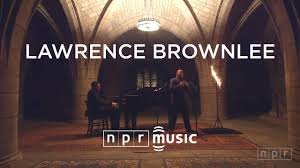
SOUNDTRACK: LAWRENCE BROWNLEE AND JASON MORAN-“There’s A Man Going ‘Round Taking Names” (Field Recordings, February 17, 2016). 

I know of Brownlee from a Tiny Desk Concert.  But this is a whole other order of magnitude.  He and pianist Jason Moran are playing a spiritual about death in an active crypt.

Brownlee’s voice is powerful and soaring, but full of anguish.  And Moran’s piano is so intense, especially at the end.  He plays the melody but he allows for a lot of overtones and echo to nearly overpower the music.

At the very end, he plays some high notes by literally chopping at the keys like a karate chop–powerful, sharp and dissonant.

Here’s the blurb for more context:

Opera singer Lawrence Brownlee is known for portraying kings and princes. But lately he’s been thinking about real people: Trayvon Martin, Michael Brown and Freddie Gray, to name a few.

He’s been thinking about the Black Lives Matter movement and an old spiritual called “There’s a Man Going ‘Round Taking Names.” Decades ago, singers like Paul Robeson and Lead Belly recorded it. Brownlee, with jazz pianist Jason Moran, revives the old song to tell a new story for the 21st century.

“Jason and I chose this song because we felt it accurately captures a growing sentiment that’s in society today,” Brownlee says. “So many senseless deaths of young African-American men.”

A crypt, they thought, would be an appropriate setting to perform their version of the song. So we took our cameras and microphones — and a lovely piano — deep into the active crypt below the historic Church of the Intercession in Harlem. The 1915 structure at 155th Street and Broadway is a New York City landmark and a dramatic setting for occasional concerts, including a December 2015 recital by Brownlee.

“I know that the ashes of the parishioners of this church are here in this crypt,” Brownlee explains. “You can feel the weight of death, you can feel the sting. It adequately captures the atmosphere, the somber mood that we are trying to capture with this song.”

In this arrangement, an already solemn song becomes even more dark and agitated.

“What [Jason] has done with the piano part has made it build, and you feel the unrest, the turmoil, the tension that is underneath,” Brownlee says. “This is something that is painful and difficult to deal with.”

Woah.

[READ: January 31, 2018] “Self-Portrait with Beach”

This is the story of an older couple who have been together for a while.

They go to the beach, she removes her top and asks “Is the body the house for the soul or are body and soul and one and inseparable.?”  He looks at her and says, “Your body is my soul.”

She laughs that his soul is bound for decay but he continues, ‘Nothing of you will decay as long as I am alive.”

Out of nowhere a man in white comes and offers his homemade beverages.  He says they have unique powers. (more…)

Read Full Post »

SOUNDTRACK: LOCAL NATIVES-“Fountain of Youth” (Field Recordings, October 5, 2016). 

I know and like Local Natives, although I didn’t know this song.

In 2010, Local Natives came clattering into the indie firmament with the U.S. release of Gorilla Manor, an irresistible blend of in-vogue sonic signifiers like Afropop guitars, rich harmonies and the hint of a folk sensibility. In 2016, the band’s run has continued with the synth-heavy Sunlit Youth.

For their Field Recording, Local Natives played one of the singles off that album, “Fountain of Youth.” Though the recorded version is lush and electronic, Local Natives stripped the song to a driving core. The band played, and then it was off again — guitars in hand, headed for the evening’s show elsewhere in Brooklyn.

They sound great stripped to just two guitars and a tambourine standing on the water’s edge. [Local Natives Strips Down Its Sound For A Riverside Show].  I love this introduction:

The East River Ferry is a very fast boat. Local Natives came hurtling toward our crew up the river one overcast evening this summer, shouting three-part harmonies over roaring engines for a surprised clutch of fans. When the ferry docked, three of the band’s members hurried over to our pier off WNYC Transmitter Park to play this Field Recording.

I’m not sure which of the five Natives these are, but they harmonize wonderfully. And I really like that the main singer is playing his guitar while the second guitar is silent until later in the song when his higher notes are used as an excellent accent.

[READ: January 15, 2018] “Kinderscenen”

This was a fascinating story because of how much detail was given and how little plot there was.

This is the story of a boy, Toby.  It is written in a kind of childish third person, almost by a benevolent guardian.

Sentences like:

What he does know is how Daddy’s cigarette looks in the evening when sitting on a wicker chair with the other grown-ups softly talking in a row, he flips it away its red star tracing lopsided loops before shattering into sparks on the bricks.

In his heart he knows that this is the best town in the world.

In the story, Toby helps his mother garden (by lifting the prickery bushes “holding up the bushes’ skirts” which has a naughty sound that nevertheless doesn’t make it fun. (more…)

Read Full Post »

SOUNDTRACK: DEVONTÉ HYNES interviews PHILIP GLASS (Field Recordings, September 21, 2017).

This is the final video under the “Field Recordings” headline [‘When You Gonna Get A Real Job?’: Philip Glass And Devonté Hynes Compare Notes].  Unlike the other videos I have watched, this one is actually an interview, not a song.

I was unfamiliar with Devonté Hynes.  He is a 31-year-old British producer and songwriter who performs under the name Blood Orange,  He has made many hit records with the likes of Carly Rae Jepsen.  And Philip Glass was at the time of this interview, 80 years old (and calls the cast of Hamilton hipster, instead of hip-hop, but he did rave about the show (which Hynes was unable to get tickets to!).

Walk into Hynes’ third floor loft in New York’s Chinatown and you’ll find a photo of Glass on his piano. He discovered Glass’ music by chance as a London teenager, when he bought the 1982 album Glassworks on the strength of its crystalline cover image alone. What he heard after he brought it home transfixed him. Today, he says Glass’ influence “seeps” into his music.

This spring, Hynes invited Glass to his apartment where they sat at a piano, compared chords and traded stories. Ninety minutes later, their wide-ranging conversation had touched on the pulse of New York City, the pains of striking out on your own as a musician, what role the arts play in society today and Hamilton. Plus about a hundred other ideas.

This clip is only 6 minutes, and they don’t touch on all that much.  We learn that Glass grew up in Baltimore and worked in his father’s record store.  His father knew nothing about music but loved it and soon enough young Philip was the store’s record buyer.

Glass moved to New York in 1957.  His mother told him that being a musician would be a terrible life of travel and hotels.  And he thought that sounded wonderful.  He worked day jobs loading trucks and moving furniture–he never took a job he couldn’t get out off if he had the opportunity to play.

He says that Einstein on the Beach was a hit but he knew nothing about money and they actually lost money on the deal.

For his part, Devonté came from London to New York ten years ago.  he says you can hear Glass’ jobs in his music, like the sounds of the city as he drove his taxi around.

Glass concludes, “When bad things happen in the country the artists become the voice.  Without the arts our society would be a prison.”

[READ: January 17, 2018] “Sans Farine”

I really couldn’t believe how long this story felt.  Even with enjoying most of it, it seemed like it was 50 pages not 9.

The narrator, Charles Henri Sanson is an executioner in France around the time of the revolution.  He was a real person.  I didn’t know that while reading this but it doesn’t really impact my take on the story.

His father and his six brothers were also executioners.  There is quite a stigma to the job–most people are not allowed to even communicate with them, much less marry them.  And yet ask any soldier what his profession entails  He’ll answer that he kills men.  No one flees his company for that reason.

There’s a lot of detail about his life, both before and after the revolution,  He and his family have negotiated the revolution well and he still works,no killing the royals,

He talks about Joseph Guillotin reinventing the penal code–a less barbaric, swifter execution for all condemned. (more…)

Read Full Post »

SOUNDTRACK: SUFJAN STEVENS, BRYCE DESSNER, NICO MUHLY-“Mercury” (Field Recordings, June 8, 2017).

I love Sufjan’s Steven’s voice.  And this song, from the Planetarium project is just beautiful.  [Watch Sufjan Stevens, Nico Muhly And Bryce Dessner Play ‘Planetarium’ Track ‘Mercury’]  It opens with just the simple repeating piano melody and Stevens’ singing.  Eventually a guitar is added, playing complimentary melody.

Steven’s voice remains pure and powerful in this live recording. The viola from Nadia Sirota adds a lovely counterpoint to this song and leads it into the middle part which is minor keys and stings.

“Mercury” is the closing track off Planetarium, a song cycle about the planets by Stevens, Dessner, Muhly and James McAlister. The work was originally composed on commission for the Dutch concert hall Muziekgebouw Eindhoven, and first performed there in 2012. Five turns around the sun later, Planetarium will arrive in recorded form on June 9 via 4AD. “Mercury” is one of the most intimate songs on the record, a quality that’s emphasized by its spot just after the 15-minute, ambient, electronic epic, “Earth.” Where the record’s other songs foreground synthesizers and spastic electric drum samples reminiscent of 2010’s The Age of Adz, “Mercury” largely rests on Muhly’s gentle piano work and Stevens’ beautiful vocal. Where once, in the original live performances, the song swelled to a cinematic rush on the order of Illinois, it’s now spare and elegant. Its warm intimacy is all the more apparent in the group’s live performance, which features Dessner of The National lightly doubling on guitar Stevens’ wordless refrain at the song’s close. Like many of the pieces on the record, its lyrics are a constellation of the cosmic, the personal and the mythological. The song, named for the messenger god, is a perfect musical setting for the feeling of having something dear carried away from you. “All that I’ve known to be of life / and I am gentle,” Stevens sings. “

I love hearing his voice live, because it’s so perfect on record and while this is in no way imperfect, it lets us see a bit of humanity.  Even if this recording isn’t in a field or even an unconventional space, it’s still quite lovely.

[READ: January 3, 2015] “Little Man”

I feel like it takes a lot if chutzpah to recreate a story that is familiar to everyone.  This is the story of Rumpelstiltskin as told from the point of view of the little man himself.

But the twist on it is that Rumpelstiltskin isn’t a strange psycho bent on stealing children.  Rather, he is a lonely man, with no hope of finding love or having a child of his own.  Indeed, the first section is taken up with the man’s desire to have a child and his belief that having a child is not like ordering a pizza, which is how many couples seems to take it.

The story is written in second person (you), so it is meant to be even more intimate. (more…)

Read Full Post »

« Newer Posts - Older Posts »