Feeds:
Posts
Comments

Archive for the ‘Short Story’ Category

SOUNDTRACK: GRUFF RHYS-Yr Atal Genhedlaeth (2005).

In honor of the author being from Wales and of me recently seeing Gruff Rhys in concert, this is a post about his debut solo album, Yr Atal Genhedlaeth.  The title is in Welsh, as id everything else.

If you don’t understand Welsh, as I don’t, Wikipedia gives us a guide line for the album which I’m going to trust.  There are 11 songs in just under a half an hour

  • Yr Atal Genhedlaeth [‘The Stuttering Generation’, but ‘atalgenhedlu’ is Welsh for a contraceptive] is 8 seconds of stuttering voices.  I feared the disc was broken when I put it on.
  • Gwn Mi Wn [‘I Know [that] I Know’, could also mean ‘a gun I know’, a reference to the battle in the song].  Gruff played this song live with two members on drums.  It’s a cacthy near-a capella song with just the drums and his voice.  He loops his voice here (and live) to make more and more harmonies of himself.
  • Epynt [named after a mountain in Mid Wales, but about money, with the ‘E’ standing for the Euro, and ‘pynt’ sounding similar to the Welsh word for Pound].  This song has a DIY punk feel–two chords, loud drums and chanted chorus Eh-pint, eh-pint.
  • Rhagluniaeth Ysgafn  [‘Light programming’, but ‘lluniaeth ysgafn’ means a light snack].  This song has an electronic drums and simple guitar chords.  Once again, it’s Gruff’s voice that carries the melody.  As with most of these songs, he makes a big song with very few elements.
  • Pwdin Ŵy 1 & 2 [literally ‘egg pudding’, means ‘”egg custard’, two love songs]  The first part is under 2 minutes with a slinky guitar and bass.  It’s fleshed out with all kinds of weird sound effects.  The second part (all of 3 minutes) is quieter, with just his guitar and voice and some quiet percussion.  The solo is either a melodica or harmonica, I can’t quite tell.
  • Y Gwybodusion [‘The Experts’] is a simple garage rocker.
  • Caerffosiaeth [literally ‘sewage fortress’. ‘Caer’ is a common part of Welsh place-names (for example, Caergybi), used to indicate that there was originally a castle or fortress in the town/city]  This is the strangest song on the disc–full of all manner of weird sound effects.  These effects accompany the simple (cowbell and drumbeat) electronic percussion that sets the tone for Rhys’ overlapping vocals.  This song sound the most like one you might try to insert English words into the Welsh that he is singing like maybe: “Blue-eyed fork, blue-eyed fork, I love your bag and your power torch.”
  • Ambell Waith [‘Sometimes’] opens with a pretty acoustic guitar melody as all manner of quiet sound effects skitter around in the background.
  • Ni Yw Y Byd – [‘We Are The World’] is not a cover of the charity song, it is an incredibly catchy folk song with a flute (piccolo?) solo.
  • Chwarae’n Troi’n Chwerw [‘When Play Turns Bitter’, from a Welsh proverb. A Welsh language standard originally written and sung by Caryl Parry-Jones].  This six-minute song starts quietly with just an acoustic guitar,  It starts to build and go a little faster when the drums come in. By four minutes, there’s cymbals and what feels like a full accompaniment.  The last minute or so is Gruff playing the banjo.

It’s a pretty album with pretty melodies and a splash of Gruff’s wackiness strewn about.

I don’t think you’ll learn any Welsh from this records but it is neat to think you can sing along with it without knowing what any of it means.

[READ: January 4, 2017] “The Edge of the Shoal”

I thought that this was going to be yet another story about a guy fishing–and how he and his father had bonded over fishing.  Because that is how it started.

He didn’t tell his wife where he was going–just left a note to make salad.  He assumed he would catch a fish, but his real reason for going out in the kayak was to disperse his father’s ashes into the water.  (I’m not exactly sure where this is set, but I assumed Europe–okay Cynan Jones is Welsh).

The narrator was still hearing his father’s voice as he cast out for the fish.  Frankly I was worried that this story was far too long if that’s all it was going to be about.

But then things take a very different turn. (more…)

Read Full Post »

SOUNDTRACK: CORY HENRY AND THE FUNK APOSTLES-Tiny Desk Concert #792 (October 5, 2018).

Cory Henry & The Funk Apostles blew me away with the first song of this Concert.  “Love Will Find A Way” opens with a deep bass sound as the funk starts.  And then Henry adds the great sound of the Hammond.

There’s so much joy in the sound of the Hammond organ, especially for those of us of a certain age. Hearing it can transport you to the early ’70s, when every rock band seemed to have one in its arsenal: The Allman Brothers, Santana, Deep Purple. In the hands of true masters — like the late Billy Preston and the very-much-alive Booker T. Jones — the organ can be a melodic, funky rhythm machine.

Cory Henry’s name belongs in the same breath as the Hammond organ masters of the past. The instrument creates the central sound of his dynamic, neo-soul- and funk-infused musical identity, and he opens his turn behind the Tiny Desk with what feels like an encore: the full-on soul assault of “Love Will Find a Way.” The song twists and turns, then winds up as a full-on celebration — and it’s only the first song in his set.

The song does have several part including a lengthy middle solo section.  Over the heavy organ chords there’s a wailing guitar solo and a keyboard solo from the synth player.

By the end of its six minutes it absolutely feels like an encore–a show ender.  It’s awesome.

“Trade It All” is a bit more soul, less funk, which means I don’t like it as much.  B

Henry’s keyboard skills are on full display during a synth solo in “Trade It All,” which also spotlights his entire band. To my mind, they’d have sounded right at home on Stax Records in the ’70s — no small accomplishment.

The middle shows a softer, quieter side of the Hammond–one that sounds a bit cheesier to my ear.  And yet there’s no denying Henry’s deft finger work (there’ a hint of Stevie Wonder in there for sure).

The final song, the ten-minute “Send Me a Sign” has a lengthy, almost preacher-like quality and is clearly gopsel-inspired.

It showcases some of the roots of Henry’s songwriting; it’s inspired by church sermons that bloom into group sing-alongs. Just another way Cory Henry digs way back to give us something new and exciting.

[READ: October 11, 2017] “One Saturday Morning”

I have never been disappointed with a story from Tessa Hadley.  She might be one of my favorite writers whom I’ve never read outside of magazines.

This story is wonderful because the we learn so much about so many people through the eyes of one woman.

Valerie is Gil’s second wife.  Gil is in his fifties and Valerie is twenty-four.  Gil is a successful professor and she was (as someone described her with disdain) a typist.

But as the story opens, Valerie is trying to cope with Gil’s daughter.  Robyn is nine years old, can’t button her own dress and is utterly unprepared for several days at another house.  This was the first time Valerie had met her…stepdaughter?  And Robyn was plain and kind of dull.  She was polite but had no toys (she played cleverly with scraps of fabric, but would not engage when asked about them).

She was certainly a dullard when it came to food–toast was all she could think of. (more…)

Read Full Post »

SOUNDTRACK: D.D DUMBO-“Walrus,” “Tropical Oceans” (Field Recordings, May 15, 2014).

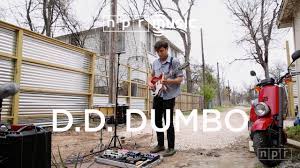
I don’t know when people started looping drums and guitar to make fuller sounds.  I guess it’s been a decade or so.  But this recording from 2014 seems positively ancient.  And yet D.D Dumbo uses the technology perfectly.  And in this Field Recording [D.D Dumbo: Looping Sounds In An Austin Alleyway] this one guy sounds huge!

Mystery seems to swirl around D.D Dumbo. We’d heard all sorts of crazy rumors about this solo musician; namely, that Dumbo is a modern-day nomad whose only worldly possessions are his guitar and some crazy customized pedals. But once he arrived for one of our SXSW Backyard Sessions, here’s what we discovered: Dumbo was born outside of Melbourne, Australia (birth name: Oliver Hugh Perry). He performs with a 12-string electric guitar, a simple drum set-up and some loop pedals. And he prefers to let his eclectic, drone-filled music speak for itself — so, alas, no comment on the nomad rumors.

As “Walrus” opens, he plays a nifty guitar riff that is part sliding notes and part harmonics.  These are looped.  He adds some vocal “ahhs” and “eeehs” and then puts in a very simple drum beat.  When the song properly starts, his style of playing reminds me of the West African guitarists I’ve heard on Tiny Desk.  It’s slinky and repetitive, almost turning into a droning rhythm.  He sings, but I’m not even sure if there are actual words.

The song builds and shrinks as he adds previously looped parts and it stops perfectly when he needs to do a quick guitar section before it starts again.

If you listen closely to his music, though, one thing is certain: It’s hard to nail down Dumbo’s influences. As he performed for a curious crowd at Austin’s Friends & Neighbors during SXSW, we heard numerous global destinations in his music — including stops in North African deserts, as well as a jaunt to the American South for a touch of the blues. Here, D.D Dumbo showcases two uniquely minimal songs: an unreleased song called “Walrus,” and “Tropical Oceans,” from his recent self-titled EP.

“Tropical Oceans,” starts with some scratched guitar strings as a percussive sound.  He builds t he ambiance by tapping his guitar body to create waves of sounds.  After the drum beats, he begins playing and singing the song proper.

[READ: June 26, 2014] “Usl at the Stadium”

So Usl is the name of a character in this story.  It’s a strange name and kind of distracts from the story somewhat because why would anyone be named that?

This story actually has nothing to do with his name, so it could have been something else and we wouldn’t even think about his name.

This story is about Usl at a Yankee game.  The Sunday game started at 2PM and Usl had gone. He had fallen asleep and was featured on the Jumbotron intermittently between 4:02 and 4:09.  Usl became an internet sensation because the announcers had talked about him while he was on screen.

So he was getting calls from newspapers and other places for “celebrities.” (more…)

Read Full Post »

SOUNDTRACK: ST. VINCENT-Masseduction (2018).

St. Vincent’s latest album seemed like a radical departure for Annie Clark.  It seemed to be all synth–a transgression from her guitar prowess.  But in fact it was a continuation of the sound that Clark generates with her guitar.

Her albums have always used synths.  And her albums have always used effects on her guitars to create different sounds.  They have just moved further along on this album.

“Hang on Me” opens the disc with drums and sound effects.  The guitar comes in but it sounds like synths (like most of the album).  Her voice is up front  (It would have been very cool if it sounded like she was whispering in your ears).  The song builds with more and more sounds.  The processed guitar still sounds nothing like a guitar but you can tell from the way it is played that it is a guitar–which is pretty cool.

“Pills” is almost all dance–lots of drums and synth sounds (which may be guitar, who can tell).  It’s the chorus, (the repeated pills pills pills) that really grabs you.  The guitars that come through have a very Prince-like feel (and the sexual connection–pills to fuck) even when the roaring fuzzed out guitar solo comes blasting through it’s not unlike something Prince would have done.  When the second part of the song comes in–absolutely quiet compared to the chaos that came before (S. assumed it was a different song) it has a beautiful melody and really showcases Annie’s voice nicely.  The two parts are so very different and yet both are really catchy in their own way.

“Masseduction” is the most poppy song on the record (and probably of her career).  It starts again with drums and Annie’s whispered vocal (again mixing her right in your ears would have been very intense).  Then comes there’s the big chorus of echoed vocals singing “mass seduction” with roaring guitars underscoring everything (even though this album feels very un-guitar there are noisy guitars galore on it, they’re just buried underneath everything).

Chanted vocals and programmed synth open up the fast-moving “Sugarboy.”  I love that the riff from “Los Ageless” is presented her in much faster and more staccato and mechanical way.  This song has a great, catchy chorus.

“Los Ageless” was the second single off the album and the dancey beat and synth sounds were quite a shock when the song came out.  For this one, her voice is mixed right in the middle of your head, which is very cool.  But it’s the “how can anybody have you” part that is so incredibly catchy and wonderful.  There’s not a lot of guitar on this song until the third verse in which all the synths drop out and you get a nasty guitar playing behind the verse–once again so inorganic but so interesting.

“Happy Birthday Johnny” is a beautiful piano ballad that showcases a great melody and lovely vocal from Annie.

“Savior” features a slinky guitar line with bits of wah-wah on it (slighty porn-y to be sure, especially given the topic of the song).  The bridge picks things up and with each subsequent verse more and more is added (backing vocals, big drums and sound effects).  It’s when the song gets to the third part, the ‘pleeeease” that it totally soars.

“New York” is another piano song, this one with more dance beats in it and the rather graphic “you’re the only motherfucker in the city who can stand me” for a chorus (odd choice for first single).  The bridge “I have lost a hero” just soars out of the piano section in a very cool way–the juxtaposition is outstanding.

After the quite ending of New York the noise and electronica of “Fear the Future” comes as quite a shock.  It’s practically a wall of noise before and abrupt ending

“Young Lover” is quieter and sounds a lot more like early St. Vincent songs.  The music is spare–thumping drums and washes of music.  But that first chorus grows very loud–crashing electronic drums and soaring vocals.  The amazing part comes toward the end as Annie hits some incredibly high notes and then caps it off with a high note that gives me chills every time I hear it.  The fact that she duplicated it live was just staggering.

“Dancing with a Ghost” is 46 seconds of waves of synths (or guitars) that I never quite realized was its own song.  It almost segues into “Slow Disco” which is a quiet song with strings and Annie singing.  When the harmony vocals come in it builds the song nicely.   Then someone (Annie?) sings a recurring motif of “don’t it beat a slow dance to death.”  It’s my least favorite song on the album and the one she has now made two (slower) remixes of.

That feels like it should end the album, but there is one more song, the dramatic “Smoking Section.”  With a husky voice Annie sings of getting stomped out and screaming “let it happen, let it happen, let it happen.”  The strings build dramatically until a loud three note riff introduces the second part of the song.

This album is pretty polarizing, even though it is St. Vincent through and through.

[READ: October 3, 2018] “The Rise and Rise of Annie Clark”

The previous story that I read by John L’Heureux was also about the Catholic church.  That one was the story of Jesuit Priesthood, circa 1954, and a man trying to join.

This one is also based around the Catholic church circa 1950.  The subject is very different, but with the same questioning attitude.

Annie Clark is a middle-aged woman in the 1950’s .  I’m unclear where this is set.  At first I thought France, but that is unlikely. so somewhere in the States, but I have no idea where.

Since the end of WWII, Annie knows that women were the real winners–women are taking charge of their lives.

But Annie is Catholic and must proceed slowly. (more…)

Read Full Post »

SOUNDTRACK: PHOEBE BRIDGERS-Live at Newport Folk Festival (July 28, 2018).

I saw Phoebe Bridgers three days after this set at Newport Folk Festival (I had no idea).  She plays five more songs at my show than here (yay, me).

The size of the crowd does’t seem to intimate her in any way and she sounds just as great (and intimate) as she did in the small club where I saw her.

A few songs into her sun-drenched Saturday Newport Folk set, Phoebe Bridgers paused and proclaimed, “I am a puddle of sweat.” It was a one-liner that primed those huddled at the Harbor Stage for the 2018 Slingshot artist’s catalog: details delivered with specificity and a subtle sense of humor.

I will say the one thing about this recording is that I don;t think you can hear all of the percussion as clearly as I could at Asbury Lanes.

The show started much the same as mine did with a beautiful languid version of “Smoke Signals” and a try-to-hold-back-the-tears reading of “Funeral.”

For the next song, “Georgia,” she brought out songwriter Christian Lee Hutson who is “going to help me sing harmonies.”  Whether it was the song itself of Hutson’s addition, but Bridgers’ voice really soars on this song.

Even Bridgers’ stage banter reflected her striking style, mixing straightforward address and astute observation. “This song is about how every time I smoke weed, I remember why I don’t smoke weed,” she said of the plainspoken plea “Demi Moore.”

She continued: “I face plant and my brain is erased for many hours and I think I’m thinking too loud.”

There’s some gorgeous harmonies on the darkly sweet song, “Killer.”  Then she played “Steamroller” solo on the acoustic guitar.

Later, she called “Steamroller,” a devastatingly candid cut from her 2015 EP, Killer, “another dark love song, thanks.”

Introducing Gillian Welch’s song “Everything Is Free” she said. “This is my friend Marshall.  We’re going to sing my favorite song about music streaming ever written.”  I loved hearing this live and it sounds just as solid here.

Up next was a song she did not play at my show.  She welcomed Christian Lee Hutson (playing guitar with Jenny Lewis) and Sharon Silva (from The Wild Reeds) played bass with me for exactly one week and I waited for a really bassist…Emily.  Chris wrote this song for me.”  The chorus goes “”lets get the old band back together again, and there’s even a line, “with Emily on bass, it doesn’t feel the same.”

The crowd reacts strongly, as they should to her awesome song “Motion Sickness.”

Despite its venom, it’s a song that unspools with a sonic ease that feel refreshing, even for an overheated festival audience.

The songs sounds great live and she holds a 17-second note just for kicks.  The sets ends (as did ours) with “Scott Street.”  She says “This is about L.A. where we live;  where it’s hot all the time.”  It’s a quiet song, sounds and represents her music pretty perfectly–quiet, sad, with clever lyrics.

At our show, we got two encores after this, so again, yay for us.  But this is a great example of her live show.

[READ: April 22, 2016] “Playing with Dynamite”

Back in February of 2017, I posted about an essay by George Saunders from 2009 in which he remembers John Updike “Remembering Updike“.  He says that back in 1992:

 It was going to be in Tina Brown’s first issue and they marked this occasion by running two stories contrasting the new writers (Saunders) with the established.  Of course the establishment writer was going to be Updike.  Saunders said he was chagrined because he knew the contrast would go something like this:

Wonderful, established, powerful representative of the Old Guard kicks the butt of the flaky, superficial, crass poseurish New Guy.  Saunders’ story was “Offloading for Mrs. Schwartz.”

I can see why they paired the George Saunders story with this particular Updike story.  Both stories deal with grief and memory loss, although Updike’s does so in a very different way.  On the other hand, their writing styles are so very different that it’s nearly impossible to compare the two stories.

The story begins with an interesting image from childhood: “one aspect of childhood Fanshawe had not expected to return in old age was the mutability of things–the willingness of a chair, say, to become a leggy animal in the corner of his vision.”  But living now “in death’s immediate neighborhood” he allowed that things like that might happen and it wouldn’t be the end of the world.

There is then an episode in Fanshawe’s day when his wife, who was younger and more spry than he, passed him going down the stairs.  She caught her heel on her dress and fell down the stairs.  It was only after all the guests had left that she said to him, “Wasn’t I good, not to tell everybody how you pushed me me?” (more…)

Read Full Post »

SOUNDTRACK: ST. VINCENT-“Savior” (2018).

St. Vincent has morphed from guitar goddess (with her own signature guitar) into a  synthy pop goddess (of sorts).  Her last album Masseduction sounded like it eschewed guitars altogether (it didn’t, exactly).  When I saw her live, she played guitar on every track (and was the only performer which was pretty awesome) but it rarely sounded like a guitar (which was cool in its own way).

So Masseduction was quite different from her earlier guitar-heavy albums.  It even featured a song based around the piano.

Now Annie Clark has reissued Masseduction as Masseducation (which is how I and many other people read the other title originally) and has more or less traded in the production and synth for piano.

The new version “pairs Clark’s resonant voice with Doveman’s Thomas Bartlett on piano. Intimate and focused, the reworked songs were performed and recorded in two days at Manhattan’s Electric Lady Studio. A handwritten letter by Clark sets the scene for this process: “Thomas and I faced each other — him, hunched over a grand piano, me, curled on a couch.”” [from NPR].

One thing that Masseduction showed was how fantastic Annie Clark’s voice is.  I’m not sure if I never noticed that her voice was great because I was focused on so much else or if she didn’t showcase it as much, but she hit and held notes that were really quite impressive.

“Savior” originally featured a slinky guitar line with bits of wah-wah on it (slightly porn-y to be sure, especially given the topic of the song).  The bridge picked things up and with each subsequent verse more and more was added (backing vocals, big drums and sound effects).  When the song reached the third part, the “pleeeease” it totally soared.

This new version opens with a muted piano, rather than slinky guitar.  The music seems to accentuate the words (which seem much more kinky in this version).  The song doesn’t build like the previous one did, although the switch from muted piano to deep bass notes is surprisingly effective.  The “pleeeease” section totally subverts the previous version.  Rather than getting big and powerful, the song actually grows quieter, more pleading.  It’s a cool twist on the same music/words.  And I like that you can hear the spoken words at the end of the song (which you really couldn’t on the original release).

This stripping of the production really makes you focus on the words (which were sometimes lost on the full album).  Annie must be pretty pleased with the ones she wrote.  I’m curious what this will do to the rest of the album.

[READ: January 7, 2017] “Vespa”

This is the story about Mark and his Vespa.  He loved his Vespa.  It allowed him a lot of freedom yes, but he also loved the look of it.

It also took him to see his girlfriend, Yasmin, in Manchester.  They were in love (and were even engaged on Facebook!).  He parked the Vespa at her school where it would be safe–even though she didn’t go to school on Fridays.

She told him to take a bus to an empty house where they could make love.  She had been there before.  (I like the way that detail was just tossed in there).

Later that day, when they went back to the school, his Vespa was gone. (more…)

Read Full Post »

SOUNDTRACK: SABA-Tiny Desk Concert #791 (October 1, 2018).

I have been thinking about why I have never heard of many of these new artists. Since I don;t pay active attention to the pop charts, it makes sense that I wouldn’t know many of these artists.  I just assume that anyone riding high on the pop chart will worm his or her way into my consciousness.

So maybe it makes sense that I haven’t heard of Saba as his fame seems to be forthcoming:

Every Tiny Desk is special, but sometimes the stars align and we’re treated to an artist just as he’s coming into his own. Six months after releasing Care For Me — a sophomore studio LP on which Saba transforms his survivor’s guilt into something equal parts traumatic and transcendent — the Chicago native paid a visit to Tiny Desk. His performance at NPR’s Washington, D.C. headquarters came just two days after he announced his first tour of Australia, New Zealand, Japan and Korea, scheduled to begin in November. It’s an incredible achievement for an independent artist who released one of 2018’s best hip-hop albums without the benefit, or creative constraints, that come with major-label backing.

The live band does a great job with this music (although it is a little too lite/lite jazz sounding for me).  But the choice of two keyboards, bass and trumpet is interesting if not inspired.

To help translate Care For Me live, Saba brought along a band consisting of the same musicians who helped bring his album to life in the studio — including Daoud Anthony [keys, with the dreads] and daedaePivot [keys, with the shaved head], who produced the entire LP with him; instrumentalists Cheflee [bass] and Brandon Farmer [drums]; theMIND and Kaina [Castillo], who contributed vocals on the record; and another featured vocalist and special guest that Saba took extra pride in introducing.  [And Tahj Chandler on trumpet].

“You’re not gonna believe me when I say it,” he prepped the crowd, turning to the tall man wearing the Saba tee and Panama hat. “This is Chandlar, my father.” Fans of the album may be familiar with Saba’s references to his dad on the songs “Life” and “Prom / King” — the epic seven-and-a-half minute eulogy to Saba’s cousin and Pivot Gang rap collective founding member, John Walt, whose 2017 murder serves as the impetus for Care For Me. But Chandlar is also an accomplished soul singer, songwriter and producer in his own right, as well as one of Saba’s earliest musical influences.

Saba himself is a really nice guy (it seems).  He’s funny and self depricating and his rap skills are impressive.

I didn’t like “Busy/Sirens” as it started because Saba’s delivery is oddly affected (he has that Chicago-style of rapping which I’m mixed on).  The chorus is very mellow and with that trumpet sounds very smooth jazz.  But there’s something fascinating about his delivery.  And the lyrics are really good–tons of words covering all kinds of personal topics with great rhymes.  theMIND sings a verse and he has a nice voice.  It switches to “Sirens” which is an interesting shift.  I hate the repeating keyboard sound, but again the lyrics are great. I wonder if the album version is different.

Hands behind your head
And they won’t let up out they lead
But if I move thats disrespect
But if they shoot then that’s just that?
And if I run then that look bad?
Drawing they gun right off their hip
I’m probably deservin’
‘Cause I know they serve and protect
But they think I’m servin’
Or they think my cellphone’s a weapon
Heard that the robber wore a black mask
I fit the description, a.k.a. “nigga”
What is the difference? It’s an enigma

After a lengthy and thoughtful introduction of everyone, he says, “I very rarely have to introduce this many people… So I feel like I did okay so make some noise for me for doing it.”

For “Logout” he shifts his delivery a little bot and I really like it.  The first verse has a great rhythm and the second verse has amazing speed.  I love how with the chorus (chorus?) it ends with four beat where every gently sings a different staggered word each time.  It’s very cool, especially that it ends so dramatically as well.

In a live set that proved to be as resonant as Care, Saba and his band showcased the album’s emotional depth and range with stark juxtaposition, like the sound of the bright hook on album closer, “Heaven All Around Me,” set against a particularly haunting version of “Life.” It’s a Tiny Desk testament from an artist whose future feels as promising as his pen.

“Heaven All Around Me,” has a cool middle section breakdown with a trumpet fill that switches into the much darker “Life.”

After some more terrific powerful verses, we get the direct chorus

Life don’t mean shit to a nigga who ain’t never had shit.

I wish him and his father a great trip to Europe and beyond.


[READ: January 2, 2017] “To the Moon and Back”

About the last Keret story I wrote:

Sometimes a very short, very well written story can really make your day.  I read this story this morning (because it was so short–a page and a quarter) and I was immediately hooked.

I feel like all of his stories are very short and compact.  This one wasn’t quite as enjoyable as the previous one, primarily because it was much darker and full of aggressive language (like his other stories, this one was translated from Hebrew by Sondra Silverston).

This is the story of a man who has been divorced from his wife.  He opens the story by telling us that he can only celebrate his son’s birthday n the day before or the day after his actual birth day because of the restraining order. “The botch.”  He asks if he can just come by and give Lidor a kiss on his birthday she says she’ll make his life hell if he does.

So he has to make up by buying expensive presents, like the $89 multi-copter drone he picked up in duty free.  However, he forgot to buy batteries for the thing.  And rather than disappointing his son, he lies and says they are going to the mall first to buy some candy. (more…)

Read Full Post »

SOUNDTRACK: ALYSON GREENFIELD-“Mama Said Knock You Out” (2011).

I found this song about 4 years ago and meant to post about it but never did.  I just saw it in my notes and decided to check it out again.

Alyson Greenfield is a pianist.  She sings (and plays) a bit like earlier Tori Amos.  And, like Tori, she takes an unlikley song to make an interesting cover.

The basis of this song is a wonderfully busy and complicated piano.  She doesn’t rap the verses exactly, but she does recite them quite quickly.

She is verbally dexterous, all while she’s playing a complex and beautiful arrangement on the piano.

The second chorus quiets down completely with a gentle piano melody and her singing softly but not un-menacingly.

It’s a fairly radical reinterpretation of the song.  There is no music in the original–just a sample of a simple musical motif), so everything that she plays is rather interesting and inspired.

I honestly don’t remember how I found this song.  But I have just looked her up and I see that it comes from an EP of covers of this ilk. The other songs include “Bad Boys” (a song I never had to hear again, even in her version).  “All That She Wants” which aside from being on piano instead of dance doesn’t sound all that different.  “Milkshake,” which I ‘d never heard of and “Gangsta’s Paradise” played on glockenspiel.

None of these covers is especially interesting because they lack the awesome musicality of “Mama.”

Since putting out that EP she released a one-off goof song called ‘Michael Cera C​*​ckblocked Me at SXSW,” and a song called “Uncharted Places,” which is kind of interesting–dancey but with toy instruments.  Her voice certainly sounds good in a poppy way.

But that was four years ago.  I’ve no idea what she’s up to.

[READ: January 5, 2018] “Blueprint for St. Louis”

I printed out this story from the web.  But apparently I missed the first page.  I was delighted that the story started with no introduction. I thought it was really cool that the first line was just:

What consumed them both right now was the situation in St. Louis.

What a wild opening.

It was said that in St. Louis there were thirty dead souls, but everyone knew that that number was low.  By a couple of decimal points. There had been a bombing and it was big.  It emerged that the explosives had been buried in the foundation of the building when it was being built two years earlier.

Terrorism wasn’t really the term anymore.  “Tax” seemed more like it.  This time it was levied on St Louis.  It was New Orleans the previous year.  Tuscon three years ago.  A tax on comfort and safety.  You learned not to be surprised.

It was Roy and Ida’s job to honor the site, honor the dead.  They designed large public graves where people could gather and maybe cool food trucks would park. (more…)

Read Full Post »

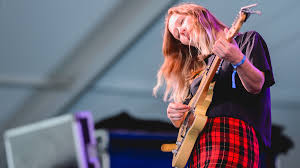
SOUNDTRACK: JULIA JACKLIN-Live at the Newport Folk Festival (2017).

I saw Julia Jacklin open for First Aid Kit and while I was looking for music by her I found this, her first show at Newport Folk Festival.

This show is a good representation of her live show, except that with when I saw her, she threw in a couple more upbeat songs–this set is a bit monotonous.  Or maybe that’s what an 11M crowd needs.

It’s often a sparse crowd that turns up to see an 11 a.m. set at a music festival — but not so at the Newport Folk Festival. When Julia Jacklin took the stage on Saturday morning, she seemed shocked to be faced with a tent full of attentive onlookers. (If it were any other festival, she pointed out, she’d probably be playing to an audience of four — and four hung-over people, at that.)

She played nine songs, several of which she played when I saw her.

“Hay Plain” is a slow meandering song  it takes almost 4 minutes before the full band kicks in, but when they do it really elevates the song.  ““Lead Light” she played when I saw her.  It has a kind of old school swing to it, almost 50s rock and roll.  The song build and stops several times.

“Cold Caller” is another slow-mover.  Midway through there’s a really cool–and to my mind, much needed–wicked guitar solo.  The backing vocals on “Motherland” mid way through the song perk things up.  She lets her vocals linger more on this one which shows of the power more.

“LA Dream” it is indeed dreamy and sweet and is mostly just her guitar.  “Eastwick” is a cool song that grows faster and louder in a rather slow and deliberate manner. “Coming Of Age” and “Pool Party” are slow brooding song.  “Pool Party” sounds familiar but defies what’s expected from a song with a title like that.

For the last song, “Don’t Let The Kids Win” the band left and it was just her on stage with her guitar.  The lyrics are so good and so well-delivered, it’s a real high point.

So, overall I find her songs to be pretty but a little flat.  She just not quite my thing.  But every time the rest of the band stepped up, the songs were much more fun for me (even when they werent “fun” songs).

To read some lyrics and what it was like to see her in person, check out this post.  That plaid skirt must be a trademark.

[READ: October 1, 2018] “When We Were Happy We Had Other Names”

This story is about death.

It opens in a funeral home, as the director is meeting with the protagonists Jiayu and her husband Chris.  The story is set in the States–Jiayu thinks about how much stranger living in the States would have been for her if it were fifty years earlier–but that’s doesn’t directly impact the story, exactly.

The gut punch of the story comes as we realize–it is mostly alluded to–that their son Evan has killed himself.  Their daughter Naomi is off at college and while she does come home for the funeral, she also cuts off a lot of access to her.

Jiayu and Chris spent a lot of time with grief–they asked if they had done something wrong–Evan had seemed so happy.  But things did have to move along.  Would they buy pumpkins for the holiday?  Christmas trees?  Would anyone notice or care if they didn’t?

But thinking about death was an all-consuming act for Jaiyu.  She wound up creating a spreadsheet of all of the people she knew or had met who have died.  She entered birth and death year as well as cause of death.  She wanted to test her memory, so she didn’t look up anything.  By remembering each person it would prevent them from become generically dead. (more…)

Read Full Post »

SOUNDTRACK: CÉCILE McLORIN SALVANT-Tiny Desk Concert #790 (September 25, 2018).

The blurb talks about Cécile McLorin Salvant’s punk roots.  This made me thing that their might be some rough elements in these songs.

But these songs sound akin to old-fashioned-sounding jazz standards (even if she wrote them recently) in the vein of Ella Fitzgerald or Sarah Vaughn.

The nod to punk seems to come in the vaguely erratic piano which verges on atonality at times.  And yet:

From listening to McLorin Salvant’s exquisite performance here, I also couldn’t tell that when she was 15, she was listening to Alice in Chains, sported a Mohawk and was into what she calls “radical feminist punk stuff,” as she told NPR after the performance. “Sometimes I still really like Bikini Kill, and I still have my little Pearl Jam grunge moments.”

What can be heard in each song is a seasoned jazz singer with a vast vocal range, meticulous technical execution and a superb classical vocal foundation, which actually began when she was just 8. Her background in classical piano is evident in the inventive harmonic and melodic construction of the first three songs heard here; all are romantically themed McLorin Salvant compositions from her third album, For One to Love, recorded in 2015. The record won her a 2016 Grammy for Best Jazz Vocal Album.

“Fog” opens with some striking minimalist almost atonal piano playing.  The song veers through many different tones and styles throughout its five plus minutes.

About “Look At Me” she says, “This was originally called “‘Friend Zone’ which is a zone I know so well.”  The piano is delicate–twinkling–as she sings about being the friend when she wants more.

She says the next song is called “Monday,” “Lets see if I remember the lyrics.”  After introducing Foster, he comments, “I just learned this on the train here, so bear with me.”  This is notable because there is a lengthy, lovely piano instrumental part in the middle.

After a hog, Foster leaves and McLorin Salvant prepares for the last song.

McLorin Salvant closes with “Omie Wise,” an American folk song that tells the tragic story of murder victim Naomi Wise and her husband and killer, John Lewis:

Then pushed her in deep waters where he knew that she would drown
He jumped on his pony and away he did ride
The screams of little Omie went down by his side.

Feminist themes are common in McLorin Salvant’s music, and while “Omie Wise” addresses gender-based violence, she says she sings difficult songs like this to address an important historical legacy. “We don’t sing to our kids and we don’t know any of our folk music anymore,” McLorin Salvant says. “But like all of the history of race songs, coon songs, minstrel music, music from Vaudeville, all of that is like, ‘No, we’re not going to address that — that’s too ugly.'”

This song is especially powerful sung a capella and even more so when it is heard on the weekend that that piece of excrement Kavanaugh is having his Supreme Court hearings.

[READ: January 19, 2018] “Admiral”

T. Coraghessan Boyle is an incredibly prolific writer.  He writes about a huge variety of topics as well.  Some of his stories are down to earth and realistic while others, like this one, are based in a near-future fantasy.

The premise of this story is simple and not all that far-fetched (especially in 2007).  A rich couple has cloned their beloved dog, an afghan named Admiral, for $250,000.  They want to raise this dog exactly as the first Admiral was raised.  They believe in the cloning to create an identical dog, but they also believe in the nurture aspect which means they need the girl who dog-sat for him to do everything exactly as she did all those years ago.

That girl, now a woman, was recently laid off and needs some cash. So when Mrs Striker called and told her she had an opportunity, Nisha said… why not?

She returned to the house where she hadn’t been in four years but which was such a large part of her childhood. (more…)

Read Full Post »

« Newer Posts - Older Posts »