Feeds:
Posts
Comments

Archive for the ‘Short Story’ Category

weltySOUNDTRACK: PAT JORDACHE-“Radio Generation”/”Radar” [CST074] (2010).

jordache“Radio Generation” appeared on Jordache’s album Future Songs in 2011.  This 7″ single has an otherwise unreleased B-side called “Radar” as well.

I think of “Radio Generation” as an unusual “single from the album because, as I wrote of the CD: It opens with “Radio Generation,” which has a really cool bouncy guitar riff and bassline.  It doesn’t quite display the signature sound that I think of this album as having but it certainly points to it.

“Radar” has even less of the Future Songs feel.  It is very sparse, with guitars that sound almost like a Western.  The vocals are slow and drawn out and then the spoken word section begins–continuing the meandering nature of the song.  The melody is pretty, but this is justifiably a B-side.

[READ: January 7, 2012] “Why I Live at the P.O.”

I read about this story in the D.T. Max David Foster Wallace biography.  I’d never read anything by Welty before, and I have no idea if this story is representative of her work.

There’s not a lot of plot to the story, which is probably why it is so successful.  Welty constructs a very funny home scenario (one that I actually had a hard time understanding at first because the names of the characters are rather odd–although perhaps not odd to Southerners?)  I had to read the first sentence a few times before I could really parse it.  It’s not complicated but the names and the dialect are…odd.

I WAS GETTING ALONG FINE with Mama, Papa-Daddy and Uncle Rondo until my sister Stella-Rondo just separated from her husband and came back home again. Mr. Whitaker!

The narrator is Sister, the older and much aggrieved sister of Stella-Rondo.  As the opening says, Stella-Rondo has moved back home.  And she has arrived with a baby (which she swears is not hers).  Sister is put out by the intrusion because she says that Stella-Rondo has always gotten everything she wanted (unlike Sister).  We have no direct proof of that although, if Sister’s telling of this story is to be believed, Stella-Rondo is a major instigator  trying to get Sister in trouble as soon as she returns.  Of course, Sister also tries to get Stella-Rondo in trouble, but her parents don’t seems swayed by her complaints. (more…)

Read Full Post »

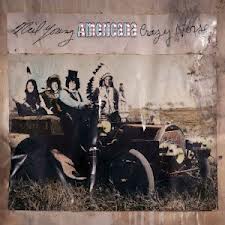
2013-01SOUNDTRACK: NEIL YOUNG WITH CRAZY HORSE-Americana (2012).

amercancaThe reuniting of Crazy Horse after a time is always cause for excitement.  In this case, they released this strange album, which seems like it should be an EP but is almost an hour long.  It’s basically the band jamming on traditional Americana songs (for the most part).  And it is totally a jam–you can hear them talking about what they just played after a number of tracks.  Critics have complained that Young hasn’t really been writing any thing new in the last few years, and this would bear that out to a certain extent.  But here’s the thing–the music is really good (for the most part), but the lyrics–the traditional lyrics–are sometimes really off-putting, almost feeling like a joke.

The one real standout is Clementine  which the band totally disassembles and make into a sloppy rocker that bears almost no resemblance to the original.  Young even plays around with lyrics, making it a much different story–with a dark, twisted ending.  There’s something a little fun about “Oh Susannah” ( I like the b-a-n-j-o part) although it sounds a little half baked.  “Travel On” also feels less successful.  I think the problem with these songs is that the fast pace doesn’t allow for the band to stretch out much–Crazy Horse works best with slow big open (sloppy) chords rather than these martial type beats.

“Tom Dula” (which is “Tom Dooley”) is almost 9 minutes  long.  This song feel like a murder ballad-a slow meandering song that rather works.  The same is true for “Gallows Pole” which has the same feel.  For me the least successful is “Get a Job,” a song I dislike at the best of times, but this is just a goofy cover.

“Jesus’ Chariot” successfully straddles the line of changing the original (“She’ll be Comin’ Round the Mountain”) with a cool minor key workout and noisy solo.  The singing is so different from the original that it doesn’t really sound like the traditional song.  They give “This Land is Your Land” a kind of country feel.  It works pretty well.  As does “Wayfarin’ Stranger” which is a very low key affair.  The album ends strangely with “God Save the Queen” which he slides into “My Country Tis of Thee.”

So this album is kind of a mess.  It probably would have made a great EP.  But it also works as a fun document of what the guys were up to before they released their “proper” album Psychedelic Pill a little later in the year.  It’s not essential by any means, but it’s an interesting item.  Interestingly, the liner notes explain the lyrical changes are actually the original lyrics–lyrics that have been lost or removed over the years.  I rather like that.

[READ: January 5, 2013] “Seal”

Kuitenbrouwer also had a story in the January/February Walrus last year.  Hmm.  But Kuitenbrouwer writes about such diverse subjects that, aside from a certain harshness in her characters, it wouldn’t be obvious that it was the same author.

I love that in this story the narrator distances himself from the story before even beginning it: “I never had another story but this one, and even it is not mine.”

And what we get is the story of a fishmonger.  He and his wife live above the fish store.  The narrator, a young boy named Ivan, lives above them on the third floor.  He is strangely obsessive about the fishmonger and his wife. He plays fishmonger every day with his parents.  And he pays a girl to go in and ask the man a question (do you like fish?).  The answer is yes and that he eats it for every meal.

The fishmonger, Kieran, is also the fisherman, walking out the back of his shop and into the sea to fish–he even gets special orders right from the sea if he doesn’t have any in the shop.  Kieran is a loud but jolly man. He knows that Ivan paid the girl to ask the question and he teases him about it.  He tells Ivan it’s cheaper to just ask him directly. (more…)

Read Full Post »

2013SOUNDTRACK: KISS-Monster (2012).

monsterThis is Kiss’ second album with their new line up–guitarist Tommy Thayer (dressed as Ace) and drummer Eric Singer (dressed as Peter).  I saw them recently and they (well,Paul and Gene) seemed…old.  Which they are, but you don’t always notice that under the makeup.  But Eric and Tommy were in good form (although I have to think it must be weird being somebody else–almost like being in a cover band even though you make new music).  Anyway, this album was said to be a hearkening back to Kiss of old, and in many ways it is.  I rather wish they went back a little further, but it definitely feels like classic Kiss.

The lead single, “Hell or Hallelujah” sounds like great classic Kiss– a great riff and a big chorus that is fun to sing along with.  The biggest surprise is probably “Wall of Sound”, one of the best Gene songs in ages.  It’s got a typical gene bridge–poppy but with a heaviness that recalls Creatures of the Night.    And Gene isn’t being cheesy on it, a trap he often falls into.

“Freak” is a cool nonconformist  song, although it sounds a little odd coming from these old men.  From a younger band (that’s not hugely popular) it might rock a little harder

“Back to the Stone Age” starts out very promising, but they fall into that bad pop-Kiss trap on the chorus–it just goes right into a super pop territory which kind of undermines the aggressiveness of the verses.  And then there’s that awful moment where the music stops and (a bad sign in general) and Gene says “I like it”  ugh.  There’s the cheese.  “Mercy” reminds me of “Young and Wasted” and that heavy era.  Although you can hear that Paul doesn’t quite have the scream he used to. “Long Way Down” is a decent middle of the album song-it doesn’t really stand out or anything.  “Eat Your Heart Out” is the standard sleazy sex song–updating it for the new decade I guess–nothing terribly interesting (but points off for using the phrase “hot mess” in the chorus).

“The Devil is Me” is one of those “evil” Gene songs that is less evil sounding than it would have been in the 70s (not sure why that is, but it’s true).  I like the scary Gene songs better than the sexy Gene songs and this one is a good one–Gene really brings it on this song–even in his bass playing.  I am always impressed when he does little bass licks–pedestrian as they may be.  (Although yea, I hate when he “talks” in songs).

Next comes the part of the album where things get weird.  “Ace” sings a song.  What’s weird is that he sings a song that’s not unlike something Ace would sing–it’s about rockets and outerspace.  He even sounds  little bit like Ace vocally.  (although the guitars don’t really sound like something Ace would write).  But how strange to write a song as if you were someone else.  Even weirder is “Peter’s” song.  Singer sounds an awful lot like Peter.  And this song sounds crazily like a half a dozen Kiss songs from the 70s (Baby Driver and others).  It’s about rock n roll, which is what Peter often sang about. This one is the more uncanny of the two.  I don’t really like the song but  I can’t get over what a good job of aping old Kiss it s.

“Take Me Down Below” is that wonderful extended metaphor for sex that really works–it’s quite funny and since Gene and Paul both sing it, it’s more of a funny song than a salacious one–nice puns, hon.  The final song is “Last Chance.” It opens with a great bass sound and ends the album on a positive note.

All in all, this is a really solid album from Kiss.  They did go back to basics–not as far as their early 70s stuff which I think we all would have liked, but at least to their second bet era–and he band seems really invigorated.   There’s a few clunkers (they can’t seem to escape  the cheese that they sprinkled on their makeup-free albums), but the hits hit big.

[READ: January 4, 2013] “The Hidden Person”

I was surprised that this story was set in Iceland.  Especially since when it started, it seemed far more city-centric.  But soon enough it transpired that the girl’s full body coverings were not religious in nature but simply sensible because of the cold weather .

This is the story of Unnur, a young girl who has bounced around from parish to parish–and recently getting mixed up with Magnus, a man who employed her, but was not kind to her.  But perhaps it was all she could expect.  She had more or less been run out of her previous parish, accused of petty crimes  theft and what not, and with that reputation preceding her, all troubles were naturally her fault.  So when some ewes go missing, she is a suspect.

There is also the shocking story of her past,  Unnur has been a foundling.  She was taken in by a widow who helped with foundlings.  When Unnur was 8, the widow died during the winter.  The girl, not knowing what to do or who to call, simply put the woman outside.  In the Spring when the widow’s brother came, he found the girl.  And the smell.  The girl was well-mannered but starving.  No one thought she killed the widow, but they did wondered at her behavior and empathy.  But what was worse was the condition she was in.  The old woman, in an attempt to rid Unnur of fleas, poured boiling grease on her head.  Now she wore a wig.

AS for the ewes, some were discovered with shotgun shells in them, and so Unnur was cleared–it was likely the work of the recluse Gudmundur Jökulsson who owned the whole valley.  No one saw him–he was solitary and territorial and not above killing sheep for his own use if they came on his own property.  Of course, he was more rumor than reality at this point–many thought he didn’t exist and some thought he was a hidden person (a fairy). (more…)

Read Full Post »

2013SOUNDTRACK: ARCADE FIRE-The Suburbs (2010).

suburbsWhen The Suburbs came out, it was hailed as a masterpiece and also panned as a hack job (more the former than the latter).  It was impossible to listen to it without hearing raves and rants.  And then Arcade Fire became a kind of punchline or punching bag, the band people loved to hate (although not as much as Nickelback).  I didn’t write about this record then because I wanted to let the air clear.  And then I kind of forgot about it.  I pulled it out again recently and found that I really enjoyed it.  It’s a long album with a lot of different tempos.  It reminds me of the kind of albums I used to listen to as a kid, yes in the suburbs, in which I could absorb an entire hour in one sitting (preferably while driving).

It’s not as indie as their first album nor is it as dark as Neon Bible.  Indeed, with the instrumentation and easy melodies, the album is almost pop (or more like radio friendly AOR music from the 70s and 80s).  There’s orchestration (but Arcade Fire has always had orchestration, that’s why there are eight of them in the band).  There’s heavy piano (which is possibly the most notable difference on this album–the keys have gone acoustic, which definitely makes the album sound more 70s than 2000s.  And there’s big choruses.

“The Suburbs” starts the album, but it’s really hard to deny “Ready to Start”–a bouncy number with a very winning chorus (yes, nominated as song of the year, but deservedly so).  “Empty Room” opens with a violin section that I assume is sampled (its sounds very classical and more as a quote than an introduction to the pumping, rocking song that follows.

“Private Prison” has great backing vocals in the chorus–Wim Butler and Régine Chassagne play off each other so well.  “Suburban War” has a great guitar riff–melodic and pretty in its repetition.  “Wasted Hours” is one of the few folky songs I can think of Arcade Fire playing–but it’s a traditional kind of folk–with la la la las–with a twist.

There are two tracks with a Part I and a Part II.  In both cases the second part complements and surpasses the first part in terms of overall energy and catchiness. “Half Light II” is a beautiful soaring track and “Sprawl II” (the one with Régine singing lead), is one of the best tracks on the album (the way the “mountains beyond mountains” section soars is wonderful).  That honor of best tracks also goes to “We Used to Wait” with its simple piano and cool guitar riff at the end of the verses.

The album feels like a lot of music I grew up with–radio friendly hits that perhaps Butler listened to as a kid, and as he reflects back on them he updates and deconstructs them.  “Modern Man” and “Empty Room” feel this way.  “Month of May” sounds like “Beat on the Brat” while “Deep Blue” opens with a  vibe of “Happy Together” but moves beyond it to a massive (and massively good) chorus.

It’s safe to believe the hype–there’s nothing here that will blow your mind, but  taken together it is a very satisfying collection of songs.  I also just learned that there were 8 different covers created for the album (although they all look vaguely the same).  The one above is the version I happened to get.

[READ: January 4, 2013] “Knowledge”

I didn’t know anything about Gordon Lish when I read this story.  The name sounded vaguely familiar.  Then I looked him up.  Evidently Lish has been writing for a long time, although he hasn’t written much recently.  He is more known for his editing than his writing.

This story is a self-obsessing tale in which the words that the narrator is saying are more important than what the words mean.  So the beginning of the story has the narrator stumbling, repeating, reiterating and then alliterating (which he criticizes himself for doing) without really getting anywhere.  He frets that everyone is watching him–the neighbors, the doorman–and that his sneaky actions were seen by all, especially when the masking tape stuck to him.

Strangely, as the story reaches its midway point we see that the narrator is Gordon Lish himself and he asks rhetorically if the reason he has removed the flyer from the telephone pole (hence the masking tape) is because he himself had something to do with the message on the flyer itself. (more…)

Read Full Post »

2013_01_07_p139SOUNDTRACK: HOLLY HERNDON-“Breathe” (2012).

herndonI love when Viking (Lars Gottrich) publishes his year’s best lists on NPR.  Between his Metal and his Outer Sound categories, there’s always something weird and cool to listen to that I would not have heard elsewhere.  This year he may have outdone himself with one of the weirdest “songs” I’ve heard.  In one sense there’s nothing weird about it–it’s very natural–but the fact that Holly recorded it, manipulated it, tinkered with it and released it on an album is fascinating.

It begins with Herndon (presumably) inhaling (a gasping, disturbing inhale) and then silence.  A long silence.  Which I believe is Herndon holding her breath.  Then she exhales.  And the process begins again.  The ins-and exs-are manipulated a little bit, making them sound mechanical and somehow even more desperate.  Nearing the end, the breath has been manipulated beyond all recognition as a human sound.  And then it comes back, sounding more male than female.  It’s staggering.

This should absolutely be used for some kind of soundtrack for something.  It’s utterly unique and utterly fascinating.  And, best of all, there’s a youtube clip for it–no video, just the album cover, which means you can just focus on the sound.


[READ: May 26, 2012] “The Lost Order”

I was delighted to see that Galchen had a new short story in the New Yorker.

The story concerns a woman who has lost a lot recently.  She is standing in the kitchen not making spaghetti (an arresting opening if ever there was one).  She is concerned that she needs to lose weight, so she is trying not to eat.  She has also recently lost her job–she tendered her resignation (she likes that word, tender).  Her husband has recently lost his wedding ring (it doesn’t “mean” anything–they don’t care for symbols).  And she has just taken a phone call from a belligerent man who orders Chinese food from her.  She listens to the entire order and even frets about making it. But of course, she doesn’t.

I loved the idea of the her taking the man’s order and promising 30 minutes.  This actually happened to me once.  I mis-dialed and the person on the other end took my order, but when I went to the (Chinese) restaurant to pick it up they had no idea what I was talking about.  I did not, as this caller does, call back 50 minutes later and call the person a cunt.  I just waited for my food with a new order.  Because of my personal association with that part I would have liked more of that angle of the story, but it proves just to be one part of a disarming collection of happenings for the narrator.   (more…)

Read Full Post »

12SOUNDTRACK: FRANK OCEAN-“Bad Religion” (2012).

frankoI didn’t know anything about Frank Ocean until I started looking at all of the  Best Albums of 2012 lists.  He was on everyone’s list and was pretty near the top of all of them.  So it was time to check him out.

It  turns out that he’s affiliated with the Odd Future collective, whom I’ve talked about in the past.  But he’s also been on a lot of big name records.  Channel Orange is his debut album (that’s not a mixtape) and the big surprise seems to be that this song (which he sang live on Jimmy Fallon) is about a male lover.  And I guess that’s progress.

So Ocean sings a slow R&B style, and I have to say his voice reminds me of Prince a lot.  Which is a good thing.  I really like this song.    It has gospelly keyboards (but in that Purple Rain kinda way).  And a really aching vocal line.  It’s really effective and it’s really simple.  And I think that’s what I liked best about this song and others that I’ve heard–he’s really understated.  Crazy, I know.

Now I do not like R&B, it’s one of the few genres that I just don;t get.  And yet there’s something about this album (the tracks I’ve listened to) that is really compelling.  It’s not awash in over the top R&B trappings, and it doesn’t try too hard.  It’s just Frank  (not his real name) and his voice over some simple beats.  A friend of mine recently said that all of a sudden she “got” this album, and  I think I may have to get it as well.

[READ: December 30, 2012] McSweeney’s #12

At the beginning of 2012, I said I’d read all of my old McSweeney’s issues this year.  I didn’t.  Indeed, I put it off for quite a while for no especial reason.  Now as the year draws to an end, I’m annoyed that I didn’t read them all, but it’s not like I read nothing.  Nevertheless, I managed to read a few in the last month and am delighted that I finished this one just under the wire.  For those keeping track, the only issues left are 13, 14, 15, 16, 20, 10, 38, (which I misplaced but have found again) and 42, which just arrived today.  My new plan in to have those first four read by Easter.  We’ll see.

So Issue #12 returns to a number of different fun ideas.  The cover:  It’s a paperback, but you can manipulate the front and back covers to make a very cool 3-D effect (by looking through two eyeholes) with a hippo.  The colophon/editor’s note is also back.  Someone had complained that he missed the small print ramble in the beginning of the book and so it is back, with the writer (Eggers? Horowitz?) sitting in Wales, in a B&B, and hating it.  It’s very funny and a welcome return.

As the title suggests, all of the stories here are from unpublished authors.  They debate about what exactly unpublished means, and come down on the side of not well known.  And so that’s what we have here, first time (for the mos part) stories.  And Roddy Doyle.

There are some other interesting things in this issue.  The pages come in four colors–each for a different section.  The Letters/Intro page [white], the main stories [pink], the Roddy Doyle piece (he’s not unpublished after all so he gets his own section) [gray] and the twenty minute stories [yellow].  There’s also photographs (with captions) of Yuri Gagarin.  And a series of drawing that introduce each story called “Dancewriting”–a stick figure on a five-lined staff.  They’re interesting but hard to fathom fully.

LETTERS (more…)

Read Full Post »

grantladn4SOUNDTRACK: PUBLIC IMAGE LTD-“Poptones” and “Careering” on American Bandstand (1980).

abThe Dick Clark article below alerted me to this bizarre gem–PiL “playing” on American Bandstand.   The article talks about John Lydon ignoring the lip synch, climbing into the audience and generally disregarding the show’s script. The video suggests something sightly less sinister (although maybe for 1980 it was outrageous–do you really cross Dick Clark?).

Dick Clark himself announces the band nicely, and then the crazy off-kilter bass and simple guitar of “Poptones” kick in.   Lydon runs into the bleachers with the kids (most of whom are dressed in New Wave finery not unlike Lydon).  They shriek with glee when he comes nearby (do any of them know who he is?  I have no idea).  When Lydon’s spoken rambling come in a little later you can’t help but wonder what the hell they are doing on AB.

Then, Lydon starts grabbing people from the audience and pushing them towards the stage–something I believe was unheard of on AB.  The fans dance around to the impossible-to-dance-to “Poptones.”  The song ends and Dick asks John if he wants the kids out there for song two.  Yes, song Two!  He does and John faux lip synchs through “Careering,” avoiding cameras at all costs and dancing with the kids–one of the most egalitarian performances I can think of from Lydon.

And listen for Dick asking Jah Wobble his name (reply THE Jah Wobble) and him saying, nice to meet you Wobble.  What a surreal moment–wonder what Dick thought of it.

Enjoy it here:


[READ: December 28, 2012] Grantland 4

Grantland continues to impress me with these books (and no, I have not yet visited the website).  My subscription ran out with this issue and I have resubscribed–although I take major issue with the $20 shipping and handling fee.  I even wrote to them to complain and they wrote back saying that the books are heavy.  Which is true, but not $5/bk heavy.  The good news is that they sent me a $10 off coupon so the shipping is only half as painful now.

This issue’s endpages were “hypothetical baseball wheel-guides created by JASON OBERG–they were pretty cool and a fun idea.  They look very retro, but use contemporary batters, pitchers and catchers.  I’d like to see them for real.

Each issue makes me like sports a little bit more, but not enough to actually watch  them.

(more…)

Read Full Post »

grantladn4SOUNDTRACK: BAD RELIGION-“Fuck You” (2012).

badrelIt’s hard to believe that Bad Religion has been around for thirty years and has never written a song called “Fuck You” before.  Typically they write songs with more profound lyrics.  So I guess this is kind of lazy.  But it’s still fun.

Bad Religion write (mostly) blistering punk songs in under three minutes   They have of course written longer songs, but mostly they do these quick tracks.  Despite the blister, Bad Religion also love harmonies and backing vocals–and for a punk band, they are quite melodious.

After all these years, the band still sounds good.  It’s true that it’s kind of hard to tell when certain songs were recorded as a lot of their music sounds similar.  However, on this track I think the middle slower part sounds like it might be a newer, fuller sound.  But still, when you get to the chorus, it’s hard not to recognize that old time Bad Religion.

[READ: December 26, 2012] “Denny Coughlin”

I have come not to expect too much from the fiction in Grantland.  It’s usually a fine story but not much more.  And that’s okay–I don’t think sports stories can be all that original–you either win or lose, right?

This story did things a little differently   It’s about prisoners playing hockey.  I didn’t even catch on that they were prisoners right away–I liked that the story doesn’t spoon feed the details, it just got right to the action.  Anyhow, in a prison in Walpole, MA, the prisoners from Southie would face the guys from Charlestown twice a week in the yard.

There were only two rules.  1) No injuries–if you get hurt, tend to yourself.  The guards are sick of people in the infirmary.  And 2) the ball is in play wherever it goes, even under the bench that the guards sit on.  The guards know to get up if the ball goes there. (more…)

Read Full Post »

[WATCHED: December 16, 2012] McSweeney’s #11

11

THE DVD that came with Issue #11 was listed as a “Deleted Scenes” bonus feature for this issue.  The colophon of the book explains in great detail what they wanted to do and how they went about doing it all.  And that’s all quite amusing in itself.

Now, of course, there are no “deleted scenes” up front.  The DVD is, at first glance, authors reading from the works in the book.  But as you scroll down the menu, there are some deleted scenes, as well as behind the scenes features and audio commentary.  All in all there’s about two hours worth of stuff crammed in here and some of it is quite interesting.

DELETED SCENES

This is where the authors read from their works.  They each read between 3 and 6 minutes, with some of them reading different sections (Samantha Hunt), but most of them reading a chunk.   (more…)

Read Full Post »

CV1_TNY_12_10_12Steinberg.inddSOUNDTRACKDAN DEACON-“Electronica Hanukkah” (2010).

elechanDan Deacon is rapidly becoming one of my favorite oddball musicians.  I really don’t know very much about him, but he seems willing to give away music to various projects and put them for free on soundcloud (he has a proper album out as well this year which has been well received).

“Electronica Hannukah” is a paean to consumerism–set to a noisy processed electronic beat.  The superprocessed chorus voice is, well, super processed.  Deacon’s song is snarky and funny and yet the harmonies are actually quite pretty.

I’m not sure that this is what the holiday is about.  But you can determine that for yourself.

[READ: December 19, 2012] “A Voice in the Night”

This is a multipart story told in multiple sections.  We have three story lines labeled I, II, III and each story line is broken so that the next can continue.  That may sound more confusing than it needed to be.  So let’s step back.  In story line I, we see the biblical story of Samuel, whom God called in the middle of the night.  In story line II, we see a young boy staying awake in case God calls him in the middle of the night.  In story line III we see that boy as an old man whom God has not called.

There are four breaks in the story, one for each time Samuel was called.  The first three times, Samuel assumes it is his holy master Eli who has called him.  But Eli is asleep and tells Samuel to go back to bed himself.  On the third visit Eli says that it must be the Lord calling him.  And he should answer correctly.

Unlike Samuel, the boy in the second story line is not a believer   His father does not believe and the boy does not want to stay for the religious part of Sunday school.  And yet the story of Samuel stays with him all the time and he tries desperately to stay awake in case the Lord calls.  Which he may not really want anyhow, as it means a lot of work. (more…)

Read Full Post »

« Newer Posts - Older Posts »