Feeds:
Posts
Comments

Archive for the ‘Sex’ Category

SOUNDTRACK: LALAH HATHAWAY-Tiny Desk Concert #769 (July 25, 2018).

I have no idea who Lalah Hathaway is.  The blurb doesn’t really help, giving her familiar lineage but not much more.

Lalah Hathaway comes from royalty: Her late father Donny Hathaway’s … set the bar for inspired, old-school soul singing. But living in that kind of shadow can also be a burden, robbing the offspring of an identity apart from that of the famous parent.

This was by my estimation, the most boring Tiny Desk Concert I’ve seen.  The blurb raves about her once but I found it dull and flat.  Her lyrics were uninspired and the music was spare to the point of nothingness.

I always watch a Tiny Desk twice to see if I miss anything the first time.  This one was painful to watch twice. At least it was only 11 minutes.

The younger Hathaway’s appearance behind the Tiny Desk pulls back the curtain a bit for a close-up encounter with her powerfully expressive voice  [powerfully expressive?]

In “Change Ya Life,” Hathaway’s dusky contralto paints an exciting portrait of blissful cohabitation — but on her terms. “I’m going to teach you how to treat me like I deserve,” she sings, adding, “I’ll give you the world.” She draws on a tradition of romance and sensuality in the best soul music, but with a feminist twist that eschews old-school, male-centric lyrics and attitudes.

I like the feminist twist, but when a song has twinkling keys (Lynnette Williams) and a cheesy bass line (Eric Smith) the line “I can fuck around and change your life” just doesn’t seem to fit.

“Boston,” her ode to her second home (she’s from Chicago), is a meditation on self-discovery and longing. The band perfectly straddles slow-jam R&B and a jazz-ballad sensibility.

She was signed in college and told to move to L.A. because Arsenio is there (did she work with him?).  She wrote this song about Boston .  It’s a slow torch song type of song (tikki tikki drums) that name checks tons of Boston area locations (Charles River, Cambridge, Downtown Crossing)

So much of the most powerful music from the Civil Rights Era wasn’t about literal accounting of injustices; many of those songs enshrouded morality plays in the guise of romantic longing. Hathaway introduces the set-closing title track of her new album Honestly as an explicit reflection “of my country at this time.” If you heard it for the first time without the introduction, it comes across as a lover’s lament. But Hathaway’s soaring vocals infuse it with the passion of resistance to bring her set to a close on a hopeful, joyous note.

I love the premise of this song and how it was written.  But even a cool, angry song like this is so tepid.  She asks the audience to sing along to these great lines:   “I don’t even want you no more.  You can walk out that door.”  And you can barely hear them (and the audience is certainly loud between songs).  She does a little of that R&B vocal gymnastics that I dislike at the end just to cap it off.

Not my thing, I guess.

[READ: January 15, 2018] “Family Means Nothing to Me”

This is an except from a story called “Family Means Nothing to Me and I Dislike Children.” I can’t really imagine what the context of the rest of the piece is, but this is  a funny/honest appraisal of the narrator’s self.

She says she finds her nephews and nieces odious.

She has had pets in the past but when she breaks up with a boyfriend she makes him keep the pet. (more…)

Read Full Post »

SOUNDTRACK: LUCIUS-Live at the Newport Folk Festival (July 27, 2018).

I was considering going to see Lucius at Union Transfer on July 25.  Something came up and I wound up not getting tickets.

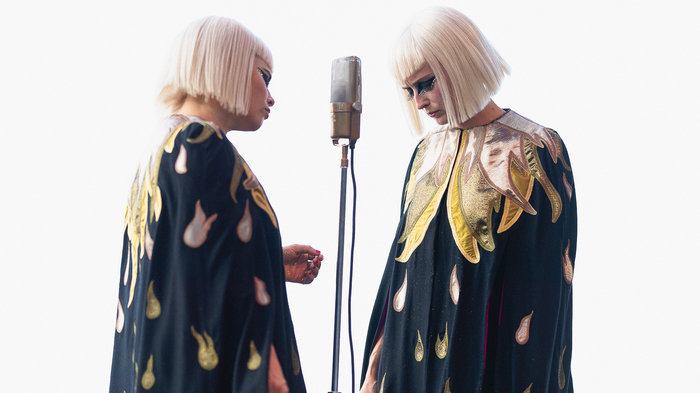
While hearing a stream of them isn’t quite as good as seeing them live (especially since their look is so arresting), it was great to hear what I missed.

For this tour, Lucius was unplugged–acoustic versions of their songs and some covers.

It sounds like there may have been more going on at Newport (as there always is)

Accompanied by members of yMusic, students from the Berklee College of Music on strings and J. Blynn, along with Lucius regulars Jess Wolfe, Holly Laessig, Dan Molad, and Peter Lalish. The group also incorporated choreography into the set, with the dancers known as The Seaweed Sisters.

Songs included favorites new and old, like “Woman” and Turn It Around.” Tears were shed as they movingly tributed the recently departed producer and musician Richard Swift. Lucius performed Swift’s song “The Most of What I Know” (from his 2006 album Dressed Up for the Letdown) and, in typical Newport fashion, were joined by Brandi Carlile and the Twins, Nicole AtkinsSharon Van Etten and Bedouine.

Go Home” is my favorite song of theirs.  They opened with it.  I could have gone home happy.  “Right Down the Line” is a song I didn’t know by Gerry Rafferty.  It sounds pretty 70s–slick and poppy.  “Something About You”  featured the Seaweed Sisters doing choreography.

“Feels Like a Curse” is a slower number with strings.  It’s quite pretty.

“Turn It Around” is another favorite of mine, with big claps and a wonderfully catchy chorus (yes, I would have stayed for this!)  I love the power behind the chorus: “She’s looking through the wrong end of the telescope ha!”

Brandi Carlisle joins them for “Dusty Trails” and when they sing the “we’ll be alright” at the end, it is really transportive.

Next up

“They movingly tributed the recently departed producer and musician Richard Swift. Lucius performed Swift’s song “The Most of What I Know” (which I don;t know) and, in typical Newport fashion, were joined by Brandi Carlile and the Twins, Nicole Atkins, Sharon Van Etten and Bedouine.

“How Loud Your Heart Gets” is a little too overwhelmed by strings to really appreciate their vocals (which is crazy since they sing loud!).  “Woman” also sounds great and is a stunning set closer. The “encore” (sort of) is “A Dream Is A Wish” a lovely a capella version.

Below is the set list from Newport and what i would have seen had I gone to Union Transfer.

SET LIST:

  • “Go Home”
  • “Right Down The Line” (Gerry Rafferty)
  • “Something About You”
  • “Feels Like A Curse”
  • “Turn It Around”
  • “Madness”
  • “Dusty Trails”
  • “Most Of What I Know” (Richard Swift) [did not play at UT]
  • “Two of Us On The Run”
  • “How Loud Your Heart Gets”
  • “Woman”
  • “A Dream Is A Wish” (Daniel Bedingfield-Disney Song)

UNION TRANSFER SETLIST (duplicated songs in bold)

  1. Go Home
  2. Tempest
  3. Right Down the Line (Gerry Rafferty)
  4. Something About You
  5. Neighbors
  6. Feels Like a Curse
  7. Until We Get There
  8. Sweet and Tender Romance (The McKinleys)
  9. Turn It Around
  10. Madness
  11. True Love Will Find You in the End (Daniel Johnston)
  12. Two of Us on the Run
  13. How Loud Your Heart Gets
  14. Woman
  15. Dusty Trails
  16. Strangers (The Kinks)
  17. A Dream Is A Wish (Daniel Bedingfield-Disney Song)

[READ: August 6, 2018] “Displaced”

I enjoyed this story but it seemed to take forever.  I attribute this to Ford’s writing style although there’s nothing I could point to about it that makes me feel this way.

This is a story about a recently turned 16 year old boy, Henry, whose father died unexpectedly.  Henry’s main sadness about the is that if his father had lived longer, his mother would have divorced him and Henry could have gone o military school.

He is now alone, with his mother, in the South.  His fellow students have placed him in a strange limbo because of his father;s death .  He doesn’t like it.

In their neighborhood is a house for “transients.”  Out front is a sign that says DIAL 33377 (that’s all) and everyone referred to it as the DIAL house.  Secretaries and waitresses lived there.   Young married couples.  Even two men living together.  Henry realizes now that he and his mother were transients too, they just didn’t call themselves that. (more…)

Read Full Post »

SOUNDTRACK: PALEHOUND-A Place I’ll Always Go (2017).

Ellen Kempner’s voice is a bit louder in the mix so you can really hear the words despite the fact that she is still singing mostly in a whisper.

It’s a logical step from her previous album and every thing sounds a bit bigger and a bit better.

“Hunter’s Gun” is slow and a little creepy with the echo on her vocals and her whispered lyrics.  There’s also some great weird effects floating around in the background–especially by the end as the echo more or less takes over.

“Carnations” starts simply enough with a quiet chugging riff.  But the chorus is a wonderful–louder guitar with the guitar and vocals doing the same catchy melody.  It also has some great lyrics

They’re still in love with their ex
And I’m not feeling my best
This is a bad combination

‘Cause I’ve been dreaming I might
Just up and bail on this plight
And maybe go on vacation

Pack up my shit in the dark
And if the car doesn’t start
It spares us both conversations

“Room” is slower more acoustic-feeling.  It’s a sweetly romantic song with the lovely chorus line “She keeps me…  at night.”

“If You Met Her” starts out kind of sinister musically, but it has a really catchy chorus as well  It’s a wonderful song about breakup and new love perfectly summed up with this ending line

I’m with someone new
And I know that you would love her if you met her

The set up of rocker followed by slower song continues with  “Silver Toaster,” a loose, acoustic song that reminds of a snarky/simple Nirvana song (with a banjo solo!)

“Turning 21” has a big shoegaze guitar sound and a wonderfully catchy melody in the bridge.

“Flowing Over” mixes some good guitar lines and a rocking mid bridge section but its the oh oh oh oh section and the way it changes throughout the song that is the major hook.

“Backseat” opens with pulsing keys.  It’s a dark mediation that segues into the beautiful guitar of “Feeling Fruit, ” a pedestrian-seeming lyric that is much deeper and quite moving.

“At Night I’m Alright With You.” is a quiet moody song with a real Twin Peaks vibe.

These two releases are great but to really get to see how amazing Ellen is, check her out live.

[READ: January 23, 2018] “A Change in Fashion”

When I read this recently it sounded really familiar.  Clearly I had read it back in 2006 and it was so striking that I remembered it 12 years later.

And indeed, it is a memorable story, even if it’s not especially profound or funny–it’s mildly amusing and thoughtful.

Basically, this is an account of the way fashions changed after the Age of Revelation.  Girls and women were happily showing off their thongs but it was as if, after a half a century of reckless exposure, a weariness had overcome women…a disenchantment to invite a bold male gaze.

At first girls were opposed to it–it reminded them of old photographs in boring albums.  But soon it became stylish to wear dresses that brushed the floor–wearing lambskin gloves and rising collars. (more…)

Read Full Post »

nyoct20

SOUNDTRACK: MOBY-One Song, Two Days, Three Versions (Project Song: May 4, 2010).

Project Song was a nifty little show that NPR Music created.  The premise was that NPR would give a musician some prompts and a recording studio.  They then had two days to write and record a song.  I don’t know how much of the process was to be filmed, but presumably most of it. Then it would be edited down to a fifteen minute show.  The results are pretty cool and it’s a shame they only made five of them.

The fifth and (presumably) final one they did was about six months after the previous one.  This Project was offered to Moby.

Moby generally works alone in his New York apartment, but for Project Song, we asked him to bring along a collaborator. He picked Kelli Scarr, a Brooklyn-based singer and songwriter with a breathtaking voice. They arrived at NPR, a bit nervous and eager.

It takes weeks, even years, to write a song. NPR Music’s Project Song challenges musicians to do it in just two days. And every Project Song participant has worked right up to the last-minute — that is, until Moby.

He and collaborator Kelli Scarr finished their song in a little more than a single day. In fact, they had so much time left over, they recorded a second version of the song. And after that, they gave a small concert for the staff at NPR.

I kicked off the songwriting process by showing them a series of photographs and words. The surreal images came from New York artist Phil Toledano; you can see more of his work at NPR’s Picture Show blog. Moby and Scarr are both drawn to an image of a man in the woods wearing a trenchcoat. [Moby: “A disconcerting loneliness that I really like”].  There’s a brown briefcase on the earthen floor beside him, and his head looks like a glowing storm cloud.

Next, I gave them a series of words to choose from. Moby picked the word “flight.” Scarr chose “Sunday,” which Moby calls “the most depressing day of the week.”

Not too long after, Moby puts the card with the word “Sunday” printed on it, along with the photograph, on a nearby chair. He picks up a bass guitar and immediately starts playing a riff in the key of E. Turns out, this hastily played bass line would become the bedrock for their new song.

Just six hours later, the first of three versions of “Gone to Sleep” was recorded.

When he arrives he says he thought about cheating with chords ahead of time, but he likes the idea of jumping headlong into a project.  And as the blurb says, within minutes he’s got a bass line, some synths and drums.  Then a guitar line and more keyboard sounds.

Then they work on lyrics.  Moby says, “My favorite type of unsettling art is art that isn’t immediately unsettling.”  he cites the classic example of “Mack the Knife.”  You first hear it and it’s happy and then you listen to the lyrics and its terrifying.

The end of the video clip plays the whole song, guitar and piano and atmospheric.  Then over the closing credits they play a somewhat less atmospheric, gentler version of the song.  And then there’s the Tiny Desk which is altogether different.

It’s like Moby broke Project Song by making it seem too easy.

[READ: July 27, 2017] “Christina the Astonishing (1150-1224)”

I’ve read a few things by Vladez Quade, but this one is quite different from anything else.  It’s actually quite different form anything else I’ve read, period.  The closest author this reminded me of would be Brendan Connell, who likes to thoroughly investigate a historical character (real or imagined).

But this story is based on an actual; person:

St. Christina the Astonishing has been recognized as a saint since the 12th century. She was placed in the calendar of the saints by at least two bishops of the Catholic Church in two different centuries (17th & 19th) that also recognized her life in a religious order and preservation of her relics.

The story tells of her life from the point of view of her older sister and is written in a rather formal, almost canonical, style with section headings in an old style: “How She was Led Forth from the Body and How She Lived Again.”

The narrator, Mara, tells us that Christina lay dead in her coffin, a grave awaiting her.  Mara is sad, she loved Christina, “I see this now.  She was difficult, unknowable but I loved her.”

But at the same time she says that perhaps if they had hastened, outrun the melody.  If we’d only got those last words out, “He might have spared us our miracle.”

For indeed, the dead Christina not only rose bodily from her coffin, she levitated to the rafters. The narrator and her sister Gertrude clutched each other in fear. (more…)

Read Full Post »

SOUNDTRACKTHE WOODEN SKY-Live at Massey Hall (June 23, 2017).

I don’t know this band at all.  I’m fascinated that he lead singer Gavin Gardiner and the keyboardist Simon Walker have the same haircut and glasses but are not related.  The band has a kind of folk-rock vibe.  Nothing really stands out about them to me, but I did enjoy the songs while they were playing them.

For The Wooden Sky, getting to Massey Hall always seemed unreachable.  But they say that getting here you can feel the history and see that the place opened in 1894.  Its pretty surreal.  Just looking out on stage you can feel–holy shit, this is cool.

“Life is Pain, Pain is Beauty” is a six-minute song that opens with a nifty guitar riff.  The keys and violins act as a kind of drone underneath.  The middle has a cool rollicking section with big drums and groovy keyboard solo.  There’s a nice jam element to the song, too with Jason Haberman on bass.

Gardiner has a kind of drawl or something.  His delivery is unique without being especially noteworthy.  On some of the later songs he puts on a strange vibrato that I find a bit unsettling.

“Our Hearts Were Young” has a cool violin part that runs through the song.  The backing vocals during the chorus are amazingly catchy.

It’s weird that they interrupt this song to talk about them making their record.  They miss a verse and a solo of the song to talk about them recording in their own studio.

He introduces “Deadhorse Creek” by saying that his parents are celebrating their 40th anniversary in a couple of days so this if or them.  It’s about living and growing up in Manitoba.

This song is also interrupted so they can talk more about working in the studio, how they recorded this song three different times.

There a wild harmonica solo from Gardiner mid song.

He invites his best friend Andrew Wyatt to the stage to play banjo–you know the passion he brings to the stage.  HE is listed as a member of the band, so this is a weird moment with him on stage.  They play “The Wooden Sky,” a mellows darker song where Gardiner introduces that vibrato singing. There’s a more mellow harmonica solo.

“Swimming in Strange Waters” is the most fun song. It rocks with some wild singing by the end.

“Angelina” ends the show quietly with Gardiner singing solo with acoustic guitar.  He says it is dedicated to his friend Aaron who passed away in 2010.  The rest of the band gathers around behind him as he plays.  Midway through the song Edwin Huzinga introduces a fiddle melody and Andrew Kekewich plays a kick drum as the song builds.   They all gather round to sing backing vocals.

[READ: January 24, 2018] “Question 62”

This short story has two plots running parallel.  It involves two sisters and wild cats.

How’s this for an opening line:

She was out in the flower bed, crushing snails–and more on them later–when she happened to glance up into the burning eyes of an optical illusion.

Until recently Mae had lived with her sister Anita in Waunakee, Wisconsin.  She now lived in Southern California where it never rained, except that it had been raining all week.  The snails loved this rain and were destroying her garden.  Which is why she was destroying them–despite being a vegetarian and wishing no harm to come to animals, really.  She and Anita made a vow to become vegetarian in junior high school.

But it was while she was crushing snails that she looked up and saw…could it be?  A tiger? She was startled, obviously.  She quietly cried for her husband (he was asleep inside). The tiger didn’t seem aggressive, it just seemed inquisitive at the sound of her voice. (more…)

Read Full Post »

SOUNDTRACK: FROM THE TOP-Tiny Desk Concert #758 (June 22, 2018).

From the Top is a radio show (and podcast) which showcases young, talented classical musicians.

For over 20 years, From the Top (distributed by NPR) has built an impressive platform to celebrate the music, lives and stories of youngsters playing classical music. That’s right. Young people in this country love classical music.  We invited three talented From the Top musicians to the Tiny Desk. No squeaky violins here. These kids are terrific players.

From the Top alum Derek Wang is our good-natured emcee, in addition to serving as a sensitive accompanist for two of the pieces.

The first piece is played by 12-year-old violinist Kaia Selden–sparks fly (and bow hairs, too) when  she tears into

  • Henryk Wieniawski: “Scherzo-Tarantelle, Op. 16”

A bouncy piano opens up this amazingly fast violin piece.  Selden plays with fire and passion as her fingers fly over the fretboard for these incredibly fast notes and runs.  It’s stunning how composed and confident she is.

She explains that the song is a tarantel, a kind of dance, named after when you are bitten by a tarantula–you have to dance really fast and crazy to get the venom out of your system.

Up next is cellist Noah Lee who uncovers fascinating new sounds on his instrument

  • Mark Summer: “Julie-O”

The piece opens with plucked notes and strummed chords.  He pays what sounds like rock riffs and then after a minute or so he picks up the bow and begins playing the instrument conventionally–with some quick runs and cool sounds.  Then he adds new sounds–slapping the strings with just his left hand and then using his right percussively.  There’s some more plucking notes and full chords before ending with more bowed music.  It’s a mesmerizing solo piece.

The third musician is Javier Morales-Martinez who makes his velvety clarinet sing in elegant music:

  • Francis Poulenc: “Clarinet Sonata, II. Romanza”  The

The juxtaposition of piano and clarinet is quite lovely and Javier greats some amazing sounds out of the instrument,.

Javier says that when he was 7 or 8 he used to play music with his dad from Mexico.  He was later introduced to classical music and has been playing it ever since.

It’s an inspirational set from amazing young musicians.

[READ: February 9, 2016] “The Flower”

Erdrich had a short piece in the previous issue of the New Yorker, and here she gets a full short story.

I was really surprised to find this story set in 1839 in Ojibwe country (although I see that Erdrich has written extensively about Okibwe country, so that’s my bad, clearly).

The story is a fairly simple one.  There is an older Ojibwe woman, Mink, who is wailing and carrying on, demanding the trader’s milk –a mixture of raw distilled spirits, rum, red pepper and tobacco–from Mackinnon.  It was driving Mackinnon crazy, but Mink was from a family of healers and could not be denied.

The other man in the tent was Mackinnon’s clerk, Wolfred Roverts who was trying his best to get the sound out of his ears. Wolfred aged 17 was from Portsmouth New Hampshire.  He missed his home terribly but there was no life for him back there. (more…)

Read Full Post »

SOUNDTRACKTHE WEATHER STATION-Live at Massey Hall (February 5, 2016).

I know of The Weather Station from All Songs Considered.  The Weather Station is Tamara Lindeman and she has been making music under this name for many years.

But as her profile rises, she says that she has been moving from small clubs to bigger venues:

“So many things I’ve learned, like how to perform on a big stage and make sure people pay attention to you and hear your words.”

The larger venues are odd because her songs are “thoughtful and philosophical not full of showmanship” but you don’t really have a choice you’re in that situation–step up and be confident

The set opens with “Tapes” which is very quiet and soft with lovely backing vocal oohs and a pedal steel guitar.

“Floodplain” is a bit more upbeat but there’s some  interesting guitar work and a nice juxtaposition with the bass.

I love the titles of “Almost Carless” and “Shy Women.”  About “Shy Women” she says it’s about a particularity conversation but it could apply to 1,000 conversations.  It’s my favorite song with some great moments of backing vocals and chord changes

On “All of It was Me” she sounds a bit like Aimee Mann. She says “Loyalty” is also about a conversation.

She talks about evolving as a performer, playing electric guitar on “Personal Eclipse.”  She talks about how on a big stage you have to expand to fit the space you are given and so “Know It To See It,” finally rocks out–the drums and bass really adding something to her music.  The show ends with “Way It Is, Way It Could Be.”

She was joined by Ben Whiteley, Ian Kehoe,  Adrian Cook, Ivy Mairi and Misha Bower.

[READ: February 4, 2018] “Sick Soldier at Your Door”

Reading all of these excerpts in Harper’s has really brought to my attention just how much fiction is written about war.  It’s not a genre I like, so I had no idea it was so popular. This is an excerpt from a then forthcoming novel.

Anse Burden is apparently the main character. He says he has found six soldiers from the ’91 desert war with Iraq.

He talks about how he was on Percordan and Dexedrine when he was shot down.  Others believe he shot himself down (is that even possible?  I guess so.) He was found babbling incoherently.  There’s a great description of him being in the surf with his parachute attached looking like a dirty white whale rising up and down. (more…)

Read Full Post »

SOUNDTRACKPEACHES-Live at Massey Hall (August 4, 2016).

Peaches is afraid of no one.  She bears it all, lyrically, visually, sexually (sample lyric: “Can’t talk right now this chick’s dick is in my mouth”).

She stands center stage, all by herself atop a small pyramid.  She programs some beats at the back of the pyramid and then begins singing the lyrics to “Rub.”  She demonstrates quite exaggeratedly where the rubbing out to take place

Tell on my pussy
Whistle blow my clit
Watch it open up
Cause it can’t keep a secret

What’s great about Peaches is that she was 49 at the time of this performance and she held nothing back–doing a very impressive split at the top of “Operate.”

She began the show with an oversized cape and what looks like a catcher’s chest protector with the outline of abs on it.  When she takes those off she reveals a body suit with hands all over it–grabbing her.

Next up is “Vaginoplasty.”  She introduces the song that it “is not about a big dick or big tits it’s about my big fucking vagina.”  Its at this point that her two dancers (Jess Daly and Agent Cleave) come out wearing gigantic vagina body suits.

In addition to being about her vagina though, she also addresses transgender issues

If you’re born as a man
But know you’re a woman
I understand
Gotta get it, get it girl

About this song she later said:

I think “Vaginoplasty” is about an important subject, but I also think it’s hilarious. The song is about a big vag, but then you have to think, Why does that gross me out?

Her voice is terrific on this song as well, she hits some really powerful notes.

“Mean Something” features a duet with “Feist.”  Feist sings the eerily compelling chorus.  It’s a great song without being explicit.

During an interview she talks about going to Berlin where she was appreciated before returning home to make her album.

After an onstage costume change, Peaches wears a fabulous outfit that’s a giant vagina and she walks out into the audience, walking across the backs of the chairs until she stops and says, “These are my parents!” (their reaction is..amusing).

“How You Like My Cut” is more of a rap–incredibly sparse with lyrics that are not terribly eloquent

How you like my cut
How you like my cut what
How you like my cut

But it seems more about the mood than the words.  Words are suitably important for “Fuck the Pain Away” (now that is something you did think you’d be singing at Massey Hall).  Both songs feature her dancers in minimal bondage gear.

The chorus that gets the crowd chanting is

S I S I U D, stay in school cause it’s the best

With repetition, the lines eventually sound like “SIS, stay in school cause it’s the best IUD.” Peaches thus ties the education of women directly to birth control and reproductive autonomy.

For the final two songs, she has one more outfit change (which leaves her topless, but with pasties on).  “Dumb Fuck” has an incredibly catchy chorus of “dumb fuck, you dumb fuck, you dumb fuck” which is certainly cathartic.

The final song is “Close Up” and is a duet with Joel Gibb from The Hidden Cameras.  They have a lot of fun with the song.

[READ: January 9, 2017] “The Bog Girl” 

Some stories are so weird that you have to keep reading.  And when they get even weirder and even more compelling, you sort of marvel at the way it unfolds.

This story was one of those.

Cillian is a fifteen year old boy working in the peatlands in an island off of Ireland on the archipelago known as the Four Horsemen.  He is working illegally, but his boss hired him because his house abutted the peatlands.

The story gives a brief history of peat–how it is created and used for fuel and explains that the lack of oxygen allows things to decompose there–so there are all kinds of dead animals in the peat.  But no one notices because it is now industrially harvested.

Then one day, as he is digging up the peat, Cillian sees a hand.  It proves to be the hand of a girl.  When she is exhumed, her body comes out intact.  She is cute with a sweet smile.  The police determine that she is not a recent murder, that she is probably 2,000 years old.  Well, Cillian is lucky that he lives on a remote island. (more…)

Read Full Post »

SOUNDTRACKTANYA TAGAQ-Live at Massey Hall (December 1, 2015).

This show begins the third season of Live at Massey Hall.  There are ten episodes in all.  And the first one is with the otherworldly whirlwind of Tanya Tagaq.

Tanya Tagaq is an Inuit singer.  She works with throat singing, but in a new (and somewhat controversial) manner.  She pairs the deep growls and grunts with high-pitched wails.  Her songs become primitive and raw and she seems to become possessed by the music.

This performance is simply amazing–there’s probably been nothing like it.  And what is most remarkable about the performance is that it is all improvised.

But none of this would work if the music were subpar or uninteresting and here’s where she is to be commended for selecting this group of musicians.  Including the 50 voice Element Choir.

Jesse Zubot plays violin like no one else, often as a percussive instrument and with all kinds of effects. Bernard Falaise plays guitars in washes of sound.  he’s also manipulating everything to create otherworldly effects.  And Jean Martin plays drums like no one I have seen.  It’s so much fun to watch.  And the way he punctuates things on and off the beat is really inspired.

The performance is intercut with an interview from before the show.  Its kind of a shame to interrupt the flow of the performance, but she’s also got a lot of interesting things to say.

The show opens with Zubot’s amazing violin, which includes him sliding the bow up and down the neck sideways to make a kind of scraping (but pleasant) sound.

She tells us (paraphrasing)

The combination of the venue and the audience impacts the music which is improvised.  They fall into the groove of the place–a cement box of mosh pits will come out differently from a seated hall.

I’m pretty grounded and I’m lucky because I spend half my time in the air.

Indigenous people are having a voice.  When I was growing up there was more shunning of our own culture.

Around 3:40 she starts singing/fluttering her voice. The choir is filling in behind her.

Around 5 minute she starts doing some real deep vocals and the drums kick in.

Martin is an amazing drummer.  He keeps the beat constant but is playing all over the cymbals and snare on polyrhythms with lots of clacks and rim shots.

Things get really intense around 8 minutes with the choir singing and the lights swirling and Tanya hitting cool high notes.

A kind of natural quieting moment occurs around 10 minutes and she talks about throat singing.

13 minutes she gets into a kind of rhythmic breathing with some cool sound effects from….someone.

After 19 minutes things start to build in intensity. It is so much fun watching the musicians play everything especially Martin–the way he is practically out of his seat hitting things.  Tagaq is singing in a  high voice, on her hands and knees.

Around 24 minutes things build to a peak that lends to a quieter moment and it cuts to her cracking up over

having people give me shit for not being traditional…. over the internet

Then the show comes back until the end.  She makes animal noises sounding like she’s having a conversation, with finger-animal-horns on her head.  Ecstatic moans and animalistic groans evoke a kind of call and response with the choir.

The final uninterrupted ten minutes are just an amazingly tense exercise.  Between the lights, the tension of the guitar the thumping of the drums and Tagaq herself being possessed where you can hear her “human voice” coming through the growls.

At 31 minutes she starts howling, and it sounds like a wolf–not a person doing a wolf.  The chorus is answering her as she poses and distorts her body.   And then she starts her circular breathing.  The sound of her breathing in and out is so intense–is she being chased, is she in the throes of passion.  Combined with the motions she makes and again the amazing percussion the last ten minutes are just mesmerizing.

Then it’s all denouement as she comes back into herself with thunder rumbling and crackling as she breathes.

I sure hope Owen Pallett didn’t have to follow that!

[READ: May 15, 2018] “Slingshot”

This is a story about love and how people perceive it.

The narrator explains that she was 70 when she met Richard who was thirty-two at the time.

Richard moved in next door and had lots of parties.  He was a fun-loving kind of guy and he had lots of lovers.

But he also stated that there is no such thing as love.  The narrator’s granddaughter Rose claimed to be in love all of the time and would then wind up crying by the phone.  The narrator herself had been in love–she had been married once some thirty years ago. (more…)

Read Full Post »

SOUNDTRACK: TOM MISCH-Tiny Desk Concert #749 (June 1, 2018).

Tom Misch sings music that I would classify as boring.  It’s kind of lite-jazz.

Misch has said before that he isn’t a jazz purist intrinsically, but the way he opens up a guitar solo or jams with saxophonist Braxton Cook, jazz music certainly runs through him.

His voice is interesting but “that soothing timbre of his voice” is more soporific than anything else.

The blurb certainly raves about him:

I first caught wind of this UK wunderkind in 2014. Crafting his own instrumental projects and remixing tracks by artists ranging from Busta Rhymes to Lianne La Havas, Misch steadily garnered a dedicated following on SoundCloud. From there, he collaborated with other London artists and released EPs of original music on the platform. Misch’s style doesn’t revel in what’s going on in pop music today; like a handful of other artists from the UK, his interpretation of hip-hop and R&B is a continuation of what the greats who came before him started.  In 2016, Misch — still just 21 years old at the time — decided to dabble more in songwriting.

He plays three songs (totaling 17 minutes) and I genuinely thought the second song was the same as the first.

“It Runs Through Me” has an enjoyable guitar solo and a long sax solo (Braxton Cook).  Although “I Wish” sounds like the first song at first, there is an interesting moment  midway through the song where they thrown in a riff and change the tempo a bit.  There’s also a long wah wah solo which is neat.

The final song “Movie” is a total smoky nightclub jazz song.  There’s a piano solo (the pianist (Joseph Price) even has a jazz hat on).  It’s got all the elements.  But I would never go into a smokey jazzy nightclub.

The rest of the band includes: Tobias Tripp (guitar/violin/vocals), James Creswick (bass), and Jamie Houghton (drums).

[READ: February 7, 2018] “Borscht”

Sergey has been living in the US for about a year.  His plan was to go to the States to work for a year and send money home to his wife.  But it had been a year and she felt that maybe he should stay longer and make more money.  They had enough for a house, but they’d need more for furnishings and the like.

He was sick of installing carpets.  He hated the feel and the smell and the stupid names of colors for ugly carpets : Morning Fog, Bay Fog, Autumn Leaves, he decided they should be called Moldy Bread or a A Pile Of Cow Dung On A Warm Day

He woke one morning with an erection and a headache.  He looked at the picture of his wife–he had only the one.  She didn’t look happy, and he no longer remembered what she looked like aside from the picture.

His roommate Pavel had a woman over.  She wasn’t Sergey’s type, but she was wearing next to nothing and she smelled good.

He found the paper under the couch and in the back were personal ads.  There was one that caught his eye : “A warm, sexy woman will tend to your needs. Affordable.” (more…)

Read Full Post »

« Newer Posts - Older Posts »