Feeds:
Posts
Comments

Archive for the ‘Sci-fi’ Category

SOUNDTRACK: BILLIE HOLIDAY-“Strange Fruit” (1939/ (live1959)).
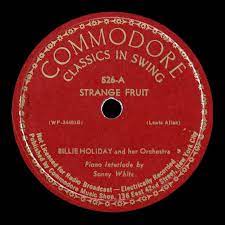
This haunting song is sung with minimal piano accompaniment.  In between verses, the original version has some stark trumpet solos, although they are not present in this live version.

Southern trees bear a strange fruit
Blood on the leaves and blood at the root
Black bodies swingin’ in the Southern breeze
Strange fruit hangin’ from the poplar trees
Pastoral scene of the gallant South
The bulgin’ eyes and the twisted mouth
Scent of magnolias sweet and fresh
Then the sudden smell of burnin’ flesh
Here is a fruit for the crows to pluck
For the rain to gather
For the wind to suck
For the sun to rot
For the tree to drop
Here is a strange and bitter crop

She sings the words slowly (the song is 3 minutes long despite the relatively few words), letting the image linger in your mind as she stretched out “burning flesh”  and “for the crows to pluck.”  The way she agonizingly sings “drop” and “crop” really emphasizes the last lines.

The studio version has a haunting guitar line–the only guitar in the song–as a little coda.  It’s a remarkable addition and really affecting.

I can’t imagine the courage it took to sing these words in 1959 let alone 1939.

This song has a fascinating origin.

Thomas Shipp and Abram Smith were two Black men who were hanged in a spectacle lynching in 1930.  A photograph was taken by studio photographer Lawrence Beitler.  He sold thousands of copies of the print [which is amazingly disturbing and I can’t imagine who would have bought them].  In 1937 Abel Meeropol, a Jewish school teacher from New York City saw a copy of Beitler’s 1930 photograph which “haunted [him] for days” and inspired his poem “Bitter Fruit” which was published in The New York Teacher in 1937 (under the pseudonym Lewis Allan). Meeropol then set his poem to music, renaming it “Strange Fruit” which Billie Holiday recorded in 1939.

[READ: March 8, 2021] Kindred [the fight]

This week took us to the end of the book.

Dana arrived home with Kevin this time.  He’s initially happy to be home, but is soon very restless. He was in the past for five years.  They have only been in their new house together a few days–noting is familiar here.  He is agitated and irritable.  He tells her about some of the horrible things he’s seen like a woman dying in childbirth.  It’s interesting that this horror comes from Kevin telling Dana about a woman’s whose master beat her until the baby fell out of her.

I feel like Kevin is overreacting to his return–his agitation seems way too great.  I realize that things are new in this house, but you’d think that even after five years, being home wouldn’t be such a bad thing.  And then he tells a story like the above and while I still don’t understand why it’s not just a relief to be out of there, i can see that he’s got PTSD.

But he was jumpy–the sound of jet overhead freaked him out.  Again, would five years without a jet overhead make you forget that they existed before hand?

Earlier Dana had been concerned that Kevin could be “won over” to the bad side. But he tells her that he had been helping slaves to escape.  he even imagined that they might both want to go back to help more slaves escape–to do good historically speaking. (more…)

Read Full Post »

SOUNDTRACK: NINA SIMONE-“Mississippi Goddamn” (Live in Antibes, July 24-25, 1965).

This song is amazing for so many reasons.

Nina Simone wrote this song in less than an hour as a response to  the murders of Emmett Till and Medgar Evers in Mississippi, and the 16th Street Baptist Church bombing in Birmingham, Alabama (see the posts from John Lewis’ March).

It is simple and straightforward.  She pulls no punches, from the title to the explicitness of the lyrics.

The intro (and chorus) get right to the point

Alabama’s gotten me so upset
Tennessee made me lose my rest
And everybody knows about Mississippi, goddamn

She doesn’t stop there.

Don’t tell me, I’ll tell you
Me and my people just about due
I’ve been there so I know
They keep on saying
“Go slow!”

But that’s just the trouble “too slow”
Washing the windows “Too slow”
Picking the cotton “Too slow”
You’re just plain rotten “Too slow”
You’re too damn lazy “Too slow”
The thinking’s crazy “Too slow”
Where am I going What am I doing I don’t know

Having the band chant back “too slow” during the bridge is a nice call for support.

What’s most scary about this song is how little has changed since she wrote it fifty years ago,

Picket lines, school boycotts
They try to say it’s a communist plot [substitute Antifa or BLM now]
All I want is equality
For my sister, my brother, my people, and me

In the Antibes version, she substitutes Governor Wallace in one of the lines–and you can tell how intensely she feels these words.

Then there’s the music–a sort of bouncy jazzy number that could easily be about anything.  The lyrics are straightforward, but the music almost softens the bite, or at least.  In the Carnegie Hall recording she even jokes “This is a show tune, but the show hasn’t been written for it, yet.”

The middle section, which is a little quieter, definitely sounds a bit more sinister.  And justifiably

Hound dogs on my trail
School children sitting in jail
Black cat cross my path
I think every day’s gonna be my last

Watching this video is really intense.  I wonder how impactful this was in France. And I can’t imagine what the impact was like at Carnegie Hall.

[READ: March 8, 2021] Kindred [the fight]

This week’s read is one long, painful chapter.

After the first few sections have established the scenario, the more you think about it, the more you realize how many things can (and likely will) go wrong for Dana.

Each time Dana is sent back in time, the gap between instances grows.  Time doesn’t pass in the present the same way it does when she goes back.  She had been gone for nearly two months but when she returned home she had been “gone” for less than a day.

Now that Kevin has remained, she fears for him as well and those fears are completely reasonable–he was treated well in that world because he was white.  He looked forward to watching the expansion of our country West.  Could he become a hardened white person if he was there for too long?  Kevin seems like a pretty decent fellow and doesn’t seem like he would become an owner of anyone, but you could see him getting caught up in everything that’s happening. (more…)

Read Full Post »

SOUNDTRACKMARTHA REDBONE-GlobalFEST Tiny Desk (Home) Concert #135/154 (January 13, 2021).

Martha RedboneGlobalFEST is an annual event, held in New York City, in which bands from all over the world have an opportunity to showcase their music to an American audience.  I’ve never been, and it sounds a little exhausting, but it also sounds really fun.
The Tiny Desk is teaming up with globalFEST this year for a thrilling virtual music festival: Tiny Desk Meets globalFEST. The online fest includes four nights of concerts featuring 16 bands from all over the world. 

Given the pandemic’s challenges and the hardening of international borders, NPR Music and globalFEST is moving from the nightclub to your screen of choice and sharing this festival with the world. Each night, we’ll present four artists in intimate settings (often behind desks donning globes), and it’s all hosted by African superstar Angélique Kidjo, who performed at the inaugural edition of globalFEST in 2004.

The fourth artist of the third night is Afro-indigenous appalachian performer Martha Redbone.

Martha Redbone performs her Tiny Desk Meets globalFEST performance from her home studio in Brooklyn’s Navy Yards. Native and African-American singer-songwriter Martha Redbone is known for her mix of folk, blues and gospel from her childhood in Harlan County, Ky., which she infuses with the eclectic grit of pre-gentrified Brooklyn. Inheriting the powerful vocal range of her gospel-singing African-American father and the resilient spirit of her mother’s Cherokee, Shawnee and Choctaw culture, Redbone broadens the boundaries of American Roots music.

“The Garden of Love” starts with Martha playing percussion sounds.  Keyboardist Aaron Whitby is playing some backing chords while guitarist marvin Sewell is playing some interesting slide guitar sounds.   Martha sings in a very traditional style.  Then the song starts proper with an old sounding blues riff and the song feels old and gospel-like.

She tells us her inspiration is the Appalachian mountains where she grew up–rattles, soul music, the blues.

“Talk About It” is a prayer for stronger communication around the world.  It’s a more conventional sounding soul song, with heavy keyboards and Redbone’s vocals taking the fore.

“Underdog” is a very pretty ballad with slide guitar sounds and gentle keys.  But it’s all about her gorgeous voice.

[READ: March 1, 2021] Kindred [prelude-the fall]

I’m always happy to start a new group read with the fine folks at Infinite Zombies. Normally we read big books by white men.  So this time it was decided to pick a different kind of author.

I was pretty pleased to see that Octavia E. Butler would be the new reading choice.  I had only recently heard of her and had recently read Mind of My Mind, which I really liked.  So it was a great opportunity to read more from her.

Kindred is Butler’s most famous book.  I was looking forward to reading something different from Mind (although I do intend to read the rest of that series).

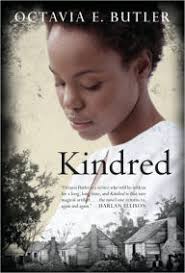
I didn’t know what this book was about.  The cover of this book gives absolutely no indication is what’s going inside.  In fact, it looked pretty much exactly like what is not happening in this book.

I was blown away by the first sections of this book.  Butler’s style is not fancy and I found this direct writing to be really effective at conveying what is going on.

Butler basically puts a horrifying slave narrative into a science fiction story.

It starts very abruptly with the prologue.  The narrator, Dana says that she lost her arm on her last trip home.  The police question her husband Kevin but she assures them it is not his fault.

Then the story resumes with The River.  It flashes back to when this all started–June 9, 1976.

In The River, Dana and Kevin are unpacking books in their new California home when suddenly Dana feels dizzy.  She is pulled through space into a river where a young red-haired boy is drowning.  Dana thinks quickly and stomps into the river to rescue the him.  She even does some mouth to mouth

The boy’s mother starts blaming Dana for what’s happening even while she is trying to resuscitate the woman’s son.  Dana succeeds and just as the boy, whose name is Rufus comes to, his father holds a shotgun at Dana’s head.  What is the black woman (who is dressed like a man) doing with her mouth on his son?

Rufus’s father is Southern and they seem very, very old-fashioned.  But just as Dana fear the worst from the shotgun, she flies back to her bedroom.  She is covered in mud and soaking wet, but Kevin says she was gone maybe ten seconds.  He has a hard time believing her (who wouldn’t) despite the proof of the mud on her clothes.

What in the hell just happened? (more…)

Read Full Post »

SOUNDTRACK: JULIA BULLOCK-Tiny Desk (Home) Concert #119 (December 1, 2020).

I had not heard of Julia Bullock, so when I started this video I was surprised that she was an operatic singer.  Their setting seems so casual–just her sitting next to her husband, Christian Reif, at the piano.  And then pow–what a voice!

Soprano Julia Bullock prefers to be called a “classical singer.” It’s a rather humble, even vague, appellation for one of today’s smartest, most arresting vocalists in any genre.

Bullock is in Munich Germany and has decided to sing songs in both langauges.

Carefully choosing songs in German and English, Bullock begins with something bittersweet and introspective by Franz Schubert that cautions patience when looking for inner peace.

Franz Schubert: “Wanderers Nachtlied II” [Wanderers Night Song] features poetry by Goethe and is barely two minutes long.  It’s a wonderful start.

She follows with “Wie lange noch” (How Much Longer), a World War II-era song by Kurt Weill. Written after Weill emigrated to the United States, the song contained coded messages for Germans back home. But Bullock has no time for secrets in these days fraught with uncertainty. The meaning behind her insistent cries of “How much longer?” as she stares straight through the camera, couldn’t be more transparent.

That direct look at the camera is certainly uncomfortable–I hope the right people are made uncomfortable by it.

The next two songs are a gut-punch of clear-eyed observation, struggle and hope. The spiritual “City of Heaven” finds a determined protagonist facing down sorrow.

The song is sung as a spiritual, but Bullock’s operatic voice cannot be denied.

while Billy Taylor’s “I Wish I Knew How it Would Feel to be Free,” written at the height of the civil rights movement, speaks truth to power. At the very end, Bullock spins out a long flowing line on the word “free.”

After a soft piano intro, she sings the beginning of the song a capella.  So that when the piano comes back in it’s even more powerful.  As are the deep notes she hits.

[READ: December 29, 2020] “The Heart of the Circle”

This was an excerpt in the back of the novel Simantov.  It’s another book from Angry Robot and “more Israeli fantasy.”  The story was translated by Daniela Zamir.

I enjoyed the way this book starts right in the middle of the action–giving very little in the way of context.

A few people (college students) are seated at a bar.  There’s Reed and Daphne.  He is close with Daphne (her curls tickle his nose), but she is a free spirit.  There’s also Reed’s brother Matthew.  Daphne and Matthew were supposed to be an item (according to the boys’ mother) but it never happened.  Their mother now sees her as part of the family–as a sort of sister.

They are all somber.  It is the day after the latest murder.

The first murder was unbearable.  This is now the fifth or sixth and they are almost numb. This time they didn’t know her, but they were marching with her when she was killed.

When pyros tried to get revenge after the first murders, they were arrested and executed by the Prevention of Future Crimes Unit. (more…)

Read Full Post »

SOUNDTRACK: CONTROL TOP-Control Top (2019).

Control Top is an intense punk/new wave band from Philly.  They are a must-see live.  Ali Carter is a dynamic front person.  Al Creedon’s guitar is a blast to see live and Alex Lichtenauer’s drums are even better when you can feel them.

This is their debut album.  A couple of songs run over 3 minutes, but most are in the two and a half minute range (the album is ten songs in 29 minutes).  While the music is mostly hardcore-ish, they have a very cool early new wave sound–robotic and precise.  There’s angular rhythms and interesting juxtapositions all underneath carter’s (mostly) screamed vocals.

“Type A” sets the mold with screamed vocals, interesting lead riffs and heavy chords.  Creedon makes all kinds of interesting walls of noise which never detract from the melody of the song itself.  “Office Rage” has thundering drums and a cool change of guitar sounds midway through the song.  not to mention when Carter sings “service with a smile,” the band pauses and she shouts “eat shit.”  How they manage to squeeze a guitar solo into this 3 minute song is beyond me.

“Chain Reaction” has jagged guitar chords and a robotic vocal delivery.  I love the way Carter’s bass holds down the melody while the guitar is just playing a wall of noise.  “Unapologetic” runs to almost four minutes with two distinct parts, the main verses that have distorted harmonic guitar notes and Carter’s staccato delivery and the piercing high notes of the “who’s” the bull in the China shop now?” part.

“Straight Jacket” is less abrasive than the other songs with a more new wave feel and Carter’s vocals more melodic.  “Covert Contracts” plays a lot with empty space–there’s moments with just bass and moments with just drums but the loud guitars are never far away, ready to fill in with squalls just when the song seem like they might be getting too quiet.

“Betrayed” returns to the angry style of the earlier songs–harsh guitars and appropriately angry vocals.  “Ego Deaf” has a few pummeling drum rolls in just over two minutes with a bass and drum-only portion before the ringing solo comes in.  “Traffic” is only 90 seconds long and it soars with harsh notes and angry vocals. Amazingly, it even has time for a slower middle section and a pause before the speed resumes.

“Prism” is a terrific new wave song.  The verses start with just bass and drums and vocals.  The chorus is crazy catchy, yes catchy.  Although the noisy guitar squalls after the chorus keep it from being too poppy.  The disc ends with “Black Hole” which shows off more of those drum fills and that rumbling bass.

This album is a cathartic blast and when the 30 minutes are over, you’ll want to start it again.

[READ: November 10, 2020] Mind of My Mind

I recently read (and loved) an excerpt from one of Octavia Butler’s stories.  So when this book came across my desk (perhaps all of her books are getting reissued in trade paperback?) I immediately decided it was time to start reading her books.

Obviously one wants to read a series in order.  But this was the book I so I hoped I could start here.  I had seen there was a prequel to this book, but that it was written after this one.  Just to make things more confusing, none of the books in the Patternist series were written in chronological story order.  Here is the story timeline (and when they were written).

1 Wild Seed (1980)
2 Mind of My Mind (1977)
3 Clay’s Ark (1984)
4 Survivor (1978)
5 Patternmaster (1976)

So this is the second book written and the second book chronologically.

At any rate, I didn’t need the other books to appreciate or understand this one.

The premise is fairly simple, but the execution is outstanding. (more…)

Read Full Post »

SOUNDTRACK: LITTLE BIG TOWN-Tiny Desk (Home) Concert #91 (October 6, 2020).

Little Big Town is a country band that has been around for a while.  I feel like I’ve heard of them, but I’m not sure.

Evidently the band is really the four main singers, but they have added more touring members for this Concert.

They open with “Nightfall.” It has nice folkie guitar and Karen Fairchild sings with a strong folksinger style. The snaps from Hubert Payne’s drums really ring out in a cool way.  Thee upright bass John Thomasson adds a nice anchor to the melody.

I thought maybe they weren’t all that country after all.  But as soon as the chorus jumps in and the accents start flying–especially the high notes from Kimberly Schlapman–the country has come into the house.  The song is catchy though.

Up next guitarist Phillip Sweet jokes is the “most profound thing” they’ve done.  “Wine, Beer, Whiskey” opens with a surprise trumpet intro from Jacob Bryant.  Although songs about drinking are about as cliché as they come, the stompin,’ dopey tone is quite fun and Jimi Westbrook’s lead delivery sells it well.

They apparently use some songwriters known as the Love Junkies who came up with “Girl Crush.”  There’s some nice harmonies on this track.  You really can’t hear keyboard player Akil Thompson on the other songs, but his chords ring through here.  Westbrook puts down his guitar while Sweet plays.

They end with “Boondocks” their first hit about where they come from.  I like the bowed bass and Evan Weatherford’s slide guitar lead, but the thought of thousands of people stompin’ along to these lyrics is a tad disturbing.

[READ: October 5, 2020] Parable of the Talents [an excerpt]

During the COVID Quarantine, venerable publisher Hingston & Olsen created, under the editorship of Rebecca Romney, a gorgeous box of 12 stories.  It has a die-cut opening to allow the top book’s central image to show through (each book’s center is different).  You can get a copy here. This is a collection of science fiction stories written from 1836 to 1998.  Each story imagines the future–some further into the future than others. As it says on the back of the box

Their future.  Our present.  From social reforms to climate change, video chat to the new face of fascism, Projections is a collection of 12 sci-fi stories that anticipated life in the present day.

About this story, Romney writes:

I’ve ended this collection with a meteor.  An African -America woman born with “hyperempathy” must navigate the 2020as and 2030s in a hellscape formed by climate change disasters…  The reader is introduced to a rising demagogue whose slogan in “make America great again.”  Did that send chills down your spine?

At the time she was writing, however, it’s more likely she was inspired by the past than by the future.  When Ronald Reagan accepted the presidential nomination from the 1980 Republican National Committee, he gave a speech in which he promised, “For those who’ve abandoned hope, we’ll restore hope and we’ll welcome them into a great national crusade to make America great again.  Butler perceived the problems behind that phrase and used science fiction to explore how such a mindset could lead to history repeating itself, resulting in story that is even more powerful today than when she first wrote it.

I first looked at the date of 1998 and thought it was so current, not exactly realizing it was 22 years (and a lifetime) ago.  Without even reading the story, just reading the above paragraph, it’s pretty easy to see exactly what Reagan wrought.  He really was the beginning of the end for the country.

And Butler could totally read the writing on the wall.

Not much happens in this excerpt.  A farm is burned and most people killed. the refugees take shelter with the narrator at their farm/commune.

It’s the details below that are so chilling. (more…)

Read Full Post »

SOUNDTRACK: LINDA DIAZ-Tiny Desk Concert (October 5, 2020).

In the past I’ve been quite aware of the Tiny desk Contest winner.  But this year, with the pandemic , it passed me by completely.

So I don’t know anything about Diaz or any of the other competitors, except for what I just looked up now.

And I find it a little cheaty that she won because

Diaz actually made an appearance at the Tiny Desk last year, as a backup singer for Jordan Rakei.

However, she seems very nice and I’m happy for her that she won, especially after reading the blurb she wrote for this concert.

At one point, we finally had everything set and ready to go. Then, days before the shoot, I tested positive for COVID-19. I will spare you all the details (lots of tears, lots of phone calls), but I am so grateful for my band, the NPR Music team and the Javits Center for going above and beyond for me, the human as much as me, the musician.

That’s right, the Javits Center.  This set is filmed on op of the Javits Center fifty days before the election.  That’s September 15–potentially a chilly day to be on top of a New York City building.  Also, who knew the top of the Javits Center was green and lush?

But more important than any of that is this quote that she reiterates in the set and mentioned earlier this year, that “Black joy is radical.”

“I do think it is a radical thing to be like, ‘I’m happy and I’m focusing on my joy and I’m focusing on my purpose and I’m not necessarily focusing on an audience or what other people want from me,’ ” she says. “But truly, I am recognizing the things in my life that are good, and many of those things are coming from my community. I think in that way, it’s super radical to love yourself as a Black person in this time.”

She sings three songs from her Magic EP.  She says that the EP was inspired by her favorite book The Ten Loves of Nishino Paperback by Hiromi Kawakami.  I find it a little strange that he favorite book came out only last year but whatever.

I don’t know a lot about R&B (duh), so I can’t honestly see what would have set her apart from the 6,000 other entries.  Her voice is lovely.  Her songs, like “Magic” are gentle and sweet.  But I don’t find her any more memorable than many other singers.

Having said that, her Tiny Desk Contest winning song “Green Tea Ice Cream” is really catchy and of the three is the most musically interesting.  It opens (like the other two songs) with sprinkling of gentle keys from Jade Che and a mildly funky bass from “Fat Mike” Mike Fishman (who co wrote and produced the record).  Her backing singers, Bianca B. Muniz and Jacqueline A. Muniz (the only two who aren’t socially distanced up there because they are sisters) really shine in their backing vocals here.

Throughout the set drummer Andrés Valbuena plays some cool drums and percussion sounds, but they really stand out on this song.

After showing some of the personal effects she brought with her (I wonder if doing the Tiny Desk here instead of at the actual desk with the in house audience was less nerve-wracking), she encourages everyone to vote.

Then it’s on to the final song “Honesty” which is about “speaking your mind and talking about what’s important to you and communicating with others and how that’s a really scary thing to do.”

The set is pleasant and enjoyable, but far less memorable than past winners.

[READ: October 2, 2020] “The Forbidden Words of Margaret A.”

During the COVID Quarantine, venerable publisher Hingston & Olsen created, under the editorship of Rebecca Romney, a gorgeous box of 12 stories.  It has a die-cut opening to allow the top book’s central image to show through (each book’s center is different).  You can get a copy here. This is a collection of science fiction stories written from 1836 to 1998.  Each story imagines the future–some further into the future than others. As it says on the back of the box

Their future.  Our present.  From social reforms to climate change, video chat to the new face of fascism, Projections is a collection of 12 sci-fi stories that anticipated life in the present day.

About this story, Romney writes

In this story an imprisoned Black woman is forbidden to speak because her words are too powerful.  I’m including it here for two reasons. First, because it captures my central theme of predicting not just individual pieces so technology, but also what t feels like living in 2020.  I read this story an I recognized its truth: that a woman’s words can be powerful, but they can just as often be viewed as dangerous.  The second reason I included it is because it is really, really good.

Romney is right, this story is really, really good. It is also pretty simply summed up by her first sentence.

The story is written as a report for The National Journalists’ Association for the Recovery of The Freedom of the Press.

The report is from the journalist who was able to meet Margaret A. in prison. (more…)

Read Full Post »

SOUNDTRACK: JHENÉ AIKO-Tiny Desk (Home) Concert #89 (October 1, 2020).

This is the 89th Tiny Desk Home Concert (if I’m counting correctly) and I am really surprised that this is probably the 40th one (not counting at all) in which I’ve never heard of the artist even though they are referred to as a star or at least wildly popular.

In this Tiny Desk (home) concert, R&B star Jhené Aiko coasts through an eight-song medley that plays like the ultimate nod to her legions of fans — fans who’ve been begging for a Tiny Desk for a long time.

Is “star” warranted?  I don’t know.  But here’s her raving blurb:

The Los Angeles native’s star status is a result of her music’s versatility and vulnerability. Jhené Aiko Efuru Chilombo has carved out a space of her own over the past decade, despite a rapidly changing R&B landscape. As a songwriter, she leaves no stone unturned, explicitly expressing her struggle, joy and sexuality while always administering the vibe.

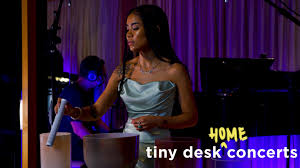
The set begins with Aiko stirring a singing bowl, which I admit is pretty nice. I have a tiny one, but it’s nowhere near as cool as hers are.

Backed by an ensemble of masked players, Aiko bookends her set with a sound bath of singing bowls that’s peace personified through sound.

I appreciated the way the note of the singing bowl segues perfectly into Julian Le’s opening piano for “Lotus (Intro).”  Aiko has an old-fashioned vocal style–deep and breathy.

The short song fades out and in comes Brain Warfield’s thumping percussion and a gorgeous harp trill from Gracie Sprout that signals “Stranger.”

It is also short and as it fades and she drinks some tea, the bass from Bubby comes sliding in to open “Do Better Blues.”  The song pauses and she says she wants only three things in a relationship:

Eyes that won’t cry ; lips that won’t lie ; love that won’t die

Things slow down to the piano and chimes as the band jumps into “To Love & Die.”  Iam quite impressed wit her vocal restraint.  There’s a few moments of R&B diva wailing, but mostly, she sings very nicely and prettily with no histrionics.

This works especially well on “Born Tired” which opens with just a harp.  It’s impressive how well this acoustic setup works with these songs.

This medley of songs is disconcerting because everything is so short. She only plays two minutes of “Born Tired,” before Bubby’s high chords on the six string bass introduce “W.A.Y.S.” which has the most R&B styled-vocals so far.

“Summer 2020” opens with harp and piano and a spoken introduction from Jhené  as she introduces the “quarantine edition” of her band.  After a verse she throws in a verse from “Everything Must Go” without changing the music.  I do have to wonder about the mindset of someone who writes the lyrics:

I am no god or messiah
But here’s what I know

Three chimes on the singing bowls introduce “Eternal Sunshine” as she sings almost a capella.  The band comes in to flesh out the song and she ends with a lengthy R&B warble which quickly fades out as the song comes to an end.

I’m still not sure if she’s a star, but I am really impressed with her voice and musical choices in this set.  Often, I have found that when I really like an R&B performer’s Tiny Desk, it’s because of the way it is stripped down–both instrumentally and in production terms.  So I’m not going to listen to her album because this set was a perfect introduction to her and just enough for me to enjoy.

[READ: September 24, 2020] “The Intensive Care Unit” 

During the COVID Quarantine, venerable publisher Hingston & Olsen created, under the editorship of Rebecca Romney, a gorgeous box of 12 stories.  It has a die-cut opening to allow the top book’s central image to show through (each book’s center is different).  You can get a copy here. This is a collection of science fiction stories written from 1836 to 1998.  Each story imagines the future–some further into the future than others. As it says on the back of the box

Their future.  Our present.  From social reforms to climate change, video chat to the new face of fascism, Projections is a collection of 12 sci-fi stories that anticipated life in the present day.

About this story, Romney writes

When I first thought about stories for this collection, I knew J.G. Ballard had to make an appearance.  Initially, I had chosen an entirely different piece.  Then COVID-19 came to the United States and I learned how very bad I was at predicting the future.  ‘The Intensive Care Unit’…is a story about living entirely in isolation: no human-to-human contact, ever. Even families live together through screens, not physically in the same space.

Frustratingly, she ends with

I’ll leave you to guess which other Ballard story this one replaced.  [I don’t know him well enough to even hazard a guess].

I haven’t read many J.G. Ballard stories, but I have it in my head that all of his stories are very dark and very violent.  The few that I have read certainly were.  And this one is no exception.

It’s starts off with a violent sentence: “Within a few minutes the next attack will begin.”

The room he is in is filled with his wife’s faint breathing, his son’s irregular movements, marked by smeared hand prints on the carpet, and his daughter’s limp body under the fallen lamp. (more…)

Read Full Post »

SOUNDTRACK: GARCIA PEOPLES-Hear Here Presents (2020).

Sometimes it takes a band you like to introduce you to something you didn’t know about.

Like Hear Here Presents, a non-profit studio in Wisconsin that records bands in a small setting with great audio quality.  And there are some fantastic bands (and yes, many many more that I haven’t heard of) on their page.

The band just released their session from this live show on bandcamp.

Back in January, Garcia Peoples went into the studio at Hear Here Presents for a session.

I’m not sure how long the sessions usually are, but this one runs about 35 minutes and consists of two songs.

Up first is what they are calling “Hear Here Jam.”  It’s 12 plus minutes of  a jamming instrumental.   It’s impression how tight these guys are that they can improv for 12 minutes and not only not step on each others toes, but actually make a composition that sounds interesting.

There’s a raging guitar section at around three minutes and an impressive build to a peak around 8 minutes before finishing up a few minutes later.  Having the three guitar of Tom Malach, Danny Arakaki, and Derek Spaldo allows for terrific interplay and a depth of sound.

That depth of sound is really evident on the second song, which opens with the introduction to “One Step Beyond.”  Of course, before they start that, there’s some tuning to be done, with some snippets of recognizable riffs:  Close Encounters of the Third Kind, “Hey Joe,” “Sweet Child of Mine.”

But once everyone is ready, it’s down to business.  It’s fun picking out which guitars are playing what in the complex intro to “One Step.”  It’s impressive the way the three guitars can keep the looping melody original and changing while bassist Andy Cush more or less take a lead role.

It’s also important to keep an eye (or an ear) on drummer Cesar Arakaki because he can keep a beat and keep it from being dull as well.

Then after nine and a half minutes of intro, the band shifts gears into the rocking “Feel So Great,” a terrific song with a fantastic musical bridge.  Ringing guitars and a super cool bass line propel the song before the chill chorus.

Not content to let a short, catchy song end their set, they proceed to stretch of “Feel So Good” starting around 15 minutes.  Multi-instrumentalist Pat Gubler trades his keyboard for flute as the psychedelia commences.  After some raging guitar work up until about twenty minutes, the band slows things down to ring to a close.

The only thing disappointing about this set is that when the song is over, you can hear them talking and someone says, “we can do another one,: just as the audio cuts out.  What else did they play????

[READ: September 24, 2020] We All Die Naked [an excerpt]

During the COVID Quarantine, venerable publisher Hingston & Olsen created, under the editorship of Rebecca Romney, a gorgeous box of 12 stories.  It has a die-cut opening to allow the top book’s central image to show through (each book’s center is different).  You can get a copy here. This is a collection of science fiction stories written from 1836 to 1998.  Each story imagines the future–some further into the future than others. As it says on the back of the box

Their future.  Our present.  From social reforms to climate change, video chat to the new face of fascism, Projections is a collection of 12 sci-fi stories that anticipated life in the present day.

About this story, Romney writes

[In 1896] Svante Arrhenius first calculated the increase in Earth’s surface temperature caused by increases in industrial carbon production — what we now know as the greenhouse effect. …  As far as I know, James Blish is the first science-fiction writer to imagine an apocalypse caused by climate change due to carbon dioxide emissions.  It’s a biting satire, simultaneously bleak and gregarious, that catches the characters on the brink of catastrophe through climate change.

To me, this story felt a little preachy.  But then, I’m reading it after fifty years of this kind of story already existing.  I imagine it was pretty impactful back in the era of Silent Spring (if sci-fi ever had an impact on anything).  And, indeed, it’s still pretty impactful given how many things he gets right.

The protagonist, Alexei-Aub Kehoe Salvia Sun-Moon-Lake Stewart, Sa. D., is forty and set in his ways.  He is the General President of Local 802 of the International Brotherhood of Sanitation Engineers.

Blish was eerily prescient to 2020 in one aspect of the story

Adjusting his mask–no matter how new a mask was, it seemed to let in more free radicals from the ambient air every day–he put the thought aside and prepared to enjoy his stroll and his lunch.

But some things are more grim.  The roads around Times Square, Wall Street and Rockefeller Center are all canals. (more…)

Read Full Post »

SOUNDTRACK: NUCLEAR POWER TRIO-“A Clear and Present Rager” (2020).

Today was one of the best days America has seen in four years.

Because here’s an EP to rock your politics off.*

Nuclear Power Trio is a band made up of Vladimir Putin on bass, Kim Jong-un on drums and Donald Trump on guitar.  And they totally rock. This first song from their new album is an absolutely rager, as the title says. It’s a three and a half minute instrumental that starts off with a monster riff and some really hightech fretwork from Putin on the bass.  When the main “verse” comes in, Trump shows his amazing dexterity on the eight string guitar.  He plays surprisingly tasteful licks in between the shredding. This is some pretty classic rocking instrumental stuff ala Joe Satriani, but with the whole band totally keyed in.

A big surprise comes a minute and 45 seconds in when an unnamed fourth member (in the video he appears as a secret service agent) plays an gentle acoustic guitar break, allowing Trump to do some gentle volume-controlled notes. This quiet section happens twice and after the second one, Putin just goes mental on the bass while Kim Jong-Un shows what impressive double bass capabilities he has.

The video for this song is rather disturbing.

But I gotta say, I’d much rather have these three nutcases in a kick ass band than in charge of any country.

[READ: September 24, 2020] The Space Merchants [an excerpt]

During the COVID Quarantine, venerable publisher Hingston & Olsen created, under the editorship of Rebecca Romney, a gorgeous box of 12 stories.  It has a die-cut opening to allow the top book’s central image to show through (each book’s center is different).  You can get a copy here. This is a collection of science fiction stories written from 1836 to 1998.  Each story imagines the future–some further into the future than others. As it says on the back of the box

Their future.  Our present.  From social reforms to climate change, video chat to the new face of fascism, Projections is a collection of 12 sci-fi stories that anticipated life in the present day.

About this story, which was translated by Andrea L. Bell, Romney writes

the wonders of robot-controlled automation allow people to live in ease within the perfect mechanism of a programmed city–but in the end lead to ineffable discord within the mind of the protagonist.

This story was a little hard for me to wrap my head around.  The story follows P. as he makes his way through his daily life in Arconia.

P. is an evaluator.  But P. was distracted.  Not only did he not mind having evaded his work, he felt euphoric about it. This was not normal. (more…)

Read Full Post »

« Newer Posts - Older Posts »