Feeds:
Posts
Comments

Archive for the ‘Revenge’ Category

lastman1 SOUNDTRACK: BLACK PRARIE-Tiny Desk Concert #262 (January 14, 2013).

blakcpBlack Prarie is 3/5 of the Decemberists (that seems like a hint directed at Colin Meloy, ha ha).  No actually they are a kind of folk-country band “started by Chris Funk and Nate Query, who wanted an outlet for some of their rootsy, mostly instrumental string-band wanderings.”  Jenny Conlee from the band has also joined on accordion.  That leaves Annalisa Tornfelt’s who sings “sweetly countrified vocals and [plays] violin.” I feel a little bad for the other guys in the band who are not mentioned, but I don’t know their names either.

They play three songs.  “Dirty River Stomp” is a fun instrumental with prominent accordion in the beginning and then a banjo solo and then a violin solo.  It is indeed a big stomping song.   I love the way the song sounds like it has built to an ends but there is a small accordion coda tacked on.

For “Nowhere Massachusetts” there’s a switch from banjo to guitar.  The opening section of the song sounds so much like Guster’s “Careful” that I was sure that’s what song this was.  But indeed, it is not and it goes in a very different direction after that intro.  Coincidentally, Guster also has a song that about Massachusetts (“Homecoming King”).  But this sounds really nothing like Guster once the song starts—there’s accordion and slide guitar and fiddle and of course the vocal melody is very different.

Jenny introduces “Richard Manuel” with “We’re gonna rock this out.  We’re gonna bring it.”  It turns out to be a fairly slow, quiet song.  But with some intense lyrics.  And again there is some great accordion work on this track.

As the show fades out there is much excitement about tote bags, although I’m not sure who is getting what.

[READ: December 15, 2016] LastMan 1

This is the final series of older First Second books that I hadn’t read yet.  I brought home this book 1, some time ago, but when I saw that there were six volumes and that they’d all be released relatively quickly, I figured I’d just wait until they were all out and read them closer together.

This book was originally written in French (and called Lastman there as well).  These editions were translated by Alexis Siegel.

The art is black and white (and grayscale) and the characters are what I can only describe as very French looking. The faces are very minimal, with some of them looking almost bleached out but for eyes and a mouth.  Some of the men are rather grotesque-looking while the one woman is a knockout.  (The book is safe for younger teens, with just a cleavage and an underwear shot, although the whole book is about fighting).

So the story is a little confusing (at least in Book 1).  The main plot is not at all confusing, but the context is never given, so we must try to piece it all together,

Set in an unamed village, the 184th annual Tournament of the Realm is coming up.  We first meet young Adrian who is practicing for his first competition tomorrow.  His teacher is Mr Janesen (with a full head of blond hair and a goatee) and while he is hard on them, he seems fair.  He tries to get Adrian to really harness his powers for the battle. (more…)

Read Full Post »

two-worse  SOUNDTRACK: CHEICK HAMALA DIABATEN-Tiny Desk Concert #285 (July 6, 2013).

hamalaNPR Music has been the sole source of my exposure to music from Mali.  I have really grown to like its slightly unusual patterns which are all based on a fairly standard rock structure.  But unlike some of the other Mali musicians I’ve been exposed to, Diabaten does not play guitar.  He plays banjo and the ngoni (but there is plenty of guitar in the song too).

The blurb tells us

Malian tradition lies at the heart and foot-stomping soul of Cheick Hamala Diabate and his band, but their melodies and undeniable rhythms cut across age and ethnicity. Diabate primarily plays the ngoni and the banjo; think of the ngoni as a great-grandfather to the banjo and it all makes sense, because both instruments share the ability to convey melody and plucked percussive rhythm.

Diabate is from Kita in Mali and born into a family of griots, or storytellers; his first cousin is the legendary kora player Toumani Diabate. Cheick Hamala Diabate makes his home these days in a Maryland suburb a few miles over the D.C. line, and his musicians are American-born and inspired by this lively lyrical music, which often tells a tale about Mali and its people as part of the sway and shake.

“Mali De Nou” sounds fairly traditional–with all of the percussion.  And then about a minute and half in a noisy scratchy guitar solo plays over all of the music–a very Mali sound.  But it’s interesting that, for the beginning anyhow, Diabate isn’t doing all that much.  In fact, the song feels almost overwhelmed by percussion (but in a good way). There’s a shaker or two, big floor drums (congas?) and a drum held between the knees and there’s even that big round gourd drum.

There’s also a sax and a bass, the lead guitar and of course, Cheick’s banjo.  By the middle of the song,  Chieck does some lead banjo playing.  And then it sounds like he’s put some effects on the banjo making it sound almost like a kettle drum—he even plays the strings below the bridge.  He really gets a lot of cool sounds out of the instrument

After this song he chats briefly and wants to “Invite you guys to visit Mali, it’s a beautiful country, you’ll be more happy.”

For “Talcamba” he switches to the ngoni.  He explains that the original ngoni had 4 strings, but his has 7 so he can play…more.  This instrument can play reggae, salsa, everything.  This is when he says the American banjo is like the grandson of ngoni.

Tacamba is a dance from north Mali—you can move your body (he waves his arms).  There are vocals but they are mostly a chanted refrain   The solo on the ngoni isn’t a conventional solo, it’s him flicking the strings making a very interesting sound.  I could have used more close-ups of this instrument as you could barely see the strings, and I’d love to see how he fit 7 on that small neck.  Half way through the song it shifts gears and the tempo really picks up—there’s a fast guitar solo with all that percussion keeping up.  And then the percussionist puts down her shaker and starts dancing in the center of the room.  It feels inspired and impromptu and it’s a lot of fun to watch.  While she’s doing that, Cheick picks up a hand drum and starts creating a new rhythm.  It is joyful and celebratory.

For the final song, “Djire Madje,” he switches to acoustic guitar which he plays lefty upside down (so the high notes are at the top).  He plays the lead riff.  At one point the electric guitar is also playing a lead but in a very different styles and they work very well together.

[READ: October 10, 2016] The Terrible Two Get Worse

I really enjoyed The Terrible Two, and this sequel is just as enjoyable.  The pranks are bigger, but the victim has changed.  Why?

Because Niles Sparks’ and Miles Murphy’s pranks got their principal fired!

Principal Barkin was the perfect guy to play a prank on–he had no sense of humor, he was pretty jerky and his face got really purple when he was upset.  But Principal Barkin is nothing compared to his father.  We met his father in the previous book–he yelled a lot, especially at Principal Barkin.  You see, the principal’s father was the previous principal, and he was a tough guy–he took no guff from anyone.

So after a delicious opening prank, Niles and Miles set about to making a great prank on Photo Day.  One of the great things about these books is the illustrations (by Kevin Cornell).  Sometimes the text incorporates the illustrations into the story. Like with Picture Day–the hilariously bad “pictures” absolutely make the sequence.  But it’s what they do to Principal Barkin’s son (who has paid the extra $10 for a gray background) is frankly genius.

But even better is what they have done to the whole school photo– a prank many months in the making.

(more…)

Read Full Post »

two SOUNDTRACK: MOHAMMAD REZA SHAJARIAN-Tiny Desk Concert #276 (May 20, 2013).

rejaI had never heard of Mohammad Reza Shajarian, but I see that he was voted one of NPR’s 50 Great Voices.

With the visit of the incredible, honey-voiced Mohammad Reza Shajarian from Iran, we lucked out by having him sing on not just any day, but on the biggest holiday of the Persian calendar: Nowruz, the New Year.

Shajarian is accompanied by brothers Sohrab and Tahmoures Pournazeri (celebrated musicians in their own right) and French percussionist Robin Vassy.

They play one song, an improvised piece called “Az Eshgh (Love Song).”  There is an upright, bowed instrument, the Kamancheh which plays the lead melody for much of the song.  The rest of the music comes from the Tar, one of the most important musical instruments in Iran and the Caucasus.  It has a rather tinny sound.

Meanwhile, the drummer has several different gourd drums.  He hits one with his fist and scratches the notches on the side.  Around three and a half minutes in, he starts blowing into this whistle-like object that makes a wind sound.  He also has two gourds that are floating in water.  He takes one out and we can hear the dripping.  He gets almost two minutes of a solo to play all of these sounds.  Its very cool.

Interestingly, even though this Tiny Desk is all about Shajarian, he doesn’t sing all that much.  But when he does, it’s quite powerful.  As the blurb says:

In the course of this love song, titled “Az Eshgh,” Shajarian unleashed torrents of swooping, soaring, goosebump-inducing sound — still perfectly controlled at age 73.

[READ: September 20, 2016] The Terrible Two

I love Mac Barnett.  He’s one of my favorite children’s authors.  I only know Jory John a little but I’ve enjoyed what I’ve read by him.  There are also fantastic illustrations by Kevin Cornell to make this book a delightful story about pranksters.

The book opens in Yawnee Valley, a quiet place where cows are the main thing.  Literally.  They are everywhere–and you hear them mooing all day and night (and throughout the book).  Miles Murphy (the dark haired boy on the cover) is moving to Yawnee Valley.  And he is not happy.  He has already sighed 100 times that day.  He hates the thought of leaving his friends and starting a new school.

Page twelve lays out an excellent summary of what it’s like to be a new kid in a school.  What kid are you going to be?  chess kid? basketball kid?  front-row kid? kid who’s allowed to see R-rated movies?  Kid whose family doesn’t own a TV and just wants to watch your TV?  And so many more options.  But Miles knows who he is.  He’s the prankster.

But when he gets to school (this is the first day of school), someone has moved the principal’s car to the front of the stairs–blocking the front door. Looks like Yawnee Valley Science and Letters Academy already has a prankster.

The principle is Principal Barkin.  He loves being principal of the school, as his father and his father and his father and his father had been.  There was one embarrassment in the family chain of command–the principal who actually closed the school during a blizzard, but otherwise, their record was sound–no closures.  And Barkin’s own son was poised to become the principal as well. After all, he had been elected president the past two years–just as had all of his ancestors–president and then principal–that’s the plan.

But this first day of school was not a good day for Principal Barkin.  And Chapter 6 lists the 40 things that happened as soon as he found out that his car was blocking the main entrance (none of them were good for him).

Principal Barkin suspects and questions everyone for being responsible for doing this prank.  And when he sees Miles–the only child he doesn’t recognize–he automatically assumes he is guilty.  Miles assures him that he didn’t do it.  Principal Barkin says okay but he will have his eyes on him.

Barkin then gives him a book called 1,346 Interesting Things You May or May Not Know About Cows.  He also gives Miles a buddy.  The buddy is named Niles.  He is dressed in a blazer with a sash that reads “school helper.”  The introduction goes like this: “Niles is the student who first told me abut my car.  Miles is the student who I suspect moved it.”

Niles is the most cheerful, obnoxious child Miles has every seen.  And he will not let up.  Niles introduces Miles to people (like Holly the girl who sits next to him).  He states the obvious.  And he tells Miles about Josh Barkin, the Principal’ son.  And boy is Josh a jerk.  Josh intentionally hits Miles in the face with his backpack as he walks by.

Niles says “while i don’t want to call anyone the worst, Josh is pretty mean sometimes…also he really likes the word nimbus for some reason.” (Josh calls everyone a nimbus as an insult).

Another kid who makes a lot of noise and is used mostly for comic effect is Stuart, Stuart talks in all caps and really really states the obvious.  Everyone hates him.

Miles is still pretty bummed about someone else being the school prankster.  But when Josh comes over in the cafeteria to give him a hard time, Miles deliberately dumps his food all over himself and then manages to blame Josh.  Josh says he didn’t do it, but Niles supports Miles.  When Miles asks why he would lie for him, Niles says that Josh made him swallow a rock over the summer–twice.

Miles gets home an has a kind of rough night.  So doe Principal Barkin whose father calls to yell at him for the embarrassment of his school day.  But while Bakin is beaten down, Miles is inspired.  And he comes out with his greatest prank ever.

The awesome birthday party of a boy he just made up, Cody Burr-Tyler.  The plan?  Make the party secret, tell only a few people and then watch everyone show up with presents.

It’s a great plan and it works.  And just as he is about to reap his rewards, Cody Burr-Tyler shows up and steals the show.  What just happened?

I don’t want to spoil who the prankster is.  He is impressed by Miles but sees some serious flaws.

Like the birthday party–did Miles really think he could fool the entire class and walk away with a bunch of presents and have people still like him?  He had to learn to be subtle.

And so the prankster offers to let him join forces to become a great pranking team.  But there is no way Miles is going to join forces with HIM.  So instead, Miles challenges him to a prank battle.

And the rest of the book is a series of escalating pranks.  The whipped cream one is outdistancing as is the diorama double cross (everything about the plan is genius–on both sides).

Can these two join forces to torment the person who most needs some comeuppance?  (Yes).  But what can they do that will really be a spectacular prank that people will talk about for years?

I was surprised and delighted by the final prank and I love the way they pulled it off.

I’m really looking forward to book two.


Read Full Post »

nySOUNDTRACK: THE SECRET SISTERS-Tiny Desk Concert #564 (September 12, 2016).

secretsisThe Secret Sisters are, in fact, Lydia and Laura Rogers, two sisters from Alabama.  They sing pretty folk/country or even traditional songs and have wonderful harmonies.

“Tennessee River Runs Low” is from the point of view of the river (and is really quite delightful).  It comes complete with an “oh de oh de oh de oh” section.  The music is pretty simple (just a little strummed guitar) and their wonderful voices.

After the first song she says that she has seen lots of Tiny Desk Concerts and they’re thrilled to be there.  It’s more spacious than you might think.  They could square dance there–except they can’t square dance.  She says that it feels kind of like being a zoo animal.

The second song is “a super duper sad song.”  Since their previous record came out they have both gotten married–to different men, she clarifies.  (Well, they are from Alabama, they joke).  They don’t know what to write about anymore–who wants to hear happy songs?

“You’ve Got It Wrong” is indeed a sad ballad–a very pretty, very traditional sounding country song.  Their voices really sell it.

Before the final song, she says that “if you want to be happy and in a good mood don’t ever come to one of our shows.”  They only play downer music. She explains that  they grew up singing gospel in a church that had no musical instruments.  It was only their voices and no solos or choirs.   She didn’t realize they were learning how to sing at church–that’s where their harmonies come from.

So they are doing an old gospel number, “Flee as a Bird.”  The melody of the verses its wonderful–the kind I’ve never heard in a church song before.

I would never see these guys in concert, but fora Tiny Desk, their songs were quite lovely.

[READ: March 7, 2016] “A Spoiled Man”

This was a lengthy story that seemed to speak to the futility of life.

There were a lot of details which made the story really interesting, but as I think about summarizing it, I realize that the story is bombastically a man lives, succeeds, fails and dies.

Fortunately Mueenuddin tells a lovely winding story that shows just how much a man’s life can change.

The story is set in Islamabad and the main character is Rezak, “a small, bowlegged man with a lopsided, battered face.”  He is outside of the mansion of a local man who has recently married an American woman.   The woman proves to be a nice person who genuinely seems to enjoy her new life.  In Pakistan.  And people liked her as well.

Rezak tried to make himself useful around the mansion. Despite his appearance, he is a strong man and he does wind up helping the workers.  At the end of the day they invite him for dinner, but his pride makes him refuse. (more…)

Read Full Post »

thrilignSOUNDTRACK: ADIA VICTORIA-Tiny Desk Concert #545 (June 30, 2016).

adiaAdia Victoria has a rough, raw voice that goes well with her simple, exposed guitar sound.  The blurb says her music “carries the singular perspective of a Southern black woman with a Seventh Day Adventist upbringing, who never felt like she’d fit in.”

She sings three song, mostly in a great, raspy voice.  For “Stuck in the South” she actually seems to be gritting her teeth as she sings: “I don’t know nothing ’bout Southern belles / but I can tell you something ’bout Southern hell.”  When the first verse ends, and her band kicks in, it adds such interesting textures.  A distorted bass and a lead guitar playing quietly distorted sounds.  This song is really captivating.

“And Then You Die” with its swirling sounds and keyboards has a very distinctly Nick Cave feel–gothic in the Southern sense of the word.  Indeed, the first verse is spoken in a delivery that would make Nick proud. This is no to say she cribbed from Cave but it would work very well as a companion song  I really like the way it builds, but the ending is so abrupt–I could have used some more verses.

After the second song the band heads away and Bob says “They’re all leaving you.”  She looks at them and growls, “Get off the stage!” to much laughter.

She sings the final song “Heathen” with just her on acoustic guitar.  It is a simple two chord song.  It’s less interesting than the others, but again, it’s the lyrics that stand out: “I guess that makes me a heathen, something lower than dirt / I hear them calling me heathen, ooh like they think it hurts.”

I’m curious to hear just what Adia would do with these songs when she’s not in this Tiny format.  I imagine she can be really powerful.

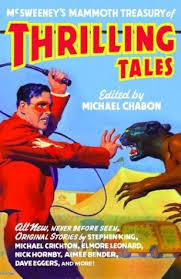
[READ: November 23, 2016] McSweeney’s Mammoth Treasury of Thrilling Tales

For some reason or another I have put off reading this McSweeney’s volume for many years.  This is technically McSweeney’s #10, although it was also released in this printing from a  major publisher. Sadly for me, my McSweeney’s subscription had expired sometime around here so I’ve never actually seen the “official” Volume 10 which I understand has the exact same content but a slightly different cover.

One of the reasons I’ve put off reading this was the small print and pulpy paper–I don’t like pulpy paper.  And it was pretty long, too.

But I think the big reason is that I don’t really like genre fiction.  But I think that’s the point of this issue.  To give people who read non-genre fiction some exposure to genre stuff.

Interestingly I think I’ve learned that I do enjoy some genre fiction after all.  And yet, a lot of the stories here really weren’t very genre-y.  Or very thrilling.  They seemed to have trappings of genre ideas–mystery, horror–but all the while remaining internal stories rather than action-packed.

Which is not to say I didn’t enjoy anything here. I enjoyed a bunch of the stories quite a bit, especially if I didn’t think of them as genre stories.  Although there were a couple of less than exiting stories here, too. (more…)

Read Full Post »

castle SOUNDTRACK: TINDERSTICKS-The Waiting Room (2016).

tinderstIt had been four years since the previous Tindersticks album.  And this one was not released on Constellation Records, but rather on Lucky Dog.  Whether or not that had anything to do with the sound of this record I don’t know, but I really like this album a lot.

“Follow Me” is a slow broody melancholy instrumental with a high accordion playing a lovely melody.  It’s completely evocative.  “Second Chance Man” has a kind of unsettling vibrato on Staples’ voice.  But the melody (sparsely played initially on keyboards) is really catchy.  The rest of the band fleshes out the sound after a verse and chorus.  I love that it builds in the middle and then again at the end with horns lifting the gloom off the song.  “Were We Once Lovers” has a thumping bass line and an uptempo feel as Staples’ sings in a kind of falsetto.  I love the way all of the parts form together in the chorus that’s introduced by a simple but effective guitar: “How can I care if it’s the caring that’s killing me.”

“Help Yourself” opens with some soulful horn blasts and Staples’ whispered vocals.  The bass keeps the song going as occasional horn blasts accent this strangely catchy song.  Staples also sings in an uncharacteristically angsty style in this song, which is strangely unsettling as well.  I love the way the song keeps circling round and then almost surprising the chorus when it comes back.

Whenever Tindersticks use a female guest vocalist, they really seem to step up their game.  “Hey Lucinda” is an incredibly catchy song, starting with simple bells and an accordion playing a great melody.   When Staples’ deep voice is balanced by the exotic voice of Lhasa, it makes for a great pairing.  It’s unusual for a catchy song to be so spare, but the simple accordion accents really hold the song together before it takes off near the end.

“This fear of Emptiness” is another gentle instrumental with bass and acoustic guitar accompanied by accordion sections (sometimes dissonant near the end).  “How He Entered” is another spare song with mostly bass and keys and an occasionally scratching sound as an ascent.  But it’s still a very catchy melody.

“The Waiting Room” has that same echo on his voice as he slowly sings over a keyboard melody.  His anguished singing of “don’t let me suffer” totally makes the song.  “Planting Holes” is a short delicate instrumental with a sweet but melancholy keyboard riff running through it.

Perhaps the most dynamic song on the disc is “We Are Dreamers!”  It’s the angriest song I can think of from Tindersticks, with rumbling keyboards and tribal beats as Staples sings bursts of vocals.  But it’s when Savages’ singer Jehnny Beth adds her voice that the song turns really aggressive.  They sing the chorus “This is not us/ We are dreamers!”  And as Beth takes over the chorus, shifting pitch and intensity, Staples is commenting including lines like “You can rob us/ You can trick us/ Peer over our shoulders and steal our ideas”

The final song is “Like Only Lovers Can.”  The delicate and pretty keyboards belie the sadness in the lyrics: “We can only hurt each other the way lovers can.”  The quiet keyboards end the disc.

[READ: March 15, 2016] Castle Waiting Volume 2

I loved Castle Waiting.   And I couldn’t wait to read Volume II.

And I loved it even more.  Linda Medley is such an engaging storyteller.  Her characters feel utterly real and funny and charming.  I could read more and more and more from her.  Which is why I am so bummed that the series ends here (with rumors that she is doing more).

This volume is a bit more playful.  The characters are well-established and settling into their lives at the castle.

As in the previous volume, there are a lot of flashbacks to Jain’s childhood.

But there’s also a lot of wonderfully meandering stories in the present. The man who looks like a horse (literally) has injured his hoof, so he is hobbling around and is not as useful as he might be (and is cranky about it).

But the main story centers around the arrival of two dwarves, I mean hammerlings–only racists would say dwarves.  They are the relatives of Henry, the quiet blacksmith (who is actually human, but was adopted by the dwarves).  Henry is super excited to see them (as excited as his monosyllabic grunts allow him to be).  Actually, we finally learn why he is so standoffish and quiet most of the time.

They are here for a very specific an(and embarrassing) purpose.  They need women’s clothes for the human who works with them back home.

Their presence enlivens everyone in the Castle. They are fun and interesting–enjoying hard work and being very playful. It is with their help that the Castle dwellers do some remodeling, find a booby trap and even learn how to play nine pin bowling.  The older women who still live in the castle take some bets about who will win–with much merriment.  I love that there a whole chapter about them bowling.

There’s a subplot about Jain’s son Pindar being a leshie–a species we learn a bit about, although we also learn that they are extinct.  This plot line is never concluded properly, though.

We also finally learn about Doctor and his crazy mask (it was a sort of gas mask for the plague).  They are all worried about his sanity, especially when he starts walking around wishing everyone a happy Yule (the Christmas stocking subplot is outstanding).

Speaking of Jain, she has decided to move into the Castle (where there is indeed a ghost).  But her kindness appeases the ghost somewhat.  Especially when she teaches Simon to read (I love the scene where he learns to read and then sits at the table reading instead of eating–just like in my house).

There’s a hilarious thread about a very stubborn goat (whom Simon can outsmart).  And a multi-chapter thread about Sister trying to get a cross for Jain’s room.  We finally get to the bottom of the house sprites (they are adorable when we finally find out what they want).  Finishhtory!  Finit!  Reetoomee.

I am so attached to these characters, that I need to hear more about them.

As in the previous book,Medley’s art is simply gorgeous.  She does realism like no one I know and her characters have an awesome blend of realism and hyper-realism that makes them so enjoyable to look at (and unbelievably detailed as well).

There have been a number of graphic novels that I have gotten completely attached to, but none like this.  It was so bittersweet to finish this, knowing there’d be no more–but holding out hope for a surprise some day.

Read Full Post »

castlewaitingSOUNDTRACK: TINDERSTICKS-The Something Rain [CST086] (2012).

tinders This was Tindertsicks third and final full length album for Constellation.  It has some noisy elements–especially the distorted guitar–that feel different from their other releases.  Although overall I find the album a bit too slow and drawn out.

The first song on this disc, “Chocolate” is quite unlike other songs by the band.  It is a 9 minute slow song with a spoken word story delivered by by keyboard player David Boulter.  The music sets a nice tone for this story of living in a squalid bedsit and heading into town.  As the song picks up momentum, the guitar lines and the rest of the band add more atmosphere.  In the story, he goes to the bar to play some pool and picks up a woman–a regular.  By six minutes, the whole band, including horns is playing and the song is louder and more noisy while the story continues.  For the final two and a half minutes the band drops out and the denouement reveals a secret.  It’s a cool story, well delivered.

“Show Me Everything” opens with some slow bass and a buzzy electric guitar as the backing voice sings “show me…”  And, after ten minutes on the disc, we finally hear Stuart Staples’ iconic voice sounding deep and whiskery as lawyers.  I love the songs with the female backing vocals like this one.  “This Fire of Autumn” is a faster song with a throbbing bass line and catchy chorus (with more backing vocalists).  The addition of the vibes makes this a great Tindersticks song.

“A Night so Still” slows things down almost to whisper with the gentle keyboard riff under Staples’ languid delivery.  “Slippin’ Shoes” is a bit more upbeat and the horns come in right at the front of the song.  I love the way the bridge seems almost sinister and slick before resolving into a bright chorus.  “Medicine” is another slow song with multiple layers of guitars and slow horns and strings.

“Frozen” opens with slow horns that sounds like feedback, almost.  When the fast bassline and almost discoey drums come in, it’s kind of surprise, but a nice pick me up from the previous slower songs.  Staples is singing quickly over himself–the echoes of his voices catching up to his new lines. And the scratchy guitars and jazzy horns make a nice moody soundtrack of him pleading “If I could just hold you, hold you.”

“Come Inside” is  7 minute song with a simple keyboard riff that floats over the slow beat.  There’s a long slow jazzy outro–too long frankly.  The final song is the 2 minute “Goodbye Joe.”  Its all tinkling bells and a shuffling bass, a pleasant instrumental to end the disc.

While Tindertsicks albums tend to be kind of slow, this one has a few too many extended slow parts and not enough of Staples’ magical crooning or the more dramatic sounds that the band does so well.  I’m not sure why their next album was not put out by Constellation, ether.

[READ: February 15, 2016] Castle Waiting 1

I have been aware of Castle Waiting for a long time.  I believe I have even picked up an individual book at the comic book shop (of course I never read it because I wanted to start from the beginning).

So this book collects Chapters 1-19 (plus an epilogue).

I was instantly hooked by Medley’s outstanding drawings–so believable and realistic while exaggerated enough to make them all unique characters.  Not to mention the fact that there are humans and human hybrid creatures (and no one bats an eye).  And then top it off with the incredibly creative first chapter.

The story opens with a king and queen having a baby.  Actually they couldn’t have a baby so they employed a local witch for assistance.  The nice witch gives them good advice but when the town’s evil witch hears of this betrayal she plans to curse the baby.  And thus on the girls’ fifteenth birthday, the evil witch says she will prick her finger on a needle and die.  This should sound vaguely familiar to fans of fairy tales   But Medley puts a twist on things immediately by removing all needles form the castle and hiring a creature named Rumpelstiltskin to do all of their work off site.  Rumpelstiltskin has been cut in half and stitched together so when the creature asks for the Queen’s child in payment, the King yells at him and says he knows what kind of trouble that leads to.

The good witch is able to deflect the curse somewhat to make her sleep for 100 years (that should also sound familiar) rather than dying.  So, when the girl’s fifteenth birthday arrives, the bad witch comes and brings a needle to set the plan in motion.  The princess falls asleep–the whole castle falls asleep and, in a neat twist, the bad witch is killed.

And then Medley has a ton of fun with the story.  When the prince comes to wake up the princess, they run off an get married.  And there’s a hilarious multiple paneled spread of the rest of the castle sanding there, mouths agape.  As the scene ends, we see three older women telling a man with a bird’s head that that all happened along long time ago.  And the castle has been a refuge ever since. (more…)

Read Full Post »

sandwalkerSOUNDTRACK: SACKVILLE-Low Ebb EP (1996).

lowebb Sackville was a Montreal based folk group who released one album through Constellation Records, and a couple of other releases on other labels.  When they broke up, most of the members of the band went on to play with other bands, many of whom were later released on Constellation.

The focus of the band is really singer/guitarist Gabe Levine whose voice shows a lot of folk, rock and avant garde influences.  His voice sounds at once familiar and also strangely unique.

And this EP was their first release.

The first song is “Messengers.” I love the way the violin cuts through the slow verses to add a great melody to the chorus (including some raw scratching sounds before the verse starts again).  There’s a hint of Mike Doughty in his delivery too. “Donkey Song” opens with some quiet verses and violins has a loud clamorous chorus—super fun and stomping with a nice side guitar riff.  “William” has a standard American folk song melody but the way he sings it is very Social Distortion (through a tinny modulator).  The fiddle gives it more of country sound, but still kind of alt

“Showcase Showdown”  opens with a cool slide guitar and very different vocal style delivered by Kurt Newman.  And the chorus is fund and perhaps a little silly in three-four  dance rhythm “your eyes scare us more than the mirrors on the dance floor.” It’s the most fun song on the disc.  “Low Ebb” continues with the more rocking sound with big brash guitar and crashing cymbals.  It also features some quiet but cool backing vocals—a kind of scream that acts as a drone.   “Thomas” opens with a slide guitar and quiet vocals, the chorus is a major highlight with the vocal duet playing against the loud crunching stop-start guitars.  “This Thing I Want, I Know Not What” is a straight ahead folk song with a lead violin and a pretty melody.  “Cheap” has a quiet melody ending with some slide guitars and violin.

It’s a solid E.P. with even better music on their full lengths.

[READ: June 25, 2016] Last of the Sandwalkers

This is a fascinating book that proves to be an amazing look at beetles and insects and a somewhat interesting adventure story.

I actually found myself a little confused by the story when it started because while I knew it wasn’t going to be realistic (the beetles are leaving their civilization to discover the world) it was also very rooted in real insect knowledge.  And then it got a little out-there so the level of reality in the story wavered from time to time and I found myself getting pulled out of the story to try to puzzle things together.

Which was a shame.  Another shame is that it doesn’t tell you that there are notes at the back of the book (do most people flip to the end to discover this?  Because I didn’t).  And the notes are one of the best parts of the book.  But more on that later.

The protagonist of the story is Lucy.  She is in charge of a small team who have decided to leave their home to go exploring.  Her team includes Professor Bombardier; Raef, a lighting bug (with a secret); Mossy, a giant beetle with a big horn and Professor Owen who has huge mandibles. They also run into Ma’Dog, an old storyteller who is rather cantankerous.

The story begins with Lucy’s diary as the teams sets out from Coleopolis.  They quickly discover Old Coleopolis which was destroyed by coconuts falling from a tree.  It was said that the city was destroyed 1,000 years ago by the god Scarabus, although Lucy can’t believe how not-overgrown it looks after 1,000 years.  It all seems very suspicious. (more…)

Read Full Post »

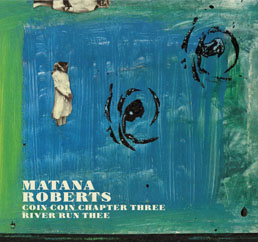
fakeSOUNDTRACK: MATANA ROBERTS-Coin Coin: Chapter 3 Mississippi Moonchile [CST110] (2015).

cst110cover_258x242I felt like the first Coin Coin disc was way too long, so imagine my surprise to discover that the whole Coin Coin series is planned as a 12 chapter collection!

Unlike the previous 2 chapters, this album was created entirely by Roberts.  She is credited with playing saxophone, Korg Monotron and a 1900s upright piano.  But like the others, the tracks bleed into each other and seem to end indiscriminately.

This disc also quotes from The Star Spangled Banner, Beautiful Dreamer, The Pledge of Allegiance, My Country ‘Tis of Thee, Lift Every Voice and Sing and All the Pretty Horses.  As well as samples from Malcolm X and a field recording of a travel through Mississippi, Louisiana Tennessee and NYC.

The first song, “All is Written” is 10 minutes long.  She sings quietly and starkly (voice breaking) while spoken words overlap behind her voice (and the saxophone and drones).  Her singing is at times pained and strained—aching with the truth of her words.  As “The Good Book” begins, the spoken word continues but the main sound is an industrial throbbing.  Near the end, a new metallic sound comes screeching in and then resolves into a kind of drone while angelic voices takes over for song three, “Clothed to the Land, Worn by the Sea” which is more pleasant.

“Dreamer of Dreams” resumes some spoken word and synth noises while two overlapping tracks of sax solos play.  “Always Say Your Name” has some more drones and a wild sax solo.  “Nema Nema Nema” experiments with analog synth noises while she sings a pretty melody with other voices circulating behind her.  “A Single Man o’War” has a high pitched drone. which is accompanied by several three note chants.

“As Years Roll By” is spoken words, with drone and church bells.   And lots of “Amens.”  “This Land is Yours” has lots of voices speaking and overlapping.  It ends with someone singing “come away with me come away,” which segues into “Come Away” with a noisy background and spoken voices talking about Zanzibar.  Then there is a keening, pained voice singing the middle. “JP” is a speech about he slave trade.

Although this album is difficult, it is more manageable than her other releases in this series.  But manageability clearly isn’t her plan, she is making a statement and it is exciting and frightening to listen to.

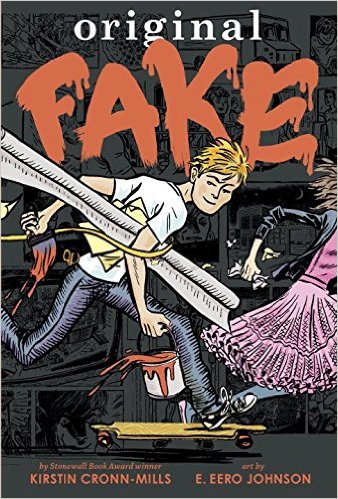
[READ: August 10, 2016] Original Fake

You should never judge a book by its cover.  But I really liked the cover of this book a lot.  And the title was intriguing, so I grabbed it off the new book shelf.

And what a great, fun story it was.

The book opens with Frankie sneaking into his school at 6:30 AM.  No one else is there except maybe the janitor.  He is sneaking into the school to do a small amount of vandalism. But the vandalism is not your typical vandalism.  On the school hallway is a mural that is currently being painted.  Frankie is an artist but he was not asked to paint the mural (no one really knows he does art).  The mural is a of a lake and farm fields and all that.  And he has decided to tag the mural.  He has painted a water-skiing abominable snowman giving the hang loose sign in the corner of the lake.  “He’s maybe six inches tall, and I kind of put him close to a rock so he’d blend in, but if you get close, its pretty obvious he doesn’t belong. He’s completely amazing.”

Amid the telling of the scene is a drawing of Frankie painting the snowman–this book is full of illustrations by Johnson.  Most of the illustrations complement the story but a couple actually tell the story, too. (more…)

Read Full Post »

class3 SOUNDTRACK: OUGHT-Sun Coming Down [CST115] (2015).

oughtsunSun Coming Down changes but also enhances the sound that Ought worked with on their debut. This album is faster overall–with fewer slow and mellow sections.  It is jittery and sometimes hostile but very much alive.

And yet as with the debut you can hear inspirations from The Fall and trippier Sonic Youth throughout the album.  And there’s more than a hint of No Wave sprinkled throughout.

Notice that Tim Beeler is now known as Tim Darcy.  But the band is the same and Matt May’s fuzzed-out keys often sound like a second guitar.  And drummer Tim Keen and bassist Ben Stidworthy keep the pace perfectly.


“Men for Miles” has a very Mark E. Smith feel–especially in the chorus–a kind of spoken/shouted style.  But that’s not the only way that Ben “sings.” There are actual sung parts like the “tear to your eye” section.   The music is kind of like Protomarytr–aggressively, slightly angular but mostly fast and propulsive.  I love the guitar riff which is surprising and yet catchy at the same time.  And amid a quieter moment, he asks, “Excuse me, did you say there’s a chance of bringing this whole fucker down?”

“Passionate Turn” is a but less intense, but it has a nicely sung verse and a cool, unusual chanted chorus.  There’s also a nifty guitar riff right after the chorus.  The steady rhythm of the bass really keeps the song moving along.

“The Combo” has aggressive guitars and a lumbering bass and drum line combined with some noisy guitars and more of that Mark E Smith chanting vocal.    The middle section grows almost pummeling with the noisy guitars and jackhammer drums as he chants “it’s a little bit strange” in a voice that sounds like he’s almost mocking punk singers.  It’s a surprise about 2/3 of the way in when the vocals grow almost positive: “Jubilation coming.”  It’s one of two songs on the disc that are just over 3 minutes but which still pack a lot of music in.

“Sun’s Coming Down” opens with a ringing feedbacking guitar and some noisy soloing.  “I am talking out of my ass because my heart is not open.”  About half way through, he starts saying “just like that, it changes” and the music follows suit–it changes to a slower thumping drum with some vocals “oooh oohhoohhoooh.”  The song reaches its end with a guitar that sounds like a police siren before returning to that calming “oooooh.”

I love the way “Beautiful Blue Sky” opens.  The guitar riff sounds very familiar in tone, and when the other guitars and noises come in it has  very Sonic Youth feel, with a pretty guitar riff. And then some spoken words enter over some abrasive scratchy guitar “warplanes, condo” that morph into a series of clichéd phrases: “beautiful weather today, how’s the family, how’s your health been, fancy seeing you here.”  The middle section slows things down with “I am now longer afraid to die because that is all I have left.  Yes.  I am now longer afraid to dance tonight because that is all I have left.”  And the ecstatic way he says “Yes” is surprisingly powerful as it sounds so different–almost ecstatic– from the rest of his delivery

“Celebration” is a much shorter piece with a sort of angrily chanted “Celebration.”  There’s buzzy guitars and a feedback-seeming drone behind the music.  It all leads up to a slow down where he chants, “All right, I’ll take it!” in a rather louche voice.

“On the Line” begins with the vocals sung quietly over a buzzing drone.  Slowly a synth line comes in.  The song sounds like nothing else on the disc until  the drums and guitars come bursting forth and the song blisters along.  And then it settles back to the quieter section with spoken word recitation.   The changes are abrupt and switch between a mellow poetry and garage rock.

“Never Better” opens with an aggressive riff and keening vocals.   It has a quieter chorus but the song never flags in intensity.

Even though it is obviously the same band, their three discs really explore many different facets of their sound.  I’m really looking forward to what the come out with next.

PERSONNEL
Matt May: Keys, Vocals
Ben Stidworthy: Bass
Tim Keen: Drums, Violin
Tim Darcy: Vocals, Guitar

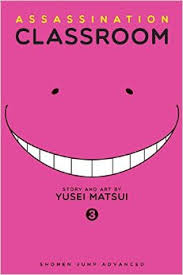
[READ: September 24, 2016] Assassination Classroom 3

I looked up this series online and saw that there are currently 21 volumes in it!  (11 are translated into English so far).  I can’t imagine how he can keep this story going (and at a pretty fast pace until the Earth will be destroyed) for so many more books!

This book begins with the students still on vacation in Kyoto.  Two of the girls have been captured by other students.  It’s a disturbing chapter with the implication that these boys have done things to girls before.  But Koro Sensei’s book about field trips actually covers the event of a kidnapping!  So the rest of the class is on it.  It even suggest where they might find the culprits (how did he know?).  It’s also a really big book and can be used as a weapon.  And our class comes out unharmed.

In the next chapter a new assassin named Red Eye is sent to take out Koro Sensei.  Red Eye is a sniper but he is baffled by Koro Sensei–who is able to stop a bullet with a dumpling.  Koro Sensei proves to be such a good teacher that even the Red Eye can learn something from him.

After a light episode in which the kids try to learn about Koro Sensei (and Irina’s) past girlfriends/boyfriends, a new student is added to the class.  But this student is a computer named Autonomous Intelligence Fixed Artillery.   It is a fast learning computer (with a pretty girl as its avatar).  And it is designed to learn from its mistakes.  It estimates that bu the end of the day it will have a .03% chance of killing Koro Sensei but by the end of the month it will be 90%.  So it begins class by opening fire on Koro Sensei (despite the fact that it breaks the class rules and disrupts class).  And then the kids have to clean up the mess of BBs.  In fact the kids are so annoyed that they tape the machine up so it’s guns can’t come out.  Eventually Koro Sensei teaches it that it needs to respect the fellow students or it will never blend in.  Koro upgrades the machine who actually seems to enjoy learning.  This is pretty fun sequence of chapters.

In the next section, Koro Sensei is affected by humidity–his head swells to a crazy size.  But that proves to be a diversion compared to the real plot that follows–revenge on a cheating girlfriend and her jerky boyfriend.  It’s very funny and quite elaborate.

The final chapter of the book is all about Irina.  She is trying to teach them to speak without an accent but the kids can’t seem to get their Ls and Rs correct.  She says that if they can’t get them straight, she will have to French kiss them (totes inappropes–although the previous chapter revealed that she was 20, which is much better than the mid 30s I assumed she was).  But we soon see that Irina’s “handler,” the guy who sent gave her the assignment, determines that she is no longer the right assassin for the job.  She is pissed but her services are no longer useful.

The book end with Koro Sensei proposing a test between Irina and her handler to see which one is the better assassin!

This manga is written in the traditional style of right to left, which is fun.  It is translated by Tetsuichiro Miyaki with an English adaptation (whatever that means) by Bryant Turnage.

Read Full Post »

« Newer Posts - Older Posts »