Feeds:
Posts
Comments

Archive for the ‘Religion’ Category

tpk3SOUNDTRACK: OBETROL-“The Sound Machine” and “Chopped an Dropped”(2011).

obetrrolObetrol is a band that I can find out very little about. They seem to have 5 songs out and each one is quite different. My favorite is “The Sound Machine” which has a lush sound with twinkly guitars and a wispy female vocalist singing over the top of it.  It has a very trippy slow motion quality to it.  The singer sings a bit like a delicate Kim Gordon (in that shes not always exactly on key).

It’s hard to get more out of this song since it’s only 2:25, but I think it would make a cool intro to any record.

“Chopped and Dropped” on the other hand opens with buzzy guitars (and a “Kick Out the Jams” sample).  The vocals are sung (screamed) by a man. It is a fast-moving tinny punk song with trippy female echoed vocals in the background.

Hard to pin them down, but you can check them out here.

[READ: July 28, 2014] Pale Summer Week 3 (§22)

This week’s read is only one section because it is almost 100 pages of one person’s testimony.  Presumably, this is also part of the testimony on videotape which was broken down into smaller sections.  But there is no “context” for this section;  no ID number.  Although it does address very similar issues and questions.  I was on the fence about how much to include here.  So much of it is “irrelevant,” that I hate to get bogged down in details.  So I think it will be a basic outline of ideas until the more “important” pieces of information surface.

§22

For the most part, this is all inside one man’s head as he talks about his life in college, after college, and into the Service.  In terms of advancing the “plot,” there’s not much (until the end).  Mostly this is simply a wonderful character study, full of neuroses and problems that many people face at some point (to one degree or another).  We don’t know who this author is (very minor spoiler: we will learn who it is in §24 [highlight to read]).

The interviewee states that “A good bit of it I don’t remember… from what I understand, I’m supposed to explain how I arrived at this career.”

Initially he was something of a nihilist, whose response to everything was “whatever.”  A common name for this kind of nihilist at the time was wastoid.  He drifted in and out of several colleges over the years, taking abstract psychology classes.  He says that his drifting was typical of family dramas in the 1970s–son is feckless, mother sticks up for son, father squeezes sons shoes, etc. They lived in Chicago, his father was a cost systems supervisor for the City of Chicago. (more…)

Read Full Post »

tpk2SOUNDTRACK: SYLVANSHINE (2014).

sylvanOne of the fun things about doing these summer posts is finding appropriate music to each week’s write up. I like to find something related to what’s down below.  Last week it was an artist named Pale King.  This week it’s a band called Sylvanshine.

Sylvanshine is a cover band from Texas.  According to their web site, they play covers of Collective Soul, Van Halen, The Black Crowes and Stevie Ray Vaughn. I didn’t listen to any of their live tracks, but the excerpt of their version of The Toadies’ “Possum  Kingdom” is pretty spot on.

Learn all about them (or book them) at their website.

[READ: July 21, 2014] Pale Summer Week 2 (§10-§21)

Week two continues some of the characters’ lives and introduces us to them at the Service.  It also has a couple of very lengthy passages in which people spout their opinions about aspects of the country and the Service which are thoughtful and, frankly, very interesting and would work as good meme quotes, if you liked that sort of thing.

§10

This is a two-paragraph chapter about bureaucracy “the only known parasite larger than the organism on which is subsists.”

§11

A list of syndromes/symptoms associated with Examination Postings in excess of 36 months (ending with “unexplained bleeding”).

§12

Leonard Stecyk is back in this short chapter.  He is an adult now. He is walking door to door to introduce himself to his presumably new neighbors, and to offer to the neighbors the Post Office’s 1979 National Zip Code Directory–“his smile so wide it almost looked like it hurt.”

§13

An unnamed character is inflicted with nervous profuse sweating.  (This character will be identified later).  This chapter also has footnotes (as did the Author’s Foreword), although these footnotes are in the third person (as is the chapter).  Does this mean it is written by Dave Wallace too?  It is another thoroughly detailed chapter that I find very enjoyable to read even if it doesn’t advance the “story” much. (more…)

Read Full Post »

tpk1SOUNDTRACK: PALE KING-“An Airing” (2013).

paleNope, I never heard of the musician Pale King until I searched for a song to put here.

This song begins as a piano instrumental (with some keyboards layered over).  It swells and lifts through some simple chord changes.  A martial beat comes in from time to time to give it some urgency.

This might actually work as a the opening credits to the never-to-be made movie of The Pale King, or perhaps a soundtrack to §1 (which is a short prose poem type of thing).

At about 1:45, some guitars burst through (adding some drama), and the drums grow louder.  It builds slowly until it starts to taper off and ends much like it began

I don’t know much or anything about the artist except that he’s from Toronto and he has a bandcamp site where you can hear this track.

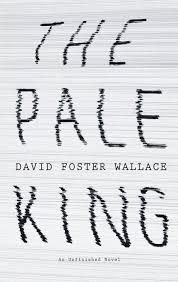
[READ: July 14, 2014] Pale Summer Week 1 (§1-§9)

In other Summer Reading Group posts, I have tried to summarize chapters, make connections between characters that I may have missed in earlier readings of the book and, just tried to be more microscopic about my reading.  I don’t usually philosophize too much about the stories, but I do wax poetic from time to time.  Having said all that, The Pale King presents its own unique challenges because the book is unfinished.  So it’s not always clear if any connections can be made from chapters that are elliptical. DFW in particular likes to write scenes without naming characters, giving the reader something to discover later on, perhaps.  So you may have a scene that has no named people in it, but their speech patterns or details are referenced later, allowing you to piece things together.

There is definitely some of that piecing going on here, but as I said, when a book is unfinished, and this one was largely pieced together by editor Michael Pietsch, it’s not clear if you are missing something or if it simply isn’t there.  So there will be some speculation, and some omissions for sure, but we press on.

A further complication is the collection of Notes and Asides at the end of the book.  Some reveal information about characters that is not necessarily evident in the book, some talk about things that might have happened or even might have been removed if DFW had played around with the text more.  In general I am not going to read these now, so as to avoid spoilers.  But I may insert them later (with spoiler warnings) to make it easier to make sense of the book later.

The primary setting for the book is the IRS Regional Examination Center in Peoria, IL set in 1985.  Editor Michael Pietsch (in his thoughtful and helpful Editor’s note which is mandatory reading if you are going to read the novel) says that DFW described the book as “torandic,” with elements coming in and going out over and over.

The other key question is just how unfinished is this?  We have no idea.  It feels like it could go on for a ton longer, and yet it no doubt would have been edited down to a more manageable size afterwards.  There are sections that seem like they could have more and others that seems like they would have been trimmed a lot.  And then of course, there could be other things that never even saw the light of day.  None of that should keep anyone from reading the book though. (more…)

Read Full Post »

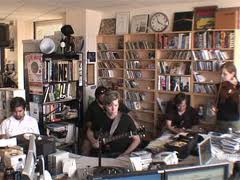
animalSOUNDTRACK: THE BOTH-Tiny Desk Concert #346 (April 7, 2014).

bothThe Both is a mini-supergroup of sorts featuring Aimee Mann and Ted Leo.  I don’t know too much about Ted Leo, but I do know a lot about Aimee Mann.  I was curious to hear what these two sounded like together (this Tiny Desk was recorded before their album was released and was one of their first public performances together).

They play four songs, and I feel like they sound very much like Aimee Mann songs.  I never thought of Aimee Mann as having a terribly distinctive voice, but I guess she does.  And her voice and melody lines over these simple songs sounds very much like her own.  Since I don’t know much about Ted Leo, I don’t know exactly what he adds to the songwriting.  His voice is good (he can hit some high notes) and his guitar playing is minimal but very effective.

“You Can’t Help Me Now” sounds a lot like an Aimee Mann song, so it’s nice to hear Ted come in on the second verse, to change it up a bit.  “Milwaukee” sounds a lot like a Beautiful South song to me–the way the verses are sung and the way the chorus comes in, there’s just something that sounds very much like the way Paul Heaton writes songs (this is a good thing).  “No Sir” is a rather different song from the others.  It  features some great echoey guitars to open and has a loud ringing guitar solo.  The verses still sound like Aimee Man (that has to be unavoidable), but the choruses change things up.

“The Gambler” sounds like a jointly written song.  It’s a bit more raucous and highlights both of their strengths.  Overall, the music isn’t the most exciting but I’m not really sure what else would have come out of this pairing.  Obviously, if you like Aimee Mann, you’ll like The Both.

What’s most interesting to me is seeing Aimee Mann play–she is so causal (she barely changes expression and hardly opens her mouth when she sings) and she stands up so straight and calm.  Check it out here.

[READ: June 26, 2014] Animal Crackers

I’ve mentioned Gene Luen Yang’s books before–I’m very fond of him.  So I was thrilled to see a new book by him.  Except that this isn’t new, my library just happened to get it now. This book was published by Slave Labor Graphics in 2010, but these stories are much older than that.  In fact, the back of the book has a note from Gene in which he explains that the first chapter of this book was actually the first story he ever created.

And what a story it is.

The book is actually three interlocking stories.  Two longer stories: “Gordon Yamamoto and the King of the Geeks” and “Loyola Chin and the San Peligran Order.”  And a brief interlude called “Sammy the Baker and the M.A.C.”  You know they are interlocking because Gordon appears in the Loyola story (and because they both stick cable TV cables up their nose at some point), and because Sammy appears in the Gordon story.

In the first story Gordon is a bully.  He and his buddy Devon find the King of the Geeks each year in school and “crown” him (with super glue and old underpants).  They think this is very funny and plan to do some more devious things to him later that day.  Of course, when Miles, King of the Geeks gets home, his mother is very upset (naturally) and plans to call the police.  But the only thing that he cares about is his father.  Whose only comment is to wonder how he wound up with such a sissy son.

Gordon wakes up in the middle of the night with a pain in his nose.  It turns out to be a space alien (the aliens learned that humans use so little of their brains that they can store data in our brains for use later).  The only way that Gordon can help with this problem is by sticking the coaxial cable in his nose.  Which he does.  And the little alien dude explains what he has to do.  Which is, of course to go to the King of the Geeks (whose brain they are also using) to find the instructions for how to evict the spaceship.  But as they try to exchange the proper information, Gordon gets all of the Geek King’s memories.  And suddenly he feels really bad about what happened. (more…)

Read Full Post »

may20014SOUNDTRACK: CRYPTOPSY-“Slit Your Guts” (1996).

cryptI had never heard of this band until I saw the song mentioned in the article.  The song is impossibly fast with speeding guitars, super fast (inhuman) drums and an indecipherable growl as vocal.  In other words, a typical cookie monster metal song.  And yet, there is a lot more to it and, indeed it took me several listens before I could even figure out what was happening here, by which time I had really fallen for the song.

There’s a middle section which is just as punishing and fast but which is basically an instrumental break–not for showing off exactly but for showcasing more than the bands pummel.  It has a short guitar solo followed by a faster more traditional solo (each for one measure, each in a different ear). Then the tempo picks up for an extended instrumental section.  The melody is slightly more sinister, but it sounds great.  There’s even a (very short) bass solo that sticks out as a totally unexpected (and fun) surprise.

Then the growls come back in, staying with the new melody.  The vocals are so low and growly that they are almost another distorted instrument rather than a voice.

After that there’s a lengthy proper guitar solo.  As the song comes to a close,  it repeats some previous sections before suddenly halting.  It’s quite a trip. And it definitely makes me want to hear more from them (whatever their name means).

[READ: April 14, 2014] “Destroy Your Safe and Happy Lives”

Robbins, who is a poet, but about whom I know little else, takes us on a sort of literary tour of heavy metal.  His tone is interesting–he is clearly into metal, like in a big way (at the end of the article he talks about taking his writing students to see Converge (although he doesn’t exactly say why)), but he’s also not afraid to make fun of the preposterousness of, well, most of the bands–even the ones he likes.  It’s a kind of warts and all appreciation for what metal is and isn’t.  many people have written about metal from many different angles, so there’s not a lot “new” here, but it is interesting to hear the different bands discussed in such a thoughtful (and not just in a fanboy) way.

His first footnote is interesting both for metal followers and metal disdainers: “Genre classification doesn’t interest me.  Listen to Poison Idea’s Feel the Darkness followed by Repulsion’s Horrified and tell me the main difference between hardcore punk and metal isn’t that one has a bullshit positive message and one has a bullshit negative message.”

But since Robbins is a poet, he is interested in metal’s connection to poetry.  And in the article he cites William Blake (of course), but also Rilke and John Ashbery and (naturally) Milton’s Paradise Lost, as well as Shelley, Lord Byron and Charles Baudelaire.  He talks about them not because they are cool poets, but because they have also talked about because of metal’s “most familiar trope…duh, Satanism, which might be silly–okay, its’ definitely silly, but has a distinguished literary pedigree”.  Besides, he notes that Satan has the best lines in Paradise Lost (and I note that just as Judas has the best songs in Jesus Christ Superstar).

But sometimes this Satanism turns into a  form of paganism which then turns into nature worship.  From Voivod’s “Killing Technology” to black metal’s romanticism of nature (sometimes to crazy extremes–but that’s what a band needs to do to stand out sometimes).  Metal is all about the dark and primordial, a”rebuke to our soft lives.”

And yet, as a poet, Robbins has some quibbles with metal: (more…)

Read Full Post »

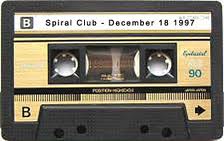
briefSOUNDTRACK: RHEOSTATICS-Spiral Club, Guelph Ontario (December 18 1997).

spiral This show has an interesting technical glitch that the owner thankfully fixed. It was a soundboard recording (which is awesome), but evidently there was static in the right channel that rendered it unlistenable.  So he simply removed the right channel and mixed it mono.  The sound is actually excellent—one of the best early shows they’ve done.  But since there is only own channel, you miss a lot of what, I think, is Dave’s guitar.  When guest Tyler McPherson plays his solo, I believe you can’t hear it.  Yet despite that, it still sounds great.

I feel like the band was a having a lot of fun on this Thursday night in Guelph (every night in Guelph is a weekend). They mention that their Nightlines episode was aired on the night of Lady Diana’s death (so they feel some kind of weird connection to her).

There’s a few firsts in this set as well.  It’s the first time they plated “Junction Foil Ball” (from Nightlines).  They seem to have finally settled in with “Harmelodia” not “California” in “Easy to Be with You.”  They toss in a bit of “Tubthumping” at the beginning of “Horses,” and a bit of the Monkees, song “Look Out Here Comes Tomorrow)” at the beginning of “Queer.”

Of course there are some flubs as well.  Martin messes up California Dreamline big time and Dave gets lost in the counting of “Four Little Songs” (and then says he never went to school).

But it’s the banter that is the fun part of this show.  They ask the crowd not to shout out requests for a couple of songs.  There’s a very funny sequence in which they try to play a Coors lite anthem.  And Martin says he’s out of his mind.  Dave says he’s a madman and Martin calls him a manatee.  And then someone offers Dave an Islanders jersey which he says he can’t accept—it is too generous, but he’ll always remember it (and now so will we).

Before the end of the set, they offer the crowd some of the food they have backstage (if you like olives). But then they say that $18 was a bit steep of a ticket price for the show (can you imagine?).  So they’re going to play extra long because the ticket price was so high.  Man, how cool is that?

[READ: Summer 2013] Brief Encounters with Che Guevara

Several years ago (long before Billy Lynn’s Long Halftime Walk) I read about Ben Fountain…somewhere.  I was reading an interview with a writer who talked about some new writers that he liked.  Ben Fountain was one of them, and this writer specifically mentioned this collection.  A week or so later I was in a dollar store of all places and saw this book on their piles of books.  I couldn’t believe the serendipity. So I bought it (for a dollar).  And then kind of forgot about it (so much for my theory that if I buy a book I’ll read it).  But I did eventually get around to reading it and now sadly not only do I have no idea who originally introduced me to Fountain, I can’t even find it with online searching (and frankly I could have read it anywhere).  Also, Fountain has since written Billy Lynn which received all kinds of praise (and which I haven’t read), so trying to find specific praise for Fountain from 7 years ago is a lost cause.

And just as I forgot to read it I forgot to write about it until now.  This was his first collection of stories.  There are eight in total.  Even though it has been awhile, most of the stories were so powerful and well constructed that I remember them quite well. (more…)

Read Full Post »

boxersSOUNDTRACK: ANDREW W.K.-Tiny Desk Concert #37 (November 30, 2009).

wkWhen I saw Andrew W.K. on the list of Tiny Desk players I was intrigued to say the least. W.K. is a maniac.  His first album was packed with full throttle, really dumb party anthems.  Later he made an albums of… piano instrumentals.  Then he became a motivational speaker.  He’s done children’s shows and he recently did an anthem for an internet cat.  He even played drums for 24 hours straight–setting a world record.  So who knew what to expect.

Well, I didn’t expect two lengthy piano improvisations (quite pretty, if a little scattered).  Holy cow, does he attack that keyboard!  The improvs are really unexpected–meandering and interesting (mostly), especially at the end where they kind of decay.

Then he plays a keyboard version of “I Get Wet” which sounds almost symphonic especially compared to the pummeling version on the record.

He ends with a faithful cover of “The Moon Is a Harsh Mistress” made famous by Linda Ronstadt.  He sings in a proper voice and if you didn’t know it was Andrew W.K., it would be a pretty normal song.

Nothing like what I expected, this is a most unusual (and slightly awkward–for a motivational speaker, Andrew seems a little distracted) Tiny Desk.

 [READ: February 19, 2014] Boxers & Saints

Gene Luen Yang is a wonderful artist and storyteller.  He has written several books that I’ve enjoyed quite a lot.  This is a two volume set that is meant to be read together (although each story is more or less independent).  I assume that Boxers should be read first since Saints has an epilogue, at least that’s the order I read them.

This story is about the Boxer Rebellion.  I knew literally nothing about the Boxer Rebellion, so for those who don’t, here’s Britannica: (more…)

Read Full Post »

eleanorSOUNDTRACK: BILL CALLAHAN-Tiny Desk Concert #21 (July 13, 2009).

billcBill Callahan (formerly known as Smog) plays beautiful slow ballads.  He has a deep, calming, gorgeous voice.  And his songs have a very traditional acoustic feel (even when he plays electric guitar).  He is excellent at what he does.

But I’m afraid I just don’t really like his style all that much.  I can absolutely appreciate why he is so well-regarded, because even as I’m listening to this Tiny Desk set I keep thinking how good everything he is doing is.  Man, his voice is so interesting, and his music is so pretty (the strings add a very nice touch).

But I just can’t imagine myself ever choosing to listen to his album.

In fairness, a song on a mix tape would probably be awesome, and I did enjoy the three songs here: “Jim Cain,” “Rococo Zephyr” (great title, and my favorite of the three) and “Too Many Birds.”  And I can imagine if I was ever on a mellow music kick that this would be where I’d start.  So if you enjoy pretty, mellow music done incredibly well, Bill Callahan is definitely your guy.  I feel like he is not as well-known as he ought to be, so check him out.

[READ: January 23, 2014] Eleanor Rigby

Completing three Douglas Coupland novels in two weeks may seem daunting, and it is especially so when the books are as dark as these have been.  (With Coupland’s follow up book, JPod, he would go in a different direction and kind of break the darkness somewhat.  And the new book which just came out seems like it is more humorous than dark).  This book is perhaps the most insular of his career and perhaps the most insular book I’ve read.  The title is puzzling (and is ultimately revealed), although Coupland says that he was inspired by wondering what happened to Eleanor Rigby after the (Beatles, duh) song was over.

So in this story, the main character is named Liz Dunn.  Liz is a blank.  She claims that she is so dull that if she were an extra in movies, she would be asked to leave the scene because she is too devoid of character to even be an extra.  (Actually, Liz lays the self-pity on a little too thickly throughout the book–we got the point).  Liz has a brother, who is an accomplished world traveller, and a sister who lives nearby and pops in to check on her once in a while.  Both are married and have their lives together, unlike Liz who lives by herself in a room with no personality at all.

Liz’ sister is beautiful and got up to all kinds of trouble in school and William has always been successful, but Liz was…nothing.  She didn’t like to do much.  And she pretty much holds herself up as the antithesis of her sister.  She watches movies all the time in her living room. And then she goes to sleep.  She works at a well paying but dull job and she has saved a ton of money because she never spends it on anything.

As the story starts, she is getting wisdom teeth out. She takes a week off from work, but he boss (the Dwarf Whom I Report To) calls to say that someone will bring some work over to keep her busy.  She has bought a bunch of tear jerker movies in hopes of riding out the painkillers with them.  And then she gets a phone call.  A man named Jeremy has her name on his medic alert bracelet and he is in the hospital.

Liz doesn’t know who he is, but then takes a guess and goes to see him in the hospital.  And it turns out to be…her son. (more…)

Read Full Post »

heynosSOUNDTRACK: JULIE DOIRON-Tiny Desk Concert #20 (July 6, 2009).

julieI don’t know Julie Doiron exactly–her name sounds familiar, and I know the band Eric’s Trip (she was the bassist), but I don’t really recognize her.

Nevertheless, I really enjoyed her Tiny Desk Concert.  Unlike most of the musicians, she busts out an electric guitar, and although it’s quiet, there’s some good buzzy distortion on it, especially in the first song “Heavy Snow.”  And it sounds good with her voice, which is powerful, even if she does seem nervous.

On “Ce Charmant Coeur” she sings in French and then messes up when she admits she’s thinking of other things and is distracted by the intimacy of the setting.  Bob and company calm her by saying that she is sweating less than Tom Jones did (and there’s very funny joke about her breasts popping out (they don’t)).

She plays “Tailor.” It seems like she tried earlier and stopped half way through and is now trying again (the Concert itself starts midway through, so I assume that’s what was cut off).  It’s a pretty, mellow song (very different sounding from “Heavy Snow”).

For the last song she plays “Consolation Prize” which she says is unlike any she’d written before.  There’s a chaotic section in the middle which they agree we can just imagine because shes not going to play it in this setting.  The blurb with the show says that she normally rocks out pretty hard–something that I’d like to see.

In looking up Doiron’s past she was on Kill Rock Stars and Sub Pop, so I must have seen her name a lot back in the day.  I now see she has recorded with all kinds of bands that I like, and I’m curious to hear her more rocking edge (especially since she is so polite and sweet and nervous here).

Check it out here.

[READ: January 11, 2014] Hey Nostradamus!

After finishing the exciting All Families are Psychotic I moved on to his novel with my least favorite title and with a horrendous cover.  You’d think that I would remember these books but I had no memory of this one either, and I’m fairly certain I read it within the last ten years.

Coupland must have been in a very dark place with this book as well.

There are four sections, each from a different person’s point of view.  This technique of having a person tell his or her story is something Coupland does very well in all of his works–he loves to tell stories about telling stories.

But the darkness about the book is that it is set in a school just as three student gunman come in and shoot up the cafeteria, killing dozens of students, including the first narrator, Cheryl.  This was written with the Columbine shootings in mind, although it has nothing specifically to do with Columbine.

In Part 1, Cheryl has already been killed as she is relating this story to us.  She tells us about herself and her decision to join Youth Alive! a religious group in school.  She and her friends in the group are very moral and are quite clique-y (and they are not widely liked).

The latest thing in Cheryl’s life which has her preoccupied and which has her Youth Alive! group very upset is that she has been spending a lot of unchaperoned time with Jason.  Everyone knew they were dating, but it seems to have gone further now.  And Cheryl explains to us (but not them) that she and Jason have started having sex.  But not until after they rushed off to Vegas and were quickie-married (which no one knows, not even their parents). (more…)

Read Full Post »

familiesSOUNDTRACK: MARIA TAYLOR-Tiny Desk Concert #19 (June 29, 2009).

mariaI’d never heard of Maria Taylor before this Tiny Desk Concert.  She was part of the duo Azure Ray (who I also don’t know).  Then she went solo and as of this recording has released three albums.

Taylor has a pleasant voice (she reminds me of a number of different Lilith Fair singers, although I can’t pinpoint who specifically), but it’s not especially remarkable.  The first song “Ladyluck” I found to be nice.  The second song “Time Lapse Lifeline” fared better–the guitar melody was a little stronger, and the harmonies really helped.

The final track, “Clean Getaway” is another pretty gentle ballad (the two guitars really help add texture to all of these songs).  Although even the end seemed to just stop without actually ending.

I didn’t find Maria Taylor to be terribly memorable.  However, the Tiny Desk setting seems to be the best way to hear Taylor as her voice is well suited for an intimate location.

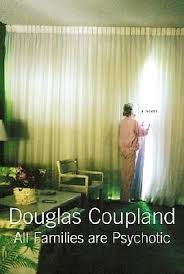
[READ: January 17, 2014] All Families Are Psychotic

I saw recently that Douglas Coupland had a new book coming out in 2014.  And I also knew that I had three of his older novels to re-read, so I decided to make this the Winter of Douglas Coupland and read all three of those books before his new one came out.  Then I got to work and saw his new book on top of a pile of newly delivered titles.  Sigh.

Well, there was still no reason I couldn’t read the other three in a row, possibly even before anyone wanted his new book.  So, off I went.  And indeed, I finished this book on our little vacation.  And even though I’m fairly certain I’ve read it before (it came out just before or after 9/11/01, gasp) I didn’t remember a thing about it.

This book has a title that I’m mixed about.  It’s a great sentence, but I’m not sure it’s a great title.  And although someone speaks the title in the book, it doesn’t really explain the book very well.

In fact it’s pretty hard to explain the book quickly. (more…)

Read Full Post »

« Newer Posts - Older Posts »