Feeds:
Posts
Comments

Archive for the ‘Record Labels’ Category

wawa SOUNDTRACK: RE:-Alms [CST032] (2004).

cst032webRe: creates soundtracks for a dystopian world.  Where metal and computers are integrated with nature.  So a track like “Golem” which opens this album starts with what sounds like a golem walking–trudging desolate feet. Then there’s big bells that echo throughout. The multi-note music that anchors the song is eerie and enticing.

This album does not use the same “gimmick” as the previous one, where song titles were all words that should have the re prefix.  So song two is called “Orientalism As A Humanism.”  It runs nearly 9 minutes and opens with what sounds like an alarm but may actually be mechanical sounds (a saw perhaps?). But it is softened to make it a very interesting sound that swirls around half of your head.  Meanwhile the other half of the song has a totally different sound.  By the 5 minute mark it is primarily drums and noises. Until that all drops off for a bit of static. Some loud percussive noises fill the song until it turns into a fast paced drums beat which lasts for just a few seconds before the songs ends.

‘On Golden Pond” opens with more footsteps. Then there some squeaks and a splash and a voice saying “splash it.” And later a voice saying “You should see our house” These recordings are so clean, I have to wonder what they are from.   “Radio Free Ramadi” opens with near silence. After about a minute of gradually increasing sounds, the big noisy electronics come in.  It is a big noisy blast of noise like the first album.  “Lasers, Tracers, Radar Drones” opens with gentle chimes and slowly melds different noises and electronics.  “Pawk” opens with an acoustic piano–a nice relief from the electronics. It’s a simple melody, stark and bare, and is interrupted by what sounds like people making seagull sounds. The disc ends with “Home Security” a song with a huge burst of noise and electronic malfunctions.

Once again, this album is not for the timid or those who dislike dissonance, but if you’re open to experimentation, Re: proves to be a very interesting band.

 [READ: May 13, 2014] The Wawa Way

For my birthday, I jokingly told my family that I wanted a Wawa Sizzli for breakfast, a Wawa Shorti for lunch, a Wawa Bowl for dinner and a Wawa chai latte for dessert. We didn’t have any of that (although I did get some Wawa chocolate milk before work), but suffice it to say I love my Wawas (most people have one, but I have two—the one by my house and the one by my work).

I grew up in North jersey where 7-11 was the king of convenience.  I loved the 7-11, it was handy and had all kinds of junk food available. But once I moved to Central Jersey, I discovered the amazingness of Wawa. (In truth I knew about Wawa from trips to South Jersey, but it was more of a novelty then).

What makes Wawa so superior? Most people would say their coffee. I don’t drink coffee, so I can’t address that.  But what I do like is their stuffed pretzels, their hoagies (and their touch screen for ordering), their milk and chocolate milk, their hot (non coffee) drinks and their newish cold drinks—all made to order. I also like their brightness and their cleanliness. And, when I go to the third Wawa (which is out of the way but close), I think their gas prices are fair and the people who work them are always nice. And, more impressively, they were open during Hurricane Sandy when so many other places were closed.

So when the family saw that a book about Wawa was coming out, it seemed an obvious choice for my birthday (purchased, I hope, at a Wawa for ½ off the cover price). (more…)

Read Full Post »

millionSOUNDTRACK: RE:Mnant [CST015] (2001).

cst015webThere is a (tiny) gimmick with this album.  The band is called Re: and all of the songs have titles that work when you add “re” as a prefix.  So song titles include: 1. scue 2. duce 3. solute 4. cipe 5. straint 6. buke 7. pent 8. legate 9. volve 10. ject 11. gulate.  This makes me smile, even as the music can be a bit more challenging.
The first track is simply noise and electronic pulsing for 2 minutes. It melds into track 2 in which the noise ends but the electronic pulsing continues. Then a faster, newer noise comes in and stays there while the beeping gives us a rhythm. Then all the noise drops out and it is replaced by a more delicate wave of almost strings. Then what sounds like detuned strings play some notes while the noise is buzzing in the background and swirling around your head.  The 7 minute track 3 is a bit much. It opens with the sound of a kind of static and mechanical sounds. It has a feel of a horror movie soundtrack, especially as it builds and tension mounts with the “bass” notes that come through. Even though I find it long, by the time it really gets going I could listen to a lot more of it, I think the buildup at the beginning is too long.

The fourth track brings in some interesting percussive sounds, but mostly it seems to be about the background noises that swell and get in your head (those piercing high notes).   Track 5 introduces an acoustic guitar. I feel like this should have gone earlier so it’s not as much of a surprise at this stage. It’s quite a pretty melody (with more of those electronic noises floating around the background and it’s a nice interlude among all of the mechanicals. 6 also has a guitars–this time electric–playing a staccato rhythm. The chords are nice and there’s that persistent electronic noise floating around to keep it somewhat edgy.   7 employs feedback sounds and beats with what sounds like human voices. And interesting piece of soundtrack noise.

Track 8 starts off quietly but introduces some more guitar. There’ an interesting melody with the electronics buzzing around in the background.  9 has big percussion sounds and lasts a reasonable 3 minutes. 10 is an acoustic guitar song that reminds me of something Beck might do, and it’s too short at 2:15. The final track, 11, is mostly low pulsing sounds. It’s kind of meandering end to the disc that features a lot of uptempo noisy music.

[READ: April 25, 2014] A Million Heavens

I’ve enjoyed John Brandon’s other novels, and I had read an excerpt from this one in McSweeney’s #41.  I found it enjoyable and somewhat confusing.  And, actually that’s a bit how I feel about the book as a whole.

Each section of the book (from a paragraph to several pages) has a different character as its title.  What’s confusing is that it starts off with “The Wolf” who is a major character and is (for the most part) sentient and thoughtful.  The wolf roams the periphery (as wolves do) coming close to interacting with characters but seeming more like  a narrator than a character.  The next character we meet is Soren’s Father.

Soren’s Father’s story is a catalyst for much of the book’s action.  Soren was at piano practice.  He was a new student.  When the teacher walked away, he played a piece of beautiful music for about 15 seconds and then passed into a coma.  He has been in the coma for a few months now with no real hope of recovery but with no real indication of not recovering either.  Soren’s Father is a pragmatic man, not interested in the music his son played, nor in the plans and prayers of the people who are holding a vigil outside.  Really he just wants this over so he can go back to his old life.  But he is ever faithful to his son, sitting with him every day, letting his business slowly erode.  Over the course of the story, several people become connected to Soren’s Father.

The Piano Teacher is another character.  She feels responsible for all of this.  She didn’t want any kind of prodigy, if that’s what Soren is, she just wanted kids to play the piano badly so she could teach them to do better. (more…)

Read Full Post »

8 SOUNDTRACK: BLACK OX ORKESTAR-Nisht Azoy [CST038] (2006).

cst038webOn the second (and so far final) Black Ox Orkestar album, the songs are longer and the whole disc has a more polished feel.

It feels less like friends gathered on a night for music (which is what the first one seemed like) and more like a band playing the music in the studio.  There’s more precision in the instrumentation and more instrumentation overall.  The voices,  like on “Bukharian” are layered, bringing in bass voices that didn’t appear before.  The album also feels a bit more like a GYBE type of project–more building, more epicness.  “Tsvey Taybelakh” [Two Doves] is over 7 minutes long.  And even though a song like “Az Vey dem Tatn” [Sad Is the Father] is clearly Yiddish (the vocals are the big giveaway) they sound like more than folk songs, they sound bigger, more “important.”

“Violin Duet” has a slow mournful piece and then a sprightly fun dance piece.  “Ratsekr Grec” is a big instrumental dance piece that  sounds familiar but is not the song I’m thinking of (which is from a movie, I believe).  The 7 minute song actually has elements that feel a bit like Led Zeppelin’s “Kashmir” (with clarinet).  And the final song “Golem” begins like an epic with slow guitars and strings in a very traditional melody.  It has a number of false endings at around 3:30 and again at 5 minutes.  And since album has some translation of the lyrics, (which are still sung in Yiddish) we can see the lyrics move beyond traditional Yiddish yet are firmly grounded in them:

“We made a new golem/ We created our guard/ Without soul and without mercy/ He watches the gate/ Like the cameras on the fence/ Like the barbs on the wire/ Like the concrete barricades/ He becomes landscape/ But no. It can’t go on/ No. It can’t go on/ Not like this…,”

Again, if you don’t like traditional Yiddish music (or vocals sung in Yiddish) you won’t like this, although the adventurous may want to give it a chance.

[READ: May 6, 2014] 8

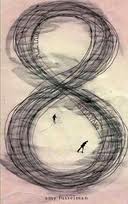
The cover above is actually not the cover of the version I read.  The McSweeney’s Two Books in One does not seem to have this cover for 8 anywhere (which is a shame because I like the way the covers of each book parallel each other (and make the infinity loop as well)).   Interestingly, the original version of the book featured the subtitle: “All True, Unbelievable.”  And that might be useful to include here too.

Amy Fusselman’s 8 is a sequel of sorts to The Pharmacist’s Mate.  In that book, she wanted to get pregnant.  In 8, she not only successfully gave birth to the boy from that first book, she has also had a second child.   And like many new parents, she understands that no matter how much you wanted children, sometimes for your own sanity you need to hide from them to have a few minutes to yourself.  It’s refreshing to read a normal person write about her children.  Especially when she and her husband try (and fail) to do sleep training.

But fortunately, that is not all Fusselman talks about.  She also talks about when she was raped as a shockingly young girl.  This tragic story is dealt with in a variety of ways and, surprisingly, never in a particularly dark or somber manner.  She calls her assailant “My pedophile” and spends a lot of the book working with alternative healers to come to grips with what happened to her.  And while this story is obviously hugely important in her life, it doesn’t seem to cloud everything she does.  (more…)

Read Full Post »

pharm SOUNDTRACK: BLACK OX ORKESTAR-Ver Tanzt? [CST029] (2004).

cst029webBlack Ox Orkestar play traditional Yiddish music in a somewhat untraditional manner.

There are half instrumentals and half songs with vocals sung in Yiddish (which means I don’t know what they mean).  According to the Constellation website they are a: blend of originals and new arrangements for pieces pulled from various Eastern European songbooks.  And since the members come from “punk-rock, free-jazz, and other liberation musics,” it’s an approach to this music that may interest people who don’t normally like traditional music (and may turn off those who do).

.  I can’t really speak to the music, as I’m quite unfamiliar with it.  I prefer the instrumentals because I like the way the music tends to interweave.  Like “Cretan Song” which is a rollicking fun song like the Yiddish equivalent of an Irish seisún.  And yet. some of the vocals songs are really enjoyable too, like “Toyte Goyes in Shineln” which has a great melody and feels very familiar to me.  While “Ver Tantz?” begins as a slow melancholy song and turns rambunctious–almost chaotic.

Enjoyment depends on an appreciation for tradition Yiddish music, of course.

[READ: May 5, 2014] The Pharmacist’s Mate

I read this book a few years ago.  I read it again because McSweeney’s reissued it with Fusselman’s other book 8 on the flip side.  I wanted to read 8 and decided that since Pharmacist was so short I would read it as well.

And I’m glad I did because while they are not related exactly, they both work as a form of non-fiction and 8 is a nice postscript to what she talks about in Pharmacist.

As with most genre defying books, this is more or less a memoir, although it is written in a somewhat strange format–each small section is numbered (and eventually all the numbers turn into 1s because she realizes that she is starting anew with each section.

The Pharmacist’s mate of the title is her father, now deceased.  She includes notes from his time in the war as a sort of parallel to what’s going on with her own life. She very much wants a baby.  And through the book we see her engage in multiple ways of conceiving from natural to in vitro.  And then we read her angst about becoming a parent  And losing a parent. (more…)

Read Full Post »

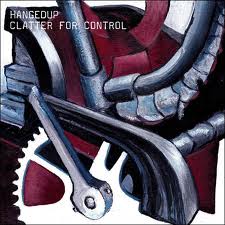
dec20133SOUNDTRACK: HANGEDUP-Clatter for Control [CST034] (2005).

clatterClatter for Control is Hangedup’s third and (so far) last album.  As Kicker was an evolution from their debut, Clatter feels like an evolution as well.  It feels like a more experimental work with fewer “proper’ songs proper and more soundscapes and ideas.

“Klang Klang” is a fast, yes, klanging song.  The viola is slightly discordant and the riffs are abrupt and staccato and it builds into a frenzy.  “Alarm” is more spooky sounding with tape manipulation. “A Different Kind Of Function” starts with some staccato notes and then builds into merging lines of viola and feels almost like a remix song.  “Kick-Back-Hub” is 90 seconds of squeaking bowing and metal clanking along with some very fast drums. It melds into “Eksplozije” which is 2:25 and is more feedback and big noisy drums.

“Go Let’s Go” feels like an actual song with riffs and chords, while “Derailleur” is another short piece, just under 2 minutes of noise and rattling and wildly untuned viola sounds.  “Fuck This Place” has a bass guitar although you wouldn’t necessarily know it (there is more bottom end), it feels like the viola is actually vocal samplings which is neat. “How We Keep Time” is a slower song with languorous viola sounds and sparse drumming.  “Junk The Clatter” feels like the most song like of the bunch. After a minute intro a fully realized riff comes out.  There’s some beautiful melodies and when the song ends it has a cool rocking section.

I prefer Kicker in Tow, but there’s record is a lot of fun too, full of unusual and discordant sounds–if you like that sort of thing.

 [READ: May 5, 2014] “I Can Say Many Nice Things”

I wound up reading about 3/4 of this story in one sitting and I loved it.  But when I came back to finish the end, I didn’t really like it as much.  I though the first part was engaging and complex without being convoluted.  I was interested in the direction the story was going and I was disappointed that it went where it did.  The ending ultimately makes sense within the context of the story, but I enjoyed so much of what happened before that I guess I didn’t want it to end.

So what was so great?

Fleming is an writing teacher.  A disgruntled and unpopular writing teacher.  He has been given a chance to teach a writing class… on a cruise!  A five day cruise with all expenses paid and ten well-paying students signed up for a morning and afternoon class.  Everyone he knew thought he was so lucky (colleagues pretended to be jealous)–it would certainly be an easy way to rack up positive evaluations from happy cruisers?  But Fleming is a pretty miserable guy.  He’s even more miserable because he intended to get in shape for the cruise, but in fact he got fatter, and he feels lousy about himself.

Even though at heart this is a story about teaching and writing (typically not great story topics), the set up is unusual–especially as we slowly come to realize that he is trapped on this ship. And when you add in some of the other details, I thought this was a really interesting setup.

Here’s some details that i found compelling. (more…)

Read Full Post »

dec20133SOUNDTRACK: HANGEDUP-Kicker in Tow [CST022] (2002).

hanged2Hangedup’s second album is bigger and better than the debut (which was pretty good to start with).  This one is far more intense, and much better sounding.

I love the way the first song “Kinetic Work” starts out in such a fast and intense fashion and then shifts gears to a slower beat about 90 seconds in. Then it reverts back to a fast building song, growing very intense by the end.  “Sink” is a scattered affair with the drums taking “lead” playing all kinds of noises and rhythms over the slow beat of the strings. “Losing your charm” is more about tone and mood—with a steady pulsing beat and ever more energetic strings. It sends a middle eastern vibe too.

“View from the Ground” brings in some more unusual sounds—very machine like (with lots of echo on the percussion). And the strings sound a bit more like guitars here. “Moment for the Motion Machine” is a 1 minute 28 second precursor to the 13 minute “No More Bad Future.” If there was ever an epic instrumental of two instruments, it is this. Like a suite from GYBE, it builds slowly with grinding viola and occasional mechanical percussion.  The song changes pace and then assumes a kind of martial beat at around 5 minutes in. And then shifts gears growing more and more intense until the end.

“Motorcycle Muffler” is metallic and machine-like with interesting effects on the cool ringing tones–it sounds like he may be actually banging on a muffler.  “Automatic Spark Control” starts slowly but builds aggressively with the occasional ringing note as a progress bar. “Broken Reel” ends the disc with a slow series of viola chords (and overdubs). The title implies and the song sounds like an Irish dance, and it does, but one that is well, broken and several paces too slow.  It’s quite a change from the rest of the record, but it shows an expanding style and shows just how much they can do with two instruments. Hangedup is a very cool experimental band for those who like melodic noise.

 [READ: May 2, 2014] “Flight”

This story is about a very stoic couple breaking up.  It is narrated by the woman.  She says that her husband, Allan, left her about a year ago.

When they were first together he talked about her in a way that sounded like he felt they had a cozy life,

like the castles he used to build out of straw bales when he was a boy.  Inside the castle was a den in which to eat cookies and drink fruit juice while listening to the rumble of the combine in the next field.  That’s what being with me was like, Allan, said.

But it seems that it was really more suffocating than cozy.  Allan worked for a wind farm company and traveled the world as a technical consultant.  But he never told her anything about where he went–he found it hard to describe and explain.  So she eventually bought him a camera.  He took pictures and sent them to her from around the world.  But he got back he still had nothing to say to her.

dolly-sods-wilderness-west-virginia-hdr-photography-sunsetThe one place that is mentioned in the story is Dolly Sods, West Virginia, (see this cool photo to the right of Dolly Sods from Captain Kimono).  [I had never heard of Dolly Sods Wilderness, but it is protected land and is described : Dolly Sods is an area of high elevation wind-swept plains on the Allegheny Plateau. At elevations of 2,600 to over 4,000 feet, the area has extensive flat rocky plains, upland bogs, beaver ponds, and sweeping vistas. The plant life and climate on this high plateau resembles northern Canada, and many species found here are near their southernmost range].  The narrator explains how there are parts of Dolly Sods that have never been touched by human hands.  In the picture that Allan sent from there, he is next to a wind turbine that is going to be put up. (more…)

Read Full Post »

dec20133SOUNDTRACK: HANGEDUP-HangedUp [CST016] (2001).

hanged1Hangedup is a noisy band made up of two people: Genevieve Heistek on viola (often looped) and Eric Craven on drums and percussion.  The whole enterprise has a kind of DIY sound—like (very good) first takes done in fit of creative outpouring.

 “Winternational” opens the disc with slow and somber viola.  But after 1:41 the drums come in and the tempo changes into complex song–the way that simple patterns morphs around is really cool. It turns into a great instrumental song, with a low, almost detuned bass sound and lots of percussion. “Propane Tank” has more great weird percussion (sounding like he’s possibly hitting everything in the room). The sounds are manipulated and twisted but make a very interesting beat.  It’s pretty cool “Powered By Steam” builds then slows with some great strings and percussive sounds following in and out of a strong melody.  “New Blue Monday” is more of the same but with a new an interesting beat arrangement and texture. It also has a great ‘riff” and melody .

“Tapping” is mostly drums (tapping). The beginning is a little monotonous although the effects in the background are interesting to try to imagine what they are.  It builds slowly so by around 5 minutes the song has some momentum.  I imagine its interesting to see live and it works for a slow building monster song but its dull compared to the rest of the disc.  “Czech Disco Pt.II” makes up for it with frenetic drums and viola. “Wilt” plays with interesting bell-like percussion.  “Bring Yr Scuba Gear” has building viola; however, this song has bass guitars (guest bassist Ian Ilavsky who is also on “Powered by Steam”) and overdubs by Efrim Menuck which make this the most traditional sounding rock song of the bunch. Which is no bad thing.

Hangedup are certainly experimental but they are very cool and different sounding, too.

[READ: May 5, 2014] “Interview 8 (Mother)”

This is an excerpt from Ball’s novel Silence Once Begun.  As such, it’s a little hard to talk about it fairly.

It begins with an interviewer’s note that he was awoken by Mrs Oda who felt she needed to clear something up.   The rest of the except takes the form of an interview.

Mrs Oda tells a story about Jiro, (presumably her son) about why he cannot be trusted.  Her story concerns Jiro when he was young.  He would pretend that he was a lord and he would preside in judgment over his toys.  All the toys (even things like blocks or spoons) would plead to him for something.  First they would all shout at once and he would declare that they would all be executed if they could not speak in turn.

Then each toy would make its case (perhaps it didn’t like where it was placed last night).  Regardless of what the toy asked for, his response was the same to each one: “Don’t open your mouth again or I’ll have you killed.” (more…)

Read Full Post »

walrus maySOUNDTRACK: POLMO POLPO-Like Hearts Swelling [CST026] (2003).

polmo“Swelling” is the operative word for this disc from Sandro Perri (who is the only person in the band).  Perri layers waves of music.
The album is comprised of drones and loops and is largely ambient in nature.   There’s five songs in 46 minutes. Opening track “Romeo Heart” builds from silence to super loud punk noise.   The 11 minute “Requiem For A Fox” introduces a kind of  underwater heartbeat pulse and detuned sounds.  By around 7 minutes the drums kick in bringing the song to a faster beat until it concludes with an acoustic guitar section and a wild slide solo at song’s end.  “Farewell” builds slowly over 5 minutes with interesting drums sounds.

At 13 minutes, “Sky Histoire” adds a tambourine, which brings in an interesting (albeit minor) percussive element that the other songs didn’t have. By the end, the song is totally intense.  It even has bells and chimes.  The final track, “Like Hearts Swelling” feels like real instruments rather than samples and keyboards.  It features Genevieve Heistek from Hangedup looping and weaving her viola.

Regardless of how great this album is (which it is), if you don;t like ambient music this is not for you.  But if you can get absorbed in the sound, it is a great collection of songs.

[READ: May 1, 2014] “Juno Pluvia”

As this story opens, the narrator, whose name is Hero, is protesting about her cousin Nile.  She tells us to forget about him because a dead body has recently washed up on the beach and that is what we should be worried about.  The man (clad in speedos and nothing else) has been dead for five years–the cold water of Lake Michigan preserved him.  And it was Nile who found him.

When she questions Nile about what he was doing when he found him, Nile says he was fishin’, which she doesn’t believe for a second.  And then she allows us to consider Nile after all: “grease incarnate…did he ever wash?”  And all the while, her mother warned her about him…to never ever get into his van.

Hero relates sadly that she was never invited.  He was never to be her first, she was never to be one of his girlfriends, who were all cross-eyed and bucktoothed anyway.

And thus, the remainder of the story focuses on what she told us to ignore–her cousin Nile. (more…)

Read Full Post »

harpoctSOUNDTRACK: GLISSANDRO 70-Glissandro 70 [CST037] (2006)

glissThis peculiarly named band comes from the two members of it.  Craig Dunsmuir is in a band called Kanada 70 and Sandro Perri has stuck his name on the end of the word “glissando” which is a musical term for gliding from one pitch to another.

Interestingly the music doesn’t glide so much.  “Something” opens with a simple, pretty repetitive guitar pattern that keeps getting bigger and bigger. And then bird sounds flow over and around.  It’ a very beautiful introduction.  When it starts getting faster and more complex, it’s actually quite a musical feat.   “Analogue Shantytown” follows with an unusual opening.  Someone singing the word “shantytown” into a harmonica. It’s a weird and interesting sound.   When the guitar begins it sounds very 80s King Crimson-like with wild staccato guitar  Then the chords come in, with a simple repetitive rhythm. And then more and more voices start singing different phrases over the top. Like a rocking fugue.

“Bolan Muppets” has another simple, pretty rhythm and simple but lovely guitar line. More layers of voices (who knows what they are saying) propel this song along.  By around 5 minutes (of the 7 minute song) the songs settles down into a simple guitar progression with very nice vocals (in English).  “Portugal Rua Rua” opens with some more nonsense words (unless he’s singing in Portuguese). Then a single guitar plays along with the rhythm. Then some vocals come in English and the song fleshes out a bit more. By the end they start chanting lyrics from Model 500’s “No UFOs”) which gets a little crazy but is quite fun.

The final song is 13 minutes long. It opens with a baritone guitar playing a fast riff. The song starts to add layers of music—drums, percussion, guitar squalls. By 4 minutes it kind of settles into a repeated guitar rhythm with chanting in the background. That stays in a kind of holding pattern for a bit until around 8 minutes when they start messing with the sounds.  It ends with more chanting in a decidedly Talking Heads feel (and indeed they start using a chant from the Talking Heads at the end).

So this proves to be a wild and raucous record.  It has a decidedly dancey sensibility, but is not a dance record.

[READ: April 25, 2014] “Sic Transit”

I really enjoyed this T.C. Boyle story quite a lot.  So much in fact that not only have I been thinking about it all day, but I could easily see him fleshing out the story into a novel.

It’s a simple enough story on the surface.  In a pleasant suburban town, there’s a house that is overgrown and–out of place.  So it’s no surprise to find out that the owner is dead.  But it is disturbing to think that he was dead for eight days before anyone noticed and that they only noticed because of the smell.

That’s when the narrator learns that the mysterious neighbor, the one whose house you couldn’t even see from the street because of the overgrowth of bushes was a singer for a band from the late 70s and early 80s called Metalavoxx.  (I have to say that I feel this band is not quite right for the time they are depicted as having played–I feel like they are about five years ahead of their time with their name and their look).  At any rate, Carey Fortunoff, the singer, is dead.  And the narrator feels strangely compelled to learn more about a man he doesn’t actually care about and never heard of.

Mostly this is because the narrator has just turned fifty and is thinking about mortality.  What must your life be like to die and not be found for eight days? What kind of strange life did this guy live?  So, on a Sunday morning he decides to at least peek in the man’s house.  And when he finds a door unlocked, he decides to go in. (more…)

Read Full Post »

clockworkSOUNDTRACK: FEU THÉRÈSE-Ça Va Cogner [CST049] (2007).

feu2Bands change sounds from one album to another all the time, but few as radically as this one. From weirdo psychedelic band to French new wave pop band, from 6 minute instrumentals to 2 and 3 minute songs with vocals.

At times the album feels like Kraftwerk meets Serge Gainsbourg (which I know is an unfair reduction, but when your singer mostly talk/sings in a deep French voice, the comparison is apt.  And yet the album is fairly poppy and catchy as well.

“A Nos Amours” opens the disc with three minutes of synth happiness. It even has a section where the music drops out and the bass resumes its place.  Recall in their debut that at 4 minutes of each song something radically different happened.  Now the songs just end. “Visage Sous Nylon” features the more Kraftwerk sound—but it’s an almost organic Kraftwerk (which I know makes no sense but there it is). “Les Deserts des Azurs” has a kind of Tangerine Dream feel with washes of analog synths.

“Le Bruit du Pollen La Nuit” has a weird kind of synthy 70 s rock feel but the music almost drops out entirely (but not quite) while the vocals (in French) are spoken. It feels like it’s mocking and serious at the same time.  It’s also got a discoey chorus singing “You’re just a just a just a pretty boy!”

“Nada” has a synthy almost disco feel.  “Ça Va Cogner” is just over 5 minutes long and consists of various delicate swells of synths.  I kept waiting to hear The Beach Boys “Wouldn’t It Be Nice” burst forth from the waves, until about half way in when it turns into a simple delicate melody and a children’s chorus. “Les Enfants” is a simple ditty with hummed lyrics.  It’s poppy and catchy as anything

“Ferrari en Feu Pt. 2” is a fast synth songs with slap bass. (Part 1 was on the debut and sounded nothing like this).  “La Nuit Est un Femme” is a slow synth track with a female backing vocals over a sung male lead. The end of the song adds some loud textures to this otherwise sweet song bringing in some really interesting tensions.  The disc ends with “Laisse Briller Tes Yeux Dans le Soleil,” a synthy instrumental that ends with cheesy charm.

This album is really wonderful–surprisingly catchy and dancey and yet exotic enough to not sound like anything else that (most) people are familiar with.  All of the Constellation albums are streaming on their site, but this one is especially worth checking out.

[READ: April 15, 2014] Tales from the Clockwork Empire Book 1

I was very intrigued by this book because of the steampunk nature and because I have a strange fascination with clockwork ideas–a technology that is precise and interesting yet which never really took off beyond clocks and small toys because other technologies were more powerful

I thought that the cover was kind of interesting with this gigantic metal head holding ball.  But on closer look the man in the ball was very poorly computer rendered and that should have been a tip off.  For all of the people in the book have this same unfinished-rendered look.  It looks a lot like storyboards of unfinished versions of Pixar films.  I mean, really cheesy and really unfinished and really unsettling. This is especially noticeable on the rendering of Napoleon Bonaparte in the “end credits” of the book.

I hate to harp on the graphics, but this is a graphic novel after all.  All of the non human elements looks fine, many look even better than fine, bordering on photo realistic.  But the humans all seem ugh, creepy and stiff and just dropped on top of these scenes.  It is terribly distracting and may even make the dialogue feel stiffer than it actually is.  Because the dialogue felt very stiff and mechanical as well.

It is the kind of story that seems historically accurate in the details and works very hard to let you know that it is accurate.  Indeed, in the end of the book Duerden goes to great lengths to show the accuracies in the writing.  But there’s so little flow in the dialogue that it seems like a lecture.  Basically the entire book feels like, not a first draft, but like the draft before the final draft.  Like the book is going to go back to have a final polish to make the dialogue breezier and make the pictures look better.

This is all a shame since I haven;t eve talked about the story yet. (more…)

Read Full Post »

« Newer Posts - Older Posts »