Feeds:
Posts
Comments

Archive for the ‘Prostitution’ Category

SOUNDTRACK: WEEPING TILE-eePee (1995).

Canadian singer Sarah Harmer was originally in the band Weeping Tile.  As far as I knew, they had only released this cleverly titled EP.  Further research at Sarah’s site proves this to be incorrect.  They released two albums and this EP, all of which are available at her site (and elsewhere).  There’s also mention of something called Secret Sessions although there is no evidence of its physical existence on the net.

So this EP is 7 tracks and features two songs that were recorded later on Sarah’s solo discs.

The opener, “Anyone” opens with a nice R.E.M. type guitar sound, but jumps into an uptempo alt rocker.  It’s a very satisfying opening and seems like it should have been a hit.  Interestingly, the next song, “Basement Apt” was a hit…six years later on Sarah’s solo disc.  This version is rawer and feels slower even though it is the same overall length.  The big difference is that Sarah’s solo version has a louder and faster drum track that really makes the song fly.  This version feels more aching though.

“Dogs and Thunder” introduces a more country sound (folk guitar and strings) that Harmer would experiment with off and on for years.    It’s followed by a great cover of Neil Young’s “Don’t Let It Bring You Down.”

Another highlight is “Westray” a very stark almost a capella track which highlights Sarah’s raw voice.  It’s very affecting.  And the disc concludes with “King Lion,” a great song that is back to guitar basics.  The chorus is wonderfully catchy.

This is a great EP from a short-lived Canadian band.  Sarah Harmer has always had great songwriting chops and it’s fun to hear her in her more youthful rock version here.

[READ: January 11, 2011] “Hard Currency”

This is one of the longest stories in The Walrus that I can remember.  It’s set in Russia and concerns Alexei, a Russian writer who now lives in America.  He has had great success internationally (and won a Pulitzer) for his novels, all of which were set in Russia.

And yet, for all of his connections to his motherland, he doesn’t really like Russia very much.  He has been back there several times but he is never treated with respect. In fact, he is never even treated as a Russian–despite his birth, people look at him and know that he’s not a Russian anymore.

The plot of the story is about prostitutes.  [I am pretty surprised at the proliferation of prostitutes in stories…do authors frequent prostitutes more than other people?].  When the story opens, we learn that Alexei’s very first sexual experience was with a prostitute.  And now, twenty-eight years later, after much success and a failed marriage, he has returned to Russia and has called upon another prostitute. (more…)

Read Full Post »

SOUNDTRACK: TAME IMPALA-“Lucidity” (2010).

I heard this song on the NPR’s 5 Artists You Should Have Known in 2010.  The album, Innerspace, is only available in Australia (imported on Amazon for big bucks) but I guess that’s why people download music.

This song is really cool. It feels very My Bloody Valentine to me.  However, inevitable comparisons to The Beatles abound, but that’s mostly in the vocals (which is kind of funny since they are Australian).  But it’s really a very sixties British vocal sound–not unlike early Who).

The big difference comes in the music which is psychedelic and wild in ways that The Beatles never quite managed.  There are great big washes of noise, and the sound quality sounds retro, even though it obviously isn’t.  Comparisons to the great Swedish band Dungen are not misplaced either.

I’ve listened to a few more tracks by them on YouTube, and I think this album could easily be one of the best of 2010 if only more people could hear it!

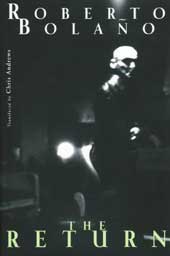
[READ: January 3, 2010] The Return

With the completion of this collection of short stories, I have now caught up with all of the published works of Roberto Bolaño (in English of course).  [The next book, Between Parentheses, a collection of nonfiction, is slated for June].

So The Return contains the 13 short stories that were not published in Last Evenings on Earth.  That collection inexplicably took shorts stories from his two Spanish collections Llamadas telefónicas (1997) and Putas asesinas (2001) and combined them into one collection in English.  It wasn’t quite as evident in Last Evenings, but it seems more obvious here that the stories in Putas asesinas are grouped together for a stylistic reason.  So, to have them split up is a bit of a bummer.  And yet, having them all translated is really the important thing.  And, again, Chris Andrews does an amazing job in the translation

This collection of stories was very strong.  I had read a few pieces in Harper’s and the New Yorker, but the majority were new to me.  Bolaño is an excellent short story writer.  Even if his stories don’t go anywhere (like his novels that never quite reach their destination), it’s his writing that is compelling and absorbing.

This collection also had some different subject matter for Bolaño (it wasn’t all poets on searches). (more…)

Read Full Post »

SOUNDTRACK: BUKE AND GASS-“Page Break” (2010).

NPR has selected the 50 best CDs of 2010.  I knew a few of them but had never heard of a bunch of other ones (about 20% are classical).  This CD with the bizarre cover has a great write up:

The wannabe tech-geek in me was initially attracted to Buke and Gass for the band’s two handmade instruments, which modify a baritone-ukulele and a guitar/bass hybrid run through heavy-duty amps (also handmade, mind you).

The problem (and perhaps its because I’m listening at Xmas time) is that the main melody line of the bridge makes me want to sing “Hark, Hear the Bells” and so this feels like a Christmas song even though it’s not.

Whoops– check that.  That melody is certainly there, but I just learned that I was listening to it in mono.  The other speaker presents all kinds of interesting things that distract from that melody (and project much more coolness).

I like the intensity of the track (and the fact that it’s under 2 minutes long).  It’s pretty heavy and the female vocals are nicely aggressive.  And by the end of the song, the syncopation is downright awesome.

It’s amazing how listening to the ENTIRE song can really change your mind.  This is definitely a cool track and will make me investigate the band more.

[READ: December 22, 2010] “One Night of Love”

I had recently gotten interested in reading Javier Marías when I was looking for information about Roberto Bolaño.  I discovered that New Directions Press, the publisher of all of Bolaño’s smaller books also published translations of all of Marías’ books too.  This story comes from his new collection of short stories While the Women Are Sleeping.  (I had also forgotten that McSweeney’s published his book Voyage on the Horizon a few years ago).

I didn’t know where Marías was from when I first started this (I assumed he was Mexican because of the New Directions connection–he’s actually from Spain).  Anyhow, when I thought he was from Mexico, I wondered if there was some kind of connection between his style and Bolaño’s, but also if he was trying to reintroduce magical realism to Bolaño (who abhorred magical realism).

Well that’s moot, (he may be doing that but not because he is from Mexico).

So this story concerns a man who is dissatisfied with his wife’s sexual appetite and performance.  He has taken to visiting prostitutes (see why the Bolaño thing rang true?), but he is concerned because the prostitutes  have grown “increasingly nervous and increasingly expensive” ([Nervous]?). (more…)

Read Full Post »

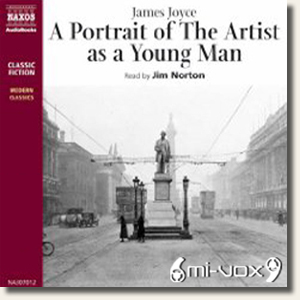
[LISTENED TO: November through December 2010] A Portrait of the Artist as a Young Man

I initially ended this post with: “Even though this audio was unabridged, it felt a bit like hearing an abridged version.  I suspect I shall have to actually read the novel again in 2011 to see what I missed.”  Well, I assumed that the audio was unabridged.  But now I see that there is another recording which is 7 discs as opposed to my copy’s 3 discs.  Gadzooks!  In tiny print on the back of the box, I see now that this is abridged.  NO WONDER I felt like so much was left out of the story.  It actually made me think that the story wasn’t all that coherent.  As such, you can kind of disregard this post until I listen to the unabridged version (which is available free for download here).

So, back to my initial review:

I was listening to this audio book while exercising.  The fact that it took me as long as it did to finish the audio book is more of a testament to my lack of exercising than the book itself.  Although I will say that unlike Dubliners, I found that listening to this book (and again, perhaps it was the distance between listenings) to be somewhat unsatisfying.  And of course, as with all of these Naxos CDs, the vocals are recorded so quietly (except when he starts screaming–the hellfire sermon is so loud it scared my family upstairs) that you really have to try to listen hard to hear the whispers.  The final chapter–Stephen’s diary–is read so quietly it was hard to hear over the exercise machine, even with the sound up all the way.

So this is the story of Stephen Daedalus before Ulysses, when he was, as the title states, a Young Man.  My favorite memory of reading this book was when I read the opening aloud to a sick friend who thought that I was messing with her:

Once upon a time and a very good time it was there was a moocow coming down along the road and this moocow that was down along the road met a nicens little boy named baby tuckoo….

Stephen is of course, baby tuckoo, so this novel is more than just the young man days.   But from this baby story, we quickly jump to Stephen at school and we see an episode that impacted his whole life: boys who were teasing him pushed him into a stagnant pool of water. (more…)

Read Full Post »

SOUNDTRACK: TIJUANA NO!-Transgresores de la Ley (1994).

In the mid 90s, when I was living in Boston, I discovered MTV Latino, and the Rock en Español resurgence.  Since I’m always interested in new music, I bought a few CDs by these Spanish-singing bands.  For most of my life I’ve thought about the rabid Japanese audiences who loved bands that sand in English.  Did they understand the lyrics?  And did it matter?  Well, here was a test for me.

Tijuana No! was the first band I bought and I really liked it (and still do).

The disc opens with a rollicking ska rocker “Goples Bajos” which features a wonderful horn filled breakdown and ends with a blistering guitar solo.  The title track, “Transgresores de la Ley” opens with a military beat and a military sounding flute before taking off with a heavy verse and, more impressively, a punk/shouty chorus.

My favorite song is “Tu y Yo,” it’s funky all over the place and has a super heavy midsection.  And “Borregos Kamikazes” has a wonderful juxtaposition of speedy, almost loco lyrics in the verses with some great group vocals in the chorus.

The first surprise (for me) comes with “La Esquina del Mundo” because suddenly there’s a female vocalist on lead.  She sounds great (her voice has a cool echo on it) and although she doesn’t quite convey the heaviness of the rest of the track, it’s an interesting juxtaposition.

The second surprise is that the track “Conscience Call” is mostly in English (I got so used to not understanding the lyrics that I was quite surprised to hear words I understood).

The final surprise comes with the penultimate track: an excellent cover of The Clash’s “Spanish Bombs.” Again sung by the female vocalist, her voice works wonderfully with the track.  The chorus, sung in Spanish, is really perfect.

So, in answer to the question, do you need to understand the lyrics to enjoy the music?, I’d say no.  Although it is nice once in a while.

[READ: November 20, 2010] The Savage Detectives

This was the Bolaño novel that I had initially wanted to read because the reviews were so glowing (amusingly enough it turns out to be virtually the last book of his that I read).  And now that I have read almost all of his books, it’s obvious how this book fits into his larger scheme of writing (I wonder what I would have thought if I hadn’t read the other books, too.  In fact, I wonder if I would have liked 2666 more at the time if I had read this one first.  As it is, I think I enjoyed this more having read 2666 first).

[DIGRESSION: When I was reading 2666 I found a fantastic review of 2666/The Savage Detectives by Daniel Zalewski, which reviews 2666 and The Savage Detectives in context of Bolaño’s life].

In a previous post I noted how Bolaño doesn’t really write conventional novels.  And this one is no exception.  Part I is the diary of Juan Garcia Madero, a 17-year-old aspiring poet.  It covers from November to December 31, 1975 .

Garcia Madero talks about his introduction to the visceral realists, a group of Mexican poets whose legacy is more or less unknown to us now (in the book–in reality there was no such group).  The two main visceral realists are Arturo Belano and Ulises Lima, and we will follow or look for these two for the rest of the book.

As with other Bolaño books, there is a massive obsession with sex.  At first Garcia Madero is a virgin and thinks about sex a lot.  Then he finally has sex with first one woman and then many women.  And he writes about them in his diary and spares no details.  (Many entries reveal him having sex with one of his girlfriends 5 or 6 times a night).  And there are of course whores and other deviant sexual individuals (including a guy who carries a large knife by which he measures his penis–we never see this, it’s all hearsay, but it’s in there).

And during this time, he is writing poetry as well–a fully welcomed member of the visceral realists.   (more…)

Read Full Post »

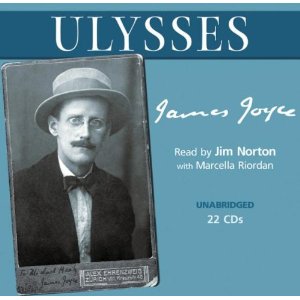
[LISTENED TO: September 27, 2010] Ulysses [abridged]

Because I am a glutton for punishment, I decided to listen to the abridged version of Ulysses as well (what’s 4 more hours of my life?).  (This edition is by Naxos, which Amazon is selling as a download).  I decided that the main reason was that since I have the text so fresh in my mind, it would be interesting to see what they abridged.  I mentioned in a recent post that the abridged version is 4 discs (just under 5 hours).  That is a serious abridgment, from 40 to 5 hours (actually the Naxos unabridged version is only 22 discs…how come theirs is so much shorter?  It seems that Jim Norton reads much faster).  And I am curious to see what they consider the “essential” text of the book.  Plus, realistically, I would never really want to do it at a later date.

So this version is read by two different people: Jim Norton (who read Dubliners, Portrait, and an abridged Finnegans Wake too) and Marcella Riordan.  There are a number of places where the two interact (she is Molly in the early scene in bed and she is some of the whores in the nightwon scene…it adds some real dramatic resonance to the story). (more…)

Read Full Post »

[LISTENED TO: Week of September 20, 2010] Ulysses 17-18

The final two Episodes of the Ulysses audio book were a mix of nothing new and massive revelations.

Episode 17, the catechism, doesn’t reveal all that much in the reading.  It’s a fairly straightforward Episode, so there’s not very much in the actual reading that would impact it.  One or two things do become somewhat clearer with the audible emphases but questions like this one are still a beast to unpack:

What counterproposals were alternately advanced, accepted, modified, declined, restated in other terms, reaccepted, ratified, reconfirmed?

Although in Episode 18, Molly says:

he says hes an author and going to be a university professor of Italian and Im to take lessons what is he driving at now

So I guess the Italian lessons plan is settled?  Which gives us some account of Stephen’s future.

But back in 17, this time through I became more aware of the

interment of Mrs Mary Dedalus, born Goulding, 26 June 1903.

So Stephen has been “in mourning” for almost a year.  Is that standard for Ireland at the time?  And how interesting it is that

Rudolph Bloom (Rudolf Virag) died on the evening of the 27 June 1886.

Their parents died on almost the exact same date (different years, obviously).  This is another interesting similarity that is not directly mentioned in the Q&A. (more…)

Read Full Post »

[LISTENED TO: Week of September 13, 2010] Ulysses

Episode 15 is a huge one, so I finished up that and 16 this week.

One thing I noted about Episode 15 is that in this section:

THE VOICE OF ALL THE DAMNED Htengier Tnetopinmo Dog Drol eht rot, Aiulella!
(From on high the voice of Adonai calls.)
ADONAI Dooooooooooog!
THE VOICE OF ALL THE BLESSED Alleluia, for the Lord God Omnipotent reigneth!
(From on high the voice of Adonai calls.)
ADONAI Goooooooooood!

the texts that are printed backwards are played as the forward recording flipped in reverse.  It was a cool effect.

I really didn’t enjoy Episode 16 while I was reading it.  I felt it was overly long and perhaps too focused on the mis-named sailor.  Plus, I was really looking forward to Episode 17 (which is my favorite).  But this time, with someone else reading the hard words, I was able to appreciate quite a lot more about this Episode.

Lar’s comments about Skin-the Goat also helped to give some background to this odd character.  And this leads me to a question that I sort of thought about while reading, but which comes up a lot more for me in this listen:  Joyce’s opinion of Ireland and of Irish independence.  The Citizen in the earlier episode was all about the Irish language and Gaelic sports.  And now in this Episode there is a lot of talk about Parnell returning.  Was this all included because it is what old men in Dublin talked in Dublin in 1904, or was it something that Joyce had a vested interest in (even while he was living in Paris where he wrote the book).  [I could investigate this, but that seems like an awful lot of work.] (more…)

Read Full Post »

[LISTENED TO: Week of September 6] Ulysses

This week I almost finished Episode 15.  I’ve just finished where Bella turns into Bello and things get really weird.  And I have to say that this Episode, for all of its craziness, is masterfully handled by Donal Donnelly.  I’ve already raved about his vocal stylings in the earlier chapters, dealing with so many different men.  But in this chapter he proves to be very dextrous at male and female voices, with a very delicate voice for some and an incredibly masculine woman’s voice for Bello (very well done indeed).  He has also proven himself to be a treat with sound effects (of which there are many here).  I won’t say for certain that it makes this insane Episode a lot clearer, but it certainly makes it easier to follow.

Back to Episode 13. The Gertie section is written in a style that is supposed to be romantic, very quick and flowy.  And Donal really nails it.   After the business of Episode 12, the lightness of 13 is wonderful, and it really brings to life the scene, especially when the rockets go off.

One thing I picked up this time is that Bloom assumes that he knows exactly when Blazes and Molly consummated their affair.  Even re-reading it now, it wasn’t quite as clear as the way he read it aloud:

Funny my watch stopped at half past four. Dust. Shark liver oil they use to clean could do it myself. Save. Was that just when he, she?
O, he did. Into her. She did. Done.
Ah!

So, yes I suppose it’s obvious, but sometimes reading along you just don’t pick things up.  And it took the way he read it for me to realize just what those short sentences meant. (more…)

Read Full Post »

SOUNDTRACK: THE CHIEFTAINS-The Long Black Veil

Like the Dubliners, The Chieftains are a bunch of old men who play traditional Irish music.  Unlike the Dubliners, they have gained a fan base beyond the trad scene.  This album in particular features a great deal of crossover material.

Guest singers include: Sting (singing in Irish!), The Rolling Stones, Sinéad O’ Connor, Marianne Faithfull,Van Morrison and Tom Jones (!)

The Sinéad tracks are really great, as she uses her voice wonderfully on the spare musical tracks. “The Foggy Dew” is particularly powerful, and “He Moved Through the Fair” isn’t too shabby either).

Sting’s track is very Sting (with trad accompaniment); Mick Jagger sings the title track, but it doesn’t do a lot for me.  Van Morrison is Van Morrison, regardless of who he’s playing with.  And Tom Jones is so over the top on “Tennessee Waltz” that it’s hard not to laugh with him.

The song with no guests, “Changing Your Demeanor” is a cute Oirishy song with deedly-ee-ayes.

It’s the final song, “The Rocky Road to Dublin” (which I’ve already said is a favorite by other artists) that fares the worst here.  About midway through the song, The Stones seem to burst in (think Run DMC & Aerosmith but a lot older) and play a really sloppy version of “Satisfaction” while The Chieftains are playing their trad song.  Nobody fares well in this version and it’s a shame to have included it on an otherwise good disc.

This is not really a good place to hear the Chieftains as a trad outfit.  It’s certainly more of a showcase album.  But it might work as a crossover introduction to some of these songs.  And yes, the album is very adult contemporary…there’s not a lot of rocking going on here.

[READ: Week of August 16, 2010] Ulysses: Episode 15 [Circe]

This is the Episode I remember most from my previous reads.  I didn’t remember the details, mind you, just the absolute insanity of it.  This is also the place where you can look if you’ve ever wondered why this book was brought up on obscenity charges.  Those first few chapters, with the outhouse and the impure thoughts are mild; even Bloom’s masturbation, while controversial doesn’t hold a candle to all of the insanity that is contained within this Episode.

It was also the only week where we read just one Episode.  And that’s because it is loooooong.  True, it is written in play form (ie, lots of white space), but it is still about 4 times longer than any other Episode.  And man is it a doozy.

I’ve already read that Daryl was just going to write WTF about this Episode.  Of course, that’s sort of what I felt about the previous one, so I guess it’s no surprise that I did enjoy the nonsense of this one.  I’ve always had a great appreciation for the absurd, so this is right up my alley.  This is not in any way to suggest that I understood it, even a little.  But there were parts that I laughed at and parts that I smiled at and parts that I practically blushed at.  Good fun!

Of course, the big question in this chapter is (aside from what the hell is going on and why is it so long) what’s real and what’s Bloom’s fever dream.  This is preceded by the big question of why Bloom is having these fever dreams (or whatever they are).  I’ve been under the impression that he is drunk (but my tenuous following of the previous chapter makes me a little unsure just how drunk he was or if he drank at all.)

In a nutshell what happens is that Stephen (and Lynch) go to the red light district.  Bloom follows behind.  Bloom had a massive memory flashback/acid trip/freak out, and then he “rescues” Stephen (and his money) from the brothel.  He can’t save Stephen from getting punched in the face by a soldier, but he is able to keep him from getting arrested (with Corny Kelleher’s invaluable help).  Bloom, despite his inaction, then offers to take Stephen home.   (more…)

Read Full Post »

« Newer Posts