Feeds:
Posts
Comments

Archive for the ‘Pornography’ Category

200px-FatesWorseThanDeathSOUNDTRACK: THE STATLER BROTHERS-“Flowers on the Wall” (1965).

flowersonthe Vonnegut mentions this Statler Brothers song in Palm Sunday as well.  I know this from Pulp Fiction–a song that I found very amusing and never would have guessed was a classic country song.  Country music was very different in 1965 than it is now.  I don’t even know if there was a folk or bluegrass category back then, and this song, with its banjo and bouncey acoustic guitar is a great example of the kind of country music I like.  And those harmonies!

This song certainly seems to be about insanity–about a man counting flowers on the wall, playing solitaire with a deck of 51 cards, smoking cigarettes and watching Captain KAN Kangaroo.  Don’t tell him he’s nothing to do.  What a weird little song.  And man is it catchy.  No wonder it was a #1 hit.

[READ: May 31, 2013] Fates Worse Than Death

After reading Palm Sunday I learned that Fates Worse Than Death was a kind of autobiographical sequel to that non fiction book.  I also learned that the two essays that make up Nothing is Lost Save Honor which is impossible to find (and for which I can’t even find a cover) are available in FwtD.  However, since there is no real contents or index, you do have to read the whole thing to find out which chapters contain the essays.  Or you can just look here and see that “The Worst Addiction of Them All” (which was published in The Nation) is in Chapter XIV and “Fates Worse Than Death” appears in Chapter XV.

The last time I read a bunch of Vonnegut together I got a bit burnt out on him and the same thing happened here.  The problem with Vonnegut’s nonfiction is that he tends to repeat himself.  A lot.  And while this book is ostensibly about the 1980s, he talks an awful lot about his family and his friends from the war and his other literary acquaintances., like he did in Palm Sunday.  In a number of places, he says that he doesn’t like to read himself in English, and it would seem that he doesn’t proofread to see if he said something already either.

This is not to say that the book is not worth reading.  Indeed, if you read Palm Sunday in the 80s and then this one in the 90s, you might not remember all of the details that pop up again, but when you read them days apart…well. (more…)

Read Full Post »

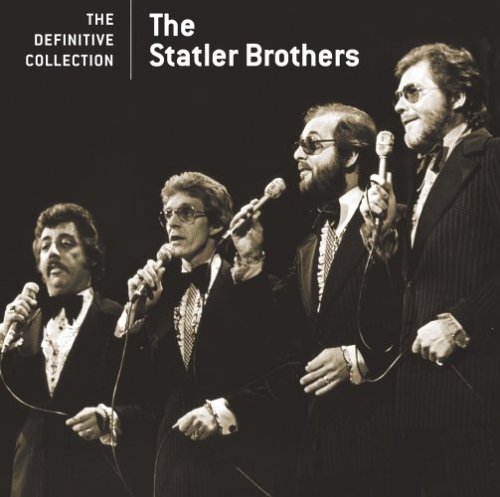
PalmSundayFrontandBackSOUNDTRACK: THE STATLER BROTHERS-“Class of ’57” (1972).

stalerI don’t know much about The Statler Brothers.  They are considered country, although this song is hardly country–it’s more folk with some bluegrass and, the real selling point–great harmonies (especially the bass singer with the big mustache).

The song is a wonderful coming of age song, sad and funny with a list of what happened to everyone in the class of ’57.  Like:

Betty runs a trailer park, Jan sells Tupperware,
Randy’s on an insane ward, Mary’s on welfare.
Charlie took a job with Ford, Joe took Freddie’s wife,
Charlotte took a millionaire, and Freddie took his life.

John is big in cattle, Ray is deep in debt,
Where Mavis finally wound up is anybody’s bet.

But the kicker comes at the chorus:

And the class of ’57 had its dreams,
Oh, we all thought we’d change the world with our great words and deeds.
Or maybe we just thought the world would change to fit our needs,
The class of ’57 had its dreams.

And then at the end:

And the class of ’57 had its dreams,
But living life from day to day is never like it seems.
Things get complicated when you get past eighteen,
But the class of ’57 had its dreams.

Vonnegut quotes the entirety of this song in the book and I’m glad he did, it’s a very moving song and really captures American life.

[READ: May 26, 2013] Palm Sunday

After writing several successful novels, Vonnegut paused to collect his thoughts.  And Palm Sunday begins: “This is a very great book by an American genius.”  It is also a “marvelous new literary form which combines the tidal power of a major novel with the bone-rattling immediacy of front-line journalism.”  After all the self praise, he decides that this collage–a collection of essays and speeches as well as a short story and a play which is all tied together with new pieces (in TV they would call this a clip show)–this new idea of a book should have a new name and he chooses: blivit (during his adolescence, this word was defined as “two pounds of shit in a one-pound bag.”  He proposes that all books combining facts and fiction be called blivits (which would even lead to a new category on the best seller list).  Until then, this great book should go on both lists.

This book is a collection of all manner of speeches and essays, but they are not arranged chronologically.  rather they are given a kind of narrative context.  What’s nice is that the table of contents lists what each of the items in the book is (or more specifically, what each small piece is when gathered under a certain topic).

Chapter 1 is The First Amendment in which he talks about Slaughterhouse Five being burned and how outraged he was by that–especially since the people so anxious to burn it hadn’t even read it (and the only “bad” thing is the word motherfucker).  The first speeches included are “Dear Mr. McCarthy” to the head of the school board where his books were burned and “Un-American Nonsense” an essay for the New York Times about his book being banned in New York State.  The next two are “God’s Law” for an A.C.L.U. fund raiser–it includes his confusion as to why people don’t support the A.C.L.U. which is working for all of our own civil liberties. (more…)

Read Full Post »

SOUNDTRACK: THE APPLES IN STEREO-King of Carrot Flowers, Pt. 3 from Score! 20 Years of Merge Records: The Covers (2009).

The Apples in Stereo have made the first song on this covers disc in which I categorically like the original better.  I don’t know that much about the Apples in Stereo, although I know they are tangentially related to Neutral Milk Hotel.  But I don’t know if their style is in general like this version–keyboardy and simplistic, or if this is a goof project for them.

Of course, the original of this song, by Neutral Milk Hotel is an indie classic, so you’d be hard pressed to try to do a respectful version and make it sound better.  It’s nice they did something different, I just don’t like it as much.

[READ: April 6, 2012] “The Porn Critic”

This is a story that is superficially facile–it confirms the age-old belief that women just do not like porn.  And yet there’s some interesting dynamics at work that I found really enjoyable.

The story is about Kromer.  Kromer was believed to be a hedonistic satyr–that a life of partying, drugs and sex followed him wherever he went.  But that was not exactly true–he was around a lot of it, just never in the middle of it.  The debauchery in his life was all thanks to his friend Greta.

Greta has a trust fund that will not mature until she reaches 30.  She was so outraged at not having the trust fund that (and I love this phrasing) it “drove her mad with the determination to die squalorously before she became wealthy.”  Despite her lack of access to the fund, she did have at her disposal  her father’s “man.”  He would cater to her every whim at any hour of the day.

And so she lived the hedonistic lifestyle–drugs and drinking, closing out parties and hanging with wild transsexuals (and calling for deliveries from delis across town to the bar she was currently in).  And she also hung out with Kromer–who was terrified of her debauched friends, but loved the access to her father’s servant.

Kromer’s reputation was also helped because he worked in a porn shop called Sex Machines.  He worked for a local real estate maven who owned all kinds of stores–from coffee to video to adult marital aids.  I love the details of Sex Machines, and that its “interior and stock had been painstakingly derived from that of a famous San Francisco shop, founded by a sex-positive lesbian collective. In lieu of such a collective, the owner had installed Kromer,”  So instead of Toys in Babeland Manhattan got Sex Machine.

Sex Machine also published a newsletter which included reviews of the latest porn movies.  And Kromer was the sole reviewer–he watches dozens of films (the output is tremendous!) and tried to simplify their content for the clientele.

As a result, he had tons of porn movies lying around his house.  And as a result of that, very few people, women especially, had visited his apartment. (more…)

Read Full Post »

SOUNDTRACK: BATTLES-“Ice Cream” (2011).

My friend Lar told me about Battles way back in 2007.  I listened to the concert he sent me, and it was great. But my memory of the band was that they were really heavy (the drummer was in Helmet and Tomahawk for cripessakes).

But they’re not so much heavy as noisy and crazy.  And this track is a head-spinning amalgam of keybaords, unsettling rhythms, processed guitars and singing from Argentinean techno producer Matias Aguayo.  The lyrics sound like they are not English, but they are (with heavy effects on them).

The song is weird, indeed. But after just one listen, I was totally hooked.  It’s catchy and bouncy and very sunny and it’s a real joy to listen to.   I absolutely must go back and check out their debut Mirrored.

Listen at NPR.

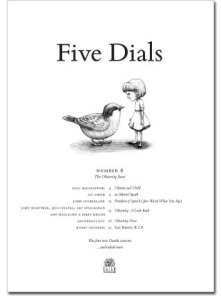
[READ: April 28, 2011] Five Dials Number 6

Five Dials Number 5 was an excellent issue that I enjoyed immensely.  They followed it up with Number 6, which deals with a subject that I was very passionate about in the early 90s: censorship/obscenity.  When I was in high school and college, the PMRC was the big bogeyman for advocates of free speech (of which I am one).  I still advocate passionately for freedom of speech (now that I’m in a library, the issue can be part of my daily life), but it seems like there are so many more important issues in the world, that stickers on a record seem kind of silly.

Nevetheless, as this issue reminds us, those who control what is said control what we hear.  And that’s true for music and books, as well as our everyday news.  So, free speech should never be taken lightly.  Although this issue looks largely at obscenity in England, they also pull up some good information from Jello Biafra as well.

CRAIG TAYLOR-A Letter from the Editor: On John Mortimer and Obscenity
John Mortimer appears later in the issue. He was the lawyer who defended Lady Chatterly’s Lover against accusations of obscenity.  And Taylor points out that Mortimer’s attitude was that he “understood the silliness of censorship.”  And with that attitude, he was able to work to convince juries of that silliness.  The rest of the issue looks at important cases of censorship over the years, from The Dead Kennedys to NWA (it’s nice to be reminded about how “dangerous” they were when they came out).  He also laughs at the lame attempts at putting adult content on network TV (Fudge you!). (more…)

Read Full Post »

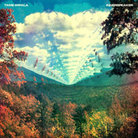
SOUNDTRACK: TAME IMPALA-“Lucidity” (2010).

I heard this song on the NPR’s 5 Artists You Should Have Known in 2010.  The album, Innerspace, is only available in Australia (imported on Amazon for big bucks) but I guess that’s why people download music.

This song is really cool. It feels very My Bloody Valentine to me.  However, inevitable comparisons to The Beatles abound, but that’s mostly in the vocals (which is kind of funny since they are Australian).  But it’s really a very sixties British vocal sound–not unlike early Who).

The big difference comes in the music which is psychedelic and wild in ways that The Beatles never quite managed.  There are great big washes of noise, and the sound quality sounds retro, even though it obviously isn’t.  Comparisons to the great Swedish band Dungen are not misplaced either.

I’ve listened to a few more tracks by them on YouTube, and I think this album could easily be one of the best of 2010 if only more people could hear it!

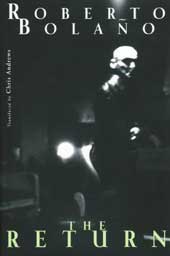
[READ: January 3, 2010] The Return

With the completion of this collection of short stories, I have now caught up with all of the published works of Roberto Bolaño (in English of course).  [The next book, Between Parentheses, a collection of nonfiction, is slated for June].

So The Return contains the 13 short stories that were not published in Last Evenings on Earth.  That collection inexplicably took shorts stories from his two Spanish collections Llamadas telefónicas (1997) and Putas asesinas (2001) and combined them into one collection in English.  It wasn’t quite as evident in Last Evenings, but it seems more obvious here that the stories in Putas asesinas are grouped together for a stylistic reason.  So, to have them split up is a bit of a bummer.  And yet, having them all translated is really the important thing.  And, again, Chris Andrews does an amazing job in the translation

This collection of stories was very strong.  I had read a few pieces in Harper’s and the New Yorker, but the majority were new to me.  Bolaño is an excellent short story writer.  Even if his stories don’t go anywhere (like his novels that never quite reach their destination), it’s his writing that is compelling and absorbing.

This collection also had some different subject matter for Bolaño (it wasn’t all poets on searches). (more…)

Read Full Post »

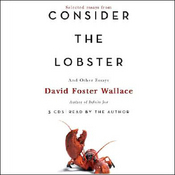
[LISTENED TO: November 18, 2010] Consider the Lobster

This was the final audio book that DFW read.  As with Brief Interviews, this is a collection of selected, unedited essays [actually it says “Text slightly edited for audio, with changes approved by the author.”  I don’t know these essays verbatim, but it seems like the changes simply acknowledge that this an audio essay and not a written one].

The only problem with the entire package is how few essays were selected.

I don’t know if it’s because this collection was recorded later and DFW felt more comfortable reading or because DFW had more fun reading these essays or that these essays lend themselves to more animated reading, but this collection is absolutely stellar.

The audio book includes

  • Consider the Lobster
  • The View from Mrs. Thompson’s
  • Big Red Son
  • How Tracy Austin Broke My Heart

and, sadly, that’s it.

Not included are (more…)

Read Full Post »

SOUNDTRACK: SUPERCHUNK-1,000 Pounds (2000).

This EP has four tracks: an acoustic version of the title song and, for the first time that I’m aware of, a cover track.

“1,000 pounds” is another great Superchunk single.  It’s boppy and catchy and there’s more and more instrumentation thrown into the mix–acoustic guitars, more strings, a crazy sounding guitar solo with effects I don’t recognize.  It’s also another song where the title is sort of thrown into the chorus without making it sound like the focus of the chorus–another fun Superchunk trick.

The acoustic version subverts the original somewhat with a strange swing vibe.  And speaking of vibes, there are actual vibes in the song.  It almost sounds like a different song entirely.

The second song, “White Noise” is a no longer novel twist to a Superchunk song (they’ve been throwing in so many twist to their sound that it’s impossible to pin them down to anything).  There’s a cool guitar and bass line that sound, somehow, unlike anything else they’ve done.  The soloing is also pervasive, running throughout the verses.  It’s a very cool song.

The big surprise comes in their cover of David Bowie’s “Scary Monsters.”  Their version is noisy and feedback-filled with crazy guitar solos throughout some of the choruses.  It’s full of reckless abandon and is one of their craziest track in some time.  And really it sounds almost nothing like the original.

It’s a great EP and worth tracking down.

[READ: October 10, 2010] “The Volunteers”

Chang-rae Lee is the next writer in the New Yorker’s 1999 20 Under 40 collection.

This story is set during World War II.  However, unlike most WWII stories that I have read, this one is told from the point of view of Japanese soldiers (specifically, it is narrated by a Korean-born, Japanese-raised medic).

The narrator, Lieutenant Kurohata, is friendly with an inferior soldier, Corporal Endo.  He and Endo are from the same town so they have a friendship which, when they are alone, supersedes their ranking differences (although Kurohata is a little uncomfortable about that).  Endo, like many soldiers, is somewhat obsessed with a series of photos of naked women.  He is constantly trading for new ones and then showing them (surreptitiously) to Kurohata.  Kurohata is not terribly impressed with the behavior–he seems more mature in general–although he also implies that he is not very sexual–and he finds the whole proceedings somewhat beneath him. (more…)

Read Full Post »

SOUNDTRACK: BEN FOLDS-University A Capella (2009).

The story goes that Ben Folds heard some a capella bands and decided to give them some airtime.  So he had them record a bunch of his songs.

I have been surprised at how much I enjoy some kinds of a capella music.  Ed Helms’ stuff on The Office is certain fun, but on a more serious level, it’s amazing what these singers can do with their voices in terms of diversity, range and even sounds.

But at the same time, it’s the lead vocalist on most a capella tracks that sell the song.  And, on this disc there are a lot of lead singers I don’t like. Part of it is because I don’t like R&B vocal stylings, which I find too over the top at times.  Although I do admit that there;s one or two on here that work very well.

Overall, I enjoy this disc.  It’s fun to hear different interpretations of songs that I know and like.  Although I think realistically its the songs that Ben himself sings that I enjoy the most.

[READ: April 25, 2010] Romantic Dogs

This is the final Bolaño book that I’m going to read before finishing 2666 (Savage Detectives you’re next).  And it happens to be a collection of Bolaño’s poetry.

I have a complicated relationship with poetry.  I have written (and had published) a few poems.  I dated a woman who was (and I suppose still is?) an excellent poet (hi, Paula).   When I worked for a literary magazine, I learned how to judge poetry.  And yet, I don’t really read it.  And I think the reason for that is that, in my head, poetry deserves more attention than I’m usually willing to give it.  I feel like a poem should be pored over, read and re-read and, if good enough, memorized.

I have memorized about two poems in my life.  And since I often don’t feel like devoting a ton of time to poems,  I just don’t really read them.  And that’s a shame for me, because while poetry does demand a closer look, it’s not a precious item that should be put on a pedestal and looked at only when company comes over.

And Bolaño is as good a poet as anyone to demonstrate that. (more…)

Read Full Post »

SOUNDTRACK: THE DEAD MILKMEN-Chaos Rules: Live at the Trocadero (1994).

It wouldn’t be a complete look at the Dead Milkmen without mentioning their one live release.

Chaos Rules is a surprisingly good live set (taken from two separate concerts).  They had to leave all of the songs from their Hollywood Records discs off this collection, so this comes across more as a classic concert rather than a comprehensive one.

The band sounds great and the songs sound pretty close to the originals.  Not that the originals were hard but it wasn’t always obvious whether the Milkmen were doing what they were doing on purpose.  This set suggests that they were.

As any good live band, they play around with their songs, being surprisingly angry about local politics and changing the (by then twenty year old) “Bitchin Camaro” intro to reflect that.

The only reason it would have been nice if they had been allowed to include some of the Hollywood Records songs (they do sneak one in under a different name) would be to see if they played them any differently.  Since the early tracks are pretty chaotic, I wonder what would happen to the latter, more mellow songs.  Did they stand up under the weight of the nonsense or did they become more ramshackle as well?

I guess I’ll never know.  This is not essential by any means, but it is an interesting artifact for the curious and is totally enjoyable for DM fans.

[READ: April 23, 2010] Distant Star

Because Bolaño never does anything typical, this novella is a spin-off of sorts to Nazi Literature in America.  The introduction states that “in the final chapter of my novel Nazi Literature in America I recounted, in less than twenty pages and perhaps too schematically, the story of Lieutenant Ramirez Hoffman…which I heard from Arturo B.  He was not satisfied with my version…So we took that final chapter and shut ourselves up for a month a half in my house in Blanes, … where we composed the present novel.  My role was limited to preparing refreshments, consulting a few books and discussing the rest of numerous paragraphs with Artuto…”

Okay, there is so much wonderful deception in just this introduction to this book it totally cracks me up.  (Arturo B has long been a stand in for Bolaño himself). In the original, the narrator is named Bolaño (he is the narrator in jail who eventually helps the detective locate the poet).

For yes, the story is the life of a poet who is also a murderer.  And, the story is pretty much the same as the 20 or so pages of Nazi Literature.  It is now an extended meditation on this particular poet.  All of the events that were present in the short version are here, they are all just fleshed out with Bolaño’s wonderful details and full biographies of other characters.

The big, weird thing though is that almost all of the names have been changed (to protect the guilty?).  So even though the poet of this book has the same exact  life story as Lieutenant Ramirez Hoffman, he never has that name in Distant Star (and he goes through several pseudonyms).  There are twins in the short version who now get new names.  Even the poetry teachers have different names.  However, the detective who hunts him down at the end has the same name.  Weird.

The book works as a critical assessment of the Allende administration (which is why the real Bolaño was imprisoned).  But on to the story. (more…)

Read Full Post »

SOUNDTRACKTHE SPACE NEGROS Do Generic Ethnic Muzak Versions of All Your Favorite Punk/Psychedelic Songs from the Sixties (1987).
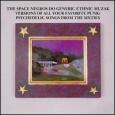
I stumbled upon this CD again when I was looking for a Sparklehorse disc (alphabetical you see).  I originally discovered this album when I was a DJ in college and the absurdity of the title instantly grabbed me.

And never has a title so accurately described the music within (except for “the space negros” part which is just weird).  Anyhow, the disc is indeed a collection of generic ethnic muzak recordings.  But it predates that late 90’s “ironic” muzaky recordings of hipster songs.

Nevertheless, it is muzaky background versions of songs from the sixties (and a few originals).  The difference comes in the instrumentation: zithers, harpsichords, clarinets, autoharp, etc.  In other words, this isn’t a guy making cheesy Casio recordings of classic songs.  This is a collection of musicians reinterpreting songs for fun (and presumably to get high to?).

The most noteworthy songs for me are “Silas Stingy/Boris the Spider” medley and The Stooges’ “We Will Fall.”  In fact, I didn’t recognize any of the other songs on the disc (the 13th Floor Elevators and The Electric Prunes are the only bands that I recognize aside from The Who and The Stooges).

So, this is clearly a labor of love.  Whether or not you will love it depends on your tolerance for trippy muzaky renditions of songs that sound like they’re from an Indian restaurant/hash shop circa 1964 (that exists on the moon?).  The CD reissue includes thirty more minutes of tunes which are all just listed as More Generic Muzak (no covers here).   It’s strange that these more nebulous bonus tracks really tend to show off how good the rest of the disc is.  Sure in part that’s because the other tracks are actual songs, but it also shows how well the weird musical approach to these songs works when it is focused with a good starting point.

The Space Negros (headed by Erik Lindgren) made several discs, but it’s hard to find a lot of information about them online.  Even their own website is surprisingly devoid of information (although you can buy the disc!)

[READ: April 19, 2010] “Prefiguration of Lalo Curo”

Even when I try to stop reading Bolaño, the stories keep arriving in my mailbox.  This story (to be released in his forthcoming story collection The Return) looks at the history of Lalo Curo.  For those of us reading 2666, Lalo Curo figures prominently in The Part About the Crimes.  And in 2666 his history is given.  So this short story is a bit confusing within the canon of Bolaño.  2666

In this one, Lalo’s mother, rather than being raped and impregnated as a young girl (as had all of her mother’s mothers) was a porn star.  Lalo was born Olegario Cura (surname Cura (The Priest) because his father was a priest).  And, as with all my favorite Bolaño stories, there’s all kinds of fun questions regarding narrator and intended reader.  Lalo’s mother “Connie Sánchez was her name, and if you weren’t so young and innocent it would ring a bell” along with her sister and friend were all stars in a series of porn movies.  The man behind the movies was a German [another thing that recurs in Bolaño] named Helmut Bittrich.  Helmut treated them well, and the whole production company felt like a (weird, certainly) family.  In fact, Connie made films even when she was pregnant with Lalo (lacto-porn!).

Connie had tried legitimate theater (even Broadway!), but eventually, her career went towards porn.  The bulk of the story is given over to (graphic) descriptions of all of her films.  But the most interesting section is about Bittrich’s understanding of “the sadness of the phallus.”  After all those graphic scenes we get this remarkably poetic moment:

he’s naked from the waist down, his penis hangs flaccid and dripping. Behind the actor, a landscape unfolds: mountains, ravines, rivers, forests, towering clouds, a city, perhaps a volcano, a desert.

Pajarito Gómez is the male actor described above.  He is the primary male in all of the porn films.  He wasn’t well endowed, but he had a special kind of presence on screen.  As the story ends, Lalo goes in search of Gómez and finds him easily. They share a moment, watching movies and reconstructing the past.

It’s an interesting story, one that fully fits within the Bolaño landscape.  Bolaño is pretty obsessed with porn, and this story is obviously no exception.  It may not be the best introduction to Bolaño’s work, and yet in many ways, it’s pretty much Bolaño in a nutshell.

For ease of searching I include: Bolano, Sanchez, Gomez

Read Full Post »

« Newer Posts