Feeds:
Posts
Comments

Archive for the ‘John F. Kennedy’ Category

SOUNDTRACK: ROKIA TRAORÉ-GlobalFEST Tiny Desk (Home) Concert #136 (January 14, 2021).

Rokia Traore.GlobalFEST is an annual event, held in New York City, in which bands from all over the world have an opportunity to showcase their music to an American audience.  I’ve never been, and it sounds a little exhausting, but it also sounds really fun.

The Tiny Desk is teaming up with globalFEST this year for a thrilling virtual music festival: Tiny Desk Meets globalFEST. The online fest includes four nights of concerts featuring 16 bands from all over the world. 

Given the pandemic’s challenges and the hardening of international borders, NPR Music and globalFEST is moving from the nightclub to your screen of choice and sharing this festival with the world. Each night, we’ll present four artists in intimate settings (often behind desks donning globes), and it’s all hosted by African superstar Angélique Kidjo, who performed at the inaugural edition of globalFEST in 2004.

The final artist of the fourth and final night is Malian singer Rokia Traoré.

Rokia Traoré performed at globalFEST in 2005, the music festival’s second year, and it’s a thrill to present her meditative performance as part of Tiny Desk meets globalFEST. Her work is rooted in the Malian musical tradition, but defies the confines of a single culture. Born in Mali to a diplomat father, Traoré had a nomadic upbringing that exposed her to a wide variety of international musical influences. She joins us from Blues Faso, a theater inside her Foundation Passerelle in Mali, which she created to support emerging, interdisciplinary artists, from music and the performing arts to visual arts and photography.

She plays three songs that more or less segue into each other.  I don’t know a lot about music from Mali, but the little I know I can recognize from the Ngoni played by Mamah Diabaté and the guitar played by Samba Diabaté, with lots of speedy runs.   In “Souba Lé” melody is played on the balafon by Massa Joël Diarra (although I wish they’d have shown us it up close).  Both this song and “Tiramakan” feature subtle bass from Aristide Nebout.  The final song “Fakoly” is a little louder and drummer Roméo Djibré is a bit more prominent.

But all of these songs are all about Rokia Traoré’s vocals which soar and ring out.

[READ: February 25, 2021] March Book 3

Each book has gotten longer.  Book one was 121 pages, Book 2 was 187 and Book 3 is 246.

This book begins right after the bombing of the Sixteenth Street Baptist church in Birmingham, Alabama in 1963.   You meet the victims before they were killed.  It continues through until the passing of the Voting Rights Act in 1965.  Holy cow was there a lot of violence in these two years and the amazing art by Nate Powell never shies away from showing it.

Eagle Scouts at Klan rallies who then go on to kill Black teenager’s, hicks in pickups celebrating the deaths of the girls in the church with anti-integration chants and, as we see more and more in this book, police killing innocent people and not getting in any trouble because of it.

This book has opened my eyes to what Black people have known all along about police forces.  That they are completely corrupt and need to be restructured from the ground up.  When you see that it was their job to be racist in 1963, is it any surprise that they are still racist in 2021?

Reading a book like this I can’t help but think that the best thing we could have done for our country would have been to let the south secede.  Bring all people of color north and let the racists fester in their own lack of diversity.  Because their racism poisons the whole country.  And yet that is exactly the opposite belief that this book is based upon.

I’m embarrassed at how naïve I am. (more…)

Read Full Post »

SOUNDTRACKELISAPIE-GlobalFEST Tiny Desk (Home) Concert #136/156 (January 14, 2021).

ElisapieGlobalFEST is an annual event, held in New York City, in which bands from all over the world have an opportunity to showcase their music to an American audience.  I’ve never been, and it sounds a little exhausting, but it also sounds really fun.

The Tiny Desk is teaming up with globalFEST this year for a thrilling virtual music festival: Tiny Desk Meets globalFEST. The online fest includes four nights of concerts featuring 16 bands from all over the world. 

Given the pandemic’s challenges and the hardening of international borders, NPR Music and globalFEST is moving from the nightclub to your screen of choice and sharing this festival with the world. Each night, we’ll present four artists in intimate settings (often behind desks donning globes), and it’s all hosted by African superstar Angélique Kidjo, who performed at the inaugural edition of globalFEST in 2004.

The second artist of the fourth and final night is First Nations singer Elisapie.

Elisapie returns to Tiny Desk for a show-stopping performance from Montreal, with the disco globe of our dreams helping to light her set. Elisapie, in both her songs and work, is a resounding advocate of First Nations culture in Canada. In her set, she harnesses an incredible energy with electrifying, emotive vocals.

I had really enjoyed Elisapie’s previous Tiny desk.  I found her to be a less extreme, but no less dramatic performer than Tanya Tagaq.  Her band is outstanding creating all kinds of textures to surround her voice.

The first song is “Qanniuguma.”  It starts quietly with a single ringing guitar note from Jean-Sébastien Williams and little taps of percussion from Robbie Kuster.  Joshua Toal adds some quiet bass as the guitar plays some higher notes.  After a minute Elisapie starts singing.  Another 30 seconds later the drums get louder and Jason Sharp start sprinkling in some raw bass saxophone.  As the song grows more intense, Elisapie adds some breathing and chanting–throat singing.  Things quiet down and then build again with the sax and the guitar soloing as the drums and bass keep things steady

Behind her you can see Mont Royal, which has a lot of history.

The second song “Wolves Don’t Live by the Rules” is “a small song” but very meaningful.  It starts in a similar way with ringing notes an thumping drums.  She sings this one in  English and it feels like a much more conventional sounding song.  It’s pretty quiet but the instrumental breaks adds huge guitar chords and the end is really loud.

Introducing the final song, “Arnaq” (which means Woman) she says women tend to forget that we have a lot of strength and we should celebrate it loud and clear.  This one opens with a loud raw sliding guitar like an early PJ Harvey song.  The song’s chorus builds with an “ah ya ya ya” as the instruments add chunky noises–scratches from the guitar and skronks from the sax and all kinds of precious.  It’s a cool noise fest, although the guitar could be a smidge louder.

I’d really like to see her live.

[READ: February 25, 2021] March Book 2

Book Two picks up John Lewis’ life.

Like the first, it starts with Lewis’ preparations for the inauguration of Barack Obama.

Then it flashes back.  Lewis was in college and had moved to Nashville where the growing student movement was gaining strength.

The visuals are even more striking in this book.  The panels of the white woman pouring water and then soap (or flour) on the quietly sitting Black diners and then hosing them down is really arresting.  As is the sequence (which is almost entirely black) of a room full of peaceful protestors being locked in a room when the fumigator was set off.

I couldn’t believe that a man couldn’t really left us there to die.  Were we not human to him?

Then next round of protesta was at the segregated movie theaters.  I love that they chose the Ten Commandments to protest (the irony was lost on the whites in Alabama).  The Black protesters would line up and would be refused seating.  Hundreds of people who would then get back on line and be refused seating again.  Whites would throw things at them and hurl abuse at them. (more…)

Read Full Post »

SOUNDTRACKEDWIN PEREZ-GlobalFEST Tiny Desk (Home) Concert #136/155 (January 14, 2021).

Edwin PerezGlobalFEST is an annual event, held in New York City, in which bands from all over the world have an opportunity to showcase their music to an American audience.  I’ve never been, and it sounds a little exhausting, but it also sounds really fun.

The Tiny Desk is teaming up with globalFEST this year for a thrilling virtual music festival: Tiny Desk Meets globalFEST. The online fest includes four nights of concerts featuring 16 bands from all over the world. 

Given the pandemic’s challenges and the hardening of international borders, NPR Music and globalFEST is moving from the nightclub to your screen of choice and sharing this festival with the world. Each night, we’ll present four artists in intimate settings (often behind desks donning globes), and it’s all hosted by African superstar Angélique Kidjo, who performed at the inaugural edition of globalFEST in 2004.

The first artist of the fourth and final night is Edwin Perez.

From the basement of the Bowery Electric in downtown Manhattan, composer and vocalist Edwin Perez and his 10-piece band come together to put on a show. With a strong backbeat and enough room to move around, Perez’s up-tempo energy brings the party and keeps it going. The theme of the night is salsa dura music, which originated in New York in the 1970s and gained acclaim thanks to acts like the Fania All-Stars and Spanish Harlem Orchestra.

This set is a lot of fun (even with the seriousness of the second song).  Cuban music is so full of percussion and horns it’s hard not to want to dance to it.  And this band has three percussionists: Nelson Mathew Gonzalez: bongo, cowbell (from Puerto Rico); Manuel Alejandro Carro: timbales (from Cuba); Oreste Abrantes: (from Puerto Rico).  The horn section is also pretty large: Leonardo Govin (from Cuba) and Michael Pallas (From Dominican Republic): trombone; Jonathan Powell (from USA) and Kalí Rodriguez (from Cuba): trumpet.

They play three songs. “La Salsa Que Me Crió” has lots of percussion and a great trumpet solo.  Perez even dances during the instrumental breaks.  And throughout, Jorge Bringas (from Cuba) keeps the bass steady.

After introducing the band, he says “Say her name Breonna Taylor.  Say his name Philando castile.  Say his name George Floyd.  End the abuse.”  This is the introduction to the quieter “No Puedo Respirar” (I Can’t Breathe).   Despite the subject, this song is not a dirge.  I don’t know what the words are but there is joy in the music as well.  There’s a jazzy keyboard solo from Ahmed Alom Vega (USA).

Yuniel Jimenez (From Cuba) opens the final song “Mi Tierra” with a fantastic introductory solo on the Cuban tres guitar.  The rest of the song brings back the Cuban horns and percussion. There’s even a drum solo (or two) in the middle.

[READ: February 25, 2021] March Book 1

I had heard amazing things about this trilogy of books.  I don’t know why it took me so long to get around to reading them.  Now that John Lewis is dead for almost a year, it was time to read them.

This is essentially a biography so it’s not easy to write about.  It’s also an incredible story of selflessness, fortitude and unbelievable courage.

The framing device is very well executed.  After a brief prologue that shows John and is marchers getting attacked by police, the book shows us Washington D.C. January 20, 2009, the day that Barack Obama is being inaugurated President.  Since John is (in 2009) in office he will be attending the ceremonies.

As he is preparing and getting ready to leave, a woman and her two children walk into his room hoping to look at Mr. Lewis’ office–a inspirational moment for her young boys.  But it happens that John (or Bob as he is called) is still in his office. They are embarrassed to interrupt, but he welcomes them warmly and shows them some of the things around his office.

Like photos of him meeting President Kennedy when Lewis was 23.  And from the March on Washington in 1963, where Dr King gave his “I have a dream” speech.

Then the boy asks him why he has so many chickens in his office.

The story then flashes back to young John (called Bob by his parents).  His father purchased 110 acres in Pike County, Alabama for $300. John was incharge of the chickens on the farm.  He also loved preaching.  He learned to read at 5 and began preaching to the chickens (they never said Amen or anything).

He also loved going to school.  He would even away from his house on the days his father insisted all the children work in the field because he didn’t want to fall behind.  (Even if it meant getting in trouble).

One of the first being moments in his life wa when his Uncle Otis drove him North.

Otis knew which places offered colored bathrooms and the ones where you would never get out of the car: “Alabama, Tennessee, Kentucky.  These were the states we had to be careful in as we made our way North.”

It wasn’t until they got to Ohio that his uncle relaxed.  They arrive in Buffalo 17 hours later and John was amazed to see white and black people living next door to each other. (more…)

Read Full Post »

SOUNDTRACK: THE ANGELUS-“The Young Birds” (2019).

Every once in a while I like to check in with Viking’s Choice on NPR’s All Songs Considered.  Lars Gottrich specializes in all of the obscure music that you won’t hear on radio.  For this month, he did a special focus on Patient Sounds. a small label based out of Illinois.

[UPDATE: At the end of 2019, Patient Sounds closed shop. I’m not sure if any of these songs are available outside of Bandcamp].

Lars had this to say about the label

Matthew Sage, who runs the label, knows that dynamic drone, jittery footwork, oddball drone-folk, hypnagogic guitar music and cosmic Americana can exist in the same space.

The second song of the week is by The Angelus.  Lars describes the song:

Redemption often comes at the hands of something bigger than yourself, but as The Angelus’ soul-rattling doom-gaze reminds us, the love of young children will make you humble.

This song starts with crashing heavy chords–cymbals and loud guitars.  But then it settles down to a groovy death riff.  The surprise to me was when the singer began singing.  He has a soft melodic voice which totally changes this from a heavy dark song into a kind of melodic slow heavy song.  The chorus is surprisingly heavy and even ends on a kind of positive mood.

[READ: September 1, 2019] “Class Picture”

This story surprised me because it started

Robert Frost made his visit in November of 1960, just a week after the general election.  It tells you something about our school that the prospect of his arrival cooked up more interest than the contest between Nixon and Kennedy.

If Nixon had been at their school, they would have glued his shoes to the floor.

This is quite a lengthy story and there are a lot of components.  Wolff fleshes out this school very well.  So well, in fact, that I could see this being developed into a novel [It is actually an excerpt from a novel]. Although for the purposes of this story, the plot is dealt with fully.

It also makes me wonder if such a school could actually exist.  Certainly not in 2020, but even in 1960?  Because this school exhibited pride in being a literary institution. Glamorous writers visited three times a year and the English masters carried themselves as if they were intimates of Hemingway.  The teachers of other subjects (math, science) seemed to float around the fringe of the English masters’ circle.

The tradition at the school was that one boy would be chosen to meet the famous author who was coming next.  This year it is Robert Frost.  Each boy would submit an entry (in the case of Frost it would be poetry).  The author himself would select the winner.  And these meetings were a big deal to everyone on campus.

The narrator is very excited but he knows that his poems are subpar–he writes fiction.  He was on the school’s literary magazine board so he was familiar with the other great writers in his class.  There were three.

George Kellogg was a proficient writer of poetry, although the narrator found the boring.

Bill White was the narrator’s roommate.  He’d written most of a novel already and his poems were impressive.

Jeff Purcell was the third.  He was also on the literary magazine and was quick to dismiss others.  Could that translate to his own writing?

The one detour from the poetry angle is about smoking.  The school forbade smoking but a lot of boys did anyway.  The narrator said he loved smoking.  He smoked in storage closets and freezers, steam tunnels and bathrooms.  He even went out for cross-country so he could smoke while running in the woods.

If you were caught smoking you were expelled.  It happened every once in awhile.  A person was sent home just before the Frost Poem deadline.  This made the narrator quit smoking on campus.

The narrator wrote a poem for the occasion but he didn’t think it was good enough.  So he decided to submit an older one on the off chance that Frost liked it.

I won’t spoil the winner, but Frost did come to the school and he read some of his poems aloud.  During the Q&A that followed a master asked a question.  Interestingly he misstated the title of the poem.  He called it “Stopping in Woods” which Frost corrected instantly to “Stopping by Woods on a  Snowy Evening”  The master continued the question asking about iambic lines  Frost says “Good for you, they must be teaching you boys something here.”

The boys all laughed and Frost seemed pleased–had he made a mistake about the master or had he known all along?  The boys were surprised to learn later that Frost was quite funny.

The end of the story shows the winner of the contest questioning the value of his poem.  He felt that Frost mis-read it and that perhaps he won for the wrong reasons.  Should he blow off Robert Frost?  Is he crazy?

I really enjoyed this piece and found myself thoroughly engaged.  If this is part of a novel, I would be very curious to read it.  Turns out it is an excerpt from the novel Old School.

Read Full Post »

SOUNDTRACK: VANILLA FUDGE-The Beat Goes On (1968).

I thought the first Vanilla Fudge album was odd–covers of contemporary songs done slowly and with little resemblance to the originals.

Well, this second album was downright bizarre.

It  doesn’t really have any “songs.”  Rather, it’s more of a collage–a history of recorded sound as interpreted by the Vanilla Fudge.  There’s a few snippets of classical pieces, some rocks songs, historical vocal recordings and final words from the guys in the band.  All sandwiched between snippets of them playing The Beat Goes On, the Sonny Bono song.

It’s a weird enough record on its own, but when you read just a little but about it, it gets even weirder.  According to the Wikipedia entry:

The group was at odds with producer George “Shadow” Morton during recording, as Morton made his own concept album without significant input from them. In the liner notes of Sundazed Records’ 1990 CD reissue, the band denounces it as a failed experiment on the producer’s part.     ….
In his autobiography Stick It!, Carmine Appice declares: “Even listening to it now – which, let me tell you, I rarely fucking do – The Beat Goes On sounds like an album that Spinal Tap would be wary of making.”

The album opens with an instrumental “sketch.”  It is primarily the Vanilla Fudge keyboard sound with some occasional piano and guitar sounds washing in and out.

After a recording of Thomas Edison reciting Mary Had a Little Lamb, a ponderous voice says PHASE ONE and they start with the first iteration of “The Beat Goes On.”

Then comes what is now probably the fourth surprise already.  The track is titles “Eighteenth Century: Variations on a Theme by Mozart: “Divertimento No. 13 In F Major”” and it’s 45 seconds of Mozart on harpsichord!  It’s followed by a 45 second version of “Old Black Joe” by Stephen Forster, this time sung quietly with acoustic guitar and bass.

That was meant to represent the nineteenth century.  The twentieth century has a bit more diversity with Cole Porter, Glenn Miller and Elvis.  There’s rags on piano with a trap drum.  “In the Mood” sounds like it’s in a roller rink and “Hound Dog” sounds really tinny and awful.  The music is played perfectly, but the quality of the recording is deliberately (I assume) poor.

The next section is called The Beatles, because they clearly didn’t record enough Beatles on their first album.  But this time they do it more like the originals, not like the Vanilla Fudge.  In less than two minutes, they run through excerpts from “I Want To Hold Your Hand,” “I Feel Fine,” “Day Tripper,” “She Loves You,” and “Hello Goodbye.”   Except that for the final track they sing “You say hello and I say goodbye…”  And they laugh into…

PHASE TWO.  This has another version of “The Beat Goes On” followed by six minutes of Beethoven (if you;re keeping track, Beethoven was before the 20th century).  They play “Fur Elise” & “Moonlight Sonata” on keys with bass.  But it builds up with rocking drums and   build rocking with drums and keys and guitar.  It gets crazy fast and loud.

Then another version of “The Beat Goes On” followed by another version of it (the original would have switched sides at this point.

PHASE THREE is called “Voices in Time” and it is literally 8 minutes of historical recordings by: Neville Chamberlain, Winston Churchill, Franklin Delano Roosevelt, Harry S. Truman and John F. Kennedy.

Then on to PHASE FOUR which after one version of “The Beat Goes On” is talking sections with the band members.  They are labelled “Merchant/The Game is Over”

Vinnie on guitar says a few things concluding with “As life goes on, the beat goes on.”  Tim on bass does an “interview” in which he (or someone) asks him questions which he answers–about sex, politics and ice cream among other things.  He sounds pretty much  like an ass.

Carmine says “I play drums.  Listen to my drums if you wanna hear me talk.”  And finally after some Indian style music comes Mark the lead vocalist.  He uses his time to read a bit of the Bible, a passage about Moab.

The whole business ends with the longest yet version of “The Beat Goes On.”

The CD comes with a Bonus Phase.  There’s a cover of The Beatles’ “You Can;t Do That” and an original  These two songs are certainly the highlight, especially their original song “Come By Day, Come By Night.”  I love the bassline and choral voices.  This really points out what a waste it was not to record their own songs.

The sixties were a weird time.

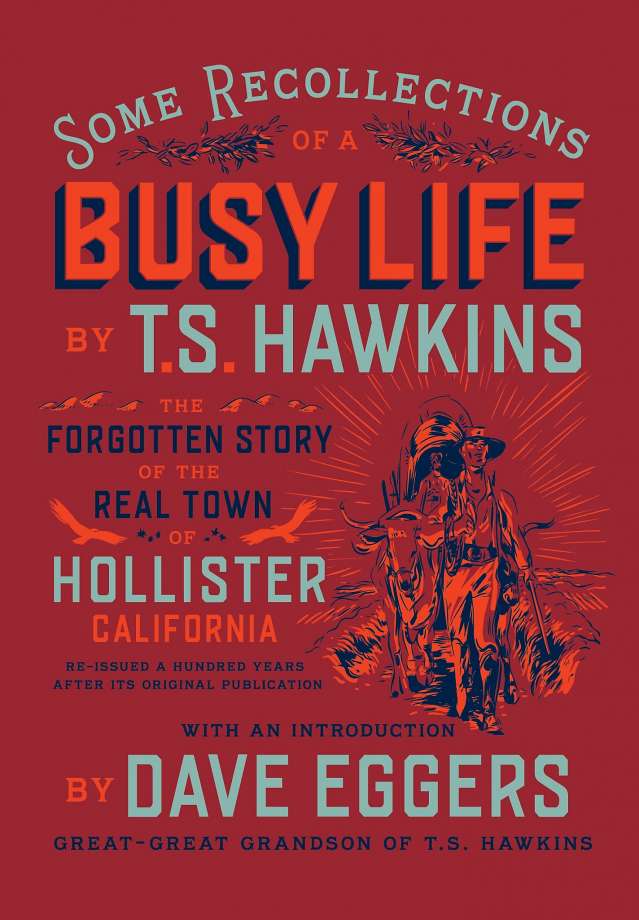
[READ: July 22, 2017] Some Recollections of a Busy Life

The beginning of this book includes Dave Eggers’ essay that was in the New Yorker, July 20, 2015 issue.

Read about it here.

T.S. Hawkins was Dave Eggers’ great-great grandfather.  In 1913 Hawkins wrote Some Recollections of a Busy Life and printed 300 copies.  Now 102 years later, Eggers was able to use his press to get it reprinted,

What’s even more disconcerting is that we’re prepared for the book to be 102 years old, but it starts with Hawkins talking about what it was like seventy years ago.  So the beginning of this book is actually set in the 1840s and 50s.  He was born March 6, 1836 in Missouri about 12 miles from the Mississippi River. His grandfather had been from Virginia and then moved to Kentucky and then on to Missouri.

He is writing his recollection not believing that the general public would care about them but he hopes his children and grandchildren might be interested in the changes which have taken places over the years of their grandfather’s life.

He grew up West of the Mississippi with no railroads and no telegraphic or telephonic communication with the rest of the world.  News in the East took weeks to reach them.  Electrical lighting was a thing undreamed of.  They made their own soap with the ashes from their fires.  Their clothes were homemade. (more…)

Read Full Post »

SOUNDTRACK: LYDIA AINSWORTH-“Afterglow” NPR’S SOUTH X LULLABY (March 23, 2017).

I was unfamiliar with Lydia Ainsworth, but I was instantly struck by the setting of her lullaby.

We asked Lydia Ainsworth to perform in Raum Industries’ Optic Obscura installation. Surrounded by dim, long-hanging optical fibers that look like an infinity room of cat’s whiskers, she sings a stripped-down version of the slow-burning “Afterglow,” accompanied only by an upright bass and light percussion.

I’m not sure what the original song sounds like, but this version is moody and intense.  The upright bass opens the song as Lydia’s whispered, sensual vocals come forth.  She has a beautiful voice and it is especially haunting in this setting.  It reminds me a bit of someone else although I can’t decide who.

The starkness of the silence when she stops singing is intense.  And I really like the way the song ends, not abruptly exactly, but rather unexpectedly.

[READ: March 21, 2016] T-Minus

Jim Ottaviani did the amazing graphic novel Feynman, and in the blurb about him in that book, it said that he also wrote T-Minus.  Coincidentally I had just brought T-Minus home for Clark and I to read.  He read it quickly and said it was very good.  It took me a little longer to read (I’m sure he didn’t read all the details) because Ottaviani jam packs this book with interesting facts.

As the title says, this is about the race to get a man to the moon.  It begins 12 years before the actual date occurred.  And it toggles back and forth between the United States and the Soviet Union.

On the margins of many pages there are drawings of all of the various attempts each country had to get a rocket into the air.  The drawings show the design and then at the bottom it states the duration of the flight, the date and some other details.  The USSR’s first rocket (1957) lasted all of 20 seconds before exploding.  The U.S’s first rocket lasted about 7 seconds.

We meet a handful of people who were instrumental in the design and origination of these rockets.  (Ottaviani explains that many of these people are composites of real people involved–if he wanted to include everyone, there would be 400 people in every panel). (more…)

Read Full Post »