Feeds:
Posts
Comments

Archive for the ‘Poetry’ Category

nov 2013SOUNDTRACK: VIC CHESNUTT-Tiny Desk Concert #2 (June 5, 2008).

chesnuttVic Chesnutt seems to have come into my life at random times. I bought the charity record/tribute album (Sweet Relief II) only because I liked a lot of the artists on it–I’d never heard of him at the time.  More recently his records were released on Constellation, a label I trust wholeheartedly.  And then just as I was really starting to appreciate him, he died in 2009 from an overdose of muscle relaxants.

He was a fascinating person.  A 1983 car accident left him partially paralyzed; he used a wheelchair and had limited use of his hands (which you can see in the video).   He struggled with drugs and alcohol and depression.  Despite all of this, he released his first album in 1990.

Robin Hilton, music dude at NPR, introduces him here and talks about how much he loves his music.  But even Hilton’s association with Chesnutt is checkered.  He writes that when he was younger and went to see him in concert, “[Chesnutt] was often drunk and sometimes belligerent. I walked out of at least one performance,” and “all of this probably made it easy to dismiss Vic Chesnutt’s music. He was a challenging guy, and his unpolished, idiosyncratic songs weren’t easily digested.”

And yet for all of that Chesnutt seems rather shy and unsettled in this Tiny Desk setting.  He seems unsure about what he wants to play and often asks if he should play this or that song.

He plays 5 songs (for 26 minutes total).  The opener is “When the Bottom Fell Out.”  A lot of Chesnutt’s songs, especially in this setting sound similar.  His voice is incredibly distinctive, as is his playing.  But since most of his songs are just him strumming and singing, they sound quite similar.  The second song, “Very Friendly Lighthouses” sounds a little different because he plays a “horn” solo using his mouth as a trumpet. It is a web request which he says he’ll “try” to do (and that he needs a cheat sheet).  I don’t know the song but it sounds fine to me.  He also emphatically states that the song is not about Kristin Hersh (something she has claimed).

“Panic Pure” also has a Kristin Hersh connection (she recorded it on Sweet Relief).  He says he stole the melody from “Two Sleepy People” by Hoagy Carmichael.  He turned it to a minor key and wrote his song.

For the next track, he asks if he should try a new song that he just wrote–more or less asking permission to do this unreleased track.  “You really want me to try out a new song that might suuuck?” (resounding yes). “We Were Strolling Hand in Hand” proves to be a very good song indeed.

The final track “Glossolalia” comes from North Star Deserter, the album I own.  It’s about being an atheist songwriter in a Christian country.  It’s funny that he says he hasn’t played it in a long time (it’s from his then new album…).

Chesnutt was not for everyone, clearly.  But his music is haunting and beautiful in its own way, and this is a very engaging setting to see him perform.

[READ: November 8, 2013] “Lovely, Dark, Deep”

Karen told me to check out this story and while I was planning to, she got me to move it up higher on my pile.  And I’m really glad she did because there is so much going on in this story that I was glad to be prepared for it.

The story seems simple enough, a young girl goes to interview famed poet Robert Frost at a writer’s workshop.  She is an unknown writer writing for a small college journal (Poetry Parnassus) and really has no business interviewing the Poet Himself.  She is shy and literally virginal.  When she walks up on Frost, he is sound asleep on a porch.  She dares to take a few pictures of the man (which later sold for a lot of money…although presumably not for her).

When Frost wakes up he is surprised and a little disconcerted by the young girl.  And then he gets cocky with her, suggesting she sit on the bench with him.  She demurs and begins trying to be as professional as possible.

Frost proves to be an obnoxious interviewee, full of ego for himself and nothing but disdain for all other poets.  She is intimidated by him, fearing that all of her questions are silly.  Then she tries to ask him some insightful questions but he tends to dismiss them as obvious or simply ignore them.  Eventually she asks one personal question too many and he becomes blatantly offensive.  He asks about her panties and if they are now wet (the cushion she is sitting on is damp from rain).  And he bullies her terribly.  She is offended but remains strong and continues to ask him questions. (more…)

Read Full Post »

2013-10SOUNDTRACK: VOIVOD-The Best of Voivod (1992).

bestvoivodMost Best of records promise you a selection of popular songs from a band.  Voivod never really had any popular songs, so this is an interesting choice to start with.  This may also be the only Best of compilation of a band where people who like some of the songs almost assuredly will not like other songs.

As my posts about the band have indicated, Voivod changed drastically over their first six records (which is the  period this collection covers).  And so in twelve tracks and 50 some minutes you get the very diverse history of this very unusual band.  I’m not going to talk about each track (already done that), but I will list the songs

  • Voivod [War and Pain] classic screaming metal.

  • Ripping Headaches [Rrröööaaarrr] brutal, but I must say sounds a ton better than the original CD.  I wonder if this was remastered for the compilation).

  • Korgull the Exterminator [Rrröööaaarrr] hard to believe they used two songs from this album.

  • Tornado [Killing Technology] heavy but quite catchy.

  • Ravenous Medicine [Killing Technology] signs of complexity enter the heaviness.

  • Cockroaches [EP] a strange inclusion, almost a rarity.

  • Tribal Convictions [Dimension Hätross] very complex with some heaviness.

  • Psychic Vacuum  [Dimension Hätross] I’m surprised they didn’t pick other songs though from this album.

  • Astronomy Domine [Nothingface] their hit.

  • The Unknown Knows [Nothingface] very hard to choose just two songs from this masterpiece.

  • Panorama [Angel Rat] Their newest single and quite a departure from everything that has come before.

  • The Prow [Angel Rat] their prettiest number ever.  If you buy this CD for this song you’ll hate the early stuff.

Although Voivod fans (like Dave Grohl)

are diehard, anyone who would buy only a Best of record from the band is sure to be disappointed. There are so many phases of the band and they are so radically different from “Voivod” to “The Prow” that it’s almost not even the same band.  I’m very curious as to what sales for this album were like.  (Even the cover isn’t that inspired)

[READ: September 2013] The Walrus: Tenth Anniversary Issue

It’s hard for me to believe that The Walrus has been around for ten years (even they seem a bit surprised).  I still remember hearing about the magazine on Book TV from some Canadian channel that I just happened upon.

When I heard about it The Walrus seemed interesting–kind of like Harper’s and elements of the New Yorker but all about Canada.  I’ve been a Canuckophile for decades now, so it seemed like an interesting prospect.  And over the ten years of the magazine, while I haven’t written about every issue, I have read every article.  I have written about all of the short stories that they’ve published.

This issue eschews some of my favorite elements (the short articles in the front and the arts section in the back), but they make up for it with an oversized issue (twice as long as usual and the articles are all packed with content) and some fascinating articles.

And while there are none of the short articles from the front, there are “Time Capsules,” one page articles about things that have happened in the last ten years: The iPhone, Sports Concussions, Armed Drones, The Residential School Apology, Justin Bieber, Foodies, Hand Sanitizer and Cyberbullying.  It’s interesting to read about these phenomena from a slightly different perspective.  We know that Canada and the U.S. share many similarities but there are, at heart some core differences.  And it’s these differences that make you rethink a subject.  (more…)

Read Full Post »

bossSOUNDTRACK: THE OCTOPUS PROJECT-“Sharpteeth” (2013).

octopusThe Octopus Project play largely instrumentals, but this track has vocals.  It begins with a very synthy keyboard sound–very retro.  But it soon grows huge with big swirling sounds and a ton of other instruments.

I’m not sure why they do so many instrumentals because their vocals–male and female playing at odds with each other–work wonderfully together.  They’re kind of a talkie singing which works well in this song.

Bob Boilen says one of the musicians is a great theremin player.  I assume that that’s what the solo is although it doesn’t have the eerieness of a theremin–perhaps that’s just the production?

By the middle of the solo, the whole band kicks in and it is a noisy cacophony but with a pretty melody still going on.  It’s a very cool song, and I’m bummed that I’ve never heard of them before (they’ve been around over a decade).

[READ: August 20, 2013] The Boss

This is the fifth book in the McSweeney’s poetry series.

I don’t know Chang’s poetry (although I have apparently read it in The Believer) and two things struck me.  She really sticks to her theme and she likes playing with words.

What I found initially very exciting but then a little exhausting (perhaps her poetry is better taken in small doses) was the play on words.

Like the vibrancy of “I Once was a Child” (more…)

Read Full Post »

walrusjulySOUNDTRACK: J MASCIS-“Fade Into You” (2013).

jmazzy I really liked this Mazzy Star song when it first came out.  Over the years I have gotten a little tired of it–it was a bit overplayed and a bit too…something.  So it’s nice to have this remarkably faithful cover from J. Mascis.

Mascis is of course the singer from Dinosaur Jr, and is usually fond of screaming guitar licks and wild vocals.  But one must not forget that Mascis is also a king of melody (underneath the noise are beautiful pop gems).  And this simple acoustic song fits very well with his vocals style and falsetto.  There are some beautiful overdubbed guitar licks, and it never veers into the treacle at all.

I prefer Mascis’ to the original now.

Perhaps more fascinating than the cover is why he has released it:  It accompanies a limited edition (360 pairs) of shoes.  [So limited edition that my size is sold out already].

The shoes are vegan (or however you phrase that) and feature a purple faux suede and a stripe from Mascis’ guitar strap.  As the write up says: In addition to having a design inspired by J Mascis’ guitar strap embroidered on the back, the purple shoe comes with an exclusive 7″ picture disc of Mascis covering the Mazzy Star classic “Fade Into You”.

And I have to say that the $75 price tag is surprisingly cheap for a limited edition/star inspired/benefit type shoe.  You can buy a pair (maybe) here.  Or just listen to the song at Pitchfork.

[READ: July 15, 2013] Three Poems

This issue of The Walrus is the Summer Reading issue.  It includes three short stories and three poems.  In light of my recent decision to try to read more poetry, I was pleased to see three poems here, even though in my head Summer Reading is all about Fiction.

Since there are only three poems (by different authors), I’m going to mention them all in one post, as I hate to write more words in a post than the author did. (more…)

Read Full Post »

43SOUNDTRACK: IRON MAIDEN-Killers (1981).

killersKillers picks up right where Iron Maiden left off–indeed many of these songs were written at the same time as the first album.  The difference is new guitarist Adrian Smith.

It opens with the great (but simple) instrumental “Ides of March” which segues into the blistering “Wrathchild.”  And it’s on this song that you can tell some of the rawness has been removed from the recording.  The guitars sound a wee bit more polished.

And you can tell the band are getting a bit more symphonic with the bass harmonics that intro the wonderful “Murders in the Rue Morgue” a song that feels long but actually isn’t.  It has several parts that all seem to signal the end until Clive Burrs drums come pounding in to restart the song.  Very cool.  “Another Life” is another fast punky song, and while I like it, it is probably one of the weaker songs on the album.  But that’s okay because it is followed by one of Maidens greatest instrumentals–“Genghis Khan” which has beautiful symphonic soaring solos over a cool propulsive beat.

“Innocent Exile” opens with another great noisy slappy bass riff that only Harris was doing at the time.  “Killers” is a classic track: fast and yet complex, with a very cool riff.   “Twilight Zone” sees Di’Anno reaching for higher more operatic notes.  He makes it, but you can just tell that the band needs more from their vocalist.  “Prodigal Son” opens with a pretty acoustic guitar intro.  I used to like this song quite a bit (whatever Lamia is), but I can see that it’s actually quite long and meandering (maybe this one is more like “War Pigs”).  It’s pretty but could probably be a bit shorter.  “Purgatory” sounds like track off the first album–fast raw and punky with screaming riffs.  “Drifter” ends the disc with a cool bass line and some more thrashing.  It’s a solid ending for an album that overall works pretty well, but which kind of shows that the band had to either do something big on the next album or get stuck in a rut.

[READ: June 1, 2013] McSweeney’s #43

And with this issue I am almost all caught up with my McSweeney’s.  More impressively, I read this one only a few days after receiving it!

This issues comes with two small books.  And each book has a very cool fold-out/die cut cover (which is rather hard to close and which I was sure would get caught and therefore ripped on something but which hasn’t yet).  The first is a standard collection of letters and stories and the second is a collection of fiction from South Sudan.  Jointly they are a great collection of fiction and nonfiction, another solid effort from McSweeney’s.

Letters (more…)

Read Full Post »

42SOUNDTRACK: IRON MAIDEN-Iron Maiden (1980).

Steve Harris was on That Metal Show recently.  Harris is the baimssist and primary songwriter for Iron Maiden and has been since their first album in 1980.  When I was in high school Iron Maiden was my favorite band hands down.  I had all their albums, I had all their singles, all their hard to find British vinyl 12 inch singles, even a few pictures discs.  Wonder if they’re valuable?

Every album was an epic event for me–I even played “Rime of the Ancient Mariner “off of Powerslave to my English class (not telling anyone it was 13 minutes long).

And then, after Somewhere in Time, I just stopped listening to them. Almost full stop.  I did manage to get the first four albums on CD, but the break was pretty striking.  I actually didn’t know that they’d had personnel changes in the ensuing years.  I’d vaguely heard that Bruce Dickinson  left, and that others followed, but I don’t think I quite realized that they were back to their big lineup these days.

Anyhow, Harris was so earnest and cool that I had to go check out some of their new stuff. Which was okay.  I’d need more time to digest, but then I had to listen to the first albums again.

And wow I had forgotten how much the first Iron Maiden album melds punk and prog rock into a wild metal hybrid.  There’s so much rawness in the sound and Paul Di’Anno’s vocals, not to mention the speed of some of the tracks.  And yet there’s also some epic time changes and starts and stops and the elaborate multipart Phantom of the Opera….  Wow.

The opening chords of “Prowler” are brutal.  But what’s surprising is how the second song “Remember Tomorrow” is a lengthy song that has many ballad-like qualities, some very slow moody sections–although of course each chorus rages with a great heavy riff and a blistering solo.  On the first two albums Paul Di’Anno was the singer.  He had a fine voice (it was no Bruce Dickinson, but it was fine).  What’s funny is that Bruce does the screams in “Remember Tomorrow” so much better in the live version that I forgot Paul’s vocals were a little anemic here.

However, Paul sounds perfect for the rawness of “Running Free” a wonderfully propulsive song with classic Harris bass and very simple metal chugga chugga riffs.  And this has one of the first real dual guitar solos–with both players doing almost the same riff (and later Harris joining in on bass).

“Phantom of the Opera” is the band’s first attempt at an epic multi-secton kinda-prog song.  It opens with a memorable, if slightly idiosyncratic riff and some wonderfully fast guitars/bass.  There’s a great slow bit that morphs into an awesome instrumental soloing section with bass and twin guitars playing a wonderful melody.

“Transylvania” is an instrumental that is challenging but probably not one of the best metal instrumentals out there, although again when Dennis Stratton and Dave Murray play in synch solos it’s awesome.  This track segues into “Strange World” a surprisingly trippy song (with effects that seem like keyboards but which aren’t).  It’s slow in a “War Pigs” kind of way, but it doesn’t entirely break up the album, because there are other slow bits on the disc.  It is a little out of place though.

Especially when “Sanctuary” blasts forth.  True, it wasn’t originally on the album (in the UK), but man, blistering punk or what!  “Charlotte the Harlot” was always one of my favorite songs (it taught me what a harlot was after all), it’s quite proggy, with a lot of stuttered guitar work and a middle section that features some loud and complex bass.  The disc ends with the by now almost immortal “Iron Maiden.”   A great raw riff opens the song, a harmony guitar partners it and the band blasts forth.  Who even knows what the lyrics area about, the song just moves and moves–There’s even a great chaotic bass/drum break in the middle.  And listening to the guitar noises in the solos at the end.  Amazing.  It’s quite the debut.

[READ: June 7, 2013] McSweeney’s #42

I have made it a point of (possibly misguided) pride that I have read every word in every McSweeney’s issue.  But this issue has brought that to an end.  As the title states, there are twelve stories in the book.  But there are also sixty-one authors writing in eighteen languages.  And there’s the rub.  One of my greatest (possibly misguided) shames is that I don’t speak any other languages.  Well, I studied Spanish and German, I know a few dozen words in French and I can read the Greek alphabet, but none of these would help me read any of these stories.  So, at least half of this book I didn’t read.

But that’s kind of the point.  The purpose of this book is to make a “telephone” type game out of these stories.  Stories are translated from one language to another and then re-translated back into English.  The translators were mostly writers rather than translators and while some of them knew the second language, many of them resorted to Google Translate or other resources to “read” the story.  Some people read the story once and then rewrote it entirely, other people tried to be as faithful as possible to the original.  And so what you get are twelve stories, some told three times in English.  Some versions are very similar and others are wildly divergent.

I normally write about the stories in the issues, but that seems sort of beside the point as the original stories were already published and were selected for various reasons (and we don’t even see any of the original stories).  The point here is the translation(s).  So, in a far less thorough than usual way, I’ll list the contents below. (more…)

Read Full Post »

Burn-This-House-175x250SOUNDTRACK: THE KNIFE-“Heartbeats” (2002).

knifeheart

I learned of this song from the José González cover that was featured in the (very cool) Sony video with the bouncing balls.  The song turned me on to González, but not necessarily the song itself.  I knew The Knife did the original  and I remember when I first heard it, I didn’t like it nearly as much as the González version.

It’s been a few years and there’s a new The Knife album out and in the New Yorker review of it Sasha Frere-Jones mentioned this song again.  So I wanted to listen to it without the cover so prominent.  And indeed, the González cover is quite straightforward (acoustic guitar rather than mega synth, but otherwise pretty spot on). The Knife’s version is very retro synth-sounding .  It reminds me of a wacky 80s song.  Or perhaps a 2000’s Europop song.

The vocals are high-pitched and a wee bit over the top, but all in all it’s very catchy.  Frere-Jones said that The Knife version was very popular but evidently I didn’t travel in those circles because I don’t recognize it as being huge.

And I still like José’s version better.

I know it’s not really cool to show the video of the cover version when I’m talking about the original, and it’s really not that cool to use a commercial as a video, but it is still very fun to watch.

[READ: April 30, 2013] Burn This House

For the last day of April, the last day of poetry month, I read a new book of poetry that came across my desk today.  This is Kelly Davio’s first collection.  She is an MFA and quite an accomplished poet (managing editor and Pushcart nominee).  I also thought that I would see if she was a “modern, weird” poet or a more traditional one (I secretly hoped for more traditional as I’d burnt out on wacky ones).  For the most part she is more traditional and I liked most of her poems quite a lot.

The book was divided into five sections.  And I have to admit that the final few sections contained poems which seems a little forced to me (more on that later).  For it was in the early pages that I thought the poetry was most magnificent.

Although when I first started reading I was afraid that the poetry was going to be ponderous without enough concrete detail.  Like in “auguries” which showed a series of potential omens (Davio seems to have a thing with birds crashing into windows) which were effective, but I didn’t like the ending: “To what /significance such eroded things?” It seemed too vague to be powerful.

But the poems that came right after were just wonderful with detail like in “The First Lines” which had this description of a scarecrow: (more…)

Read Full Post »

fivedials_no27b

SOUNDTRACK:  FREEGAL MUSIC (2013).

freegalNot only am I a librarian, I’m also a patron of libraries (we currently use four!).  I’m also a huge advocate of library usage.  Everyone knows you can get free books at the library.  And many people know (but many people don’t) that you can get free CDs and DVDs from the library.  Well, I’m advocating a new service that many libraries have implemented (both the library where I worked and my local library have it).

It’s called Freegal and it allows you to download (and keep) three songs a week.  The selection is quite impressive, as they have made agreements with 10,000 record labels.  That’s 10,000 LABELS, not artists, so huge numbers of songs are available. I did a few random searches and was delighted by how much was there.

Even their genre divisions are impressive.  Just check out this sample selection from the B’s: BeBop Big Band Black Metal Bluegrass Blues Bolero Bollywood Brasil Soul Brazilian Breakbeat BritPop Broadway.

So check out to see if your library subscribes.   You get three free songs every Monday morning!  Not bad for the price of a free library card.

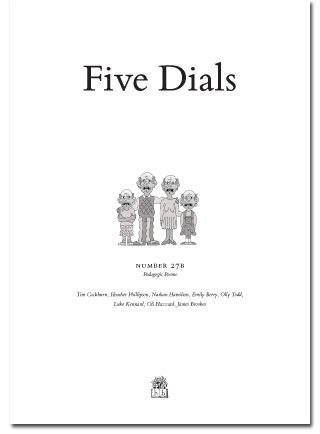
[READ: July 3, 3011] Five Dials Number 27B

I haven’t posted about a Five Dials in a couple of issues, primarily because I find writing about anthologies is very time consuming (I have recently read three McSweeney’s which I haven’t had the time to edit together into posts).  The good news is that I have only missed two issues, but I know that at least one of them is pretty large.  I was a little bummed to see another new one already, but then I saw that this issue was not only short, it was full of poetry.  And, since this is my poetry month, why not end the month with a little more poetry.

I enjoyed the offputting cartoon on the cover of this issue which is creepy and funny at the same time.  (Illustrations are by Sophia Augusta, Hannah Bagshaw, Kyle Platts, Tom Rees and Joe Prendergast.  I assume Augusta did the cover).

There was no letter from the editor or any of the usual suspects in this issue.  Rather this issue opens with a Letter from the Poetry Editor.  It is shaped like a poem but isn’t one.

SAM BUCHAN-WATTS-On Parenting Poems
Mentioning a 1954 parenting guide (from Elizabeth Longfellow), Buchan-Watts says that they asked eight young poets to choose a chapter heading from Longfellow’s book Points for Parents, and to make a poem starting from that title.

And it’s now that I admit that these poems have set me back terribly in my appreciation of poetry which I have been nurturing all month.  If ever there was a collection of seemingly random words, it is these. (more…)

Read Full Post »

chelotti SOUNDTRACK: PETER GABRIEL-“The Book of Love” (2010).

pg

This is a cover of the Magnetic Fields’ song (not the fifties song).  I have this strange relationship with the Magnetic Fields.  I love the songs that Stephin Merritt writes.  His melodies are simple but timeless.  And his lyrics are usually wonderful.  Like from this song:

The book of love has music in it
In fact that’s where music comes from
Some of it is just transcendental
Some of it is just really dumb

And then there’s Merritt’s voice.  It is deep.  Almost comically deep, especially when he sings slowly, it brings on a strange profundity to these words.  And it works pretty well.  Although sometimes I want the songs to be…more.  And that’s where the covers seem to come in.

Gabriel’s cover doesn’t change the song really at all.  But it has Gabriel’s voice, which soars and it has Gabriel’s sense of instrumentation, which also soars.  Perhaps it’s that Merritt’s songs deserve bigger and lusher treatments–they practically scream for Broadway.    And while Gabriel’s version is nowhere near Broadway over-the-topness, it fleshes things out nicely.

Of course, it may very well be that Merritt’s understatement (and oftentimes, just one instrument) provide a successful counterpoint to the spectacle that the song could be.  And maybe that’s why they are so successful.

But Gabriel’s version is really great, too.

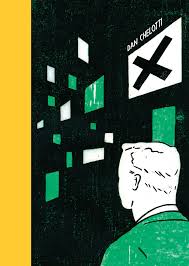
[READ: April 20, 2013] X

One more book of poetry for April, this one by Dan Chelotti.  It is Chelotti’s debut, and Chelotti’s poetry is wild and weird and often quite funny.  It is also unapologetically modern.  As you can see from the first poem “Ball Lightning”

I am looking out over
one of the first real gray
days of autumn listening
to a podcast in which
these two men are talking about
the phenomenon of ball lightning.

Or, more sadly in “ Grieving in the Modern World” in which he compares the way people’s grief in the old days was so public, but now it seems so small and insignificant, oh and besides:

…the microwave is
almost finished heating
my dinner , and the newshour
is about to begin. (more…)

Read Full Post »

circleSOUNDTRACK: BOB MOULD-Black Sheets of Rain (1990).

I blacksheetstend to think of this as a very dark and claustrophobic album, which it is.  And yet it is also unavoidably Bob Mould, meaning that there are pop elements all over it.  There’s also some very cool, simple bass lines that tend to spruce up some moments of the album making it a bit more fun than it would be without them.

Even if the title track is over seven minutes long, with some really blistering guitar solos, there are still really poppy elements to the chorus.  As for claustrophobic, the title and cover make this seem like it would be really quiet and insular.  But a song like “Black Guard” is quite inviting.  And the third song, “It’s Too Late” is one of the poppiest songs that Mould has written.  The opening chords are so obvious and recall so many classic rock songs that it’s almost too pop for its own good.

“One Good Reason” is another longer song and it, too, has a catchy chorus.  “Stop Your Crying” is one of Mould’s great songs–a nasty-seeming minor chord structure with Mould’s screamed lyrics.  And yet he still manages to make you want to sing along.

The largely acoustic (with disconcerting organ) “The Last Night” is a breakup song.  A major downer with the odd lyric: “Tonight’s the last night that I will ever spend with you.  Please don’t ask me why cause I don’t know, yea.”  A similar kind of breakup song is “Out of Your Life.”  The difference is that “Out of Your Life” is incredibly poppy.  A major key with bouncy bass and super sing along chorus.  It’s two sides of an idea.  “Disappointed” sounds very much like earlier Hüsker Dü with that buzzy guitar that is unmistakably Mould.  The album ends with “Sacrifice/Let There be Peace” in which the dichotomy of Mould’s sounds are in full evidence.  Mould’s voice sounds completely shot by the end as she screams and growls (it’s amazing he could even speak after recording some of these songs).  The lyrics are practically impossible to understand and yet in the background Mould is chanting/singing a very steady chorus of “Sacrifice” and there’s a very melodic guitar line going on.

It’s an interesting ending to a very schizophrenic album.  It’s nowhere near as dark as I remember, but not exactly a cheery walk in the park either.

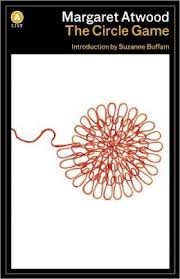
[READ: April 10, 2013] The Circle Game

It’s funny that I’m reading so much poetry, as I don’t typically enjoy it.  Well, April is National Poetry Month after all, so why not.  I received this Atwood book at work.  I really like Margaret Atwood a lot and I hope to delve into her oeuvre more.  So why not take the opportunity to scan this brief volume of poetry (which I thought was new, although I now see is from the sixties).

I’ve read a lot of different types of poetry this month and I found that I really enjoyed Atwood’s work a lot.  Could it be because it’s 40 some years old and not “new” poetry?  I don’t know.  Could it be that she uses parentheses a lot (could be).  Or is it just that she is a great writer.

Her poems actually made me think about the nature of poetry itself.  Why does a fiction writer write poetry?  It seems like some of these poems are simply very short stories.  Is that all a poem is?  A very short story (I mentioned how flash fiction has arisen as a genre, and some of these pieces feel like they could be rendered as flash fiction.  I often find flash fiction unsatisfying and I think it’s because poetry is even tighter and more effective than a flash fiction piece.

I’m also intrigued by Atwood’s poetry because she is writing about atypical stuff (as is Atwood’ wont).  So there’s not a lot of “love” here, except under the guise of something else. (more…)

Read Full Post »

« Newer Posts - Older Posts »