SOUNDTRACK: REGINA CARTER-Tiny Desk Concert #54 (April 11, 2010).
Regina Carter is a (jazz mostly) violinist (although I am unfamiliar with her). Her then new album, Reverse Thread, was a collection of African melodies played via Carter’s jazz sensibilities. She had been playing with a larger group on tour, but she decided to strip down the band to just herself on violin, Will Holshouser on accordion and Yacouba Sissoko on kora.
They only play two songs, although since the set is 12 minutes, they are long songs (about 6 minutes each). And they are beautiful and meandering with many solos.
I have to admit that for the first s9ng, “N’Teri” (written by Habib Koite) I feel like the kora comes across as the main instrument. I could listen to Sissoko play that all day. Although by the middle of the song Carter and Holshouser trade off solos, violin to accordion, which is pretty cool.
“Kanou” (written by Boubacar Traoré) is a bit more upbeat and almost dancey. In this song all three musicians get equal billing and its really cool the way each instrument seems to come to the fore a little. I also enjoyed that even though this is Regina Catrter’s show, she puts her violin down for a bit while Holshouser takes a long accordion solo. But mostly they all work together perfectly–a wonderful combination that I’ve never heard before.
[READ: April 14, 2015] “Musa”
This is a simple story of loss and how it can affect everyone around them.
Musa is the narrator’s older brother. He is a strong figure in the family and the narrator respects him like no one else. Their father had disappeared long ago and Musa was more or less the man of the family.
And then Musa was murdered. The narrator was upset of course, but he was also offended by this because he imagined his brother was invincible and even worse, the way he died was so insignificant.
But it hit his mother even harder. She acted as if she were widowed and she treated the narrator as an insignificant afterthought. Her whole life was soon dedicated to mourning Musa and to finding his killer. (more…)
This is the explanation directly from Snooks as to what this is:
Hello,
In 2003 I had this hair-brained idea to run a radio station out of my bedroom. Two years previous, I attended Acadia University where I became the program manager of a thing called Radio Acadia nestled in the beautiful Nova Scotia Annapolis Valley, and was well aware of how to operate an online station. So, I set things up and ended up producing a show in my kitchen all about my favorite band, the Rheostatics. I had done numerous shows on them before, and I think I did a pretty good job with this one. I advertised the show on the Rheostatics yahoo list, but ended up with just one listener in Ontario I think.
Sadly, due to my rather busy work schedule, plans to take over the world with a pirate radio station that would change every music listener, and crush every commercial radio station into oblivion, had to be scrapped. Enjoy.
So this is 2 hours of Rheostatics music with some introductions by Snooks. Snooks provides general information about the band, some chronology and band member lists. But I think the best part is when he talks about meeting some of the guys and some personal anecdotes (especially about Tim Vesely).
I like the way he groups the songs thematically: History (songs from their early days and about the record industry), Acoustic Times (their more mellow numbers), Tim and I (songs by Tim), Bruce Willis and the Rheostatics (a great title if ever there was), Art (their more outlandish songs) and Reflective (their more reflective songs). I am surprised that “Horses” didn’t make it, though.
There’s nothing new here–it’s all songs from the albums (including Double Live)–but it’s fun to hear them played in this order.
[READ: March 25, 2015] “All You Have to Do”
It’s 1972 and Sid Baumwell, aged sixteen, is looking for more from his small town. He was handsome and had a lot of potential (his teachers said so). He genuinely believed he could be president.
One day at the grocery store he saw a card table offering a contest. The man at the table asked him if he felt like a winner and Sid said yes. The contest was for a lifetime supply of aluminum foil. And the man at the table, Bill Baxter, said that Sid looked like winner. Bill smiled at him. He gave him some sound if clichéd advice about school and made a slightly suggestive sexual joke. And then Sid left.
On the way home, Bill pulled up next to him in his car and offered him a ride home. Sid said sure. They started talking about cars. Bill laughed about his own car and after a few comments, Bill said that if Sid played his cards right the car could be his. Sid is confused and Bill doesn’t really clarify.
As Bill drops him off, he suggests that Sid will want to get out of this town. When Sid says it’s a nice town, Bill snidely remarks that nice is the kiss of death. Sid if offended, but it makes him think about his town. (more…)
SOUNDTRACK: DANIEL LANOIS-Tiny Desk Concert #415 (January 13, 2015).
I don’t really know very much about Daniel Lanois. I know he’s a great producer. I know that he’s worked with Brian Eno on an umber of projects. I even know that he has at least one album out of his own. But other than that he’s an enigma to me.
And he remains so here.
He and his bassist Jim Wilson and drummer Brian Blade, play three instrumentals that are more or less improvised.
Lanois stands with his back to the audience, facing the other two guys. And aside from some closeups of his gear, the only interesting thing visually that happens is that the drummer knocks over an LP during a song and picks it up.
Lanois’ gear is totally perplexing to me—there’s knobs and buttons but no keyboards, so I don’t know where the sounds are coming from. The bassist keeps a steady rhythm while Lanois turns and spins and slides things. Musically it’s not all that interesting—it’s sort of mellow background electronica.
The best part of the whole deal is the drummer. He plays some amazing fills and runs on that snare and hi hat. It’s amazing the complexity he is able to achieve with just a bass, snare and hi hat. He also smiles a lot which is nice to see from these rather dour men.
Lanois doesn’t say a thing during the set, not even when it’s over. You can see it here.
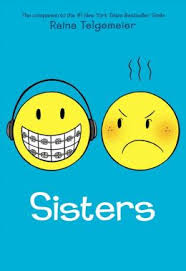
[READ: February 10, 2015] Sisters
I really enjoyed Smile, although I found out about Smile when Sisters came out. So this is a sequel to Smile (although Raina still has her braces on during the book, so I guess it’s more of a concurrent story).
As the story opens, Raina (age 14) and her family (her mom and dad. her baby brother (6) and, grr, her sister (age 9)) are visiting relatives in Colorado. Their dad has some work to attend to so he will be flying in a few days later, but everyone else is going to hop in the van and drive from Colorado to California and then back–so that’s basically two weeks in the car and one week in California. Ugh.
The only saving grace is that their van has three rows of seats so each girl has a seat to herself while their brother rides shotgun.
Before they head out, we see that Raina and her sister Amara are on each other’s nerves constantly–with Raina ultimately shouting “Why did I ever ask for a sister?!” Then we see flashback of Raina as a young girl desperately wanting a sister to play with. And when Amara finally came–Raina was in love–until she realized that the baby would be sharing room with her. There’s a joke about Amara meaning “immortal” in Sanskrit and “love” in Latin and her father muttering “it also means bitter one.” And it turns out that Amara is a pretty cranky kid–especially where Raina is concerned. (more…)
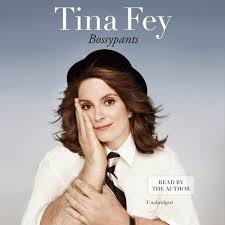
After listening to Amy Poehler’s audio book, it made me want to listen to Tina Fey’s book. Sarah had read the book and said it was very funny, but I imagined that the audio would be even funnier. And boy was it ever funny.
And here’s where I apologize to Tina Fey. I had always heard her spoken about in such lofty terms as the funniest writer, the golden child (insert various rave here), and I wound up holding her to an unfair standard. I never found her funny enough for me. She made me laugh, but, for instance, I thought Mean Girls could have been…more somehow. After listening to this, I realized what the problem was for me. I always felt like her stuff could have been more pointed or something, but I realize that given the media she works with she was unlikely to “get away” with anything more pointed–certainly not on Saturday Night Live or 30 Rock. Rather, she did lots of subtly feminist (or sometime over the top feminist) jokes that I didn’t really appreciate for what she was doing. But when she lets loose in this book it is really amazing to hear what she herself–not a team of writers–has to say. Of course, having said that, and having listened to the book, I absolutely need to rewatch 30 Rock (although I never cared for the Tracey Morgan or Jane Krakowski characters) and maybe even some old Weekend updates.
But, I already know Tina’s response to me, because she says it in the book. And, it talks about something Amy Poehler once said. (more…)
Karl Ove mentions many bands in this book, but the deLillos are the only Norwegian band that he plays. They sing in Norwegian and play sprightly, jangly guitar pop–they would fit in very well with some of the lighter alt bands from the late 80s and early 90s.
I have no idea what they’re singing about (well, the title translates to “love” so I guess I know what they are singing about.
The singer has a high, delicate voice and there’s some interesting harmonies. I really like the way the song transitions from verse to chorus with the picked guitar notes–very catchy.
It comes from their second album, Før var det morsomt med sne (Beforeit was funin the snow), which along with their first was quite popular and was reissued with a bonus disc in the 90s. Having said that I see that Amazon has one copy of the disc and no album cover listed. Worse yet, I can’t find many other songs online (Spotify lists the album, but I can’t get it to play).
Sorry, deLillos (even searching for you gives us more Don DeLillo than you guys).
[READ: June 24, 2014] My Struggle Book Four
I started including the British edition page numbers because at my work we received both editions of the book, and I received the British one first so I grabbed it and started reading. I noticed the page numbers were quite different (the British book is taller and the print is quite bigger, although this doesn’t explain why the previous books have fewer pages).
I had been interested in the differences between editions from the get go. I had enjoyed the American editions, but I enjoyed reading this British edition more (bigger print?). But when I noticed on one of the pages that the word “realise” was spelled as I typed it, it made me wonder if the American edition changed that to the American spelling. [Actually, I see that Don Bartlett lives in Virginia, so perhaps he translates it into American first]. While I wasn’t about to go into a deep inspection of the topic, when I saw the American edition on a shelf at work, I had to do a little comparison.
And what I found out was that even though Don Bartlett is the (amazing) translator for both editions, someone (perhaps Bartlett himself?) is translating the American into British (or vice versa). I looked at a couple of pages and noticed these changes from British to American:
BRITISH EDITION = AMERICAN EDITION
Pack it in, now = Give it up, now
roll-up = rollie [about hand rolled cigarettes]
looked daggers at = gave her a dirty look
a complete prat = completely useless
is that possible? = really?
to cook and wash up = cooking and doing the dishes
I had got = I’d gotten
had penned = had written
and yes, realised = realized.
Other than select phrases, every word is exactly the same. So somebody goes through the books and changes them to British english idioms and spellings. That’s fascinating.
I also see that this is the first book I had not read an excerpt from first. Not that it would have made any difference as to whether I read the fourth one. I couldn’t wait to get my hands on it.
So book four is set in Håfjord, a town in Northern Norway near Finnsnes (a five hour flight away–okay I had no idea Norway was so big!). Karl Ove is 18 and has decided to become a grade school teacher there for one year. The tax breaks are great if you teach, and he plans to teach and write his masterpieces and then get out. He has no interest in teaching, but the town is small (most grades are 3-7 students), so he figures it can’t be too hard.
As in most of Karl Ove’s books, the stories jump around and flash back and do not stay all in this one time, but it is largely set in this locale.
My first thought was that I have never read a story with as much semen (both nocturnal emission and premature ejaculation) in my life. It is a strange take away from the book, but there it is. Karl Ove is 18 and really wants to have sex for the first time. About 3/4 of the way through the book he reveals that he never masturbated (it just never occurred to him, apparently, and at 18 he’s too old to start–what!?). As such, he seems to have wet dreams every night. And every time he gets near a woman, he has an orgasm too soon. He is horny all the time–it’s a bit disconcerting.
And since I mentioned that, I don’t know if Karl Ove’s life is typical of Norway, but I am shocked by the number of women who take their clothes off around him (he may have never had sex, but he was about to on at least a half-dozen occasions). And he says that all through school (from around age 13 and up) it was common place for the boys to lift up the girls’ shirts and kiss and or fondle their breasts. It is mind-boggling to me. And the 16 year olds all seem to be having sex all the time–this may be skewed from Karl Ove’s perspective, but that’s what I now believe happens in Norway.
But while sex is the main theme of the book–sex, sex sex, there is more to it.
Karl Ove’s parents have split up and his father has started drinking in earnest. The dad has remarried and has just had a baby. Incidentally, I was also shocked to read that Karl Ove’s father, who is an abusive stodgy old man who is cranky and mean and abusive and all the stuff that we read about in the other volumes was only 43 at the time that Karl Ove was 18. So the old man who I pictured as a gray-haired curmudgeon in this book is actually younger than me. Great.
In Håfjord, Karl Ove is teaching kids who range from age 13 to 16. It’s disconcerting to read about him thinking lustful thoughts about his students, until he reminds us that for most of the students, he is only 2 years older than them. I am pleased to say that he behaves himself (except in his mind) with all of the students. There’s even a really interesting flash forward to eleven years later when he runs into two of them again.
He proves to be a pretty decent teacher it seems. The kids mostly like him (the girls all think he is hot) and he is young and tries to make it fun (he himself hated school and everything about it). He even seems to help out an awkward boy (although that is never resolved). We see him teaching, trying to interact with the kids and generally being a pretty good guy.
Until the booze comes out.
For in addition to semen, this book is chock full of alcohol. Before graduating from gymnas (high school), Karl Ove basically stopped caring about anything. He spent most of his time drunk. It is astonishing the amount of drinking he does–it’s practically like an Amish Rumspringa how crazy he goes. But even in this retrospective look, he talks about how much he likes it, how it loosens him up and makes him less nervous.
But really he just spends most of his time drunk, hungover or sick. He even got into the hash scene for a while. He was living with his mom at the time and she was appalled at the way he acted–especially when he threw a party which trashed their house. She even kicked him out for a time.
He seemed to be over the drink in Håfjord, but it turns out that there’s precious little else to do except drink up there, especially when it grows dark for most of the day. So there is much drinking–he only misses class once or twice because of it but he comes very close a lot.
The irony that he is appalled at his father’s drinking, while drinking so much himself, is apparently lost on him.
The other main preoccupation with Karl Ove is music. He talks a lot about his great taste in music (he reminds me of me–a little insufferable). Back when he was in gymnas, he spent a lot of time discussing his favorite bands and favorite songs. He got a job (at 16) writing reviews for a local paper (holy crap, jealous!) and then later gets a job writing a column for another paper. For the previous book I listed a lot of the bands he mentioned, and I wish I had written them down for this one. U2 features prominently (this is 1987, so I’m guessing Joshua Tree), but also Talking Heads, a Scottish post-punk/new wave band The Associates and their album Sulk which he describes as “an utterly insane LP.” he and his brother really like The Church and Simple Minds (before they got so commercial). He also has a whole thread in which he makes connections with albums:
Briano Eno, for example, started in Roxy Music, released solo records, produced U2 and worked with Jon Hassell, David Byrne, David Bowie, and Robert Fripp; Robert Fripp played on Bowie’s Scary Monsters; Bowie produced Lou Reed, who came from Velvet Underground, and Iggy Pop, who came from the Stooges, while David Byrne was in Talking Heads, who on their best record, Remain in Light, used the guitarist Adrian Belew, who in turn played on several of Bowie’s records and was his favorite live guitarist for years. (64).
He also specifically raves about “The Great Curve” from the Talking Heads album, and of course, he raves about the first Led Zeppelin album as well.
Music is a huge part of his life (and he dresses accordingly too). It’s unclear whether the kids think this is awesome or not, but he may be a bit too much for some of the locals. The locals are mostly fishermen (which makes sense), and Karl Ove is a bit intimidated that he is so wimpy compared to them–one of the women even teases him about his tiny arms.
But his main focus is writing. He writes a few shorts stories (to my knowledge he has never published any of them). We see some excerpts and they seem fine–he fancies himself Hemingway. But he also mentions a bunch of Norwegian authors (I love when he does that). Sadly again, not too many of them have been translated into English. [I really hope that some mega fan creates a database of all of the bands and authors he mentions]. He also talks briefly about his first novel which alludes to his time teaching here. I happened to read a small summary of said novel (Out of the World) and feared that it spoiled what was going to happen. But, in fact there does appear to be a difference between his fiction and non-fiction.
The book moves very quickly–from party to party, from failed sexual attempt to the next, even from his staying up all night long trying to write. And most of the time he comes off as kind of a dick–he is also very self-critical, which somehow tempers that dickishness.
As with the other books I cannot figure out exactly why I am so addicted to his writing. I brought the book home on Thursday night and finished it (all 548 pages of it) Monday night. This really completes the picture of himself as he moved from childhood to adulthood and really lays the foundation for whatever is to come next. Early in the book he talks about the books that he loved at that age, books that talk about the move from childhood to adulthood. And thus, this book becomes something of a bildungsroman as well. Although whether or not Karl Ove actually grew up at the end of this book will have to wait until volume 5 (which I have to assume is still another year away as there is no information about it online at all!).
For ease of searching, I include: Hafjord, For var det morsomt med sne.
SOUNDTRACK: MATT HAIMOVITZ & CHRISTOPHER O’RILEY-Tiny Desk Concert #426 (March 14, 2015).
There’s no introduction or fanfare for cellist Matt Haimovitz and pianist Christopher O’Riley’s Tiny Desk set. They just start right in with a romping Beethoven piece. I don’t know these two, but the notes say the duo has a new album out called Shuffle.Play.Listen., in which music by Stravinsky and Astor Piazzolla mingles with Cocteau Twins and Arcade Fire. There’s no contemporary music in this set, but it’s very cool nonetheless.
The Beethoven piece sounds alive and wild and very modern. The Glass piece is slow and beautiful The final piece is lively and playful (with hints of darkness). It introduced as reminding O’Riley of a scene in The Unbearable Lightness of Being when Daniel Day-Lewis gets a quickie.
It’s especially fun to watch how animated Haimovitz is. The set list:
Beethoven: Cello Sonata No. 4 in C – IV. Allegro vivace
Philip Glass/Foday Musa Suso: The Orchard
Leoš Janáček: Pohádka – II. Con moto
[READ: April 6, 2015] Five Dials 33 Part II
After several themed issues of Five Dials we get back to the ones that I really like–random things thrown together under a tenuous idea. It’s got some great authors and a surprising amount of large scale doodles–full page scribbles and some drawings that go from one page to the next (which works better online than in print). Some of the giant illustrations also are fun–they are of jokey images like a memory stick that states I have only memories. The art was done by JODY BARTON.
As with a previous issue there is a page of contributors and “The Unable to Contribute Page.” These are journalists unfairly imprisoned (see more at cpr.org). The Table of Contents is back, along with the FAQ: (more…)
I typically don’t read memoirs. I don’t really care that much about celebrities to bother with most of them. I do like author and comedian memoirs, however, because they’re usually well written and/or funny accordingly. I have recently been on a big Amy Poehler kick because of the end of Parks and Recreation, so I was really exited when this (finally) came in at the library.
If you have read the book, note that the audio book is chock full of things that are not in the book. She talks a lot about the “studio” she is recording in (she says she built it). She and Seth Meyers seem to have a fun improv banter going on (which I assume is not in the book). And the final chapter was read live in front of a UCB audience. To my ear this chapter is the funniest thing in the book, probably because it is the least formal sounding and the audience really enjoys it. On the other hand, after having looked through the book in the store the other day, I see that the book is chock full of things (mostly pictures) that are not in the audiobook. So choose wisely.
The audio book is read by Poehler, which is pretty cool. She has help from Carol Burnett and Kathleen Turner (although I don’t think either one says more than a few lines) and Patrick Stewart who recites her poetry and epigrams. Seth Meyers gets a chapter and Amy’s parents chime in a few times. But here’s the thing, evidently her Leslie Knope character is almost Poehler’s talking voice, but not quite. There is something disconcerting about listening to her sound not exactly as you are familiar with her sounding. I think she talks a little more slowly and deliberately (which makes sense for an audio book) than Leslie does. So that actually took some getting used to.
Here’s the other thing. This book is not all that funny. And it is not really meant to be all funny. I mean, there are funny parts sure, but it’s not a laugh a minute story. Poehler gets into some serious issues (a lengthy chapter about apologizing to a disabled girl whom she inadvertently offended on national TV, visiting a third world country, and various other dangers of growing up and being a parent). Poehler sprinkles these humor but they are quite serious. (more…)
SOUNDTRACK: MISSY MAZZOLI-Vespers For A New Dark Age (2015).
Missy Mazzoli’s Vespers for a New Dark Age, is a 30-minute suite for singers, chamber ensemble and electronics. The piece was commissioned by Carnegie Hall for the 2014 Ecstatic Music Festival.
It’s a fascinating mix of traditional and contemporary instruments. And there’s a surprise musician as well: Martha Cluver and Virginia Warnken Kelsey from Roomful of Teeth, provide operatic soprano voices. Mazzoli’s own ensemble Victoire, provides the music while Wilco drummer Glenn Kotche adds percussion and thunderous pounding.
As the suite opens, electronic chimes sound before the beautifully soaring voices come in (I don’t know who is who). The instrumentation is complex and the vocals are often in English (but operatic and not always obvious to hear). There’s some great rising and falling notes from various instruments.
The first piece is called “Wayward Free Radical Dreams” and I like the surprise of the simple English phrase “Come on, come on come on” A bell ringing is the segue into part 2, “Hello Lord.” Over a lonely flute and some synths, the vocalist sings a poem by Matthew Zapruder for lines like: “hello lord / sorry I woke you / because my plans / are important to me / and I need things / no one can buy / and don’t even know / what they are / I know I belong / in this new dark age.”
I love the rising and falling notes of “Interlude 1″ over the fast violin moments. “Come On All You” opens with some ticking hi-hats and squeaky violins. There’s a lot of drums in this song—some punctuate the melody until the soprano voice takes over and then around 4 minutes into the section, the drums burst to life. “New Dark Age” has some moody synths under the soaring voices and “Interlude 2” opens with the sound of big deep bells.
“Machine” has a mechanical staccato feel in both strings and voices. When it returns to “Come on Come on” refrain (this time with two voices), it’s very cool. The “Postlude” ends the piece with moody strings and distorted mechanical sounds that overwhelm the voices at times. The piece ends on an up note but not in an overwhelmingly happy feeling.
The final piece on the disc is not part of the suite, although it fits in sonically. It is called “A Thousand Tongues (Lorna Dune Remix)” and it has echoing pianos and overlapping synths. While this piece is pretty it is probably the least interesting of the disc. Perhaps because there are fewer voices and more synth melodies. Perhaps because it is a remix. The song feels fine, but not as compelling as the suite.
I was happy to discover his disc, which really explores different classical motifs.
[READ: March 15, 2015] All My Puny Sorrows
As with many books, but especially those published by McSweeney’s, which I always read, I didn’t really know what this was about. I can pretty much guarantee it would not have been high on my list had anyone told me it was about dealing with a suicidal sibling.
But what’s great about the McSweeney’s imprint is that they gather such a wide variety of books and most of them are of such good quality that I know I won’t be disappointed. And this book not only didn’t disappoint, I found it really fantastic.
The story is fairly simple, although from my perspective it was also fairly exotic. The main action of the book takes place in present day Winnipeg. But there are flashbacks to the main characters’ childhood in 1979. And the way it opens–with the family watching as the house that their father built is put on the back of a truck and driven away is one of the more memorable opening passages of a book that I’ve read.
The family consists of the narrator Yolandi, her older sister Elfrieda and their parents. And, perhaps most exotic to me they are Mennonites. Their family is not entirely pious in the tradition in their town–they are seen as somewhat less than observant. Things were made even worse by the deliberately provocative nature of Elf. She was creative, she loved to read and she had a real sense of outrage. The church pastor once accused her of “luxuriating in the afflictions of he own wanton emotions.” She embraced poetry, particularly the line “all my puny sorrows” and decided it would be her slogan. So she began spray paining AMPS all over the town. (more…)
From March 17-March 21, the SXSW festival raged on. And my friends at NPR Music were there so I didn’t have to be. In past years they have had a nightly recap of their favorite shows of the day. This year they upped the ante by inviting a musician to sing a lullaby. Most of these lullabies occurred in some unexpected outdoor location at 2 or so A.M. after a long day of music.
The final lullaby comes from new to me singer Torres. She has one of my favorite songs from the NPR Austin 100 “Strange Hellos.” It starts slow and builds and builds. This is not that song (which would never work as a lullaby).
This is the only lullaby to feature an electric guitar. And even though it is played quietly you can hear her fingers sliding up and down the strings squealing away. This is a song from her new album Sprinter. And it’s quite lovely. I’m looking forward to hearing the full album when it comes out.
This issue of Harper’s featured five essays (well, four essays and one short story) about “Growing Up: five coming of age stories.” Since I knew a few of these authors already, it seemed like a good time to devote an entire week to growing up. There are two introductions, one by Christine Smallwood (who talks about Bob Seger) and one by Joshua Cohen who talks about the coming of age narrative.
I’m not sure why Wells Tower submitted fiction rather than an essay (he comfortably does both), but I’m glad he included this story as I think it’s a really interesting one. And yes it does cover growing up–and may even be based on fact, who knows.
This is written from the point of view of a seventeen year old girl, Maxine. She has been invited to Hammer Island (of the coast of Maine) for the summer to watch the (frankly wicked) daughter of famed film producer Morris Walls. Walls terrifies people in Hollywood, but when he comes to Hammer Island he is treated like everyone else. I loved this example:
Morris flicked a cigarette butt over the boardwalk rail. A teenage boy walking behind us retrieved it. He jogged up to Morris, tapped him on the shoulder, and slipped the cigarette butt into his palm. “No littering,” said the boy. “I know you’re new here, but we take it pretty seriously. Technically, there’s a three-hundred-dollar fine. I’m not going to report you, but just so you know, most people would.” In California or New York, threatening Morris Walls and handing him garbage would have been a sure way to get sworn at, slapped, doused with hot coffee. But Morris understood that attacking the boy would be pointless. The boy was of the island, and he spoke with the full authority of the place behind him.
And I loved the general pretension of the island:
Whenever anybody walked by, you had to call, “Hello! Come up, come up! We’re picking crabs!” Or you had to say that if you owned the house and the person passing by owned a house on Hammer, too. If you had been coming to Hammer Island for thirty summers, renting the same house for $4,000 a week, you did not get summoned to a porch for crab picking. You were still looked upon as an interloper and a thug.
Interestingly, this is all just set up for the real story which has little to do with Walls and nothing exactly to do with the island. For this story is about Maxine and a teenaged boy, Todd Greene. When Maxine is able to get a way from Lola (the brief story about Lola is hilarious), she would watch Todd play tennis. He was masterful. And after his matches he would talk with her. And soon enough he invited her onto his boat.
When she arrived at the dock, a short, dwarfish man was polishing the boat and Todd was nowhere to be seen. The man seemed to have nothing but admiration for Todd, talking about what a good sailor he was and making the boat perfect for the young man. When Todd finally arrives, he takes the keys, says nothing to the man and he and Maxine head out to open waters, where “Todd talked me out of some but not all of my clothes.”
Two days later, Maxine was invited to the Greene’s house where she discovered that the “dwarf” was actually Todd’s father. Todd’s mother and brother are, like Todd, gorgeous, and she can’t figure out the father’s place. But it seems that his place is simply to serve everyone. And when he makes a mistake with dinner, the whole family reams him out. But this time, having had enough, the father storms out and is not seen on the island again that summer.
Maxine is surprised that Todd keeps in touch over the year with quarterly updates on his exploits. And they both plan to return to Hammer Island next summer. When they do return Todd’s father is there waiting (and he has a plan). The end of the story is exciting and emotionally complicated. It’s a very satisfying story indeed.
I talked about this once before and mentioned how I was anticipating a huge difference between this version and the original. But really, most of the changes are quite subtle. Reading a bit more about it, it seems like McCartney mostly wanted to fix “The Long and Winding Road” and then took the time to tweak little things (he fixes some bum notes for instance).
This seemed like a chance for Paul to take the record back from Phil Spector, although I guess Spector didn’t really do all that much to the album—he really only tweaked four songs: Across The Universe, I Me Mine, Let It Be and The Long And Winding Road. And so Paul removes Phil’s hand on those–and those are really the most notable changes. As for the rest of the disc, he took out all the chatting between and silly songs (Dig It and Maggie Mae) and adds “Don’t Le Me Down,” from the rooftop concert.
I assume that if I were a Beatles die hard, I would immediately notice all of the changes on this disc. But, for a casual listener, here’s what I noticed: “Get Back” is even shorter than the original. “Dig a Pony” is the same rooftop, although it seems to be mixed better. “For You Blue” has a bit more acoustic guitar but is otherwise not too different.
“The Long and Winding Road” has the most notable changes. The strings and chorus are removed. The dramatic BUH BUH before the chorus is still there–almost more pronounced on the organ. I like this version more than the original, although I have to say it sounds an awful lot like Wings or McCartney solo in this version.
“Two of Us” doesn’t sound all that different—a little cleaner maybe. “I’ve Got a Feeling” sounds a bit cleaner too–apparently it is a composite of the two versions from the rooftop concert. “1 after 909” sounds about the same–a little cleaner and with out the Danny Boy at the end. This version makes it sounds even more like an “old” song since the rawness of the recording has been removed.
“Don’t Let Me Down” was not on the original. This version was taken from the rooftop concert. And it sounds great here. Strange that it wasn’t included in the first place. “I Me Mine” removes the chorus and overdubs, and sounds a bit more rocking. “Across the Universe”–I like this version a lot better. It’s much cleaner and really lets the music shine, rather than there being so much echo on it. “Let It Be” is stripped down as well, and the guitar solo sounds a little different.
In general, I like this version better, although I do miss the funny bits a little. This feels more like a record than a soundtrack to a film. But again, the changes aren’t that substantial overall.
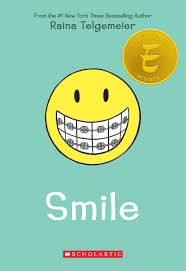
[READ: January 10, 2015] Smile
I had heard of this book–I’d heard that it was a huge sensation. Of course it wasn’t really on my radar of books, so I wasn’t really sure what it was about. I read an interview with Telgemeier recently which made the book sound really interesting so I decided to check it out (and was frankly surprised that there was a copy in the library).
And I really liked the book a lot. From the little I knew about it, I assumed it was just her life with braces (and from the interview, I gathered that her little sister was really a pain–she apparently is a big presence in the sequel). Well, the sister is a pain, but that’s mostly in the beginning of the book (the sister is very funny and they tease each other mercilessly). Yes, the book is about braces, but it ‘s about much more than that.
Oh and it’s also autobiographical, which was pretty obvious.
So, Raina is in 6th grade and she is scheduled to get braces. She is freaked out about this, of course, because everyone makes fun of people with braces. (Although they never made fun of me and I understand they don’t anymore, but we’ll see if my kids need them). Although she has lots of friends, so they should support her. (more…)
 SOUNDTRACK: REGINA CARTER-Tiny Desk Concert #54 (April 11, 2010).
 Regina Carter is a (jazz mostly) violinist (although I am unfamiliar with her). Her then new album, Reverse Thread, was a collection of African melodies played via Carter’s jazz sensibilities. She had been playing with a larger group on tour, but she decided to strip down the band to just herself on violin, Will Holshouser on accordion and Yacouba Sissoko on kora.
















 I Just Read About That...