Feeds:
Posts
Comments

Archive for the ‘NPR/PRI/PBS’ Category

6916SOUNDTRACK: MARGARET GLASPY-Tiny Desk Concert #560 (August 22, 2016).

margaretI really love Glaspy’s 2016 album Emotions & Math.  Her lyrics are sharp, her voice is unusual and mesmerizing and her guitar licks are simple but just chock full of hooks.  What’s not to like?

This Tiny Desk sees her playing songs from that album. Her band is just a bassist, a drummer and her on guitar and voice.

“Emotions & Math” starts off quietly with just bass and drums while she sings in that unique way of hers.  Then the guitar comes in–it’s nothing fancy, but it plays off the bass notes in a very cool way.  And it’s super catchy too.

“Love Like This” opens with a cool bass and drums rhythm–bouncy and tribal.  And when her guitar comes in, it’s with a ripping couple of chords before disappearing again.  Once again, the bass is rumbling along with her chords accenting in a neat way.

“You and I” bounces along with some low chords and bass and Glaspy’s most growly vocals. This song features the first “solo” which is really just the notes of the chords played, but it really stands out among the deep notes.  And once again, the whole business is really catchy.

“Somebody to Anybody” is just her singing and playing guitar.  Although it feels a little quiet without the rhythm section, she fills in more guitar parts on this song and it feels quite full.  And the chorus is, that word again, very catchy.

It was this Tiny Desk that sold me on getting her album, and I’m glad I did.

[READ: March 17, 2016] “The Running Novelist”

This essay appeared in the Summer Fiction issue of the New Yorker.  Since I really like Murakami, and hope to read more of him one of the days, I’m going to include this essay because it is as surprising as some of his fiction.

This is the story of how he became a runner and how he became a novelist.

He had been the owner of a small jazz club (which I feel he has written about in one of his stories).  It stayed open late and was a novelty in Tokyo at the time.  He had a niche audience and while many people didn’t like the place, he had a steady clientele.

His friends said it would never work, but he didn’t listen and he became quietly successful.  He was there in the morning and worked late at night.  And once he made a profit he hired people to help him out. (more…)

Read Full Post »

slowreadSOUNDTRACK: DIRTY THREE-Tiny Desk Concert #245 (October 15, 2012).
dirty-3For a Murakami collection I should really have picked a jazz Tiny Desk Concert.  But none jumped out at my on my list.  So I decided to do something that might be jazzy in spirit, even if it is nothing like jazz at all.

Dirty Three are a three-piece band which consists of violinist Warren Ellis (who works closely with Nick Cave), drummer Jim White (who I had the pleasure of seeing live with Xylouris White), and guitarist Mick Turner (who has released a string of gorgeous instrumental solo albums and worked a lot with Will Oldham).

I’ve liked Dirty Three for years, although I kind of lost touch with them back around 2000.  So it was fun to see that they are still working.  (They’ve released all of 3 albums since 2000).

Jim White plays an eccentric but very cool style of drum–it always feels improvised and random, and maybe it is, but it’s never “wrong.”  Turner is the only one who is keeping the song, shall we say, “stable.”  He’s got the rhythm and melody both with his strumming.  And Ellis is all over the place with melody lines and bowing.

For this Tiny Desk, they play three songs.  Their music is ostensibly instrumental although Warren Ellis is not above shouting and yelling and keening when appropriate.

The first two songs are from their 2012 album and the last one is from Ocean Songs.

“Rain Song” opens with Ellis strumming the violin while Turner plays slightly different chords.  Then Ellis takes off on a series of spiralling violin rolls.  As always, White is back there waving his arms around with the loosest grip on drumsticks I’ve ever seen.  He plays brushes on this song but the drums are far from quiet.  Meanwhile Ellis is soloing away, yelling where appropriate and doing high kicks when White hits the cymbals.   As the song comes to an end, White is going nuts on the drums and Ellis takes off his jacket (revealing a wonderful purple shirt) .  He starts screaming wildly as he physically gets into his violin playing.

“The Pier” is about realizing that it’s the rest of the world that is driving you crazy.  It’s about “trying to undermine Facebook and realize a new way of communicating with people beyond the internet.”  It’ about… are you ready Mick?  Okay.  “The Pier” is a slower song with some plucked violin.  Ellis climbs up on the desk and dances around as he plays.  This one feels a but more controlled but in no way staid.

For “Last Horse in the Sand,” white switches to mallets and adds a tambourine to his cymbal.  It’s really interesting to watch White play around with things–moving his gear around as he plays.  He switches sticks and seems to be not even paying attention, but without ever really losing momentum or timing.  For this song, Ellis and Turner are the mellow ones while White is just all over the place with his amazing drumming.

I haven’t said anything about Turner because he is really the grounding of the band, while the other two are taking flights of fancy.

This is a wild and untamed set and it’s a lot of fun.  It’s also amusing to watch the audience witnessing this seeming chaos.

[READ: December 16, 2016] Slow Reader Vol. 1

Madras Press had released 16 small books, which I enjoyed reading quite a lot.  I have posted about some and will post about more in the new year.  But word is that they have given up on the small books and have switched their attention to a new magazine/journal called Slow Reader.  The first issue came out this month and it collects stories, essays, poems, illustrations, and other things that center around novelist Haruki Murakami.

Support this small press!  You can order this issue directly (and name your price, although I think the asking price is $6).

From an article elsewhere I’ve learned that future issues will cluster around M.F.K. Fisher, Kazuo Ishiguro, and Patricia Highsmith.

This issue contains essays, fiction and illustrations, some dating back as far as 2000.

CHIP KIDD-cover illustration (wind-up bird)
Chip Kidd is awesome

GRANT SNIDER-Murakami Bingo Board
This bingo is hilariously apt–covering most of the bases of Murakami’s writing: cats, jazz, running, and even a Chip Kidd cover.

JESSE BALL-Sheep Man
A line drawing of a sheep standing upright with the caption “The sheep man’s peculiar tail was never visible to me.”

HARRIET LEE-MERRION-Diner illustration
A nice line drawing of a corner diner

KAREN MURPHY-Sputnik and two moon illustrations
Two simple drawings of Sputnik and two moons.

BEIDI GUO-Hard Boiled Wonderland and the End of the World map
A cool map of the locations of the novel.

DINA AVILA–Murakami Tasting Menu at Nodoguro in Portland, OR
I don’t really get if the menu items are related to the stories but it’s a neat idea that there are foods named after his works. But why are so many called IQ84?

EUGENIA BURCHI–IQ84 menus
A drawing of foods with what I think are character names (I haven’t read the novel yet).

FABIO VALESINI-train illustrations taken from the book trailer for Colorless Tsukuru Tazaki and His Years of Pilgrimage
No idea what the original context is, but it’s a neat, clean drawing of a train station.

JEFFREY BROWN-“In Conversation” What Jeffrey Brown Thinks About
The first piece is an amusing cartoon in which Brown scores a job at an indie bookstore by mentioning Murakami.  The little blurb says that it is an only slightly exaggerated account. There’s also a later picture by Brown of Murakami’s face posted on a bulletin board (with a lost cat flier), that’s really great.

DANIEL HANDLER-“I Love Murakami”
Handler begins his piece by apologizing to dozens of authors before saying that Murakami is our greatest living practitioner of fiction.  He mentions a few books but heaps a ton of praise on Wind Up Bird Chronicles and mentions his excitement at  finally getting Norwegian Wood in English (it had been untranslated for many years).  He wrote this essay in 2000.

YOKO OGAWA-“On Murakami’s “The Last Lawn of the Afternoon” [Translated from the Japanese by Stephen Snyder]
Ogawa writes about a house in her neighborhood which has a lawn that she finds unsettling–it’s perfectly manicured and a pale, cool shade of green.  She is reminded of the Murakami story in which a boy mows a woman’s lawn and she asks him an unexpected question.  Ogawa imagines a woman in that home asking the same kinds of questions.

ETGAR KERET-“What Do We Have in Our Pockets?”
This was inspired by Murakami’s story “On Seeing the 100% Perfect Girl One Beautiful April Morning.”  This story is about a man whose pockets are always bulging with unusual items.  People often say to him, “What the fuck do you have in your pockets?”  And his answer is that he carries things that he imagines the perfect woman needing–a stamp or a toothpick.  It is a wonderfully charming story.

RIVKA GALCHEN-“The Monkey Did It”
Of all of the items in this collection, this is  the only piece I’d read before.  I remembered parts of it (particularly the excerpts from “A Shinagawa Monkey,” and her talking about Colorless Tsukuru Tazaki.  I also recalled her saying that she liked his short stories better than his novels, but that she was perhaps wrong in thinking that.  The one thing I didn’t pick up on last time was that in the beginning of the essay she writes about Toricelli’s Trumpet or Gabriel’s Horn–an item with finite volume but infinite surface area.  She says this perfect describes Murakami’s work.  And I love that she ties it to translator Philip Gabriel who is a gentle and modest translator–perfect for the watery novel.

TESS GALLAGHER-“Murakami and Carver Meet at Sky House”
Before he had written any substantial works, Murakami translated Raymond Carver’s works into Japanese.  Ray was excited and bemused that Haruki and his wife Yoko would travel from Japan to meet with him.  This essay tells us that the following poem came about as Ray tried to imagine how his poems could possibly be appreciated in Japan.  Murakami told him how both the Japanese and American people of the 1980s were experiencing humiliation at being unable to make a decent living.  Gallagher says that if they were to meet today Ray would be awkward about Haruki’s stature.  But he would have loved knowing that Murakami had translated everything he had written.

RAYMOND CARVER-“The Projectile”
This poem is wonderful. It begins with Carver speaking about his meeting with Murakami and then flashing back to when he was 16 and was hit with an ice ball.  It was thrown from someone in the street through a small crack in the window of the car he was riding in–a chance in a million.

RICHARD POWERS-“The Global Distributed Self-Mirroring Subterranean Neurological Soul-Sharing Picture Show”
This is the most abstract and “intellectual” of the essays here.  It speaks of a team of neuroscientists discovering a lucky accident–that neurons in the brain fire when someone else makes a motion that we recognize.  Similarly, in Murakami–representation is the beginning of reality.  He speaks of the parallel narratives in Hard Boiled Wonderland.  He wonders at the universality of dreams and ideas in Murakami.  “But if his own stories are steeped in the endless weirdness hiding just inside everyday life, how then to account for Murakami’s astonishing popularity throughout the world?”

MARY MORRIS-“The Interpreter”
I loved this story.  An American business woman is giving a series of lectures in Japan.  She is assigned a translator who goes with her nearly everywhere.  She is a little annoyed that he is always there, but he is very respectful of her and only speaks when spoken to.  She assumes he is translating her speeches correctly, but during one, the audience laughs where there was nothing funny.  She doesn’t want to disrespect him, but she can’t imagine what he said to them.  In the next one, they are practically doubled over with laughter at what he says.  Finally she has to confront him about it.  He reveals astonishing insights into her personal life.  And the next day he is called away–just as she has begun to feel close to him.

In the author’s note, she says that the she was at an writer’s meeting in Princeton (where she teaches) and Murakami was there eating with them. He was by himself, and she talked to him because she was a fan of his work.  She relates a story of holding up a sign for him when he ran the New York City Marathon.  She says that the part about the translator and his family (which I didn’t mention) is from an actual translator she met in Japan.

AIMEE BENDER-“Spelunking with Murakami”
Bender speaks of trusting Murakami.  She says when the cat started speaking in one of his books, she began to mistrust him.  Nevertheless, she says, she loves a lot of writers but only trusts a few of them.  She’s not trusting Murakami’s honesty or his ability to make her smarter.  Rather, she trusts him like a man with a torch in a cave–someone who is willing to explore–and to be in front leading the way.

SUMANTH PRABHAKER-Editor’s Note
Prabhaker would like to ask the world’s philosophers why some things seem to happen to us in a random fashion.

Read Full Post »

tinySOUNDTRACK: GREGORY PORTER-Tiny Desk Concert #550 (July 18, 2016).

gregory Gregory Porter is a soul singer.  For this Tiny Desk Concert, it’s just his voice and a piano played by Chip Crawford.  It’s odd that in the middle of July he’s wearing a suit and what looks like a balaclava, but whatever.

The first song, “No Love Dying” is a slow piece and Porter doesn’t really get to show off his power too much.  But his voice sounds great.  When it’s over he says he likes to think of that song in times of trouble, and we are welcome to take it into our houses in time of trouble as well.

“Take Me To The Alley” is about the backstreets and forgotten places and how we treat the people who are in those alleys.  This is also a slow, pretty song.

The final song is a warning, and we’ll know what’ its about when we hear the lyric: “Don’t Be a Fool” that’s all you need to know.  It, too, is a mellow piece, full of love and offering advice to not be a fool.

I didn’t know Porter before this, and I was pleasantly surprised by his songs.

[READ: November 18, 2016] The Tiny Wife

Back in 2014, I ordered all 16 books from Madras Press. Unfortunately, after publishing the 16 books they seem to have gone out of business (actually they are switching to non-fiction, it seems). They still have a web presence where you can buy remaining copies of books.  But what a great business idea this is/was

Madras Press publishes limited-edition short stories and novella-length booklets and distributes the proceeds to a growing list of non-profit organizations chosen by our authors.  The format of our books provides readers with the opportunity to experience stories on their own, with no advertisements or miscellaneous stuff surrounding them.

The format is a 5″ x 5″ square books that easily fit into a pocket.

Proceeds from Kaufman’s book go to Sketch— Working Arts for Street Involved and Homeless Youth.

This has been my favorite story from Madras Press so far. It was suitably weird but it followed its own internal logic and was really funny/intense at the same time. (more…)

Read Full Post »

moors SOUNDTRACK: CHRIS FORSYTH & THE SOLAR MOTEL BAND-Tiny Desk Concert #549 (July 15, 2016).

solarIn the blurb about The Solar Motel band, Lars Gotrich says that Chris Forsyth’s group usually plays high energy and maximum volume.  But here, they have picked some of their more mellow pieces.  And I frankly think they are all fantastic (I actually don’t even want to hear their louder stuff).

“Harmonious Dance” opens with four single repeated notes before the slow echoed chords fill the room.  The drummer is playing with brushes and dangling some bells (which he eventually holds in his mouth while playing with both hands).  There’s a feeling of Explosions in the Sky on this song–but without as much drama.  Rather, the mid section turns away from the vibrato to a more structured picked section which allows room for a guitar solo.  The blurb says the song “meditates on a gently unfolding melody shared between Forsyth and guitarist Nick Millevoi.”

Speaking of the drummer, the blurb tells us that “due to touring conflicts, The Solar Motel Band’s rhythm section is different here than on record, but bassist Matt Stein provides a grounding force, as drummer Ryan Jewell … loosens the very ground beneath it all.”

Forsyth introduces the second song with the strange comment: “It gives me great pleasure to say the title of this next song: ‘The First Ten Minutes Of Cocksucker Blues.'” Why great pleasure?  Anyhow, the title refers to the unreleased Rolling Stones documentary directed by Robert Frank.  There’s a kind of funky, rougher edge to this song that has Forsyth playing some simple chords while Millevoi plays some wailing classic-rock-style solos.  In fact, the whole thing has a classic rock feel, except with a more contemporary jamming feel.

A buzzing drone segues into “Boston Street Lullaby.”  Unlike the other two songs this one is very mellow and kind of trippy. At times (especially the way that Millevoi bends some of his guitar licks it feels distinctly like Pink Floyd’s “Echoes.”  The end has some cool jangly spacey guitar and Jewell is doing all sorts of interesting things to the kit, including changing the sound of his snare by pressing on it at different spots.

I am curious to hear what other kinds of stuff they play.

I am bummed to read that they opened for Super Furry Animals this summer.  I really wanted to get to that show, but I was out of town.  That would have been a great double bill.

[READ: November 14, 2016] The Moors

Back in 2014, I ordered all 16 books from Madras Press. Unfortunately, after publishing the 16 books they seem to have gone out of business (actually they are switching to non-fiction, it seems). They still have a web presence where you can buy remaining copies of books.  But what a great business idea this is/was

Madras Press publishes limited-edition short stories and novella-length booklets and distributes the proceeds to a growing list of non-profit organizations chosen by our authors.  The format of our books provides readers with the opportunity to experience stories on their own, with no advertisements or miscellaneous stuff surrounding them.

The format is a 5″ x 5″ square books that easily fit into a pocket.

Proceeds from Marcus’ book go to the Friend Memorial Public Library in Maine.

This is a story that is set in the time it takes for a woman to fill up her mug of coffee.

It begins with the amusing concept that our protagonist Thomas saying that he felt bad about speaking in baby talk to a colleague.  And then it pulls back so we can see just what is happening.

Thomas has incredibly low self esteem.  He immediately takes a dislike to this colleague who is so composed and together.  He wonders if there’s a word for the contempt that he imagines she feels for everyone around her (based on the way she walks and is dressed).

And then over what seemed like three dozen too many pages, we learn the extent of his insecurities.  He is too fat, he might have erectile disfucntion, he believes that they are throwing pigeons at the windows every hour to mark time.

He is so insecure and his lashing out is just so unpleasant that I really didn’t want to read about why he acts this way (which we do sort of learn at he end).

Essentially this is man at a loss.  The way his home life has been going has certainly compounded his loss.  But the road to get there felt too long and either too misogynistic or self-pitying most of the time.

If this had been half as long I would have liked it much better.  Although I really don’t think I could ever actually enjoy reading about this character–baby talk or not.

Read Full Post »

2016-12-05-21-06-09SOUNDTRACK: BILL FRISELL-Tiny Desk Concert #191 (February 3, 2012).

I’d published these posts without Soundtracks while I was reading the calendars.  But I decided to add Tiny Desk Concerts to them when I realized that I’d love to post about all of the remaining 100 or shows and this was a good way to knock out 25 of them.

billI’ve been aware of Bill Frisell for decades.  He has played with just about everyone that I like, and I’m sure I have his guitar on about a dozen albums.  And yet I don’t really know all that much about him.  I certainly didn’t know what he looked like and, honestly, I wasn’t sure what to expect from this Tiny Desk Concert.  I feel like most of the places I know him from are noisy avant-garde music.  So I was pretty surprised to hear that this would be a concert of delicate reworkings of John Lennon songs.

From the blurb:

On this day, Frisell came to perform the music of John Lennon. Now 60, Frisell witnessed the birth of The Beatles and all that it meant to moving the world from cute, catchy songs to sonic adventures — a world of music we don’t think twice about anymore. After all these years of hearing The Beatles’ music, he’s still discovering it, finding small phrases in the songs we know so well — “Nowhere Man,” “In My Life” and “Strawberry Fields Forever.”

Frisell introduces a lot of songs by saying that the Beatles have been a huge part of his life.  And yet, he’s never really played them by himself in this exposed way.

Bob describes some of the gear that Frisell uses, like the

Electro-Harmonix 16-second delay, a pedal I used to use in live performance in the 1980s. I know how fragile and sometimes unpredictable it can be, but it’s the backbone of Frisell’s bag of many tricks. With that equipment enhancing Frisell’s nimble, deft fingerwork and uncanny sense of melody, it all adds up to a brilliant and disarmingly humble performer.

I didn’t recognize “Nowhere Man” for much of the song—he’s exploring areas and pockets of the song–but every once in a while the vocal line peeks through.

When he starts “In My Life,” he plays what sounds like the opening notes to “Lucy in the Sky with Diamonds.” I was sure he was going to play it so it’s quite a shock when he doesn’t and then he takes a really long intro solo before getting to the familiar melody of “In My Life.”

For such a legendary figure he is amazingly soft-spoken and humble.  He’s even embarrassed that he’s reading the music rather than having it a part of him.

There’s a pretty lengthy intro before he gets into that very familiar melody of “Strawberry Fields Forever.”    This one is my favorite of the bunch because of all the effects that he plays on it—echoes and reverses and all kinds of cool sounds that emanate from his guitar.  And “Strawberry Fields” is always present in it.

This is 20 minutes of very pretty, sometimes familiar music

[READ: December 25, 2016] “The Adventure of the Blue Carbuncle”

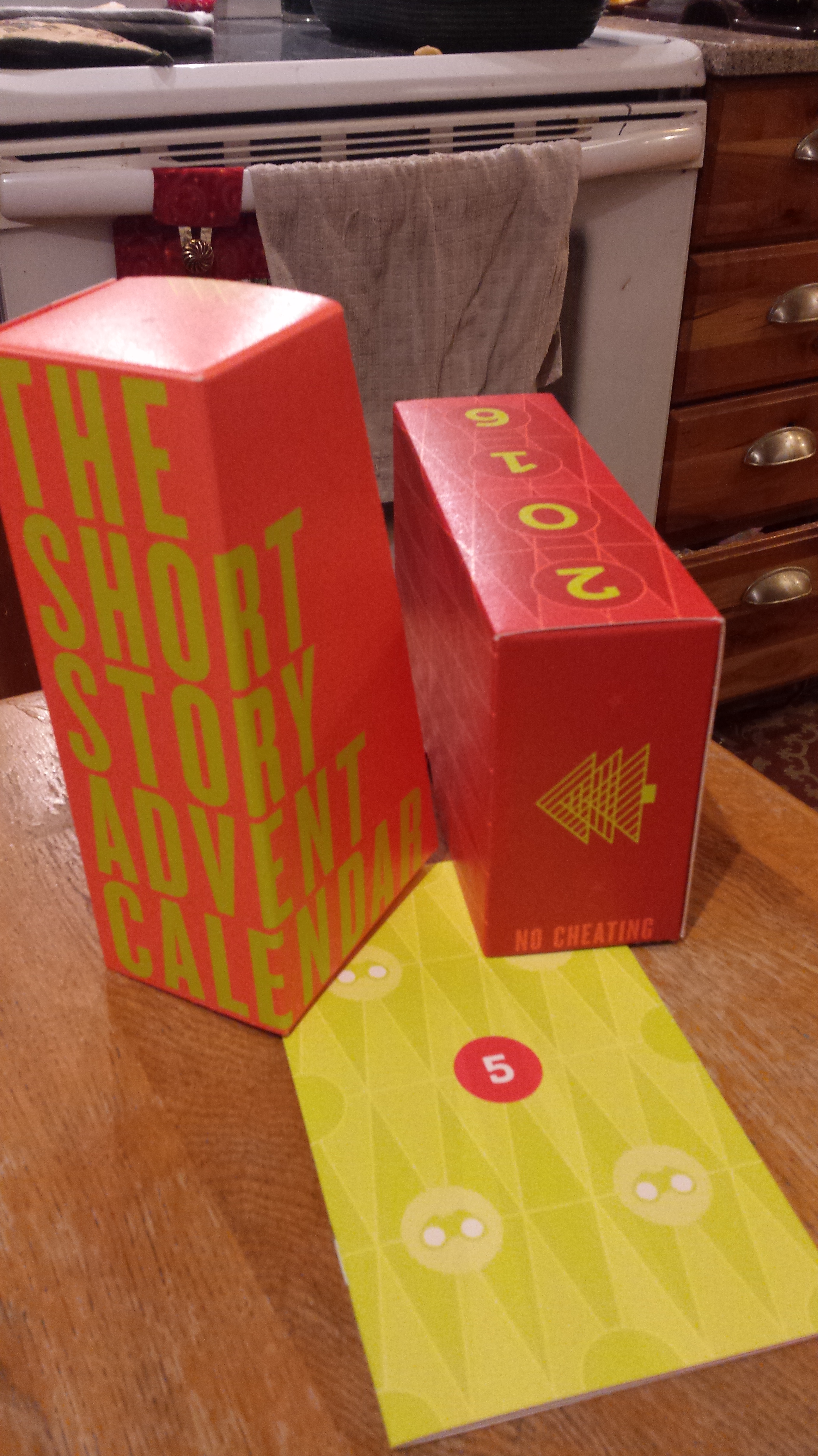
Near the end of November, I found out about The Short Story Advent Calendar.  Which is what exactly?  Well…

The Short Story Advent Calendar returns, not a moment too soon, to spice up your holidays with another collection of 24 stories that readers open one by one on the mornings leading up to Christmas.  This year’s stories once again come from some of your favourite writers across the continent—plus a couple of new crushes you haven’t met yet. Most of the stories have never appeared in a book before. Some have never been published, period.

I already had plans for what to post about in December, but since this arrived I’ve decided to post about every story on each day.

I have read this story before (and I’m pretty sure one of the Sherlock shows did an episode of this story).  It’s probably one of my favorite Holmes stories.

But first thing’s first: For this story, carbuncle is not the first definition: an abscess; but the second: a bright red gem (except this one is blue). (more…)

Read Full Post »

2016-12-05-21-06-09SOUNDTRACK: THE CRANBERRIES-Tiny Desk Concert #197 (February 23, 2012).

I’d published these posts without Soundtracks while I was reading the calendars.  But I decided to add Tiny Desk Concerts to them when I realized that I’d love to post about all of the remaining 100 or shows and this was a good way to knock out 25 of them.

cranbI really liked The Cranberries’ first album, but was turned off by them when they got overplayed on their second album (If I never heard “Zombie” again…”).

I didn’t realize that they launched a comeback of sorts back in 2012.  And this Tiny Desk Concert was a stop on their tour.  They play five songs–far more than most bands.  They may have been one of the biggest st bands to play up until now.

For this set, they strip down to acoustic guitar, tambourine, electric bass and Dolores O’Riordan’s vocals.

One of the things I liked about their first album was her delicate voice.  She found her more aggressive voice on later songs (where her accent really leaks through).  And that brash style is present here.  Which makes “Linger” sound a little odd and a little less pretty.

They play two then new songs which I rather like: “Tomorrow” and “Raining in My Heart.”  Since I’ve no expectations about them, I find her voice works very well with them.  They also seem much simpler than some of their earlier songs and she not doing anything unusual with her voice..

“Ode to My Family” (the doo-doodoo-doo song) sounds pretty good in this setting.  Although I always laughed about the “does anyone care” refrain because well, sometimes I didn’t.

They take a request to play “Zombie” and I have to say I really like it in this acoustic format.  She straps on an acoustic guitar and plays most of the “leads.”  She definitely does some unusual things to her voice, but overall its sounds good.  Somehow the electric bass really adds to all of the songs–I never noticed how much it added before,

Overall, the “lads” sound good and her voice has maintained its power.  Although I can help but think she looks a lot like Billie Joe Armstrong with that haircut.

[READ: December 24, 2016] “Being Mary”

Near the end of November, I found out about The Short Story Advent Calendar.  Which is what exactly?  Well…

The Short Story Advent Calendar returns, not a moment too soon, to spice up your holidays with another collection of 24 stories that readers open one by one on the mornings leading up to Christmas.  This year’s stories once again come from some of your favourite writers across the continent—plus a couple of new crushes you haven’t met yet. Most of the stories have never appeared in a book before. Some have never been published, period.

I already had plans for what to post about in December, but since this arrived I’ve decided to post about every story on each day.

This is theoretically the final book in the Short Story Advent Calendar (wow that went fast).  But there is a bonus story for tomorrow (how cool!).  Let’s not get ahead of ourselves.

This short story is about a girl, Laura, who is supposed to be Mary in the school Christmas pageant.  She has always wanted to be Mary (she is six now) and feels she was destined to play her.  Last year she was an angel, which was disappointing.  But at least she wasn’t Jezebel or Judas or “poor old Leah, the unwanted older sister.”

But tragedy has struck.  Literally. (more…)

Read Full Post »

storiesSOUNDTRACKPOLYPHONIC SPREE-Tiny Desk Concert #259 (December 21, 2012).

The Polyphonic Spree performs a Tiny Desk Concert.I really enjoyed Polyphonic Spree’s first album (and their strange robes and cult-like following (apparently even within the band).

They put out a Christmas album some time ago, and since we have a big pile of Christmas albums, I grabbed that one.  I didn’t love it, but it was a fun addition to our collection.

This Tiny Desk Concert is notable for just how many members of the band are behind (and on the side of) the Tiny Desk (perhaps 18?).

And the band is suitably musical–trombone, trumpet, keys, drums, bass, cello, violin and a ten (or so) piece choir.

Interestingly, I find that the weak link in this whole thing is leader Chris DeLaughter.  It’s just that his voice is really not that interesting. It’s especially notable on “The Christmas Song” where he sings some high notes unaccompanied.  When the choir comes in (and they change the melody) it sounds really cool.  I especially love the way they make “reindeer really know how to fly” into a high note.

The first song is “Happy Xmas (War Is Over)” which I feel is the Christmas song they might be best known for.  It’s pretty traditional to the original, with the choir filling in for the kids.  The addition of horns really adds a lot to it.

“Silver Bells” gets a pretty rocking treatment–the buildup at the beginning is pretty cool.  They change the main melody to an almost circus-like waltz. I love the way it sounds when everyone joins in–and when the choir is singing along to the rocking end (with a very different melody) it sounds great.  But once again DeLaughter’s voice doesn’t seem up to the task of leading this larger group.

But it’s festive and fun, especially with everyone in red robes (and DeLaughters green one).

[READ: December 2016] Christmas Stories (1854-1864)

Last year, I started reading some Charles Dickens Christmas Stories in December.  I imagined that I’d finish the whole book this season (all 750 pages of it), but I didn’t come close.  I enjoy these stories but they are not quick reads by any standard.

The fascinating thing with a lot of these stories is that they appeared in All the Year Round, a Victorian periodical founded and owned by Dickens and published between 1859 and 1895 throughout the United Kingdom.  But just because these stories came out for the Christmas issue doesn’t mean they have anything to do with Christmas directly.

I thought I’d be reading a whole chunk of the book in a row, but I wound up skipping around a bit.  Maybe next year I’ll finish the remaining stories. (more…)

Read Full Post »

2016-12-05-21-06-09SOUNDTRACK: MIGUEL-Tiny Desk Concert #260 (December 31, 2012).

I’d published these posts without Soundtracks while I was reading the calendars.  But I decided to add Tiny Desk Concerts to them when I realized that I’d love to post about all of the remaining 100 or shows and this was a good way to knock out 25 of them.

miguelI didn’t know Miguel before this.  I’d heard of him, but I didn’t know any of his songs.  Given the above blurb I assume that his songs are poppy and really dancey.  But this acoustic performance is fantastic.  Miguel’s voice is great and he has amazing presence up there.

Miguel turned up in the NPR Music offices early one morning, after playing a show late the night before. He appeared light and calm, and betrayed no hint that he was nervous about stripping his highly produced hits down to their bones. Accompanied by just his guitarist, Dru DeCaro, Miguel eschewed flash and went big on small gestures — ingratiating ad libs, only one full spin and voice control that kept the songs close to his chest but emotive enough to translate to the back of the room.

He commands the room with little gestures like when he takes off his sunglasses or lifts his hat briefly.  And then there’s his winning smile.

“Do You…” opens with a fun lyric: “It’s Friday and I’m feeling good.” Then he turns to the audience and asks, “It is Friday right?”  The chorus is also fun, and rather unexpected.  “Do you like drugs?  Do you like drugs?”  “Well, me too”(too much laughter) “Do you like hugs?  Do you like hugs?  Me too.”  He hits an amazing falsetto in the middle of the song and then keeps it up high as he sings the next section.

“The Thrill”is his favorite song off his second album.  It feels like an anthem or a dance song that people might love.  It’s about being at a club, and this line struck me as interesting:

Jamie, Johhny and Jack know
Shoot ’em up, shoot ’em down, jus-jus-just sh-sh-shoot up
Dance it up, we never black out

It’s not quite as successful as an acoustic song, although he sounds great and comfortable singing it.  He does some small dance moves during the quiet end section.

“Adorn” was apparently a Grammy nominated song. I wish I knew the original for comparison’s sake.  But the song works really well with an acoustic guitar.  Frankly, Dru DeCaro is masterful at playing these songs–heavy strumming and even harmonics when called for–nice accents too.  Miguel hits some great falsetto hoooos and the ending where he goes high on adore and then ends with a quietly spoken “you” is nicely dramatic.

I don’t know what’s become of Miguel in the last four years, but if the pop music thing doesn’t work out, he’s got a  great career with just a guitar and his voice.

[READ: December 23, 2016] “The Lunacy of Gumbo”

Near the end of November, I found out about The Short Story Advent Calendar.  Which is what exactly?  Well…

The Short Story Advent Calendar returns, not a moment too soon, to spice up your holidays with another collection of 24 stories that readers open one by one on the mornings leading up to Christmas.  This year’s stories once again come from some of your favourite writers across the continent—plus a couple of new crushes you haven’t met yet. Most of the stories have never appeared in a book before. Some have never been published, period.

I already had plans for what to post about in December, but since this arrived I’ve decided to post about every story on each day.

This was the least story-like story of the collection.  Honestly, I’m not even sure what to make of it.

The narrator says that back in 1980, he was in Louisiana.  It was 11PM and they had been drinking all night.  Finally someone said they should have a gumbo and the narrator thought that that was insane. (more…)

Read Full Post »

CV1_TNY_11_01_10.inddSOUNDTRACK: THE OH HELLOS-Holiday Tiny Desk Concert #588 (December 19, 2016).

ohhellosThere was a time when a band played one Tiny Desk Concert and that was it.  That tradition has been broken twice before on special occasions.  But this time, the distance between shows was just over a year.  What gives?

Well, in addition to the band being pretty sick last time, The Oh Hellos have released The Oh Hellos’ Family Christmas Album and are on the Christmas Extravaganza Tour.  so what better group to do a holiday Tiny Desk Concert?

The band plays four songs.  Their EP is full os interesting folky transitions that sound nothing like the main songs, but which flow into them seamlessly.  Like “Deck the Halls” which has a rocking intro and rocking chords on the downbeats.  There’s also fun bluegrass fiddles and banjo.  I really like how the music of the song sounds so different from the traditional version and yet when they actually sing it, it is spot on.

Then a wild shift in tone to a beautiful acoustic rendition of “Mvmt III: “Silent Night, Holy Night”” sung by Maggie Heath.  The opening guitar melody is really different and interesting–enticing and unexpectedly morphing into the traditional song.  Once the main part of the song is done, they switch to a kind of oh ho oh ho chant–folky and warm.

For the next song Tyler says that its a tradition in their extended family that for the holidays they eat a lot and then break out the hand chimes.  He says they are going to sing the one verse of “Jingle Bells” that everyone knows.  Bob asks if there are more.  Tyler’s not sure. They play some kind of hand bells (and Bob gets one too) while everybody sings.

The final track is “Mvmt IV: “Every Bell On Earth Will Ring.””  It opens with another cool rolling guitar intro on acoustic guitar which is followed by the electric guitar.  And the song morphs into “Joy to the World.”  The harmonies are outstanding.  And once again, you’d never guess the song by the guitar parts.  The middle  rocks out in a very fun way until it shifts to a section of “I Saw Three Ships” sung by Maggie.  With about 1 minute left snow starts falling from the ceiling as they shift to “O Come Let Us Adore Him.”

It’s a pretty fantastic Tiny Desk Holiday show. And their album seems like it might be a fun addition to any holiday music collection.

[READ: July 19, 2016] “Blue Roses”

I’ve never read anything by Hwang before so I don’t know what her stories are typically like.  But this one has such a distinctive narrator that I wondered if she normally writes like this.  The story is the first person from an older Taiwanese lady, Lin.  She is opinionated and judgmental and, I think, most often wrong.

Linstarts by saying she had asked her daughter if she might invite her friend Wang Piesan over for Christmas Dinner.  The daughter says she doesn’t know this woman, so no.  This gets Lin so mad that she more or less refuses to talk to her daughter for most of the rest of the story.

It was bad enough that her daughter said no but then her husband suggested “if you want to invite her maybe you should host.”  Lin is outraged: “I’ve waited your whole life for you to invite me to dinner.  Now you want to take it back?”  To make things worse her daughter called back the next day to ask if she would babysit that night.  Lin is appalled: “She didn’t realize that anything had happened between us.”

Lin said no and also that she also wouldn’t be going to Christmas Dinner now. (more…)

Read Full Post »

2016-12-05-21-06-09SOUNDTRACK: YVA LAS VEGASS-Tiny Desk Concert #241 (September 24, 2012).

I’d published these posts without Soundtracks while I was reading the calendars.  But I decided to add Tiny Desk Concerts to them when I realized that I’d love to post about all of the remaining 100 or shows and this was a good way to knock out 25 of them.

yvaYva Las Vegass is a fascinating performer.  With just her voice and a small stringed instrument she sounds like no one else I’ve heard.

The blurb says:

she infuses Venezuelan folk traditions with a punk aesthetic. I heard songs as allegories, songs that told stories and songs that felt like deep primal screams, all accompanied by a traditional Venezuelan cuatro — a small stringed instrument similar to a ukulele.

She does not use a pick and her strumming varies from delicate and soft to aggressive and loud   And her voice is really powerful.

“Mariposas” starts off slowly with some delicate strumming and her singing.  When she gets to the fast chorus, her playing is so hard and percussive that the song changes tempo incredibly.

Introducing “Tonadas Y Cantos” she says that people in Venezuela sing this song to milk their cows.  It’s a traditional song but she plays it a little harder and a little punk “because that’s who I am.”  She sings fast and aggressive (some lyrics so fast it’s impossible to even know what the words are).   And while most of the song is in Spanish, there are some English lyrics too: “What do you do when you can’t pretend anymore. What do you when being dead sounds good.  Be brave be strong.”

This song ends very abruptly and the next one starts just as fast—there was clearly an edit–I wonder what they edited out.

“Polo Margaritenoio” is a traditional Venezuelan song “with no author because someone stole it.”  The writer “was a woman who was very vulgar like me.”

Yva is a fascinating performer and while she’s not very flashy, she commands attention with her voice and her playing.  I only wish I knew what she was singing.

The blurb continues:

You can’t quite see her cut-off jeans and Chuck Taylor high-top sneakers behind Bob Boilen’s desk, but in attitude and style, Yva Las Vegass is punk-rock through and through.

As the show ends, she says “I worked my ass off, you can tell by how much I sweated in my wool hat.”

[READ: December 22, 2016] “At Christmas Time”

Near the end of November, I found out about The Short Story Advent Calendar.  Which is what exactly?  Well…

The Short Story Advent Calendar returns, not a moment too soon, to spice up your holidays with another collection of 24 stories that readers open one by one on the mornings leading up to Christmas.  This year’s stories once again come from some of your favourite writers across the continent—plus a couple of new crushes you haven’t met yet. Most of the stories have never appeared in a book before. Some have never been published, period.

I already had plans for what to post about in December, but since this arrived I’ve decided to post about every story on each day.

This is the first story on this collection that I have read before!  That’s not bad out of 22 stories.  (Or it’s very bad t hat I haven’t been reading enough stories).

I haven’t read that much Chekov, but I have read this one.  When I read it last time, I liked it but was more than a little confused by the ending.

I feel like I got a little bit more out of it this time, but the ending is still a puzzle.

This very short story is set up in two parts.

In the first part, an old couple from the country wish to send a letter to their daughter in the city whom they have not seen in four years.  She had gotten married and had sent two letters to them.  But they have not heard from her since that second letter several years ago.  Her mother, Vasilissa , wanted to send a letter sooner, but there was no one to write it for her.

At long last, and with so much to say, Vasilissa finally she asks Yegor, the innkeeper’s wife’s brother, “who had done nothing but sit idly at home in the tavern since he had come back from military service, but of whom people said that he wrote the most beautiful letters, if only one paid him enough.” She pays him 15 kopecks.

Vasilissa had spent so much time imagining what to say to her daughter.  But now that she is under pressure, she has drawn a blank.  Yegor asks what their son-in-law does.  He used to a be a soldier but now he is a door-keeper at a hospital.

Yegor begins writing some very formal sounding military instructions, “Fate has ordained you for the military profession.”  Of course the mother wants to tell her daughter about the famine and their poor crops.  And she wonders if she is a grandmother yet.

Vasilissa is revolted by this man (although I’m unclear if she knows what he is writing or not).  But she looks at him: “He was the very essence of coarse, arrogant, stiff-necked vulgarity, proud to have been born and bred in a pot-house, and Vasilissa well knew how vulgar he was, but could not find words to express it.”

The next morning, Vasilissa walked 11 miles to the post office and mailed the letter.

Part Two opens on New year’s Day, with the daughter’s husband working as a porter at a doctor’s office.  He receives the letter and delivers it to his wife.  The daughter is very excited to receive the letter. She reads the letter to her children.  And she is excited–laughing or crying, it’s hard to tell.  She reads of the snow and the warm fire and the doggie.  She huddles close with her children until he leaves the room.

The husband remembers back to three or four letters that she had asked him to send but which are still lying around somewhere.

And it’s super poignant.  And the more I think about it and reread it, the more powerful it is.

But then there’s a final line which I simply didn’t get.  I even translated the French “Charcot douche,” but it didn’t really help.  I can’t decide if those final words are meant to be significant or just suggesting that life goes on.

Incidentally, there are several different translations of this story available.  This one was by Constance Garnett.  Although I found the version online at Eldritch Press, translated by Marian Fell to be a bit easier to read–despite the fact that it was translated in 1915.

Read Full Post »

« Newer Posts - Older Posts »