Feeds:
Posts
Comments

Archive for the ‘NPR/PRI/PBS’ Category

2014_11_10SOUNDTRACK: LORD HURON-Tiny Desk Concert #247 (October 25, 2012).

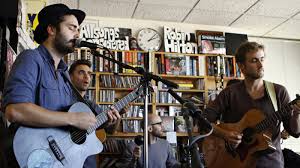
lordhironLord Huron is one of those bands that I hear of a lot, but whom I don’t really know much about. I also think they are someone I like, but listening to this Tiny Desk Concert, it’s clear they are not any of the bands I think they are.

As far as this Tiny Desk Concert goes, Lord Huron proves t be a five piece folk outfit.  They have lovely harmonies

“She Lit A Fire” is a pretty standard folk song.  Although I like the way the song shifts gears to a faster guitar style.  I really like the way the one guy’s guitar sounds like mandolin, too.  “Time To Run” is a bit faster and catchier.  In fact, when the oh oh oh oh part comes in, it’s hard not to want to sing along.  And the middle part where it’s just guitar and bongos is pretty hard not to enjoy.

“Lonesome Dreams” opens with some echoed bass notes. It’s got some really catchy parts although I don’t really love the yodeling voice that he puts on.  The band does four songs (practically unheard of).  “Ends of the Earth” opens with that same yodeling voice, but once the harmonies kick in it sounds great.

I didn’t realize that Lord Huron had only released their first album in 2012.  They have really made a name for themselves.

[READ: July 20, 2016] “Primum Non Nocere”

I enjoyed this whole story except for the very end which seemed to turn the story into something else.  In retrospect that something else is also pretty interesting and it throws a whole new light on the story, but I enjoyed the story so much as it was that the twist really impacted the way I enjoyed the rest of the story.

The title translates as “first, do no harm” and the story is about a youngish girl and her mother–who is a psychotherapist. 

I loved the way the story began.  Jewel is totally embarrassed that her mother asks her patients if they are “Cell phoning.”  She says it all the time.  How lame.  Until she realizes that her mom is actually asking if they are “self-harming.”

Her mother was brutally honest about a lot of things and was, of course, right about everything.  One thing that her mother always said was “that no one ever gets beyond high school. It’s all high school for the rest of your life.” Not true, Jewel knew, yet also true.

Her patients loved her for that unconventional understanding. She stood up for them; she visited their homes and talked to their problematic relatives, went to the store with them, walked them along the river, allowed them to bring their pets to their therapy sessions. She came to her children’s defense, too, with teachers or friends or the parents of those friends. She was brutally honest, blunt.

(more…)

Read Full Post »

booksSOUNDTRACK: YO LA TENGO-Tiny Desk Concert #271 (April 15, 2013).

y-o-la-tenI’ve enjoyed Yo La Tengo’s music for years and years.  I have many of their records, although I’d never consider them a favorite band. They’re just a reliable band I like.   This Tiny Desk Concert sees the venerable band in acoustic format (with no drums!).  Ira Kaplan sings and plays guitar, drummer Georgia Hubley sings backup and bassist James McNew plays an acoustic 12-string guitar.

Yo La Tengo has a lot of diversity in their records.  And even here, their songs sound quite different.  I had never before considered that on “Is That Enough” Kaplan sounds like someone out of A Mighty Wind (Harry Shearer perhaps?)  I also never considered how much they sound like The Velvet Underground (which I guess others have, but I especially noticed when Hurley sings her slow song).  McNew also adds some lovely high-pitched harmony vocals (compared to Georgia’s deeper harmonies).

After the first song, Kaplan says, “You in the back will never hear this one”  They start “Tears Are In Your Eyes” from their 2000 album (and I can’t help but hing that McNew’s 12 sting is out of tune).  Georgia sings and sounds incredibly like Nico on this song.

It’s strange how Ira keeps whispering to Georgia (you can kind of hear him) throughout the song–the microphone is really sensitive.

“Ohm” is one of my favorite songs from their album Fade. Its simple, but with some great harmonies and I love the way the song–which is fairly straightforward–goes up an octave during the “say goodnight “ part.  That little melody shift really makes this song wonderful.  And it sounds terrific here.   I also love how the end is a repeating of the same chord and chanting vocals while Ira plays a wild (but acoustic) guitar solo.

I’ve never really considered seeing Yo La Tengo live (they tour all the time), but maybe I should.

[READ: January 23, 2017] “Don’t Be Evil”

Before Simon Rich started writing longer pieces for the New Yorker, his Shouts & Murmurs pieces were usually pretty short–and he crammed a lot of funny into that short space.

This piece is all about Google.  It’s kind of one-note, but it’s still pretty funny.  And its brevity prevents it from wearing out its welcome.

So it begins with him saying how much he loves the Google Dictionary feature.  It’s really convenient, but sometimes the results can be strange.  Then he gives some examples: (more…)

Read Full Post »

[ATTENDED: March 4, 2017] clipping.

I first heard clipping. on All Songs Considered about a month ago.  The song was noisy and brash and vulgar and featured incredible rapping from a voice that I recognized but couldn’t place.  Then they told us that the rapper was Daveed Diggs who was Thomas Jefferson and the Marquis de Lafayette in Hamilton.  He won a Tony for the role(s).  And now here he was fronting this band of experimental glitch-hop.  And there he was just a few dozen feet from us. 

I love the Fillmore, but it’s one of the few venues that we don’t ever seem to be able to get very close to the stage for.  I guess the artists are a little more popular (and tend to sell out) so there’s less wiggle room at some of the other shows.  So we were further back than I would have liked.  But we could still fully absorb the spectacle.

Clipping are not exactly the kind of band I’d pair with The Flaming Lips (who sing about rainbows and love and whatnot).  And indeed, the contrast was pretty stark.  But the Lips have a crazy stage set-up and it seemed to work perfectly with the kind of static and noise that Clipping creates.  And I’m sure they loved being able to hook into the Lips’ wall of video screens behind them. (more…)

Read Full Post »

 socks kronosSOUNDTRACK: KRONOS QUARTET-Tiny Desk Concert #322 (November 25, 2013).

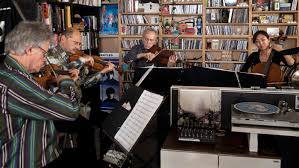
2013 was the 40th anniversary of Kronos Quartet.  I first heard of them about eight years after they started with their cool arrangement of “Purple Haze.”  And then I learned that they were like a sponge, soaking up and playing music from all over the world: In just one year they released albums with tango, songs by South African composers, Polish composers, jazz musicians and so much more.

I have many of their releases, although I realized I more or less stopped listening to new stuff from them around the turn of the century (since when they have released some 16 albums!).

Well, amazingly, the Quartet is still the same original players (except for the cellist–the cello is like Kronos’ drummer as they seem to replace her every couple of years).

They play three pieces here and the three range the gamut from dark and broody to rather sweet to quirky.  In other words, typical Kronos.

For more info:

The musicians —  David Harrington (violin) and longtime members John Sherba (violin) and Hank Dutt (viola) and new (as of 2013) cellist Sunny Yang — could reminisce over more than 800 new works and arrangements they’ve commissioned in 40 years. But instead, the new-music train pushes ever onward to new territories. They remain a living, breathing world-heritage site for music.

Now in the midst of its 40th-anniversary tour, Kronos brings to this Tiny Desk Concert a new arrangement, a work from a new album and, for Kronos, something of a chestnut, a piece the group recorded a whopping five years ago.

“”Aheym” (Yiddish for “homeward”) was written for Kronos by Bryce Dessner; a member of the Brooklyn rock band The National, he studied composition at Yale. The music thrives on nervous energy, pulsating with strumming and spiccato (bouncing the bow on strings) while building to a tremendous fever.”

I love this piece. It is intense and dramatic with its 4-3-3 bowing from all four members.  There’s an interesting cello melody with pizzicato strings from the rest.  The overall melody seems somewhat circular with different instruments taking on different leads.  But this song also plays with some interesting bowing techniques.  In addition to the spiccato (about 4 minutes in), the players drag the bow for momentary scraping and scratching sounds.

Another wonderfully dramatic moment comes at 7 minutes where each musician takes a turn bowing his or her note while the violin plays a super fast series of notes.  The song builds and build in dramatic until it gets to about nine and  half minutes and it reaches its powerful ending.

“Lullaby,” opens with plucked cello notes and strummed viola.  “It is a traditional song with Afro-Persian roots (from the group’s Eastern-flavored 2009 album Floodplain), [and] is woven from different cloth altogether. Colorful tones that lay between our Western pitches are threaded through the music, anchored by a gorgeous solo from violist Dutt; his contribution takes on the warm and weathered sound of a grandmother singing to a child.”  It is slow and moody and beautiful.

Harrington introduces the final piece by saying it’s by a performer that no one had heard of–including, until recently, even himself.

“Kronos caps off the concert with another hairpin turn, this time to a fresh arrangement of “Last Kind Words,” a little-known blues song from around 1930, recorded by singer and guitarist Geeshie Wiley. In Jacob Garchik’s exuberant arrangement (which Kronos premiered this fall), interlocking strums and plucks provide a kind of rhythm section, while Harrington’s violin stands in for the now-forgotten blues singer.”

There’s lots of plucked notes from everyone–including plucked bent note on the viola which gives it a real “early” guitar sound.  While I don’t know what Geeshie sounded like, so I can’t compare the violin to her vocal, the whole thing sounds great together.  In fact the whole thing is unlike any string quartet I’ve heard–so different and wonderful.

I’m going to have to bust out so Kronos CDs.

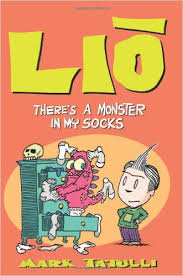
[READ: September 10, 2016] There’s a Monster in My Socks

I’ve been quite puzzled about the publication history of the Liō books.  And this just adds another layer of confusion.  This book covers the exact same time period as Happiness is a Squishy Cephalopod which was published in 2007.  The difference is that Cephalopod placed all of the strips in order, while this one seems to move things around quite a bit (the thinner format also means that it can’t quite handle the single panel strips very well.   But more egregious is that this volume (remember, the one printed after the previous one) prints the Sunday color strips in black and white.

The book also leaves some of the strips out.  It covers the date range from May 15, 2006 – Feb 16, 2007 (Cephaolopod went to May 23), but while it has the Feb 14 strip, it does not have the Feb 15 strip.  Weird.

So, basically this is an inferior version of the same book, but the publishers presumably wanted the books in this more friendly size (or some other nefarious reason).

I’ll include the review of Cephalopod below.

And, here’s the current list of existing Liō books. It’s a shame that there are years and years of strips thus far uncollected. (more…)

Read Full Post »

dressSOUNDTRACK: IMANI WINDS-Tiny Desk Concert #277 (May 29, 2013).

windsFor some reason this video and audio has been removed from the NPR site (no explanation is given).  But I found it elsewhere and was able to really enjoy it.

But they have left up the blurb:

When Igor Stravinsky began composing The Rite of Spring, his ballet for vast symphonic forces, he could hear the music in his head but couldn’t quite figure out how to write it down. It was just too complicated.

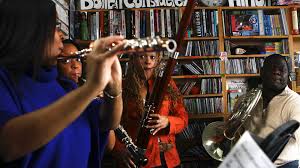
Today, 100 years after The Rite‘s premiere, the fearless musicians of Imani Winds make it all sound remarkably easy, given that they’ve condensed Stravinsky’s massive walls of sound down to just five instruments: bassoon, clarinet, flute (doubling on piccolo), oboe and French horn.

Make no mistake: Many of the jagged rhythms and crunching chords remain viscerally intact, albeit on a more intimate scale. As the group huddled behind Bob Boilen’s desk, bassoonist Monica Ellis noted the opposing ratios, saying, “It’s apropos in some strange way that we are playing one of the most massive pieces in some of the smallest instrumentation in one of the smallest settings that it could possibly be played in.”

The setting might be small, but in this clever arrangement by Jonathan Russell, we learn that a wind quintet, when called upon, can make a mighty and sonorous wail. Just listen to how the Imanis cap off “Dances of the Young Girls” with the entire quintet in full cry (at about 4:30 into the video). The bassoon repeats a fat bass line while the clarinet runs its snaky scales. The piccolo, in piercing chirps, serves as a foil to a frenzied oboe and snarling “whoops” from the French horn.

But not everything in The Rite is all pound and grind. Stravinsky’s transparent introduction, almost impressionistic, is a fluttering aviary of winds — even in the original — with individual colorings for each instrument. It’s all rendered beautifully here by Imani Winds, musicians brave enough to play David to Igor Stravinsky’s imposing Goliath.

This concert is fascinating to watch (and listen to) because even though this piece is familiar (to me) in theory, it’s apparent that I don’t really know it.  And I can see why this piece was so controversial when it came out–it is weird and chaotic and almost random at times.  I imagine that seeing it as a ballet might make it more cohesive, but it’s still pretty out there.

I love that the bassoon seems to be the primary instrument–one that doesn’t typically take center stage.

The group breaks up their selections into three primary chunks.

Selections from The Rite of Spring:

For “Introduction” the bassoon is the primary instrument playing the initial melody.  Then the clarinet and oboe give the whole thing an unsuaul sound–to say the least.  The French horn actually works as the the bass for this part.  It’s also neat watching the flautist switching between flute and piccolo.  I’m not sure when the second part “Augurs of Spring” begins, but I assume it’s when the bassoon repeats that initial melody and then the French horn plays a staccato bass note. The music sounds kind of threatening but whimsical at the same time.

Somewhere in here “Dances of the Young Girls”  begins.  I assume once the piccolo starts chirping and swooping.   And then the band grows very loud before abruptly stopping.

The second segment she describes as incredibly picturesque. “Ritual of Abduction” begins nosily with almost total chaos from all the instruments–the piccolo stands out as sharp and piercing.  As with the other segments, I’m not sure when “Spring Rounds” begins, but I have to wonder if this is when the music seems to go circular and then slow down. There are low notes from the French horn while someone is playing accent notes that sound, not off, but dissonant–providing stark contrast with the rest of the slow movement.  There are some blares of music from the French horn as well.

I’m guessing that “Dancing Out of the Earth”  begins with the fast bassoon melody: up down up down up down up down with trills and swirls from the flutes and clarinet.  It rises and rises very dramatically and then stops.

They tell us that it’s not possible to play the entire ballet so they have taken the “greatest hits” and for this show it’s the greatest hits of the greatest hits.  Consider it a deconstruction with five instruments. But it still evokes the spirit of this sacrificial dance.

She talks about how controversial this was in 1913, “when ballet was meant to be about… I was going to say flamingos…. fairies swans, the other water animals.”   This is the final moment the virgin who sacrifices herself dances herself to death.  And they are going to exemplify trombones and timpani and all that loud stuff (the French horn player laughs and says “Grr I am trombone”).

“Sacrificial Dance: The Chosen One” begins with a three note melody–again it is somewhat threatening.  There’s lots of little fast runs by the French horn with accents from everyone else.  It stops dramatically at one point and then resumes with so many different melodies.  And then comes the surprise ending with a rising flute line and then a low end from the horn.

Without taking away anything from Imani Winds, I ‘m sure this performance doesn’t do the whole thing any justice.  But it is amazing to imagine how much more there is to it.  And it is amazing that these five instruments can evoke so much.  It’s an uncomfortable and somewhat shocking first listen.  It’s amazing that is over 100 years old, although it sounds so contemporary.

I don’t know why it’s not on NPR any more. I found it on YouKu (whatever that is).  I have been able to watch it twice but on two other times I was unable to watch it.  So keep trying, it’s worth the effort.

[READ: May 5, 2016] The Boy in the Dress

David Walliams is best known (if he is known at all) as the tall one on the sitcom Little Britain.

I had no idea he wrote books (he has done over half a dozen children’s books), and I was happy to start with this, his first one.

This book is illustrated by Quentin Blake, who is best known (if he is known at all) as the illustrator for the Roald Dahl books.  So his simple, somewhat sloppy, style might look familiar.

The story is, as the title suggests, about a boy who wears a dress.  And the story is very funny–not because it makes fun of him for wearing a dress, oh no.  In fact, I love the story for going out of its way to show that it is normal that a boy might want to wear a dress. (more…)

Read Full Post »

luchSOUNDTRACK: THE CRISTINA PATO TRIO-Tiny Desk Concert #305 (September 21, 2013).

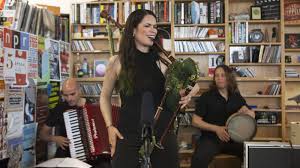
patoI didn’t know who Cristina Pato was or what instrument she played.  So when the show started (without visuals), I assumed she was the accordionist (because the show starts with some wild accordion music).  But in fact, Pato is playing the bagpipe.  Pato’s instrument is the gaita, a Galician bagpipe, and her roots lie in traditional Galician music — though she also boasts graduate degrees in classical piano, music theory and electronic composition.

I love the sound she band gets together with the funky staccato accordion notes and the wild racing pipes.  They are very jazzy and very idiosyncratic.  Her percussionist uses several different types of drums—the ubiquitous box drum and a hand held drum as well as various shakers and other sound makers.

They play three songs.  It’s interesting how much of the first song is taken up without the bagpipes—there’s lenghy sections where the accordion has the floor and she is just happily dancing around.  And the accordionist is amazing.  he plays all kinds of different styles and gets an amazing range of sounds out of that one instrument. He wails!  Of course I see now that the song is actually written by the accordionist: “Victor Prieto: ‘Mundos Celtas.'”  So it’s no wonder that she is happy to sit back and let him shine.  (Prieto , like Pato, is a native of the town of Orense in Galicia).  While he is playing, she whoops and hollers to get everyone pumped.  But once she gets her instruments going she is a nonstop blur of fingers and wild notes.  I particularly like that she has a section where the note is slightly flat and she continues to slowly raise it until it gets in pitch.  I also love–due to the nature of the bag pipes–that she can scream and whoops while still pressing air out of the bags.  And at the end of the song, she is just wild with fast notes.  It’s a very intense piece.

The second piece “Traditional/Cristina Pato: “Alalá Re-rooted” starts with her singing.  She is unmiked so you can’t really hear her, but I don’t really enjoy her singing as much as her playing so it’s okay.  I do love the interesting sounds the percussionist Shane Shanahan (Shanahan is American, but is also a longtime member (with Pato) of Yo-Yo Ma’s Silk Road Ensemble) is making.  Overall, this is a fairly dissonant piece—with her sounding almost like a free jazz players (but on pipes rather than sax).  I do love near the end where she almost seems to get a harmonic overtone on the pipe.  It’s a great moment—but fairly weird how the song just sort of fades away before seguing into the final song.

Victor Prieto & Emilio Solla: “Muñeira For Cristina” this song seems to be all about percussion with lots of drumming and a very noisy tambourine that Pato plays.  She gets the crowd clapping along and then  when she and Prieto play the same awesome riff together,it sounds great.  I love watching her shake the finger part while she’s playing it, to get a cool almost whammy bar sound out of it.  The song totally rocks and the whole set with the unlikely combo of accordion and bagpipe is startlingly wonderful.

[READ: April 20, 2016] Comics Squad: Lunch!

I really enjoyed the first Comics Squad book and I was delighted that a second one came out.  I just recently saw that a third one is coming out the summer–I love that it is called Detention and is coming out on Independence Day.

Like the first collection, this one is edited by Jennifer L. Holm and Matthew Holm (Babymouse/Squish) and Jarrett J.  Krosoczka (Lunch Lady).

But the rest of the line up is quite different this time around, which is cool–allowing other artists to shine.  This time there are stories from Cece Bell (El Deafo) ; Jason Shiga (a great indie artist who does some kid-friendly and some decidedly not kid friendly books) ; Cecil Castelucci & Sara Varon ; Jeffrey Brown and Nathan Hale (his own series of historical stories).

Like the previous book, the Holms and Krosoczka sprinkle the book with comments and interstitials from Babymouse and Lunch Lady. (more…)

Read Full Post »

recessSOUNDTRACK: BUIKA-Tiny Desk Concert #298 (August 26, 2013).

buikaI had never heard of Buika before, so I had to rely on the blurb:

Concha Buika’s voice doesn’t come from inside her petite body: It comes from Africa, and from the past. There are obvious traces of flamenco, itself a historical mash-up of the Moors and various transitory cultures in southern Spain and north Africa.

During her flights of improvisation, we also hear the influence of Cuban vocalist Celia Cruz, a product of Afro-Cuban culture, mixed in with Ella Fitzgerald, who was the pinnacle of African-American jazz vocal expression.

In these two performances, we hear Buika interpret her own lyrics after a handful of albums in which she’s interpreted others’ words. With her eyes closed tightly, she inhabits these poems of love and heartache as if she were reliving them again before our eyes.

Buika’s singular voice has attracted a cadre of fans who’ve become enchanted by her voice and her leave-it-all-on-the-stage performances in clubs and theaters around the world. Watch this video and join the club.

So as the notes say, these two pieces are improvisations.  Not knowing Spanish all that well, I don’t know how much is made up or even how much is just sounds rather than actual words.  But it certainly sounds more off the cuff than written out.

The music is just a piano and a box drum and her voice.  Her voice is raw and pained, but quite pretty.  The two songs are called “La Noche Mas Larga” and “La Nave Del Olvido.”

[READ: April 15, 2016] Comics Squad: Recess

I found out about this collection in the back of a Babymouse book.

Comics Squad is a collection of eight comics from some of my favorite artists.  It basically works as a bunch of short, shall we say graphic novellas, from Jennifer L. Holm and Matthew Holm (Babymouse/Squish) ; Jarrett J.  Krosoczka (Lunch Lady) ; Dav Pilkey (Captain Underpants) ; Dan Santat ; Raina Telgemeier and Dave Roman  (Smile and Astronaut Academy); Ursula Vernon (Dragonbreath) ; Eric Wright (Frankie Pickle) and Gene Luen Yang.

Since it’s edited by the Holms and Krosoczka they sprinkle the book with marginal comments and interstitials from Babymouse and Lunch Lady.  But each artist/author gets a story, and I enjoyed them all.

GENE LUEN YANG-“The Super-Secret Ninja Club”  This was a really fun story about a group of boys who meet at recess.  Once they know that noone is watching, they put on their masks and become the super-secret ninja club.  But Daryl, a decidedly un-ninja like boy wants in…desperately.  He’s never had a passion for any club before but this one is totally him.  The one boy says that since winter break is about to start, when the get back to school, they can talk about him joining.  So Daryl spends all inter break practicing.  Will it be enough?  The answer is very funny.

DAV PILKEY-“Book ‘Em, Dog Man!”  This story begins with a letter to the parents of George (the main character in Captain Underpants) from his teacher saying that she asked for a written assignment and once again he drew a cartoon.  She has attached the offending (and offensive) cartoon for them to see.  Petey the cat is in jail .  He wants to beat the superhero Dog Man.  But Dog Man is too smart  So Petey realizes that if he removes all the words from books no one will be smart anymore.  He invents a ray which does just that.  What will the world do when they can’t read anymore?

JARRETT J, KROSOCZKA-“Betty and the Perilous Pizza Day”  “Lunch Lady” is a cartoon I didn’t really know before reading this collection. Lunch Lady appears in the margins of the pages of the book, but not in this actual cartoon.  Rather, the star of this cartoon is Betty, Lunch Lady’s helper. And since Lunch Lady can’t be there, Betty will have to deal with lunch.  But it is pizza day!  The only hope is the Pizzatron 2000.  Unless, of course, it develops a mind of its own and goes on a rampage.

URSULA VERNON-“The Magic Acorn”  I don’t know Dragonbreath all that well, although C.  has read all of them.  This story is pretty simple.  Although since I don’t know the characters I don’t know if it is representative of anything prior.  Scratch, a squirrel who is rather realistically drawn (Vernon’s drawings are great) is interrupted by Squeak, a far more a cartoony squirrel.  Squeak is excited because he found a magic acorn.  Scratch states that this is the 318th “magic acorn” that he’s found.  And besides they have recess in ten minutes.  Well, this acorn may not exactly be an acorn, but it is certainly magical.

JENNIFER L. HOLM & MATTHEW HOLM-“Babymouse: The Quest for Recess”  In this brief story Babymouse has a few fantasies that prevent her from actually getting outside for recess.  First she is late for school (dreaming about Camelot) then her locker brings her to Zeus, making her late for class.  A western dream makes her disrupt lunch and then the barbarian fractions invade during math class.  Can she keep it together and actually get outside?

ERIC WIGHT-“Jiminy Sprinkles in ‘Freeze Tag'”  So I don’t know this comic at all either. Jiminy Sprinkles is a new student to the school (he is a cupcake). He immediately befriends a peanut who tells him to watch out for The Mean Green Gang, a group of vegetables.  (Their leader is Russell from Brussels (ha)).  The Mean Green Gang is pretty tough but Jiminy has a secret weapon of his own–a very funny one that the Mean Green Gang actually gets a kick out of too.

DAN SANTAT-“300 Words” This is an interesting look at the story The Giving Tree.  The kids were assigned a book report on the story three weeks ago and it is due today.  John is one of the boys who didn’t do the assignment and he’s about to write his 300 words now.  It’s a tree. It gives things.  But another boy has a better idea–he’s going to ask Sophia for her paper.  Even though the last time he talked to her he threw up on her.   Sophia has an interesting answer for him.

DAVE ROMAN & RAINA TELGEMEIER-“The Rainy Day Monitor” is a wonderful take on kickball.  Since the kids can’t go outside to play because of the rain, their recess is indoors.  And they are closely watched by Boring Becca the totally boring fifth grader.  When they ask if they can play kickball inside she asks the kids if they have ever played Dungeons and Dragons.  They groan until she says they should play kickball using dice and imaginary characters.  Pretty great idea Becca!

The end of the book is set up with fun fake ads and useful tips.

One “ad” is an offer for Babymouse Binoculars.  I also really liked Lunch Lady’s tips on how to draw Betty (which skip from 3 to 12 while Squish sweats).

This was not only a great introduction to all of these fabulous comic writers, it was a really funny collection in its own right.

The end of the book says “Do you think there will be another one? As sure as there is syrup on pancakes there’ll be a Comics Squad #2.”  And indeed, there was a second one.

Read Full Post »

SOUNDTRACK: LA SANTA CECILIA-Tiny Desk Concert #327 (December 16, 2013).

santaAs this disastrous presidency continues to dismantle all the goodness in our country, and as the liar who current resides in the White House continues to claim that those who disagree with him are enemies of the people (I mean COME ON), I wanted to share magazine covers that show that a majority of people (both inside and outside of our country) think that Trump is the real enemy.

Originally I planned to just run these covers with no comment.  Then I heard this band La Santa Cecilia and decided that they needed to be put with these images.

La Santa Cecilia are from Los Angeles, California.  “Some of us were born here some of us were brought here and we have a passion for traditional Latin American music; but we also love to rock n roll.  We love blues and jazz.  And we love to celebrate that diversity.  And we love to celebrate where we come from and where we are.”

And unlike the hatred that we are inundated with: “La Santa Cecilia spreads joy every time its members plug in to do a show. They do it one dance step at a time, with cumbias, corridos, elegant mambos and plain old rock ‘n’ roll.”

La Santa Cecilia plays a traditional Latin American sounding music, although there is definitely a twist–lots of rock leanings.   “Falling” is sung in English and it is beautiful and heartfelt.  It’s also got a great guitar solo (and a cool little bass solo).

Introducing the next song, she says: “We’re proud to be from immigrant parents, to have been able to come to this country and to travel the world and share what this music is all about and that it is from the United States.  And we just need immigration reform so we can all be able to travel.  This is for all of the people who are out working in the kitchens in the beautiful strawberry fields.”

The song, “El Hielo (ICE)” is sung in Spanish.  But in the middle she recites a passage in English that has become more relevant now.  “Ice like snowmen in the wintertime; like ice cream under the summertime sun.  Happiness.  ICE: immigrations customs enforcement… and we never know when it will get… us.”

The final song returns to the joy.  “Monedita” is happy song.  “It’s Friday, lets dance.”  It’s got a wonderfully upbeat melody from the button accordion.

This push to ban immigrants is short-sighted and ignorant.  We are all from immigrants and immigrants have so much to offer.  Even if it is music and happiness.

So RESIST.

3068356-inline-i-1-nyt-one-side-effect-of-trump-seriously-great-cover-art

RESIST!

RESIST!

and more importantly

IMPEACH (and preferably IMPRISON) the racist hate mongerer.  #ITMFA

It is not normal for our country’s president to be so despised, especially by our allies.  It is not normal for our country to be humiliated by a man who spends more time on Twitter and then has the temerity to say ‘Nobody Knew Health Care Could Be So Complicated.’  Idiot.

So Democrats, Clinton earned 3 million more popular votes–do not cave to this White Power endorsing man who cares nothing for the citizens of this country.

And Republicans, stop putting your personal gains ahead of what is good and just.  Supporting neo-Nazis, bigots, polluters, dismantlers of the foundations of our country will certainly come back to bite you on the ass. (more…)

Read Full Post »

dragonpunchjohnny SOUNDTRACK: PEDRO SOLER AND GASPAR CLAUS-Tiny Desk Concert #216 (May 14, 2012).

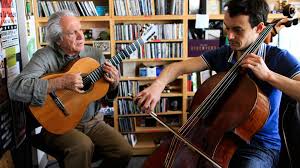
edrogasparPedro Soler and Gaspar Claus are father and son.

Soler plays a delicate, intimate version of flamenco guitar, while his son turns the cello into an exquisitely expressive voice.

I feel like the two could not play any differently and yet their styles meld to create some beautiful music.  The blurb continues:

Though 45 years separate them, pay attention to how they communicate. Music as a living language, and an invisible emotional exchange, is clearly apparent in these improvisational compositions.

The two are pretty fabulous to watch and hear.  Pedro plays so many different styles with his guitar–finger picked flamenco delicacy all the way to aggressive powerful strumming.  Gaspar can also play beautiful soaring melodies–both low and high notes– and then at times he will bow so hard that you can hear the pressure he’s putting on the strings.

They play two pieces.  “La Petenera” is a new song which talks about a woman who was very beautiful.  She had a “love crisis.”  In order to get revenge she had all of the men in the village fight and they all killed each other over her.  Pedro also tells us that Federico García Lorca wrote  three poems about her.

About 4 minutes into the song he plays some crazy noisy stuff that would make any noise band proud. And then he comes out of that chaos with some incredibly delicate bowing.

Gaspar is also not afraid to make serious noise—sliding up the strings to the highest notes and squeaking them or sawing gently while Pedro plays some beautiful melodies.

But Gaspar also plays beautiful passages as well and he seems to be watching hm all the while

Bob asks if they can remember the earliest times they played together.  Pedro (in very broken English) explains that he was giving a flamenco guitar class and Gaspar was watching and then he repeated the exercises on the cello and Pedro says his eyes bugged out.

“La Graneña” is a kind of music from Grenada.  It starts slowly and is a beautiful piece with a lot of lovely guitar playing and Gaspar’s beautiful cello.  It’s very different from the noisy passages of the first piece.   There are some amazingly high soaring notes he plays on the cello, too–almost touching the bottom of the instrument.

About half way through the song it builds and builds with steady chords until it settles down into a quiet picked guitar and plucked cello melody.  It’s delightful and so very different from the rest.

[READ: February 11, 2016] Johnny Boo Meets Dragon Puncher!

It took four years for a new Dragon Puncher book to come out.  And it’s a crossover with Johnny Boo!  (You could also say it took one year for a new Johnny Boo book to come out and its a crossover with Dragon Puncher, but whatever).

This book is set in the winter and Dragon Puncher is looking for the Ice Dragon.

She demands silence as she prepares for battle.  Spoony-E is getting majorly impatient waiting for her to prepare.  And then while “meditating,” Dragon Puncher falls asleep. (more…)

Read Full Post »

zooms SOUNDTRACK: NOVALIMA-Tiny Desk Concert #208 (April 12, 2012).

novalimaNovalima is a band from Peru.  And the blurb really captures them quite well:

Something about tradition inspires reverence and creativity. Throughout Latin America and parts of the U.S., musicians are exhuming centuries-old musical cultures and infusing them with new life to create songs that sound both familiar and new. Peru’s Novalima is doing just that with Afro-Peruvian music.

Over the course of three superb albums, the group has addressed the legacy of slavery in Peru in the form of the traditional lando, a dance rhythm with roots in West Africa. The slow, deliberate beats are played out on a variety of traditional instruments — most notably the cajon, a big rectangular box that drummers hit before drawing sounds out with their palms and fingers. The result can be as deep as a bass drum, but can also hit the high-pitched pops of finely tuned bongos or Middle Eastern dumbeks.

They play three songs which feature acoustic guitar and five string bas anda  lot of percussion–including a donkey jawbone.

“Karimba”is sung by one of the men drumming.  There’s lots of group singing as well–a real party feel.

“Guayabo” and “Festejo” are sung by the female singer.  The bass line for “Guayabo” is just great–weird and almost punk.  It’s kind of sinister even if they don’t sound sinister singing over it.  He’s also wearing a strange kind of drum around his neck–like a box that opens and closes (and you store the sticks in it, apparently.  The middle of the song is all percussion and voice–a celebration of sorts, before that bass returns.

“Festejo” also has a strange, interesting guitar riff.  There’s some great call and response parts of the song–the men really getting into it.  As the song ends the guy with the box and the woman get up and dance in the crowd.  By the end of the song, you realize that it’ sa lot of fun–a groovy dance song like no song you’ve ever head before.

[READ: March 7, 2016] Johnny Boo Zooms to the Moon

As this fifth book opens Johnny is riding a skateboard and Squiggle is towing him.  They are going to go to the moon.  But even Squiggle Power cant get the skateboard to move more than a few inches.  But Squiggles never give up so they wind up falling asleep, no further than when they started.

In the dark, stars come down to see what Johnny is doing.  They tell him he needs star shaped wheels to go to the moon, and that “almost makes sense.”

The stars prove to be very funny–fighting over counting and them fixing his skateboard by braking the wheels of so the stars are now wheels.

And off they zoom, going very fast! (more…)

Read Full Post »

« Newer Posts - Older Posts »