Feeds:
Posts
Comments

Archive for the ‘NPR/PRI/PBS’ Category

[ATTENDED: August 26, 2017] Purling Hiss

I know Purling Hiss from NPR’s All Songs Considered.  Last year they played the band’s “3000 AD” which I instantly fell in love with.  There was a cool shoegaze feel to it with a bunch of noisy elements that I really enjoyed.

I knew that the bulk of the band’s catalog was basically Mike Polizze making music for himself.  It was pretty noisy and abstract with lots of jam moments.  They are now a band–I’m not sure who the other two guys in the band were (based on the latest album, I’m assuming Ben Hart on drums and Dan Provenzano on bass)–and they have gotten more musical since then.  But thy are still noisy.  So I expected a lot of squalling feedback and pummeling sounds.

I was quite pleased with how melodic the band’s songs were (no idea what songs they played, but I assume most of it came from their newest album).  (more…)

Read Full Post »

SOUNDTRACKTOWER OF POWER-Tiny Desk Concert #775 (August 13, 2018). 

I don’t listen to a lot of soul, but when the soul is firing, it is utterly infectious.

And when the soul is performed by veterans (Tower of Power formed in 1968), it’s even better.

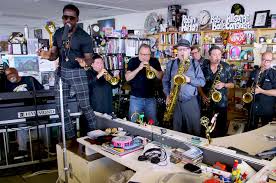
The Tower of power features five horn players, a bassist, guitarist, drums and keys.  And they all gathered behind the Tiny Desk.

When the 10 members of Tower of Power were in place behind Bob Boilen’s desk, strategically positioned around the band’s famous five-piece horn section, their first collective blast three beats into the sound check literally made the video crew jump. It was more a force of nature than a sound, and an impressive display of the “five fingers operating as one hand” concept of band cohesiveness.  A band this big will inevitably have some members come and go, but it’s important to note that the original songwriting nucleus of bari saxophonist Stephen “Funky Doctor” Kupa and bandleader/tenor saxophonist Emilio Castillo continue to write and perform, as does original drummer David Garibaldi.

Meanwhile, lead singer Marcus Scott stood on the desk.  And man he was a powerful singer.  He could wail and hit some fantastic high notes while he was at it.  He really sets the stage well with “On the Soul Side of Town.”  It’s a new song and is nearly five minutes long/

The backing vocals are dynamite as is the wonderfully retro-sounding keyboard solo from Roger Ray.

Things quiet down for a guitar solo from Jerry Cortex that takes a few seconds to get gong but it sounds great once it gets there.

The other two songs were classics from their 1973 album Tower of Power.  The backing vocals sound old school (and totally right on).

The first “So Very Hard to Go” was introduced: “If you ever had your heart broken before, you’ll understand the words of this song.”  It’s a surprisingly mellow track after the wildness of the first song.  And as the blurb notes, “the playing, the passion and the precision remains unchanged after all the years.”

The next song has Marcus asking “the eternal question.”  “What is Hip?”  starts with a wailing guitar solo and then asks some questions, most of which are still more or less relevant  today:

So you want to jump out your trick bag
And ease on into a hip bag
But you ain’t just exactly sure what’s hip
So you start to let your hair grow
Spend big bucks to cop you a wardrobe
But somehow you know there’s much more to the trip

So you became part of the new breed
Been smokin’ only the best weed
Been hangin’ out on the so-called hippest set
Being seen at all the right places
Being seen with just the right faces
You should be satisfied
Still it ain’t quite right

You done even went and found you a guru
In your effort to find you a new you
And maybe even managed
To raise your conscious level
As you striving to find the right road
There’s one thing you should know
What’s hip today
Might become passe

By the end with the Scott leading everyone on to call and response cheers, it’s impossible not to feel good.

[READ: January 22, 2017] “Terminix

This was a willfully deceptive story ad I enjoyed how crazy it would make anyone working in such a situation.

The narrator worked at a job that he felt was totally beyond his comprehension.

Finally, he asked the boss’ secretary is she could shed light on the work they did. She said, of course not

“It’s all set up so you can do your job without knowing. You’re supposed to enjoy the mystery of it.  I know I do. It’s very satisfying to me at the end of the day to know I’ve helped out without knowing anything. You have so much less baggage to carry home with you,”

He asks her is it has anything to do with pandas.  She laughs but doesn’t know.  He said there was a huge order of bamboo.  She says she assumed it was something to do with missiles.

Later the boss came to him ans asked what he and his secretary talked about. (more…)

Read Full Post »

SOUNDTRACK: ALA.NI-Tiny Desk Concert #643 (August 14, 2017).

ALA.NI is a London-born, Paris-based singer who draws inspiration from her uncle, a British ’20s and ’30s cabaret star by the name of Leslie “Hutch” Hutchinson.  She writes her own songs in the style of the standards he sang.

ALA.NI is sweet and funny and very charming.  She exudes calm and grace as she stretches and waves her long limbs and fingers.  It’s mesmerizing.  And her voice sounds amazing.  The blurb notes:

The singer asked us to record her set using her vintage RCA Ribbon microphone, which she carries around in a small briefcase between shows. It’s a security blanket, a bit of visual branding, a statement of stylistic intent — and, not for nothing, a big reason ALA.NI’s voice carries with such warmth and intimacy.

“Cherry Blossom” sounds terrific.  The guitar is gently echoed and her voice is soft and delicate but incredibly right on.  You could easily imagine hearing the pops and clicks of old vinyl behind her.

Between songs she is chatty and funny.  She raves about the NPR gift shop, “I got some beeswax paper that I can wrap my sandwiches in.”

She says that “Ol Fashioned Kiss” is about kissing.  She plays an acoustic guitar which she uses mostly for percussion in the beginning, but then she adds some gentle strums herself.  It’s a simple, old-fashioned bluesy song.  She does a lot of scatting.  And as the song comes to its natural ending, she says tells her guitarist, “no no keep it going, there’s too many toys here.”  She plays all kinds of things on the desks—a small drum set, some other percussive thing and even the cow mooing can.

“Suddenly” sounds like an old song–it’s so hard to believe these are new.  And then comes

Darkness at Noon is a powerful old-fashioned sounding song that opens. “We agreed to end this love affair.”  It’s chilling and gorgeous.

When the song is over she introduces her guitar player, “this is Marvin Dolly on guitar.  It’s actually Marvin’s birthday today.”  She leads everyone in a version of Happy Birthday she hits some amazing high notes while everyone else sings along  She turns as the song ends, “wow you all can sing as well.”

What a delightful person with such an enchanting voice.

[READ: June 25, 2017]  “Why Aren’t You Laughing”

Sedaris has become a lot more reflective in his later writing.  There’s still humor to be had, but for the most part this is a sad tale about his mother.

He begins by talking about the plainness of the North Carolina house he shares with Hugh (he calls Hugh his boyfriend, although I thought they were married).  He says even the theater manager at the box office he performed at knew what their house look like: “spread out over four levels and paneled in dark wood like something you’d see on a nineteen seventies TV show.”  Hugh liked to point out that the pint of the place was the view.

The title of the piece comes as he says he is signing his name on tip-ins for his books while Hugh reads the final draft of the manuscript.  Depending on Hugh’s reaction or silence David would shout Whats so funny? or Why aren’t you laughing? (more…)

Read Full Post »

SOUNDTRACK: JOHN PAUL WHITE-Live at the Newport Folk Festival (July 29, 2017).

I don’t really know all that much about John Paul White, except that he was in the fabulous duo The Civil Wars, and that he writes intelligent but downbeat folk music.

For indeed, his songs are not cheery by any stretch.  But they are very pretty.

I know the first song, “Black Leaf,” from his Tiny Desk Concert.  I loved it then and I love it now. After the song, he asks, “How are you?  Are you well?  You should be well.  No one should be complaining, least of all me in this black suit.”

And, despite his tone, he is not above making jokes with his audience.  Like when he introduces the second song, “Martyr,” he says, “We’ll be doing  while lot of death metal covers. I figured this would be the place. This song is by a band called Sepultura.”  [Nervous titters from the crowd before he starts playing a pretty JPW song that sounds not unlike a contemporary Barenaked Ladies song, especially his delivery of it].

“The Once and Future Queen,” is a slow, quiet song with a big chorus full of pretty harmonies.  When it ends, he says:

I guess it’s probably my duty to warn you….  You came to a folk festival so you probably weren’t looking for happy songs anyway…  If you came to this set looking to be cheered up, you’re screwed.  Let’s get that out of the way.

I loved “Hate the Way You Love Me,” during the Tiny Desk Concert, but when the backing singers accompany him on the chorus and the gorgeous fiddle from Kelli Jones fills the song, it’s really wonderful.

He jokes, “Glad you’re enjoying the death metal.  I didn’t think it would go over as well as it has.”  But he then plays “Fight for You,” a fairly rocking song–with some rocking distortion on his guitar and a snarl in his voice (and a pretty heavy chorus).

I tend to think of JPW as kind of a mellow singer with a great voice, but he really lets loose in the middle of “Hope I Die.”  In addition to a really powerful singing section, there’s a pretty wild solo going on (violin or guitar or both).  He introduces Adam Morrow over here on the guitar, so I assume he had something to do with it.

He says, “I’m not gonna pretend that all of you have any idea who I am.” [cheers]  He jokes, “That’s called fishing for a compliment.”  But he continues,

To those of you who do I apologize.  It’s been awhile.  it took a lot to get me out of the house.  I was incredibly happy sleeping in my bed and going to dance recitals and football games and the lot. And then these melodies started coming back in my head.  And if I gave into it I’d be back out here doing this.  I and I didn’t want that at all.  No.  No offense, but I didn’t want of see any of your faces.  But once I wrote these songs I wondered if people would connect with them…  and I still doesn’t know why I did that.  So thank you.

In introducing the slow ballad “I’ve Been Over This Before,” he says “This is one of the first songs that came to me. I was obviously listening to a lot of old country music, because that’s where it all starts for me.”

He continues, “I promise you I won’t bore you with song meanings because most of the time I have no idea what they mean most of the time.  But this one is personal for me.”  He says “Simple Song” is indicative of the folk spirit of telling stories and passing them down to further generations.

This came from my grandmother.  When my grandfather passed away he was battling many demons that everyone was having to battle alongside him.  She was raising 14 kids because of those demons.  So… I thought he was perfect, I though that he was always happy, but that was not true and when he passes away, she didn’t cry.  I asked her why  and she said ‘I cried so much for your grandfather when he was on this earth, there’s no way I’m gonna cry for him now that he’s better off.’  And so I thought, ‘Number 1, I want to punch you  in the face.  And then 2 much later in life, that that is a song waiting to happen.’  So this will also cheer you up.

The song and sentiment are beautiful with plaintive lap steel guitar: “I will remember I will remember I will remember you… but I will cry for you no more.”

He continues, “So it’s said that festival crowds… this quiet does not happen.  This is beautiful I really do appreciate it.  I’m a very dynamic performer and I need this kind of environment so…  Festivals scare the shit out of me.  I have to thank you from the bottom of my heart.  This is an unbelievable atmosphere to play in.

before the final song, the rocking “What’s So,” which I also know from Tiny Desk, he says “This is the first time Newport for all of my band so they’re geeking out pretty hard.”  In addition to Jones and Morrow, there’s Reed Watson on drums and Matt Green on bass.

“I need more band members so I have time to tune.”

“What’s So” has an aching descending chorus line that is just terrific.

I really like John Paul White’s music and I’d love to see him live in a quiet sit down club..

[READ: June 24, 2017] “It’s a Summer Day”

I know Andrew Sean Greer from a few McSweeney’s books.

This was a simple story but told in a really cool style.  It concerns Arthur Less, a writer, who has been called to an international conference where he is in the running to win a prize.  But the prize is minor and no one–not he nor his agent–thinks he has a chance.  In fact, the only reason he went was to get out of going to a wedding of an old flame, Freddy.

Freddy had once given him advice about international flights: “They serve you dinner, you take your sleeping pill, they serve you breakfast, you’re there.”

I love the narrator’s voice in this story.

He had been to Italy before. Once when he was 12.  And the second time with Robert Brownburn (Yes, that Robert Brownburn, the famous poet).  They had been dating for a while and were at a good point in their relationship.

He did as instructed with the pills, but woke up in the middle of the night–only two hours having passed!  He takes out another pill and then it’s time for breakfast.  He is in a fog and the first few pages are an amusing comedy of him possibly going the wrong way.  He barely makes his local flight (and is shocked to see ashtrays in the airplane seats–charming or frightening?) And then… was it a mistake to get in the car marked for Sr. Ess?  The driver speaks no English and it sure looks like he is heading in the wrong direction. (more…)

Read Full Post »
SOUNDTRACK: JOSEPH-Live at the Newport Folk Festival (July 29, 2017).

 Every year, NPR goes to the Newport Folk Festival so we don’t have to.  A little while afterwards, they post some streams of the shows (you used to be able to download them, but now it’s just a stream).  Here’s a link to the Joseph set; stream it while it’s still active.

Joseph is a band of three sisters and their sound is a little like Indigo Girls–if there were three of them.

When Natalie, Meegan and Allison Closner shout together to the heavens, accompanied only by Natalie’s acoustic guitar, it’s a joyful noise that intrinsically celebrates their bond.

So yes, Joseph is all about harmonies.  They play six songs from their recent album I’m Okay, No You’re Not which is a pretty great release (with a few songs that go a little too commercial).  For the most part, it is just one guitar and three voices.

Their first song “Stay Awake” starts off quietly with one of the sisters (Natalie, I assume) singing and plucking a spare melody on the guitar.  And then about a minute and fifteen second in, all three sisters sing and suddenly the song is magical.

 “Canyon” has a number of amazing moments, but especially when they sing along with one of the sisters taking lead and the other two doing some great harmonies.  When the lead sings “I wanna feel it,” all three singers soar to the rafters in a gorgeous harmony (around 7:25 of this set).

They get applause for “S.O.S.” before playing it.  This is their poppiest song and the one that verges closest to a sound I don’t like (especially for them).  But it’s hard to deny it when they sound so good live.

For “Planets” they ask if anybody wants to sing and they give the audience a mildly complicated melody to sing.  I can’t really tell if the audience is any good at it, but the sisters seem to like it.  And “I Don’t Mind” has a terrific melody even without the harmonies, but when they come in it’s even better.

They describe “Sweet Dreams” as like a lullaby that they used to say to their mom ” Sweet dreams, I love you, good night.”  But this song is anything but a lullaby.  The melody is sophisticated and their voices are powerful.  It’s quite something,.

They have time for two more.  We’ll sing one from our old record and…maybe our single.  That single, “White Flag” finds a stellar balance of pop and folk.  It hits just the right edges of pop to make the song insanely catchy but with an almost aggressive folksiness that is undeniable.  And live it’s almost breathtaking.

Their voices are just amazing.

[READ: June 20, 2017] “I Have Fallen in Love with American Names”

Earlier this month I posted a piece from Roth about names.  I assume that this excerpt comes from the same source.

Roth’s parents were born in New Jersey at the start of the twentieth century.  They were at home in America even though “they had no delusions and knew themselves to be socially stigmatized and regarded as repellent alien outsiders.”  And that is the culture that Philip grew up in.

Butt the writers who shaped his sense of country were born in America some thirty to sixty years before him.  They were mostly small town Midwesterners and Southerners.  None were Jews.

What shaped those writers was not mass immigration from the Old Country and the threat of anti-Semetic violence, but the overtaking of farms and villages  values by business culture.

He says what attracted him to writers like Theodore Dreiser, Sherwood Anderson, Ring Lardner, Sinclair Lewis, Thomas Wolfe and Erskine Caldwell was his own ignorance of everything North South and West of Newark, New Jersey.  And the way that America from 1941 to 1945 was unified: (more…)

Read Full Post »

SOUNDTRACK: WILCO-Live at the Newport Folk Festival (July 29, 2017).

Every year, NPR goes to the Newport Folk Festival so we don’t have to.  A little while afterwards, they post some streams of the shows (you used to be able to download them, but now it’s just a stream).  Here’s a link to the Wilco set; stream it while it’s still active.

I have been really enjoying Wilco’s most recent albums, but it’s their live shows that are exceptional.

Opening with “Random Name Generator” they segue into a very string-heavy “Via Chicago” (a one-two punch of greatness that would leave me flabbergasted).  The recording of this song is particularly great because you can really hear the craziness that Nels Cline adds to the noisy sections.  And the strings also loom large, which I find interesting.  It sounds like a full string section, but maybe its’ just synths?

Wilco have so many albums and so many songs.  Most of their live shows run over two and a half hours.  So this barely-over-an-hour set means excising.  And yet they don’t just play a hits set.  There’s quite a few songs from their latest album, Schmilco and a deep cut from Wilco (The Album).  That particular song “Bull Black Nova” has a cool guitar solo back-and-forth between Cline and whoever else was on guitar at the time.

A mellow “Reservations” leads to a lengthy “Impossible Germany” with an extended guitar solo from Cline.  “Misunderstood” gets a big round of applause (and a suitably chaotic middle section–a mini freakout).

Earlier, Jeff Tweedy said “I don’t feel like talking” but before “Heavy Metal Drummer he says, “I guess I feel like talking a little bit…  Nah.”  Then “Hope we didn’t ruin your lovely day, we didn’t mean to if we did.”

They play a fairly shambolic “I’m the Man Who Loves You” which means not that they play it sloppily but that they play it noisily–from time to time one instrument or another has a little noisy fun while everyone else keeps playing like normal.

As the set starts winding down and Tweedy starts to chat with the crowd, someone shouts something and he says

Happy birthday?  Don’t bring that up.  It’s nowhere near my birthday.  [pause] I might never have another one. [groans from the audience] I just wanted to draw everyone’s attention back to our mortality.  I thought we were having too much fun… it sucks. [pause]  You guys have been heartwarming and reassuring.  Every time I think that everything in the world completely sucks we get to play in front of an audience and share something with people that I know is real and I know it exists and will always exist…  And there will always be more of this than whatever the fuck that is.

They play a lovely “Hummingbird” and a crowd pleasing “The Late Greats.”  Tweedy tells us that “my dad says ‘life is happy and sad and it hurts,’ I wrote about 1,000 songs to say that.”

Tweedy can’t help impart some more advice for our troubled times:

Just show up.  Just show up for everybody and things will be all right.

Before the final two songs, he says, “A lot of people have been yelling for this song, which is understandable.”  It’s from the Billy Bragg & Wilco album of Woody Guthrie songs and it’s called “Christ for President.”  It’s more true now than ever.

For the final song, Billy Bragg himself comes out (that’s what so cool about Newport Folk Festival) and they play a rousing rendition of “California Stars.”

Festivals are never quite as good as regular concerts if you really want to see one band. The sets are always shorter than you want.  But this is pretty fine.  And the recording quality is superb.

[READ: June 20, 2017] “The Countess’s Private Secretary”

This issue has a section of essays called “On the Job,” with essays about working written by several different authors.

Jennifer Egan was indeed the private secretary to a Countess.  The Countess was a woman of some authority.  One time Egan was on her way to work for her.  There was some kind of fire emergency in the building and pedestrian traffic was halted.  The Countess shouted out the window to the emergency crews insisting that Egan be let through.  And she was.

Egan said that being the private secretary often meant “becoming” her–starting at 1PM their lives were more or less the same. It helped that Egan herself was tall and slender, Catholic and full of nervous energy.  She was also short-tempered, just like the Countess.  Indeed, even their handwriting matched pretty well.  Although the Countess told Egan that she liked and her, Egan always knew she was just a servant.  The Countess was not above telling her that garlic oozed from her pores for days after she ate it.  Plus her cowboy boots were coarse, her spelling was atrocious and so on.

(more…)

Read Full Post »

SOUNDTRACK: MARGARET GLASPY-Live at the Newport Folk Festival (July 30, 2017).

Every year, NPR goes to the Newport Folk Festival so we don’t have to.  A little while afterwards, they post some streams of the shows (you used to be able to download them, but now it’s just a stream).  Here’s a link to the Margaret Glaspy set; stream it while it’s still active.

Margaret Glaspy has been making music professionally since 2010, but she released her solo debut last year and it’s really good.  She plays a rocking guitar, although she seems to play a lot on the higher strings.  Her sound isn’t tinny, but it’s a much more treble than bass.  But she’s got a two piece backing band to pick up and complement the low end.

She also has a unique vocal delivery style.  She enunciates words with a strange inflection–I never would have guessed that she is from California.  And it’s that unique sound that I think makes her lyrics that much more interesting.  She’s also not afraid to throw in a curse or a graphic description in her lyrics.

Glaspy played 13 songs in total.  10 of the 12 songs from her record, two new ones and a Lucinda Williams cover.

She doesn’t speak much, she just gets right to the music, playing the first five songs faithfully to the record with just enough grace notes to make it stand out.  But she seems to let it all hang out by the time she gets to “Situation” which has a much louder, rougher guitar sound–she really lets loose and it sounds great.

She introduces the band Daniel Ryan on the bass and Tim Kuhl on the drums and then she starts the slower “Black is Blue.” I hadn’t noticed before but at times her delivery is kind of like Laura Marling’s in this song.  “You Don’t Want Me” has a spoken word section and her delivery once again reminds me of Marling’s.  They certainly don’t sound alike, but there is something similar in the style–that would be an awesome double bill.

She might explain her lack of talking when she says, “This is my first time at Newport and I don’t take it lightly.  So thank you so much for having me.”

The NPR blurb also sees a lot of strength at the end of her set, so I’ll let them sum up

She says she’s “Got some new songs for you:”

a slow-burner called “Mother/Father” and another that doesn’t yet have a title [the chorus: life was better before we were together].  A late-set highlight was “Memory Street,” which boiled over into a seething solo before a final verse that had Glaspy repeating a disjointed phrase over and over, to the point of uneasiness [it is quite long, she sings the words “Times I” with an appropriate skipping sounding drum click for over 20 seconds]— a compelling imitation of the skipping record her lyrics invoked.

She plays a cover of Lucinda Williamss’ “The Fruits of my Labor.” and then ends with “You And I” and that catchy circular guitar riff that is so wonderful and original.

Glaspy has been on my list of people to see live and I hope she comes back this way after she tours around for a while.

[READ: June 20, 2017] “The Work You Do, The Person You Are”

This issue has a section of essays called “On the Job,” with essays about working written by several different authors.

Toni Morrison (it’s hard to think of her as doing something “before” being an author) speaks of working for Her, in the 1940s in a house that had all kinds of things that she had never seen before: a hoover vacuum cleaner or an iron not heated by a fire.

She gave half of her earnings to her mother–which meant she was helping pay the rent, which made her feel good. But she also got some money to squander of junk. (more…)

Read Full Post »

SOUNDTRACK: PINEGROVE-Live at the Newport Folk Festival (July 30, 2017).

Every year, NPR goes to the Newport Folk Festival so we don’t have to.  A little while afterwards, they post some streams of the shows (you used to be able to download them, but now it’s just a stream).  Here’s a link to the Pinegrove set; stream it while it’s still active.

I was pretty excited to hear what Pinegrove did at a big venue like this.  And, true to form, they sound great and are kind and generous to the people helping them out as well as all the fans who are there: “thanks for taking a chance on us.”

What’s particularly fun about Pinegrove is that their songs are mostly pretty short–but they feel fully complete.  But that means you can get 11 songs in a 45 minute set.

The band is in the process of writing and recording new music but this set is all older stuff (1/2 from Cardinal and the rest older).  But this is such a clear recording (with occasionally pops from the bass), that it’s great to be able to hear these songs live and to hear what they do differently with them.

The first song, “Old Friends,” Evan Stephens Hall seems a little less voice-cracking than usual (as if he’s trying to sing pretty for the Festival), but when he gets into the middle of “Aphasia” he sings “But if I don’t have you by me then I’ll go underground” with reckless abandon and the crowd goes nuts.

To me the most notable difference in these songs is the louder harmony vocals of Nandi Rose Plunkett.  And they sound terrific (Plunkett has her own band Half Waif who I’ve been interested in seeing, although i hope it doesn’t distract her from Pinegrove).

They run through several of the songs and they all sound great–the band really transcends when they play live. (and the rabid fans certainly help).

He introduces the band and has a problem getting Plunkett’s name out (I’ve got an avocado in my mouth).  Then he runs through everyone else: Samuel Skinner on guitar, Joshua Fairbanks Marre on the guitar and vocals, Adan Carlo on the bass guitar, Zachary Levine on the drum kit and vocals (he gets a big response).  And then they introduce Lincoln their newly acquired trusty stuffed sloth.

They dedicate “Angelina” to Lincoln, (he ends by saying “just a tiny little song”)

Okay we’re gonna quickly play two more songs.  After a quick “The Metronome” Hall introduces the final song by saying

Most of these songs are about love whether it be romantic, platonic, or familial and when they began they were about how to love the people we knew the best we could, but a more important initiative is loving the people we don’t know as well as we can.  It’s a localized sentiment but also a very public sentiment.

This works as a wonderful introduction to “New Friends” which sounds tremendous with all of the harmony vocals firing on all cylinders.

[READ: June 20, 2017] “Brush Clearing with the Teen-Age Boys in Arkansas”

This issue has a section of essays called “On the Job,” with essays about working written by several different authors.

Richard Ford writes of working in the summer of 1967.  He worked for the Neighborhood Youth Corps in Little Rock.  It was not a job he wanted, just one he could get.  He had always had jobs and wasn’t about to not have one during the summer while living with his mother.

So he enrolled in this program which “summons images of clean cut boys standing at attention, but was really about low income (black) kids getting work experience.”  And he realizes now it was designed to keep them in school and out of the State’s hair. (more…)

Read Full Post »

SOUNDTRACK: MAGGIE ROGERS-Tiny Desk Concert #642 (August 7, 2017).

I had been hearing Maggie Rogers’ name on WXPN and have liked “Alaska” which they’ve been playing.  But I didn’t know much else about her.

But reading the blurb reminded me of where I had initially heard of her:

Maggie Rogers became a viral star on the strength of a video in which Pharrell Williams raves about a demo of what’s become her signature song, “Alaska.” Since then, Rogers has signed a label deal, toured extensively and released a sweetly approachable, inventively arranged EP called Now That The Light Is Fading.

For her Tiny Desk debut, Rogers performed all three of the EP’s best-known songs, opening with the recent singles “On + Off” and “Dog Years,” the latter of which she calls “a song for all the pups.” Then, after dismissing her band, she treated us to a few warm words about public radio before introducing “Alaska.”

Maggie has an interesting voice that sounds similar to someone (it’ll come to me), but with a slight country twang.  It seems like she could easily fall into the country umbrella but her songwriting goes in a slightly different direction.  (I’m also astonished that she looks to be about 18).

She plays three songs (there are 5 on her EP),

“On+Off” starts with a piano intro and Maggie singing. When the middle section kicks in and she plays guitar there a much louder sound. It’s quite catchy.  I really like the delivery of the “Ooohs” that she adds.  There’s something about the way she does it that sounds very cool.

“Dog Years” is a slower, slightly more country-sounding song, but again the “ooohs” won me over.  This time the ooohs are harmonized by her band and it sounds even better.  She also demonstrated some wonderful high notes.

Her band leaves for the final song which she starts by telling everyone that “public radio has been a part of her musical discovery–since she used an NPR compilation to DJ her middle school recess.”  She’s very sweet.

Th final song is “Alaska” which she says is a song about coming back into your body.  It has a really pretty chorus–once again, her voice soaring to lovely high notes.  I prefer the recorded version to this solo version, but she sounds great by herself as well.

[READ: June 27, 2017] “Crossing the River No Name”

I was a little concerned about this story because it was set in Khost, Afghanistan and I thought it was going to be an intense war story–and war stories, like sports stories, pretty much end one of two ways.

So it begins on a rainy night in March 2009.  The narrator and his patrol are sent to interrupt a group of Taliban.  They reached a river and Hal, the leader, called on the best swimmers to swim across and set up the guide rope.  They made it across and secured the line.  The rest of the patrol got across but when it was the narrator and Hals’ turn they hit trouble.

Hal was afraid of the water.  He’d joined the Navy to get over that fear and it worked.  Most of the time.  He knew of one other example when Hal had had a brief freak out.  But this was the second one.  The river grew darker and they were pulled under. (more…)

Read Full Post »

SOUNDTRACK: DIET CIG-Tiny Desk Concert #641 (August 2, 2017).

The guys at NPR have raved about Diet Cig for quite some time.  Especially their live show.  They played at a small club near me and I thought about going but I couldn’t make it.  So I was happy to hear they played a Tiny Desk so I could see what all the fuss was about.

Diet Cig is yet another duo:

with drummer Noah Bowman propelling the high kicks and constant pogo bounce of guitarist and singer Alex Luciano. With a candied voice, she sings of being on the cusp of adolescence — but underneath that bright veneer Alex sings truth to power, and about what it means to be a punk in a skirt, dealing with disrespectful souls. “I think you’re the kind of guy / who would meet me at a party / and forget my name / and try to take me home all the same,” she sings on “Sixteen.”

And while the songs do have some angst, it’s the incredibly happy infectious nature of Luciano that made me instantly fall in love with them and berate myself for not going to see them in a small club when I had the chance–I see they’re selling out shows in London now.

They play 3 songs in 9 minutes (and the last one is pretty extended because Luciano is dancing all over the place: on desks, on the drums, everywhere.  None of the songs are terribly complex, but that’s fine.  They’re charming pop punk nuggets

“Sixteen” is what gets the parental warning. Its starts off slowly:

when I was sixteen I dated a boy with my own name / it was weird in the back of his truck / moaning my own name while trying to fuck

then it picks up and Alex starts bouncing around.  And although the song is kind of sad, “I’ll never barbecue again, and you can keep all of your shitty friends” she can’t stop smiling all the way through.

“Tummy Ache” is when she really starts dancing–doing high kicks and bouncing around all while playing nonstop guitar.  The lyrics are simple but great: “I don’t need a man to hold my hand / and that’s just something you’ll never understand.”

“Harvard” is the first song they wrote.  It has the amusing chorus of  “fuck your ivy league sweater.” She bounces all over the place, climbs on the desk, steps over to the drums and plays the last chords from the bass drum.  As the final chord rings out she reaches into her fanny pack and throws confetti all over herself as she jumps down.

The set is delightful and adorable and boy, I hope when they come back to the area it’s to another small club.

[READ: August 2, 2017] “New World”

This story centers around a global event that I know nothing about.  That combined with some confusing lineage angles made this story less satisfying for me than it should have been.

The story is about the independence of Ceylon (currently Sri Lanka) from Britain.  The story presumes we will know a few details about this event (I knew none: Independence from Britain occurred in 1948, but had a convoluted history trying to attain full independence).  I assume knowing that is useful to the story.

But for our story the impact is more local.  When the new prime minister Don Senanayake spoke first in English and then in Sinhala–no one knew what he was saying–but they all heard the word Ceylon.  Sir William (no last name given) left the country on the eve of independence and he left all of his property to Mr Balakumar, the Tamil manager.

The story is written from a “we” narrator: “We didn’t see Selvakumar approach.”  The “we” are married ladies (who mustn’t be too old, although they do mention husbands at one point).  They are mostly interested in Selvakumar’s story.

This character was fascinating but slightly confusing–at one point he says of himself:  “How can an Indian bastard be prime minister?”  Selvakumar worked for Mr Balakumar, and the man often whipped the boy for doing a poor job (I loved the grotesque detail that he was beaten so hard with the sugar cane that he “smelled like brunt molasses.”

But the real conflict for Selvakumar is with a boy named Muthu.  Muthu, they said, would grow up to be like his father Mr Padmanathan who thought of himself as a big boss.  Muthu was 10 and that was the only reason his father allowed his son to have a friendship an “Indian coolie.”  Muthu would teach Selvakumar whatsoever he learned in school.  The thing that stuck with Selvakumar the most was Marco Polo and his travels.

While the village was celebrating its independence, a storm came through the village.  The rain came hard and fast and began to knock down the poorly made houses.   It flooded the ground, which turned into raging torrents.  When the rain subsided, the people slept “by the ruins of our homes.”  And yet despite the destruction, they knew that Independence would be a more lasting and powerful event for them.

As they assessed the damage, it became clear that Selvakumar was missing.  Had he been killed?  Everyone scoured he area for him.

But I found this part really confusing.  The main part of the story was full of so much detail that I was really surprised by how unstraightforward the end was.  .

This sentence, once unpacked, makes sense but reading it in context created so many visuals that I couldn’t parse it right away.

By the time we discovered the yellow-tipped butterfly on the fat corpse, Muthu’s father had rounded the hillside, dragging his son by the ear with one hand and comforting the wailing Mrs. Balakumar with the other.”

So much is going on there.

Suffice it to say that someone has died.  But something else largely unexpected has happened as well.

The end of the story sees the women imagining their future and the future of the boys in the village as well.

There was a lot going on in this story and I felt like some things came just out of the blue. It was strange how the story begin speaking of the future as one thing but then things changed dramatically after the storm.  Although apparently not because of the storm.

Read Full Post »

« Newer Posts - Older Posts »