Feeds:
Posts
Comments

Archive for the ‘NPR/PRI/PBS’ Category

SOUNDTRACK: BETSAYDA MACHADO Y PARRANDA EL CLAVO-Tiny Desk Concert #707 (February 16, 2018).

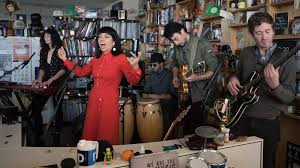
How can you not love a band that is decked out in wonderful colors and whose only instruments are percussion?

I love the first song, “Santa Rosa.”  The chorus is super catchy and when they raise the note in the chorus on the “Oh! Santa Rosa” the song just soars.  Although Betsayda Machado sings most of the songs, this one opens with one of the men (in yellow) singing and I really like his voice, too.  I could even figure out the gist of the words.

And the percussion?  Two floor drums, 2 hands drums, shakers and that friction drum.  So cool.

So who are these folks?

The roots of the music of Betsayda Machado y Parranda El Clavo extend to the Venezuelan slave trade, and while the vocals are in Spanish and not an African dialect, the instruments the group plays date back more than 500 years.

The large bamboo cylinders, the djembe-like drums and the large friction drum together create a symphony of interlocking polyrhythms that was unlike anything I’d heard. Machado’s vocals soar over the unrelenting rhythms, and when she harmonizes with the other singers, it creates a choir-like display of African call-and-response vocals.

When discussing African-influenced music from the southern hemisphere, we often focus on countries like Brazil and Cuba, places where the folk music eventually made its way into popular music. Afro-Venezuelan culture and music is rarely featured or even acknowledged outside of the country. As you’ll see in this video, that should change once music fans take in the beauty of Machado’s voice and the power of her historical message.

“Alaé Alaó” is much more somber, but the percussion is incredible–three men playing bamboo sticks against bricks–the details of what they do are fascinating.  The song starts to pick up with bongos and other hand drums as the guy starts singing again.  During the middle of the song one of the women goes out dancing on the main floor with some of the crew.  This can only lead to more dancing.

“Sentimiento”  The guy in yellow sings the beginning of the song and then Betsayda comes in.  The friction drum is back along with all the shakers and percussion.  I love the way they all stop perfectly at the end.

The band includes: Betsayda Machado, Nereida Machado, Youse Cardozo, Blanca Castilo, Adrian “Ote” Gomez, Jose Gomez, Oscar Ruiz.

[READ: November 20, 2017] Science Comics: Dogs

I have enjoyed every Science Comic that has come out, but this might have been my favorite.

In addition to being about a great topic: dogs, it was also updated with a ton of new information that I had no awareness of.  On top of that there’s a ton of scientific information about genetics, evolution and natural selection.  To top it off, it’s narrated by an adorable pup named Rudy who loves a tennis ball.

Once Rudy drags his owner to the dog park, Rudy can tell us all about dogs.

He explains that all dogs are from the species lupus, and yet look at how different all of the breeds are.  So Rudy rushed back to 25000 BP (before present). (more…)

Read Full Post »

815SOUNDTRACK: BORIS-Heavy Rocks (2011).

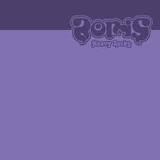
Heavy Rocks, also known as Heavy Rocks 2011, was released at the same time as Attention Please and New Album.   The album has the same name and cover style and font as their 2002 album Heavy Rocks, although this one is purple and the 2002 release was orange.

Heavy Rocks shares the tracks “Jackson Head” and “Tu, La La” with New Album.
Heavy Rocks
shares the tracks “Aileron” with Attention Please, although it is radically different.
New Album shares the songs “Hope,” “Party Boy” and “Spoon” with Attention Please. 

The vinyl edition features extended versions of “Missing Pieces” and “Czechoslovakia.”

Unlike the other two albums, this one is largely heavier, exploring their more metal urges.

“Riot Sugar” (“甘い暴動”, lit. “Sweet Riot”) 3:56  has a raw sound with a soaring solo and a chugging, heavy tone.  It abruptly ends mid guitar solo and segues into “Leak-Truth,yesnoyesnoyes-” (“Leak-本当の反対の反対の反対の反対-“, “Leak (The Opposite of the Opposite of the Opposite of a Real Opposition)”) 4:11  which opens with a quiet unprocessed guitar and then the song starts rocking out–a kind of grungy alt-rock sound.  The vocals are whispered with a kind of throbbing bass line throughout.

“Galaxians” 4:09 opens with pummeling drums and all kinds of (80s) arcade sounds–including a bomb dropping and Atsuo screaming and shouting.  It is heavy and raw and pure punk.

“Jackson Head” (“ジャクソンヘッド”) 3:00 The version of this song is less synthy than that on New Album.  It’s got those punky distorted vocals right up font a shouted chorus of Jackson Head repeated over and over.

“Missing Pieces” (14:27 on vinyl release) 12:22  starts slowly with a pretty guitar melody and muted vocals.  After 6 minutes the song rocks but doesn’t get too noisy.  But after two more minutes it turns into complete and utter noise for another 2 minutes.  Then it all drops away and goes back to the quiet intro guitars.  The last two minutes just rock out.

“Key” (“扉”, lit. “A Door”) 1:46 This is a quiet brief instrumental with twinkly keys and a soaring solo.  It segues into “Window Shopping” 3:57 which opens with a woman speaking Japanese and then some heavy riffage.  There’s a shoegaze echo on the whole thing, especially the doo doo/ doo doo chorus.

“Tu, la la” 4:21 Such a great riff they had to play it twice.  This is a heavier and more guitar based version than on New Album.  It’s my favorite Boris song.

“Aileron” (“エルロン”) 12:45  The version on Attention Please is 2 minutes of acoustic guitar.  This one is nearly 13 minutes, and it begins with a slow echoing guitar notes but it soon gets heavy.  It’s a long, slow, heavy piece with drones and echoed vocal for nearly the whole song, although after 12 minutes there is a delicate piano coda.

“Czechoslovakia” (“チェコスロバキア”, 5:46 on vinyl release) 1:35 Not sure what happens in the vinyl version, but this short rocker has loud guitars and thunderous drums.  Just as it’s about to take off it fades after 90 seconds and ends the album.  Always leave them wanting more.

[READ: February 8, 2016] “Package Tour”

This was the 2015 New Yorker fiction issue.  It featured several stories and several one-page essays from writers I like.  The subject this time was “Time Travel.”

For the final time travel essay Sam Lipsyte balks at a couple’s genuine desire to use a time machine to go back to Brooklyn a few decades to buy a cheaper brownstone.  People in Brooklyn apparently constantly bemoan who cheap places were in their youth, but this one, well:

I pictured the couple hunched in some rattling claptrap wormhole-traverser–because all time machines are built with scrap iron and held fast with duct tape and cut-rate rivets, even those designed for hunting down investment lofts.  Their lips would be peeled back by G-Forces as their ship shredded along the seam of the space-time continuum until they landed in Cobble Hill, 1974.  There they’d hop out, buy a building, and head back. (more…)

Read Full Post »

815SOUNDTRACK: BORIS-New Album (2011).

In 2011, Boris released three albums at roughly the same time.  The three albums are linked because they share tracks (usually very different versions, sometimes radically different).  And, of course, the CD and LP feature different versions of several tracks (but none seem to have a different cover).

New Album shares the songs “Hope,” “Party Boy” and “Spoon” with Attention Please. 
New Album shares the tracks “Jackson Head” and “Tu, La La” with Heavy Rocks.
Heavy Rocks
shares the tracks “Aileron” with Attention Please, although it is radically different.

Sargent House CD (Total length: 50:10).  Interestingly, this American release is longer than the other two.  It is quite poppy with some heavier elements.  There’s a lot of songs that could even be considered dancey (!).

“Flare” 5:04 opens with sirens blaring and a gentle electronic introduction a song bursts forth that feels like total J-pop.  A little heavy (in parts) but this is really dancey.  There’s a great Wata solo in the middle and a rather heavy ending.  The percussion throughout is very mechanical sounding like ea car engine sputtering.  It’s a remarkable sound for Boris.

“Hope” 3:43 is a poppy / shoegazey song sung by Wata. It’s synthy (with trippy synth sound effects  throughout).  It’s slick and catchy.  The version of Attention Please is a more organic, with strings instead of electronics.

“Party Boy” 3:48 opens with a synthy riff and thumping bass drums.  It is the catchiest thing they’re released with a really poppy chorus and interesting swirling synths around the vocals.  There’s even a harp in the middle of the song.  The version on Attention Please is much heavier with a buzzy bass guitar and almost no synths.

“Luna” 8:29 has fast electronic drums and processed Wata backing vocals.  It is super techno sounding.  The middle section is an instrumental with electronics that sound very Eastern (sped up, but that kind of scale).  It’s followed by some heavy guitars and pounding drums.  A ripping staccato guitar solo follows.  There’s even a few moments that sound like Sigur Rós.  Why the song “Black Original” didn’t make this album but is on the Japanese versions is a mystery to me.

“Spoon” 4:29 Opening with single keyboard notes over a pounding drums and distorted guitars, this song sung by Wata is fluid and catchy.  It’s the most shoegazey thing they’ve done so far.  There’s a total Stereolab vibe in this song.  The ending features a series of intense ascending chords.  The version on Attention Please has no synths, just shoegaze guitars.

“Pardon?” 6:00 The song opens with woozy electronic but soon changes to very gentle guitars and an almost jazzy bassline.  The whispered vocals are downright soothing.  There’s a trippy almost delicate guitar solo that runs through until the end.

“Jackson Head” 3:11 This is the most punk song on the record, but it’s electronic punk with very dark synths.  The lyrics are shouted with a repeated chant of “Jackson Head.”  The solo sounds like single, distorted snyth notes under the pulsing of the rhythm.  The version on Heavy Rocks is less synth menace, although it does sprinkle trippy synths throughout the song.

“Les Paul Custom ’86” 4:10 A whispered vocal over a thumping potential dance beat.  When Wata takes over vocals the song changes style, but only slightly.  Distant synths enter the song and try to install a melody on it, but it seems to be fighting everything else.  Wata’s spoken “echo” echos around your heads in a cool swirl (if you wear headphones).

“Tu, La La” 4:15 “Tu La La” has the best riff of any Boris song, It is fast and catchy and really interesting.  This version has strings that kind of overwhelm the greatness of the riff. (I prefer the version on Heavy Rocks)  The end of this version has an intense buildup of staccato strings.

“Looprider” 7:01 is a quiet song with a slow bassline and interesting guitar lines.   The last minute or so is fast synths, building and building with a siren effect that echoes the start of the album.

This is a pretty unexpected release from the band who created Heavy Rocks and Amplifier Worship, but I think it’s a great addition to their catalog.

For comparison sake:

Daymare LP Total length:       45:40

  1. “フレア (Vinyl Version)” (“Flare”; features introduction quoting the end of “Looprider”) 5:02
  2. “希望 -Hope-” 3:40
  3. “Party Boy (Vinyl Version)” 3:43
  4. “Black Original (Vinyl Version)” 4:33
  5. “Pardon?” 5:54
  6. “Spoon” 4:23
  7. “ジャクソンヘッド” (“Jackson Head”) 3:09
  8. “黒っぽいギター (Vinyl Version)” (“Dark Guitar”; English title “Les Paul Custom ’86”) 4:06
  9. “Tu, la la” 4:11
  10. “Looprider (Vinyl Version)” 6:59

Tearbridge CD Total length:       45:39

  1. “Party Boy” 3:49
  2. “希望 -Hope-” 3:43
  3. “フレア” (“Flare”) 4:21
  4. “Black Original” 4:27
  5. “Pardon?” 5:59
  6. “Spoon” 4:28
  7. “ジャクソンヘッド” (“Jackson Head”) 3:12
  8. “黒っぽいギター” (“Dark Guitar”; English title “Les Paul Custom ’86”) 4:09
  9. “Tu, la la” 4:15
  10. “Looprider” 7:13

[READ: February 5, 2016] “Fall River”

This was the 2015 New Yorker fiction issue.  It featured several stories and several one-page essays from writers I like.  The subject this time was “Time Travel.”

For this essay McGuane travels back to 1955 to his grandmother’s house in Fall River section of Boston.

He says there is little compassion between the duchies of this town.  The Irish Catholics dominate every neighborhood, with each having its own church.  But eventually Irish Catholic men like his uncles started showing interest in the Italian, French Canadian and Jewish girls–going so far as to marry some of them.

He wants to go back there to 1955 when there were half as many people and each town had its own personality.  The ragman is known as “the sheeny” and he imagines that the sheeny is a soon-to-be-famous sculptor.  He brings up a lot of other single incidents, like the “Portagee” boy who came to exact revenge on the author;s brother for breaking his arm.  Or how Emeril Lagasse comes from “up the Flint.”  There’s Cockney immigrants Down Almy Street who are known as “jicks” (a one-size-fits-all Irish insult). (more…)

Read Full Post »

815SOUNDTRACK: BORIS-Pink (2005/2016).

You never know exactly what you’re going to get with an experimental band like Boris.  Well, you sort of know what you’re going to get–it will be loud and heavy (mostly).

Boris is and pretty much always has been a trio from Japan: Takeshi on vocals, and double neck bass/ guitar;  Atsuo on drums and some vocals and Wata – with guitars effects and vocals.

.  Their first album came out in 1996 and was a 60 minute continuous piece of drone metal.  It is considered ground breaking (and ground shaking) and is completely influential.  It (along with half of their catalog) is currently out of print, at least in the U.S.  Boris is also nigh impossible to collect all of their music, if you like that sort of thing.  Their Japanese releases are inevitably different from any American release (and sometimes vinyl differs from CD).  Either by track order or length of song or even the mix of particular songs

A decade and eight (plus) releases later with names like Amplifier Worship and Heavy Rocks, they put out Pink.

Pink is a landmark album for Boris (two years ago they toured the album),  because even though it was still incredibly heavy, it also experimented.  Most notably with shoegaze.

.

Pink has a specific track listing on both American and Japanese releases, but the vinyl mixes things up.

The CD releases open with “決別” (“Farewell”) a beautiful soaring 7 minute slow song with a catchy chord sequence and lovely ringing guitars.  Although the beauty is interrupted by Wata’s wailing guitar solos.  She plays some wonderful soaring notes although at times they are rather piercing.  But it’s still kind of soothing and dreamy

Until track 2, when “Pink” scorches forth with a  super fast super heavy super guitar blast.  Four minutes of all out metal with soaring guitars, heavy drums and some appropriate screams from drummer/singer Atsuo.  And if you listen with headphones, there may be two or three guitars echoing in there (in addition to Wata, Tetsuo exclsuivly plays a doubleneck bass/guitar so you never really know what you’re going to get form him next.

The two and a half-minute “スクリーンの女” (“Woman on the Screen”) continues the thrash while the two-minute “別になんでもない” (“Nothing Special”) only increases it with a guitar so fuzzed out as to be almost recognizable.

“ブラックアウト” (“Blackout”) shows another side of the band.   Still loud, still heavy, but grindingly slow and sludgy (those shoegaze days are long gone).  The song ends with nearly a minute of ringing feedback before abruptly cutting off and switching to a more standard heavy metal sound in the 75 second instrumental “Electric.”

“偽ブレッド” (“Pseudo-Bread”) stomps along with fast drums and all kinds of distortion.  It’s even got a kind of mumbly sing-along chorus.  In the second half of these song there’s a great riff and even some “ooh oohs” to sing along to.  It’s really catchy until the ten seconds of noise tacked on at the end (the vinyl version extends this sheer brutal wall of noise to six minutes!).

“ぬるい炎” (“Afterburner”) changes tempo a lot.  It sounds like a big old 1970s rock song with chanted vocals and hand claps.  Wata’s solo is pure old school classic rock.  Prominent drums and highly distorted guitars split headphones as the vocals sit in the middle of the three-minute “6を3つ” (“Six, Three Times”).

“My Machine” is only two minutes on the CD, but it is eleven on the vinyl.  The Cd version taken from the middle of the song–where there’s more bass and echoed guitars underneath, while the eleven minute version has soaring guitars and washes of waves moving back and forth.  It’s dreamy and lovely until the ending feedback, of course.  But that fades out and then it’s just relaxing washes of waves until the main melody pokes it head back up briefly and then fades once more.  There’s a kind of rumble for the last minute or so of the extended version which leads into “Farewell” on the vinyl.  But the CD continues with “俺を捨てたところ” (“Just Abandoned Myself”).  On the American release, it’s eighteen minutes long, although it’s only ten minutes on the Japanese version.

The song is a favorite of many fans.  It’s got a totally catchy riff with distant vocals singing a catchy melody.  It’s like 7 minutes of a super catchy metal song with great vocals, a catchy melody and a terrific baseline riff.  There’s some very cool sounds that bounce around the song too.  Around eight minutes the heaviness goes away and soaring guitars take over, but with a low rumble to keep it grounded.  The next six or so minutes are pretty much classic metal drone–two chords repeated slowly while a feebacking guitar wails over the top.  The only difference is the kind of quieter guitar that;s sort of soloing throughout–almost plucking out notes amid the noise.

Pink was reissued in 2016 as a deluxe two disc package.  The second disc is called Forbidden Songs with nine well-produced and great-sounding tracks.

“Your Name Part 2” is dreamy and melodic.  It opens quietly almost like a spaghetti western with some bass notes, soaring guitar notes, and quietly echoed vocals.  “Heavy Rock Industry” starts with some loud droning chords and then about a minute an a half in there’s just drums and Atsuo whooping until the song takes off again.  “SOFUN” is four minutes of a heavy pummeling riff and scorching solos.

“non/sha/lant” is like a heavy short jam with bass riffage and soloing followed by some guitar work.  “Room Noise” is catchy with a cool bassline and soaring guitars.  “Talisman” is slow and heavy with loud distortion.  There’s a shouted chorus with heavy downtuned guitars that makes it almost singalongy.

“N.F. Sorrow” is nearly eight minutes long.  starts off slow with echoed vocals and a shaker.  It’s a quiet moody piece that builds to a heavy chorus with rumbling slow bass.  When the song really gets moving around 6 minutes there’s some great driving bass under Wata’s solo.

“Are You Ready?” is a simple two note riff on the guitar with a chorus of loudly whispered menace.  The song fades on a wild solo.  And the bonus disc ends with the 2 minute “Tiptoe” a quiet piece of gently plucked guitars and echoed notes that resolves into a really catchy melody.

Boris has dozens of records out but this is certainly the place to start–you get to experience pretty much all phases of the band.

[READ: July 21, 2015] “Lost Luggage”

This was the 2015 New Yorker fiction issue.  It featured several stories and several one-page essays from writers I like.  The subject this time was “Time Travel.”

Mueenudin imagines travelling back in time to the 1930s when India was still unified, to visit his father when he was young.

His father was a lawyer and when he studied at Oxford, the girls nicknamed him The Shiek. (more…)

Read Full Post »

SOUNDTRACK: NICK HAKIM-Tiny Desk Concert #706 (February 14, 2018).

I thought the name Nick Hakim sounded familiar, but I had forgotten it was from an NPR SXSW Lullaby in which Hakim was draped in fairy lights.

In this Tiny Desk, his music seems much more jazzy.  He has an abundance of instruments, as well.  Two guitars (him and a lead guitarist) and a keyboardist who also has a piano at hand.  It lends itself to a lot of different sounds.

“Cuffed” has a slinky bass line and I like that the lead guitar makes a sound like rim shots almost.  I really enjoyed that the same guitar later plays a muted guitar solo.  Even the keyboard solo is a little trippy and wobbly.

As the blurb says, the music of Nick Hakim occupies a space and time that is faintly out of this world. The guitars and machinery that make up his music feel slightly askew, as though someone slowed down the tape machine every once in a while. His raspy voice feels drenched in a cavernous space.

Hakim’s songs seem very personal (“exploring the quietude of inner thoughts”), like this couplet:

she taught me to make love with patience not just thinking about myself/
to really feel the other person, oh my love, what would I do without you

“Needy Bees” slows things down to piano and a jazzy guitar with mellow lyrics like “let me live inside of your mind.”  And as the blurb notes, the music feels warm and spacious.  Again weird and wobbly guitar solo comes out of the middle of the song.

I find the way he sings “Roller Skates” to be comically restrained.  I imagine it could come across as really passionate but it seems odd the way he holds back some of his opening vocal sounds.   The sprinkling piano and cool bass breakdown in the middle of the song are terrific.

I didn’t like him at first but by the end I was getting into it.

[READ: November 15, 2017] “Bad Dog”

Not only does the dog die in this story, it is horrifically killed.

I gave away that ending, something I am loathe to do.  But you can probably  thank me for not having to read that particular piece of horror.

Having gotten that out of the way, I have to admit that this story was really compelling and craftily written.

At first I wasn’t so sure what was going on.  A lot of names are tossed out with little context.  But it soon becomes apparent that the narrator’s daughter Abby (now 31) and her husband Tim own a dog which they adopted from Tim’s friend who was moving.  They adopted it because they assumed they would not be having children.  But now they do.  A girl named Rose. (more…)

Read Full Post »

 SOUNDTRACK: MARLON WILLIAMS-Tiny Desk Concert #705 (February 12, 2018). 

Bob Boilen has such nice things to say about Marlon Williams, that I’m leaving most of the blurb.  I found his voice to be lovely but didn’t enjoy his music quite as much as Bob did.

Marlon Williams, the 27-year old, New Zealand-born, Melbourne-based singer is in love with a good, traditional blues or country tune and that’s just how he opens this Tiny Desk Concert, with a song called “When I Was A Young Girl” (also known traditionally as “One Morning In May” or “The Bad Girl’s Lament”). …  Williams’ rendition is more stunning than any version I’ve heard with its long, deep-throated incantations. The purity of Marlon Williams’ voice is rare and entrancing.

He reminded me a lot of Antony on this song–deep and resonating and slow.  The song is quite earthy (drinking in ale houses) for such a soaring delivery.

After that first tune, performed solo with just his acoustic guitar, he strapped on his electric guitar, brought out his band, snapped his fingers to set the beat and sang about being stoned and running around Los Angeles dressed as a vampire. At the time of our taping, back in October of last year, “Vampire Again” was the newest song since Marlon Williams’ 2016, self-titled release.

Marlon adds some weird and noisy guitar solos throughout the piece.  But I am mostly taken aback by these lyrics:

I am happy to reveal
I can smell you from 100 yards (SNIFF) fresh white linen
Felt like only  yesterday I was as weak as Woody Allen
Now I stand proud and tall as the home that you were born

The end of the song is a crazy cacophony of vibratos and buzzy synths, like a wild surf rock party.

He launched into a tune we’d not heard before. He calls “What’s Chasing You” a song about horror films, but it sounds like a 1950s tune about unrequited love.

This was a fun, simply fifties sounding tune with nice harmonies.

I can’t help but hear Steve Coogan in the way he introduces the next song.

The brilliant session ends as the band gathered around a single microphone for another new tune called “Make Way For Love.” We now know it’s the title track to Marlon Williams’ forthcoming album and it reveals an intimacy at the heart of what makes him such a magnetic artist.

This also sounds like it would fit n perfectly in a 1950s romantic movie–especially when the other guys (David Khan (electric guitar); Benjamin Woolley (bass); Angus Agars (drums)) sing gentle backing vocals.

[READ: June 26, 2017] “Irman”

I enjoyed a story from Schweblin a few months ago, but I did not like this one.  This one was also translated from the Spanish by one of my favorite translators Megan McDowell.

This is one of those stories that frustrates me with unreality in a real setting.

As the story begins, the narrator is very thirsty but her husband(?) Oliver is driving so they can’t stop (!).  They finally get to a truck stop but it is empty.  The restaurant was big and I “desperately needed to drink something.”  [So just go to the bathroom and get water, then].

A short man in an apron appeared and although he seemed to be the water he looked suspicious.  Oliver ordered drinks but the man didn’t say anything.  When Oliver asked if they could have something fresh and quick the man said yes as if “something fresh and quick were an option on the menu.”  I liked that line. (more…)

Read Full Post »

 SOUNDTRACK: THE CROSSRHODES-Tiny Desk Concert #704 (February 9, 2018).

Who knew there was explicitly Christian rap?  I mean, obviously there must be. But I never expected to hear it, especially not Christian songs that used the n-word and the f-word.

I’d never heard of The Crossrhodes, so here’s what the blurb says

Witnessing The Crossrhodes perform at the Tiny Desk instantly snapped me back to their early beginnings, just a few miles away from NPR headquarters. In 2001… the Crossrhodes stepped on stage. Week after week, the band passionately performed original material that jumped between society’s woes and their own love lives. Word eventually spread outside of the D.C. area and one-half of the group, Raheem DeVaughn, landed a record deal.

DeVaughn went on to achieve R&B superstardom, earning two Grammy nominations, while the other half of the group, Wes Felton, has remained a pillar of D.C. culture, excelling as both a musician and actor. They reunited and released their first album in over a decade last year. Footprints on the Moon recapitulates and magnifies the ideals they conveyed in the early 2000s with a hyper-focused sense of urgency.

Poet, Raquel Ra Brown opened the show with a poem.  After her introduction, and they were the band is dressed, I expected to hear more of a gospel sound, not for him to start out by going “yo, unh.”

“Footprints on the Moon” seems to be inspirational, but what’s with this lyric:

They lyin’ bout them there two white feet
That landed on the moon a year after they killed King

And again, the songs are fairly pious and you get this couplet:

The only topic of discussion is who they touchin’
Or who they buyin’ or who they fu**in’

Sure there’s politic on the song, but where is this music going?

“How You Gon’ Fall” has a pretty great chorus but the verses are again, pretty rough

cops shot 30 rounds in 15 seconds
4 month old baby in the rear section
another mother gotta call the reverend
a dead daughter, sister, veteran
now the media posing all the questions
slandering the victim pointing out aggression
somehow the angel of god kept the baby protected
coz grandma prayed beyond the pictures and necklace

The tautology of “Praying Prayers” is surprisingly catchy .  It’s probably my favorite song of the bunch

“America” has some well thought out complaints about the country, and it ends with the last few bars of the National Anthem.  I like that they took a knee during that part.

As the show ends, he gets everyone to chant, “I got the power, you got the power, we got the power; that’s power to the people.”

Overall, there was some good stuff in this set. Not my thing but I can certainly appreciate most of it.

[READ: September 21, 2017] “Fistfight, Sacramento, August 1950”

So the crux of this story is that a fist fight between two men brings a man and a woman together.

How delightful.

The story is written in a thoughtful manner, but it is still just about two dumb drunks fighting.

Inexplicably, James Sutter, in a bar, leans over and says–as if to no one–I hate Okies. Frannie Begara challenges him to a fight outside.

So they go out in the dark (the streetlight frames their ring).  Each man has his fan base ringing behind him. (more…)

Read Full Post »

SOUNDTRACK: IBEYI-Tiny Desk Concert #703 (February 7, 2018).

ibeyiI have been fascinated with Ibeyi since I first heard them a couple years ago.  Their more recent song “Deathless” is just outstanding.  I’d also heard they put on a great show.

So I was looking forward to this Tiny Desk.

But just who are they?

They come by their connection to the Afro-Cuban culture by way of their late father, Miguel “Anga” Diaz, an in-demand Cuban percussionist who was part of a vanguard musicians who reinvigorated Cuban music before he died prematurely at age 45 in 2006. The sisters, Lisa-Kaindé (in blue) and Naomi (in orange) Díaz, carry that calling in their DNA, and how they’ve manifested it into their own art is nothing short of amazing.

The show begins with the sisters singing a capella: an invocation of a West African Yoruba deity called “Oddudua.”

The first song they play is “Deathless.”  “This song is dear to our hearts.  It’s made for you; for us.  Whatever happens, this moment is deathless.  We made it for you to feel for three minutes and believe it.”  Naomi hits a sampler to get the horns going and then Lisa-Kaindé plays the nifty buzzy keyboard melody and vocal samples.  Then Naomi starts playing the batá, which is really fun to watch.  Lisa-Kaindé sings lead (her voice breaks on one of the high notes)

The twins (Ibeyi means ‘twins” in Yoruban) perform their music with the batá drums associated with Yoruban sacred music and their elaborate vocal arrangements channel the call-and-response of traditional African music. The melding of their voices when they harmonize can be breathtaking, but the same can be said about the messages behind their songs, themes that inspire both inward introspection and celebrations of life.

The drums are such a cool percussive element that I didn’t expect.  The chorus is so uplifting and joyful even as it has a tinge of menace.  They get he audience to sing along in a rather inspiring call and response of the chorus.

“Valé” is a lullaby written for their niece–she sings frozen and she’s really into it.   Naomi sings leads while Lisa-Kaindé plays the pretty piano melody.  It is a delicate, quiet song (a lullaby, duh).  Then Lisa-Kaindé sings lead and Naomi plays cool percussion on a box drum which include lap-slapping as well.

Lisa-Kaindé says “Transmission” is the heart of their album.  It’s nearly seven minutes long and goes through several changes throughout.  They are both by the keys for the start of this one, with Naomi playing bass notes and both of them singing out of the same microphone.

The audience sings the gentle “Transmission” chorus as Naomi speaks in Spanish and then she adds the batá and sings some lovely harmonies.  It’s quite moving.

[READ: February 6, 2018] “Stanville”

I’ve been meaning to read one of Kushner’s novels for a while now because of great reviews.  But in the meantime, I have these short stories.

I’m not sure if this is an excerpt or not.  It feels pretty full on its own, but I coud easily see it going much further.

This story is done from two points of view.  A third person POV for the one main character, Gordon Hauser.  And then, later, a first person point of view for another major character Romy Hall.

Gordon Hauser is teaching G.E.D. classes in a women’s prison.  He was surprised to find that people would much rather teach in men’s prisons.  Indeed, no guard wanted to work in a women’s prison “female prisoners bickered with the guards and contested everything, and the guards seemed to find this more treacherous than having to subdue riots.” (more…)

Read Full Post »

SOUNDTRACK: VICENTE GARCÍA-Tiny Desk Concert #701 (February 2, 2018).

Singer-songwriter Vicente García plays a delicate acoustic guitar and has a pretty crooning voice.

The blurb says that he

is still relatively under the radar, but performances like the one he gave at the Tiny Desk are starting to turn some heads.

García’s music isn’t dominated by his native Dominican Republic, but you can hear it in every note. His poetic lyrics are like short stories, sung by a voice both plaintive and evocative, yet always distinct.

“San Rafael” is quite a pretty song echoing the beauty of San Rafael.

Before “A La Mar” (the title of second album which means ‘to the sea’) he introduces [unclear] Vasquez from Dominican Republic on percussion and Ricardo Muñoz from Bogota on the keys.  There’s a neat moment where he plays a harmonic on the guitar in a rather unusual way.  The delicate percussion really adds a lot, as does the bass line plays on the keys.

“Dulcito e Coco” opens with a lovely guitar melody and a close up of the fascinating percussion box that Vazquez is playing–a purple, strangely-shaped box that seems to get different sounds where you strike it.  The song stays quiet throughout although it does get a bit bigger by the end.


[READ: November 13, 2017] Silly Rhymes for Belligerent Children

I was so excited to see Trace Beaulieu in person.  Ans even though this book is available everywhere, it was especially neat to buy it from the man himself and get him to autograph it.

It is subtitled A Yucky Big Book of Rainy Day Fun for Belligerent Children & Odd Adults with Nothing Better to Do.  The illustrations are by Len Peralta who apparently has not done anything else I’ve read even though his work looks so familiar and is really good.

So what is this?

Well the title is pretty accurate.  Trace has concocted snarky funny poems.  Most of them are pretty short (and in this format are often two or three lines per page) and accompanied by an illustration). (more…)

Read Full Post »

SOUNDTRACK: HURRAY FOR THE RIFF RAFF-Tiny Desk Concert #702 (February 5, 2018).

I first heard of Hurray for the Riff Raff from their previous album (the song “The Body Electric”).  I loved Segarra’s voice and the politics behind the song.  I could hear that she was a proud woman, but I had no idea that she was a proud Puerto Rican as well.  I learned about that aspect of her music when they played Newport Folk Festival.

Alynda Segarra’s unamplifed voice in this Tiny Desk performance had no problem rising above the drums, congas, cello, violin, bass, keyboards, and an electric guitar. The passion for her Puerto Rican roots feels boundless. As Soul Captain for Hurray for the Riff Raff, she and her band weave tales of man’s inhumanity to fellow humans, often from bigotry, intolerance and ignorance.

“Rican Beach” adds a lot more Latinx accents to the music–between the congas and other percussion from Juan-Carlos Chaurand and the riffs and, of course, Segarra’s lyrics, this is a much more culturally aware album without removing any of the folk/rock that the band is built on.

First they stole our language
Then they stole our names
Then they stole the things that brought us faith
And they stole our neighbors
And they stole our streets
And they left us to die on Rican Beach

“Pa’lante,” is such a wonderful mix of the Hispanic and Americana.  Singing in Spanish to Juan and Miguel the song includes a more traditional American folk style with piano (Sarah Goldstone), violin (Claudia Chopek), cello (Patricia Santos) and even a guitar solo (Jordan Hyde).  Introducing the song, she says, “There’s a lot of people trying to hold us back but we have a whole generation of children counting on us to change the world.  And I believe in us.”

The song “Pa’lante,” one of the most articulate songs of a generation, speaks of being colonized and hypnotized, sterilized and dehumanized, with the refrain, “pa’lante” which translates as “forward.”  To continue the fight to freedom and respect:

“To all who lost their pride, I say, Pa’lante!
To all who had to survive, I say, Pa’lante!
To my brothers, and my sisters, I say, Pa’lante!”

But before that empowering end, the opening lyrics speak to the everyday that we all want:  Over  a simple piano melody, she sings:

Oh I just wanna go to work / And get back home, and be something
I just wanna fall and lie / And do my time, and be something
Well I just wanna prove my worth / On the planet Earth, and be, something
I just wanna fall in love / Not fuck it up, and feel something

And then more specifically:

Colonized, and hypnotized, be something
Sterilized, dehumanized, be something
Well take your pay / And stay out the way, be something
Ah do your best / But fuck the rest, be something

After four verses the song shifts gear entirely.  There’s some louder chords and then it moves on to a an almost chamber-pop style with some prominent snare drum Charlie Ferguson.  The end of the song, with her singing “P’alante” it’s catchy and inspiring at the same time.

For “Nothing’s Gonna Change That Girl” Segarra picks up a guitar.  It’s a slower more traditional folk song with full string accompaniment.  There’s quiet backing vocals and delicate yet pronounced bass from Justin Kimmel and some fun percussion before the ending refrain “before you love me like this, oh yeah, love me like this.”

I have tickets to see them and Waxahatchee this spring, it should be a great double bill.

[READ: July 22, 2016] “Sweetness”

I haven’t read very much by Toni Morrison.  I have always intended to but just never did.

So this might be the first thing I’ve read by her.  And man, does it pack a lot into the few pages of it.

The story begins with a woman saying, “It’s not my fault. So you can’t blame me.”  And then she reveals that what’s not her fault is the color of the skin of her baby.  The woman–the mother–is a light-skinned black woman with “good” hair, “what we call high yellow.”  So was the girl’s father.  So how could the baby have come out so dark-blue black?  She was embarrassed as soon as the baby was born.

She talks about her family’s past–how her own mother was light-skinned and could have passed but chose not to.  She told the price she paid for that decision–colored water fountains and, even more offensive: a colored Bible. (more…)

Read Full Post »

« Newer Posts - Older Posts »