Feeds:
Posts
Comments

Archive for the ‘Mystery’ Category

SOUNDTRACK: SSINGSSING-Tiny Desk Concert #651(September 21, 2017).

I have never seen or heard anything quite like SsingSsing.

It’s easy to dismiss them as a novelty by looking at them, but their music is really compelling.  Their songs may be (as stated below), a regional folk style, but the music is really groovy and interesting–the bass is nicely prominent but never obtrusive, and the guitar plats a lot of different strumming techniques, bringing very different intonations to the music.

And then there’s the front trio who are totally infectious.

One look at (and listen to) the cross-dressing, Asian rock band SsingSsing and you would hardly think they’re singing music inspired by traditional Korean folk. But SsingSsing isn’t like any other band I’ve ever seen or heard.

The group sings a regional folk style called minyo and the gender bending look has to do with shamans not glamour. As singer Hee-moon Lee describes it, “In Korean traditional art, male shamans, called baksu, have the body of a male. But as mediums, they need more than a single sexual identity, because they’re channeling both male and female spirits. When I act a female character and sing, I have to overcome the fact of my being a male sorikkun (singer), and try my utmost to bring a more neutral, unisex feeling to the performance. It sounds silly, but I feel like going back to the sensibilities of my youth, when I liked Madonna, helps.”

They play three songs:

“Minyo Medley” opens with reggae guitars and the strangely infectious vocal of the female singer doing a nearly cartoon-high pitched” Oh” sound and the taller male singer (with the cute white bob and white lipstick) laughing and then stating “Oh,” as if surprised out of his laugh.  It’s weird and catchy and cool all at the same time.  The lead singer with the magenta curls sings traditional vocals and eventually the other two join him.  The middle of the song slows down to a quiet guitar motif and mellow singing from the lead singer.  The end of the song picks up speed with an almost ska feel as it rocks to an end.  Then there’s a little coda of that opening (and even more crazy laughter) as the song ends properly.

On “Nanbongga (Song of Beloveds)” the woman sings lead which opens with a slinky groove and all three gently dancing.  The two men alternate spoken words before the woman singing in a traditional female Asian style takes over.  By the middle of the song everyone is dancing with the men singing back up and the tall guy (I love that he is holding a clutch the whole time) saying what sounds like “caw.”

The final song, “Saseol Nanbongga (Narrative Song of Beloveds)” appears to be a variant on the middle song (although perhaps not, it is musically quite different).  However, the taller guy does a lot of very fast recitations in the verses with impressive delivery.  The backing vocals are really catchy and the lead singer is really into it. The song totally rocks by the end.

How bummed am I to have found out that they were at MusikFest this summer and I could have seen them?  Because this is a band that begs to be seen live.

I don’t know which singer is which, but here’s the band members: Hee-moon Lee (vocal), Da-hye Choo (vocal), Seung-tae Shin (vocal), Young-gyu Jang (bass guitar), Tae-won Lee (electric guitar), and Chul-hee Lee (drums).

[READ: June 25, 2016] Amulet: The Stonekeeper’s Curse

I read the Amulet series last year but for some reason never got around to posting about the books.  So, let’s get this series finished.

The Stonekeeper’s Curse opens pretty dark.  We head to a tower where guards have captured the creepy looking guy from book one (Emily could have killed him when he attacked them, but she spared his life).  Turns out this guy is the son of a faceless creature (in a scary mask).  The father says that his son has failed him again.  The son argues but the father’s mind is made up.

He will have one more chance to get the amulet and the girl and he will have help from an older looking creature named Luger.

Cut back to a colorful scene with a walking house (that happened in book one, too). Navin is “driving ” the house and is doing a pretty good job.  They are on their way to Kanalis to get medicine for their mother who was injured in the first book.

Kanalis has suffered a curse and most of the people in town are slowly turning into animals.  It may or may not be contagious.  As our heroes walks around, a fox-person is following them. But as soon as the creepy elf guy charges, the fox steps in.  Emily sees him and asks who is he.  He says he’s a bounty hunter.  Miskit says they don’t want to deal with his kind.  He ultimately relents and admits he’s not really a bounty hunter.  His name is Leon Redbeard and he offers to help them if they will help him too. (more…)

Read Full Post »

SOUNDTRACK: PENGUIN CAFE-Tiny Desk Concert #628 (June 16, 2017).

I recently found out about Penguin Cafe from a piece on All Songs Considered.  I learned that Penguin Cafe Orchestra was responsible for some cool/unusual classical/pop recordings back in he 1970s and 1980s.  And it’s likely that if you listened to NPR back then, you heard some of their music.:

The music of Penguin Cafe is like no other. Its origins date back to the early ’70s, within fever dreams Simon Jeffes had that were brought on by food poisoning. In those dreams he imagined a dispassionate world “where everyone lived in big concrete blocks and spent their lives looking into screens. In one room, there was a couple making love lovelessly. In another there was a musician sat at a vast array of equipment, but with headphones on, so there was no actual music in the room.” Eerily accurate.

But he also imagined a place, the Penguin Cafe, where folks could gather, for pleasure, cheer and music. He wanted to hear what that music would sound like, and so created the Penguin Cafe Orchestra. I was always a huge fan of that original music; listeners of NPR may have heard it often in-between news stories during the many years I directed All Things Considered.

But Penguin Cafe Orchestra is no more.

While Simon Jeffes died in 1997, his son Arthur has been creating new music infused with his father’s original inspiration. He calls his group, simply, Penguin Cafe. You can hear Brazilian sounds in the rhythms, classical and minimalism in the strings, Asia in its harmonium, African sounds in the kalimbas. But honestly, it’s none of these; it’s a universal dream state.

If you’re looking to explore further be sure the listen to Penguin Cafe’s recent album The Imperfect Sea, which nods to Kraftwerk, Simian Mobile Disco and Franz Schubert. It’s none of these.

The band has a lot of strings: Oli Langford (violin) Clementine Brown (violin) Vincent Greene (viola) Andy Waterworth (double bass).  There’s also a ukulele (Des Murphy) which you can’t hear too often, but it is notable on the final song.

“Wheels Within Wheels” is cover of a song by Simian Mobile Disco.  It is nearly five minutes long with slow, building strings and a simple melody that seems to be never ending as it remains the same while the backing chords change.  In addition to the strings, there’s a guy (Neil Codling) playing a dulcitone on top of the real piano (he’s holding his hand up by the end).  And the percussionist (Darren Berry) seems to have a wooden plank to play on.  He uses mallets on the wood to get quite a deep sound.  It’s a really fun piece.

“Protection” has a catchy piano motif (played by Arthur with outstretched arm on the dulcitone) in 7/8 time.  But everyone else plays in 4/4, so the motif changes every time.  After a few bars, it switches to the real piano and the strings are really lovely while that’s going on.  The ducitone player has switched to a large ukulele and the percussion consists of drums sticks on the piece of wood–fast clicking sounds.

“Ricercar” is an old renaissance Italian term.  At the beginning of a fugue you embed a theme that is expounded on later.  This song opens the album and few themes come back later in the album.  Jeffes plays a quiet melody on the dulcitone.  About half way through the song he opens the piano and seems to be dampening the strings with his hand while playing the notes.  The percussion includes a shaker and the mallets on the wood once again.  It’s upbeat and catchy and a lot of fun.

This is a really enjoyable show–classical music for people who like to have fun as well.  As far as the original band goes, if you’ve heard anything by Penguin Cafe Orchestra, it’s probably this piece: “Music for a Found Harmonium.”

[READ: June 24, 2016] Amulet: The Stonekeeper

I have really enjoyed Kibuishi’s Explorer collections, so it seemed sensible to try out his Amulet as well.  And what a great, interesting and unusual story it is.

Although I must admit I was pretty shocked by the fact that the main characters Emily and Navin are in a car accident in the prologue and their father is killed.  What a way to start!

After the death of their father, the family (Emily, Navin and their mom) move out to an old country estate to get some perspective on things.  As they begin to clean up the old house, they go into a room of inventions by their ancestor Silas Charnon.  The story is that Charnon went missing one day and was never heard from again. While Emily is looking over some books, a creepy ghost creatures hovers behind her.

Navin and Emily look around (they don’t see the ghost) and soon, Emily puts her hand on a hand-shaped plate and a necklace–an amulet–is revealed.  Emily puts it on and when Navin complains, she says he can wear it tomorrow.  But that night the amulet speaks to her.  It tells her to stay with her family and keep the safe–they are in danger. (more…)

Read Full Post »

SOUNDTRACK: AIMEE MANN-Tiny Desk Concert #618 (May 8, 2017).

Aimee Mann is pretty legendary at this point.  Starting out in ’til Tuesday, she has since made a name for herself as a solo artist (and collaborator).  Her solo albums are sweetly sad: she writes pretty melodies with rather downcast lyrics that sometimes have humor in them.  She has done a previous Tiny Desk with Ted Leo–they were called The Both.

Her voice is calm and kind of deep and she casts rather an imposing figure given her height.  I saw her live about ten years ago and while I don’t remember all that much from it, I know I enjoyed her.

I have a few of her albums, but I haven’t really gotten anything recently because she’s a bit to melancholy for me, and I feel like her songs tend to sound a bit the same–I keep waiting for all of these songs to end with the chorus of “I’ve Had It” (one of her earlier songs that I rather like).

Despite these criticisms, there’s no doubt that her songs are quite lovely, and when Jonathan Coulton sings backing vocals it’s pretty great.

She plays four songs from her new album, Mental Illness. On “Rollercoasters” it’s just her and Coluton.  The second song is “You Never Loved Me”–“It’s another cheery, optimistic number.”  For this track, Aimee plays guitar and is joined by Paul Bryan on bass and Jamie Edwards on piano.  The band fleshes out the sound nicely, with a good bottom end.

The title of “Goose Snow Cone” is never explained, which is a shame.  There’s a lovely guitar melody on this song.   “Patient Zero” opens with a backing ooooh vocal.  There’s some great deep bass notes from the piano and I love the way the end of the song features the guys singing a chorus while Aimee sings a counterpoint vocal.  It’s my favorite moment in the show.

[READ: March 2, 2017] “The I.O.U.”

I didn’t think I’d read any storied by Fitzgerald (aside from Gatsby) but it turns out I had read a short story by him about five years ago.  I described it as enjoyable but slight.

This story from 1920 is clever and funny and was previously unpublished.

I enjoyed the initial construct:

The above is not my real name—the fellow it belongs to gave me his permission to sign it to this story. My real name I shall not divulge. I am a publisher. I accept long novels about young love written by old maids in South Dakota, detective stories concerning wealthy clubmen and female apaches with “wide dark eyes,” essays about the menace of this and that and the color of the moon in Tahiti by college professors and other unemployed. I accept no novels by authors under fifteen years old. All the columnists and communists (I can never get these two words straight) abuse me because they say I want money. I do—I want it terribly. My wife needs it. My children use it all the time.

Interesting opening, right?

So the unnamed publisher tells his story that six months ago he contracted for a book that was going to be a sure thing.  It was by Dr Harden, the psychic Research man.  He had published Harden’s first book in 1913 and it was a huge success.  This one promised to be even bigger.  The crux was that Harden’s nephew had been killed in the war and Dr. Harden had been able to contact him with psychic powers.  Harden was a distinguished psychologist–no fruitcake–and his book was neither callous nor credulous.  He even mentions in the book how a man named Wilkins had comes to his door claiming that his deceased nephew owed him three dollars and eighty cents–but Dr Harden refused to ask his dead nephew about the money–that was like praying to the saints about a lost umbrella.

When the book was finally done (and it looked beautiful), they sent copies everywhere–300,000 first print run.

The book was a success already and he decided to visit Dr Harden to celebrate.  He hopped on the train with some free copies of the book.  He handed them out to people on the train

Before we came to Trenton, a lady with a lorgnette in one of the staterooms was suspiciously turning the pages of hers, the young man who had the upper of my section was deeply engrossed in his, and a girl with reddish hair and peculiarly mellow eyes was playing tic-tac-toe in the back of a third.

The publisher fell asleep and when he woke he saw the man reading the book seemed deeply agitated.  The publisher asked him what the matter was and the man said that the value of the book depended entirely on whether the young man was actually dead or alive.  The publishers said the the man must be in Paradise not–in Purgatory.  The man said it would be even more embarrassing if he were in a third place.

Like where?

Like Yonkers.

For, it turns out that the man reading the book was in fact Cosgrove P. Harden: “I am not dead; I have never been dead, and after reading that book I will never again feel it quite safe to die.”

I loved this joke:

The girl across the aisle was so startled at my cry of grief and astonishment that she put down a tic instead of a tac.

The rest of the story concerns our publisher’s attempts to figure out what to do about this mess.  Surely the not-dead boy wouldn’t spoil all of the fun (and money).  They wind up going to the doctor’s house where the publisher meets Thalia, the woman who was in love with Cosgrove.  And she is angry at the Doctor for humiliating Cosgrove in death.

And the publisher gets an idea.

So he plays out his idea as best he can and things seem to be going along pretty smoothly but then Fitzgerald does something rather unexpected and I really got a kick out of it.  It turned this story which was pretty funny into a story that was pretty funny and really clever as well.

I wonder why it was never published.

Read Full Post »

SOUNDTRACK: THE WESTERLIES-Tiny Desk Concert #576 (November 2, 2016).

The Westerlies call themselves “an accidental brass quartet,” (two trumpets and two trombones).  I don’t know if a brass quartet has a “standard make up,” but having only two instruments seems to make for an unexpected sound–one that feels more like a marching band than a swing or big band, but which is clearly not playing marching band music.  “Trumpeters Riley Mulherkar and Zubin Hensler and trombonists Andy Clausen and Willem de Koch can blow hard — after all, this is a brass band — but the surprise comes in their soft tones and subtle phrasing.”

The band doesn’t only play standards either.  For this Tiny Desk, they play three originals:

Clausen provides two tunes, beginning with “New Berlin, New York,” which sports a snappy theme, standing out like a bright tie on a smart suit. A scurrying pattern of interlocking notes furnishes the underlying fabric.  [I really like the staccato trombone notes which are really fast and bouncy.  Mulherkar  gets a pretty cool solo in the middle of the piece, but it sounds best when the two trumpets play together.  And yet there is another moment later on where it’s just one trumpet and one trombone and it sounds very cool.  I love watching the trombone play all of those fast notes].

Hensler’s “Run On Down” evokes the calm beauty of Washington’s San Juan Islands, north of the band’s former home base. [I love that he can get a different sound out of his trumpet without seeming to do anything different in his playing style. The song opens with two lonely sounding trumpets.  Midway through Clausen plays a sound like a person talking or humming.  I didn’t know you could change the tone and sound of a trombone like that].

Clausen ‘s closing number, “Rue Des Rosiers,” conjures up the circus-like vibe of a Parisian street scene. A whimsical theme gradually coalesces from fragments and grows into a rollicking amusement. [He introduces the piece by saying it was “inspired by a crazy old man riding a tricycle down the street of Paris. It was a giant tricycle and was wearing a beautiful bejeweled vest and there were windmills and horns and was something straight out of the circus.”  And boy, does this ever evoke circus music with the opening bass notes and the screaming trumpet.  The song slows down before building up into a rollicking circus piece.  And when one trumpet and one trombone put a mute on the sound gets all the more wild.  The piece ends with a variation on the traditional circus music before concluding].

[READ: June 2, 2016] Copper

After enjoying Kabuishi’s Explorer series I saw this book by him.

Copper was his first “comic strip” creation.  The story follows a boy named Copper who is quiet adventuresome and his dog Fred who is practical–and tries to keep him out of trouble.

In the introduction, Kabuishi says that the first comic (called Rocket Pack Fantasy) reflected his inner life at the time.  This proved to be his first published comic.  It was pretty dark (and black and white).  In that first one, he imagines wearing a rocket pack and then dropping bombs on a city.

But after a few more strips, Copper became more optimistic and Fred was there to question that optimism.  Kabuishi also added color. (more…)

Read Full Post »

SOUNDTRACK: ALICE RUSSELL-Tiny Desk Concert #288 (July 15, 2013).

I read the name Alice Russell and pictured some kind of folk artist.  Boy, was I surprised to see a woman with  bleached blonde hair, a leather jacket and a funny t-shirt.  And then her band started playing low groovy soulful music.

Turns out:

Russell is a classic soul-infused singer — close your eyes and it’s easy to hear a Southern drawl, but truth be told, she’s a Brit. American-style R&B from Britain has a long history dating back to the 1960s with Dusty Springfield and on up through 21st-century artists like Adele. As for Alice Russell, she’s been making great soul music for 10 years, and her arrangements on To Dust often include a dose of electronics.

I didn’t love her voice when the first song “To Dust” started.  But as soon as the chorus kicked in I was hooked–wow, what a great voice she has and with the full band playing behind her it sounded amazing (the sampled backing singers was a bit flat, but otherwise OK).  And by the second chorus, man she is belting out the song—it’s great.  The Adele comparisons are spot on.

Then she hit Bob’s gong at the end of the song and told us that it was an ode to the taxman.

“For a While” is a great big soul song.  The drummer gets some great sounds out of that one drum he has.  And they keys sound great too.  I love the middle part where there’s some seriously long pauses in between beats–they are all wonderfully in sync.  At the end of the song she yells “I didn’t gong!” and then makes a peculiar hand gesture about a turtle.

“Heartbreaker” has such a classic-sounding riff it’s hard to believe it’s a new song.  I like it a lot (although I don’t care for the chanted “when it falls, when it breaks” by the guys).

I have to agree with this blurb about her:

To Dust is Russell’s fifth album, but the hiatus that followed 2008’s Pot of Gold may be the reason too many people don’t yet know what she’s doing. This stuff is as powerful as the work of any American singer making soul music in the 21st century. If you haven’t heard of her yet, think of this as a well-overdue introduction.

[READ: May 15, 2016] I Kill the Mockingbird

I bought this book from the bookstore in Bethlehem, PA.  I don’t buy too many books these days but I saw this one in the PA authors section (and it was 20% off) and the title sounded intriguing.  So I grabbed it.

And I’m I glad I did. This book was outstanding.  I loved it from the first chapter and was thrilled that the ending was also very satisfying–not easy given the way the story was heading for a conclusion that could have gone in many different directions.

So what’s this about?  Well, there are three kids, Lucy Elena and Michael.  They are at the heart of the story.  I loved loved loved that these three were great friends who’d known each other forever.  And they were all big big big readers. Such an awesome start to a story. (more…)

Read Full Post »

SOUNDTRACK: DAKHABRAKHA-“Kolyskova” NPR’S SOUTH X LULLABY (March 21, 2017).

I loved DakhaBrakha’s Tiny Desk Concert.  It was mesmerizing and beautiful.  And so the performers came to SXSW and did a lullaby.  And as the blurb says, they brought their “cello, keyboard, accordion – and tall, wool hats! — to the balcony of the Hilton Austin hotel.”

This lullaby of “Kolyskova” quiets things down a bit.  The song opens with simple keyboard notes.  One of the women sings, and when they reach the end of the verse, the male accordionist sings a falsetto that matches the women’s tone.  The woman on drums makes a strange sound–like a baby crying or animal yelping.

Then he winds up singing lead on the second verse in that falsetto with the women singing backing vocals.  Then the cello and drums kick in to build the sound.   The third verse is sung by the cellist as the keys play a pretty melody.

The song is upbeat with lots of bouncy vocals, even though the lyrics seem rather dark.  ‘The band only ever calls it “Lullaby.” It’s a quiet, contemplative song that the band says is a “connecting of several lullabies” with “philosophical lyrics that [say] we have time for everything — time to laugh and cry, time to live and die.’

I love at the very end as the song slows down to just the keyboardist singing because the drummer adds a very cool breathing as a kind of percussion accompaniment.  And then as the camera pulls back the two attack the keyboard making a cacophony of fun notes.  I bet they’re a lot of fun live.

[READ: June 2 2016] Explorer: The Hidden Doors

This is the third (and I assume final) in a series of graphic novel short stories edited by Kazu Kibuishi, the creator of Amulet.

I really enjoyed the first one a lot and was pretty excited to read the rest. As with the other two I was delighted by the authors involved and the quality of these stories.

The three books are not related to each other (aside from thematic) so it doesn’t matter what order you read them in.

This book revolves around the theme of “hidden doors.”  I like the way each author takes a concept that seems like it would be pretty standard and turns their stories into things that are very different indeed. (more…)

Read Full Post »

SOUNDTRACK:  NINA DIAZ & Y LA BAMBA’s LUZ ELENA MENDOZA-“January 9th” & “Living Room” NPR’S SOUTH X LULLABY (March 20, 2017).

I was intrigued by this pairing because Luz Elena Mendoza has a shirt buttoned up to her neck and, from the angle of the first song, it appears that she has her long sleeves down, while Nina Diaz (originally from Girlfriend in a Coma) is wearing a sleeveless T-shirt with tattoos showing up and down her arms.  They seem somewhat mismatched.  Until they sing.  (And also during the second song when it becomes obvious that Luz Elena’s arms are covered in tattoos as well).

The two have never played together, but after NPR Music paired them in the courtyard of St. David’s Episcopal Church for a late evening performance, we’re beginning to wonder why not. They’ve both played the Tiny Desk (Diaz twice, once with Girl In A Coma) and both navigate complex emotions and notions of identity in their music. Also, they just sing beautifully together, Mendoza’s yodel swirling in Diaz’s gritty croon.

Luz Elena’s song “Living Room” is first.  She plays guitar and sings. It’s a short song with Nina’s nice high harmonies over Luz Elena’s deeper voice.  The blurb also notes: Mendoza shares a brand-new song here, “Living Room.” When the two harmonize its confession — “I feel like I’ve been undressing all my thoughts in front of you” — it is, in tandem, starkly intimate and separate.

Nina Diaz’ song “January 9th” is a bit more fun (partially because I know it from her Tiny Desk Concert, but also because it’s a bit more upbeat).  I like Diaz’ singing quite a bit.  Mendoza’s backing vocals add nicely to the “bad one/sad one” part of the chorus.  The blurb adds: “It’s a bluesy ballad with a through line of ’60s pop, a tribute to her late grandmother, cooed and howled into a warm Austin evening.”

Future collaborations should be called for.

[READ: June 27, 2016] Explorer: The Lost Islands

This is the second in series of graphic novel short stories edited by Kazu Kibuishi, the creator of Amulet.

The three books are not related to each other (aside from thematic) so it doesn’t matter what order you read them in.

This first one is all about “lost islands.”  What was neat about this book was that since the premise of an island is so broad, the stories were all very different. (more…)

Read Full Post »

SOUNDTRACK: L.A. SALAMI-“Day To Day (For 6 Days A Week)” NPR’S SOUTH X LULLABY (March 17, 2017).

L.A. Salami’s full name is Lookman Adekunle Salami.  I really enjoyed Salami’s song “Going Mad As The Street Bins.”  His delivery is great and there were some rather unexpected chords.

For this performance of “Day to Day,” he is standing on the balcony of the Hilton Austin hotel overlooking the downtown skyline.

I usually try to pair kid-friendly songs with books, but there’s some curses in this song).

The music is basically the same for 7 minutes (although it does build by the end), which means you must focus on the lyrics. And they are pretty dark.  It talks about boredom on public transportation as well as gruesome deaths on the news.  There’s talk of mental health, like this section:

Went to work for the NHS –
Mental health, people depressed.
Met Joanne – Scared of living,
Afraid of dying, terrified of being.
Then met Paul, a schizophrenic,
Shaking limbs, paranoid fanatic –
Unwashed 10 days in a row –
So afraid almost paralytic.
I tell them that I do the same –
In certain moods, on certain days…
But despite the sane ways I can think
I could not do much to convince them…

But mostly I enjoy his delivery which has his slightly accented voice and charming mannerisms.  The first time I heard this I wasn’t as drawn to it as I was his other song, but each listen unveils something more to like about it.

[READ: June 1, 2016] Explorer: The Mystery Boxes

This is the first in a series of short graphic novel short stories edited by Kazu Kibuishi the creator of Amulet.

Sarah brought these home for the kids to read and they were sitting around our house for a while so I picked one up.  When I flipped through it and saw all the great authors in it I knew I had to read them.

The three books are not related to each other (aside from thematic) so it doesn’t matter what order you read them in.

This first one is all about “mystery boxes.” (more…)

Read Full Post »

2016-12-05-21-06-09SOUNDTRACK: BILL FRISELL-Tiny Desk Concert #191 (February 3, 2012).

I’d published these posts without Soundtracks while I was reading the calendars.  But I decided to add Tiny Desk Concerts to them when I realized that I’d love to post about all of the remaining 100 or shows and this was a good way to knock out 25 of them.

billI’ve been aware of Bill Frisell for decades.  He has played with just about everyone that I like, and I’m sure I have his guitar on about a dozen albums.  And yet I don’t really know all that much about him.  I certainly didn’t know what he looked like and, honestly, I wasn’t sure what to expect from this Tiny Desk Concert.  I feel like most of the places I know him from are noisy avant-garde music.  So I was pretty surprised to hear that this would be a concert of delicate reworkings of John Lennon songs.
From the blurb:

On this day, Frisell came to perform the music of John Lennon. Now 60, Frisell witnessed the birth of The Beatles and all that it meant to moving the world from cute, catchy songs to sonic adventures — a world of music we don’t think twice about anymore. After all these years of hearing The Beatles’ music, he’s still discovering it, finding small phrases in the songs we know so well — “Nowhere Man,” “In My Life” and “Strawberry Fields Forever.”

Frisell introduces a lot of songs by saying that the Beatles have been a huge part of his life.  And yet, he’s never really played them by himself in this exposed way.

Bob describes some of the gear that Frisell uses, like the

Electro-Harmonix 16-second delay, a pedal I used to use in live performance in the 1980s. I know how fragile and sometimes unpredictable it can be, but it’s the backbone of Frisell’s bag of many tricks. With that equipment enhancing Frisell’s nimble, deft fingerwork and uncanny sense of melody, it all adds up to a brilliant and disarmingly humble performer.

I didn’t recognize “Nowhere Man” for much of the song—he’s exploring areas and pockets of the song–but every once in a while the vocal line peeks through.

When he starts “In My Life,” he plays what sounds like the opening notes to “Lucy in the Sky with Diamonds.” I was sure he was going to play it so it’s quite a shock when he doesn’t and then he takes a really long intro solo before getting to the familiar melody of “In My Life.”

For such a legendary figure he is amazingly soft-spoken and humble.  He’s even embarrassed that he’s reading the music rather than having it a part of him.

There’s a pretty lengthy intro before he gets into that very familiar melody of “Strawberry Fields Forever.”    This one is my favorite of the bunch because of all the effects that he plays on it—echoes and reverses and all kinds of cool sounds that emanate from his guitar.  And “Strawberry Fields” is always present in it.

This is 20 minutes of very pretty, sometimes familiar music

[READ: December 25, 2016] “The Adventure of the Blue Carbuncle”

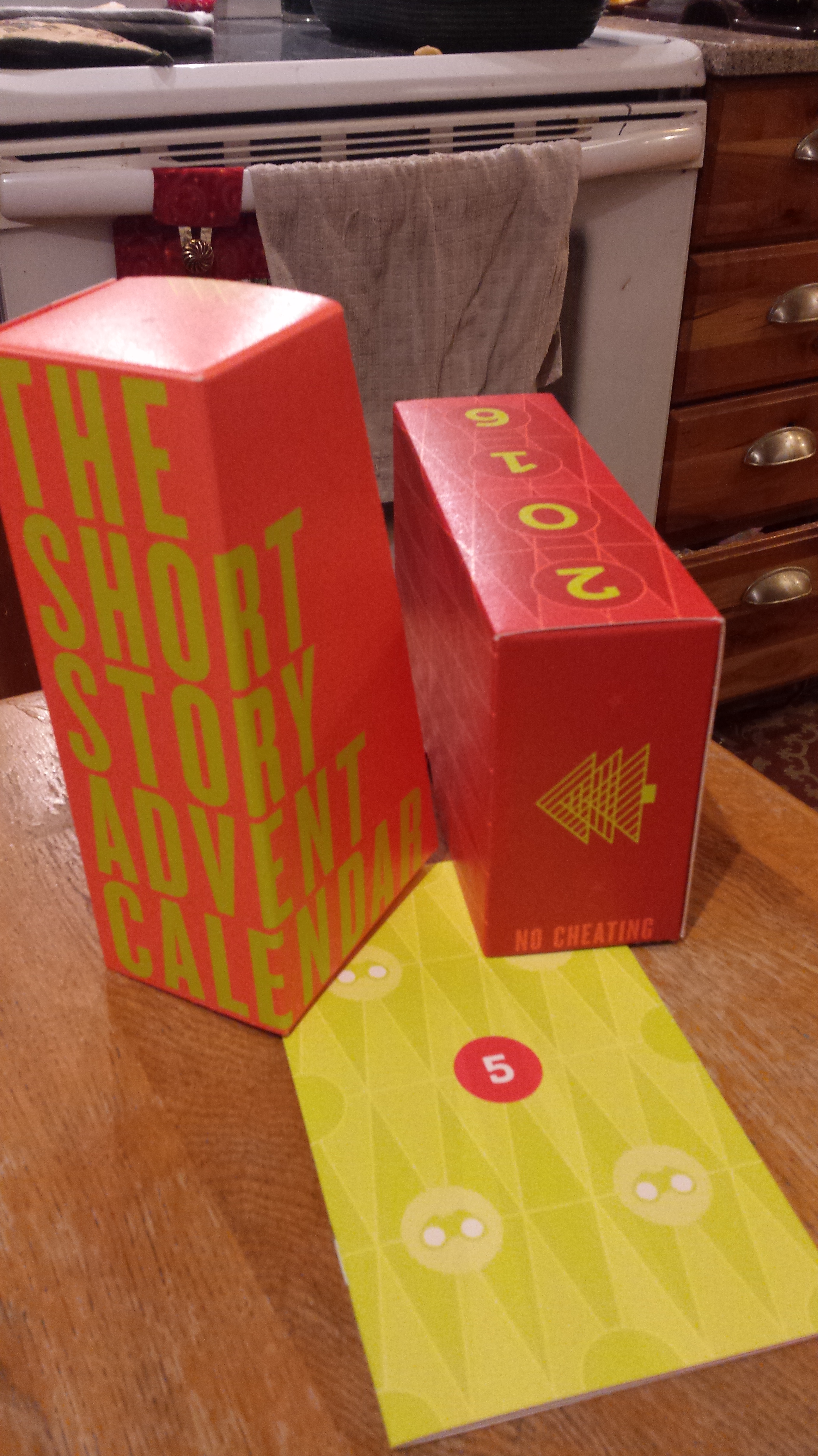
Near the end of November, I found out about The Short Story Advent Calendar.  Which is what exactly?  Well…

The Short Story Advent Calendar returns, not a moment too soon, to spice up your holidays with another collection of 24 stories that readers open one by one on the mornings leading up to Christmas.  This year’s stories once again come from some of your favourite writers across the continent—plus a couple of new crushes you haven’t met yet. Most of the stories have never appeared in a book before. Some have never been published, period.

I already had plans for what to post about in December, but since this arrived I’ve decided to post about every story on each day.

I have read this story before (and I’m pretty sure one of the Sherlock shows did an episode of this story).  It’s probably one of my favorite Holmes stories.

But first thing’s first: For this story, carbuncle is not the first definition: an abscess; but the second: a bright red gem (except this one is blue). (more…)

Read Full Post »

princessSOUNDTRACK: DAWN OF MIDI-Dysnomia (2013).

domI heard about this disc while listening to The Organist podcast. (Episode 6)  I didn’t know anything about Dawn of Midi, but I understand they were/are a kind of improvisational jazz band (piano, contrabass and drums).  But don’t stop reading yet.  Dysnomia (between this and Method of the W.O.R.M.’s Cicatrix, I am certainly learning a lot of new words) is certainly jazzy.  But it doesn’t feel like jazz exactly.  In fact, I would never have guessed that they were playing real instruments.

The album is 47 minutes with 9 songs.  They are all instrumental and more or less flow into each other.  And as I say, I never would have imagined that it was just three instruments playing the music.  Not because it sounds weird–there’s nothing particularly unusual sounding about the record.  But because it is so precise.

And indeed, the piano doesn’t really sound like a piano (it’s a little muted), but the other two instruments are quite clearly drum and bass.  And yet it’s the rhythms and textures of the songs that are so unusual.  The songs are minimal, true, but they are complex in that minimalism.  So while there’s repeated piano notes, there’s complex drum patterns.  And the songs morph and change over the course of the record.  And not just from track to track but within a song as well.

Without going into great musical detail, there’s not a lot to say about the individual tracks.  As I say, it’s a lot of repetition, but there’s enough morphing that it never gets boring.  Maybe the piano is the emphasis for these few minutes, then a snare drum takes over.  Or the beat shifts or speeds up.  It’s really cool.  And it’s really hard to believe that these three guys are playing this live and not with machines.

I really can’t say enough about this record.  I didn’t expect to like it as much as I do, but I find that I can’t stop listening to it.

Check it out at their bandcamp site.

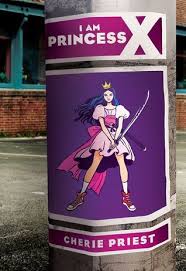
[READ: July 17, 2015] I am Princess X

Sarah brought this home from the library and said that I would like it and, as usual, she was right.

The story is about May and Libby, two young girls (fifth grade?) who are thrown together (they don’t know each other but are both skipping gym class) and form a cool bond.  Libby is a great artist, and while they are sitting in the Kindergarten playground, the little kids come over and ask her to draw things.  Soon enough, Libby draws a princess (I like that it was suggested by a boy).  She’s wearing red high tops, a crown and cape and has a cool katana sword (I must say this has to be the smoothest playground ever if she could get that much detail out of playground chalk).

The girls name her Princess X and since May can’t draw, she comes up with stories about her.  And soon enough, Libby and May have binders full of the Princess’ adventures.

As with a lot of YA books, there’s a horrific tragedy that follows.  Libby and her mom are in a car and her mom drives them off a bridge where she and Libby die.  (I know!).  May always thought there was something suspicious about the whole thing–Libby had a closed casket–but since May was a little girl no one paid her any mind.  Libby’s dad fled Seattle and that was the end of contact for May.

Meanwhile, May’s parents divorced and may moved back to the South (people in Seattle tease her about her accent).  But she does get to come up to Seattle to visit her dad from time to time.

And this time, when she’s walking around old haunts, she sees a sticker on a window.  It is Princess X and it even says “I am Princess X”  What the heck?  Well, when Libby’s dad sold the house, all of their Princess X stuff was given to goodwill.  So it must be someone who found it and stole their ideas.  But what if it’s something else? (more…)

Read Full Post »

« Newer Posts - Older Posts »