Feeds:
Posts
Comments

Archive for the ‘Voivod’ Category

werwolvsSOUNDTRACK: VOIVOD-Nothingface (1989).

nothingI have talked about Nothingface before, but here it is in sequence with the Voivod catalog.

This is the culmination of Voivod’s move toward progressive metal. Even nearly 25 years after its release, this remains one of my favorite albums ever.  The guitar chords are complex and wonderful.  Snakes’ voice is melodic with odd tinges of weirdness thrown in—where he goes up or down a note unexpectedly.  Plus, he has that peculiar pronunciation/emphasis that makes the words sound even more exotic (like “repugnant”).  And despite the fact that they cover Pink Floyd (!), the album is still heavy.

The whole band is in top form here—Away’s drumming is explosive and complex, Blacky has a fantastic rumbling sound that’s not distorted but really fills in the bottom end and Piggy’s guitar is masterful.  “The Unknown Knows” has some cool staggered notes and a great catchy guitar riff during the verses but the time changes come fast and furious.  I love the way the guitar and bass play off each other in this song.  But then comes the cover of “Astronomy Domine”.  Imagine the band from War and Pain who used to cover Slayer and Venom now covering Pink Floyd.  It’s hard to fathom, but man, do they pull it off wonderfully—adding a heavy bass element but keeping it very faithful.  And Away’s drumming is stellar.  It’s a marvelous cover.

“Missing Sequences” starts with a cool bass line and Snake’s great pause… “NOW!” Then when he starts singing again, his voice is phased in a very cool sci-fi kind of way.  There’s also some interesting effects—keyboards maybe–in many of the songs.  There’s also a great part where there’s a rumbling bass and Snake’s scream of “GO!” before a weird guitar solo and then even weirder shifted guitar chords.  It’s magnificent.

As is the guitar playing in the verses for “X-Ray.”  I’m not even sure how Piggy came up with the bizarre chords in “Pre-Ignition.”  And yet despite the harshness, there’s pretty melodies like in the cool catchy “ground and rock and sand” section of the song.  And as for pretty, the quiet beauty that opens “Into My Hypercube” is really impressive for such a dissonant album—Snake whispers his vocals and the guitars are all pretty, major chords.  Until the bridge where dissonance enters and then the post bridge (who even knows what to call these song parts) which is once again a heavy round of dissonant chords.  And then when the “tumult in the dark” section starts, it’s practically a whole new song—until Blacky’s bass section reintroduces the beginning motif.

The final track has a wonderful moment where Snake’s voice follows Piggy’ unusual guitar line perfectly.  And then the very cool almost funky (great bass sound) of Blacky after the “too late for S.O.S.” line.  The album ends abruptly (too late for S.O.S.) and you’re left contemplating everything that just happened (I haven’t even mentioned the lyrics).

It’s a prog metal masterpiece.

[READ: August 26, 2013] Werewolves of Montpellier

I enjoyed Jason’s Lost Cat so much that I went to the library and checked out some other books by him as well.

Werewolves has the same looking characters as in Lost Cat, but they are different people (I assume).  The strange thing about this book is that the werewolves don’t look all that different from the main drawings.  At first I wasn’t even sure that he was wearing the werewolf mask.  But on closer inspection there are subtle differences (the eyes, the ears, the fingers).  Indeed, it took two reads for me to really notice all the subtle details.  Nevertheless, it’s just funny to imagine the characters thinking he was a werewolf when he looks for the most part the same anyway.

But so this story starts with the main character, Sven, dressed like a werwolf and breaking into someone’s house.  When the victim comes home, she catches him, but is frightened and he flees out the window.  In the next scene his next door neighbor, Audrey, (not his girlfriend, as she is dating a woman named Julie) brings him some food and tells him that he was in the paper (unidentified but in costume).

Then we see the main character and a bird looking guy playing chess in the park (and talking about the value of escalators for checking out women’s asses).  The main characters seems to be primarily dog-like and bird-like, but they intermingle freely.

The final new characters are two men talking about the photo.  They say that the werewolf in the photo is not part of their brotherhood and they want to punish this newcomer for causing them trouble. (more…)

Read Full Post »

esqSOUNDTARCK: VOIVOD-Dimesnion Hatröss (1988).

hatrossDimension Hatröss takes the advances from Killing Technology and moves them even further into craftsmanship and prog excellence.  In the Killing Technology band photo and in this one, Blacky had shaved part of his head—which was pretty outrageous for a metal band in the late 80s.  It’s just a small visual showing how the band was different from other metal bands.

It also opens with some interesting sounds—a swirling noise that coalesces into a fantastic solid heavy riff—a confident metal riff that is more sophisticated than most of their output already.  And then a cool noisy chord from Piggy lets you know that this album is going to be…different.  And so it is, a wonderful mix of metal and prog rock chords (and long songs)  all used as the background of a sci-fi story of The Voivod.  The dissonance is amazing on the album—Piggy is playing chords that seem like they shouldn’t come from a guitar.

“Tribal Convictions” is a little less harsh than “Experiment” and you can really hear Snake has been honing his singing skills.  There’s even multiple tracks of vocals (including a deep voice singing along on this track).  And there are so many different sections—and the first that stands out on the album is Piggy’s echoed guitars just before the “who’s the God” section.  Or the repeated chords that open the fantastic “Chaosmongers”—sounding for all the world like electronic malfunction.  And yet for all of the experimentation, the songs are still heavy—the chorus of this song is very fast and full of Away’s noisy splash cymbal.  My favorite parts comes at around 2:15 where Piggy plays these great fast chords and Blacky plays a very cool accompanying bass line.  Indeed, Blacky’s bass sounds great on this record.  And when that riff repeats later in the song, it’s followed by a great concluding section.

“Technocratic Manipulators” is a fast heavy song—a very traditional sounding metal song until the “that’s not for me” comes in with a  huge time change that last… for one measure.  I love how the song ends with a repeated section of “I’d rather be…” until the final line, “I’d rather…think.”

Then comes one of my favorite Voivod songs with the awesome title “Macrosolutions to Megaproblems.”  It opens with some increasingly dissonant chords, but also features some loud chanted singalong sections followed by a ringing guitar solo that sounds like a siren.  All within a few seconds of each other.  It also has the thoughtful bridge, “You better shake up your mind, coz if you’re just staying blind, integrity you won’t find.” And another super cool dissonant chord sequence on the high notes of the guitar—I don’t know how Piggy thought of these sequences.  Just to top it off, the ending sequence is a series of descending chords, each one odder than the last.

“Brain Scan” has a cool riff at the end of each verse that is actually surprisingly major chord bright—amidst the chaos of the rest of the song (more great bass from Blacky and some crazy sounds of a brain scan—Snake’s voice processed?).  “Psychic Vacuum” is one of the songs where I have to wonder how they can switch to different sections so fast.  “Cosmic Drama” opens with a distant echoic riff and then nothing but heaviness.  And yet it keeps up that sci-fi experimental feel.  This is one of the great heavy metal records of the 80s.  technically brilliant playing, odd time signatures and yet still some really catchy music.

The CD has an addition of the Batman theme song.  It’s a very odd addition and has no place on the record, but I’ve always liked it because it is so weird. (It’s also only 1:45).

[READ: August 29, 2013] “Nirvana”

I was apprehensive about reading this story because I tend to dislike Esquire fiction. But Adam Johnson won the Pulitzer Prize for fiction for The Orphan Master’s Son (which I haven’t even heard of), so I figured this must be better than the male bonding stories that usually appear in Esquire.

And so it was.

This also happens to be the second stories about a virtual reality President that I’ve read in a few days.  How about that.

So this story is set in some kind of future.  And in this future the President has been assassinated (and has been dead for three months).  The story seems like it is set in the near future (so I kept imagining Obama as the dead President and I wonder if others do too).  But something is odd, because the protagonist has been whispering to the President (and evidently the President is talking back to him).  However, what’s more significant to the narrator is his wife. (more…)

Read Full Post »

grantldnSOUNDTRACK: VOIVOD-Killing Technology (1987).

killingAs I said, this album’s art looks much better.  And you can hear from the first notes that this album is better produced and is going to be a lot more interesting than the previous two.  It’s hard to know just how much of a leap this is from Rrröööaaarrr because that album was so muddy–maybe there were gems of guitar chords under all that noise.  Like the previous openings, there’s a sort of prologue to the album.  But unlike the previous album’s swirls, this one is beeping with a computer voice announcing “we are connected”

The opening chords are heavy, but man they sound clear—like they weren’t recorded underground.  You can also hear all of Piggy’s weird higher notes—he’s playing complicated chords, not just solo notes.  And when the chorus of “Killing Technology” rolls around, it offers stop and start rhythms and Snake’s voice even goes up an octave at the end.  But the first real indication that Piggy is on to something new comes in the bridge. Underneath the robotic voice, Piggy is playing some really strange-sounding chords.  The story is that he had been admiring Robert Fripp’s guitar work and so he added some of those King Crimson-y angular weird chords to his repertoire.  And he melds them perfectly with the heavy thrash that the band had been playing.

Lyrically also, this album has moved away from killing and headaches.  “Killing Technology” while having “killing” in the title is a very different subject:

The star wars have started up
The new invention is coming out
Making a spider web over the atmosphere
To make them sure that we can’t get out of here

Computers controlling your functions
Seems like we got electronic alienation
Trading children for a new kind of robot
Waiting for the old people to disappear

Quite a departure from Rrröööaaarr’s “Fuck Off and Die”

Stand up, right now, kill

No pleasure, the pain comes down here
No return, don’t look back, there’s no tomorrow
And if you’re a fucker and don’t believe it
I’d say fuck off and die, fuck off and die

“Overreaction” leans more towards the heavier side—Snake screams a bit more—but the subject (nuclear disaster) is thoughtful.  Then comes their first truly amazing song: “Tornado.”  Not only building like a tornado, this song allows them to talk about violent imagery without resorting to bloodshed. It’s even scientific:

Cumulonimbus storms arrive
Lightning flashes a hundred miles around
Electrical collision course
Creates the elephant trunk

But the best part is the chorus—it’s simple enough (just the word Tornado repeated) but it’s completely catchy and sing-alongable with bright major key chords.

“Forgotten in Space” features some great drumming from Away—he’s really quite underrated both in speed and technique—which explands even more on later albums.  “Ravenous Medicine” is another highlight—an interesting series of uncomfortable chords opens this track about scientific research.  It’s a pretty fast, heavy song.  Although not too complicated except for the occasional breaks as the story progresses.

“Order of the Blackguards” is another fast song, but this one has so many parts that if you don’t like one, just wait a few seconds for the next one.  “This is Not an Exercise” ends the disc proper.  The middle section has a great heavy riff.  But it’s the beginning of the ending sequence which is so perfectly sci-fi that really sets the tone of the album and looks towards the next one.  It’s cool to think of Piggy playing these spacey chords on his guitar.  And when Blacky’s bass rumbles in to resume the song, it’s quintessential Voivod.

By th way, this disc is a concept album as well.  There’s a “Killing Side” (the first three songs) and a “Ravenous Side.”  The strange thing about the CD though is that they have added two tracks from their Cockroaches EP which is nicockroachesce.  But they put one song at track 4 (the end of side one).  How odd to put a bonus track in the middle of a sequenced album.

The EP came out before the album and it has a slightly different feel from the album proper.  Although as a step towards Killing Technology it’s perfectly in sync.  “Too Scared to Scream” is heavy and has some interesting time changes—I love the way the song feels like it is crashing to a halt around 3:30.   “Cockroaches” feels like more traditional metal.  It opens with drums and Piggy playing a typical sounding metal solo.  Then the riffing starts and it’s very heavy indeed. Even the staggered section near the end sounds like a mosh section more than the prog time changes that Voivod uses on the album proper.  The song ends with Snake screaming as the cockroaches are coming.  A good ending to the EP and a pretty good ending to the disc.

The whole album has a very mechanical and robotic feel—the chords that Piggy plays just sound like mechanical failure, it’s very well constructed and foreshadows the music of their future.

[READ: July 9, 2013] Grantland #6

Grantland #6 covers from Sept 2012-Dec 2012.  Despite the short time frame, this is the largest issue yet.  And it maintains all the quality that I’ve come to expect from the book/magazine thing.  Which means, I love the writing (especially about people/sports I’m not that interested in).  And it also means that the editing is typically crap.  In this issue the editing was crap more because they simply forgot to remove mention of hyperlinks.  At least I assume that’s why sentences like “See here for ____” are included in any given article.  But yes, there are some very simple typos that Word would correct pretty easily.

But beyond that, I really enjoyed this issue.  And I’m finding it amusing how much certain people and shows crop up in a given time frame.  So this is a four month period and Kobe Bryant still dominates (there will never be an issue without at least one Kobe article).  But this time Homeland is the big show (since Breaking Bad has been on hiatus I gather).  Basketball remains the favorite sport here (even though they speak of football as being the most popular sport).

Chuck Klosertman and Charlie Pierce continue to write thoughtful (sometimes funny) articles.  And I like how there is still talk of Jeremy Lin even if Linsanity has gone away somewhat. (more…)

Read Full Post »

conchitaSOUNDTRACK: VOIVOD: Rrröööaaarrr (1986).

roarI have always loved this album because of its name (preposterous and complete with umlauts).  It also has the classic Voivod song “Fuck Off and Die.”  Interestingly, a band that Voivod liked, Venom, released a song “F.O.A.D.” the previous year.

But man, is this album hard to listen to.  The production seems even worse than on their debut.  And the songs seem faster and a bit harder to understand.  Perhaps it was my mood when I re-listened, but songs like “Ripping Headaches” seemed more portentous than fun.  And “Slaughter in the Grave” is just light years behind the kind of songs they would write as soon as the next album.

I like to think of these first two Voivod albums as part of a pair.  The cover art is kind of similar.  But starting with the next album, the cover art would jump ahead in detail and quality.  All of Voivod’s art (and apparently the entire concept of The Voivod (you’ll have to look that up) was by Away.  He has released a coffee table book (which you can’t get anymore) but a lot of his art is online at his website.

Not many people think too highly of Rrröööaaarrr, and it is safe to say that compared to their next several albums, this one might be best ignored.

[READ: August 29, 2013] Hi, This is Conchita

This is another book that crossed my desk.  I recognized…the translator of all people (Hi, Edith Grossman) but not the author.  I couldn’t remember why I recognized her name and then I realized she had translated Don Quixote, which is supposed to be an excellent version.

I also liked the cover and the packaging of the book (sometimes that’s all it takes) and since I left the book I was reading back at home, I brought this with me to lunch.

Imagine my surprise when the first story opens with a man calling a phone sex line (in graphic detail).  I flipped through the story (which I thought was a bunch of short stories) but is actually a very long story called “Hi, this is Conchita.”  In this story, each “chapter” is a phone call and each chapter title is the phone number and time of the call. (more…)

Read Full Post »

lostcatwarandSOUNDTRACK: VOIVOD-War and Pain (bonus stuff) (2004).

The War and Pain reissue was packed with goodies for Voivod fans.

You get “Anachronism” which is 3 songs from their very first live show in June 1983.  (“Condemned to the Gallows,” “Blower,” “Voivod”). They had (it sounds like) a surprisingly large audience for the show.  You also get “To The Death” which is 3 songs from the Metal Massacre V sessions (“Condemned to the Gallows,” “Voivod,” “Iron Gang”) of which “Condemned to the Gallows” was used on that compilation.  I think this is one of their better early songs, and it’s a shame it never got a proper release (although it’s all over this package).

If the sound quality on their proper album was bad, you can imagine how bad this sounds.  Their first show may have been recorded on a microcassette it is so low-fidelity.  And somehow the Metal Massacre tracks sound like they were left in a puddle of mud since 1984.  I have the Metal Massacre albums and I don’t think they sounded that bad.

That leaves Disc 2: “Morgoth Invasion.”  This is a live show from December 1984.  It has 16 songs (surprisingly no “Voivod” and two covers:  Venom’s “Witching Hour” and Slayer’s “Chemical Warfare”).  Like the previous live tracks, this one sounds pretty dreadful–but not quite as bad.  It is fun for the historic value–hearing the band play fast and tight hearing Snake’s guttural French (he did most of the between song banter in French).  Also hearing how well they play the covers shows how seriously they took their metal.

The third disc is a CD-ROM.  You get lyrics to the album, biographies of the band and comments on the 20th anniversary release.  There’s also band photos and art by Away.  There’s even the old  video for “Voivod.”

But for fans the most exciting part is the “Sounds” section.  In addition to including all of the above audio (in case you wanted it all on CD-ROM?), there’s also seven songs from a 1984 concert.  I am fairly certain that these tracks would eventually be released on the To the Death 84 album (it’s the same order and I don’t have that record).  Again, the sound quality is not great, but it’s interesting to hear these songs played live–to hear just how fast these guys can play.

So the anniversary package is worth investing in if you like your Voivod.  If not, wait a couple more albums when they become amazing.

[READ: August 26, 2013] Lost Cat

I had not heard of Jason before this book passed across my desk.  Jason is a Norwegian graphic artist and comic book maker whose real name is John Arne Sæterøy.  Many of his books have been published in English by Fantagraphics.  This one was translated (from the Norwegian I assume, although Jason now lives in France, so maybe it was written in French) by Kim Thompson.  The interesting thing about the translation is that I didn’t realize it was one at first…I just thought the characters were deliberately speaking in a weird sort of way.  I wonder if this is intentional on the translator’s part.

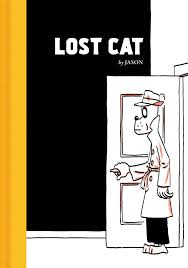
The striking thing about Jason’s art is that his characters do not have eyeballs (as you can see from the cover art).  This seems to convey an overall sadness to the characters.  And yet he is also incredible at creating mood and tone from these animal people (even without eyeballs!).

This story has a few threads that tie it together.  As the story opens we meet Dan Delon, a private detective.  As he walks home for the night he sees a lost cat sign.  A few panels later he see the cat.  He calls the number and returns the lost kitty.  The kitty’s owner, Charlotte, is very nice.  She invites him in and gives him a drink.  She owns a local bookstore which he was recently in (although they did not meet).  They seem to have a lot in common.  Charlotte is fascinated that he’s a private detective.  But he quickly dismisses the excitement saying that it is mostly just taking pictures of people having affairs–and then upsetting both parties when all is said and done.  He seems to realize the loneliness of his life as he says this (again, conveyed wonderfully with the art). (more…)

Read Full Post »

laraSOUNDTRACK: VOIVOD-War and Pain (1984).

warandIt was easy to know that Voivod were going to be an unusual band.  Their name is crazy.  All the members had nicknames like Piggy, Blacky, Snake, and, confusingly, Away.  And they were French Canadian, which meant that their singer’s first language wasn’t English–I love the way he stresses things in his vocals especially on later albums, and he had the guttural French that sounds like a cookie monster vocalist even when he is just speaking.

Later on, their prog and psychedelic leanings would come out more, but on their debut, they were just a noisy, screamy pounding metal band.  And this debut has typically bad mid 80s metal production to top it off.

In 2004 the album was remastered with bonus tracks, a full live concert and a CD ROM with all kinds of goodies.  I originally thought the remaster didn’t sound that good, but there is definitely some clarity that the remaster brings.  It allows you to hear a lot of the subtleties (and there are some) that were lost in the original.

There are hints at the kind of weird sounding noises the band would make on future albums, but this is mostly just fast, pounding music.  I’d have liked them to re-record this stuff before Piggy died, just to see what a proper recording studio could do with these earlier songs.

Of course, now that I have listenedto it again with better equipment, I’m changing my assessment somewhat.  Despite the very heavy nature of the songs there are some very cool sequences in here.  They are nothing compared to the complexities that the band would undertake in just a few short years, but there are some really interesting things underway and the remaster definitely highlights them a little better. It still sounds pretty bad 9especially compared to their later records), but hey, they only spent $2,000 and recorded it in a studio where the engineer had never heard a metal band before.

[READ: August 23, 2013] Lara’s Book

I have known of this book since it came out in 1998.  I was a huge fan of Douglas Coupland and yet I had zero interest in Lara Croft or Tomb Raider. So I simply ignored this book.  But because I’m being all completist with this blog, it was time to bite the bullet and see what this piece of nonsense was all about.

And it is just as weird and creepy as I feared.

There are several sections to the book, most of which are written by Coupland.  I will admit right up front that I did not read the strategies and secrets from Kip Ward–sorry Kip, it seemed like fun but between the crazy fonts and layout and the fact that I will never play the game it just seemed like too much. (more…)

Read Full Post »

SOUNDTRACK: R.E.M. “Superman” (1986).

Even though R.E.M. is all about Michael Stipe, “Superman” is one of my favorite R.E.M. songs.  I know it’s a cover, and I know the lyrics are kind of dumb, but there’s something about Mills’ singing voice that I love (I often think his backing vocals are the strongest parts of R.E.M. songs).

Stipe didn’t like the song and refused to sing lead.  This gave Mills his debut lead vocal appearance.  You can hear Stipe in the background–he sounds great, too.  A total throwaway song that is awesome.

By the way, the original by The Clique, which I never listened to before, is very strangely clipped in the vocals.  I was sure that the band was not American by the vocal delivery, but apparently they’re from Austin.  Huh.

I know I should have picked Voivod’s cover of “Batman” for this post, but how creepy is that R.E.M. cover?

[READ: July 21, 2012] “The Only Human Superhero”

I have it in my head that I might one day read all of Jonathan Lethem’s works.  Although I’m not all that sure I like him that much. (There’s so many Jonathan’s writing, I can’t keep track of who I like).  He has 18 entries on this blog (although I see that none are for his novels).  Nevertheless, I  must like him pretty well.

Anyhow, this article is a one page thing about Batman The Dark Knight.  This was written before the terrible, horrible, unimaginable tragedy in Colorado, so there is no insensitivity about it. (more…)

Read Full Post »

ij7SOUNDTRACK: VOIVOD-Nothingface (1989).

nothingfaceIn light of Marathe and the Antitois, and Quebec separatists everywhere, I figured I’d mention my favorite CD by a rocking Quebecker band.  When Voivod started they were a rumbling thrash band.  They put out an album with the wonderful title of RRRÖÖÖAAARRR.  They were very fast, very loud, and their singer had a really peculiar delivery style.  I later learned that this was because he’s a Quebecker and French is his first language.  Since he sings in English, his stresses and emphases are off-kilter, (and the guitarist seems to play to this particular feature, so the music is off-kilter as well) making for a very surreal experience.

They were probably my first inroduction to really cool French names.  Because even though they had stage names (Piggy, Blacky, Snake, and my personal favorite: Away) their real names were foreign and cool like Denis D’Amour and Jean-Yves Theriault.

Nothingface is the pinnacle of their prog-creative energies.  It is a fantastic progressive-rock/heavy metal hybrid.  There are fascinating time-changes, with cool atmospheric aspects that counterpoint the heavy sections.  And the overall theme of the album is technology gone awry.

On their previous records, melody was not really evident.  And it’ hard to believe that a disc that is so full of time changes could still be melodious.  Yet the bridge of “Nothingface” is quite pretty, which, again, counterbalances the weird chord structures of the solo section.  There’s even an awesome cover of Pink Floyd’s “Astronomy Domine” that adds some cool metal guitars to an already trippy song  The Floyd version is spacey and psychedelic.  Voivod add an element of menace to the song.  Very cool.

And then there’s a song like “Missing Sequences” which has 4 different sections in the span of less than two minutes.  An opening that is slow and spacey, interrupted by a loud “Now!” which brings to a weirdly chorused verse that morphs into a rough staccato bridge followed by a speedy guitar break and then yet another verse style.  By the time we hit the 2:30 mark, the song breaks down into a bass-only sequence.  And then it mostly repeats itself. That is, until the ending minute which is something new entirely.  It sounds impossible on paper and yet it is done seamlessly and is one of my favorite tracks on the disc.

There’s also the weirdly propelling and compelling “ground and rock and sand come crumble tumble down” sequence of “Pre-Ignition” that throws a cool catchy riff in the midst of a fast charging song.  And “Into My Hypercube” has some fantastic riffs, including another really cool bass-only section.

And the whole album works great with headphones.

In the 1990s, metal bands experimented with lots of different genres and effects, but it was this 1989 release that really highlighted what kind of fantastic music you could make within the strictures of heavy metal.  Voivod makes some pretty unusual sounds with their instruments (guitar most of all), and the album can be a challenge, especially if you like you music light and easy), but for me, this is one of the best discs around.

[READ: Week of August 2] Infinite Jest (to page 508)

50% through.
Halfway House, er, I mean Half Way Home.
Thoughts:

The rewards are coming quickly now.  There seems to be a payoff every few pages.  I am totally loving this book and the environment it has created.

Since the Boston Marathon is mentioned in the book, I’ll say that we are currently at the 14 or so mile point (downtown Wellesley).  Congratulations, you have just made it through “Screech Tunnel.”  [See the Boston Marathon route here.]

ij

I’ve been going on and on about chronological years and when exactly Subsidized years started.  I even quoted other people who had calculated the actual year that Subsidized time was set up.

And, of course, all this time, all we had to do was to look at the NAME of the Year of Yushityu 2007 Mimetic-Resolution-Cartridge….  As this clever thread shows, others figured out pretty early in the reading that the 2007 in the year was a pretty big clue as to what year Subsidized Time began.

(Presumably non O.N.A.N. countries do not follow Subsidized Time?  And the, again, presumably Japanese made Yushitsu is on numerical-year-time.  Or is that a thread that has already been discussed already?).

I am pretty embarrassed to have realized this at this late a date, and I’m delighted that everyone let me figure it out for myself (and that no one was cruel enough to rub it in.)

Now if you wanted to argue against the Yushityu 2007 as a dead giveaway to the year, you could say that, for instance, Microsoft Products don’t always indicate the year that they came out.  But for confirmation of Yushityu, we can use a perpetual calendar.

We learned that November 7th is the the day of the exam that Schacht is taking.  This is a Saturday class.  The perpetual calendar show that Nov 7th falls on a  Saturday in 2009.  Therefore YDAU=2007.   I’ve been trying to use all this logic to puzzle this information out, and here the author basically just TELLS us it from–well, not the get go exactly–but from a pretty early point.

All of this self-flagellation is also because of my own lack of clock-watching in the book.  I have somewhat obtusely not been following the chronological dates very carefully.  It was only when I consciously realized that Marathe and Steeply are having their mountainside chat in April/May of the YDAU when all of the events at E.T.A. and Ennet House are taking place in November that it dawned on me that the time line was not only present, it was pretty important.

So, I spent some time crafting a general timeline of events–something I haven’t seen anywhere else, (but then I haven’t actively been looking for it because I don’t want to get Spoiled).   So at the end of this post I’m going to put my timeline of events thus far. I’ll see how important it is to update it in future posts.

But now on to the book:

This week’s reading jumped back and forth between topics a bit more frequently. (more…)

Read Full Post »

« Newer Posts