Feeds:
Posts
Comments

Archive for the ‘The Doors’ Category

booger1SOUNDTRACK: “WEIRD AL” YANKOVIC in 3-D (1984).

in3dAfter Al’s debut he came roaring back the next year with In 3-D a disc which opens with his first Michael Jackson parody “Eat It.”  The song was leaps and bounds above anything on the debut (even if there are still hand farts in it).  The song actually sounds like the original (if a little less “full” and a little goofier and on the whoo hoos).  But the solo by Rick Derringer rocks and the whole song works very well.  The rest of the album is a solid mix of originals and parodies

I didn’t really understand that “Midnight Star” was meant to parody the Weekly World News and such (I didn’t really know those papers at the time) but I thought the headlines were funny.  And yes its a lot of fun to sing a long to.  It’s always funny when Al parodies a song that is already rather stupid (My Sharona, or in this case Safety Dance), and “The Brady Bunch” opens with a general overview of stupid TV shows and then morphs into the The Bunch’s theme song to the music of “Safety Dance.”  “Gonna Buy Me  A Condo” is a reggae song which I never really got the joke of as a kid.  I mean, I knew it was reggae but I didn’t know enough about reggae to know that this song is kinda funny, about selling out for the mainstream life.  It’s not genius or anything but it’s kinda funny–in fact I think it’s funnier now than I ever did as a kid.

“Jeopardy” works perfectly as a parody.  It retains all of the weird sounds and “drama” of the original and yet it works entirely unto itself.  It’s definitely an early highlight.  This disc also introduces what would be come a staple on all his later albums:  “Polkas on 45” where he mashes together a string of songs into a polka beat.  They are always fun and clever.  This one is a mix of new wave and classic rock bands Devo, Deep Purple,  Berlin, The Beatles,  The Doors,  Iron Butterfly, Jimi Hendrix, Talking Heads, Foreigner, The Police,  The Clash,  The Rolling Stones,  and The Who.

“Mr Popeil” is another one that I didn’t full get until later (why did i like Al if I didn’t get any of the jokes?).  Ron Popeil is the king of the As Seen on TV  product (as listed in the song).  The thing that I really didn’t get was that this is was a parody of the B-52s–one of the first parodies he’d done that’s a parody of band but not really a song.  This is not a parody of Rock Lobster exactly, but it sounds quite a lot like it–and that’s a neat trick.

“King of Suede” is a parody of The Police–I never really liked it even though it does work as a parody–perhaps the original isn’t a very string song.    “That Boy Could Dance” is instantly forgettable, so much so that I had forgotten all about it.  “Theme from Rocky XIII” is a pretty funny parody of “The Eye of the Tiger.”  But it doesn’t prepare you for the genius that is “Nature Trail to Hell.”  An epic song about horror movies with the great line “if you lie the 6 o clock news you’ll love Nature Trail to Hell (in 3D).”  It’s over the top and very silly–the music escalates  with screams and strings and several different sections (although the solo section is a little anemic).  I can’t imagine what he would do with it today if he rerecorded it.

So In 3-D was a big jump in quality for “Weird Al” and was actually a pretty big hit (charting at #17).

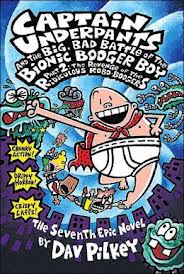
[READ: February 22, 2013] Captain Underpants and the Big Bad Battle of the Bionic Booger Boy Part 2

Since it is 2013 and not 2003, I don’t have to wait several months for Part 2.  Huzzah!

The opening comic in this book not only gives all of the Captain Underpants background that it usually does, it also includes what happened in Part 1.  At the end of the book, the robotic booger monsters (Carl, Trixie and Frankenbooger) were on the attack.  They destroyed the Combine-O-Tron 2000 so it would not reverse the effects of the machine on Captain and Melvin.  But Sulu the hamster rescued them by hurling the boogers into space (with his mouth, ew).

The boys want to get things back to normal.  But Professor Krupp (who is in Melvin’s body) is going about his business getting everyone in trouble.  Except that since he looks like Melvin people are getting angry at him rather than listening to him.  This book features a wonderful letter swap from “Check out our school’s big internet website at http://www.jhes.com” to “We shake our big butts when we swim in the toilet.”

The boys give up on trying to fix the Combine-O-Tron and decide to use the Purple Potty Time Machine that is in the library and go back in time.  There’s a great sequence in which the librarian has banned every book but one and I love the posters that are up encouraging the banning of books–it’s another awesome dig at those who censor.  And the librarian is named Miss Singerbrains. (more…)

Read Full Post »

SOUNDTRACK: JIMMY FALLON (as THE DOORS)-“Reading Rainbow” (June 2011).

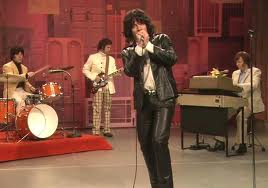
I heard this song on WXPN and it cracked me up–I believe they played it because the Reading Rainbow iPad app just launched.  But I had no idea who was doing it.  It was a spectacular Jim Morrison impression.  The Doors are iconic enough that it’s pretty easy to do Jim Morrison, but Fallon is so right on–phrasing and movements–that it’s really amazing.  And they went all out for the video (if I thought the song was good, the video is amazing): the band, the sound, the clothes, the filming–it’s all perfect.  And the craziest thing is that the nonsense in the middle–when Jimmy is reciting kids books (the Goodnight Moon section is especially cool) sounds just like some poetry that Morrison would have said.

It’s outstanding.

http://www.nbc.com/assets/video/widget/widget.html?vid=1368107

Makes me smile every time.  I’m only bummed I can’t embed it.

[READ: February-March, 2012] The Secrets of Droon: Books 22-25 & SE#3

I’ve really enjoyed Droon so far.  The stories have been interesting and fun, and they have allowed the three kids to meet interesting characters and to face some dangers.  But it is with this group of books that the series gets really intense and I’m looking forward to reading them as much as Clark is to hearing them!

It’s also growing harder and harder to avoid spoilers because the spoilers are what are so exciting about the books.  Indeed, the backs of the books even give stuff away about the previous book.  So, yes, there may be a spoiler or two in here, but it’s hard not to talk about the cool things that happen. (more…)

Read Full Post »

SOUNDTRACK: SLOAN-The Double Cross (2011).

Sloan never fail to make enjoyable punky pop songs.  Surely it has something to do with having four songwriters in the band (which must minimize clunkers).  I can never decide who my favorite songwriter of the group is as they all do fairly varied work.

“Follow the Leader” is a fast rocker (with a very cool guitar solo bit and a nice acoustic break in the middle).  While “The Answer Was You” is a bouncy piano-based song that starts out fast and then settles into one of the more recognizable Sloan voices (I wish I knew who was who–even after twenty years I have never quite determined who was singing what).  This song also has a great third part, minor keys and very dramatic structure.  It’s the first of several songs that hover around the 2 minute mark, as well.

“Unkind” is a simple guitar based song and man is it catchy, with a chorus that sticks with you.  “Shadow of Love” is a great fast rocker and even at only 2 minutes long it has several great parts.  “She’s Slowing Down Again” has some great bah bahs and a strong chorus.  “Green Gardens, Cold Montreal” actually slows things down, with a gentle acoustic ballad.  But it’s followed by one of their screaming punk tracks, “It’s Plain to See,” simply put, it’s two minutes of adrenaline.

The album changes somewhat with “Your Daddy Will Do,” a catchy disco song.  Yes, disco.  How else do you explain those keyboards riffs?  And man is it catchy.  “I Gotta Know” may be the stupidest song they’ve recorded yet.  How many times is the phrase “I gotta know” repeated in 82 seconds?  Still, you can’t deny how catchy it is.  “Beverly Terrace” returns to that cool pizzicato piano that they do so well.

“Traces” is the longest song (almost 5 minutes) and is one of the longer Sloan songs in general.  It feels like  an old classic rock song for many reasons (including Doors-y keyboards), and yet it doesn’t feel retro at all.  Neat trick, that.  The disc ends with “Laying So Low,” a piano ballad with a great catchy melody.  It slows the album to a nice ending.

12 songs in 33 minutes.  Multiple genres, multiple styles, multiple singers.  All of it wonderful.  Just an other typical Sloan album. Great jobs guys, here’s to twenty more years.

One word to yeprock records, though.  If you offer “free bonus” songs for purchasing their album, I would suggest in the strongest possible terms that the four bonus songs should not be one song each from their previous records.

[READ: December 29, 2011] Chew: Volume Three

We were quite excited to get this book–we were on the Hold list forever at the library.  So I’m surprised to see it came out back in 2010!  I assumed it was much newer than that.  I guess there’s a Volume Four out already (yes it came out, and they have just published issue 22 in single issues).  Volume three covers issues 10-15.

This mini-arc, as they call it, isn’t so much of an arc as a continuation of the awesome story line.

For those in the dark, read the first two posts.  But in a nutshell, Tony Chu is a Cibopath, which means that anything he tastes he knows the entire history of, be it vegetable, meat (ew) or, since he is a cop, human (bleagh, but hey it’s a comic book, right?).  His partner, John, is part machine now, having been practically blown up and then put back together.  And, as we start Chapter One (Issue #11), Tony is out on his first date with Amelia Mintz (alright, they got together!).  Amelia Mintz is a Saboscrivner which means she can write about food so wonderfully that you can literally taste it. (more…)

Read Full Post »

SOUNDTRACK: ULVER-Themes from William Blake’s The Marriage of Heaven and Hell (1998).

Suffice it to say, if it were not for this album I wouldn’t have read this piece by Blake.  I have been aware of it through the “doors of perception” quote that created the band name The Doors, but I never had any compelling reason to read it before.

Of course when I first listened to this, I had no idea that it was literally the entire work of Blake’s piece set to music.  And I had no idea that there would be so many diverse styles of music on the album.  I’m going to focus more on the music, as I’ll address the “lyrics” later. 

The first song starts out in a kind of synthy way–maybe early Depeche Mode.  But it quickly become more sinister, with a heavy guitar section and then a spoken word over industrial keyboards like early Nine Inch Nails.   Track two, simply called “Plate 3” is a mournful guitar solo which plays behind a woman reciting plate three.  Strangely enough, this plate is split in two parts where Blake references the bible and so Ulver end the spoken part in the middle but keep the ominous music going for the final two minutes of the track.  The next track picks up with “Plate 3, Following,” a slower piece with creepy echoey male vocals that echo the female lead.

“The Voice of the Devil, Plate Four” is a very delicate guitar part.  The female voice introduces the piece and the male voice recites the statements .  It;s the most easily understood of all the tracks (the vocals are crystal clear).  When the parts are done, the song turns in to a heavy metal guitar solo over some heavy chords. It’s a really great mix.  “Plates 5-6” is also a very clearly spoken/sung track.  Over a classical guitar with occasional heavy beats, the voice narrates (with amusing mispronunciations (there are many thoroughout the piece, but hey English isn’t their first language)).

“A Memorable Fancy (Plates 6-7)” is the first of five fancies.  This one has a very electronic feel (later period Nine Inch Nails).  This one even creates its own chorus by repeating “fires of hell” where the words do not belong.  “The Proverbs of Hell” is probably the most complex and multifarious musically.  It goes through many different musical and vocals styles.  The opening is barely audible while later parts are spoken clearly.  Other lines are hidden under a fog of noise.  Musically it’s very engaging, but it’s a shame to miss out on the poetry without a lyric sheet.

“Plate 11” also opens virtually inaudibly, with a crazy echo placed on the female vocals.  Half way through the voice become clearer and the music, which was quiet and mellow, picks up, but retains the simple melody it had.  “Intro” is an instrumental, an odd thing to include if they are following the book so specifically, as there is no intro.  It is simple, repeated waves of chords which grow louder for 3:30.   It ends with some maniacal drumming .  However, it is a nice breather as we head into “A Memorable Fancy Plates 12-13,” which opens with a very slow piano.  It turns into a largely drum-based song with a clear spoken word.  Until about half way through when the voice is heavily distorted until the end.

“Plate 14” is a percussion heavy electronic track with heavily distorted vocals (this is where “the doors of perception” bit comes from).  It leads to “A Memorable Fancy (Plate 15)” which opens with more low rumblings (like “Intro” above).  When the vocals come in, after 3 minutes, they are distant and tinny, but very clear.

Disc 1 (did I mention there were two discs) ends with “Plates 16-17.”   It opens with quiet music that slowly grows louder and more electronic.  The vocals are echoed and distorted and hard to understand.  The end of the track picks up the electronic beat for about a minute.

Disc two opens with the eleven minute “A Memorable Fancy (Plates 17-20)”.  It opens with a cool beat and a dark tone with vocals that are mostly understandable.   After a couple of minutes, the song settles into a late period Depeche Mode style–distorted guitars and vocals that sounds not unlike Dave Gahan’s.  By the end, it’s a pretty standard heavy metal chugging guitar (with a simple but interesting solo).

This is followed by another “Intro,” this time a rather pleasant guitar solo over picked guitars.   “Plates 21-22” is quite enjoyable as the vocals are clear and emphatic over a standard heavy metal song.  It feels like comfort food after all of the different styles of the disc.

“A Memorable Fancy Plates 22-24” has a great weird keyboard style (kind of Marilyn Manson).  The penultimate track is another “Intro.”  This one has some swirly minor-key guitars that sound  a bit like the guitar outro to Rush’s “Cygnus X-1.”   It goes through several iterations before ending in distorted waves that lead to “A Song of Liberty Plates 25-27”.   There are three guest vocalists on this track: Ihsahn and Samoth from Emperor and Fenriz from Darkthrone.  The interesting thing about this is that Garm (the male vocalist on all the tracks) has so many different styles of singing/speaking throughout the album that it’s hard to even notice that there are guests.

It start as mainly electronic piece with heavily distorted vocals (Ihsahn sounds like he is being strangled).  In the second part, the vocals are clearer.  The drums gets louder (sounding like the Revolting Cocks, maybe).  By the third part (Fenriz) the song turns into a guitar solo and the style of recitation reminds me of Allen Ginsbregr’s Howl.  His section ends with a distorted voice chanting the final lines and then twenty minutes of silence (the track is listed as 25 minutes, but there’s only 5 minutes of song and then 30 seconds at the end).  The final “Chorus” of the book is pretty well inaudible.

Despite the complexity of the album and the hard to follow lyrics and all of that, the entre work is really something. It is powerful and complex and runs through so many wonderful pieces and movements.  I have no idea how to classify it as it has pieces of metal and electronica as well as classical.  Perhaps it’s safe to just call it a soundtrack.

I’ve spent a lot of time talking about this CD, but I barely scratch the surface of what could be said about it.  Check out this amazing review from Encyclopaedia Metallum who go into wonderful depth and a thorough comparison of the music to the text.

[READ: November 27, 2011] The Marriage of Heaven and Hell. 

The Blake piece is available online in several places, although I got my copy from the library.  Mine contained several critical essays which I looked at briefly but decides they simply weren’t all that compelling, especially since Blake’s work (aside from details that simple footnotes might hep to clear up) is pretty understandable. 

In total, Blake’s work is 27 plates long. Each plate is hand written (in a fancy script) and many have illustrations (also hand drawn and colored).  There are allusions to many different things and it helps to be familiar with the Bible and with Emanuel Swedenborg’s theological work Heaven and Hell which is directly referenced several times.  Indeed, this work is clearly a response to that one; the opening states “and it is now thirty-three years since its advent” when Swedenborg’s book was published 33 years before Blake’s.

The gist of Blake’s piece is that God did not intend for man to separate the sensual and physical from the spiritual and mental.  It is basically a plea to hedonism, although not even seemingly to excess.  More like an “if it feels good, do it” attitude.  And he lays out these ideals pretty clearly in many of the passages.  True, there are many passages that are inscrutable (like the crazy opening–don’t be put off bu Rintrah), but when he gets to his main points, he is quite clear.  Blake attacks established religion but does not condemn God or endorse atheism.  So we get quotes like this:

“Attraction and Repulsion, Reason and Energy, Love and Hate, are necessary to Human existence.
From these contraries spring what the religious call Good & Evil. Good is the passive that obeys Reason. Evil is the active springing from Energy.
Good is Heaven. Evil is Hell.”  And shortly after: “Energy is Eternal Delight.”  Blake cites Paradise Lost as a history of the separation of these two ideas and concludes “that the Messiah [Reason] fell, & formed a heaven of what he stole from the Abyss.” (more…)

Read Full Post »

SOUNDTRACK: “WEIRD AL” YANKOVIC-Alpocalypse (2011).

Weird Al’s new album seems, believe it or not, a bit more mature (within reason, obviously).  When I first started listening to Al, he appealed to the 8th grader in me.  And while his jokes are often still childish and silly, he brings a certain older perspective now (he’s like 52 right?).  So this album, again, is silly and funny, but actually deals more realistically with issues like love (again, within the confines of a parody song).

I was also thinking that Al has always been pretty PG, a bit violent, but always cartoonish.   But as pop songs get more PG-13 and even R, Al has had to adapt, whether on purpose or not.  I mean, in his medley he sings “Womanizer” and “Blame it on the Alcohol,” certainly not appropriate for 8th graders, and yet those original songs are, indeed, popular hits.

But enough seriousness.   On to the music.  “Perform this Way” a parody of Lady Gaga’s “Born this Way” is a weird parody in that it seems like a direct comment on the artist herself.  I guess “Smells Like Nirvana” was as well, but it’s one of the rare Weird Al songs that’s not really self-contained–or actually it is self-contained but the joke works better if you know the singer.  And if you don’t know Lady Gaga, this one is kind of flat (catchy as heck and quite funny though).  “CNR” is a great White Stripes style parody.  It gets funnier with each listen and the music is great.  And the idea of Charles Nelson Reilly doing any of these things is chuckle inducing.

“TMZ”  is the first of two internet based songs.  Which is funny in and of itself.  He makes fun of celebrities and the culture of celebrity.    “Skipper Dan” proved to be very funny for us as we had recently gone to Disneyworld and wondered if the boat tour guides got to improv any jokes (I gather they don’t).  “Polka Face” is one of Al’s great polka mash ups.  This one was really enjoyable even though I knew virtually none of the songs (which may be a first).  “Party in the CIA” is a parody of “Party in the USA” a song I don’t know at all.  Based on Al’s version I think the original seems really dull .

“Ringtone” is a Queen style parody which I like quite a bit although I particularly do not like the way they sing the word “ringtone.” The rest is spot on though–especially the solo.  “Another Tattoo” is great–Al is so good at doing R&B and rap songs–the voice, phrasings and echoic recordings are spot on.   And this song is really funny.  “If That Isn’t Love” is the song I was talking about in the beginning, about being more mature.  It’s kind of a follow up to “You Dont Love Me Anymore” in which he shows how much he loves this new girl, but it’s less over the top and yet still funny.  This example shows the joke but how it’s aimed at a more sophisticated 8th grader:

And when you’re telling me about your feelings I try not to yawn
And when we’re at parties I don’t talk about your spastic bladder

or

And I almost never pretend you’re someone else when I’m making out with you

Quite different from “Another One Rides the Bus.”

“Whatever You Like” is a parody of a song called “Whatever You Like” which I don’t know.  It has to be the first parody of a song with the same title.  That bothers me a little, although I have no idea what the original is about.  I do like this one quite a bit.  “Stop Forwarding That Crap to Me” is very funny and over the top.  It’s another email/spam joke but my favorite line is vaguely sophisticated and makes me laugh every time

And your two million loser friends all have my address now because you never figured out the way to bcc:

The fact that it works perfectly with the rhythm of the song, rhymes right on and is a surprisingly clever joke is just stellar.

I’ve saved “Craigslist” for last because I think it’s just great and I can’t imagine how the idea for this was generated.  How do you go from talking about Craigslist to thinking Jim Morrison?  I’m imagining a session in which someone was making a joke about a letter to Craigslist that they read in various voices and then did it ala Morrison and the whole thing just blossomed from there.  But heavens if the music isn’t spot on and the song is funny without being novelty-funny.  You could easily play it on classic rock radio (if you can find such a station) and Doors fans would like it.

This is one of the first Weird Al albums where I knew very few of the songs parodied.  I don’t follow pop music, so that makes sense, but it really shows how out of touch I am with culture.  I also read a review talking about how the jokes are kind of old (making fun of Craigslist is so 2005).  But Al puts out a record every three years and if the songs aren’t timely, the subjects can have more lasting appeal.  Al seems to know what has staying power, so even if it’s not current it’s still funny.

And the band, as always, sounds fantastic.  As does the recording quality–the Doors sounds like the Doors, The White Stripes sounds like The White Stripes.  It’s very well done.

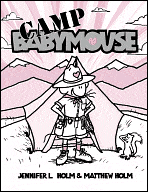
[READ: November 11, 2011] Camp Babymouse

In this Babymouse book, she goes to summer camp.  And as the voice- over points out, what on earth would Babymouse be doing at camp?  She hates everything that you do at camp.

But she’s excited to go and has a fantasy of being a great scout!

Stories always make summer camp seem like hell.  And this one is no exception. It starts when Babymouse gets to her cabin and has to climb to the tippy-top bunk (a great fantasy sequence of King Kong comes in).

The “plot” of the story is that the campers are trying to win the most points for the week.  The winners get a prize and the losers have to wash dishes.  Typically, Babymouse causes some major catastrophes (a Dr. Jekyll and Mr Hyde sequence provides a good laugh as does a wonderful Moby Dick fantsy during the canoeing competition). (more…)

Read Full Post »

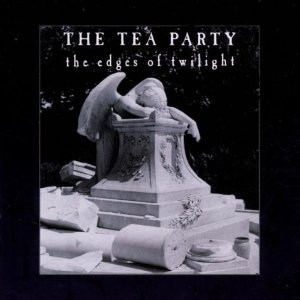
SOUNDTRACK: THE TEA PARTY-The Edge of Twilight (1995).

In the way that Ian Astbury of The Cult reminded everyone of Jim Morrison, so does Jeff Martin, singer of The Tea Party.  He looks a bit like him and he sings in a baritone voice that, while all his own, sounds like perhaps a 1990s Jim Morrison.

This, their third album, is full of what I think of as their trademark sound: all manner of exotic instrumentation laid over heavy Zeppelinesque riffs.  Opener “Fire in the Head’ is not unlike “Kashmir” in its riff, and what’s funny is that the exotic instrumentation makes it sound even more like “Kashmir” than “Kashmir” does.  Zep didn’t use instruments like the sitar and sarod to make their sound more authentic.  Indeed, authenticity seems to be what the band is going for, as later albums describe them spending time in the middle east where they learned to play these instruments more proficiently.

“The Grand Bazaar” takes that concept further with some really Eastern sounding music within a very heavy rocking track.  And “Ianna,” although not my favorite track, really showcases the Middle Eastern instrumentation in this cool, twisty track.  There’s also a more traditional rock number, “Drawing Down the Moon” which features lengthy blues-guitar solos over a fairly conventional track.

It’s not all heaviness though, as “Correspondences” is a seven minute piano based ballad in which Martin’s voice is right in your ears.  It’s on this track that you decide whether you love his voice or think he’s preposterous.  If the latter, well, then there’s the beautiful instrumental “The Badger.”  And “Shadows on the Mountainside” is a quieter acoustic number in which Martin sings in his much more delicate range.

But perhaps the most over-the-top, and consequently, best track on the disc is “Sister Awake” which features 12-string guitar, sitar, sarod, harmonium and goblet drums.  It starts slowly and quietly and builds into multiple climaxes (complete with loudly whispered “Sister!”).

Whether or not this confers any kind of approval on The Tea Party or not, Roy Harper (as in “Hats Off to Roy”) does a spoken word bonus track at the end of the disc.  I don’t know much about Roy Harper or what he was up to in 1995 (perhaps he’d do anything for a buck?) but it give an air of legitimacy, no?

The Tea Party is a band that splits people into love it or hate it groups.  They have sold millions of copies and yet there are those who despise them.  Their next album Transmission found some success in the U.S. because it was a bit more industrial sounding (with samples and loops), but they never really broke through down here.

[READ: February 4, 2011] Stories from the Vinyl Cafe

I’m not sure how I found out about this book.  I know I bought it in a Chapters in Toronto.  I wonder if it was on a display and I was intrigued by the title.  Or, more likely, I had heard a bit about him in my preparations for my trip and decided to buy his book.   Whatever the case, I didn’t read it until now.

McLean is described in one of the (practically a dozen) pages of praise and advertisements for his other books as a Canadian Garrison Keillor.  And, as lazy as that seems, it’s fairly accurate.  Especially because although McLean is a humorist (he won the Stephen Leacock Memorial Medal for Humor), like Keillor, who is mostly funny, McLean also deals a lot with serious matters.  Indeed, some of the stories in this collection are utterly unfunny: ending with a dead dog or a dead grandmother.

And here’s the thing.  These stories are slices of people’s lives.  They are incidents that impact them and are worth recollecting, but that don’t cause anyone to change.  They’re like perfect little anecdotes, and I imagine they are excellent to hear aloud. (more…)

Read Full Post »

SOUNDTRACK: BLUE ÖYSTER CULT-Imaginos (1988).

I think of this as the last BOC album (although they have released two since this one) because it was the last one that I was really aware of when it came out.  My roommate Glen was super excited about it and we listened to it all the time.  And even though I’ve said that Fire of Unknown Origin is my favorite BOC disc, I think this one may be better.

The story behind this disc is convoluted and strange.  It was apparently written by Albert Bouchard as a concept album that was designed to be 2 or 3 discs long.  He had started writing it as long ago as 1972.  Two tracks appeared in 1974 (“Astronomy” and “Subhuman” (which became “Blue Öyster Cult” on Imaginos).

Because record labels suck, the disc never got released as intended.  I’m not sure if it was ever even recorded in total.  When Imaginos was finally released in 1988, it no longer resembled the original and the liner notes are not exactly accurate about who plays what.

The concept behind the disc (and the original liner notes do explain the “concept”) is pretty confusing (for a summary, the Wikipedia entry is pretty helpful).

But if the released tracks are any indication, the whole package would have been amazing.  The songs retain the feel of the early 70s tracks, but they also feel updated to a more 80’s metal sound.  “I am the One You Warned Me Of” is a great rocking opener with wonderful use of keyboards.  What really sells the disc is the choral vocals, chanting/chorusing/adding incredible depth.  The “your master is a monster” part of “In the Presence of Another World” is fantastic.

But the centerpiece is undoubtedly, “The Siege and Investiture of Baron von Frankenstein’s Castle at Weisseria.”  The lyrics, the tension, the call and response are all fantastic.  It is one of the most unheralded hard rock songs ever.  And it deserves a wider audience.

We get a 14 year reprise of the classic “Astronomy,” this one is basically the same song but played differently, more epic.  I’m always torn as to which version I like better.  “Magna of Illusion” has a fun spoken part, “Grandaughter!”  and continues the excellence of side two.

“Blue Oyster Cult” the remake of “Subhuman,” keeps the strangeness of the song (“Ladies, Fish and Gentlemen”), but sounds quite a bit different.  It’s almost meandering on the original disc, a slow guitar solo and a Doors-sounding keyboard fill the track.  On the Imaginos version, it’s much heavier, and the keyboard is a staccato piano.  It’s also three minutes longer with the chanted “We understand. Blue Oyster Cult.”  It’s almost unrecognizable, and yet those lyrics are unmistakable.  The title track ends the disc with a catchy and cool riff and chorus.

There’s also a whole bunch of guests listed in the notes, including Robby Krieger, Also Nova (!) and Joe Satriani.

Imaginos was reissued recently but I’m not sure if it’s worth getting as it has no bonus anything on it (except corrected liner notes).  The original recording sounds pretty poor (at least compared to other contemporary discs) but I’m holding off for the proper reissue (will we ever see the whole project?) that this disc deserves.

[READ: Week of March 15, 2010]  2666 [pg 466-513]

This week’s reading is the shortest amount for the entire book.  It offers some new ideas and lots more deaths.

As the reading opens, Epifanio is continuing his investigation into the murder of Estrella Ruiz Sandoval.  He tracks down two of her friends, both named Rosa (although neither is a Rosa that we have met before).  After hanging around with Rosa for some time (and even going to her house) he learns that Estrella had been frequenting a computer shop owned by a blond blond man.  Lately, he had grown angry with her.

The Santa Teresa police decide that there is one man behind the grisly unsolved murders (they focus specifically on the three women who have been brutalized in the same manner (don’t make me write it). And they discuss whether or not he is a serial killer.  One argues that the serial killer is responsible just for the three recent deaths (that the others were done by someone else, but because they didn’t match the pattern, it can’t be the same guy).  Another proposal is that the same man is responsible for all of the killings.  But now, he is upping his gruesomeness because he feels cocky. (more…)

Read Full Post »

prospectSOUNDTRACK: TINDERSTICKS-can our love… (2001).

loveAfter Simple Pleasure, Tindersticks continued in this looser, less chamber-pop vein.  This disc features more organ fueled songs.  And– in something of a departure–they made many of the songs quite long (two are over seven minutes, one is almost nine!).  You could almost say these are jams, but that would give the wrong impression.

The band still sounds like Tindersticks (there’s no mistaking that voice), but they feel looser, less intense.  Yet they’re still passionate.  In fact, “People Keep Coming Round” and “Can Our Love” are two of their best tracks.  “People” has this really long keyboard section that my wife said sounded like the Doors, and she’s quite right about that.  But it’s more than just a Doors-keyboard solo.  It’s a catchy yet haunting single.

It’s easy to be feel disappointed about the latter Tindertsicks discs because they don’t rival the crazed intensity of their earlier ones.  And yet, Tindersticks is now a different band, playing a different kind of music.  It’s still beautiful, still affecting, it’s just different.

“No Man of the World,” the second to last song is a slow, meandering, deceptively simple song.  It features spoken lyrics and gently sung backing vocals.  And on first listen it’s nothing special, but the more you listen, the more elements you notice: strings, horns, sadness.  It’s really quite moving.

The disc ends with “Chiletime” another deceptively simple song that begins with an organ drone and simple strings.  Staples whispers his way through the first few bars.  But then the track builds to a full band with gorgeous vocals.  Then it slows down as if coming to and end, but it builds once more, this time to a beautiful finish.  It’s a perfect ending to this disc.

[READ: November 3, 2009] “The Girt Pike”

De Bernières wrote Captain Corelli’s Mandolin (which I’ve neither read nor seen the film).  In fact, this is the first story by him that I’ve read, and I’m fascinated by his style.  I don’t know if his other works are like this but I’m rather intrigued by this one.

This is a fairly simply story of a boy going fishing.  (I don’t fish myself, and I don’t really care all that much about fishing, but I’ve gotten a great deal of pleasure out of fishing stories (Paul Quarrington’s Fishing with My Old Guy was a surprise treat)).

The story opens with an endearing style that I would consider almost fairy-tale-like.  (The second sentence does indeed open with “Once upon a time”).  But the words are not of fairy-tales, rather, they reflect a somewhat nostalgic past: when boys fished in ponds with sticks and then threw the sticks to their dogs who splashed in the ponds.  Such an idyllic set up is altered somewhat once the “action” starts with the sentence: “On the morning that concerns us, however….” (more…)

Read Full Post »

« Newer Posts