Feeds:
Posts
Comments

Archive for the ‘Siskiyou’ Category

sempleSOUNDTRACK: SISKIYOU-Nervous [CST109] (2015).
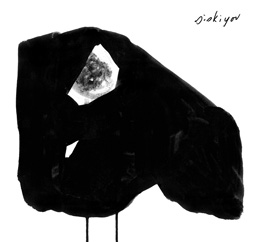
cst109covera_258x242This album begins with “Deserter,” in which a choir of children singing over a kind of spooky tone.  And then a loud rumbling bass and scratching on a guitar.  It’s quite different from the previous Siskiyou releases and outpaces the others by several steps.

Once Colin Huebert’s voice kicks in, that familiar Siskiyou sound returns—acoustic guitar and Huebert’s voice which is a mix between a whisper and Win Butler from Arcade Fire.  But “Deserter” features backing vocals and, perhaps most surprisingly, a wild baritone sax solo by Colin Stetson.  But it stays grounded with that cool rumbling bass line.

The second song “Bank Accounts and Dollar Bills (Give Peace a Chance)” opens with an echoed guitar likes some classic 1990s shoegaze music.  The vocals are a cool, intense whisper.  The verses are great and then the chorus adds a piano and his vocals rise into an impassioned wail.  The third song “Wasted Genius” adds a kind of steel drum sound that includes a great melody to the simple and slightly ominous verses.   The middle of the song switches to pummeling drums and a buzzy guitar solo before returning to the mellow verse.

“Violent Motion Pictures” has another cool whispered vocals and quiet guitars that get accented with a low bass and percussion.  There’s a neat section of falsetto vocals that remind me of Pink Floyd over a bouncy melody–before it returns to the verses.  It’s a wonderfully catchy, if brief, segment.  “Jesus in the 70s” has slow guitar lines and atmospheric keys.  “Oval Window” is a bouncy folk song (with a slightly creepy vocal over the top), but its even got a folksy kind of guitar line on it.

“Nervous” is a slow ballad.  “Imbecile Thoughts” is a fun song with stomping drums.  It has a cool ending that leads to the slow building, strings-included nearly 7 minute “Babylonian Proclivities.”  The disc ends with the 1 minute “Falling Down the Stairs.”

This album is really fantastic–an overlooked gem from 2015.

[READ: November 8, 2016] Today Will Be Different

I’ve really enjoyed Maria Semple’s books.  And this one was no exception.

She really conveys the hectic, overstimulated, over scheduled life of middle age parenting.  It helps that her stories are typically set around Seattle and that there’s a lot of excitement, tech and pop culture to throw around, too.

This is the story of a day in the life of Eleanor Flood.  Sarah pointed out, as I didn’t quite realize it, that the story takes place in one day (hence the title) although there are flashbacks that flesh out the story too.

Eleanor is, or perhaps “was” is the better verb, an artist.  She was lead animator (or something–it’s a little confusing) on the successful show Looper Wash.  When the show ended she received an advance to write a book/memoir.  That was eight years ago.

Things have been sprialling out of control for Eleanor for a while, but she vows that today will be different.  She will make a difference. (more…)

Read Full Post »

SOUNDTRACK: SISKIYOU-“Bad Days” (2012).

Siskiyou has had some medical problems and have canceled their recent tour.  They are also going on a brief haitus.  This is a shame as after their second album, they really had momentum and they sounded better than ever.

As a kind of peace offering to fans who would not be able to see the band, they recorded a cover of The Flaming Lip’s “Bad Days.”  The cover souds remarkably like the original, with one big difference: rather than squalls of feedback, Siskiyou uses only piano.  And it works very well, getting down  to the basics of the song and sounding a bit like Wayne Coyne singing.

It’s a nice tribute and  a nice “until later”

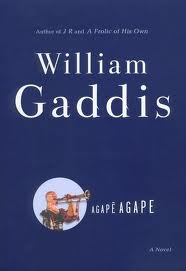
[READ: August 27, 2012] Agapē Agape

I have a long history with this book.

I was working at Baker and Taylor, a book supplier, when this book was released.  Some of the higher ups were able to get free books from the publishers they dealt with.  The guy who dealt Viking was not the friendliest guy, but since B&T paid absoluet crap wages, I was going try to get any books I could for free.   So, I asked for this book.  It was embarrassing enough to walk in and say this title with confidence, since I knew how it was pronounced (yes I took Greek in college), but knew he didn’t.  After some groveling, his reaction led me to think I wouldn’t be getting it.

But lo and behold a few weeks later it was sitting on my desk.

And now, ten years later, I’ve finally read it.

In JR, Jack Gibbs is writing a book with the name Agapē Agape, it is a jumbled history of the mechanization of the arts, starting with the player piano.  JR was finished in 1975–who knows for how long he had been working on it until then.  According to the Afterword of this book by Joseph Tabbi, Gaddis was pretty all-consumed by the idea of the player piano.  (It’s really quite an obsession).

This book is the culmination of all of Gaddis’ work on the player piano and how it removed all of the artistry from music (this theme of art and mechanization is in JR as well).   But rather than write this as an essay, which he didn’t think would be very effective, Gaddis decided to make this a novel.   I admit to not really knowing if he finished it–Gaddis died in 1998.  While it doesn’t feel unfinihsed, I’m just not sure if he was “done” with it. (more…)

Read Full Post »

SOUNDTRACK: SISKIYOU-Keep Away the Dead [CST083] (2011).

I really enjoyed Siskiyou’s first album. This album updates the sound and makes it a bit bigger.  And yet somehow the album still sounds fragile.

The album is full of songs that are catchy, but not really easy on the ear.

The first song reminds me of Arcade Fire.  Something about the ringing guitar and crescendos.  But the recording feels more like a demo, much more intimate that Arcade Fire.  “Where Does That Leave Me” is an even more spare number, just vocals and guitar although it slowly builds.  “Twigs and Stones” is the first song that sounds like the bulk of the album—where Colin Huebert’s vocals really come to the fore.  His vocal style is loud and verging on the whiny (again, like Arcade Fire).  This song also has a lot of other instruments that percolate to the top—reminding me of older Mercury Rev.

“Revolution Blues” is the standout track for me, it’s incredibly catchy (and fun to try to sing in his eccentric voice).  The accordion and the minor key intensity is really powerful.  I guess it’s a shame that it was written by Neil Young, then (although the Siskiyou version is much better).  “Dear Old Friend” is a more country sound (which for me is shorthand for slide guitars), but it keeps the same style and feel as the other songs.  “Fiery Death” is the first song where percussion makes itself known very loudly.  It’s a cool introduction of loud thumping.  “Sing Me to Sleep” is a 2 minute lullaby and “Dead Right Now” is a 2 minute coda that ends the album nicely.

The disc is short (about 30 minutes) but a lot of emotion and craft is packed into it.  It’s really enjoyable.

[READ: May 24, 2012] “Sweet Dreams”

I’m always disconcerted when a story is in English but is set in another country.  Well, that’s not exactly right.  When it seems like it’s set in another country because the author is from that other country and he or she is writing about that other country without specifying it (usually because it is translated).  It’s very Amerocentric, but perhaps everyone thinks a story is set in their town unless told otherwise.  So I didn’t realize that this story was originally written in German (it was translated by Michael Hoffman), but it felt like it was taking place in Europe.  I actually guessed France, until later on it was revealed to be Switzerland.

There’s something cool about stories that are written elsewhere, especially if you don’t know the place well, it allows for almost anything to happen.  A couple riding a bus in Europe doesn’t mean the same thing as a couple riding a bus in, say Tallahassee.  But having set up that distinction, this story is about love.  And love is universal.

The story is written from the point of view of Lara, a shy bank worker.  She has been dating Simon for several months and they have recently moved in together.  They should be in the first bloom of love—on their own for the first  time (they never felt comfortable fooling around at their parents’ houses)—but her shyness in particular won’t loosen.  She doesn’t like him to see her naked, and they are very reserved in their love-making.  And from the start Stamm places a dark tone over the story.  The get a place in the town that he likes but it’s pretty run down.  He hadn’t brought much to the apartment, and he seems critical of some of her purchases.  He even comments that “forever is a long time” when she says that the towels she bought will last forever.  And then on the bus, a man, dressed in a long black coat stares at Lara over and over.  It may be innocent, but it’s still disconcerting.

When they get home, she takes a bath (she won’t let him in the bathroom) and asks him to go to the restaurant downstairs to buy a bottle of wine.  She finishes the bath and he’s not back yet, so she reads the paper.  Which is full of more grim news.  When she reads about a dead body found in the lake nearby and since we know she doesn’t feel comfortable about the restaurant downstairs, we know something bad has happened. (more…)

Read Full Post »

SOUNDTRACK: SISKIYOU-Siskiyou [CST067] (2010).

Siskiyou is a fascinating band whose debut album was released on Constellation last year.  The main guy in Siskiyou is Eric Huebert, who was drummer for the Great Lake Swimmers.  He quit the band and moved to an organic farm in British Columbia. And while farming he created this album (which is named for the California mountain range and is not, as a I imagined, a play of the phrase Sick of You (which I will still think regardless of the truth).

There’s a wonderful article at Paste about this album, where I learned a lot about the disc.  The disc was recorded in stairwells (which seems so cool) and at field recordings on the beach.  It was made on the cheap and very independently.  And I love it.

It feels very much like a small solo project (although he is quick to point out that he had help from another Great Lake Swimmer, Erik Arensen, as well as his wife and some friends.  But really, it feels like a vulnerable man singing in his wavering voice over some stark acoustic songs.

But unlike a poppy folk album, this one feels awkward.  The melodies are beautiful, but the lack of polish and production makes the recordings feel more fragile than they might otherwise be.

Indeed, Huebert’s voice, while always on pitch, threatens to just collapse under the strain of recording that first song, the gorgeous “Funeral Song.”  But it’s the second song that tells you this isn’t just a home recording.  “Everything I Have” feels like a great Lou Barlow/Sentridoh song–recorded on lo-fi equipment, until you hear the gorgeous horns come in a play the simple yet very winning melody over the loud folk guitars.  Again, if this had been over-produced it might have veered in cheesy, but the lo fi sound (and the cool lyrics) make this one of the best folk songs I’ve heard in ages (and it’s only 2 minutes long, too).

This is followed by two delicate songs: simple melodies, on either banjo or piano and shuffle drums.  My favorite song is “It’s All Going to End.”  Horns give it a kind of mariachi feel, but lyrically it’s wonderful: “I don’t like you one little bit, keep that shit up man, you’re gonna get hit.” All sung in his delicate wavery voice (and again, under 2 minutes long).

Another highlight is the “cover” of “This Land is Your Land.”  Called “This Land,” it opens with a slow piano melody that doesn’t sound anything like the original.  And then he begins whispering the lyrics–once again totally unlike the original.  But mid way through he changes the lyrics, to a new type of song about how he is never going home.  It turns the song mournful and rather powerful.

“Never Ever Ever Ever Again” is a wonderful song of repetition.  And the two short (just over a minute) tracks, “Inside of the Ocean,” and “We All Fall Down” are charming interludes before the lengthy “Big Sur.”  “Big Sur” starts with an upbeat banjo riff but then settles down into a slow (slightly out of tune) guitar piece.  The slow pace is particularly amusing given the incredibly slowly sung lyrics “So let’s party.  Let’s party.  Let’s party.  Party all night long.”

The disc ends with “Brevity and Insult” a song of static and banjos.

Typically I don’t like slow music, but this album adds so many interesting aspects that it doesn’t actually feel slow to me, it feels interesting and challenging  and strangely uplifting.  And I’m looking forward to their next release.

[READ: October 19, 2011] “Snake

This (surprisingly short) story packs so many different ideas into it that it really jostles the reader’s emotions.   It opens with a woman in a car. She’s in the parking lot of a supermarket waiting for her boyfriend, when she begins watching two boys.  They are playing with something on the ground, although she can’t quite tell what it is.

After seeing them lifting a stick, she realizes that it is a mostly-dead snake that they are playing with.  They don’t see her and she watches them decide what to do with the creature.  They decide to play a prank.  The boys test all of the cars in the parking lot and when they find an unlocked door they drop the snake in. (more…)

Read Full Post »