It always made me laugh that this album opens exactly the same as Suck on This–with the opening drums to Rush’s “YYZ.” But it quickly bends into the propulsive bass of “To Defy the Laws of Tradition.” For many, this was their first listen to Primus, and hearing the crazy noise of Ler’s guitar come roaring out of the speakers followed by Les’ insane bass line and Tim’s wild drumming–it’s unlike anything I’ve heard before or since. And then later to hear the tapping of the bass notes during the chorus–it’s certainly defying laws of rock tradition.
The lyrics of “To Defy” are interesting to me (if Christmas didn’t come, who would cry more the child or the stores?). I also always loved the lyrics of “Groundhog’s Day” (“lingering taste of toothpaste made the milk go down a bit funny”). I like the fidelity of this recording better than Suck on This (all five re-recorded songs actually). This song also gives Ler a lot of pace for a long solo. “Too Many Puppies” is one of the earliest song Les wrote (although I believe it was different in speed at the time). It is a loud song in which Ler’s guitar stays hidden for a while then bursts forth full of noise and chaos at opportune moments.
“Mr. Knowitall” is also full of great lyrics (“they call me mr know it all, i am so eloquent, perfection is my middle name and whatever rhymes with eloquent”) and a really groovy bass with interesting “lead” guitar work. I feel like the drums get a prominent place in “Frizzle Fry” (the drums are great all the way through, but they really shine here). Of course the fast section at 4:40 is pretty amazing, too.
The opening to “John the Fisherman” is different than on Suck on This and it is crazy the sounds he get out of that bass. The quality of this recording (and the video) are great.
“You Can’t Kill Michael Malloy” is 26 second piece that was composed and performed by Matt Winegar (according to the Primus book the song is actually much longer and Les wishes he had played the whole thing here). It leads to the slow intro of “The Toys Go Winding Down” which features one of my favorite triplet-filled bass lines ever. It also features some great bowed bass from Les.
I love that “Pudding Time” opens with such a great amount of noise and that the bass is actually more of a percussive instrument for the verses. “Sathington Willoughby” is another weird little song (25 seconds) that gave them a chance to play with banjos. It serves as a great intro to the wild drums of “Spaghetti Western.” This is the strangest song on the disc (which is saying a lot). It’s almost an instrumental with Les reciting a little story about watching Spaghetti Westerns on TV (the way the boots are all reverbed out).
“Harold of the Rocks” is such a great song and this version sounds great–you can really hear what Ler is doing. It ends the album in a fun way.
Frizzle Fry is still one of my favorite albums, and it still sounds totally weird and unique all these decades later. I was marveling at how long this album is and how long many of the songs are–quite an auspicious “debut.”
[READ: January 5, 2015] “Action”
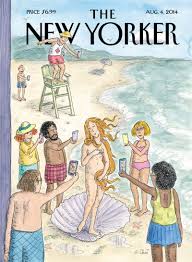
I have basically blown off the New Yorker since last summer and have now made it my resolution to read all the issues I missed from last year in a timely fashion. So here I’m starting with August.
I often like Paul Theroux’s stories, although I don’t really have a sense of his style overall. This story proved to be very simple but incredibly detailed.
It is about a boy, Albert, who works for his father in his shoe store. Albert’s father was a widower and a very economical man–he would often only speak in one word sentences, especially to Albert (“‘Where?’ meaning, “Where have you been?'”). His father worried about him, but didn’t really show it. Rather, he monitored everything that Albert did. He made sure that Albert was working most of the time that he wasn’t in school (even when the store wasn’t busy). So Albert had no social life.
Albert did have one friend (whom his father greatly disapproved of) named Eddie. Albert liked Eddie especially because Eddie often said “I’m a wicked bad influence.” Eddie knew all about Boston and showed Albert around to places that his father would have been very upset by. Of course, Albert had no money so he never went in these places, he just knew of them. Eddie also introduced Albert to his “girl” Paige, whom he described as easy. (more…)
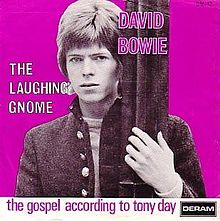
SOUNDTRACK: DAVID BOWIE-“The Laughing Gnome” (1967).
I have always liked David Bowie. Never loved him, but always liked his radio hits (and a bit more). Suffice it to say that I have never heard of “The Laughing Gnome” before reading about it in this book.
What a strange little song. I can’t tell if it came out before or after his debut solo record (he has the same haircut), but I gather it was released as a novelty record.
It’s a delightful little song. Very sixties mod with a healthy nod of dance-hall. The very different thing of course is that in the song, the main singer (Bowie) meets and sings with a sped-up-voiced Cockney “gnome.”
So the song is clearly a novelty song (what else would you call it?). Except that the production is really great and the music is really good too. Despite the gnome, the song isn’t really a “funny” song (well, there are jokes and puns, I guess). It’s certainly weird and certainly silly, but it holds up pretty well to repeated listens (even if the chorus is “ha ha ha hee hee hee I’m a laughing gnome and you can’t catch me”).
Bowie doesn’t really acknowledge the song anymore, although he did joke that he was considering performing it in a new ‘Velvet Underground-influenced’ style. Before that happens, hear the original
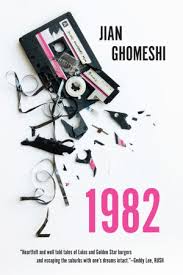
[READ: November 22, 2014] 1982
So yes, I know that Ghomeshi is in the midst of a scandal in which he is pretty undeniably a sexually abusive scumbag. I’ll say nothing more about that since things are still under investigation {formal charges were brought today]. But it doesn’t look good for Jian.
This is rather upsetting. For the women involved, obviously, but also for those of us who liked Jian and thought he was one of the good guys. Which I did. I loved Moxy Fruvous. I loved his solo album. I had a brief email exchange with him before he joined the CBC, and his show, Q was one of the best interview shows out there. He always seemed so nice and on the right side of so many issues. Ugh.
But anyhow, this is about the book, not him (although the book is about him as well). I only heard about the book when I was looking for news about his scandal (I had no idea he had written a book). The book is called 1982 because it is all about his life in the year 1982, a formative year in his childhood. (more…)
SOUNDTRACK: NELLY FURTADO-“Time Stand Still” (2010).
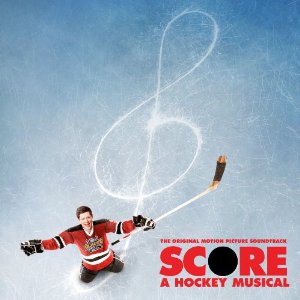
I stumbled upon this cover of a Rush song when I learned about Score: A Hockey Musical (which I stumbled on when looking for information about Dave Bidini). I hadn’t heard of the movie, but i was sure intrigued by it (the parts I’ve seen have terrible songs but since it’s all jokey, it’s okay).
This cover song is presumably an end credits song.
I don’t really have an opinion of Nelly Furtado, but, man, I really don’t like this cover. I’m of course delighted that she covered Rush at all (and it makes sense in a Canadian hockey movie to have a Rush song) but she basically strips away all of the music and adds a very simple synth riff and drums. It’s painful for a Rush fan to hear all the music taken away from this song.
Furtado’s voice actually works pretty well (especially since Aimee Mann does the backing vocals on the original) and she sings it quite nicely. I think I might like it if I didn’t know it was a Rush song, originally (the music is good, eh?). It just hurts my sense of righteousness to hear this weird lite version of Rush.
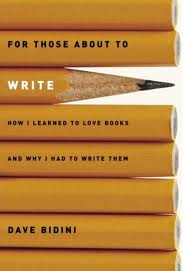
[READ: February 24, 2014] For Those About to Write
After reading Pseudonymous Bosch’s writing guide for young people, I figured I’d compare it to Dave Bidini’s writing guide for young people.
It’s interesting to see how two writers can try to accomplish the same thing in such vastly different ways. Bidini doesn’t really write fiction (he has written some, but not much), so unlike Bosch, he doesn’t try to get the young writer involved with a made up story. Rather, he presents his own life as an example of one way to become a writer.
Bidini talks about how he loved books as a kid–stapling together stories, or loving the feel of cardboard binding books together (he fondly remember his first writing project for school and how it all felt so official). He was also fortunate to have parents who could appreciate his artistic needs–so if he needed to write or to play music, they were supportive. (more…)
I loved Beach House’s previous album–the way it was magically lighter than air with swelling melodies and the unearthly vocals Victoria Legrand. Bloom opens with “Myth” which continues the magic–the simple but beautiful opening melody and then a soaring chorus which is just amazing.
But something happens after that first song, and the album suddenly comes down to earth. Perhaps it is the fairly conventional guitar and drum sound that opens “Wild” (it’ sa very cool 90’s ear guitar sound, but I feel like it doesn’t quite work with her voice. The song is still pretty, but I kind of lose interest before it ends.
Similarly, I like the simple synth opening to “Lazuli” and her voice soars nicely here, but I’m not compelled to pay attention all the way through. As I’m writing about the songs, I want to say that they are all pretty with nice melodies. And as each song opens, I smile with recognition at the quality of the song. But I keep drifting away from the song before each one ends. Is it because each song is nearly five minutes? Maybe.
The more I listen to the album the more I like most every song–there’s something about each one that I find engaging, and yet overall the album just doesn’t grip me as much as the previous album did.
It still sounds magical, but something is missing, and I’m not quite sure what that is.
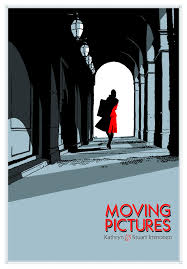
[READ: October 24, 2014] Moving Pictures
This graphic novel was simply fantastic. It was one of the most powerful and moving stories I’ve read in graphic format in a long time. I loved everything about it (even if some of the details of the story were a wee bit confusing–see below). The story explores the relationships that formed during the Nazi occupation of Paris. Specifically between a Canadian museum curator and a German soldier.
Primarily, I loved the artistic style of this book. It is black and white with some very dark sections–especially in the interrogation room where harsh shadows obscure so much. As the book opens, we see a woman sitting at a table under a harsh lamp. It is only when the POV shifts to her profile that we see the very fine and delicate lines that comprise her face. And that balance of fine lines and huge swaths of black is really stunning.
There is then a flashback. The woman from the room, Ila, is speaking to another woman who looks more or less like her (it is hard to tell the women apart as they are both blonde, with such think lines for features). They are at a train station and Ila is encouraging the other woman to take Ila’s papers and flee. She says she won’t be needing them.
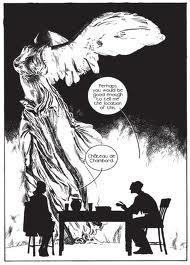
Then we return to the room, where a man, who we learn is Rolf the soldier, enters and begins interrogating her. He asks her questions, but after a few, she asks him if he has been drinking–something is clearly unusual about this interrogation. In the course of the questions, we learn that Ila is the curator at a museum. And he begins asking her the locations of certain works of art. What is gorgeous here is that the two remain silhouetted, but the artistic pieces are blown up to full size as background images. And they are wonderfully rendered.
Then he asks about some small things “hidden” in the basement. And then he asks if she is still mad at him. This interrogation seems more personal than political. We also learn that he asked her to keep one small artifacts and that she can’t remember where it is. (more…)
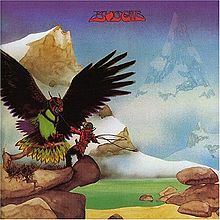
I am pretty much wholly ignorant of Budgie. I know this song “Breadfan” because Metallica covered it back on one of their covers EPs. I really Metallica’s version, but since that was pre-internet, I was never able to explore Budgie more. And then I forgot about them.
Well, just the other night, WXPN played “Breadfan” (as part of a 70s power trio segment) and I was shocked at how high-pitched Burke Shelley’s voice was (the comparisons to Rush are apt). And I was also surprised at how heavy this song was. While Black Sabbath had certainly been releasing heavy albums up until this time, this song introduced a much faster element. And there were only three members in the band!
What’s also interesting is the prog rock leanings in some of their songs, like the middle of this one. The fact that Roger Dean did this album cover and that they have a 10 minute song on this album seems to lean towards prog rock as well).
Time to dig deep in to the Welsh band’s catalog, I think.
[READ: June 17, 2014] “Beautiful Girl”
This year’s Summer Fiction issue of the New Yorker was subtitled Love Stories. In addition to the two graphic stories, we have a series of five personal essays which fall under the heading of “My Old Flame.” I like that all five writers have slight variations in how they deal with this topic.
Wolff surprises (me anyhow) by saying that when he was fifteen, he cut off the last joint of his left ring finger. This piece of information just sort of lingers there until the end of the story.
Because he then talks about how he never really had a girlfriend. In sixth grade he and his friend Terry would meet Terry’s cousin Patty and another girl in the movie theater and they would pair up and make out (clearly Terry did not make out with his cousin). But they pairings were never seen in public and never went on a further date.
But later that winter his family moved to the Cascades, where the elementary school had all of four rooms. There were ten kids in his class and nine were boys. The one girl, Nevy, drove them all crazy. She favored one then the other but her real love was horses not boys. (more…)
SOUNDTRACK: OBETROL-“The Sound Machine” and “Chopped an Dropped”(2011).
Obetrol is a band that I can find out very little about. They seem to have 5 songs out and each one is quite different. My favorite is “The Sound Machine” which has a lush sound with twinkly guitars and a wispy female vocalist singing over the top of it. It has a very trippy slow motion quality to it. The singer sings a bit like a delicate Kim Gordon (in that shes not always exactly on key).
It’s hard to get more out of this song since it’s only 2:25, but I think it would make a cool intro to any record.
“Chopped and Dropped” on the other hand opens with buzzy guitars (and a “Kick Out the Jams” sample). The vocals are sung (screamed) by a man. It is a fast-moving tinny punk song with trippy female echoed vocals in the background.
Hard to pin them down, but you can check them out here.
[READ: July 28, 2014] Pale Summer Week 3 (§22)
This week’s read is only one section because it is almost 100 pages of one person’s testimony. Presumably, this is also part of the testimony on videotape which was broken down into smaller sections. But there is no “context” for this section; no ID number. Although it does address very similar issues and questions. I was on the fence about how much to include here. So much of it is “irrelevant,” that I hate to get bogged down in details. So I think it will be a basic outline of ideas until the more “important” pieces of information surface.
§22
For the most part, this is all inside one man’s head as he talks about his life in college, after college, and into the Service. In terms of advancing the “plot,” there’s not much (until the end). Mostly this is simply a wonderful character study, full of neuroses and problems that many people face at some point (to one degree or another). We don’t know who this author is (very minor spoiler: we will learn who it is in §24 [highlight to read]).
The interviewee states that “A good bit of it I don’t remember… from what I understand, I’m supposed to explain how I arrived at this career.”
Initially he was something of a nihilist, whose response to everything was “whatever.” A common name for this kind of nihilist at the time was wastoid. He drifted in and out of several colleges over the years, taking abstract psychology classes. He says that his drifting was typical of family dramas in the 1970s–son is feckless, mother sticks up for son, father squeezes sons shoes, etc. They lived in Chicago, his father was a cost systems supervisor for the City of Chicago. (more…)
I expected Brass Bed to be a goofy band because of the snapshot image of them singing into toy microphones. I was initially disappointed by how normal they were, but I was soon won over by their interesting floating sound. They have this overall trippy underwater vibe (which seems to be accomplished by a bowed slide guitar). This is especially notable on “Yellow Bursts of Age” their best song in the set. Later the guitar solo is echoey and also underwatery. It’s a very wild sound for a fairly simple song.
They tell a funny story about being from Louisiana and encountering Washington DC snow and (of course) not having an ice scraper (although they did have bag of sand).
“Cold Chicory” is an upbeat sounding song musically although it is kind of a bummer lyrically, but again there’s the great sound of the bow on the slide guitar and the echoey lead guitar. “Please Don’t Go” is a slow song—with more interesting effects from singing into that slide guitar.
The plastic mikes do come out in the last song “Have to be Fine” in which they sing into the echoey mikes for the intro (with very nice harmonies). They sing the intro for about a minute, and then the slide guitar player takes lead vocals on this simple but pretty song (I don’t know any of their names).
At the end, the NPR folks gave them an honorary NPR ice scraper.
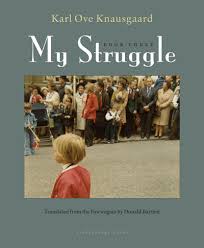
[READ: June 24, 2014] My Struggle Book Three
I read an excerpt of Book Three just a few weeks ago. And in the post about it I said I wouldn’t be reading this book for quite some time. But then the book unexpectedly came across my desk and I couldn’t resist grabbing it while it was here. So it appears that I will now have to wait well over a year before Book 4 (which is, I think about 1,000 pages–yipes). I also see that Book Three is fully called “Boyhood Island” in Britain.
At the end of Book Two, Karl Ove was more or less caught up to the present–writing about what he was then up to (with a few years gap, of course). So it makes sense that this book is about his childhood–showing us how he came to be the man he is.
The book, amusingly enough, starts off with memories that he cannot possibly remember, and he even says as much. He is using memories of his parents and piecing together pictures from when he was an infant. In 1970, (Karl Ove was born in 1968) his family moved to the island of Tromøy (and check out the idyllic picture that Wikipedia had). This is where Karl Ove spent his (rather traumatic) formative years. Their island is small, so he knows everyone in his school, but there are some amenities around like the Fina station and the B-Max, and there’s lots of soccer to be played and bikes to be ridden.
Things seem normal at first–he runs and plays with his friends, there is ample green space to run around in, and they have boats to sail on. And we meet two of Karl Ove’s earliest friends: Geir and Trond (so many people are named in the book, I’m very curious to know if any of them remember him). In an early scene they chase the end of a rainbow looking for a pot of gold (and have a discussion about what happens to it when the rainbow vanishes (the boys even play a prank on Karl Ove that they actually found the pot,a dn while he doesn’t initially fall for it, he is compelled to go back and they tease him).
But the looming figure here and throughout the book is Karl Ove’s father, who, at least according to Karl Ove’s memory, is pretty much a monstrous dick. He is demanding and exacting, unforgiving and seemingly uncaring. He is either bipolar or a drunk, jumping from goofy to outright rage in a mater of seconds. Karl Ove and his brother Yngve fear him unconditionally and, by the end of the book they both seem to hate him. The scene where their dad tries and fails to teach Karl Ove to swim is heartbreaking, especially when the dad goes home and tells their mom right in front of him “He’s frightened of water.” There are dozens of instances of fear and intimidation (often accompanied by a wrenching of Karl Ove’s ear). Like when Karl Ove turns on the TV for his grandparents (he wasn’t allowed to touch the TV but he wanted to do something nice for them). After a few minutes, the TV fizzed out and, naturally, he was blamed for it and sent to bed without supper (after some minor physical abuse). (more…)
SOUNDTRACK: RHEOSTATICS-Bathurst Street Theatre, Toronto, ON (April 4 & 5 1997).
The Rheos played two nights at the Bathurst Theatre and as I was looking at the setlists I was really impressed that in the two nights the band played 44 songs. Of those 44 only 9 were played both nights. So they played 26 different songs between the two nights. That’s cool especially compared to some bands, like Rush, who play literally the same set list every night. Of course it’s possibly more fair for a fan who can only go to one show, but for fans who will go to both, what a treat. The first night was a bit more “hit” heavy with “Claire” and “Horses” and “All the Same Eyes.” Whereas the second night had some other great songs like “Christopher” and “Soul Glue” and a great version of “Shaved Head.”
I have already written about these shows, but in going over them I found that I was very harsh about the April 4th show. Unfairly so. I complained about the quality of the sound (which is actually not that bad). And I complained about the lack of violin in King of the Past which, come on Paul, lighten up, how are they going to play that? I also accused Dave of being early on the “King of the Past” first chorus, but it was actually Martin. Oh well.
In the April 4th show they tell the audience that they are recording a live album And they engage with a guy in the front row who I wearing a Mr Bean shirt and tell him to take it off. They say he has an “umber 31” shirt under it I think—no idea what that is.
This is the first mention I’ve heard of Harmelodia, the kids album. And “Easy to Be with You”‘s lyrics are not settled yet—with California being in place of Harmelodia. “Dope Fiends” has a drum solo but sadly it is cut off.
I mentioned in the original post that the April 5 show has a lot of tracks that made it to Double Live. Like “Good Canadian,” the improv piece—man the band was big into smoking, eh? They also mention the demise of the CBC Radio show Nightlines (which they’d record an album for soon).
They play “Public Square” from their debut album, which sadly gets cut off. And a fun acoustic version of “Legal Age Life.”
The band is having fun and are so nice–they seem genuinely pleased that people came from a long way to hear them.
Between the two nights, 11 songs made it onto Double Live (there are 29 on the album in total). They sound pretty different here (mixing and all) so it’s worth checking these out too.
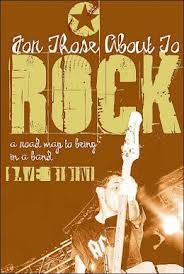
[READ: February 24, 2014] For Those About to Rock
In addition to his hockey books, Dave Bidini has written a number of books about being in a band. On a Cold Road was his memoir of touring with the Rheostatics and The Tragically Hip. Since he likes to write and since he’s a musician, it seemed to make sense to have him write a guide for beginning rockers. This book explicitly states in the first few pages that if you are as old as Bidini, the book is not for you. I am not quite that old, but I got the point. But what’s more rock n roll than not listening to the man? So I pressed on.
The book contains some real-world practical experiences for those who may be just starting out in a band. He says there was no book like this when he was a kid, so he hopes it’s useful. And the book ranges roughly between being a fun guide to rocking out and being a cautionary tale about how tedious and unfun being in a band can be (and how many people may try to take advantage of you). This book is also very specific about being in a touring Canadian band. He talks about slogging it through cold winters across the Trans Canada Highway, something that young bands from Florida certainly don’t have to deal with. But his specifics really help to shape the overall completeness of the book, so take his examples and make them your own.
So I play guitar, have never been in a band and while I always thought it would be fun to rock with others, never had any real desire to “tour.” Is this book still for me? Why yes, it is. Because Bidini has been playing music since the early 80s and he has some wonderful stories. (more…)
After Angel Rat, original bassist Blacky left the band. That’s never a good sign. After the tour for this album, original singer Snake left the band. That’s an even worse sign. I still can’t quite figure out exactly why Snake left (personal problems) but he went on to form the band Union Made. For a very detailed history of the band, check out this very cool timeline at Voivod dot net.
The Outer Limits got a pretty big release. I have an original copy that came with 3D glasses and all of the illustrations in 3D. But I was a little disappointed in Angel Rat and I don’t think I gave The Outer Limits much of a chance. It was no Nothingface. But the band was always morphing. Since Angel Rat went very commercial, this album brought things back into the prog realm (with a 17(!) minute song) but also had a lot of commercial songs.
The album opens with “Fix My Heart” which starts out much heavier than anything on Angel Rat. It’s also got some metal guitar pyrotechnics (squeaks and harmonics). Snake’s voice isn’t quite as pretty as on Angel Rat either—he growls a bit, but maintains his nicer voice overall. Nevertheless, “Fix My Heart” is a pretty commercial enterprise (as the title might even suggest). There’s some good “spacey” guitars sounds which bode will for the sci-fi angle of the album (and there’s some cool effects that reward headphone use). “Moonbeam Rider” starts with a very classic rock sounding riff and then morphs into a kind of pretty, mellow verse. But the interstitial guitar is all speed. It’s a nice mix of fast and slow. This song features some interesting bass work—nothing fancy but for the slow parts it is actually keeping the beat instead of the drums. The bassist was a studio musician for this album. There’s also what sounds like a bong during the pre-guitar solo section (the solo is fairly traditional).
“Le Pont Noir” is a mellow, slow guitar song with a very cool delay effect and Snake’s whispered vocals. The bridge gets heavy with a wonderfully weird Piggy guitar riff. It’s one of my favorite songs on the album.
Then the band’s second Pink Floyd cover appears. This time it’s the even more obscure “The Nile Song.” They have rather heavied this one up with crunching guitars and Snake’s distance screaming filling in the void (although in fairness the original vocals are also screamed). It’s not as dynamic or exciting as “Astronomy Domine,” but it’s still a cool cover. “The Lost Machine” starts off heavy with Away’s double cymbal work (a noisy splash and a fast ride cymbal). Then Piggy’s guitars have a slight delay on them which makes the opening chords sound especially odd. The bridge is a place for Piggy to show off some more weird spacey chords and some very cool guitar riffs. There’s even a spoken word narrator in the middle of the song that explains the “mission” “Time Warp” opens with a very bright and up beat sounding verse. But it quickly disintegrates into (intentional) musical chaos as the narrator gets lost in space.
This all leads up to the 17 minute “Jack Luminous.” If anyone doubted their prog rock leanings, this should dispel that immediate. 17 minutes, multiple parts, a sci-fi epic, it is prog (but heavy prog) at its finest. There are some incredibly catchy parts as well as some less catchy parts, and sections seem to change every two minutes or so. The slow down at 10 minutes is very cool—different guitar effects and the suspenseful bass line. There’s repeated sections as well, which means if you like some guitar line (the spacey part near the end) it comes back! It’s not quite as dynamic as say 2112, but it’s a very successful sci-fi epic.
“Wrong Way Street” returns to the normal and more conventional. The bass that opens the song sounds great and the chords are fairly conventional–the chorus is even really catchy. “We Are Not Alone” is a break-neck metal song, The drums are super fast, the guitars are relentless and the chorus even has an echoed “Hey!” that gets you to sing along. The song also features a cool slow, almost jazzy bass and drum section that lets Piggy throw some soloing in before returning to the fast paced verses.
There’s lots of theories about what happened to Voivod after this album. The success they had achieved earlier was now gone and the band seemed like they couldn’t decide to be metal or prog or is they should go for more pop music. The problem of course is that they were too weird to get mainstream acceptance anyway.
So Snake left and then there were only two original members. The next step would be a drastic one.
[READ: July 9, 2013] Grantland #7
This issue seemed to come hot on the heels of #6. But I enjoyed it just as much. A few notes: no Jeremy Lin in this issue. Lots of LeBron James, three articles about soccer! And a few pop culture moments that I had forgotten about.
REMBERT BROWNE AND DUSTIN PARKER-“The Jeopardy! Teen Tournament JUST. GOT. REAL.
Leonard Cooper didn’t know the final Jeopardy answer but he still won and he made a hilarious joke at the end (in cartoon format);
BILL SIMMONS-“Daring to Ask the PED Question”
Simmons talks a lot about PED’s in this forum. Of course, to me PED is my initials. For him (and sports fans) it is performance enhancing drugs. He asks why sports doesn’t do more about it. There are so many people who do it that every time we see someone who might be doing it or who suddenly has a good season, we assume they are doing them too. It would be a service to the players and the fans to have rigorous testing or none at all.
CHRIS RYAN AND ROBERT MAYS-“The NFL Coaches Family Portrait By the Numbers”
A silly analysis of a photo of NFL coaches.
WESLEY MORRIS-“Jodie Foster’s Big Night”
What exactly did Jodie Foster say at the Golden Globes? (This was in January and everybody talked about it and now it’s September and I’ve completely forgotten about it—funny ephemera of pop culture).
JONATHAN ABRAMS-“Out of Africa”
A serious look at trying to bring basketball to Africa. How the culture and language problems make it very difficult to establish any real cohesion in the diverse country. But there are a few examples of boys coming from Africa and benefiting from host families and then heading back to help those who love basketball back home. The main focus is on a 15-year-old Alexis Wangmene who came to the States (and left his family!) to try to gain an education and basketball skills. It’s a heartfelt story.
MOLLY LAMBERT-“Modern Love”
About the show Catfish which just goes to show we can sink even lower as a culture.
CHUCK KLOSTERMAN-“Mental Health Protocol”
About Royce White again. Last time there was a lengthy look at him. Now we get to hear that he thinks that everyone has some kind of mental health issue.
ANDY GREENWALD-“Eat Bray Love”
How cooking shows have gone from educational to crazy and annoying. He dislikes Top Chef and the new Anthony Bourdain show The Taste (which he says is awful) but he likes a decent show called Chopped.
ZACH LOWE-“The Fragile Science of Basketball Chemistry”
Sure the Heat were great this year, but it’s the way they evolved as a team, creating chemistry, that is so impressive.
RAFE BARTHOLOMEW-“The Pariah”
Timothy Bradley beat Manny Pacquiao in a disputed judges call. Instead of rising to fame, he has been avoided like the plague.
BILL SIMMONS-“The All-Manti Te’o Mailbag
Remember that crazy story about the football guy with the dead girlfriend who turned out to be fake? I never really understood the story and while they spend a lot of time talking and theorizing about it I still don’t get it. Did they ever find out the truth about it?
CHRIS BROWN-“Speak My Language”
When you play for the Patriots, you learn their way of doing things—it is simple and efficient, a streamlined version of what other coaches try to do.
KIRK GOLDSBERRY-“The Evolution of LeBron James”
Using diagrams, we see how much of a different player James is in just the last few years with The Heat. This article has made me want to watch James in a game while he is at his peak. So, Heat vs Bulls at the end of October, you’re on my schedule.
SEAN McINDOE-“The Non-Hater’s Guide to the NHL”
Even people who hate everyone in the NHL (which is everyone) can agree that there are some players who are universally admired: Martin Brodeur, Pavel Satsyuk. Teemu Selanne, Jarome Iginla, Jonathan Toews, Martin St. Louis, Gabriel Landeskog, Patrick Elias (Devils get two!), Ryan Smyth, Steve Sullivan, Saku Koivu, Henrik Lundqvist.
ALEX PAPPADEMAS-“God Needs a Hobby”
A look at Dan Harmon and his podcast Harmontown. Harmon seems like he might be a crazy alcoholic, but he’s also pretty darn funny.
MARK TITUS-“Duke’s Ignominious Son”
Everybody hates Christian Laettner, but that’s only because he’s pretty and he made The Shot
MARK LISANTI-“Three Days in Austin”
Dealing with the craziness of the South by Southwest film festival. Sounds awful.
HUA HSU-“The Alien Has Landed”
Soccer legend Ronaldo returns to Old Trafford
BILL SIMMONS-“The Greatest Action Franchise That Ever Was”
Live blogging the Fast and Furious 6 trailer. I admit I may have to see these films after reading this.
ZACH LOWE-“Lights, Camera, Revolution”
There’s some kind of new technology that will change the NBA forever. I pretty much don’t care.
TESS LYNCH-“Nostalgia Bites”
Watching old Real World episodes shows how much things have changed in reality TV, but also how much certain behaviors are not new.
BRIAN PHILLIPS-“Maradona, Then and Now”
Maradona was an amazing kid—at 15 he was remarkable at his ball control. Now at 52 he’s a crazy loon. What exactly happened in between?
ANDY GREENWALD-“From Big to Small, From Movie to TV”
Why not make Men in Black into a TV show—with some other film recommendations.
AMOS BARSHAD-“How Soccer Explains Israel”
I didn’t expect to enjoy this but I found it very interesting. An Israeli soccer team has signed two Muslim players and it has caused incredible animosity and even arson. How this look at a team is like a microcosm of the whole Israeli situation.
LOUISA THOMS-“Back to School”
Missy Franklin won a ton of medals in the Olympics. And then she went back to high school. What’s it like to be on her team at Regis Jesuit?
WESLEY MORRIS-“Run, Frank, Run”
Frank Ocean apparently wasn’t as huge as I thought he was.
MALCOLM GLADWELL AND CHUCK KLOSTERMAN–“The Lies He Told”
More about Manti Te’o. This discussion was a bit more helpful about what happened and how crazy it is.
CHRIS RYAN AND REMBERT BROWNE-“A List of Possible Reasons for Rob Gronkowski’s Arm Infection”
Hypothetical humor.
JORDAN CONN-“The Invisible Man”
Marc Gasol is extremely respected by scouts and agents, but the fans all think of him as Pau Gasol’s chubby little brother.
REMBERT BROWNE-“French Quarter Lessons”
While in New Orleans for the Super Bowl, Browne decided to go to a bunch of used bookstores. This is very funny and enjoyable.
JAY CASPIAN KANG-“Fiercely Disputed”
Mike Tyson’s one man show is weird and strangely affecting.
KATIE BAKER-“Do Svidanya to All That”
Several NHL players went to Russia’s KHL during the lockout. And some don’t want to come back.
CHRIS RYAN-“The All-Star Circus”
NBA All-Star weekend is a crazy circus (and sounds worse than the above SXSW festival).
CHUCK KLOSETRMAN AND ALEX PAPPADEMAS-“The Nobituary”
There was a serious rumor that David Bowie was on death’s door. Klosterman and Pappademas imagine writing his obituary.
DAVID SHOEMAKER-“Glenn Beck vs. WWE”
The WWE has always had racists as part of the act. What happens when some goons start acting like the Tea Party?
DAVID JACOBY-“The Pure Heart Meets The Bachelor”
Jacoby’s grandmother watches The Bachelor and he feels badly for her.
STEVEN HYDEN-“Is This It?”
The Strokes’ fifth album had just come out [really?]. It could be their last, but Hyden thinks their last two have been quite good.
BILL SIMMONS-“The Heat in Hindsight”
The Miami Heat came close to breaking the longest winning streak in the NBA. Simmons looks at the fallout and who “wins” and “loses” in the effort.
CHARLES P. PIERCE-“Bleu, Blanc et Rouge”
I had no idea that Charlie Pierce was a Canadiens fan!
KATIE BAKER-“The Ethics of a Family Plan”
Is it ethical to pretend that you are married to your roommate to get a family discount a ta gym? Hell yes.
EMILY YOSHIDA-“A Dark Force”
J.J. Abrams is going to direct the next Star Wars films. Why, when sci-fi is so multifaceted and so different is everything coming down to J.J. Abrams?
SEAN FENNESSEY-“The Case Against Justin Timberlake”
Timberlakes’s previous album was amazing. Then he took years off to make (bad) film and (good) TV. His star would only continue to rise if he stopped making music and only hinted that he would make another album. But the release of his new album (which isn’t that good) can only hurt him.
BRYAN CURTIS-“Waiting for Bettman”
While many New Yorker’s didn’t care about the NHL strike, Canadian writers camped out waiting for Bettman to announce the strike was over.
WESLEY MORRIS-“30 Rock Landed on Us” 30 Rock was many things, but it dealt with racial issues (at least between blacks and whites) better than any show.
RANY JAZAYERLI-“Fall of the Evil Empire”
The New York Yankees look like they won’t make the playoff this year (this was written in March and as of my writing this they have a slim chance at getting the wild card slot). It will be the firs time in a while, perhaps, just perhaps, it’s the start of a new drought for the Evil Empire.
BILL BARNWELL-“The Master Raven”
Ozzie Davis knows how to pick players for the Baltimore Ravens.
REMBERT BROWNE AND DUSTIN PARKER-The Best Chappelle’s Show Sketches of All Time”
Done as a series of cartoons (by Parker); Browne picks his eight favorites:
Charlie Murphy’s True Hollywood Stories: Prince
Wayne Brady’s Show
Charlie Murphy’s True Hollywood Stories: Rick James
Black Bush (especially now that Obama is president)
Clayton Bigsby: Black White Supremacist
Making the Band (P. Diddy)
The Racial Draft (Tiger Woods Now 100% Black)
The Niggar Family (uncomfortable and hilarious no matter how many times you watch it).
Once again, there’s another great issue of Grantland. Once again, I wish they would follow up on some of their speculative stories. But it’s fun to have a time capsule of events that occurred just a few months ago and yet which I have totally forgotten about.
And here’s the cover of The Outer Limits in non 3D style (which I haven’t see before)
So if you’re Voivod and you have just released a prog rock metal masterpiece, what’s your next step? Hire Terry Brown, famed producer of the early Rush catalog! And then try to go somewhat more commercial. And name your new, commercial album… Angel Rat?
Oh but then—never a good sign—after recording the album, original bassist Blacky left the band. It’s hard to find out exactly why (personal reasons) but he then went on to form The Holy Body Tattoo Dance Society and to create electroacoustic music.
When this album came out I was very disappointed in it—it is so far from the angular prog rock of Nothingface that I assumed the band had utterly sold out. I mean, there’s ballad moments on it, there’s hardly any dissonant chords, and most of the songs are simply verse bridge chorus. The band sounds a lot more commercial (sadly for them, the album tanked). Listening to it now with fresh ears it actually reminds me a lot of Blue Öyster Cult, especially with Snake’s vocals and the chord structures that Piggy presents. And since they used Terry Brown there’s a Rush element as well. Once I divorce the album from what came before I actually like the album quite a bit. The songs are remarkably simple (I feel like Piggy could have been playing all the parts himself at the same time), but there’s still enough interesting weirdness that the songs don’t sound boring. And once you get used to the overproduction and the fact that Snake can sing, there’s some really good stuff here. Conventional but good.
It starts out pretty heavy with a chugging guitar but soon you notice that Snake is actually singing…nicely. His voice sounds polished and good. And then you notice that the guitars are fairly conventional—there’s almost no dissonance. True it is still heavy metal and there’s some slightly obscure chords, but for the most part it’s not all that weird. Even the guitar solo is a fairly conventional speedy solo. And when the chorus comes in it’s actually quite pretty. Speaking of pretty, the band photo is one of the more glammed up moments in Voivod’s career and, without being unfair, they are not a terribly pretty band, so this is kind of a funny picture.
“Clouds in My House” is also quite a pretty song, although admittedly the verses are a little dark (with that squeaking guitar solo sound that was popular around that time in heavy metal). But the chorus is downright upbeat. There’s a cool section in the middle with a noisy (but very simple) bass popping and a guitar solo over the top of it—it reminds me a lot of Rush in sound). “The Prow” is the catchiest thing that Voivod has ever done—great sing-along verses and a big chorus. “Best Regards” has more BÖC simiarlies—the chorus in particular has a very BÖC structure. There’s also a some great bass on it. Again, not the complicated bass of previous album, but a great rumbling sound that works very well as a riff while Piggy solos. “Twin Dummy” is another fast song. This one features some of the stranger lyrics on the album. Away says that he backed off on some of the concepts for this album and let Snake so his own thing. So this song seems to be about ventriloquist dummies with the strange opening lyric “Dummy says…” But the music is fast and furious here—some weird chords and really fast bass. There’s also some keyboards on this track (pipe organ type sounds) that reminds me of Rush from around this period.
Title track “Angel Rat” sees Snake crooning over a very simple guitar ballad intro. It’s almost unthinkable. And yet the band keeps it interesting—especially Blacky’s bass. Again, I don’t know why he left, but his bass is featured nicely on this album anyhow. Blacky opens “Golem” with a powerful (but again simple) bass. There’s an occasional funky note, but it’s a very staccato song. The drums have a strangely pop quality (the way he fills in the gaps). It’s a little unsettling how obvious and catchy it is. And even more unsettling is the solo—which has a very jazz feel. I can’t even really tell what’s going on—is that Piggy or a keyboard? “The Outcast” has probably the most conventional early 90s metal sound (except…is that a harmonica?) Snake even does a falsetto at the end of a verse! Probably the biggest surprise is that the final lines are “everything’s gonna work out.”
“Nuage Fractal” at least has a very Voivod title. And the chorus sounds a lot like recent Voivod (except for the solo section). The biggest surprise has to be “Freedoom” which opens with a very pretty guitar ballad sequence. Something that early Voivod would have stomped all over. Snake is whisper-singing and Piggy is playing gently for two whole minutes. Interestingly, once the full band kicks in for the last two minutes, it is one of the heaviest sections on the album. So even when they’re being conventional, they can’t do it for too long. The bass in particular sounds very Geddy Lee to me on this track. The final song “None of the Above” Is another political song—this one about global destruction. The music is surprisingly upbeat for such a topic, but Blacky’s bass is wonderfully deep and rumbling here.
So yes, ever the chameleons, Voivod have made an album that could have sold a lot of copies–except that they’re a little too weird to do so. But it was a good experiment and resulted in some great songs.
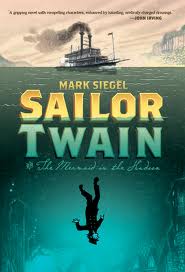
[READ: August 15, 2013] Sailor Twain
Sarah got me this book for Christmas. I didn’t read it until right now because it’s fun to stretch out Christmas gifts as long as possible.
This book is a lengthy graphic novel from our friends at First Second. It is complicated and a little confusing (the whole story is a flashback that is sort of explained in the very beginning). It’s also very beautiful.
Except, I might say, for the main character. The background images and the interstitial pages are really beautiful and detailed. But the main character is very cartoony–very two-dimensional with a triangle nose and big circular cartoon eyes. I found this very disconcerting for about a third of the book. Siegel does manage to make him very expressive and uses the big circle eyes to a good drawing benefit through, but the character just looks so–surprised?–all the time that it was hard to not notice him. Of course later on his big eyes come in handy during the darker sequences, but I still found it an odd choice. So too were the really cartoony choices of some of the other main characters–very big, comical noses or fat round faces. It certainly made the characters distinctive, but as I said, I was unsettled by it.
As the story opens, Captain Twain sits in a bar and is approached by Miss Camomille. She asks to speak to him but he says he wants nothing to do with her or his past. She holds out a necklace and says he can have it if he tells her the story. He is shocked to see it and reluctantly agrees. (more…)
 SOUNDTRACK: PRIMUS-Frizzle Fry (1990).
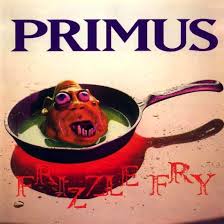 It always made me laugh that this album opens exactly the same as Suck on This–with the opening drums to Rush’s “YYZ.” But it quickly bends into the propulsive bass of “To Defy the Laws of Tradition.” For many, this was their first listen to Primus, and hearing the crazy noise of Ler’s guitar come roaring out of the speakers followed by Les’ insane bass line and Tim’s wild drumming–it’s unlike anything I’ve heard before or since. And then later to hear the tapping of the bass notes during the chorus–it’s certainly defying laws of rock tradition.















 I Just Read About That...