 SOUNDTRACK: VÍKINGUR ÓLAFSSON-Tiny Desk (Home) Concert #63 (August 12, 2020).
 Víkingur Ólafsson has a fantastic name. But even better is his way of talking about the music he plays. He adds so much detail and information about these songs that they really come to life. I don’t often buy classical music anymore, but I absolutely want to get his new record of Rameau and Debussy pieces).
Ólafsson has moved from strength to strength, releasing three terrific albums in a row (Philip Glass, J.S. Bach, Debussy-Rameau). And now that he has a young son, he wants to spend as much time with the family as possible these days.
So he tells us that he is leaving Berlin after living there for eight years, to return to Iceland with his wife and son.
He opens with a beautiful slow and stately piece from J.S. Bach (arr. Stradal): “Andante” (from Organ Sonata No. 4). The piece runs about five minutes and after four slow lines, he throws in some amazing speed near the end. he says that Bach is a good idea whether you are happy or sad–whatever it is, Bach makes things better.
Then Ólafsson offers a crash course in the fascinating music of Jean-Philippe Rameau and Claude Debussy, two French composers who lived nearly 200 years apart. Ólafsson connects the dots between the two seemingly strange bedfellows, illustrating his points with demonstrations on his Steinway.
Introducing Jean-Philippe Rameau, he says the music will go in a very different direction (than Bach). Rameau was two years older than Bach and was dubbed the Newton of harmony. He defined harmony and opened musical doors.
For Rameau: “Le rappel des oiseaux” (“The Recall of the Birds”) he says that he is playing two birds: one in his right hand and one in his left. They are calling to each other–one imitating the other with perfect recall. Then they take flight and we see the landscape under their wings. When he plays it, it absolutely comes to life.
He says that was first piece of Rameau that he had ever heard. The version he heard was by a Russian pianist who played it “more sad, more Russian.” He plays it like that original version and you can hear the remarkable difference and how both versions work so well–although I like Ólafsson’s better.
Introducing Claude Debussy, he says it’a unusual pairing since they lived 200 years apart. But Debussy’s idol was Rameau. They were both musical outsiders, reinventing music, bringing life to a tired scene.
He plays a simple Debussy melody–harmony in space, a timeless beauty. But Debussy did not like being considered an Impressionistic. He was interested in the baroque, and there is a baroque structure to his music.
For Debussy’s: “The Snow is Dancing” (from Children’s Corner), he describes the driving rhythm that never stops as he explores harmonic inventions. This song wa written for his four-year-old daughter as he was exploring the snow with her. You can absolutely hear the textures of the snow in the song.
Ólafsson has a penchant for making transcriptions, taking pieces written for other instruments and making them his own. He closes with “The Arts and the Hours,” his mesmerizing arrangement of a scene from Rameau’s final opera, which he plays as a farewell to his Berlin apartment.
Ólafsson says that he wrote his last masterpiece (an opera) a year before he died and he never heard it performed. Indeed, it didn’t get a world premiere until 200 years after he died in 1960. This is a transcription he made because he was jealous of all the conductors and orchestra players who got to play this music. Rameau (arr. Ólafsson): “The Arts and the Hours” (from Les Boréades) is more loveliness from a composer who I feel may be quite under appreciated.
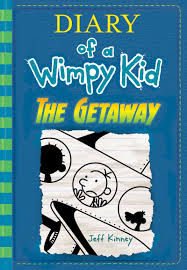
[READ: 2017 and August 15, 2020] Diary of a Wimpy Kid: The Getaway
I read this book when it came out in 2017 but never posted about it. Then I recently realized that Kinney had written two more Wimpy Kid books that I hadn’t read (and two books written by Rowley, that I don’t know at all). So it was time to get Wimpy again.
This book is a Christmas book and yet it’s not a typical Christmas story–no annoying relatives, no bad gifts, not even snow. For The Heffleys have decided to go on holiday for Christmas. Their Christmas planning was going very badly (a funny picture of the tree on its side with Manny playing with tinsel), so when they saw an ad for Isla de Corales, where Greg’s parents went on their honeymoon, they decided to get out of town for Christmas and celebrate in the warmth of the holidays.
Now, unlike shows where the place is far worse than the advertisement shows, Isla de Corales proves to be a wonderful paradise. However, the place has now been divided into the mild side for families and the wild side for couples. Obviously, the wild side is better but the Heffleys have no way to get there.
But before they arrive, they have to get there. Their entire trip to the airport is one terrible moment after another–bad traffic, lost luggage, late shuttle. Not to mention terrible lines and a hilarious pile of confusion at the security line–I love that it’s not Greg’s fault that things went so badly but the Heffleys had to pay for it anyway. And of course Manny is a nightmare. (more…)




 I Just Read About That...