Feeds:
Posts
Comments

Archive for the ‘Lucy Dacus’ Category

[ATTENDED: April 13, 2018] Adult Mom

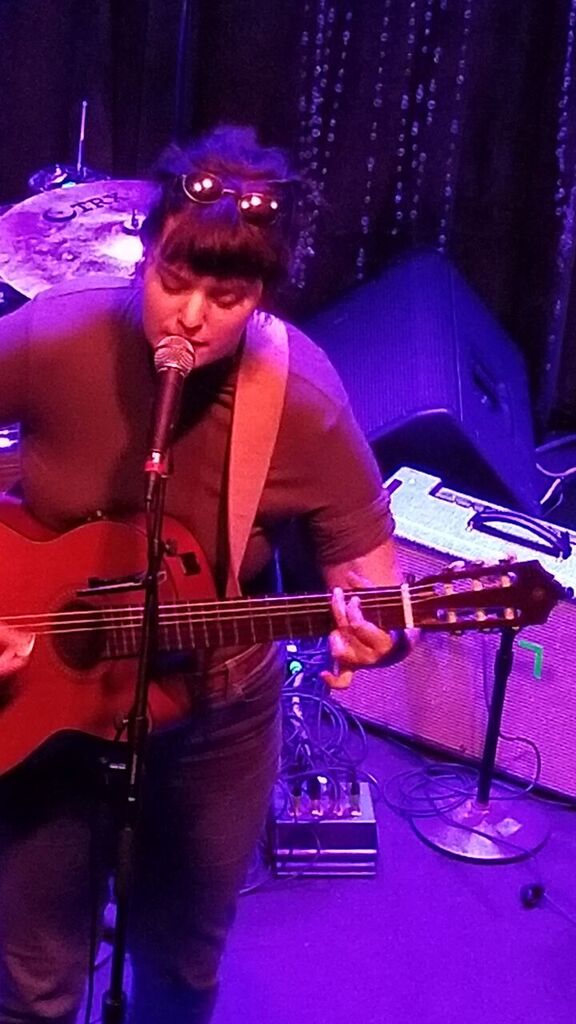
Adult Mom is a band created by Stephanie Knipe.

I had heard of them, but wasn’t too familiar with them.  I knew that they had released a number of “bedroom recordings” which is unfairly dismissive.

Nevertheless, I wasn’t expecting them to rock out as much as they did.

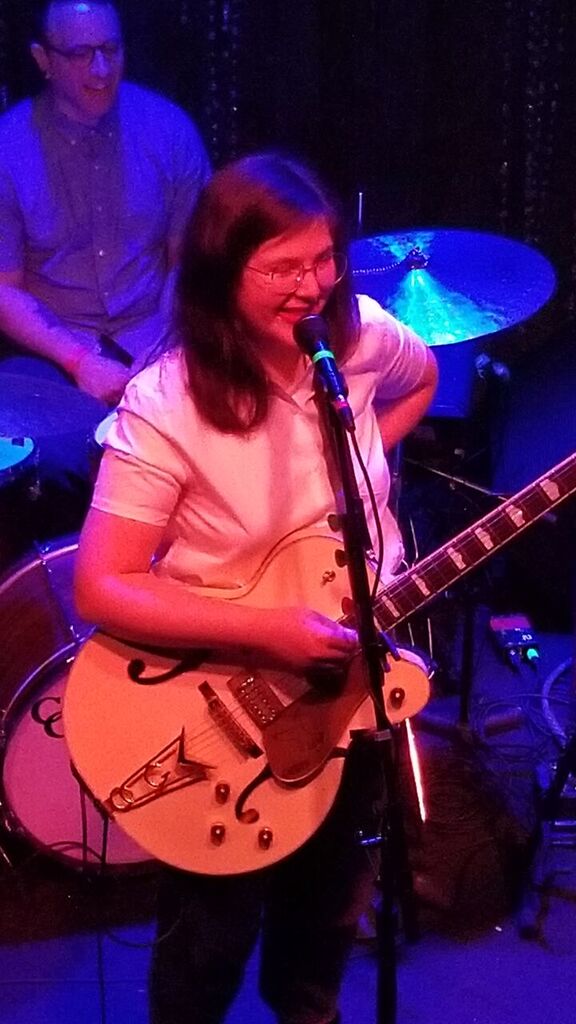
Because Lucy Dacus was offering two shows this evening, it meant that the opening bands (and Lucy herself) was somewhat truncated for the first show.  So Adult Mom only played for about 20 minutes.  (more…)

Read Full Post »

CV1_TNY_06_08_15_09.inddSOUNDTRACKLUCY DACUS-“Historians” NPR’S SOUTH X LULLABY (March 21, 2018).

I’m looking forward to seeing Lucy Dacus live in a few weeks.  Her music is often spare but grows very intense.  For this particular song it is just her and her guitarist who is creating textures and sounds as Lucy sings clearly and starkly.  She plays the (almost) title track from her new album Historian.

The idea behind our South X Lullaby series was to offer intimate moments with musicians as an antidote to the commotion and deluge that is the SXSW music festival. When we met Lucy Dacus for her Lullaby and found out she’d perform “Historians,” a most somber song from her deeply personal and triumphant album Historian, it felt just right. It’s a song of reflection, the story of two intertwined partners and the way they document one another’s lives and preserve each other’s memories.

With simple but compelling swirls of sound, Dacus begins singing clearly with a bit of softness on the edges of her words.  It’s fascinating to watch her face illuminated by the video around her (the same video that Stella Donnelly performed in front of).

The song is warm despite the sadness inherent in it.

The setting for this performance, by Lucy Dacus and guitarist Jacob Blizard, is an interactive art installation by the multidisciplinary Israeli artist Ronen Sharabani that’s part of the SXSW Art Program. This work, titled “Conductors and Resistance,” explores human-machine interaction in our ever-evolving technological world. The images projected behind Lucy and Jacob are two coffee cups, one empty and one that’s been almost drained, both tangled in and tugged at by a complex series of wires, representing what I think is human communication and miscommunication.  This is just one of three walls onto which images are projected in this installation — you can see another wall behind Stella Donnelly in her South X Lullaby video.

[READ: April 13, 2016] “The Magic Mountain”

Back in June of 2009, The New Yorker had their annual summer fiction issue.  Included in that issue were three short essays under the heading of “Summer Reading.”  I knew all three authors, so I decided to include them here.

This essay was about Aleksander Hemon’s childhood in Sarajevo.

He says that (not unlike Angell) his family had a cabin on the mountain called Jahorina.  His family would spend winter breaks there skiing and partying.  His parents thought it was heaven up there.  But he and his sister hated to go there in the summer. (more…)

Read Full Post »

manualSOUNDTRACK: LUCY DACUS-Tiny Desk Concert #553 (July 29, 2016).

lucyI didn’t realize that I knew Dacus, but I’ve heard and loved her song “I Don’t Wanna Be Funny Anymore” for months (I just never knew she sang it).

In this Tiny Desk Concert, the songs have a really gentle feel (she plays electric guitar without a pick, using her fingers to gently pick out the melodies.  Although on record, the songs are a bit sharper.  But it’s her that is so intriguing.  A lazy comparison is Sharon Van Etten, but she has that kind of tone and delivery.

“I Don’t Wanna Be Funny Anymore” has a super catchy vocal melody and simple steady rhythm.  But it’s the way the electric guitar swirls around and her voice sounds dry and disinterested (and yet it clearly isn’t).  She’s not posing as a cynical youth, she is full of regret.  The last line is “That funny girl doesn’t want to smile anymore.”  When the song is done she says, “I always tend to smile after that line.”

Before the second song she asks if anyone else’s biggest fear is having a runny nose on Tiny Desk?  She says she woke up with a runny nose, but its fine now.

I like the way “Direct Address” opens with her gentle strumming which gets really fast as she ramps up to a quick vocal delivery on each verse.   But even when she sings fast, her voice is almost like a deep intense whisper.  Once again, the last line is great: “I don’t believe in love at first sight / maybe I would if you looked at me right.”  The song ends with some cool swirling guitars.

Before the final song she tells everyone there that the NPR workers kind of have the coolest job ever and she envies them all–a little bit.

“Green Eyes, Red Face” is a slower song with an interesting, subtle melody.  Another great lyric: “I see the seat next to yours is unoccupied and I was wondering if you’d let me come and sit by your side.”  I love the way the guitar kind of bursts forth for the solo by Jacob Blizard.  This song is the most like SVE here, although you’d never mistake one for the other.  The middle of the song has some really great riffs juxtaposed with the bass.

I like how this lyric quite a bit: “With your green eyes on my red face” and I get a kick out of how she plays her last chord.  And as it rings out she rests her hands on top of her guitar patiently waiting for the song to fade out.

I’m really entranced by her voice.  But one of the most telling things is at the end of the show just as it fades out.  When talking about their show that night, she says “we’ll be a lot louder.”

I’d be interested to hear that.

[READ: November 21, 2016] A Manual for Sons

Back in 2014, I ordered all 16 books from Madras Press. Unfortunately, after publishing the 16 books they seem to have gone out of business (actually they are switching to non-fiction, it seems). They still have a web presence where you can buy remaining copies of books.  But what a great business idea this is/was

Madras Press publishes limited-edition short stories and novella-length booklets and distributes the proceeds to a growing list of non-profit organizations chosen by our authors.  The format of our books provides readers with the opportunity to experience stories on their own, with no advertisements or miscellaneous stuff surrounding them.

The format is a 5″ x 5″ square books that easily fit into a pocket.

Proceeds from Barthelme’s book go to the The University of Texas MD Anderson Cancer Center.

Okay I’ll say it.

I don’t really get Donald Barthelme.  I know that’s sort of the point of his writing–it is all anti-writing, a reaction against the novel.  But I also don’t get things like this “story.”  (It turns out it is an excerpt from a larger novel, but that still doesn’t really help).

So this “manual” is designed for sons to learn all about the different kinds of fathers there are and how to deal with them.  It states that it was translated from the English by Peter Scatterpatter.

The manual lists the different kinds of fathers: Mad fathers, fathers as teachers, falling fathers, etc.

And it’s not really helpful and it’s not really funny, and I have to wonder what keeps things like this from just ending.  How does Barthelme know when his bizarre list of things is actually done?

Some examples:

Mad fathers stalk up and down the boulevard, shouting.  Avoid then or embrace them or tell them your deepest thought–it makes no difference.

Fine, that’s good.  But then he says to notice if their dress is  covered in sewn-in tin cans or if they are simply barking (no tin cans).  If they are barking

Go up to them and, stilling their wooden clappers by putting your left hand between the hinged parts, say you’re sorry.  If the barking ceases, this does not mean that they have heard you, it only means they are experiencing erotic thoughts of abominable lustre.

What the hell?

And what to make of this “some fathers are goats, some are milk, some teach Spanish in cloisters.”

Or this: “The best way to approach a father is from behind, thus is he chooses to hurl his javelin at you he will probably miss.”

There’s an alphabetical list of fathers names which all start with  A and end with Albert.  (And the list is pretty unexpected with names like: Aariel, Aban, Abiou, Aeon and Af.

The most successful section to me was the “Sample Voice” part.  It gave three examples of a crappy dad–abusive and unsympathetic and very masculine.

The “colors of fathers” was presumably modified from a book about horses as each color is a horse color.

There’s a disturbing section about incest and then about the penises of fathers.  And finally a discouragement to patricide.

I just don’t get it.

Rick Moody provides some answers in his Afterword.  He gives some context for this story and some of his favorite bit of this manual (which was originally published in a dark book called The Dead Father.  He says he really related to this story because one of the sections opens “If your father is named Hiram or Saul” (and his father had one of those names).

He puts Barthelme in context with Gaddis and describes this manual as hilarious.

Guess you had to be there.

Read Full Post »

« Newer Posts