Feeds:
Posts
Comments

Archive for the ‘Lucius’ Category

augSOUNDTRACK: LUCIUS-“Dusty Trails” NPR’S SOUTH X LULLABY (March 15, 2016).

luciusI’m kind of mixed on Lucius. I love the vocals of Jess Wolfe and Holly Laessig, they are genuinely amazing.  But their music is often a little too poppy, too dancey for me.  So this stripped down version is just perfect.  It’s probably my favorite song of theirs now, (I haven’t even heard the original, yet).

The visuals of this lullaby are pretty awesome too.  The guitar players in the background, Jess and Holly stand on a bridge in electric blue body suits and shocks of red hair.  The image of party and dance is so contrary to the lovely music that they play.

The song starts as a kind of folkie, almost country song. The two guitars play nicely together.  And the women sing kind of gently, but with those harmonies intact.  Once they get to the chorus, though, Jess and Holly start belting out their song with their power and harmony.

And when they get to the middle section of “We’ll be alright,” the vocals are just amazing–powerful and loud and right on key.

The guitars drop out for a near a capella section–just a low drum keeping time–and they keep it up beautifully.  This song is a little too loud and intense to be a lullaby, but it’s great nevertheless.

[READ: February 10, 2016] “The Grand Shattering”

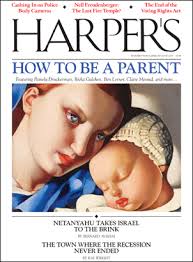
The August 2015 Harper’s had a “forum” called How to Be a Parent.  Sometimes these forums are dialogues between unlikely participants and sometimes, like in this case, each author contributes an essay on the topic.  There are ten contributors to this Forum: A. Balkan, Emma Donoghue, Pamela Druckerman, Rivka Galchen, Karl Taro Greenfeld, Ben Lerner, Sarah Manguso, Claire Messud, Ellen Rosenbush and Michelle Tea.  Since I have read pieces from most of these authors I’ll write about each person’s contribution.

I especially appreciated that the introduction which says “This forum…is not prescriptive but descriptive: not ‘how you should’ but ‘how we have.'”  Which is probably the best kind of advice a mother or father could give.”

I have enjoyed Sarah Manguso’s works.  Her last book talked a lot about her becoming a parent so this essay seemed right up her alley.

She begins by saying she never wanted to be a mother.  To her “mother” was a giving up of your self.  You couldn’t be a writer and a mother. And those writers who were mothers, she was sure that they gave up more of their writer-hood to have more motherhood. She says her fantasy at 23 when her friends were getting married was that she’d move upstate with them and seduce their neighbor’s children. (more…)

Read Full Post »

holmes4SOUNDTRACK: BOB AND ROBIN’S EXCELLENT HOLIDAY ADVENTURE, NPR, December 19, 2013 (2013).

bobrobinEvery year NPR airs a holiday music special (I’ve been posting from them for the last few days).  Initially, they were like any of the episodes, with descriptions of the songs.  Then they became a music only playlist (which was kind of nice).  Then they added some guests.  Last year they did a very enjoyable story of Bob and Robin together having a party that no one came to.  This year, today, they have released the 2013 edition.

In this story, Bob and Robin are driving to Kansas in a huge snowstorm.  They listen to some carols on the radio.  And then when the snow gets too bad they pull over into a small hotel.  Then Bob falls asleep and is visited in his dream by Annie Clark (St. Vincent), John Vanderslice, Wayne Coyne (Flaming Lips), Josh Ritter and Jess Wolf (Lucius) who tell some great memories of Christmas.

The songs they play are wonderfully diverse as usual (although there’s no Hanukkah songs this year, as Hanukkah was last month).  They range from standard favorites (Burl Ives’ “Rudolph the Red Nosed Reindeer,” “You’re a Mean One, Mr. Grinch”) to very traditional songs (“Coventry Carol” an instrumental “sleigh Ride”) to funny songs (“Christmastime for the Jews”) to a brand new one: The Flaming Lips playing “Silent Night/Lord Can You Hear Me” (which completely makes up for their dreadful “White Christmas” from several years ago).

This is a wonderfully enjoyable story/holiday special.  Listen and enjoy.

[READ: December 7, 2013] Sherlock Holmes and the Adventure of the Dancing Men

Since I’m going to write about a few of these, I’ll keep up this little intro bit so I don’t have to re-write the general ideas/criticisms.

These are indeed the actual Arthur Conan Doyle stories just severely edited and truncated.  In other words, a lot of the story is cut out and yet the original language is still in place (at least I hope it is, I hope contemporary writers didn’t write the dialogue), so for young kids I think the wording is a little confusing.  The drawings are a little too simple for my liking as well.  They do effectively convey the story, but I didn’t like the very basicness of them.  I feel they make the stories seems a little more childlike than they actually are.

Having said all that however, I found the graphic novels to be a compelling introduction to Sherlock Holmes’ shorter stories (although not for my 8-year-old apparently).

This story features the fascinating name of Hilton Cubitt.  He comes to Holmes with a confounding problem. He has discovered a slip of paper with stick figured men drawn on it.  When he showed it to his wife, she absolutely freaked out.  But she won’t tell him why.  So he brings the paper to Holmes to figure out what the heck is going on.

Since I haven’t read the original of this story,  I feel like the graphic novel is a better medium for this story because of the titular dancing men.  Perhaps the original has drawings in it, but if not, the graphic novel’s version which contains the stick figures corresponding to letters is a very successful way of quickly showing the trick.  (Even if, again, I don’t love the illustrations).

Holmes can’t do much with one slip of paper–he can’t even decode the pattern because there’s so little to go on.  But then more dancing men appear, and Cubitt brings more evidence to Holmes.  Holmes is able to crack the code (I couldn’t, but I wonder if there was more information given in the real story?).  Anyhow, Holmes has cracked the code, but that still doesn’t really solve the problem, which is the message within the code.

This may have been another case where more information would have made the story a bit more compelling.  It seems a little too easy that the “bad guy” is spotted, giving Holmes a pretty easy capture. Nevertheless, I do love a good puzzle and I’m curious to read how well the dancing men are described in the original.

Read Full Post »

« Newer Posts